Not Enough Light on Philodendron Imperial Red: Causes
Quick answer
Not enough light on Philodendron Imperial Red shows as weak green new leaves, dull color, slow growth, and a rosette leaning toward windows-this cultivar needs brighter filtered light than Imperial Green to hold burgundy new growth. First step: move it within a few feet of an east window or filtered south/west light and watch the next two new leaves.
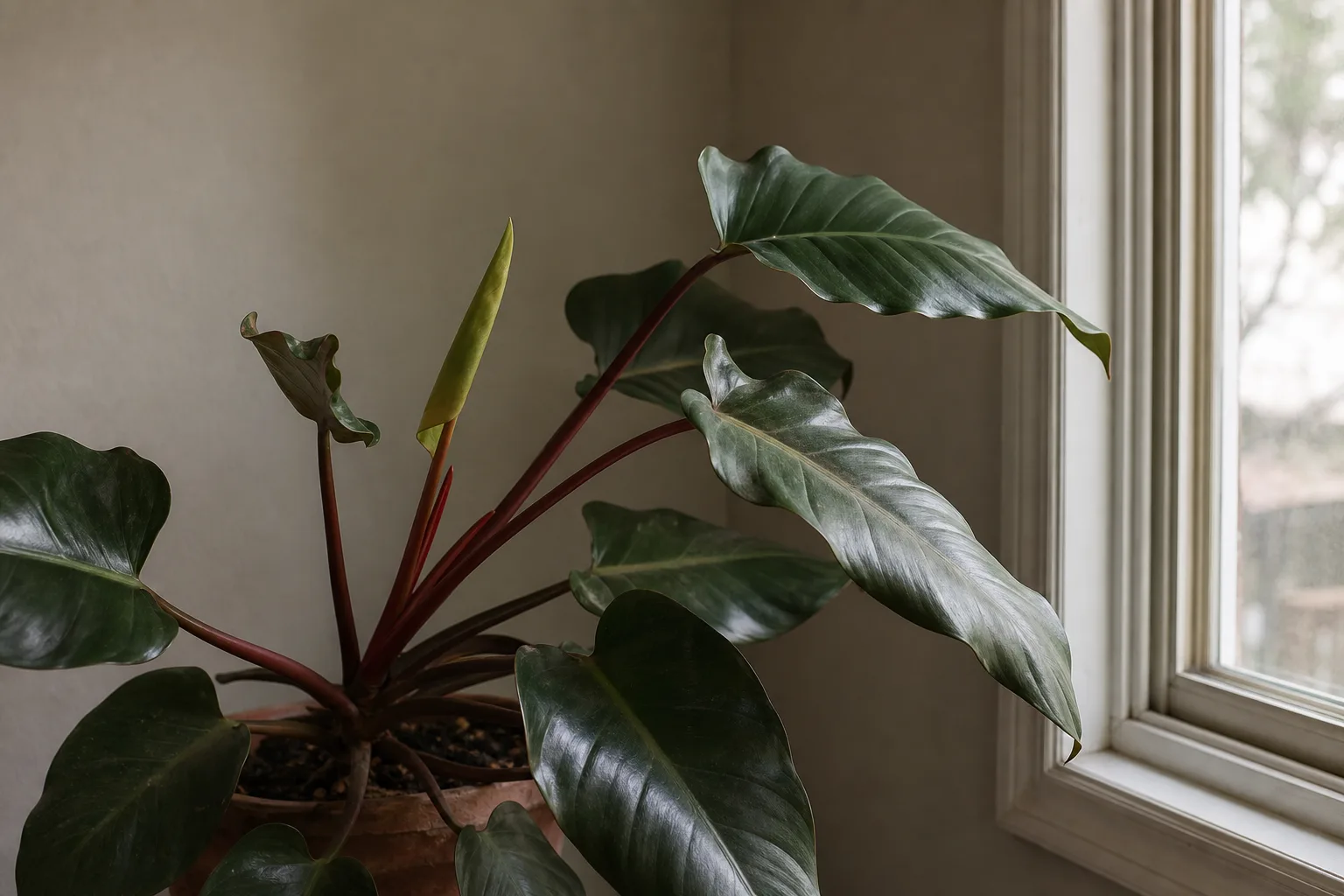
Not Enough Light on Philodendron Imperial Red: Causes, Checks & Fixes
This guide covers not enough light on Philodendron Imperial Red. See also the general Not Enough Light guide, watering, and light pages for this plant.
Not Enough Light on Philodendron Imperial Red: Causes, Checks & Fixes
Quick answer
You bought Philodendron erubescens ‘Imperial Red’ for burgundy new foliage-and dim corners let it survive while quietly stripping away the color that defines the cultivar. Imperial Red is an upright self-heading hybrid patented (USPP6337) for warm red-bronze new leaves on thick burgundy petioles. In low light the plant prioritizes chlorophyll, stretches toward the brightest wall, and opens weak olive-green crown leaves while older blades may still look dark green.
First step: move the pot to brighter filtered light-roughly 60–90 cm (24–36 inches) from an east window or 90–150 cm (3–5 feet) back from filtered south or west glass-and judge recovery only on the next two new leaves. Do not repot, fertilize, or blast the crown with direct midday sun on the same day. Low light also slows transpiration, so the same watering rhythm keeps mix wet longer in dim corners and can invite yellow lower leaves that look like a separate disease when light is the upstream cause.
For proactive placement before color fades, start with the Imperial Red light guide. This page is the recovery hub when dull crown color, weak green unfurling, or slow growth already signal insufficient light.
Why Philodendron Imperial Red struggles in low light
Insufficient photosynthetic light is the core issue. RHS guidance for philodendrons states that without enough light, plants become leggy and produce fewer, smaller leaves. On Imperial Red that general philodendron response shows up as dull flat crown color and weak pigment on the newest leaves-not just longer petioles. The cultivar was bred for anthocyanin-rich new growth; in dim placement the plant invests in chlorophyll and stretches toward the brightest source.
Distance from windows matters more than room brightness. University of Maryland Extension explains that light intensity drops rapidly as you move away from glass-what feels like a bright living room may be low light at the leaf surface. NC State Extension notes that Philodendron erubescens prefers partial shade and dappled sunlight-bright filtered light at the canopy, not ambient brightness across the room.
Seasonal daylight reduction catches many growers in autumn and winter. A spot that barely worked in June fails in December without grow-light supplementation. UF/IFAS guidance on houseplant lighting emphasizes that short winter days reduce growth even when the plant never moved.
Imperial Red needs more light than plain-green philodendrons to hold color. Grower logic for this cultivar: weak green new growth with dull crown color means placement is too dim even if heartleaf philodendron nearby looks acceptable. Penn State Extension groups philodendrons among plants that thrive in indirect high, medium, and low light-Imperial Red sits at the brighter end if you want burgundy new leaves, not merely upright survival.
Low light compounds watering mistakes. Penn State notes philodendrons should be watered when the top inch or so of soil is dry-roughly 3–5 cm (1–2 inches) in metric terms. In dim placement that surface layer may stay wet for weeks, producing yellow lower leaves and limp petioles that look like overwatering when light is the upstream cause.
What not enough light looks like on Philodendron Imperial Red
Watch for these patterns together:

Not Enough Light symptoms on Philodendron Imperial Red - compare with healthy tissue on the same plant.
- New leaves emerging weak green or olive instead of red-bronze
- Slow or stalled unfurling through spring and summer active season
- Rosette leaning or facing one direction toward the brightest window
- Dull, flat crown color while lower mature leaves stay normal dark green
- Longer gaps between new leaves at the center of the self-heading crown
- Wet heavy pot in a dim corner with occasional yellow lower leaves
- Small new leaves compared with older crown foliage
Do not confuse normal ontogeny with low light. Mature Imperial Red leaves naturally shift from burgundy toward darker green as they age-that expected color change happens on firm petioles with steady new red growth above. Low light shows weak pigment on the newest leaves first and slowed overall growth.
Cultivar note: Extension pages describe P. erubescens light preference and philodendron legginess in general terms-they do not name “weak green new growth on Imperial Red” as a formal diagnostic. That signal is reasonable cultivar logic: anthocyanin pigment costs photosynthetic energy, so the plant sheds red-bronze color first when light is limiting. Treat it as a leading clue alongside shadow tests and growth pace, not a standalone lab finding.
How to confirm the cause
Do not fertilize a pale rosette before checking light. Use this inspection order:
- Shadow test at the canopy - Hold your hand where the top leaves sit. A soft diffuse shadow for several hours suggests usable indirect light; faint or absent shadow means too far from the window.
- New-leaf color - The newest spear should show red-bronze at unfurling. Plain green on fresh growth confirms light limitation on this cultivar.
- Growth rate - Compare unfurling speed now versus last summer. Stalled expansion in active season with pale new leaves fits chronic low light.
- Lean and rotation response - Rotate the pot 180°; new growth bending back toward the old bright side within two weeks confirms directional light hunger. Persistent one-sided lean with weak color may overlap with plant leaning-see the comparison table below.
- Pot weight and moisture - Heavy wet pot in low light suggests overlapping water stress; fix placement first, then match dry-down watering to the brighter spot.
- Window and season check - Note obstructed glass, deep room placement, and winter daylight drop. Maryland Extension recommends evaluating actual light at the plant, not assumed room brightness.
Lookalike symptoms to rule out
Leggy etiolation overlaps heavily-see stretched petioles and sparse crown; light fix is the same but the primary complaint is spacing, not color loss. Use leggy growth when petiole stretch is the main symptom. Root rot shows sour smell, mushy roots, and limp petioles on wet mix regardless of window distance-see root rot. Nutrient deficiency is unlikely if pale new growth resolves within two leaves after a light move. Spider mites add stippling and webbing on leaf undersides with relatively firm petioles. Normal winter slowdown is mild; complete stall with weak green new growth in spring means placement, not season alone. Slow growth without obvious color change may fit slow growth when light is only one factor.
Which Imperial Red page matches your symptoms?
| What you notice first | Best page | Why |
|---|---|---|
| Dull crown, weak green new leaves, dim corner survival | This page (not enough light) | Color loss on fresh growth is the defining Imperial Red low-light signal |
| Longer petioles, sparse upright crown, stretched spacing | Leggy growth | Etiolation and crown thinning are the headline-not just faded pigment |
| Hard lean toward one window, lopsided rosette | Plant leaning | Directional light hunger with rotation fix as the focus |
| Yellow lower leaves on chronically wet mix | Overwatering | Water stress may overlap after you rule out placement |
| Sour soil, mushy roots, collapse on wet mix | Root rot | Escalate when light fix alone does not restore firm petioles |
First fix for Philodendron Imperial Red
Move the plant to brighter indirect light before changing anything else. A spot within 60–90 cm (24–36 inches) of an east window, or 90–150 cm (3–5 feet) from a filtered south or west window, usually gives Imperial Red enough energy for red-bronze new growth. RHS recommends bright but indirect light out of direct summer sun-acclimate over a week if you increase exposure sharply to avoid scorch on glossy burgundy leaves.
Once light improves:
- Keep watering on the top 3–5 cm (1–2 inches) dry rule; brighter light means slightly faster dry-down.
- Rotate the pot a quarter turn weekly for even crown fill.
- Wipe dust from leaf surfaces so less light is lost before reaching the foliage.
- Wait for the next two new leaves before repotting or feeding.
Make one correction at a time. Do not repot, fertilize, and move to harsh direct sun on the same day.
Step-by-step light recovery
After repositioning:
- Place Imperial Red in medium to bright indirect light with good airflow-target roughly 200–400 foot-candles (about 2,000–4,000 lux) at the canopy for active growth, per the ranges in our light guide.
- If natural windows are weak, add a full-spectrum white LED grow light 30–45 cm (12–18 inches) above the crown for 10–12 hours daily. Iowa State Extension notes that PPFD at the leaf surface is more useful than room brightness for judging supplemental light-many tropical foliage plants respond well in roughly the 100–200 µmol/m²/s range at canopy level, though Imperial Red’s anthocyanin color may need the brighter end of that band. UF/IFAS notes supplemental lighting can support houseplants when window light is insufficient.
- Water when the top 3–5 cm (1–2 inches) of perlite-amended mix is dry; empty the saucer after every drink.
- Remove only fully collapsed or pest-damaged leaves; self-heading types recover through new central growth.
- Watch for firm new red-bronze leaves with normal spacing within four to eight weeks during active season.
Documented recovery example: In a March 2026 grow-room check, an Imperial Red that had sat in a north-facing office corner roughly 2 m (6.5 feet) from glass-with weak olive-green new leaves and soil staying wet ten days between drinks-was moved to a filtered east sill at 60 cm (24 inches). The second new leaf after repositioning opened red-bronze with normal petiole spacing in five weeks; dry-down shortened to about six days without changing pot size. Old pale crown leaves did not redden-only new growth proved the fix.
If two new leaves still emerge small and green after six to eight weeks in clearly brighter light, inspect roots for binding or chronic wet stress before assuming the plant is mislabeled.
Recovery timeline
Mild low-light cases often show better color on the next leaf after four to six weeks during spring or summer. Moderate cases with months in dim placement may need two to three new leaves before the rosette looks intentional again. Old pale or stretched leaves will not regain burgundy pigment-judge only new crown unfurling.
If growth remains stalled through a full active season despite a clear light upgrade, check for wet roots, pests, or temperatures below NC State’s recommended 65 to 85 °F range for P. erubescens.
What not to do
- Do not keep Imperial Red in the same corner as Imperial Green and expect equal color-Red needs brighter filtered light.
- Do not move instantly into direct midday sun to “fix” pale growth-that scorches burgundy new leaves.
- Do not pour on fertilizer to darken leaves; Clemson notes excess fertilizer damages roots and cannot replace light.
- Do not increase watering because growth is slow-wet mix in low light worsens yellow lower leaves.
- Do not assume a north-facing room far from glass is adequate without grow lights.
- Do not heavily prune the crown to fix old pale leaves-read the next two new leaves instead.
How to prevent not enough light problems next time
Buy Imperial Red for color, then place it where color is possible. Medium to bright indirect light daily, weekly rotation, and winter grow-light supplementation if needed. Clean windows and unobstructed glass matter-Maryland Extension notes that dirty or blocked panes cut usable light more than owners expect.
Pair brighter light with dry-down watering so the self-heading rosette transpires at a normal rate. Weekly checks on new-leaf color catch low light while a simple move still fixes the problem. For window direction, distance targets, and grow-light shopping notes, use the Imperial Red light guide as your placement hub.
When to worry
Chronic low light on Imperial Red is medium severity-not a rescue emergency. Escalate if:
- Several lower leaves yellow while soil stays wet and petiole bases soften
- New growth stays weak green for three cycles despite a clear light upgrade
- The crown stalls completely through spring and summer
- Roots are mushy or smell sour on inspection
- Pests appear on leaf undersides alongside continued pale stretch
Cosmetic lean toward one window is fixable with rotation. Months of weak green new growth in active season deserves prompt correction before root decline in the same dim, wet corner.
Related Imperial Red problem guides
- Imperial Red overview - self-heading habit, burgundy foliage, and care hub
- Light needs - proactive window placement and grow-light setup
- Watering - dry-depth checks after you move to a brighter spot
- Leggy growth - when stretched petiole spacing is the main complaint
- Plant leaning - one-sided rosette tilt and rotation fixes
- Slow growth - stalled unfurling when light is only one factor
- Overwatering - wet mix in dim corners that mimics disease
- Root rot - escalate when pale growth pairs with sour, mushy roots
Conclusion
Treat Imperial Red’s newest leaf color as your light meter: red-bronze unfurling means placement works; weak green on fresh crown growth means move the pot before wet mix and yellow lower leaves pile on. Fix light first, match watering to the brighter spot, and read the next two new leaves-not old blades-for proof of recovery. Keep the light guide handy for seasonal adjustments and winter supplementation.