Overwatering on Philodendron Pink Princess: Causes, Checks
Quick answer
Overwatering on Pink Princess shows as yellow lower leaves, sour soil, and limp marbled foliage on a heavy wet pot-especially in dim display corners. Stop watering until the top 3–5 cm is dry, improve light and airflow, then inspect roots if symptoms spread.
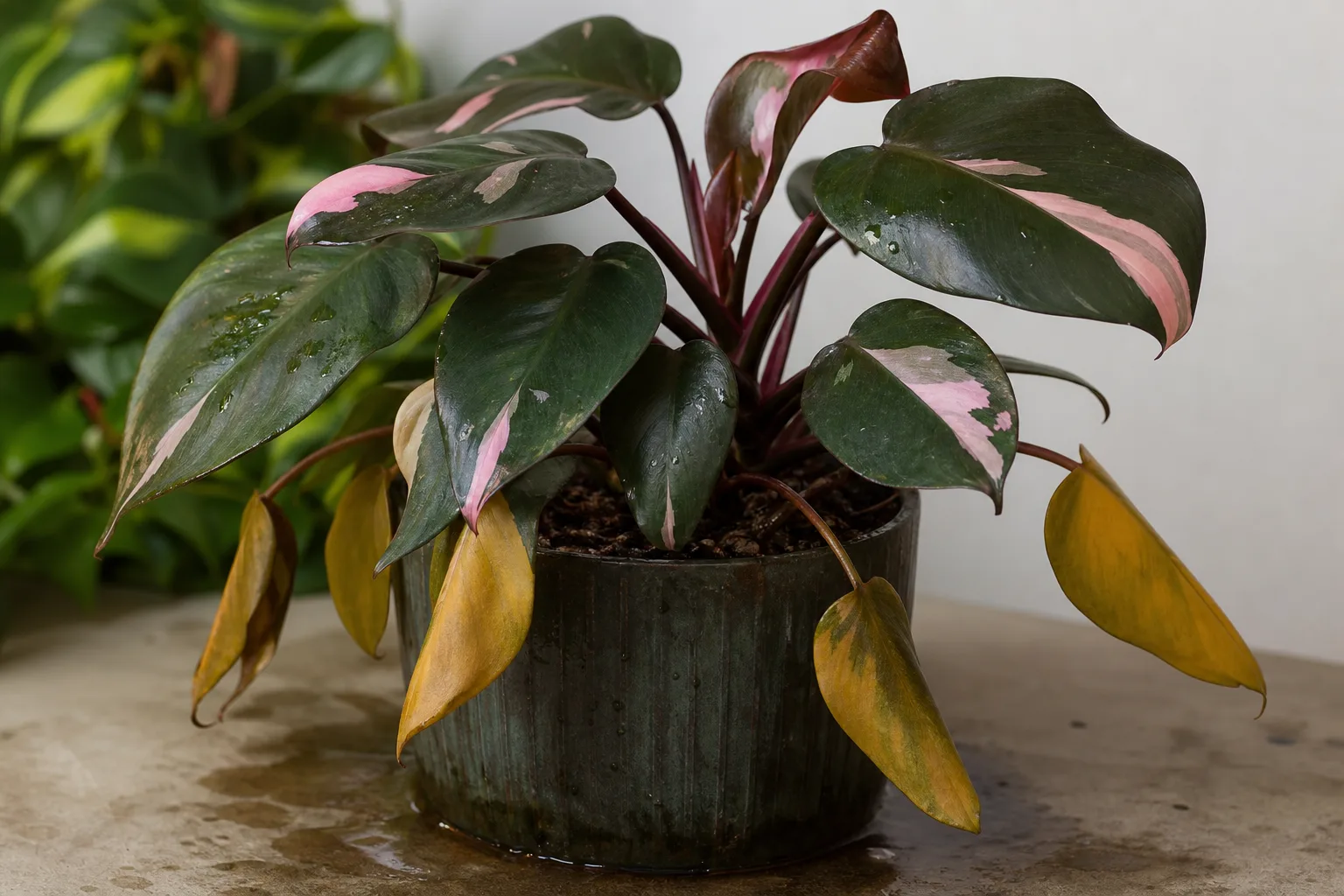
Overwatering on Philodendron Pink Princess: Causes, Checks & Fixes
This guide covers overwatering on Philodendron Pink Princess. See also the general Overwatering guide, watering, and light pages for this plant.
Overwatering on Philodendron Pink Princess: Causes, Checks & Fixes
Quick answer
Collectors often overwater Philodendron Pink Princess (Philodendron erubescens ‘Pink Princess’) because the plant looks precious-extra water feels like care, and variegated leaves in a dim display corner do not use moisture quickly enough to keep peat-heavy mix from going stale. The result is yellow lower leaves, a sour-smelling pot, and limp marbled foliage on soil that stays wet for days.
First step: stop watering and lift the pot. If the container feels heavy and the top 3–5 cm of mix is cold-damp while leaves look tired, you are in overwatering territory-not underwatering. Do not add another drink because pink sectors look floppy.
| Sign | Overwatering (this page) | Underwatering | Advanced root rot |
|---|---|---|---|
| Pot weight | Heavy days after watering | Light | Heavy; may not dry down |
| Soil 3–5 cm down | Cold-damp or soggy | Dry, warm | Sour; stays wet |
| Leaf pattern | Yellow lower leaves first | Crispy edges; limp on dry mix | Soft petiole bases; spreading yellow |
| Smell | Sour or swampy | Normal | Strong rot odor |
| After stopping water | May stabilize if roots firm | Needs a deep soak | Needs unpot and trim |
Use this page for early overwatering triage-chronic wet soil before roots fail completely. For full unpot-trim-repot when bases go mushy, see our root rot guide. For routine dry-down rhythm, start with the watering guide. For the dry-soil lookalike, see underwatering.
What overwatering looks like on Pink Princess
Healthy Pink Princess holds firm heart-shaped leaves with dark green and pink marbling along a climbing stem. Overwatering stress builds in layers-early signs are easy to dismiss on a plant where dramatic color can mask yellowing until several lower leaves are affected.
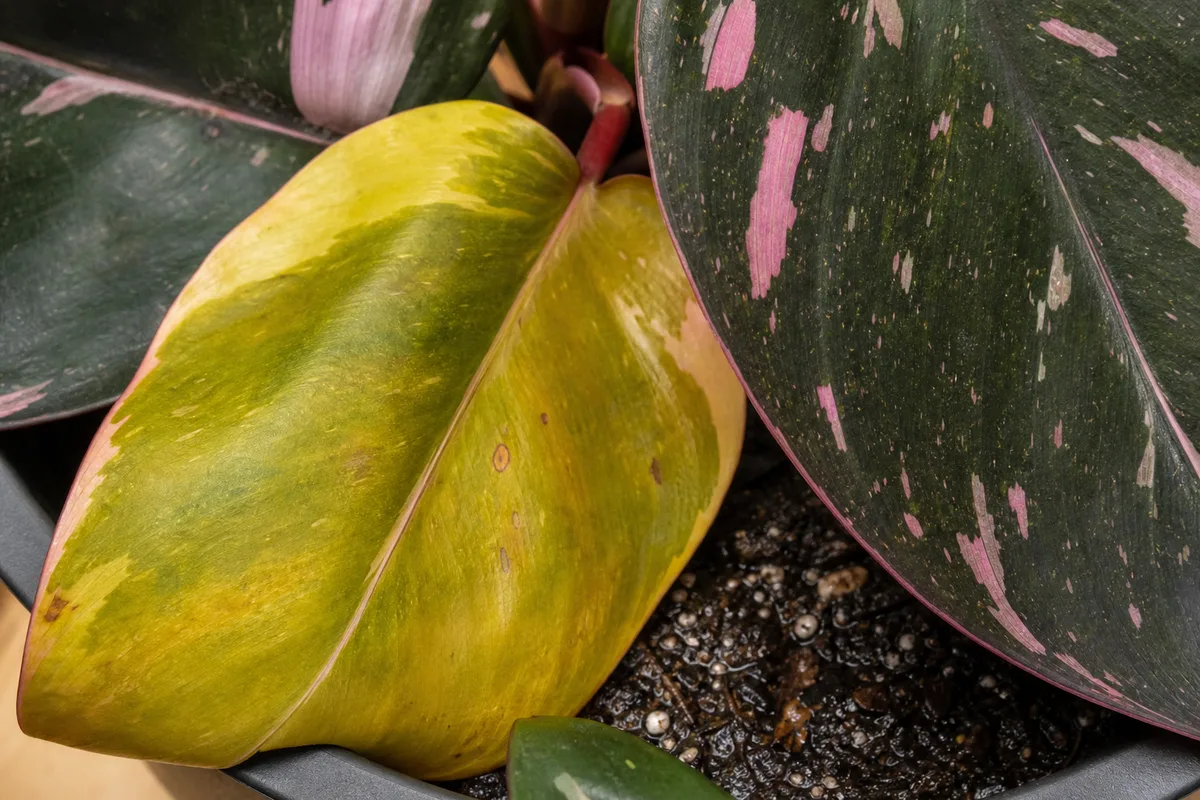
Overwatering symptoms on Philodendron Pink Princess - compare with healthy tissue on the same plant.
Yellow lower leaves on wet soil are the classic opening pattern. The oldest foliage yellows first while newer marbled leaves may still look acceptable. Unlike normal aging, which drops one old leaf at a time on an otherwise stable plant, overwatering yellowing often clusters at the base while the pot stays heavy.
Limp stems and petioles despite wet mix is the trap that sends many collectors back to the watering can. Damaged roots cannot take up water effectively, so marbled blades collapse even though the mix holds moisture. This is not thirst-it is root failure or oxygen starvation underground.
All-green reversion on new growth often appears when roots sit in stale moisture in dim light. Heavily pink sectors contain less chlorophyll and photosynthesize less efficiently than green tissue, so the plant pushes survival-green leaves when the root zone is stressed. That pattern is a stress signal, not proof you need more water.
Other warning signs together:
- Soil surface stays damp more than a few days after watering
- Sour or swampy smell from drainage holes
- Fungus gnats hovering around perpetually moist organic mix
- New leaves emerging small, thin, or pale
- White mold on the soil surface in extreme cases
- Petiole bases turning soft or translucent at soil level-an escalation sign
Fully yellow or limp leaves will not re-green or re-pink. Judge whether overwatering is improving by firm petioles, neutral-smelling mix, predictable dry-down, and one new marbled leaf-not by old damaged tissue recovering.
Why Pink Princess is overwatered easily
Pink Princess is a climbing tropical aroid that needs moist but well-drained soil and bright indirect light indoors. Overwatering is not random bad luck-it follows predictable indoor setups.
Collectors overwater statement plants in dim corners. Pink Princess is often displayed where it looks best, not where it dries fastest. In low light the plant uses water slowly while the same weekly watering rhythm from a brighter room keeps roots sitting wet. NC State notes overwatering can cause root rot on philodendrons when culture does not match how fast the root zone breathes.
Variegation compounds the mistake. Large pink sectors transpire differently and recover more slowly from root stress than all-green philodendron leaves. Pale tissue has less photosynthetic capacity, so the plant shows yellowing and limpness sooner while roots are still drowning-not because pink leaves need more frequent watering. Match water to dry-down checks, not to leaf color.
Heavy peat mix, oversized pots, and full saucers hold moisture around climbing roots longer than chunky aroid blends in appropriately sized containers. Take care not to overwater or leave philodendrons standing in water, as saturated compost can eventually cause root rot. A decorative cachepot that never gets emptied recreates bog conditions at the petiole base-a common failure point on vining philodendrons.
Winter calendar watering pushes the problem over the edge. When growth slows in cooler, shorter days, roots use less water. A summer interval that worked in July becomes excessive by November unless you confirm the top 3–5 cm is dry first. Iowa State Extension recommends checking soil moisture before watering rather than following a fixed schedule-frequency ranges like every 7–10 days in active growth and every 10–14 days in winter are practical starting guesses for many indoor setups, not extension-prescribed rules.
How to confirm the cause
Do not diagnose from one yellow leaf. Work through this inspection order:
- Pot weight - Lift the container. Heavy days after you last watered suggests saturation. Compare to how it felt right after a thorough soak-that wet reference helps you notice when dry-down has not happened.
- Soil depth check - Push your finger 3–5 cm into the mix. Cold-damp, clinging soil with tired foliage points to overwatering. Dry, crumbly soil at depth with a light pot points to underwatering instead.
- Smell - Sour odor from the drainage hole or surface strongly suggests anaerobic, decaying root tissue.
- Petiole bases - Press gently where stems meet soil. Firm is reassuring; soft, wet, or collapsing tissue means escalate beyond a simple dry-down pause.
- Root spot-check - If smell or softness is present, slide the plant partly out of the pot. Healthy philodendron roots are firm and pale to white. Brown, mushy, or slippery roots mean advanced damage-see our root rot guide.
Lookalikes to rule out
| Problem | Key differentiator |
|---|---|
| Underwatering | Light pot, dry mix 3–5 cm down, firm petioles; perks after one deep soak |
| Low light alone | Leggy spacing, faded pink, slow growth-but mix dries normally and no sour smell |
| Normal old-leaf drop | One lowest leaf yellows while rest of plant and root zone stay stable |
| Root rot (advanced) | Mushy roots, blackening petiole bases, sour smell despite stopped watering |
| Acute wilt | Sudden whole-plant collapse-see wilting guide for dry-vs-wet fork |
If several overwatering signs appear together-heavy pot, yellow lower leaves, limp foliage on wet mix-treat it as confirmed overwatering even before unpotting. If roots are already mushy, you are past early triage.
First fix for Pink Princess
One clear first action: stop watering immediately. Do not wait for the next scheduled drink. Move the plant to bright indirect light with gentle airflow so the mix can dry evenly-still avoiding harsh direct sun that can scorch marbled leaves.
Mild cases - firm roots, no sour smell
- Leave the plant in its pot and withhold all water.
- Empty any saucer or cachepot holding standing water.
- Improve light if the plant has been in a dim corner-see our light guide for placement.
- Wait until the top 3–5 cm is fully dry and the pot feels noticeably lighter before the next soak.
- When you resume, water thoroughly until runoff, then discard excess-wait until the top of the compost dries out before watering again.
Moderate cases - softening petiole bases or sour smell
- Stop watering and unpot within 24–48 hours.
- Gently shake off wet mix and rinse roots under lukewarm water.
- Trim any mushy, brown, or black roots back to firm white tissue with clean scissors.
- Let trimmed roots air-dry in shade for several hours.
- Repot into dry, chunky aroid mix in a clean pot with drainage holes. Do not water for one week.
- For the full trim-and-repot walkthrough, follow our root rot guide-the protocol is the same once roots are damaged.
Make one correction at a time. Do not fertilize, blast with direct sun, and repot into a much larger container on the same rescue day.
Recovery timeline and variegation expectations
Mild overwatering with mostly firm roots often stabilizes within two to three weeks once watering stops and light improves. You may see the yellowing pause, petioles firm up, and dry-down return to a predictable rhythm.
Moderate cases with some root trimming may need four to eight weeks before confident new growth appears. Watch for one new leaf with stable pink marbling-that is your best recovery marker.
Severe cases with extensive mushy roots and soft stem bases have limited odds for the main vine. Salvage firm stem cuttings with visible nodes if any healthy tissue remains-see our propagation guide.
Old yellow or limp leaves will not regain perfect form or color. Variegation on new leaves can return when roots recover and light is adequate; chronic all-green flush in a dim, wet corner may persist until you fix both drainage culture and placement. Do not chase pink color with extra water-that deepens the cycle.
What not to do
- Do not water because marbled leaves look limp when soil is already wet-that deepens root damage.
- Do not fertilize stressed, waterlogged roots; wait until new growth resumes on a stable dry-down rhythm.
- Do not repot into a much larger pot; extra wet soil volume slows drying.
- Do not leave the plant in a full saucer after watering.
- Do not assume variegation loss caused the problem-check roots and moisture when soil stays heavy.
- Keep away from pets when handling trimmed tissue; philodendron contains calcium oxalate crystals toxic to cats and dogs.
How to prevent overwatering next time
Match watering to how fast your specific pot dries, not a calendar reminder. For many indoor Pink Princess plants in bright indirect light, a practical starting framework-not a rule-is roughly every 7–10 days in active growth and every 10–14 days in winter, always confirming the top 3–5 cm is dry first. Cool, dim rooms may need longer intervals year-round.
Culture checklist:
- Use chunky aroid mix with perlite and orchid bark, not straight peat in an oversized plastic pot
- Choose a container only slightly larger than the root mass, with open drainage holes
- Place in bright filtered or indirect light so the plant uses water between drinks
- Empty saucers and cachepots after every watering
- Reduce frequency sharply when the plant moves to a cooler or dimmer spot
- Track pot weight weekly until you learn your home’s dry-down rhythm-details in our watering guide
Overwatering decreases oxygen available for root growth and favors decay. Prevention is simpler than rescue: let the surface dry, then soak once, then let it dry again.
When to escalate to root rot rescue
Move from this early-triage page to our root rot guide when:
- Petiole bases soften and collapse at soil level
- Mix stays wet more than a week after you stopped watering
- Soil smells sour even though you have not watered
- Spot-check reveals brown, mushy, or squishy roots
- Yellowing spreads to multiple marbled leaves within a week despite dry surface soil
- Black tissue climbs above the soil line along the climbing stem
Mild overwatering with firm roots and neutral smell usually resolves with a dry-down pause alone. Advanced rot needs same-day unpotting, aggressive trim, dry repot, and at least one week without water-waiting on hope while roots decay rarely saves a premium Pink Princess.
Conclusion
Overwatering on Philodendron Pink Princess is a habit, light, and drainage problem-not bad luck on a variegated cultivar. Confirm with a heavy wet pot, yellow lower leaves, and limp marbled foliage on saturated mix; act first by stopping water and improving dry-down conditions. Mild cases with firm roots often recover within two to three weeks. Mushy roots, sour smell, or soft petiole bases mean escalate to the root rot protocol without delay. Judge success by firm petioles, neutral-smelling mix, and new marbled growth-not by old leaves returning to perfect pink.
Related Pink Princess guides
- Pink Princess overview - full care hub
- Watering - dry-down rhythm, pot-weight checks, and wilt-with-wet-soil context
- Root rot - unpot, trim, and repot when bases go soft
- Underwatering - light dry pot and crispy margins
- Wilting - acute collapse and dry-vs-wet emergency fork
- Yellow leaves - lower-leaf yellowing patterns beyond moisture alone
Related tool
Use the Root Rot Risk Checker to narrow causes for overwatering on this plant before changing multiple variables at once.