Repotting Philodendron Silver Sword: Timing, Pot Size &
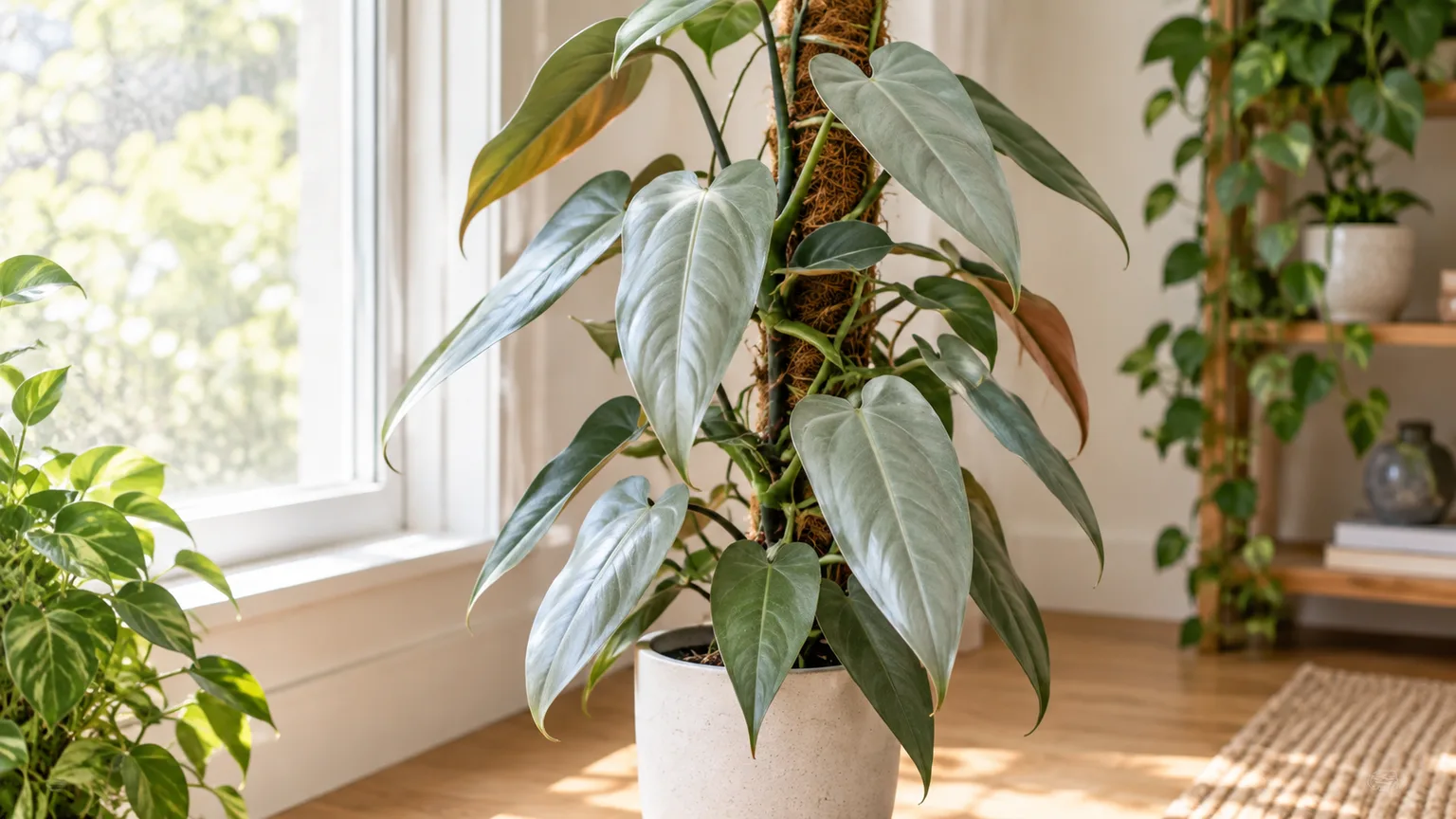
Repotting Philodendron Silver Sword: Timing, Pot Size & Moss Pole Tips
Repotting Philodendron Silver Sword: Timing, Pot Size & Moss Pole Tips
Philodendron Silver Sword repotting is climber work — refresh vertical root space, reset chunky mix, and often install or extend a moss pole in one session. Philodendron hastatum, the species behind the Silver Sword trade name, is a tropical climbing herbaceous perennial from Brazil whose metallic silver-blue arrow leaves elongate as the vine ascends support. Indoors, NC State notes it can reach 10 to 15 feet tall when supported — biology that makes repot timing, pot depth, and pole placement more important than a generic “every two years” calendar. Treating Silver Sword like a horizontal crawler such as Philodendron Gloriosum — wide shallow pan, rhizome above grade — misses how hastatum roots travel through pot depth and into aerial structures.
This guide covers when to repot, pot sizing and drainage, moss pole workflow, mix refresh tied to the soil guide, step-by-step procedure, root trimming, post-repot recovery, and the mistakes that send climbing philodendrons to root rot despite careful watering on the watering guide.
Quick Answer: Repot on Structure, Not Calendar
Repot Philodendron Silver Sword when structure fails, not because a date passed: roots circling or escaping drainage holes, mix that smells sour or channels water straight through, new leaves shrinking in spring despite good light, or a moss pole that no longer anchors as the vine gains weight. Use a pot only 2–5 cm (1–2 inches) wider in diameter — NC State Wayne County Extension recommends no more than 2 inches larger — with a mandatory drainage hole, pre-moistened chunky aroid mix, and a moss pole or trellis installed or extended during the move. Spring through early summer is the safest window; Penn State Extension advises repotting in spring when active growth begins. Expect one to two weeks of mild transplant stress, slower dry-down until roots explore fresh mix, and no fertilizer for four to six weeks after repotting.
Why Silver Sword Repotting Differs From Crawlers Like Gloriosum
Most philodendron repot articles assume either a self-heading rosette or a creeping terrestrial. Silver Sword is a clinging climber — NC State lists a moss pole or trellis as required support. The RHS philodendron growing guide describes many philodendrons as hemi-epiphytic, climbing tree trunks while roots access both bark and forest-floor organic matter. Indoors, that maps to a vertical root column in a standard-depth pot plus aerial roots on a moist pole — not a wide shallow rhizome runway.
Climbing biology and vertical root columns
Philodendron gloriosum advances horizontally; its critical moisture zone sits at the surface rhizome in a bulb pan. P. hastatum sends roots down through mix depth and along an ascending stem. Overwatering on a crawler often rots a buried growth tip; on Silver Sword it more often appears as yellow lower leaves and sour-smelling mix while the vine still looks upright — until root function collapses. Same Araceae family, different geometry. Swapping Gloriosum’s wide-pot, tip-above-grade rules onto a climbing hastatum vine is a common setup failure.
Pot shape for Silver Sword favors moderate depth with drainage — enough vertical mix for roots, not a decorative urn so tall that the bottom stays saturated while the top bark looks dry. The NC State Extension Gardener Handbook warns that when water cannot drain freely, roots lack adequate air — especially risky in peat-heavy columns without bark.
Moss pole timing at repot
Without vertical support, hastatum internodes stretch and juvenile silver tone fades in weak light — a mistake covered on the light guide. Repot time is the easiest moment to install or extend a moss pole because you can seat the stake before backfilling, firm mix around the base, and let new roots anchor into both substrate and pole surface in one growth cycle. Adding a pole six months later means disturbing an established root ball twice.
When to Repot Philodendron Silver Sword
Repot when the plant shows structural need. Penn State Extension lists practical triggers: potting mix drying unusually fast, roots through drainage holes, slowed growth despite spring fertilizing, and dense circling roots when you slip the plant out. The NC State Extension Gardener Handbook repotting section adds wilting that resolves after watering (root volume outpaced water storage), roots escaping the pot, and stunting when the root system has no room to expand.
For Silver Sword specifically, watch these check-based signals together or separately:
- Roots circling the bottom or visible through drainage holes when you lift the pot
- Water runs straight through in seconds because roots displaced most of the mix
- Mix smells sour, drains slowly, or stays dark and cool many days after a normal watering
- New leaves emerge smaller than the previous two or three despite adequate brightness
- Moss pole wobbles because the root ball no longer anchors the vine’s weight
- Salt crust on the surface and fertilizer seems ineffective — refresh may help without dramatic upsizing
A healthy Silver Sword in an appropriately sized pot with a firm pole may go two to three years between full repots — a practical indoor heuristic, not an extension-mandated interval. Active plants in warm bright rooms sometimes need attention every one to two years, matching the overview repot note. Let structure, smell, and root escape guide you — not social media schedules.
Root-bound and mix-failure signals
When in doubt, slip the plant out. Penn State Extension advises examining roots when any pot-bound symptom appears: if roots circle densely or you cannot see mix in the bottom third of the root ball, repot. NC State recommends teasing apart circling roots or cutting vertically along the root ball side so they develop outward instead of retaining the old pot shape.
On hastatum, white firm roots are healthy; tan mushy roots with a sour smell mean trim and refresh — often the same repot session, not a separate rescue later.
When not to repot
Do not repot merely because you bought a prettier cachepot, saw a “spring cleaning” post, or want faster growth from a huge new container. RHS overpotting guidance explains that excess compost stays wet longer than roots can use — a direct path to rot on moisture-sensitive aroids. Skip routine repotting when:
- The plant is actively blooming or pushing a new leaf — wait until the leaf hardens
- Winter dim light and cool rooms slow recovery — defer unless emergency
- Recent pest treatment or systemic stress — stabilize first
- Roots are healthy, mix drains well, and the pole is stable — top-dress with fresh bark instead
If yellowing leaves follow chronic wet soil, fix watering rhythm and mix before upsizing. A larger pot without fixing drainage repeats the problem with more wet volume.
Best Time of Year to Repot Silver Sword
Spring through early summer is the safest window — the same active-growth period Penn State Extension recommends for houseplant repotting when roots can grow into fresh mix and produce new foliage. NC State’s Extension Gardener Handbook states repotting is best in early spring before active growth. Warmth, longer days, and rising humidity help hastatum roots colonize chunky bark before midsummer dry-home stress.
In the southern hemisphere, invert that window: repot from September through November when local day length and warmth peak.
Fall can work for a gentle top-dress if the plant is healthy, but avoid combining full repot with the first furnace season unless necessary.
Winter repotting is a last resort. Reserve winter moves for emergencies: confirmed root rot requiring trim and fresh mix, nursery pot so degraded the root ball stays saturated, or roots completely bound with declining leaves. Otherwise wait until your local spring equinox window. Recovery in low light extends shock from days to weeks on climbing vines that depend on bright filtered light per the overview guide.
Choosing the Right Pot: Depth, Drainage, and One Size Up
Two rules operate at once: extension pot-size discipline and climber pot geometry.
One size up: Choose a container only 2–5 cm (1–2 inches) wider in diameter than the current pot — not a dramatic jump. Wayne County NC State Extension recommends no more than 2 inches larger in diameter. The RHS philodendron growing guide cautions against moving to a much larger container because excess mix holds moisture roots cannot quickly use. For hastatum, oversizing is especially risky because extra wet substrate at the pot bottom suffocates vertical roots while the moss pole top looks fine.
Depth and drainage: Use a standard nursery or ceramic pot with at least one open drainage hole. Penn State Extension requires drainage holes so excess water does not waterlog the mix. Wayne NC State confirms gravel in the bottom does not improve drainage — water saturates mix above the gravel first. Moderate depth suits climbing roots; avoid towering decorative cylinders “for stability” that trap stagnant moisture below the root column.
Weight vs stability: A climbing hastatum on a pole can become top-heavy. A slightly heavier ceramic or stoneware pot (with drainage) often stabilizes better than a tall plastic cylinder that tips when the pole shifts — without adding excessive wet volume.
Pot trait table for climbing hastatum
| Pot trait | Good for Silver Sword | Poor fit |
|---|---|---|
| Diameter upgrade | +2–5 cm over current pot | Jumping two nursery sizes “to grow into” |
| Depth | Moderate — roots plus pole base | Very tall urn with unused wet bottom |
| Drainage | Open hole; saucer emptied after water | Sealed cachepot as only container |
| Shape | Round or square with pole clearance | Wide shallow crawler pan (Gloriosum geometry) |
| Material | Plastic, ceramic, or terra-cotta with hole | Metal bucket without drainage |
Moss Pole Installation During Repot
NC State lists a moss pole or trellis as needed support for this climbing philodendron. Install or extend support during repot, not as an afterthought:
- Choose pole height — at least 30–45 cm above the current vine tip so the plant has runway for the next season. Extend existing poles with a sphagnum sleeve or stackable moss pole rather than yanking aerial roots off an old stake.
- Seat the pole before backfilling — center it 2–3 cm from the main stem base, pressing the bottom into the pre-moistened mix layer at pot floor.
- Avoid burying nodes deep — hastatum roots from nodes, but packing wet peat over multiple nodes to “stabilize” the pole invites rot. Firm mix around the base only; tie the vine loosely with soft plant ties.
- Pre-moisten the pole if using sphagnum — aerial roots attach faster to damp moss, but do not drip water into saturated pot mix. Pole moisture supplements pot checks on the watering guide; it does not replace them.
If the vine already climbed a stable pole and roots are only slightly bound, you may repot in the same diameter with fresh mix and a taller pole extension — a valid refresh without upsizing.
Soil Refresh at Repot Time
Never repot hastatum into straight garden soil or dense peat alone. Penn State Extension recommends quality soilless potting mix for houseplants, and Clemson HGIC notes philodendrons need well-drained soil to avoid root rot. For Silver Sword, use the 40 % potting mix, 30 % perlite, 30 % orchid bark blend from the soil guide — pre-moistened until evenly damp, not dripping.
The RHS hastatum profile recommends a loose, well-drained potting mix. NC State describes hastatum as preferring moist, well-drained, rich soil with acid tolerance below pH 6.0. At repot, shake or tease away no more than one-third of old collapsed peat from the outer root ball; replace with fresh chunky mix. Discard sour or fungus-gnat-infested substrate entirely.
Step-by-Step: How to Repot Philodendron Silver Sword
Gather a clean pot one size up, pre-moistened mix, moss pole, gloves (calcium oxalate sap irritates skin), sharp scissors, and a chopstick for settling. Plan 30–45 minutes on a stable surface — silver foliage tears easily.
- Water lightly the day before — Penn State Extension recommends watering an hour before repotting so the root ball slides out without shattering dry roots.
- Remove the plant — hold the pot rim, tip sideways, tap the base. Run a knife between pot wall and root ball if stuck; never yank the vine stem.
- Inspect and tease roots — unwind circling roots; trim mushy brown sections with clean scissors. Leave white firm roots intact.
- Place drainage layer of mix — add enough pre-moistened blend so the root crown sits 2–3 cm below the pot lip — NC State’s container handbook aligns substrate-line with crown, not buried.
- Install moss pole — seat stake, position root ball beside it, backfill around sides with chopstick-settled mix. Do not pack wet mix tightly — Penn State warns over-compaction restricts air movement.
- Water once thoroughly — soak until runoff exits the hole; empty the saucer within 30 minutes per Clemson HGIC drainage practice.
- Return to bright indirect light — avoid direct sun on stressed foliage for the first week. Hold fertilizer until new firm growth appears.
Root Health Inspection and Trimming
At every repot, treat root inspection as diagnostic — not optional. Healthy hastatum roots are white to tan, firm, and earthy-smelling. Problem signs:
| Root appearance | Smell | Action |
|---|---|---|
| White, firm | Earthy | Tease circling edges; repot into fresh mix |
| Brown, mushy | Sour | Trim back to firm tissue; discard old mix |
| Black, slimy | Rot | Aggressive trim; smaller pot if root mass reduced |
| Dry, brittle | None | Pre-soak root ball lightly before repotting |
After trimming rot, downsize to a pot matching the remaining root mass if you removed more than one-third — oversizing a weakened root system repeats saturation stress. Sterilize scissors between cuts if rot was advanced.
Philodendron Silver Sword is toxic to pets — wear gloves when handling cut roots and sap; wash tools and hands before touching pets or face.
Post-Repot Care and Recovery Timeline
Transplant shock on climbing aroids shows as slight wilt, paused new leaves, or one yellow lower leaf — usually mild if timing and pot size were conservative. Recovery timeline in a typical bright home:
| Phase | Timing | What to expect | Your job |
|---|---|---|---|
| Shock | Days 1–7 | Possible limp leaves; no new growth | Bright indirect light; no fertilizer |
| Root colonization | Weeks 2–4 | Mix dries slower than before | Extend dry-down checks; do not overwater “to help” |
| New growth | Weeks 4–8 | Small leaf or aerial root on pole | Resume half-strength feed on fertilizer guide schedule |
| Normal rhythm | Week 8+ | Dry-down matches pre-repot pattern | Resume standard watering checks |
Watering after repot: Fresh chunky mix and extra pot volume hold moisture longer. Wait for the top 3–5 cm to dry before the first post-repot soak unless the plant is visibly wilted and the pot feels light. Overwatering during recovery is the most common post-repot kill.
Humidity: Moderate humidity (55–70 %) softens shock — consistent with NC State’s high humidity preference for hastatum. Avoid misting leaves to “help”; wet foliage in dim recovery light invites spots.
Propagation side quest: If you trimmed long stems with nodes during repot, those cuttings can root per the propagation guide — but finish stabilizing the mother plant first.
Common Repotting Mistakes on Climbing Hastatum
Oversizing the pot — the single fastest route to rot. Extra wet mix without matching root mass suffocates vertical roots.
Skipping the moss pole — repotting into a larger pot without support invites leggy stretch and smaller silver leaves within two months.
Repotting on a calendar — “every January” ignores whether roots actually needed room. Structure beats schedule.
Burying the crown or multiple nodes — smothers growth points; keep the substrate-line where it was unless roots were exposed.
Fertilizing immediately — burns roots in fresh mix. Wait for new firm growth.
Using gravel in the pot bottom — Wayne NC State research shows it reduces effective drainage, not improves it.
Applying Gloriosum crawler logic — wide shallow pans and rhizome-above-grade positioning belong on Gloriosum repotting, not hastatum vines.
When to Use This Page vs Other Philodendron Silver Sword Guides
| Your question | Start here | Better on another page |
|---|---|---|
| When and how to repot, pot size, moss pole at repot | This repotting guide | — |
| Daily watering rhythm and dry-down checks | — | Watering guide |
| Mix ratios, pH, bark vs perlite | — | Soil guide |
| Light for silver leaf color | — | Light guide |
| Stem cuttings after trim | — | Propagation guide |
| Full species overview and toxicity | — | Overview guide |
Use this page when roots, mix, or pole stability force a container decision. Use sibling guides for ongoing care between repots.
Related Philodendron Silver Sword Guides
- Overview — species identity, support requirements, and pet toxicity summary
- Watering — post-repot dry-down rhythm and moss-pole moisture interaction
- Soil — full 40/30/30 recipe and heavy-mix warning signs
- Light — recovery placement after repot stress
- Fertilizer — when to resume feeding after fresh mix
- Propagation — rooting stem sections trimmed at repot
Conclusion
Repot Philodendron Silver Sword when roots escape, mix fails, or the moss pole outgrows its anchor — not on autopilot. Move up one pot size, refresh chunky aroid mix, install or extend support during the same session, and repot in spring when possible. Inspect roots honestly, trim rot without sentiment, and give the vine weeks without fertilizer while dry-down recalibrates. Climbing hastatum is not a crawler — treat vertical roots, drainage, and pole stability as one system, and the metallic foliage rewards the extra geometry.