Philodendron Silver Sword Light Needs: Best Window & Sun
Philodendron Silver Sword Light Needs: Best Window & Sun
Philodendron Silver Sword Light Needs: Best Window & Sun
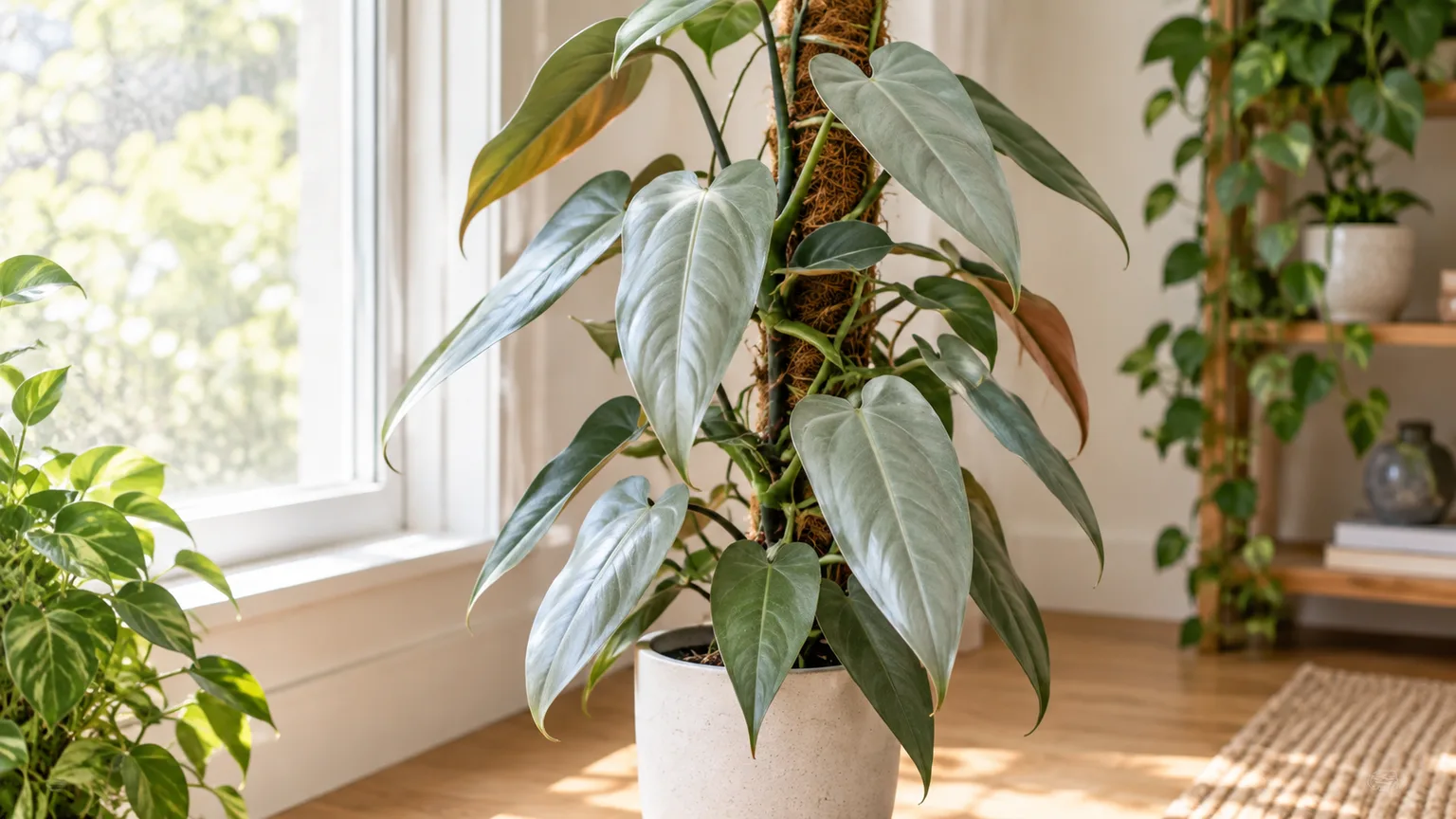
Philodendron Silver Sword (Philodendron hastatum) is sold for its metallic silver-blue arrow leaves — but that color is a light response, not a permanent paint job. In a dim corner or a nursery shade house, juvenile blades stay small, internodes stretch, and the silvery sheen dulls toward plain green before you ever need more fertilizer. Give the vine bright filtered light, a moss pole within the first year, and judge success by the last one or two new leaves, and you get the sword-shaped foliage the trade name promises.
This page is the dedicated light hub for Silver Sword. For whole-plant context, humidity, and toxicity, start with the Philodendron Silver Sword overview. For watering rhythm after you move the pot, see the watering guide.
Quick Answer
Grow Philodendron Silver Sword in bright indirect or filtered light for most of the day — typically 1–2 meters (3–6 feet) from an unobstructed east window, or behind a sheer curtain on south or west glass. NC State Extension lists P. hastatum as preferring bright, indirect sunlight with partial shade (direct sun only part of the day, roughly 2–6 hours) and warns to avoid direct sunlight that scorches leaves. The RHS hastatum profile recommends bright filtered light with shade from hot sun under glass.
Supplement with a full-spectrum LED grow light 10–12 hours daily at 30–45 cm (12–18 inches) above the top leaf when natural light is weak. Judge placement by new growth: firm silver-blue blades at equal or greater size than the previous leaf mean today’s spot works; leggy stems, wide internodes, and progressively smaller pale leaves mean too little light.
Why Silver Sword Light Matters for Leaf Color
Human eyes adapt to dim interiors. Plants do not. A living room that looks adequately lit to you may deliver only 75–150 foot-candles at a bookshelf three meters from the glass — the lower band Missouri Botanical Garden classifies as low to medium light. Silver Sword on that shelf may persist longer than a fussy calathea, but it will not produce collector-quality metallic foliage there.
Metallic Foliage and Chlorophyll Balance
NC State describes new hastatum leaves emerging reddish-orange, maturing to blue-green with silver highlights on long, sword-shaped blades with copper-toned undersides. That silver sheen reflects how the leaf balances chlorophyll and surface structure under adequate photons. In chronic low light, the plant increases chlorophyll density to capture whatever light arrives — and the metallic tone dulls toward flat green even though older leaves still look superficially healthy.
This is why beginners misread light stress as a feeding problem. If silver tone fades before yellowing or wilting appears, move toward filtered brightness first — not harder fertilizer. The RHS philodendron guide notes that philodendrons without enough light become leggy and produce fewer, smaller leaves — exactly the pattern Silver Sword shows on a dim shelf.
Climbing Geometry and Light Interception
Silver Sword is a true climber from the warm, humid, shaded understory of Southeast Brazilian rainforests — not a tabletop rosette and not a horizontal crawler like gloriosum. In nature the vine ascends tree trunks toward brighter filtered canopy light while roots stay in airy organic substrate. Indoors, a moss pole or trellis mimics that vertical path: leaves produced higher on the pole often elongate and gain stronger silver tone than leaves left dangling at pot height.
The placement test is simple: stand at the pot and look toward the window from the height of the topmost leaf on the pole. If you cannot see sky brightness from the plant’s perspective, the vine is probably too far away or blocked by furniture — even if the room feels bright to you.
Best Light for Philodendron Silver Sword Indoors
Silver Sword wants the light quality of Brazilian wet-forest understory: bright but filtered, warm, and consistent — not midday sunbeams on the glass. Clemson HGIC recommends indirect or curtain-filtered sunlight for philodendrons generally, while noting that heartleaf types tolerate very low light. Silver Sword is not a heartleaf: it behaves more like the spade-leaf philodendron described in Missouri IPM guidance — a vining philodendron that appreciates a bit more light and should sit in a moderate to bright interior location to develop full arrow-shaped foliage on a support.
In practical home terms, target the bright indirect band — roughly 1,500–4,000 lux at the top leaf on a clear late-morning reading (divide lux by 10.76 to approximate foot-candles). A soft, readable hand shadow at leaf height usually signals the right zone. No shadow means too dim for vigorous silver growth; a sharp dark shadow means direct sun — usually too harsh without acclimation.
Bright Indirect Light and the New-Growth Test
Week to week, the only metric that matters is what the newest leaf does:
- Correct light: newest blade equal or larger than the previous one; silver-blue tone holds or intensifies; internodes stay relatively tight on the moss pole; petioles rigid, not reaching.
- Too dim: progressively smaller leaves; dull green or washed-out silver; long internodes and stems leaning hard toward glass; no new leaf for many months in warm season despite good watering.
- Too bright: bleached white-yellow patches on the sun-facing surface; crisp brown scorch especially on pale juvenile tissue; sudden wilt during peak sun hours after a recent move.
If unsure, move 30 cm (one foot) closer to filtered light and wait for one full new leaf before deciding. Silver Sword punishes stacked changes — adjust light first, then revisit watering only after you read the next leaf.
Measuring Light at the Top Leaf
You do not need a PAR meter. A phone lux-meter app compared across spots in your home removes guesswork. Hold the sensor at the top leaf on the moss pole, pointed toward the window, around late morning on a clear day. Phone sensors are imprecise — use readings to compare placements, not as lab data.
| Reading at top leaf | Interpretation for Silver Sword |
|---|---|
| Below 1,500 lux (~140 fc) | Survival band; expect dull silver, leggy stems, small leaves |
| 1,500–4,000 lux (~140–370 fc) | Strong filtered target for metallic arrow growth |
| 4,000–8,000 lux (~370–740 fc) | Bright; watch smooth silver tissue for bleach in summer |
| Above 8,000 lux (~740 fc) without diffusion | Scorch risk — filter or increase distance |
Re-measure after seasonal moves because winter sun angle changes effective brightness at pole height.
Best Window Placement by Direction
Window compass gives a reliable first guess in the northern hemisphere. In the southern hemisphere, invert east/west morning-afternoon logic while keeping the same principle: filter harsh midday sun and prioritize bright indirect at the growth tip.
East, South, West, and North Compared
East-facing windows are the default sweet spot. Morning sun is bright but relatively cool; a Silver Sword 1–2 meters back from an unobstructed east pane often receives excellent bright indirect light the rest of the day. Gentle early morning direct sun on the top leaves is sometimes fine for acclimated plants.
North-facing windows supply gentle indirect light all day. In a bright room with pale walls, north can maintain an established plant through winter, but expect slower growth, smaller leaves, and longer dry-down that raises overwatering risk if you keep summer watering frequency. North is a holding zone unless you add grow lights.
South-facing windows deliver the highest total daily light. Use sheer curtains or place the pot and pole 1.5–2 meters (5–6 feet) back so blades never receive harsh midday beams. Pull farther back in summer when sun angle is high.
West-facing windows work in spring and fall and become risky in midsummer when afternoon sun carries heat through the pane. Treat west like south with extra distance or diffusion; watch the leaf face closest to glass for scorch.
Rotate the pot a quarter turn every few weeks if growth leans. Leaning is normal directional growth on a climber, not an emergency — rotation keeps the display balanced on the pole.
Can Silver Sword Take Direct Sun?
Brief, gentle direct sun — chiefly early morning on an east sill — can work for acclimated plants. Midday or afternoon direct sun through south or west glass is where smooth silver hastatum leaves fail. NC State explicitly warns to avoid direct sunlight which can scorch the leaves. The RHS hastatum profile repeats shade from hot sun under glass cultivation.
Leaves developed under lower light lack tolerance for sudden high irradiance. A plant from a nursery shade house needs gradual acclimation (see below), not an immediate south windowsill in June. If you want more intensity without scorch, increase filtered brightness — move closer to curtained south glass, add a grow light, or use a pale wall to reflect ambient light — rather than exposing silver tissue to raw sunbeams.
Low-Light Limits and Leggy Growth
Philodendrons as a genus tolerate relatively low indoor light — Missouri IPM notes many grow under forest canopies at low intensities, and heartleaf philodendron can persist at roughly 15 foot-candles — which helps survival but not the metallic form you bought Silver Sword for. Heartleaf may need 200 foot-candles or more to thrive and develop mature character; Silver Sword’s arrow foliage and silver tone sit at or above that brighter band.
In low light, Silver Sword stretches internodes searching for photons, keeps juvenile leaves smaller, and dulls silver color before roots fail. Low light also slows transpiration, so the same watering rhythm that worked near a window leaves mix wet longer — compounding root stress. The fix sequence: improve filtered brightness first; confirm the chunky aroid mix drains well; then reassess support on the moss pole.
Using Grow Lights for Philodendron Silver Sword
When natural light is weak — north rooms, winter short days, or poles set back from glass — a full-spectrum LED grow light replaces missing photons. UMN Extension recommends 12–14 hours daily for foliage houseplants and placing lamps 30–60 cm (12–24 inches) above the canopy for typical fixtures. For Silver Sword, 10–12 hours on a timer often suffices when some ambient window light is present; run 12–14 hours in truly dim rooms.
Hours, Distance, and Fixture Choice
Starting setup:
- Duration: 10–12 hours (dim room) to 12–14 hours (no usable window) on a timer.
- Distance: 30–45 cm (12–18 inches) for most LED bars; raise the fixture if leaf surfaces feel warm after an hour.
- Coverage: Center light over the top leaf and active growth tip on the moss pole, not just older foliage at the base.
- Heat check: Smooth silver blades near hot bulbs bleach like sun scorch — raise the lamp or reduce intensity.
Full-spectrum LEDs outperform standard room bulbs because they deliver balanced wavelengths without excess heat. Pair supplemental light with the humidity targets on the overview guide so new leaves harden cleanly under added intensity.
Moss Pole, Support, and Light Together
Installing a moss pole or trellis is not separate from light planning — it is how Silver Sword intercepts photons at useful height. NC State notes a moss pole or trellis is needed to support this climbing philodendron and that indoor plants can reach 10–15 feet when supported. Leaves produced as the vine climbs often elongate beyond juvenile arrow shape — the RHS profile notes mature blades can reach up to 60 cm long.
A pole in a dim corner still yields leggy, pale growth — support without brightness only changes direction, not quality. Conversely, bright light without a pole produces smaller leaves on stretched horizontal stems. For best results, install the pole within the first year and place the whole assembly where the top leaf receives bright filtered light, not just the pot rim.
How to Acclimate Silver Sword Safely
Sudden jumps from dim nursery shade to bright south glass cause bleached patches, crisp edges, and stalled new leaves. Treat acclimation as a two-week minimum when the light increase is large.
Step-by-step:
- Baseline: Note current placement and the condition of the newest leaf.
- Day 1–3: Move 30 cm closer to the target window or add a grow light at the far end of the recommended distance range.
- Day 4–7: If no scorch on the emerging leaf, move another 30 cm or lower the lamp 5–10 cm.
- Day 8–14: Reach final position — typically 1–2 m from filtered east or behind sheer south glass. Hold for one full new leaf before further changes.
- Hold other variables: Do not repot, fertilize heavily, or overhaul watering during acclimation. One variable at a time.
Do not advance if the unfurling leaf shows active bleach — retreat one step immediately and wait for the next leaf before trying again. Old scorched tissue will not revert green; you are protecting the next blade.
Warning Signs: Scorch vs Too Little Light
| Signal | Likely cause | First response |
|---|---|---|
| Bleached white-yellow on sun-facing silver surface | Too much direct sun or heat | Pull back; filter glass; check leaf temperature |
| Crisp brown patch on leaf face | Direct sun scorch | Shade; slower acclimation |
| Smaller, paler new leaves | Too little light | Move toward filtered east; add grow light |
| Long internodes, stem leaning to window | Insufficient plant-facing light | Move pole assembly closer; raise if below sill |
| Dull green replacing silver on new leaves | Chronic under-lighting | Brighten before fertilizing |
| No new leaf 4+ months (warm season) | Low light or root issue | Fix placement; then check roots and soil |
Judge by the last two new leaves after any move — not by older foliage that formed under previous conditions.
Light Changes Watering
Every light change alters evaporation rate and therefore watering frequency. Brighter placement or added grow lights mean shorter intervals between checks; dimmer placement means longer dry-down before soaking. When you move Silver Sword closer to a window, check the top 3–5 cm of mix every few days for the first two weeks. When you move it dimmer, extend the interval and confirm dryness before watering — wet mix in low light is how philodendron roots fail while older leaves still look fine.
Full soak-and-drain mechanics live on the Philodendron Silver Sword watering guide. Light and water are one system on a climbing aroid.
Silver Sword vs Gloriosum and Heartleaf Philodendrons
Philodendron Silver Sword (P. hastatum) is a climber from Southeast Brazil with hard, metallic arrow leaves that want to go up a moss pole. Philodendron gloriosum is a Colombia-native crawler with velvet heart leaves and a horizontal rhizome — it needs a wide shallow pot, not vertical support. Copying gloriosum’s low table placement onto Silver Sword often leaves the growth tip below window height where light drops sharply.
Heartleaf philodendron (P. hederaceum) tolerates very low light per Clemson HGIC — Silver Sword does not. Treat Silver Sword like a collector climber that needs bright filtered light plus support, closer to hybrid philodendrons that Missouri IPM places in medium to bright indirect light to retain foliage character.
For the full gloriosum contrast — crawler geometry, velvet scorch, rhizome placement — see the overview guide comparison section. For propagation light on fresh cuttings, see propagation.
Seasonal Light Adjustments
Day length and sun angle shift indoor light more than many growers account for. Winter lowers total photons beside the same window; a pole position that worked in June may need the assembly moved closer or a grow light added from November through February in mid-latitude homes. Summer increases heat load through south and west glass — pull Silver Sword back or diffuse even if winter position was perfect.
Re-check the new-growth test at each solstice season and adjust watering when you adjust light. After repotting or pole upgrades in spring, revisit repotting aftercare before stacking a major window move in the same week.
Common Philodendron Silver Sword Light Mistakes
| Mistake | Why it fails | Fix |
|---|---|---|
| Judging by room brightness | Human vision adapts; plants do not | Test at top leaf height; use new-growth test |
| Leaving vine on shelf without pole | Leaves stay juvenile and small | Moss pole + bright filtered light |
| Treating like heartleaf low-light tolerance | Silver dulls and stretches | Move to moderate-bright indirect |
| Sudden south-window summer move | Smooth silver tissue scorches | Two-week gradual acclimation |
| North window with no supplement | Chronic under-lighting stalls vine | Grow light 10–12 h |
| Fertilizing when silver dulls | Low light is often the cause | Brighten first; then fertilizer if new leaves still pale |
| Same watering after big light change | Overwatering in new dim spot; drought in bright spot | Relearn dry-down speed |
| Copying gloriosum crawler placement | Climber tip sits too low for photons | Raise pole or move to east table |
Pet note: Like all philodendrons, Silver Sword is toxic to cats and dogs due to insoluble calcium oxalate crystals. Light placement on a moss pole often puts foliage at pet height — plan accordingly.
When to use this page vs other Philodendron Silver Sword guides
- Philodendron Silver Sword overview — Whole-plant identity, support, humidity, toxicity, and how Silver Sword differs from gloriosum.
- Philodendron Silver Sword watering — Check-first watering rhythm after you change light or season.
- Philodendron Silver Sword soil — Chunky aroid mix and drainage when wet mix persists in a dim corner.
- Philodendron Silver Sword fertilizer — Feeding only after light and watering are stable.
- Philodendron Silver Sword propagation — Light for fresh stem cuttings and newly rooted plants.
- Philodendron Silver Sword repotting — Pole installation and post-repot recovery without stacking light stress.
Related Philodendron Silver Sword guides
- Philodendron Silver Sword overview
- Philodendron Silver Sword watering
- Philodendron Silver Sword soil
- Philodendron Silver Sword fertilizer
- Philodendron Silver Sword propagation
- Philodendron Silver Sword repotting
- Philodendron Silver Sword pruning
Conclusion
Philodendron Silver Sword light needs boil down to bright filtered exposure at the top of the vine, not merely a bright room. Place the moss-pole assembly where the newest arrow leaf receives east-window-class brightness or filtered south light, supplement with 10–12 hours of grow light when winter or north exposure falls short, and read the next one or two leaves after every move. Metallic silver-blue foliage is the reward for matching Brazilian understory brightness to a climbing habit — get those two right and watering, soil, and feeding become far easier to calibrate on the rest of the cluster.