Philodendron Silver Sword Care Guide: Complete Overview
Philodendron hastatum
Philodendron hastatum (Silver Sword) needs bright indirect light, a moss pole, chunky aroid mix, and stem-cut propagation. Toxic to pets.
Philodendron Silver Sword Care Guide: Complete Overview
Start with wateringThe most common care mistake for Philodendron Silver SwordWatering guide →Philodendron Silver Sword care essentials
Light
Water
Every 7–10 days in summer - allow top 3–5 cm to dry. Every 10–14 days in winter.
Soil
Chunky well-draining aroid mix: potting mix + perlite + orchid bark. pH 5.5–6.5.
Humidity
Moderate to high humidity (55–70 %)
Temperature
18°C to 29°C (65–85°F)
Fertilizer
Feed lightly during active growth.
About Philodendron Silver Sword
Philodendron Silver Sword has a climbing growth habit. It is also known as Silver Sword Philodendron, Philodendron elongatum, and Philodendron hastifolium.
| Detail | Information |
|---|---|
| Also known as | Silver Sword Philodendron, Philodendron elongatum, Philodendron hastifolium |
| Growth habit | Climbing |
| Scientific name | Philodendron hastatum |
Philodendron Silver Sword Care Guide: Complete Overview
Philodendron Silver Sword is the plant that looks like polished metal until you realize it is a vine, not a tabletop rosette. Philodendron hastatum — also sold as Silver Sword Philodendron and formerly labeled Philodendron elongatum or Philodendron hastifolium — is a climbing Brazilian aroid with juvenile arrow leaves in silvery blue-green tones that elongate as the vine matures up a support. Treat it like Philodendron gloriosum on a wide shallow pot and the stems stretch, the silver dulls, and new leaves stay small. Give it a moss pole, bright filtered light, and chunky mix that dries on a honest schedule, and it becomes one of the most striking collector philodendrons you can grow indoors.
This guide covers the full indoor routine: what makes Silver Sword biologically different from crawling velvet philodendrons, how Southeast Brazil’s humid understory translates to your room, light and watering rules that protect metallic foliage, soil and support geometry, feeding, propagation, repotting, pet toxicity, and the mistakes that turn an easy climber into a yellow-leaf rescue project.
What Philodendron Silver Sword Actually Is
Philodendron hastatum is an evergreen perennial in the Araceae family. Kew’s Plants of the World Online lists it as native to Southeast Brazil, where it grows as a hemi-epiphytic vine in wet tropical forest from sea level to roughly 600 meters. The specific epithet hastatum is Latin for “armed with a spear,” which matches the sword-shaped juvenile foliage collectors recognize in the trade.
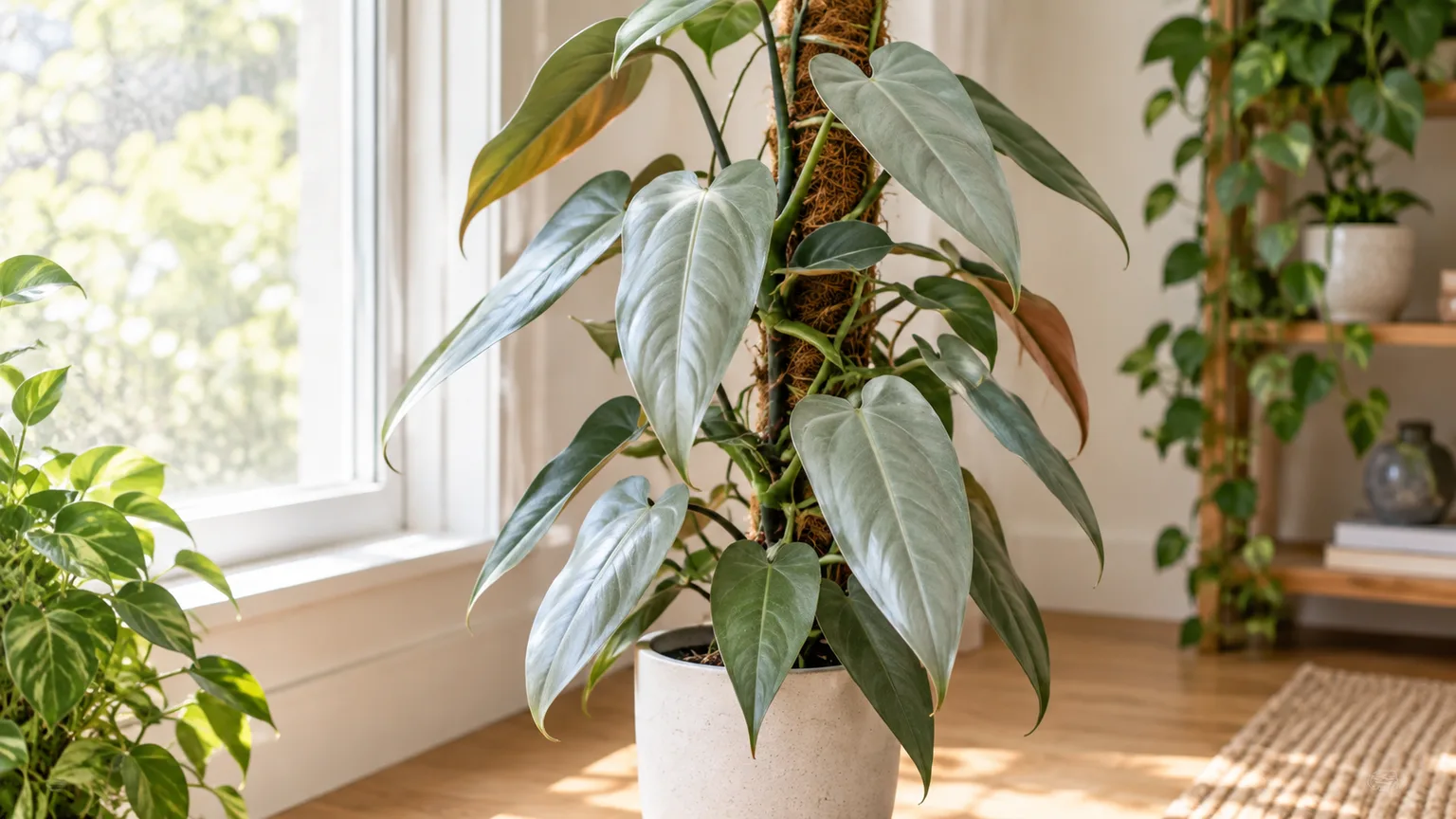
What you are buying is not a self-heading rosette. It is a clinging climber that roots into bark and leaf litter while reaching toward brighter filtered light above the forest floor. NC State Extension describes metallic silver, silvery-blue, or silvery-green foliage that starts arrow-shaped and tends to elongate and become tri-lobed with maturity, with copper-colored leaf undersides on well-grown plants.
Growth habit and the climbing imperative
Philodendron Silver Sword is a true climbing philodendron. NC State Extension notes that indoors it can reach 10 to 15 feet tall and about 2 feet wide when supported — dimensions that only make sense if you plan for vertical growth from the start. Without a moss pole or trellis, internodes stretch, leaves stay juvenile and small, and the metallic silver tone fades before you ever see the elongated mature blade the species is famous for.
Install support within the first year. Aerial roots will cling to moss, coir, or a textured trellis as the vine ascends. Hanging-basket culture works for young plants, but long-term leaf size still improves when the vine can climb rather than cascade in weak light.
Silver arrow leaves and copper undersides
New leaves often emerge with a reddish cast before hardening to blue-green with silver highlights. In strong filtered light the blade reads as metallic silver; in dim corners it shifts greener and thinner. Mature leaves on supported vines can reach 45 cm or more in length according to botanical descriptions on Kew POWO, though indoor specimens more commonly plateau below that unless light, humidity, and pole height all cooperate.
The flowers — a spadix inside a spathe — are rarely seen indoors. Do not buy Silver Sword expecting blooms; buy it for foliage architecture and the way light catches the blade surface.
Southeast Brazil native ecology
Understanding where hastatum comes from prevents expensive category errors. Wild plants grow in the Atlantic forest understory of Minas Gerais and Rio de Janeiro states, rooted in organic debris with warm humid air, partial shade, and excellent drainage between rain events. They do not live in direct midday sun on an open terrace, and they do not crawl horizontally across a forest floor like gloriosum.
That ecology translates directly to your home setup. Silver Sword wants bright but filtered light, steady warmth without cold drafts, moderate to high humidity when air is dry, and a chunky substrate that holds moisture without staying waterlogged. Copying generic “philodendron in a corner” advice — especially for low-light shelves without support — is how metallic foliage becomes plain green heart-shaped leaves on leggy stems.
Silver Sword vs crawling philodendrons like Gloriosum
Most collector confusion on Silver Sword comes from comparing it to Philodendron gloriosum, another Instagram-famous aroid with dramatic foliage — but opposite geometry.
| Trait | Silver Sword (P. hastatum) | Gloriosum (P. gloriosum) |
|---|---|---|
| Growth habit | Climbing vine | Terrestrial crawler |
| Leaf shape | Metallic arrow / sword | Velvet heart |
| Native range | Southeast Brazil | Colombia |
| Support | Moss pole or trellis required | Wide shallow pot; moss pole fights the plant |
| Propagation | Stem cuttings with node | Rhizome cuttings |
If you have grown gloriosum successfully, resist the instinct to give Silver Sword a wide crawler pot and horizontal rhizome space. The hastatum stem wants to go up. If you want a velvet heart crawler, gloriosum remains the better species choice.
Why a moss pole is not optional decor
A moss pole does three jobs for Silver Sword that a decorative stake cannot fake. It shortens internodes by giving aerial roots something to cling to. It raises leaves toward brighter filtered light without exposing blades to direct sun scorch. And it signals maturity, triggering the elongated sword-shaped foliage collectors chase.
Skip the pole and you can still keep the plant alive — but you are growing a different-looking plant than the photos that sold you on Silver Sword. For step-by-step support setup, see the Philodendron Silver Sword propagation guide once your base vine is stable.
Quick care snapshot for Philodendron Silver Sword
Light: Bright indirect / partial shade — best silver tone in filtered east or west light. Water: When top 3–5 cm of mix is dry — roughly every 7–10 days in active summer growth and every 10–14 days in winter for a standard indoor pot with drainage. Soil: Chunky aroid mix with perlite and orchid bark; slightly acidic pH around 5.5–6.5. Humidity: Moderate to high, 55–70% for best leaf texture. Temperature: 18–29°C (65–85°F); avoid cold drafts below about 15°C (59°F). Support: Moss pole or trellis within the first year. Feed: Monthly balanced liquid at half strength during active growth only. Propagation: Stem cuttings with at least one node in moss or water. Toxicity: Toxic to cats and dogs — calcium oxalate crystals.
Use this snapshot as orientation, not a calendar. Your pot size, light level, and mix chunkiness change drying speed more than any fixed “water Tuesday” rule.
Light for metallic silver foliage
Light drives foliage quality on Philodendron Silver Sword more than on many glossy hybrid philodendrons. NC State Extension recommends bright, indirect sunlight and warns that direct sun scorches leaves. The RHS philodendron growing guide likewise places philodendrons in bright filtered light with shade from hot sun — language that fits east-facing windows, pulled-back south exposures, or a few feet inside a bright west window.
Silver tone is a light report card. Adequate brightness keeps blades silvery-blue and internodes tight on a supported vine. Chronic low light produces leggy pale stems, smaller juvenile leaves, and green-dominant foliage long before the plant needs more fertilizer.
Warning signs of too much or too little light
Too little light: long internodes, fading silver, leaves staying small and arrow-shaped indefinitely, soil staying wet too long because transpiration is low. Too much direct sun: bleached patches, crispy margins, leaves curling or fading on the sun-facing side. Move gradually when correcting light — a sudden jump from a dim shelf to a south windowsill can scorch even a plant that was begging for brightness.
For window placement, grow-light PAR targets, and recovery after scorch, use the dedicated Philodendron Silver Sword light guide.
Watering rhythm that protects roots
Philodendrons fail indoors more often from overwatering in low light than from drought. For Silver Sword in a standard chunky mix, water when the top 3–5 cm feels dry — typically every 7–10 days in summer and every 10–14 days in winter, always checking the pot rather than following a calendar.
Clemson HGIC recommends allowing the upper soil to dry between waterings for philodendron indoors and notes that overwatering causes root rot. Water thoroughly until a little runs from drainage holes, then empty saucers. Avoid wetting foliage repeatedly in stagnant air, which encourages leaf spots on large blades.
Seasonal adjustments indoors
Spring and summer usually bring faster dry-down, more new leaves, and higher fertilizer demand. Autumn and winter slow all three — especially for plants within a meter of cold glass or in rooms with shorter daylight. Reduce watering frequency when new growth pauses and the top 3–5 cm stays dry longer. Keep the plant out of cold drafts below about 15°C (59°F) — philodendron roots lose function in chilled wet mix.
Full check-first workflow, pot-weight cues, and overwatering recovery: Philodendron Silver Sword watering guide.
Soil, pots, and drainage
Use a chunky well-draining aroid mix: quality potting soil amended with perlite and orchid bark so water moves through the profile quickly. NC State Extension lists acidic soil tolerance below pH 6.0 and good drainage with high organic matter — both consistent with the RHS philodendron guidance for slightly acidic compost around pH 5–6.
Drainage holes are non-negotiable. Cachepots are fine only if you empty runoff promptly. If the pot stays heavy many days after watering, fix the root environment — mix, pot size, or light — before watering again. Heavy peat kept constantly wet is the fastest route to yellow leaves on an otherwise easy climber.
Recipe ratios, repot timing links, and wrong-mix warning signs: Philodendron Silver Sword soil guide.
Humidity and temperature comfort zone
Philodendron Silver Sword prefers moderate to high humidity, roughly 55–70%, with best leaf texture and clean unfurling toward the upper half of that range. NC State Extension suggests a humidifier or pebble tray in dry climates and notes the species is humidity tolerant once established — meaning it survives typical home levels but looks sharper when air is not desert-dry all winter.
Room temperature should average 65–85°F (18–29°C) per NC State. Avoid cold drafts and sudden drops; chilled wet roots on a warm windowsill are a common winter failure mode for climbing aroids.
Fertilizer during active growth
Feed lightly during active growth — monthly balanced liquid fertilizer at half strength is enough for most indoor Silver Sword vines. Stop feeding stressed, newly repotted, or dormant plants. Excess nitrogen on a plant already in low light produces soft leggy growth without improving silver tone.
Over-fertilizing does not replace better light or a moss pole. Fix environment first, then feed. Details on NPK choice, flush timing, and burn recovery: Philodendron Silver Sword fertilizer guide.
Propagation and repotting basics
Propagate Philodendron Silver Sword by stem cuttings with at least one node, rooted in moist sphagnum moss or water under bright indirect light. Clemson HGIC lists stem cuttings as the standard philodendron propagation method indoors. Take cuttings from healthy vines in spring or summer, include one to two leaves when possible, and wait for roots several centimeters long before potting into chunky mix.
Repot every one to two years or when roots circle heavily and dry-down accelerates unrealistically fast. Size up one pot diameter at a time, refresh mix, and install or extend the moss pole during repotting so you do not snap a brittle aerial root later. Step-by-step: Philodendron Silver Sword propagation guide and Philodendron Silver Sword repotting guide.
Pet safety and sap irritation
Philodendron Silver Sword contains insoluble calcium oxalate crystals. The ASPCA lists philodendron as toxic to cats and dogs, with oral irritation, pain and swelling of the mouth, excessive drooling, vomiting, and difficulty swallowing if chewed. NC State Extension also notes skin irritation from sap on sensitive people — wear gloves when taking cuttings if you react to aroid sap.
Keep plants off floor level in pet households. If ingestion is suspected, contact your veterinarian promptly. Silver Sword is a poor fit for homes with chewing pets unless you can guarantee unreachable placement.
Common mistakes on Silver Sword
No moss pole in year one. Leggy stems and small green leaves follow, even when watering is perfect. Low light plus frequent watering. Wet mix and weak transpiration invite root rot and yellow lower leaves. Direct south sun after a dim nursery. Scorched silver patches are hard to reverse on mature blades. Heavy peat, no bark. Roots suffocate; the plant stalls while soil stays sour. Comparing to gloriosum culture. Crawler pot geometry and buried-rhizome advice do not apply to a vine that wants to climb.
When something looks wrong, change one variable — usually light or watering — and judge the next two leaves before stacking repot, feed, and prune on the same weekend. For pruning damaged or leggy growth after you stabilize conditions, see the Philodendron Silver Sword pruning guide.
When to use this page vs other Philodendron Silver Sword guides
- Philodendron Silver Sword overview — This hub page: identity, climbing habit, quick routine, and how topics connect.
- Philodendron Silver Sword light — Window placement, grow lights, and scorch recovery when silver tone or leaf size is the issue.
- Philodendron Silver Sword watering — Check-first watering, seasonal cadence, and overwatering rescue.
- Philodendron Silver Sword soil — Mix recipes, pH, and drainage troubleshooting.
- Philodendron Silver Sword propagation — Stem-cut steps, moss vs water, and aftercare for new plants.
Related Philodendron Silver Sword guides
- Philodendron Silver Sword watering
- Philodendron Silver Sword light
- Philodendron Silver Sword soil
- Philodendron Silver Sword fertilizer
- Philodendron Silver Sword propagation
- Philodendron Silver Sword repotting
- Philodendron Silver Sword pruning
Conclusion
Philodendron Silver Sword rewards growers who respect its Southeast Brazilian climbing identity: a hemi-epiphytic vine, metallic arrow leaves, and support-first culture on a moss pole or trellis. Give it bright filtered light, water when the top 3–5 cm of mix dries, target 55–70% humidity when air is dry, use chunky slightly acidic aroid mix, install vertical support within the first year, and feed lightly in spring and summer. Protect it from pets — calcium oxalate crystals are real — and measure success in elongated silvery leaves climbing a firm pole, not tabletop bush density.
Get the climber mechanics right and Silver Sword becomes one of the most photogenic vining philodendrons you can grow indoors. Get them wrong — no pole, dim corner, heavy wet peat — and it becomes a pale leggy vine that barely resembles the plant on the nursery tag. The species is not difficult for beginners willing to learn one non-negotiable rule: it climbs toward filtered light through airy mix, and every care choice should serve that habit.
How to care for Philodendron Silver Sword?
When should you water Philodendron Silver Sword?
Every 7–10 days in summer - allow top 3–5 cm to dry. Every 10–14 days in winter.
- Check top 2 inches - Every 7–10 days in summer - allow top 3–5 cm to dry.
- Drain excess water - Empty the saucer after watering so the roots are not sitting in standing water.
What soil works best for Philodendron Silver Sword?
Chunky well-draining aroid mix: potting mix + perlite + orchid bark. pH 5.5–6.5.
- Well-draining mix - Chunky well-draining aroid mix: potting mix + perlite + orchid bark.
Grower notes for Philodendron Silver Sword
What makes Silver Sword different
Philodendron Silver Sword (Philodendron hastatum) is a true climber from Southeast Brazil — not a self-heading rosette and not a crawler like gloriosum. The metallic silver-blue arrow leaves only reach their full length when the plant climbs a moss pole or trellis. Treating support as optional decor is the classic mistake: without vertical structure, internodes stretch and juvenile silver tone fades in weak light.
Silver Sword support note
Install a moss pole or trellis within the first year. NC State Extension lists hastatum as a clinging climber that can reach 10–15 feet indoors when supported. Leaves start arrow-shaped and elongate with maturity; larger leaves follow the vine upward, not outward on a tabletop.
Silver colour and light
Juvenile silver tone dulls in low light before the plant needs more feed. Bright filtered indirect light preserves the metallic blade look and tighter internodes. Direct sun scorches foliage — partial shade matches its rainforest understory origin.
Chunky mix matters
Hastatum rots in heavy peat kept wet. Use an airy aroid mix similar to gloriosum or melanochrysum culture — high organic matter with good drainage. NC State notes acid soil tolerance (pH below 6.0); a slightly acidic chunky mix matches RHS philodendron guidance.
Best placement in a real home
Give Silver Sword bright filtered light and a moss pole within the first year — leaf size and silver tone both improve with vertical support and adequate brightness. Every 7–10 days in summer - allow top 3–5 cm to dry. Every 10–14 days in winter. Humidity target: Moderate to high humidity (55–70 %). Temperature comfort zone: 18°C to 29°C (65–85°F).
Before you buy this plant
Buy Silver Sword for firm silvery juvenile leaves and at least one node for future climbing. Leggy pale stems in tiny pots often mean prolonged nursery shade. Check leaf undersides — healthy hastatum foliage shows copper-toned reverses on mature leaves.
Is it pet safe?
Philodendron Silver Sword is toxic to cats and dogs.
Toxic - calcium oxalate crystals.
Watering Philodendron Silver Sword
Every 7–10 days in summer - allow top 3–5 cm to dry. Every 10–14 days in winter.
Soil & potting for Philodendron Silver Sword
Chunky well-draining aroid mix: potting mix + perlite + orchid bark. pH 5.5–6.5.
Humidity & temperature for Philodendron Silver Sword
Philodendron Silver Sword prefers moderate to high humidity (55–70 %), though normal home humidity is usually fine. Keep temperatures around 18°C to 29°C (65–85°F).
| Detail | Information |
|---|---|
| Humidity | Moderate to high humidity (55–70 %) - normal home humidity is fine. |
| Ideal temperature | 18°C to 29°C (65–85°F) |
Fertilizer & pruning for Philodendron Silver Sword
Use feed lightly during active growth. for Philodendron Silver Sword.
| Detail | Information |
|---|---|
| Fertilizer type | Feed lightly during active growth. |
Common problems on Philodendron Silver Sword
Yellow Leaves
MediumLikely cause: Common on this plant type; confirm with recent watering, light, and root checks.
Quick fix: Inspect the plant and correct the most likely care stressor before stacking treatments.
Full fix guide →Brown Tips
MediumLikely cause: Common on this plant type; confirm with recent watering, light, and root checks.
Quick fix: Inspect the plant and correct the most likely care stressor before stacking treatments.
Full fix guide →Root Rot
MediumLikely cause: Common on this plant type; confirm with recent watering, light, and root checks.
Quick fix: Inspect the plant and correct the most likely care stressor before stacking treatments.
Full fix guide →Overwatering
MediumLikely cause: Common on this plant type; confirm with recent watering, light, and root checks.
Quick fix: Inspect the plant and correct the most likely care stressor before stacking treatments.
Full fix guide →Underwatering
MediumLikely cause: Common on this plant type; confirm with recent watering, light, and root checks.
Quick fix: Inspect the plant and correct the most likely care stressor before stacking treatments.
Full fix guide →Spider Mites
MediumLikely cause: Common on this plant type; confirm with recent watering, light, and root checks.
Quick fix: Inspect the plant and correct the most likely care stressor before stacking treatments.
Full fix guide →Mealybugs
MediumLikely cause: Common on this plant type; confirm with recent watering, light, and root checks.
Quick fix: Inspect the plant and correct the most likely care stressor before stacking treatments.
Full fix guide →Aphids
MediumLikely cause: Common on this plant type; confirm with recent watering, light, and root checks.
Quick fix: Inspect the plant and correct the most likely care stressor before stacking treatments.
Full fix guide →Leggy Growth
MediumLikely cause: Common on this plant type; confirm with recent watering, light, and root checks.
Quick fix: Inspect the plant and correct the most likely care stressor before stacking treatments.
Full fix guide →Slow Growth
MediumLikely cause: Common on this plant type; confirm with recent watering, light, and root checks.
Quick fix: Inspect the plant and correct the most likely care stressor before stacking treatments.
Full fix guide →Wilting
MediumLikely cause: Common on this plant type; confirm with recent watering, light, and root checks.
Quick fix: Inspect the plant and correct the most likely care stressor before stacking treatments.
Full fix guide →Drooping Leaves
MediumLikely cause: Common on this plant type; confirm with recent watering, light, and root checks.
Quick fix: Inspect the plant and correct the most likely care stressor before stacking treatments.
Full fix guide →Low Humidity
MediumLikely cause: Common on this plant type; confirm with recent watering, light, and root checks.
Quick fix: Inspect the plant and correct the most likely care stressor before stacking treatments.
Full fix guide →Not Enough Light
MediumLikely cause: Common on this plant type; confirm with recent watering, light, and root checks.
Quick fix: Inspect the plant and correct the most likely care stressor before stacking treatments.
Full fix guide →Fungus Gnats
MediumLikely cause: Common on this plant type; confirm with recent watering, light, and root checks.
Quick fix: Inspect the plant and correct the most likely care stressor before stacking treatments.
Full fix guide →Mold on Soil
MediumLikely cause: Common on this plant type; confirm with recent watering, light, and root checks.
Quick fix: Inspect the plant and correct the most likely care stressor before stacking treatments.
Full fix guide →