How to Grow and Care for Philodendron Erubescens
Grow Philodendron erubescens with clear light, watering, soil, and support advice. Learn to prune, propagate, troubleshoot, and handle it safely at home.
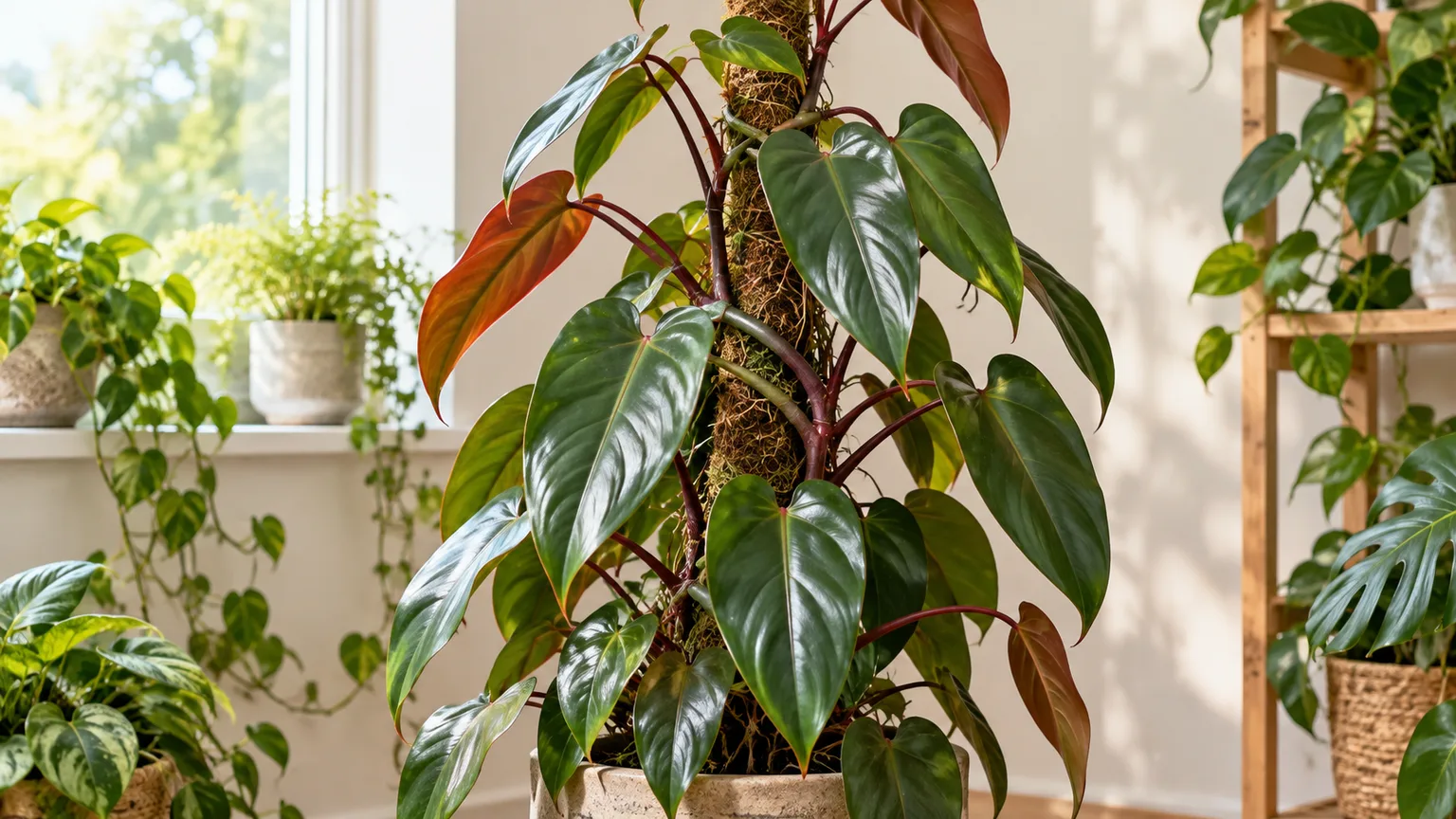
The best way to grow Philodendron erubescens is to treat it as a warm-climate climbing vine: give it bright filtered light, let the potting mix partly dry between thorough waterings, and offer a stable support if you want it to grow upward. It tolerates ordinary indoor conditions, but a dark corner, waterlogged soil, or a vine left to sprawl without enough room can make it look far less impressive than the plant it could become.
This species is often sold as blushing philodendron or red-leaf philodendron. Once you know which form you have, the routine is straightforward: assess the actual soil before watering, use a container that drains, and adjust light and feeding when growth slows rather than following a fixed calendar.
Identify the Plant Before Buying Care Advice
Philodendron erubescens is an accepted species in the arum family, Araceae, and Kew’s Plants of the World Online records its native range as Colombia. It is a climber of wet tropical habitats, not a compact rosette by default. The familiar species form has glossy green, heart-shaped to triangular leaves, reddish or copper-toned undersides, and burgundy stems or leaf stalks; NC State Extension’s profile notes that leaf size and color vary among plants.
Names on nursery tags can make the plant harder to identify. ‘Red Emerald’ and ‘Green Emerald’ are cultivars associated with P. erubescens, while ‘Pink Princess’ is a climbing, pink-variegated cultivar and ‘Prince of Orange’ is a compact self-heading form. Their foliage may differ, and their support needs may differ too. In particular, “philodendron” on a tag does not guarantee a vining habit: Iowa State Extension distinguishes climbing types from self-heading philodendrons.
You may also see P. scandens used as a name for heartleaf philodendron. Iowa State treats that name with P. hederaceum, a different species from P. erubescens. Confirm the botanical name or compare the stems and leaves before copying advice for another philodendron; similar care preferences do not mean their growth forms are identical.
Ideal Indoor Conditions at a Glance
Use this as a starting point, then let the plant and pot tell you when to adjust. A small plant in a bright, warm room can dry quickly; a mature vine in a large plastic pot in winter may stay damp much longer.
| Care factor | Practical indoor starting point | Adjust when |
|---|---|---|
| Light | Bright, filtered or indirect light | Stems stretch or new leaves shrink in a dim spot |
| Water | Water when the upper 1–2 inches of mix are dry | A small pot or warm room dries faster |
| Mix | Moisture-retentive but airy, with drainage | The center stays wet for many days |
| Temperature | A steady warm room, ideally about 65–85°F | Cold drafts or chilly nights slow growth |
| Humidity | Average home air is workable; higher humidity can help | New leaves stick or edges dry in very dry air |
| Support | Moss pole, trellis, or stake for a climbing vine | The plant leans or takes more floor space |
| Feeding | Balanced houseplant fertilizer during active growth | Growth pauses in a dim or cool season |
These are practical ranges rather than pass-or-fail thresholds. NC State Extension describes the species as warm-growing and partial-shade tolerant; the Royal Horticultural Society’s plant profile recommends bright filtered light and moist but well-drained growing conditions. Good care is the balance between moisture the roots can use and enough air around them to stay healthy.
Find Bright Filtered Light for Steady Growth
Place the plant near a bright window where the foliage receives abundant room light but is protected from long periods of hot direct sun. An east-facing window often works well; a south- or west-facing window may be suitable with a sheer curtain or a position set back from the glass. The right distance varies with window size, season, trees outside, and hemisphere, so judge the actual light at the leaves instead of relying on a universal number of feet.
Direct midday or afternoon rays can scorch leaves, especially after a plant has been growing in shade. A sudden pale, dry patch on the window-facing side suggests excess sun; long gaps between leaves and small new growth point more toward inadequate light. If you move the plant outdoors for summer, start it in open shade and give it time to acclimate before increasing exposure.
Variegated forms such as ‘Pink Princess’ generally need a bright position to maintain useful growth and visible patterning, but pink or white leaf areas can scorch just like green ones. Raising light gradually is safer than placing a dim-room plant directly in sun. Rotate the pot occasionally if growth leans toward the window, but avoid repeatedly moving it between very different conditions.
Water by Soil Condition, Not a Calendar
Check the mix before every watering. For a typical indoor pot, let the upper 1–2 inches dry; if the pot is large or the soil is dense, check deeper with a wooden skewer or by feeling the root-zone mix near a drainage opening. Water when that area is only slightly moist rather than soggy, then pour slowly until water exits the drainage holes. Empty the saucer or decorative cachepot so the roots do not sit in runoff.
The number of days between waterings is a result, not a rule. Bright light, warmth, active growth, small pots, and terracotta can shorten the interval; winter darkness, cool rooms, oversized containers, and dense peat-heavy mix can lengthen it. A simple pot-weight check helps: notice how heavy the container feels just after watering and again as it dries, then use that contrast along with the soil feel.
Wilt alone does not prove thirst. Both waterlogged roots and a very dry root ball can leave leaves limp, so check the mix before adding more water. If the soil is wet and several leaves yellow, let it dry and inspect drainage; if it is bone dry and the pot is light, water thoroughly rather than giving repeated sips that wet only the surface. Iowa State Extension advises keeping philodendrons evenly moist but not wet and not allowing them to stand in water.
Build an Airy Mix with Reliable Drainage
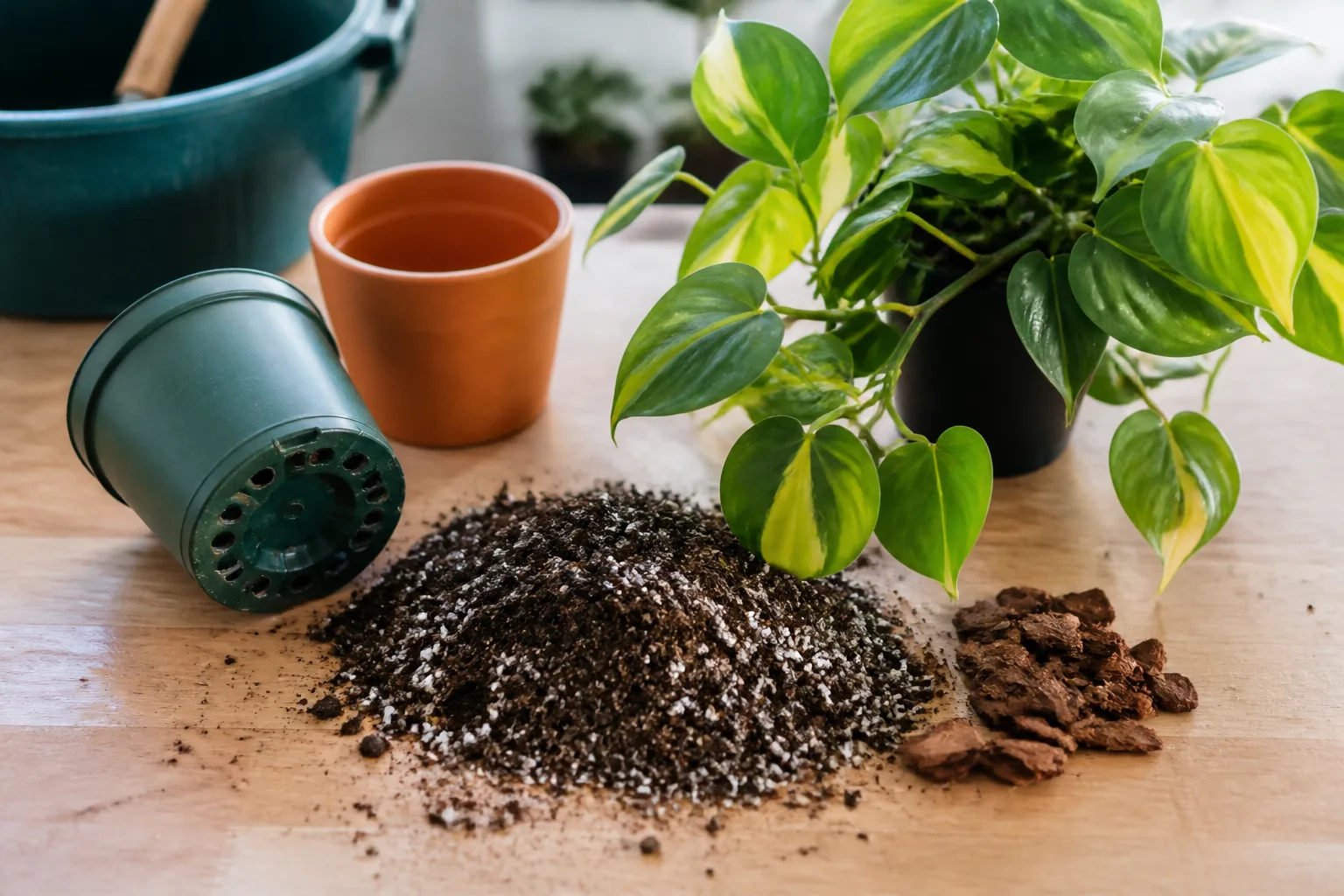
The roots need a mix that holds some moisture but does not collapse into a dense, airless block. A workable starting blend is two parts indoor potting mix, one part fine orchid bark, and one part perlite or pumice by volume. The potting mix supplies moisture and nutrients; bark and mineral pieces leave larger pores that help excess water drain and air return to the root zone.
You do not need a specialty “aroid recipe” if a quality indoor mix already drains at a pace you can manage. If a handful dries to a hard, water-repellent puck, add bark and perlite; if water runs straight through while the root ball remains dry, pre-moisten the mix and use a little more moisture-holding base. Avoid garden soil in indoor pots because it compacts more readily in a container.
Use a pot with open drainage holes, not a layer of stones at the bottom. Stones do not replace drainage and can leave a perched wet zone higher in the pot. Before repotting, moisten a handful of the fresh mix: it should hold together lightly when squeezed, then crumble apart when you touch it rather than forming a dense mud ball.
Keep Warmth Stable and Humidity Practical
Normal warm indoor temperatures suit this tropical climber. Keep it away from cold exterior doors, uninsulated glass in winter, and strong air-conditioning or heating vents that create sudden swings. NC State gives a preferred range of about 65–85°F and cautions against cold drafts; the RHS lists P. erubescens as a conservatory or greenhouse plant in its UK climate.
Humidity can improve the look of emerging leaves, but a special room is rarely necessary. If new leaves repeatedly catch or dry while unfurling, first confirm that the root ball is not cycling between bone-dry and soaked, then consider grouping plants or running a room humidifier. A hygrometer can show whether a room is unusually dry; do not chase a single “ideal” percentage if the plant is growing normally.
Misting gives only a brief local change and leaves foliage wet, so it is not a dependable way to raise room humidity. A pebble tray under the pot is similarly limited: it can add a small amount of moisture close to the plant, but it cannot compensate for a cold, waterlogged mix or dry air across a whole room. Steady temperature and sound watering usually matter more.
Feed During Active Growth
When the plant is pushing leaves in spring and summer, feed it with a balanced liquid houseplant fertilizer at the label rate, usually about once a month. If the product is concentrated or the plant is young, begin at half strength; if the mix is already enriched with fertilizer, wait until active growth resumes before feeding. Iowa State Extension recommends light feeding once or twice a month while philodendrons are actively growing.
Reduce or pause fertilizer when growth slows in fall and winter, especially if the room is cool or the plant receives less daylight. Fertilizer does not make a dim plant grow well, and it will not repair roots damaged by overwatering. If brown tips appear alongside a white crust on the soil or pot rim, stop feeding and flush the mix with clean water when it is time to water; accumulated salts may be contributing.
Do not increase the dose to force larger leaves. More fertilizer can injure roots and create salt buildup, while light and support have more influence on the plant’s shape. Resume a gentle routine when you see fresh growth and the plant is using water at a steady pace.
Give the Climbing Vine a Secure Route Up
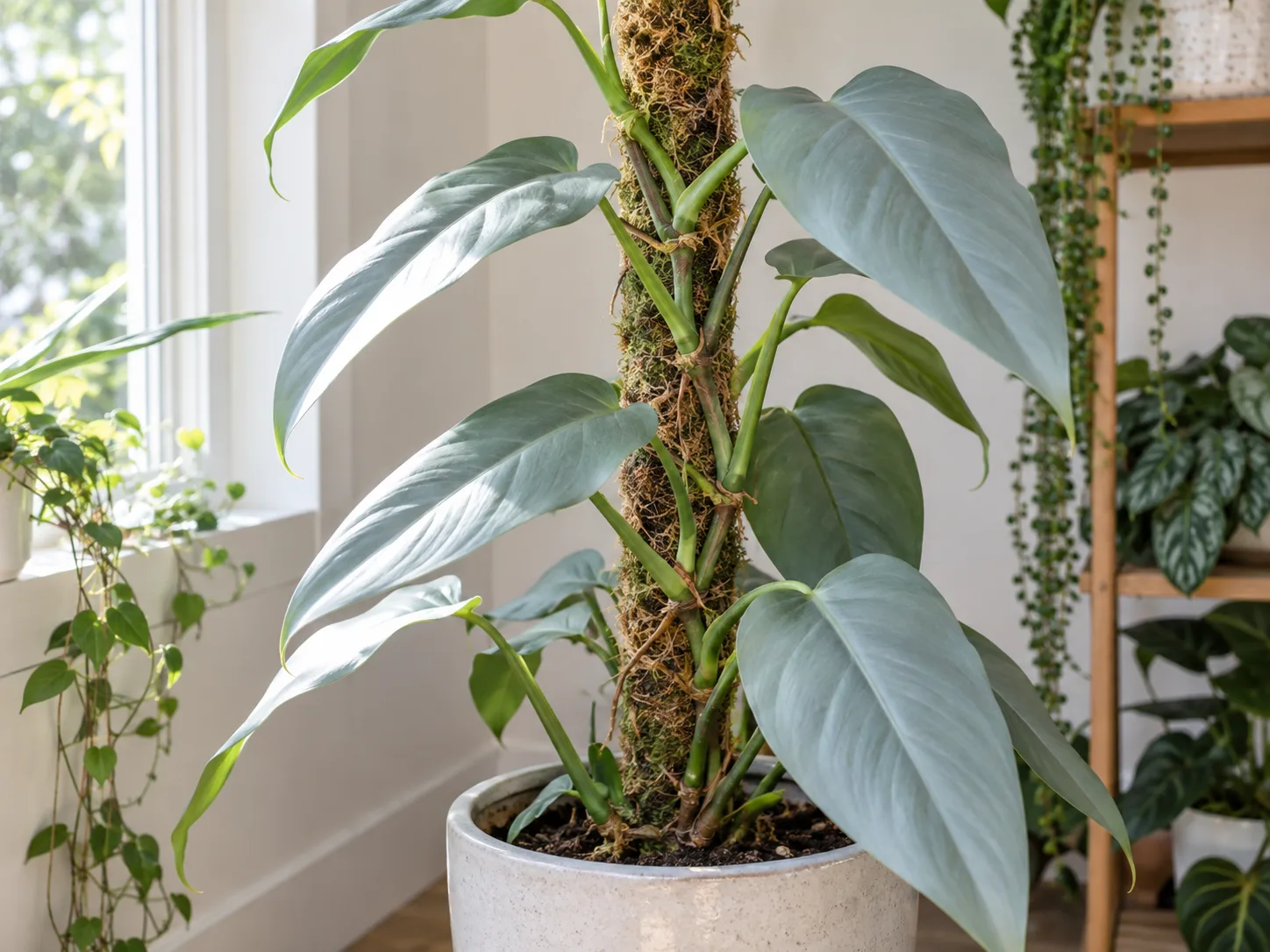
P. erubescens produces aerial roots at stem nodes and can climb when it meets a stable surface. Indoors, a support keeps a long vine from sprawling across a shelf or pulling the pot off balance. A moss pole, trellis, wooden plank, or sturdy stake can work; the best choice depends on whether you want aerial roots to attach, how tall the plant may become, and how much maintenance you want.
Set the support into the pot while repotting when possible, because forcing a pole through an established root ball can damage roots. Position the climbing stem so its aerial roots face the support, then use soft plant ties or clips to hold the stem loosely. Attach the stem between leaves rather than cinching a petiole, which must remain free to move as each leaf turns toward the light.
Guide flexible new growth as it lengthens. Do not bend an older woody section sharply to make it follow a pole; it can kink or split. NC State and the RHS both describe the species as a climber, and the RHS notes that aerial roots can grow into a moss pole if its surface stays moist.
Moss Pole or Trellis?
A moss pole gives aerial roots a textured, humid surface to grip, which can help the vine climb and anchor itself. It asks for more upkeep: sphagnum or coir may need periodic dampening, and the added moisture around the pole can affect how quickly the pot dries. Keep the pole slightly moist only if roots are meant to attach; do not keep the soil wet to make the pole damp.
A trellis or dry stake is easier to maintain and still supports stems vertically. The aerial roots may not embed themselves as they would in moist moss, but the plant can be secured to the surface with ties. Choose a trellis if you want a tidy outline or do not want to maintain a damp support; choose a moss pole if you are willing to water the support and want roots to attach. Either way, the pot itself must remain stable.
Repot When Roots or Old Mix Require It
Repotting every spring is unnecessary. Check the plant when roots circle densely around the root ball, emerge through several drainage holes, or the mix has broken down and remains wet long after watering. Another useful clue is a pot that dries unusually fast even though the plant is actively growing; roots may have displaced much of the mix. One root at a drainage hole alone is not an emergency.
Move up only one pot size, using a container with drainage and fresh airy mix. A pot that is much wider than the root ball holds excess wet soil the roots cannot use yet. Slide out the plant, loosen only roots that circle tightly, and keep the stems at the same soil depth. If the support is already entangled with the vine, avoid unwrapping every aerial root just to replace the pole; top-dress with fresh mix when the root zone is healthy and the pot remains large enough.
Water after repotting to settle the mix, let it drain completely, and keep the plant in bright indirect light while it adjusts. Hold fertilizer until you see fresh growth, particularly if the new mix contains nutrients. Avoid repotting a stressed plant simply because it is spring; diagnose whether the problem is compacted soil, root damage, or a seasonal pause first.
Prune for Shape and Make New Plants
Prune when you want to shorten a vine, remove damaged leaves, or turn a sparse top into several cuttings. Spring and early summer are convenient because active growth helps the remaining nodes resume, but a healthy vine can be cut back at other times if the plant has outgrown its space. Use clean, sharp snips and cut just above a node on the parent stem so a growth point remains below the cut.
Long stems with wide gaps usually need more light before they need more fertilizer. You can shorten them and root the healthy sections, then plant several rooted cuttings back into the pot to make it fuller. Remove a yellow leaf at its base when it is fully spent, but do not strip healthy foliage simply because one older leaf has yellowed.
Wear gloves when pruning and wash sap from skin and tools afterward. The RHS advises gloves because philodendron sap can irritate; the plant’s safety details are below. Do not remove aerial roots that are helping the vine attach unless they are damaged or in the way. Iowa State notes that aerial roots may be left alone, guided to a support, or tucked into the mix.
Take a Cutting with a Real Node
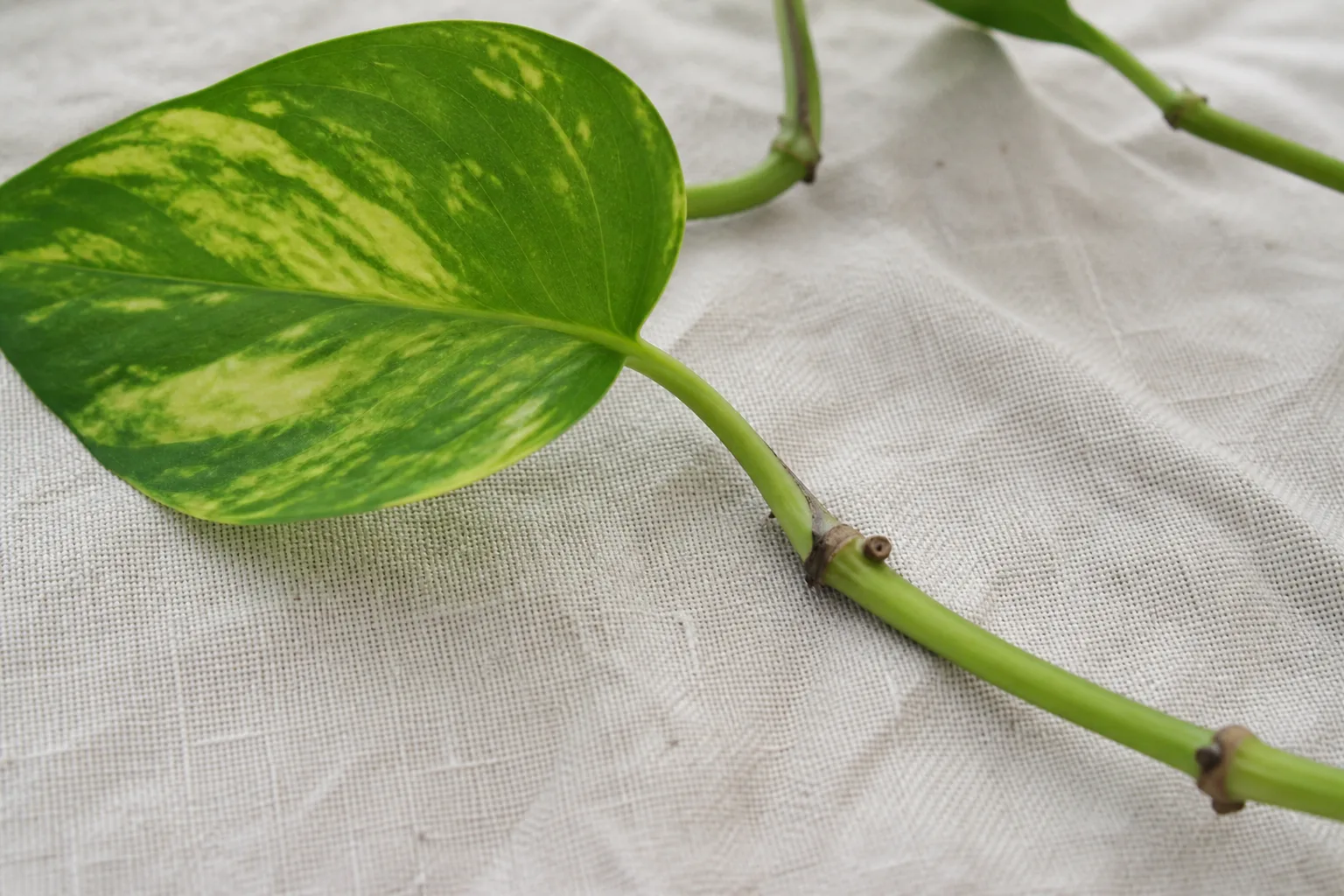
Find a healthy stem with at least one visible node: the joint where a leaf and often an aerial root emerge. Make a clean cut just below that node. A leaf stalk cut off without a piece of stem has no node and cannot grow into a new plant, so include a short section of stem and one or more leaves.
For several starts, divide a longer vine into sections with a node on each piece. Keep track of which end was closest to the pot so each cutting can sit in the right direction. Choose firm growth without pests or mushy areas; if the parent plant is actively declining, stabilize it before taking many cuttings. This small detail matters because cuttings inherit the condition of the stem they came from.
Root Cuttings in Water or Mix
For water rooting, set the node below the waterline and keep the leaves above it. Place the jar in bright indirect light, refresh the water when it clouds, and pot the cutting once it has several roots long enough to handle gently. The Iowa State Extension propagation guidance describes rooting philodendron stem sections in water or a well-drained medium; Epic Gardening’s current propagation walkthrough gives a practical sequence for choosing a cutting, rooting it, and moving it into mix.
For direct rooting, bury the node in lightly moist, airy mix and keep the pot warm in bright indirect light. The medium should stay lightly damp while roots establish but should not remain saturated. Water-rooted cuttings can look wilted for a short time after potting because they are adapting to soil; keep conditions steady rather than repeatedly pulling them up to inspect.
Seed is not the normal way to multiply an indoor collection. Mature philodendrons can flower and make seed, but houseplants rarely flower, and seedlings may not keep the traits of a named cultivar. Stem cuttings are faster, more predictable, and do not depend on pollination or fresh seed.
Diagnose Trouble in the Right Order
Change one likely cause at a time. Start with the root zone: feel the mix, lift the pot, and check whether water can escape. Then look at recent light, temperature, and feeding changes. One isolated leaf rarely identifies a cause on its own, so use the pattern across several leaves and new growth before taking action.
If the plant is declining quickly, slide the root ball out far enough to look for firm, pale roots versus dark, soft, sour-smelling roots. Trim only damaged roots with clean tools and repot into fresh, airy mix if rot is present. A yellow leaf on a wet plant is not a signal to add fertilizer; excess water, poor drainage, light stress, and normal aging can all produce yellowing.
Yellow Leaves
One older bottom leaf yellowing gradually while new leaves look healthy is often normal replacement. Several leaves turning yellow over a short period deserve a closer check. If the mix is still wet several days after watering, check drainage and root health; if the soil is dry and the pot feels light, water thoroughly and note whether the plant recovers.
If watering looks reasonable, assess where the leaves sit. Pale or yellow areas on the side facing strong sun may indicate scorch, while long gaps and small leaves usually mean the plant needs brighter indirect light. Yellowing by itself does not diagnose a nutrient deficiency, so do not feed until you have ruled out moisture and light problems.
Brown Edges, Slow Growth, Spots, and Pests
Dry brown edges can follow repeated drying, low humidity during leaf unfurling, or fertilizer salts. Check whether the entire root ball dries between waterings and whether the pot has a crusty mineral layer before raising humidity. A dark patch on a sun-exposed leaf points toward scorch; expanding wet-looking spots deserve a closer inspection and better airflow.
Very slow growth is common when daylight drops or temperatures cool. If stems become stretched and new leaves are smaller, move the plant brighter gradually and offer support; do not feed a plant that is not actively growing. Under good conditions, a leaf can still take time to emerge, so compare several growth points rather than judging progress from a single week.
Inspect leaf undersides, new unfurling leaves, stem joints, and aerial roots for spider mites, mealybugs, aphids, or scale. Isolate an infested plant, rinse or wipe pests away, and use only a product labeled for indoor plants and that pest, following its label exactly. NC State lists these pests and leaf spot among concerns for the species; watering at the base and avoiding persistently wet foliage can reduce leaf-spot risk.
Expect Rare Indoor Flowers and Treat Outdoor Time as Seasonal
An indoor P. erubescens is grown mainly for its foliage. It can produce an arum-family inflorescence, made of a spathe around a spadix, but indoor plants rarely flower. NC State Extension describes a reddish-burgundy spathe around a white spadix and notes the rarity of flowers indoors; UConn Extension explains the spathe-and-spadix form common to arums. Warm conditions and healthy growth matter more than attempts to hand-pollinate a plant that has not bloomed.
The species is tropical, so temperate-climate owners should treat outdoor placement as a warm-season option, not a permanent garden planting. Gardening Know How’s outdoor philodendron guidance recommends shade and avoiding cold nights for container plants. Move the pot outside only after cold weather has passed, set it in sheltered shade first, and bring it back indoors before nights turn cool; check leaves and potting mix for hitchhiking pests before bringing it inside.
In a genuinely frost-free climate, a sheltered shaded position may be possible, but the plant still needs protection from direct sun and prolonged cold. A balcony can be much hotter and windier than an indoor room, so watch the soil more frequently during outdoor growth. Never leave a recently indoor-grown plant in full sun and assume its forest-climber habit means it is sun-tolerant.
Keep Sap Away from Skin, Children, and Pets
Philodendron tissues contain insoluble calcium oxalate crystals. If chewed, they can irritate the mouth and throat; sap may also irritate skin or eyes. Poison Control’s explanation of philodendron exposure describes rapid mouth irritation after chewing, and the ASPCA includes philodendron varieties among plants that can harm pets.
Place the vine where children and pets cannot reach leaves or dangling stems, especially after pruning when cut material may be left on a table or floor. Wear gloves if you have sensitive skin, avoid touching your face while cutting, and wash tools and hands afterward. If someone or a pet chews the plant, contact a poison center or veterinarian for advice; seek urgent care for difficulty swallowing or breathing.
Conclusion
Give Philodendron erubescens filtered light, a warm stable room, a mix that holds moisture without staying soggy, and a pot that drains. Water after checking the root zone, feed only while growth is active, and repot when the roots or tired mix actually need it rather than because a calendar says so.
If the vine is taking over a shelf, decide whether you want it to trail or climb and add support before stems become difficult to move. For a fuller plant, prune a healthy section with a node and root it in water or mix. When leaves change, check moisture, light, temperature, and pests in that order; the pattern usually points to a fix more clearly than any single symptom.



