Marble Queen Pothos Care Guide: Light, Water & Variegation
Epipremnum aureum 'Marble Queen'
Marble Queen Pothos needs bright indirect light to maintain white variegation, watering every 7–10 days when top 3–5 cm are dry, and well-draining soil. Slow grower - patience required.
Marble Queen Pothos Care Guide: Light, Water & Variegation
Start with wateringThe most common care mistake for Marble Queen PothosWatering guide →Marble Queen Pothos care essentials
Light
bright indirect light
Water
Allow top 3–5 cm of soil to dry before watering - every 7–10 days in summer, every 10–14 days in winter. Well-draining soil prevents root rot.
Soil
Standard potting mix with 20–30 % perlite. Well-draining, airy. pH 6.0–6.5.
Humidity
40–60%
Temperature
18–29°C (65–85°F)
Fertilizer
Use balanced liquid fertilizer at half strength and stop if the plant is stressed, newly repotted, or not actively growing. Over-fertilizing; can burn the low-chlorophyll white sections.
About Marble Queen Pothos
Marble Queen Pothos is native to Cultivar of Epipremnum aureum (native to Mo'orea, French Polynesia), typically reaches Up to 2–3 m long indoors, with moderate (slower than golden pothos due to less chlorophyll) growth. Marble Queen Pothos has a trailing growth habit and part of the Araceae family. It is also known as Marble Queen Devil's Ivy and Variegated Pothos.
| Detail | Information |
|---|---|
| Also known as | Marble Queen Devil's Ivy, Variegated Pothos |
| Native region | Cultivar of Epipremnum aureum (native to Mo'orea, French Polynesia) |
| Mature size | Up to 2–3 m long |
| Growth rate | Moderate (slower than Golden Pothos due to less chlorophyll) |
| Growth habit | Trailing |
| Scientific name | Epipremnum aureum 'Marble Queen' |
| Family | Araceae |
Marble Queen Pothos Care Guide: Light, Water & Variegation
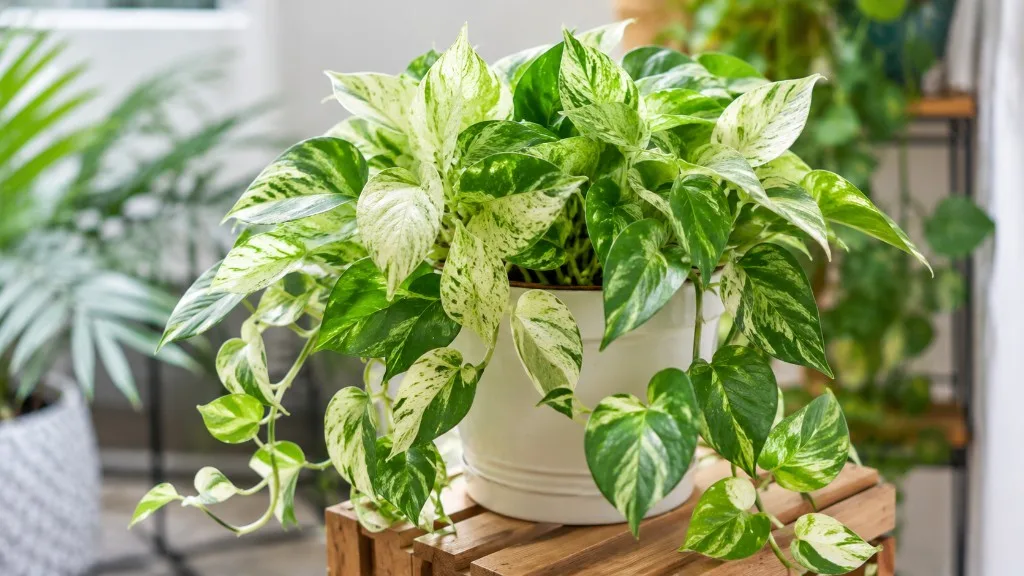
Marble Queen Pothos (Epipremnum aureum ‘Marble Queen’) looks effortless on Instagram - creamy white marbling over heart-shaped green leaves, trailing from a shelf or spilling from a hanging basket. In practice, the plant is forgiving in the way pothos usually are, but it is not interchangeable with Golden Pothos. The white sections carry far less chlorophyll, which means Marble Queen needs brighter indirect light, grows more slowly, and will quietly revert to solid green if you park it in a dim hallway and hope for the best.
This guide covers what the plant actually is, how its care differs from Golden Pothos, where to place it in a real home, how to water without rotting roots, and what to do when variegation starts fading. By the end, you should know whether Marble Queen fits your space, how to keep the white pattern stable, and when a problem is light-related rather than a watering mistake.
What Marble Queen Pothos Actually Is
Marble Queen Pothos is a cultivar of Epipremnum aureum, the species sold everywhere as Golden Pothos, Devil’s Ivy, or Taro Vine. The species is native to tropical forests in Southeast Asia - Clemson HGIC lists its natural range as China, India, and parts of Southeast Asia - with cultivated introductions from the Society Islands. In the wild, pothos climbs tree trunks as an understory vine, reaching toward dappled light filtered through the canopy.
What makes Marble Queen distinct is a stable somatic mutation in chlorophyll distribution. Instead of the yellow-gold splashes on Golden Pothos, Marble Queen leaves show a marbled mix of deep green and creamy white or pale green. Each leaf is slightly different, which is part of the appeal. The variegation is not painted on - it reflects real differences in how much photosynthetic tissue each section contains. That biological fact drives almost every care decision that follows.
Marble Queen shares the classic pothos growth habit: wiry stems, aerial roots at nodes, and glossy heart-shaped leaves that mature larger when the plant climbs. Indoors, vines commonly reach 2–3 meters over time in good conditions, though growth is moderate and slower than Golden Pothos because the white areas contribute less energy. You will also see it sold as Marble Queen Devil’s Ivy or simply Variegated Pothos, but the botanical name on the tag is what confirms you have the right plant.
The family matters for expectations. As a member of Araceae, Marble Queen shares traits with philodendrons and peace lilies: it prefers warmth, resents cold drafts, needs drainage, and contains calcium oxalate crystals that make every part toxic if chewed. It is not a fern, not a succulent, and not a low-light trooper in the same league as its greener relatives.
Marble Queen vs. Golden Pothos
Most care mistakes start with assuming all pothos are the same. Golden Pothos and Marble Queen are the same species, but they are not the same houseplant in practice. The variegation pattern changes how much light the plant can harvest, how fast it grows, and how quickly it recovers from stress.
Chlorophyll, Growth Speed, and Light
Golden Pothos leaves carry generous green tissue with yellow or gold variegation scattered across the surface. Even in moderate indirect light, enough chlorophyll remains for steady photosynthesis. Marble Queen is different: large portions of each leaf are white or cream, and those sections contain little to no chlorophyll. The plant must compensate by harvesting more light overall, which is why Clemson HGIC explicitly states that Marble Queen requires more light than other pothos varieties.
The growth-speed gap is real and normal. Golden Pothos can push out long runners in a bright summer and look full within a season. Marble Queen often takes longer to produce the same length of vine, and individual leaves may stay smaller when light is marginal. That is not a defect - it is the cost of maintaining a high-variegation cultivar. Pruning leggy stems and improving light are more effective than doubling fertilizer.
In low light, both cultivars may produce greener leaves, but Marble Queen shows it faster and more dramatically. Golden Pothos tolerates dim corners and still looks presentable; Marble Queen in the same spot will stretch, shrink new leaves, and begin reverting - producing solid green foliage to boost photosynthesis. If you only have low-light real estate, Golden Pothos is the honest choice. Save Marble Queen for the brightest indirect spot you have.
Marble Queen vs. Snow Queen
Marble Queen is often confused with Snow Queen Pothos (E. aureum ‘Snow Queen’), and the names are similar enough that mislabeling at garden centers is common. Clemson HGIC draws a useful line: Snow Queen has predominantly white leaves speckled with green, with no large green patches, and needs lots of Marble Queen Pothos light guide to grow adequately. Marble Queen has more green overall, pointed leaves, and grows faster than Snow Queen while still demanding strong light.
If your plant is mostly white with small green flecks and grows slowly, you likely have Snow Queen. If the marbling is a roughly even mix of cream and green and the vine gains length at a moderate pace, you likely have Marble Queen. Care overlaps - both need bright indirect light and careful watering - but Snow Queen is even less forgiving of shade. Check the newest leaves, not the oldest, when identifying either cultivar.
Light Requirements for White Variegation
Light is the single most important variable for Marble Queen Pothos. The goal is bright, indirect light for most of the day - enough intensity for photosynthesis across a partially white leaf, without the scorching heat of direct sun on pale tissue.
White and cream sections are more vulnerable to photobleaching and sunburn than green tissue. A few hours of direct afternoon sun through a south window can produce brown, papery patches on variegated areas within days. Gentle morning sun through an east window is usually fine if you acclimate gradually. When in doubt, filter strong sun with a sheer curtain or move the pot a few feet back from the glass.
Placement That Works in Real Homes
A practical starting point is within 1–2 meters of an east- or north-facing window, or behind a sheer curtain at a south- or west-facing window. If you measure light, Marble Queen generally does best around 200–400 foot-candles - brighter than Golden Pothos needs, but below the 500+ foot-candle range that heavily white cultivars like Snow Queen often require. A simple PAR or lux meter removes guesswork; without one, watch the plant’s new growth.
Good light signals include compact internodes, leaves that match the size of older foliage, and new leaves opening with crisp white marbling. Low-light signals include long bare stems between leaves, small new foliage, and progressive loss of white pattern on successive leaves. If you see those signs, move the plant to a brighter spot or add a full-spectrum LED grow light 30–45 cm above the canopy for 10–12 hours daily. Variegated leaves already on the vine will not regain lost white pattern, but improved light can stabilize new growth.
Rotate the pot a quarter turn weekly so both sides of the plant receive similar exposure. Trailing pothos often look lush on the window side and sparse on the back; rotation keeps growth even without requiring two windows.
Watering Without root rot on Marble Queen Pothos
Marble Queen Pothos wants the same watering philosophy as other pothos - let the soil dry between waterings - but the timing shifts with light, pot size, and season. LeafyPixels plant data and practical indoor experience align on a simple rule: allow the top 3–5 cm of soil to dry before watering again. In many homes that works out to roughly every 7–10 days in summer and every 10–14 days in winter, but the calendar is a hint, not a schedule.
Clemson HGIC advises allowing soil to dry completely between waterings for pothos, then soaking thoroughly so water reaches all roots. The two frameworks converge if you interpret “dry completely” as dry through the upper root zone, not bone-dry to the bottom of a large pot. A plant in bright light and a small pot may need water weekly; the same plant in a dim corner and oversized container may go three weeks between drinks. Always check the pot, not the date.
overwatering on Marble Queen Pothos is the fastest way to kill a pothos. Chronic wet soil causes root rot, which shows up as yellow leaves, soft stems, and a sour smell from the mix. underwatering on Marble Queen Pothos is gentler: leaves wilt and curl, then recover after a thorough soak. Marble Queen in strong light uses water faster than one in shade, so placement and watering are linked - another reason not to treat it like a low-light plant.
Reading Dryness by Touch
The top 4–5 cm dry test is the most reliable home method. Insert your finger to the second knuckle; if the mix feels cool and damp, wait. If it is dry and light in color, water. Lift the pot occasionally to learn its weight - a dry pot is noticeably lighter than a freshly watered one. For deep pots, a wooden chopstick left in the mix for ten minutes and pulled out works as a crude moisture probe: damp soil clings, dry soil does not.
When you water, do it thoroughly. Add room-temperature water until it runs from the drainage holes, then empty the saucer within 30 minutes. Never let the pot sit in standing water. If the mix dries unevenly - wet at the bottom, dry on top - the root ball may be hydrophobic or root-bound; Marble Queen Pothos repotting guide into fresh, airy mix usually fixes the rhythm.
Soil, pH, and Pot Drainage
Marble Queen Pothos is not picky about exotic ingredients, but it is strict about drainage. A standard peat- or coco-based potting mix with 20–30% perlite matches what most growers need: enough moisture retention for tropical roots, enough air space to prevent anaerobic rot. LeafyPixels plant data targets pH 6.0–6.5, which most quality bagged indoor mixes already provide.
Avoid garden soil, dense outdoor mixes, or pots without drainage holes, no matter how nice the ceramic looks. A chunky aroid blend is fine if you already use one, but plain potting mix plus perlite is sufficient. If water races through the pot in seconds and the plant wilts days later, the mix may be too porous or the plant too root-bound - add a little fine potting mix at repot time or move up one pot size.
Terracotta dries faster and suits heavy-handed waterers; plastic retains moisture longer and suits bright, warm rooms where the plant drinks quickly. Either works if you read the soil rather than watering automatically. Go up only one pot size at repotting - typically 2–5 cm wider - because excess soil holds water the roots cannot use.
Humidity and Temperature
Marble Queen Pothos is adaptable to average homes. Clemson HGIC lists a preferred humidity range of 50–70% and notes that pothos tolerate typical indoor levels of 30–60%. LeafyPixels data targets 40–60%, which is realistic without special equipment in most climates. Below 40%, you may see brown, papery leaf tips, especially in winter when heating dries the air. A pebble tray, grouping plants together, or a small humidifier near the pot addresses that more reliably than misting, which only bumps humidity for minutes and can encourage leaf spotting if water sits on foliage overnight.
Temperature comfort aligns with normal indoor living. 18–29°C (65–85°F) is the sweet spot. Clemson HGIC specifies 60–70°F nights and 70–85°F days. Keep the plant away from cold drafts below 10°C (50°F), blasting air-conditioning vents, and winter window glass that radiates chill. Heat vents can scorch leaves and dry soil unevenly. Stability matters more than chasing a perfect number - sudden moves between rooms cause more stress than a steady 22°C office.
Fertilizer Schedule and Strength
Fertilizer supports growth but cannot fix bad light or wet roots. Feed Marble Queen monthly during spring through summer with a balanced liquid houseplant fertilizer diluted to half strength, and pause in fall and winter when growth slows. Clemson HGIC suggests fertilizing every other month during spring and summer for pothos with yellowing from low fertility - a lighter baseline that still works for most homes.
Never fertilize a dry, stressed, or newly repotted plant. Water first, then feed moist soil so salts do not burn roots or the pale variegated sections of leaves. Over-fertilizing shows up as crispy brown leaf margins and white crust on the soil surface. If that happens, flush the pot with plain water until runoff is clear, skip feeding for a month, and resume at half strength. Healthy new leaves are the only metric that matters.
Pruning and Stopping Reversion
Reversion is when Marble Queen produces solid green leaves instead of variegated ones, usually because light is too low for the plant to sustain white tissue. Reversion starts on new growth, not old leaves - watch the leaves opening at the vine tips. If successive new leaves show more green and less cream, act before the stem fully converts.
The fix is two-part. First, move the plant to brighter indirect light or add a grow light. Second, prune reverted stems back to the last node that produced well-variegated leaves. Use clean scissors and cut just above a node. The vine will branch from remaining nodes and, with adequate light, often produce variegated growth again. Stems that are fully green for many nodes are better removed entirely than left to dominate the plant.
Regular pruning also keeps Marble Queen bushy. Long bare runners with leaves only at the ends are a light problem, a neglect problem, or both. Cut back leggy vines to encourage side shoots, pinching or trimming just above nodes where you want fullness. Wipe tools with rubbing alcohol between cuts if you are pruning multiple plants, especially when pests have been an issue.
Repotting When Roots Circle the Pot
Marble Queen Pothos does not need frequent repotting. Every 1–2 years in spring is typical, or when you see roots circling the surface, emerging from drainage holes, or water running straight through without soaking in. Repot into a container one size larger with fresh, well-draining mix. Water lightly for the first week while torn roots heal, then return to your normal dry-top-soil rhythm.
Do not repot on day one after purchase unless the plant is clearly root-bound or the mix is staying wet for weeks. A stable plant handles repotting well; a stressed one may shed leaves. If you must repot, choose spring or early summer when bright light and warmth support recovery.
Propagation from Stem Cuttings
Marble Queen Pothos propagates easily from stem cuttings with at least one node, and variegated cultivars generally retain their pattern through vegetative propagation - each cutting is a genetic clone of the parent. Clemson HGIC confirms that pothos cuttings root in water or moist soil as long as a node contacts the medium.
Take a 10–15 cm cutting just below a node, remove the lowest leaf, and place the node in a jar of room-temperature water or directly into moist potting mix. Keep cuttings in bright, indirect light. Roots typically appear in 2–3 weeks in water at warm room temperatures; NC State Extension notes that vines easily root in water before transplanting into soil. Change water weekly if propagating in a jar to limit stagnation.
For best variegation in the offspring, propagate from healthy, well-variegated stems, not from reverted green sections. Green cuttings root just as readily but produce green plants. If a parent vine is partly reverted, take cuttings only from the variegated portions while you correct light on the mother plant.
Toxicity to Pets and People
Marble Queen Pothos is attractive and common, which makes its toxicity easy to overlook. All parts of the plant - leaves, stems, and sap - are toxic if ingested because they contain insoluble calcium oxalate crystals (raphides). The ASPCA lists Epipremnum aureum (Golden Pothos / Devil’s Ivy) as toxic to cats and toxic to dogs, and that classification applies to every cultivar in the species, including Marble Queen.
Cats and Dogs
When a cat or dog chews pothos tissue, microscopic crystals embed in the mouth, tongue, and throat, causing immediate mechanical irritation. The ASPCA lists clinical signs as oral irritation, intense burning of the mouth, tongue and lips, excessive drooling, vomiting, and difficulty swallowing. Most exposures are painful but not life-threatening in healthy adult pets, though small animals are more vulnerable by body weight.
If you suspect ingestion, remove any plant material from the mouth, rinse gently with cool water if the pet tolerates it, and call your veterinarian or the ASPCA Animal Poison Control Center at 888-426-4435. Do not induce vomiting unless a professional directs you to. For households with cats that chew plants, Marble Queen belongs on a high shelf, in a hanging basket well above jump height, or not at all - consider a genuinely pet-safe trailer like a spider plant or peperomia instead.
Humans, especially toddlers, face similar oral irritation from chewing leaves or sap. Wear gloves if sap contact irritates your skin, and wash hands after pruning. This is a display plant, not a touch-and-taste plant for curious children.
Common Problems and Fixes
Most Marble Queen problems trace back to a short list of causes. The diagnostic order that saves time is: soil moisture first, then light, then pests, then fertilizer history.
Yellow leaves often mean overwatering, especially if several leaves yellow at once and the stems feel soft. Check whether the mix stays wet for days. If roots are brown and mushy, unpot, trim rot, and repot in fresh mix. Yellowing on older leaves only may be normal senescence - remove them and move on. Uniform pale yellow on new growth in bright light can indicate over-fertilizing or, less commonly, nutrient deficiency.
Leggy growth and small leaves point to insufficient light almost every time. Move the plant or add a grow light before changing anything else. Loss of variegation on new leaves is a light problem until proven otherwise. Brown, crispy tips usually mean low humidity, fertilizer burn, or inconsistent watering - raise humidity, flush salts, and stabilize your dry-top-soil rhythm.
Brown patches on white sections often mean direct sun scorch. Relocate the pot and trim damaged leaves for cosmetics. Wilting with dry soil is underwatering; wilting with wet soil is root damage. Spider mites leave fine webbing and stippled yellow flecks, especially in dry winter air - shower the plant, raise humidity, and treat with insecticidal soap. Mealybugs look like cottony clusters in leaf axils; dab with isopropyl alcohol and follow with soap sprays. Fungus gnats hover when the soil surface stays wet - let the top layer dry and use yellow sticky traps.
Root rot prevention beats cure. Fast-draining mix, drainage holes, and watering only when the top few centimeters are dry will solve more problems than any product marketed as a rescue tonic.
Buying and the First Month at Home
When shopping for Marble Queen Pothos, choose plants with firm stems, clean leaf undersides, and new growth showing crisp marbling. Be cautious if you see widespread yellowing, sticky residue, collapsed vines, or soil that smells sour in a dim store corner - those are stress and pest signals, not bargain opportunities. Labels vary; confirm Epipremnum aureum ‘Marble Queen’ if you can, but healthy variegated new leaves matter more than perfect naming.
After bringing it home, quarantine it for two weeks away from other plants if pests are a concern in your collection. Do not repot immediately unless the mix is clearly failing. Place it in bright indirect light from day one - not the dim spot where the pot looked cute in the shop window. Learn how fast your particular pot dries before you lock in a Marble Queen Pothos watering guide.
Watch the first month for yellow leaves, leggy growth, and root rot signs. If something appears, change one variable at a time - light, water, or pot - rather than repotting, fertilizing, and pruning simultaneously. Marble Queen is settling in when it produces stable new variegated leaves at a steady pace, even if that pace is slower than you expected.
Conclusion
Marble Queen Pothos rewards a simple contract: give it more light than Golden Pothos, water when the top 3–5 cm of soil are dry, plant it in well-draining mix with perlite, and prune reverted green growth before it takes over the plant. The white marbling is not decoration independent of biology - it is a photosynthesis trade-off that makes the plant slower, slightly thirstier for photons, and quicker to fade in shade.
If you have a bright east or filtered south window, a hanging basket or high shelf away from pets, and patience for moderate growth, Marble Queen is one of the most elegant trailing houseplants you can grow. If your best spot is a dim interior room or a floor pot within reach of a chewing dog, a greener, faster pothos cultivar - or a pet-safe species - is the more honest choice. Match the plant to the room, and the variegation largely takes care of itself.
When to use this page vs other Marble Queen Pothos guides
- Marble Queen Pothos overview - Canonical hub for this species - care topics and problems branch from here.
- Marble Queen Pothos problems - Symptom-first path when you already know something is wrong.
Related Marble Queen Pothos guides
- Marble Queen Pothos watering
- Marble Queen Pothos light
- Marble Queen Pothos soil
- Marble Queen Pothos propagation
- Marble Queen Pothos fertilizer
- Marble Queen Pothos repotting
- Marble Queen Pothos pruning
- Yellow Leaves on Marble Queen Pothos
- Leggy Growth on Marble Queen Pothos
- Root Rot on Marble Queen Pothos
- Brown Tips on Marble Queen Pothos
- Overwatering on Marble Queen Pothos
How to care for Marble Queen Pothos?
How much light does Marble Queen Pothos need?
bright indirect light
- bright indirect light - bright indirect light.
When should you water Marble Queen Pothos?
Allow top 3–5 cm of soil to dry before watering - every 7–10 days in summer, every 10–14 days in winter. Well-draining soil prevents root rot.
- Top 4–5 cm dry test - Allow top 3–5 cm of soil to dry before watering - every 7–10 days in summer, every 10–14 days in winter.
- Drain excess water - Allow top 3–5 cm of soil to dry before watering - every 7–10 days in summer, every 10–14 days in winter.
What soil works best for Marble Queen Pothos?
Standard potting mix with 20–30 % perlite. Well-draining, airy. pH 6.0–6.5.
- potting mix - Standard potting mix with 20–30 % perlite.
- perlite - Standard potting mix with 20–30 % perlite.
Grower notes for Marble Queen Pothos
What matters most with Marble Queen Pothos
Marble Queen Pothos is forgiving, but its variegation and leaf size tell you whether the placement is actually working. Long bare vines usually mean the plant needs pruning, stronger light, or a support, not just more fertilizer. In practice, the care checkpoint is simple: bright indirect light. Pair that with standard potting mix with 20–30 % perlite. Well-draining, airy; pH 6.0–6.5, and avoid changing water, pot size, and placement all at once.
Best placement in a real home
Marble Queen Pothos belongs where bright indirect light is realistic for most of the day, not only where the pot looks good. Allow top 3–5 cm of soil to dry before watering - every 7–10 days in summer, every 10–14 days in winter. Well-draining soil prevents root rot. If the pot stays wet longer than expected, move the plant into better light or reassess the mix before watering again. Humidity target: 40–60%. Temperature comfort zone: 18–29°C (65–85°F).
Before you buy this plant
Choose Marble Queen Pothos with firm new growth, clean leaf undersides, and soil that does not smell sour or feel compacted. Be cautious if you see yellow-leaves, sticky residue, collapsed crowns, or a pot that is wet in poor light. Cosmetic old-leaf damage is less worrying than weak roots or active pests.
First month after bringing it home
Do not repot Marble Queen Pothos on day one unless the mix is failing or pests are obvious. Quarantine it, learn how fast the pot dries, and keep care boring while it adjusts. Watch especially for yellow-leaves, leggy-growth, and root-rot. If problems appear, correct the condition first rather than stacking fertilizer, repotting, and pruning together.
Safety note for Marble Queen Pothos
Marble Queen Pothos is not a plant to keep within reach of pets or children. The database flags it for cats and dogs. Use gloves if sap or plant tissue is irritating, and pick a pet-safe alternative for floor pots or low shelves.
How to tell Marble Queen Pothos is settling in
Also sold as Marble Queen Devil's Ivy and Variegated Pothos, this plant should be judged by stable new growth rather than label names alone. If you plan to multiply it later, common methods include Stem cuttings in water and Stem cuttings in soil. Repot only when you see circling roots and rapid water drainage. If leggy-growth shows up early, inspect light, watering, and roots before assuming the plant is permanently weak.
Is Marble Queen Pothos safe for pets?
Marble Queen Pothos is toxic to cats and dogs. Calcium oxalate crystals cause oral irritation and vomiting. Keep out of reach of all pets.
All Epipremnum aureum varieties contain insoluble calcium oxalate crystals. Ingestion by cats or dogs causes oral irritation, excessive drooling, difficulty swallowing, and vomiting.
Watering Marble Queen Pothos
For Marble Queen Pothos, top 4–5 cm dry test and water every 7–14 days. Reduce in winter.
| Detail | Information |
|---|---|
| How often | Every 7–14 days |
| How to check | Top 4–5 cm dry test |
| Seasonal changes | Reduce in winter |
Signs of overwatering
- yellow leaves
- mushy stems
- root rot
Signs of underwatering
- wilting
- dry curling leaves
Soil & potting for Marble Queen Pothos
Use a mix of potting mix, perlite for Marble Queen Pothos. Good. Target soil pH around 6.0–6.5. Repot every 1–2 years, ideally in spring.
| Detail | Information |
|---|---|
| Recommended mix | potting mix, perlite |
| Drainage | Good |
| Soil pH | 6.0–6.5 |
| Repotting frequency | Every 1–2 years |
| Best season to repot | Spring |
Signs it needs repotting
- circling roots
- rapid water drainage
Humidity & temperature for Marble Queen Pothos
Marble Queen Pothos prefers 40–60%, though normal home humidity is usually fine. Keep temperatures around 18–29°C (65–85°F).
| Detail | Information |
|---|---|
| Humidity | 40–60% - normal home humidity is fine. |
| Ideal temperature | 18–29°C (65–85°F) |
Fertilizer & pruning for Marble Queen Pothos
Use use balanced liquid fertilizer at half strength and stop if the plant is stressed, newly repotted, or not actively growing. Over-fertilizing; can burn the low-chlorophyll white sections. for Marble Queen Pothos.
| Detail | Information |
|---|---|
| Fertilizer type | Use balanced liquid fertilizer at half strength and stop if the plant is stressed, newly repotted, or not actively growing. Over-fertilizing; can burn the low-chlorophyll white sections. |
Common problems on Marble Queen Pothos
Black Spots
MediumLikely cause: Nov 23, 2025 · Dealing with black spots on your Marble Queen Pothos can be frustrating, but with careful observation and prompt action, you can often restore the plant to its vibrant self.
Quick fix: Confirm diagnosis on your Marble Queen Pothos, then address the most likely care or pest factor described in current extension guidance.
Full fix guide →Brown Leaves
MediumLikely cause: May 24, 2026 · Why Are Marble Queen Pothos Leaves Turning Brown? Brown leaves on Marble Queen Pothos are usually a sign that the plant’s water balance, light exposure, or root health is off . Because this variety has pale marbled sections,
Quick fix: Confirm diagnosis on your Marble Queen Pothos, then address the most likely care or pest factor described in current extension guidance.
Full fix guide →Likely cause: Nov 27, 2025 · In this guide, you’ll learn how to make Marble Queen pothos plant care truly super simple—no stress, no guesswork, and no complicated routines. You’ll discover the best lighting for strong variegation, how to water it without
Quick fix: Confirm diagnosis on your Marble Queen Pothos, then address the most likely care or pest factor described in current extension guidance.
Full fix guide →Brown Tips
LowLikely cause: Low humidity or hard tap water
Quick fix: Increase humidity; use filtered water
Full fix guide →Compacted Soil
MediumLikely cause: Jan 20, 2024 · In this post, we're going to chat about the best soil for Marble Queen Pothos . We'll look into what makes a good soil mix, how to create or find one, and why it matters.
Quick fix: Confirm diagnosis on your Marble Queen Pothos, then address the most likely care or pest factor described in current extension guidance.
Full fix guide →Distorted Leaves
MediumLikely cause: If your Marble Queen Pothos is producing mostly green leaves or its white variegation is fading, it's almost certainly due to insufficient light. The white parts of the leaves lack chlorophyll, and in low light conditions, the plant priorit
Quick fix: Confirm diagnosis on your Marble Queen Pothos, then address the most likely care or pest factor described in current extension guidance.
Full fix guide →Curling Leaves
MediumLikely cause: Dec 1, 2025 · This guide will navigate the intricate world of Marble Queen Pothos leaf curling , empowering you with the knowledge to diagnose the problem and provide the necessary care.
Quick fix: Confirm diagnosis on your Marble Queen Pothos, then address the most likely care or pest factor described in current extension guidance.
Full fix guide →Faded Leaves
MediumLikely cause: If your Marble Queen Pothos is producing mostly green leaves or its white variegation is fading , it's almost certainly due to insufficient light. The white parts of the leaves lack chlorophyll, and in low light conditions, the plant priori
Quick fix: Confirm diagnosis on your Marble Queen Pothos, then address the most likely care or pest factor described in current extension guidance.
Full fix guide →Flowers Turning Brown
MediumLikely cause: May 24, 2026 · What Does the Browning Pattern Tell You? The fastest way to diagnose the problem is to look at the shape, texture, and location of the brown areas. Do this before changing your watering routine.
Quick fix: Confirm diagnosis on your Marble Queen Pothos, then address the most likely care or pest factor described in current extension guidance.
Full fix guide →Heat Stress
MediumLikely cause: Oct 9, 2023 · This post will guide you through understanding how heat affects your Marble Queen Pothos , the ideal temperature range, and practical tips to help your plant thrive even in warmer conditions.
Quick fix: Confirm diagnosis on your Marble Queen Pothos, then address the most likely care or pest factor described in current extension guidance.
Full fix guide →Iron Deficiency
MediumLikely cause: Jan 20, 2024 · Avoid fertilizing during winter unless your plant shows signs of nutrient deficiency , such as yellowing leaves or stunted growth. Even then, use a diluted solution to prevent overfeeding. Now that you know what type of ferti
Quick fix: Confirm diagnosis on your Marble Queen Pothos, then address the most likely care or pest factor described in current extension guidance.
Full fix guide →Fertilizer Burn
MediumLikely cause: Jan 20, 2024 · Marble Queen Pothos , with its striking, marbled leaves, is a delightful addition to any home. But if you want to keep those leaves vibrant and healthy, understanding the right way to fertilize this plant is essential.
Quick fix: Confirm diagnosis on your Marble Queen Pothos, then address the most likely care or pest factor described in current extension guidance.
Full fix guide →Leggy Growth
MediumLikely cause: Insufficient light causing stretched growth with green reversion
Quick fix: Move to brighter indirect light; pinch back stems
Full fix guide →Low Humidity
LowLikely cause: Feb 7, 2026 · While not required, providing your marble queen pothos with some extra humidity will help encourage strong, vigorous growth. They grow well in humid rooms such as kitchens or bathrooms.
Quick fix: Follow extension or botanical guidance for Marble Queen Pothos low humidity; adjust care before applying broad treatments.
Full fix guide →Mold on Soil
LowLikely cause: Scientific research confirms Pothos (Epipremnum aureum) is adaptable to both soil -based and hydroponic cultivation, but variegated cultivars like Marble Queen perform best in well-aerated soil mixes that prevent root oxygen deprivation.
Quick fix: Confirm diagnosis on your Marble Queen Pothos, then address the most likely care or pest factor described in current extension guidance.
Full fix guide →No New Growth
MediumLikely cause: May 24, 2026 · Marble Queen Pothos losing variegation usually means low light, unstable growth, or green vines taking over. The plant is not necessarily sick, but new leaves need better conditions to keep their marbled pattern.
Quick fix: Confirm diagnosis on your Marble Queen Pothos, then address the most likely care or pest factor described in current extension guidance.
Full fix guide →Nutrient Lockout
MediumLikely cause: Feb 22, 2026 · Because marble queen grows more slowly, it also needs fewer nutrients overall — over-fertilization shows up as brown, crispy leaf margins and a salt crust on the soil surface.
Quick fix: Confirm diagnosis on your Marble Queen Pothos, then address the most likely care or pest factor described in current extension guidance.
Full fix guide →Mealybugs
MediumLikely cause: Mar 14, 2026 · The most common marble queen pothos pests include spider mites, mealybugs , and scale insects. Prevention is simple: inspect leaves regularly, wipe foliage occasionally, and maintain stable watering habits to keep the plant h
Quick fix: Confirm diagnosis on your Marble Queen Pothos, then address the most likely care or pest factor described in current extension guidance.
Full fix guide →Plant Leaning
MediumLikely cause: For buyers who want a trailing or climbing plant that looks intentional with minimal drama, Marble Queen fits neatly into that role, as long as light and water are handled with basic competence. The variegation on Marble Queen looks like a
Quick fix: Confirm diagnosis on your Marble Queen Pothos, then address the most likely care or pest factor described in current extension guidance.
Full fix guide →Poor Root Growth
MediumLikely cause: May 24, 2026 · Marble Queen Pothos (Epipremnum aureum ‘ Marble Queen’) root rot usually starts when wet soil, poor drainage, or an oversized pot keeps roots damp too long. Yellowing, wilting, and soft stems are the warning signs to check be
Quick fix: Confirm diagnosis on your Marble Queen Pothos, then address the most likely care or pest factor described in current extension guidance.
Full fix guide →Poor Potting Setup
MediumLikely cause: Dec 26, 2025 · This guide highlights soil options and care strategies to help you grow lush, variegated vines in indoor spaces. The selections below feature plant soils and mixes that work well with Marble Queen Pothos , plus compatible pot
Quick fix: Confirm diagnosis on your Marble Queen Pothos, then address the most likely care or pest factor described in current extension guidance.
Full fix guide →Pot Too Large
MediumLikely cause: Choose the right pot : Select a new pot that is only one size larger (e.g., from a 6-inch to an 8-inch pot ). Too large a pot can hold too much moisture, leading to root rot. Jan 1, 2026 · Unlike the nearly indestructible Golden Pothos ( Ep
Quick fix: Confirm diagnosis on your Marble Queen Pothos, then address the most likely care or pest factor described in current extension guidance.
Full fix guide →Pot Too Small
MediumLikely cause: Jan 20, 2024 · A pot that's too small will restrict root growth, while one that's too large can retain too much moisture, leading to root rot. A good rule of thumb is to choose a pot that is 1-2 inches larger in diameter than the current po
Quick fix: Confirm diagnosis on your Marble Queen Pothos, then address the most likely care or pest factor described in current extension guidance.
Full fix guide →Purple Leaves
MediumLikely cause: Jul 5, 2022 · Looking for an interesting and unique houseplant? Look no further than the Marble Queen pothos ! This could very well be the perfect houseplant to add to your collection. Not only is it easy to care for, but its beautifully ma
Quick fix: Confirm diagnosis on your Marble Queen Pothos, then address the most likely care or pest factor described in current extension guidance.
Full fix guide →Potassium Deficiency
MediumLikely cause: Jan 20, 2024 · Because Marble Queen Pothos prefers a steady supply of nutrients without the risk of overfeeding. Balanced fertilizers typically have equal parts of nitrogen, phosphorus, and potassium (NPK), like a 10-10-10 or 20-20-20 blend
Quick fix: Confirm diagnosis on your Marble Queen Pothos, then address the most likely care or pest factor described in current extension guidance.
Full fix guide →Root Rot
MediumLikely cause: Persistently wet soil
Quick fix: Repot in fresh draining mix; reduce watering
Full fix guide →Rust Disease
MediumLikely cause: Apr 29, 2026 · These cuttings frequently arrive infected with diseases . This publication addresses identification and treatment of common bacterial and fungal diseases encountered during commercial greenhouse production of pothos. Crop dam
Quick fix: Follow extension or botanical guidance for Marble Queen Pothos rust disease; adjust care before applying broad treatments.
Full fix guide →Red Leaves
MediumLikely cause: Jul 5, 2022 · Looking for an interesting and unique houseplant? Look no further than the Marble Queen pothos ! This could very well be the perfect houseplant to add to your collection. Not only is it easy to care for, but its beautifully ma
Quick fix: Confirm diagnosis on your Marble Queen Pothos, then address the most likely care or pest factor described in current extension guidance.
Full fix guide →Slugs and Snails
MediumLikely cause: A Marble Queen pothosplant is a beautiful variegated form of the regular pothos plant. It has heart-shaped leaves that are variegated with yellow, white, and green colors. The Marble Queen is a trailing plant, meaning it will grow down or a
Quick fix: Confirm diagnosis on your Marble Queen Pothos, then address the most likely care or pest factor described in current extension guidance.
Full fix guide →Repotting Stress
MediumLikely cause: Aug 29, 2022 · However, like all plants, the Marble Queen Pothos occasionally needs a little extra care, including repotting . In this blog post, we'll walk you through the process of repotting your Marble Queen Pothos in five straightforwa
Quick fix: Confirm diagnosis on your Marble Queen Pothos, then address the most likely care or pest factor described in current extension guidance.
Full fix guide →Soil Too Alkaline
MediumLikely cause: Jan 9, 2026 · pH and nutrients should support pothos without high salinity. Many ready-to-use potting mixes are formulated for tropical houseplants and provide a balanced nutrient profile.
Quick fix: Confirm diagnosis on your Marble Queen Pothos, then address the most likely care or pest factor described in current extension guidance.
Full fix guide →Spider Mites
MediumLikely cause: Jan 20, 2025 · In this blog post, we’ll cover everything you need to know about identifying and treating spider mites on your Marble Queen Pothos . From understanding what spider mites are to exploring practical treatment options, we’ll mak
Quick fix: Confirm diagnosis on your Marble Queen Pothos, then address the most likely care or pest factor described in current extension guidance.
Full fix guide →Sticky Leaves
MediumLikely cause: Discover complete Marble Queen Pothos care. Learn about watering, light, soil, propagation & common issues for this stunning variegated Epipremnum aureum ' Marble Queen '. The scientific name for Marble Queen Pothos is Epipremnum aureum ‘Ma
Quick fix: Confirm diagnosis on your Marble Queen Pothos, then address the most likely care or pest factor described in current extension guidance.
Full fix guide →Thin Stems
MediumLikely cause: Jan 1, 2026 · In this guide, I am breaking down the exact science and schedule I use to keep my Marble Queens thriving. From the specific soil chemistry required to prevent root rot to the secret of maintaining high variegation, this is eve
Quick fix: Confirm diagnosis on your Marble Queen Pothos, then address the most likely care or pest factor described in current extension guidance.
Full fix guide →Likely cause: Dec 10, 2023 · Sunburnt leaves on your plant can be a disheartening sight, but don't worry—your Marble Queen can make a comeback with a little care and attention. This article will guide you through the process of reviving your sunburnt Mar
Quick fix: Confirm diagnosis on your Marble Queen Pothos, then address the most likely care or pest factor described in current extension guidance.
Full fix guide →Weak Stems
MediumLikely cause: Feb 7, 2026 · Marble queen pothos (Epipremnum aureum ' Marble Queen ') is a low-maintenance pothos characterized by marbled white and green variegation. View all Mar 21, 2025 · Marble Queen Pothos is a stunning, low-maintenance houseplant w
Quick fix: Follow extension or botanical guidance for Marble Queen Pothos weak stems; adjust care before applying broad treatments.
Full fix guide →White Spots
MediumLikely cause: Feb 22, 2026 · The white and cream sections of a marble queen leaf contain little to no chlorophyll. Chlorophyll is what the plant uses to convert light into energy, so the more white on a leaf, the less photosynthesis is happening.
Quick fix: Confirm diagnosis on your Marble Queen Pothos, then address the most likely care or pest factor described in current extension guidance.
Full fix guide →Wrong Soil Mix
MediumLikely cause: Marble Queen Pothos, like other Epipremnum species, thrives in a well-draining Aroid Mix. This type of soil provides excellent aeration, prevents compaction, and allows for proper drainage while retaining just enough moisture. Jul 18, 2023
Quick fix: Confirm diagnosis on your Marble Queen Pothos, then address the most likely care or pest factor described in current extension guidance.
Full fix guide →Yellow Leaves
MediumLikely cause: Overwatering - soil stays wet too long for this slow grower
Quick fix: Allow soil to dry at 3–5 cm before watering
Full fix guide →Yellow Seedlings
MediumLikely cause: Jul 5, 2022 · A Marble Queen pothos plant is a beautiful variegated form of the regular pothos plant. It has heart-shaped leaves that are variegated with yellow , white, and green colors.
Quick fix: Confirm diagnosis on your Marble Queen Pothos, then address the most likely care or pest factor described in current extension guidance.
Full fix guide →Wind Damage
MediumLikely cause: A Marble Queen pothosplant is a beautiful variegated form of the regular pothos plant. It has heart-shaped leaves that are variegated with yellow, white, and green colors. The Marble Queen is a trailing plant, meaning it will grow down or a
Quick fix: Confirm diagnosis on your Marble Queen Pothos, then address the most likely care or pest factor described in current extension guidance.
Full fix guide →