Ants on Marble Queen Pothos: Causes, Checks & Fixes
Quick answer
Ants on Marble Queen pothos are almost never eating the plant. They are farming sap-sucking insects such as mealybugs, aphids, or soft scale for their sugary honeydew. First, isolate the pot and wipe the sticky leaves and visible insects with a soft cloth dampened with plain soapy water. Then confirm which pest the ants are tending and treat that pest directly.
Ants on Marble Queen Pothos: Causes, Checks & Fixes
This guide covers ants on plant on Marble Queen Pothos. See also the general Ants on Plant guide, watering, and light pages for this plant.
Ants on Marble Queen Pothos: Causes, Checks & Fixes
Quick answer
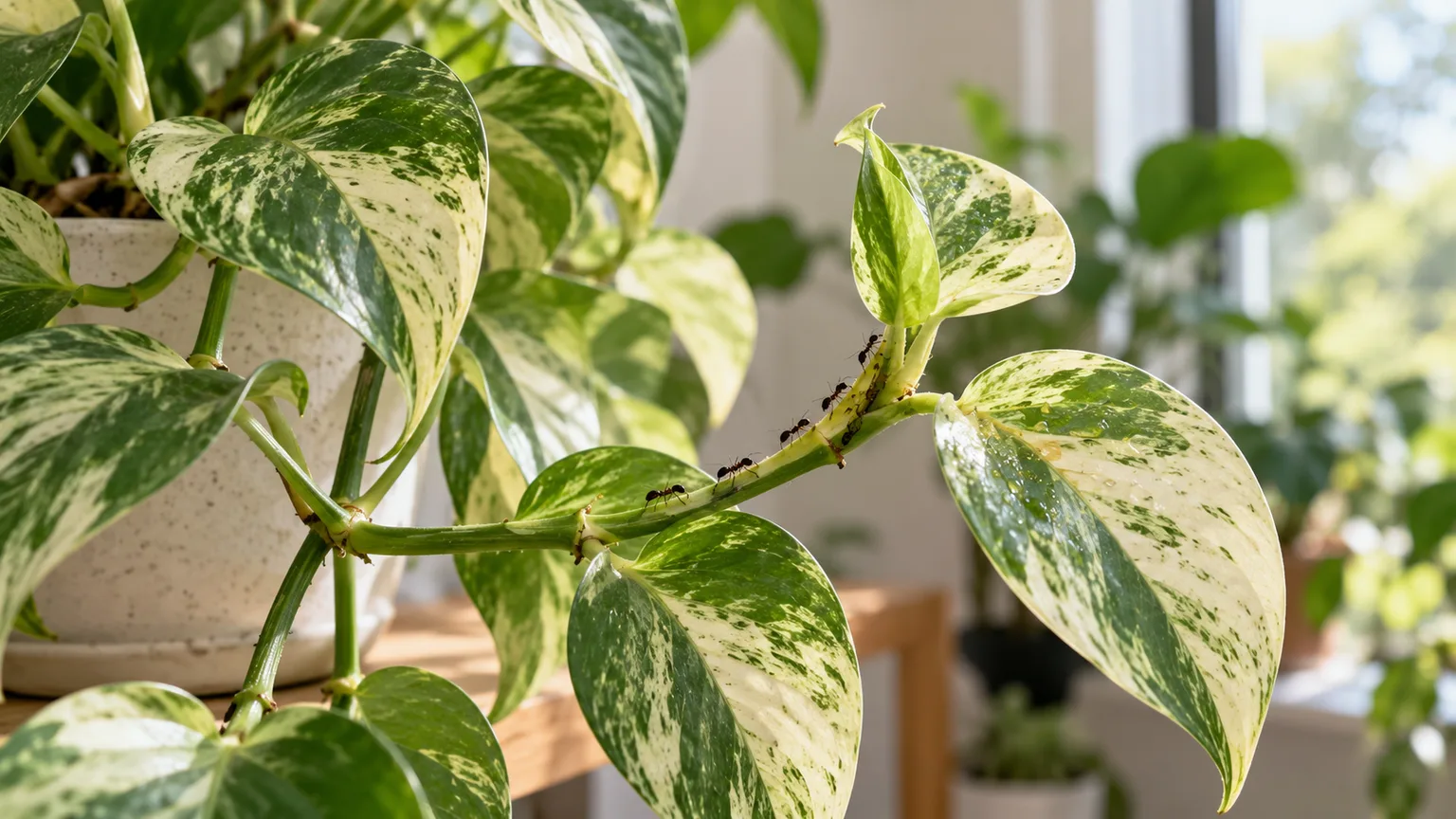
Ants marching up and down your Marble Queen pothos are a symptom, not the disease. They are harvesting honeydew, the sugary waste excreted by sap-sucking insects, and in return they guard those pests from predators — ants actively protect mealybug colonies they farm. So the fastest route to an ant-free plant is counterintuitive: ignore the urge to spray the ants and hunt the insects they are tending instead.
First fix: carry the pot away from your other plants, then wipe every sticky leaf and every visible insect with a soft cloth dampened with plain soapy water. That single step removes the ants’ food, breaks the scent trail, and exposes the real pest so you can identify it. Targeted treatment comes next.
For the general mechanics of this partnership, see our ants on plants guide. On Marble Queen pothos, the pattern usually shows up as a tidy ant highway running along one or two trailing vines toward the softest new growth.
What ants look like on Marble Queen pothos
You will notice the ants before you notice the pest. A thin, purposeful line of small ants climbs the pot rim, runs along a vine, and disappears into a leaf axil or the curled tip of new growth. Leaves near the trail feel tacky or look glossy where honeydew has landed, and the heavy white-and-green variegation makes that sheen easy to spot if you tilt the leaf toward the light. Where honeydew has sat for a week or more, a gray-black film of sooty mould may dust the upper leaf surfaces — a sticky honeydew on which black sooty moulds grow.
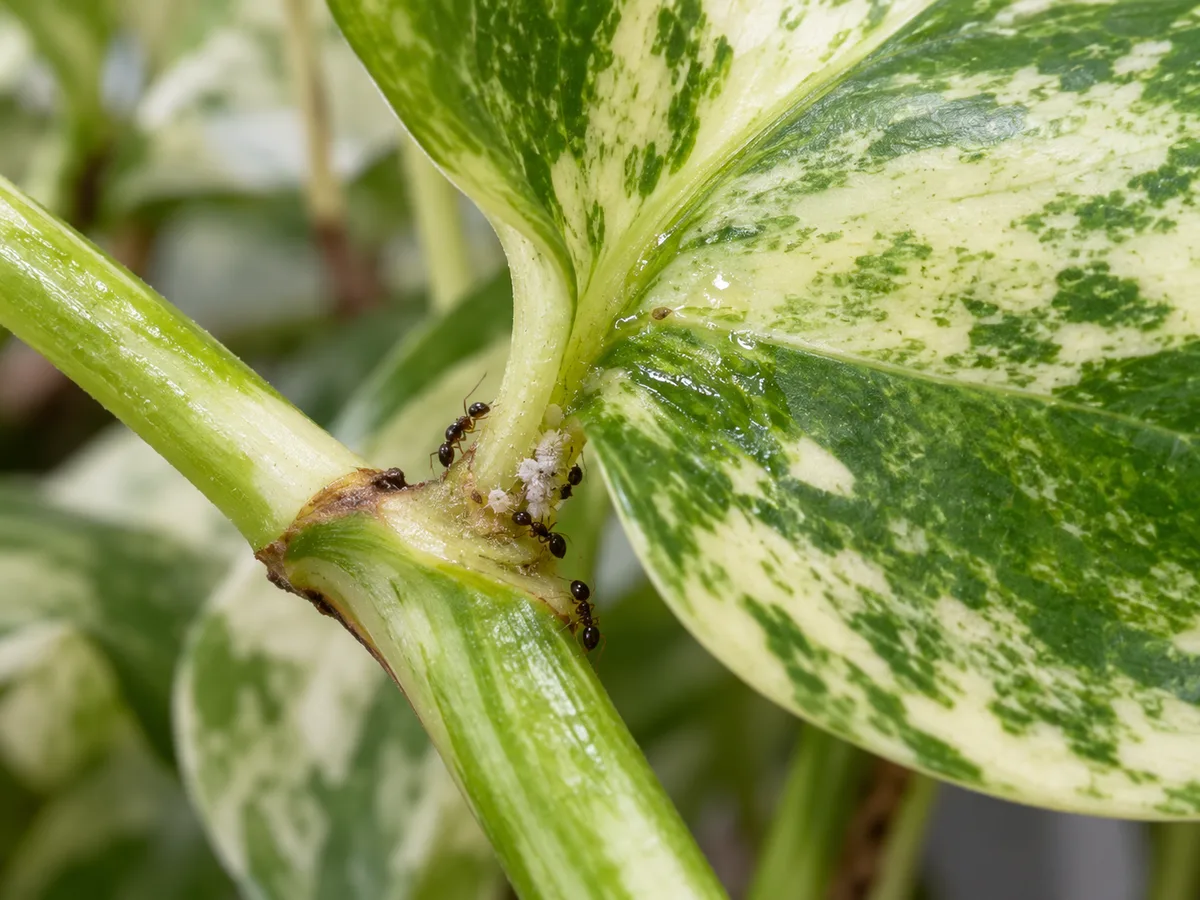
Tiny ants working a leaf axil on a Marble Queen pothos vine, with glossy honeydew on the surrounding variegated leaf.
The farmed pests themselves are small and easy to miss on a marbled leaf. Mealybugs look like tiny tufts of white cotton tucked where the leaf meets the stem. Aphids cluster as pear-shaped, slow-moving dots on unfolding leaves and soft stem tips, often green or black. Soft scale appears as smooth, immobile brown bumps lined up along a stem. If you see ants but no pest after a careful look, check again at the nodes — pothos pests wedge themselves exactly where a casual glance slides past.
Why ants pick this particular plant
Three things about Marble Queen pothos — a variegated cultivar of Epipremnum aureum, the trailing aroid familiar to most indoor gardeners — make it a good ant farm. First, its growth habit: long trailing vines with a leaf axil and a node every few centimeters give honeydew pests dozens of sheltered feeding stations, and the vines act as ready-made ant highways between the pot and the feeding sites. Ants can reach every leaf without ever crossing open soil.
Second, its care rhythm. Marble Queen is a slower grower than all-green pothos because its white sections carry little chlorophyll, so it sits in the same potting mix for longer between repottings and is often kept slightly too moist by owners compensating for its delicate look. Consistently damp, undisturbed mix in a warm room is exactly where ant scouts look for satellite nest sites — a pot with ants streaming in and out of the drainage holes, rather than up the vines, usually means a nest in the root ball rather than a farming operation.
Third, soft growth. A Marble Queen pushing pale new leaves after a feed is producing the thin-walled, sap-rich tissue aphids and mealybugs prefer. Heavy fertilizing during a growth flush can practically ring the dinner bell. None of this means the plant is weak or doomed; it means the combination of trailing stems, stable warm conditions, and tender tips is worth an ant colony’s attention.
How to confirm the real pest
Work from the vine tips inward, because that is the direction the ants walk.
- Follow the highway. Watch for a minute and note which vine the ants favor and where the stream ends. The destination is the feeding site.
- Inspect the newest growth first. Unfurl tips, the two youngest open leaves, and their undersides. Aphids cluster here; crush one gently — a live aphid smears, a shed skin flakes away dry.
- Check every axil and node along that vine. Part each leaf-stem junction and look for cottony mealybug tufts or flat scale bumps, including around the small aerial-root nubs pothos grows at nodes.
- Feel for honeydew. Run a fingertip over leaves below the feeding site. Tackiness that washes off with water is honeydew; a similar stickiness that persists on just one or two leaves points to the sticky leaf residue mealybugs and scale leave behind.
- Rule out a soil nest. Tap the pot and watch the drainage holes. Ants boiling out of the soil, plus ants ignoring the vines, means they live in the mix — a different fix (see below).
If the trail leads to cottony clusters, read the mealybugs guide for this plant. If it leads to clustered dots on new growth, the aphids guide covers the follow-up. Tiny flying insects rising from the soil instead of a marching trail are fungus gnats, which ants ignore entirely.
The first fix to try
Isolate the pot and wipe it down. Carry the plant to a sink or shower, away from your collection, and wipe every sticky leaf — tops and undersides — plus visible insects with a soft cloth dampened with plain soapy water. Rinse the cloth often. Then wipe the pot rim and saucer, which carry the ants’ scent trail, and set the plant apart from its neighbors.
This is deliberately the only thing you do on day one. Wiping removes the honeydew the ants came for, erases the trail that recruits more foragers, and leaves the pest colony exposed so you know what you are dealing with. Wiping trails with soapy water to remove the scent is the same first step university extension programs recommend for indoor ant problems. Hold off on sprays, repotting, and fertilizer until you have confirmed the pest — Marble Queen’s white leaf sections scorch easily, and every chemical applied blindly is risk without information.
Step-by-step recovery
Once wiping has revealed the pest, work through these steps in order over the next two to three weeks.
Treat the farmed pest, not the ants. For mealybugs, dab each cottony cluster with a cotton swab dipped in 70% isopropyl alcohol, then spray the vine joints with ready-to-use insecticidal soap, coating the insects themselves. For aphids, a firm rinse under the tap dislodges most of them, followed by the same soap spray on stragglers. Insecticidal soaps, horticultural oils, and neem oil applied directly to immature mealybugs can reduce numbers, so repeat the spray after seven days to catch juveniles that hatch after the first pass. Always read the product label, and keep treated plants out of direct sun until dry.
Protect the white variegation while you spray. Marble Queen’s cream sections burn faster than green tissue under oils and soaps, especially in a sunny window. Test any spray on one leaf, wait 48 hours, and treat in the evening. If a leaf yellows or crisps at the white margins after treatment, that is spray scorch on this cultivar, not a new infection — compare with the yellow leaves guide before escalating.
Evict a soil nest without repotting first. If ants live in the mix, take the potted plant outdoors and stand the pot in a bucket of lukewarm water so the surface is just covered, for about 20 minutes — the colony evacuates as the mix floods. University guidance for infested potted plants describes submerging pots in an insecticidal soap solution at one to two tablespoons per quart of water for twenty or more minutes, which handles both the nest and soil-dwelling pests in one step. Let the pot drain fully afterward; pothos roots sitting wet invite the root rot this plant is prone to in oversized or soggy pots.
Wash off sooty mould last. Once the pests are dead and no fresh honeydew appears, wipe the black film away with a damp cloth. The mould itself does not infect the leaf, but it blocks light from chlorophyll that this slow-growing cultivar cannot spare.
Recovery timeline
Expect foraging ants to thin out within two to five days of the wipe-down, provided no fresh honeydew is being produced. The pest colony itself takes longer: two rounds of soap or alcohol treatment a week apart clear most mealybug and aphid outbreaks, with a third check at week three for stragglers at the nodes. New leaves should emerge clean, firm, and normally marbled within three to six weeks in good light. Sticky residue stops accumulating immediately; existing sooty mould wipes off but does not fade on its own. If a fresh ant trail reappears on the same vine after two full treatment rounds, you missed a feeding site — re-trace the highway rather than switching chemicals.
Lookalike symptoms
| What you see | More likely | How to tell |
|---|---|---|
| Tiny black flies hovering over the soil, no marching trail | Fungus gnats | Gnats fly up when you tap the pot; ants march in lines |
| Sticky leaves but no ants at all | Early sticky leaves from scale or mealybugs | Same honeydew cause, before scouts find it — inspect axils now |
| White cotton tufts with no ant activity | Mealybugs without a tending colony | Treat the mealybugs; ants often arrive days later |
| Clusters of dots on soft new growth | Aphids | Pear-shaped, slow-moving, often with shed white skins nearby |
| Fine webbing plus stippled pale leaves | Spider mites | Mites make no honeydew, so ants ignore them |
| Leaves yellowing after treatment | Spray scorch or overwatering, not pests | See yellow leaves and overwatering |
Mistakes to avoid
- Spraying ant killer on the foliage. Contact insecticides aimed at ants coat the leaves, risk scorching the white variegation, and leave the honeydew producers untouched. The trail returns within days.
- Repotting on day one. Tearing apart the root ball of a stressed, infested pothos adds transplant shock to pest damage. Flood out a soil nest or treat the foliage first; repot only if the mix is compacted or sour. The repotting stress and compacted soil guides cover when a new mix is genuinely warranted.
- Fertilizing to “help it recover.” Nitrogen pushes exactly the soft growth that sap-suckers prefer. Skip feeding until clean new growth has held for at least a month.
- Treating at noon in a sunny window. Oils and soaps on wet leaves under strong light scorch Marble Queen’s low-chlorophyll sections. Treat in the evening and keep the plant in bright indirect light while it dries.
- Assuming one treatment finished the job. Mealybug egg sacs in vine axils survive sprays that kill every visible adult. The second pass a week later is the treatment, not optional follow-up.
Marble Queen pothos care cross-check
Ants exploit conditions, so steady routine is part of the cure. Let the top 3–5 cm of mix dry between waterings as the watering guide describes — constantly damp soil shelters soil-nesting ants and fungus gnats alike. Keep the plant in bright indirect light so growth stays compact; leggy, light-starved vines with widely spaced nodes are harder to inspect and slower to outgrow damage (see leggy growth). Use the airy, fast-draining mix from the soil guide so flood treatments drain quickly and roots stay firm. If several vines are bare or the plant has stalled, the problems hub and plant overview help you decide whether pests or basic care are the bigger issue. And because Marble Queen is toxic to cats and dogs, keep both the plant and any treatment runoff out of pets’ reach.
How to prevent it next time
Make honeydew producers visible before ants find them. Inspect the newest leaves and vine axils weekly — a ten-second look while watering catches mealybugs when they are still one cottony speck. Quarantine every new plant for two weeks before it joins the shelf; nursery stock is the most common way sap-suckers enter a home. Wipe the leaves when you water to remove dust and early honeydew, and prune back vines that drape onto neighboring pots, since touching leaves are ant bridges between plants. Feed lightly and only in active growth (see the fertilizer guide), because overfed soft tips attract aphids first and ants second.
Related Marble Queen pothos guides
- Mealybugs — when the ant trail leads to cottony clusters in the axils; use for the full colony-removal routine.
- Aphids — when soft new growth carries clustered dots; use for rinse-and-repeat aphid control.
- Sticky leaves — when honeydew is present but no ants yet; use to identify the producer early.
- Fungus gnats — when small flies, not marching ants, rise from the soil; use for soil-fly control instead.
- Problems hub — when more than one symptom is present; use to triage which issue to treat first.
Related tool
Use the Plant Problem Diagnosis Tool to narrow causes for ants on plant on this plant before changing multiple variables at once.