Plant Leaning on Marble Queen Pothos: Causes, Checks & Fixes
Quick answer
A leaning Marble Queen Pothos is usually reaching toward one-sided light, not dying. First step: rotate the pot so the lean faces your brightest indirect window, then move it to brighter indirect light if new stems show long gaps between leaves.
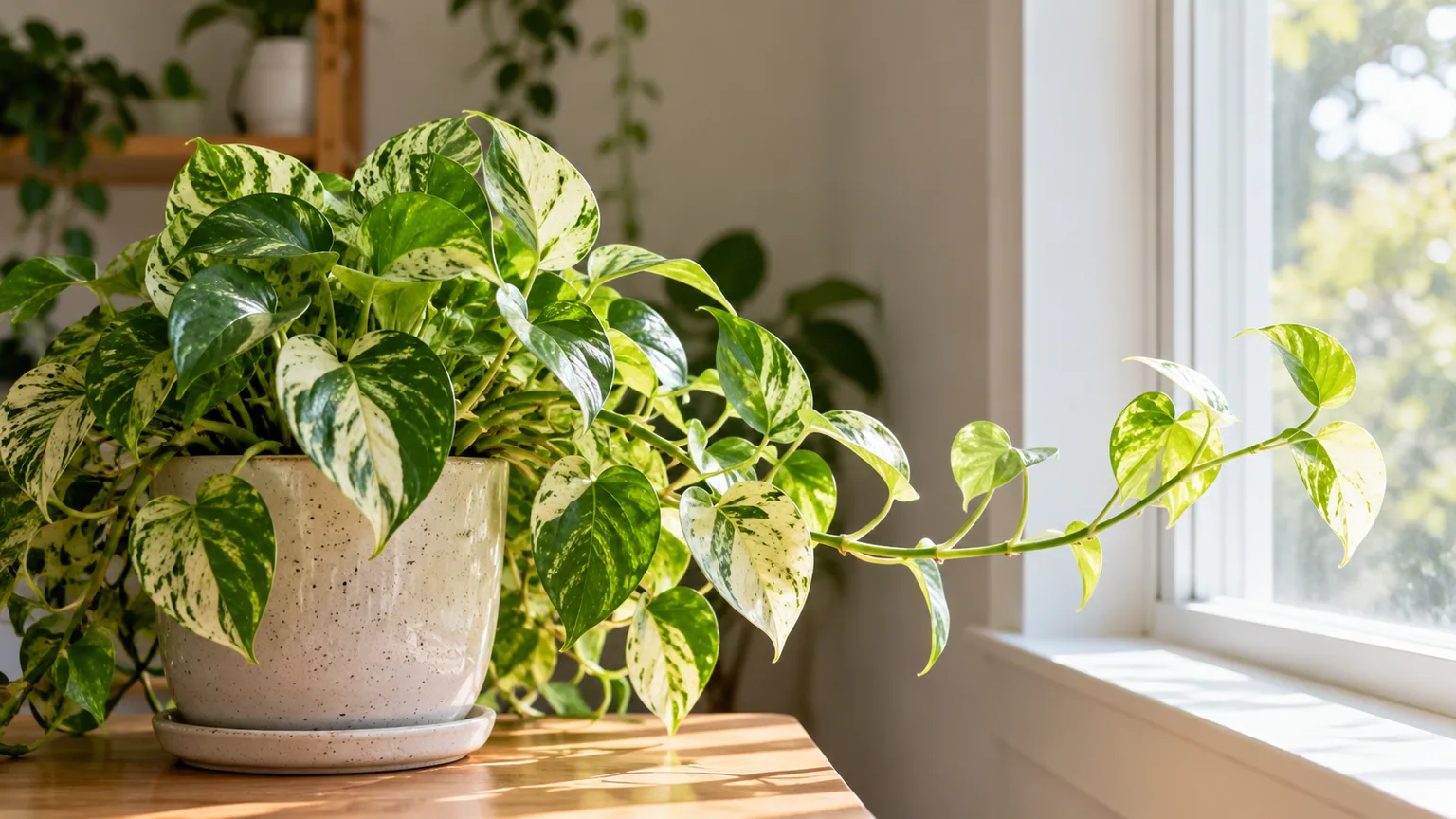
Plant Leaning on Marble Queen Pothos: Causes, Checks & Fixes
This guide covers plant leaning on Marble Queen Pothos. See also the general Plant Leaning guide, watering, and light pages for this plant.
Plant Leaning on Marble Queen Pothos: Causes, Checks & Fixes
Quick answer
A Marble Queen Pothos (Epipremnum aureum ‘Marble Queen’) that leans to one side is almost always chasing light. Pothos leaves grow toward the light, so a pot that never moves develops dense growth on the window side and bare stems on the room side until the whole display tips sideways. First step: rotate the pot so the lean faces your brightest indirect window. If new stems keep emerging with long bare gaps between leaves, the spot itself is too dim — move the plant closer to the glass or add a grow lamp. For how one-sided light bends houseplants in general, see our general plant leaning guide; on Marble Queen, the pattern usually shows up as one-sided marbled growth plus stretch, because this pale cultivar needs stronger light than its greener relatives.
What leaning looks like on Marble Queen Pothos
On this cultivar, a lean reads as architecture plus variegation. Stems bend sideways toward the strongest window, new leaves on the shaded side emerge smaller with weaker white marbling, and hanging baskets go lopsided — full on the glass side, stringy on the room side. Internodes on the leaning runners often lengthen at the same time, which is why a lean and leggy growth on Marble Queen frequently arrive together.
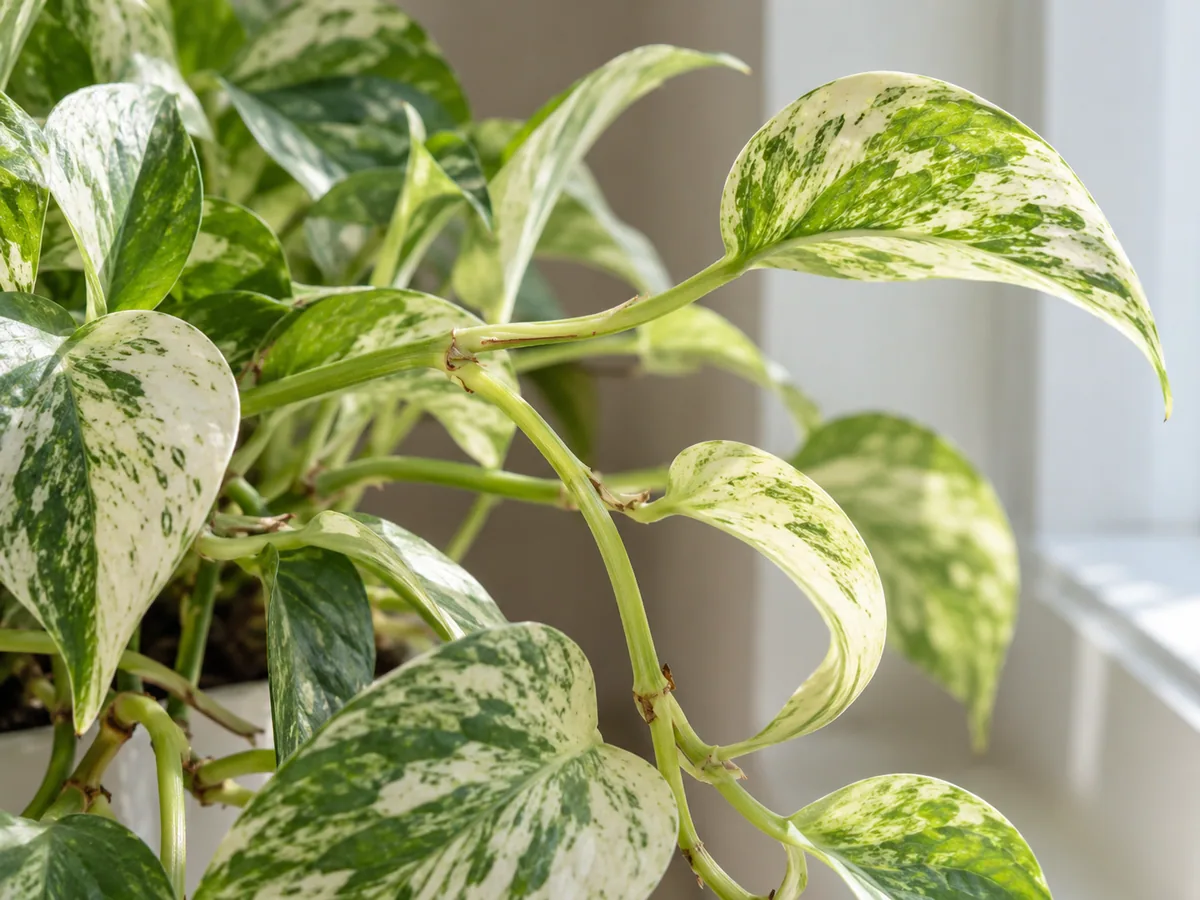
One-sided stem bend with tighter marbled growth on the lit side — compare with shaded runners on the same plant.
Primary Marble Queen signals:
- Whole vine arcs toward one window, with leaves cupping or angling toward the glass
- Dense marbled foliage on the lit side, sparse smaller leaves on the shaded side
- Longer gaps between leaves on new leaning sections than on older growth
- New leaves trending greener on the shaded runners while lit runners stay marbled
- Pot tipping or hanger swinging to one side under uneven vine weight
- Firm stems and healthy roots underneath — the plant is reaching, not rotting
What normal trailing looks like for comparison:
A healthy Marble Queen still cascades — trailing is its habit, not a symptom. Even, marbled leaves spaced consistently along runners that hang straight down from a stable basket mean the plant is simply being a pothos. Worry when growth is directional: everything bends one way and only one side keeps its variegation.
Why Marble Queen leans harder than greener pothos
White and cream leaf sections carry little photosynthetic tissue, so Marble Queen must harvest more light than a solid-green pothos to grow the same length of vine. Clemson HGIC notes that Marble Queen requires more light than other pothos varieties, and low light can cause loss of variegation on cultivars like this one. In a dim corner, the plant stretches harder toward the nearest window than a Golden Pothos would in the same spot — the lean is the visible price of running a high-variegation cultivar on a low-light budget.
That light hunger also explains the reversion pattern owners notice mid-lean: shaded runners produce progressively greener leaves to compensate, while the lit side stays marbled. If your leaning vine is also going green on the dark side, treat this page and our not enough light guide as a pair — rotation fixes the direction, but only brighter placement restores the marbling.
Trailing vine vs. true lean: reading Marble Queen’s habit
Pothos is a tropical climbing vine, not a self-supporting upright plant. In the wild it scrambles along the forest floor and then climbs tree trunks, gripping bark with brown aerial roots at each node. Indoors it does one of two things: trail downward from a shelf or basket, or climb whatever support you provide. Neither is a defect — problems start when the grower fights the habit the plant was given.
Use this test: look at where the bend originates. A vine that hangs straight down and then curves toward a side window along its length is showing phototropism on top of normal trailing — rotate and brighten. A plant whose base flops sideways out of the mix, with the whole root ball shifting, has an anchorage problem instead: top-heavy growth in a small pot, loose repotted mix, or rotted roots that no longer grip. Check the Marble Queen repotting guide if the pot itself is part of the lean.
If you want an upright plant rather than a trailer, commit to a support early. Penn State notes that pothos vines will attach to a moss-covered totem using their adhesive aerial roots at each node — but a two-meter trailer tied to a pole halfway through a lean rarely looks intentional. Decide the habit first, then correct the light.
How to confirm the cause
Work through these checks before staking, repotting, or pruning:
- Light direction test — Which way does the lean point? A bend aimed squarely at the brightest window is phototropism until proven otherwise. A lean away from light, or in random directions, points to pot or root trouble.
- Rotation history — Has the pot sat unmoved for months? Pothos specialists advise growers to turn the container weekly for balanced foliage. No rotation plus one-sided growth confirms the diagnosis.
- New growth quality — Compare the newest leaf on the leaning runner to older leaves. Compact, marbled new leaves mean light is adequate and rotation alone may fix it; stretched, greenish new leaves mean the spot is too dim overall.
- Base stability — Grip the stems gently at soil level and rock. A firmly anchored base with flexible upper vines is a light problem. A loose, wobbly base in damp mix needs a root inspection — cross-check root rot on Marble Queen.
- Soil moisture rhythm — Probe 3–5 cm deep. Penn State’s rule is to water when the soil is dry, since too much water leads to root rot — and rotted roots anchor nothing. Soggy mix plus a lean means fix drainage before staking anything. See the Marble Queen watering guide for the dry-down rhythm.
- Pot geometry — A top-heavy trailer in a small lightweight pot can tip the whole container. That is physics, not disease: upsize the pot or move the plant down from a high hanger.
If stems are firm, roots grip, soil dries normally, and growth aims at the window, one-sided light is the cause — stake nothing until rotation and placement are corrected.
First fix for Marble Queen Pothos
Rotate the pot 180 degrees so the lean faces your brightest indirect window. This single move uses the same phototropic response that caused the lean to start correcting it: shaded cells on the dark side elongate faster and new growth bends back toward the light. Phototropism is a directional response that allows plants to grow towards light, mediated by blue-light receptors — the plant is equipped to re-aim itself once you give it a reason.
Then set a weekly quarter-turn habit so both sides of the vine take turns facing the glass. Do not stake, tie, or prune on day one. Supports hold a lean in place; only light direction plus rotation actually reverse the growth pattern. If the brightest window is more than about two meters away, rotate and move the plant closer — rotation without adequate intensity just produces an evenly stretched plant.
Step-by-step recovery
Once rotation is set, follow this order:
- Brighten placement — Aim for bright indirect light at leaf level: within 1–2 m of an east window or behind a sheer curtain at south or west glass. Pale marbled zones scorch in harsh direct sun, so filter strong rays rather than parking the pot on the sill. Detail: Marble Queen light.
- Stabilize the pot — If the container tips, move the plant to a heavier pot or a lower, stable shelf before the vine snaps at the base. Water lightly for a week after any emergency repot.
- Add support for climbers — For an upright look, insert a moss pole and loosely tie the leaning stem to it, letting aerial roots grip the support over the coming weeks. Tie below nodes, never cinch stems tight.
- Prune after confirmation — After two to three compact, marbled leaves emerge at the runner tips, cut back bare or permanently bent sections just above a variegated node. Full cut guidance: Marble Queen pruning.
- Root the cuttings — Marble Queen vines easily root in water, so place tip cuttings with at least one node in a jar and replant them to fill the sparse side. Workflow: Marble Queen propagation.
- Hold fertilizer — Skip feeding until new growth looks stable for two weeks. Nitrogen pushes soft green growth on a plant whose structure is already unbalanced.
Permanence rule: bent woody stem bases rarely straighten completely. Judge success by new growth — even direction, tighter spacing, restored marbling — not by the old arc disappearing.
Recovery timeline
| Timeframe | What to expect on Marble Queen |
|---|---|
| Days 1–7 | Lean stops worsening; leaves on the shaded side start angling toward light |
| Weeks 2–3 | New leaves emerge more evenly; spacing tightens if brightness is adequate |
| Weeks 4–6 | Several marbled leaves confirm the fix; prune bent bare sections and root cuttings |
| Beyond 6 weeks | If lean continues or new leaves stay green and stretched, light is still too low — move closer or add a grow lamp |
Marble Queen grows more slowly than Golden Pothos even in good light, so give recovery a full month before declaring failure.
Lookalike symptoms
| Pattern | Leaf / stem look | Soil / pot | Likely cause | Next step |
|---|---|---|---|---|
| Bend toward window, firm stems, one-sided marbling | Supple growth aiming at glass | Normal dry-down | Phototropism | Rotation → this page |
| Long bare internodes with sparse leaves all around | Stretch everywhere, not one-sided | Often stays wet | Low light etiolation | Brighten → leggy growth |
| Limp vines plus yellow leaves and sour mix | Soft stems, may collapse | Heavy, wet at 3–5 cm | Overwatering / root damage | Dry out → overwatering |
| Mushy base, blackened stems, plant wobbles | Rotted stem bases | Soggy, smells off | Root or stem rot | Inspect → root rot |
| Thin floppy stems that cannot hold leaves up | Spindly all over | Any | Weak growth | Support plus light → weak stems |
| Droop after a long dry spell, recovers on watering | Limp then firm | Bone dry, light pot | Underwatering | Soak → watering guide |
Wet soil plus lean is the overlap that matters most: chronic damp mix in a dim corner produces stretch and root damage together. Key difference — pure phototropism has firm stems and normal dry-down, while rot adds mushy bases and permanently soggy soil.
What not to do
- Staking a stretched stem without fixing light — the tie holds the angle while new growth keeps reaching past it.
- Rotating daily — quarter-turns weekly give the plant time to respond; spinning the pot every morning just confuses the growth direction.
- Repotting on day one — a firmly rooted leaner needs light, not fresh mix. Repot only for tipping pots or rotted roots.
- Hard-pruning before light improves — cut tips stretch right back in the same dim corner.
- Fertilizing a leaning, stressed vine — salts cannot replace photons and can burn pale leaf sections.
- Tying stems tightly to poles or trellises — cinched ties scar pothos stems; keep ties loose and below nodes.
How to prevent leaning next time
Treat rotation as maintenance, not rescue. A quarter-turn every week keeps all runners photosynthesizing evenly, which is the cheapest fix in houseplant care. Pair that with placement this cultivar actually likes — bright indirect light at leaf level — and the vine fills in on all sides instead of lunging at one window. Match watering to the brighter spot, since a plant using more light drinks faster; the Marble Queen watering rhythm keeps roots gripping firmly so the pot stays anchored. For baskets, hang where daylight reaches both faces of the plant, not just the glass side.
When to worry
A slow one-sided lean with firm stems is cosmetic. Escalate when:
- Stems soften at the base while soil stays damp — possible early root rot layered on light stress.
- Several leaves yellow and drop within a week without pest signs.
- The pot smells sour or roots feel mushy on inspection — unpot before chasing more light.
- The whole plant tips repeatedly despite a stable, adequately sized pot.
- New growth stays solid green after four to six weeks in a spot you believed was bright — placement is still too dim.
Keep pruning debris away from pets: all Epipremnum aureum cultivars are toxic to cats and dogs, so fallen leaves belong in the bin, not on the floor.
When to use this page vs other Marble Queen Pothos guides
- Lean aims at the window, stems firm — this page: rotation, placement, and support.
- Bare stretched stems everywhere, not one-sided — leggy growth: etiolation and pruning sequence.
- New leaves losing white marbling — not enough light: placement mistakes and variegation fade.
- Wet soil, limp vines, sour smell — overwatering first, then root rot if roots are mushy.
- Thin floppy stems rather than a directional bend — weak stems.
- Where to cut and how to shape — Marble Queen pruning; multiplying rescued tips — propagation.
Related Marble Queen guides
- Marble Queen overview — cultivar baseline and Golden Pothos comparison
- Marble Queen problems — symptom-first hub when something looks wrong
- Marble Queen light — window placement and grow-lamp setup
- Marble Queen watering — dry-down rhythm that keeps roots anchored
- Marble Queen soil — airy mix that prevents soggy-root tipping
- Leggy growth on Marble Queen — stretch and pruning recovery
- Not enough light on Marble Queen — variegation fade deep dive
- Weak stems on Marble Queen — floppy growth vs directional lean
- Root rot on Marble Queen — when soggy mix underlies the lean
- Overwatering on Marble Queen — wet soil in dim corners
A leaning Marble Queen Pothos is asking for light, not surgery. Rotate toward the brightest indirect window, brighten the spot until new leaves stay compact and marbled, then support, prune, and propagate the recovered vine.
How we wrote and verified this guide: Recommendations were checked against Penn State Extension, NC State Extension, Missouri Botanical Garden, Clemson HGIC, ASPCA, and OpenStax Biology references cited inline. Author: sai-ananth. Reviewer: LeafyPixels Review Board. Methodology: plant problem guidance is reviewed against botanical references, extension resources, and LeafyPixels plant-care data before publication. Claims validation: claims-validator-v1 pass with inline external links documented below. Last reviewed: 2026-08-28.