Weak Stems on Marble Queen Pothos: Causes, Checks & Fixes
Quick answer
Weak stems on Marble Queen Pothos are usually shade-stretched runners that cannot hold their leaves upright, made worse by this slow variegated grower's low chlorophyll. First step: move the plant to bright indirect light and shorten the weakest vines just below a node so regrowth emerges compact. Stems that feel soft or mushy at the nodes instead point to wet soil and root stress, which needs drying out before any pruning.
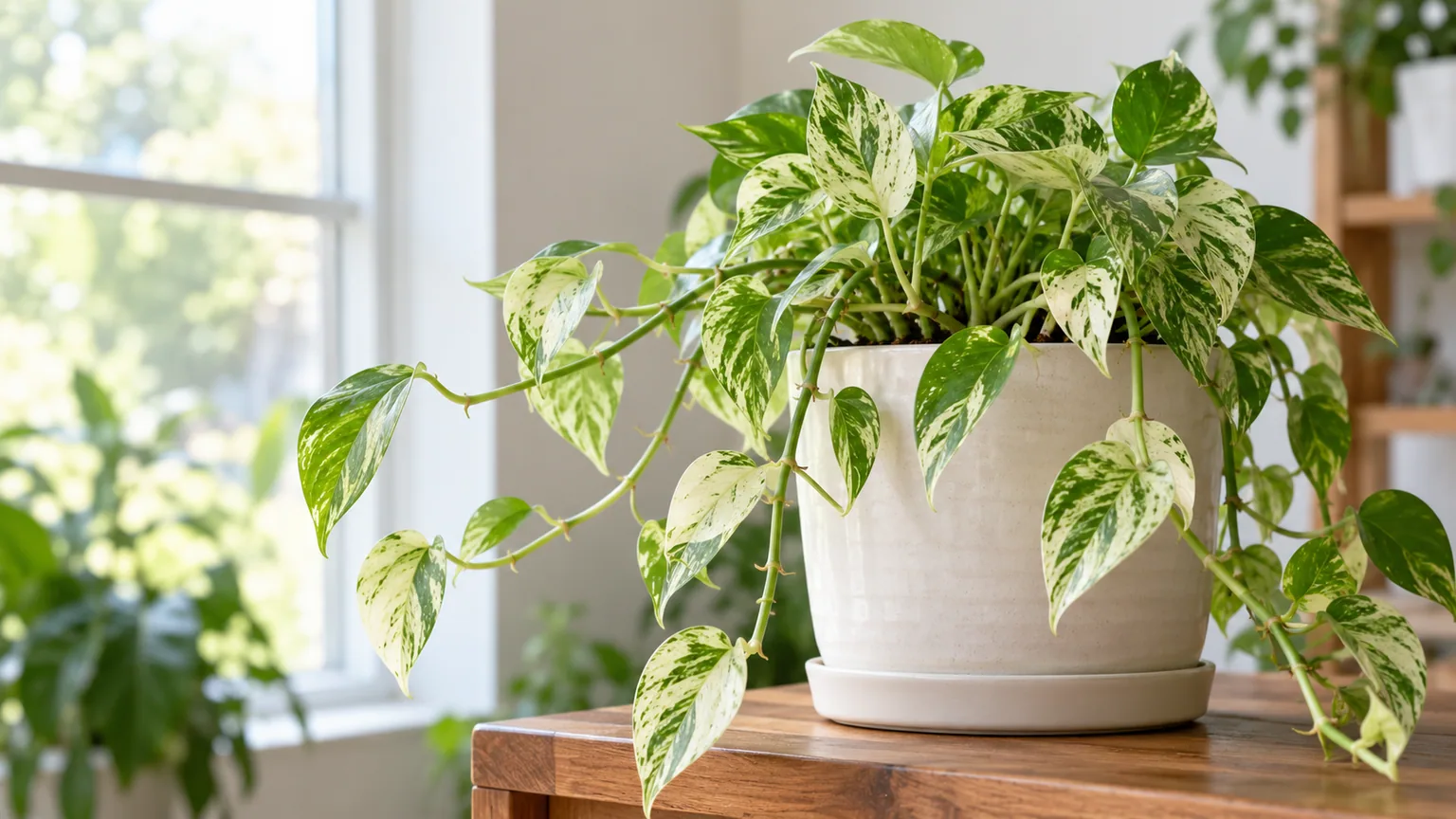
Weak Stems on Marble Queen Pothos: Causes, Checks & Fixes
This guide covers weak stems on Marble Queen Pothos. See also the general Weak Stems guide, watering, and light pages for this plant.
Weak Stems on Marble Queen Pothos: Causes, Checks & Fixes
Quick answer
Weak stems on Marble Queen Pothos (Epipremnum aureum ‘Marble Queen’) are vines that bend, flop, or cannot hold their leaves upright instead of trailing firmly. The usual driver is too little light: the plant stretches its runners toward the window, spacing leaves far apart and building thin tissue. This cultivar suffers faster than solid-green pothos because its white-marbled sections carry less chlorophyll, so it needs brighter placement to build the same stem strength.
First step: move the pot into bright indirect light, then shorten the weakest vines just below a node. Pothos prefers bright, indirect light and survives dim corners only by stretching, which is exactly what weakens the stems. One exception changes everything: stems that feel soft, translucent, or mushy at the nodes point to wet soil and root stress, not shade. Dry the pot out and check roots before you cut anything. For the general mechanics of why stems flop on any houseplant, see our weak stems guide. On Marble Queen, the pattern usually shows up as long bare runners with small greening leaves plus slower recovery than you would expect from a Golden Pothos.
What weak stems look like on Marble Queen Pothos
Shade weakness reads as architecture first. Firm trailing vines carry full-sized heart leaves at even spacing and hang in a smooth curtain. Weak vines kink or fold under leaf weight, develop wide bare gaps between nodes, and push smaller, paler, increasingly green leaves near the tips as the plant sacrifices marbling for chlorophyll. The whole plant often leans toward the brightest window, with the longest, barest runners on the shaded side.
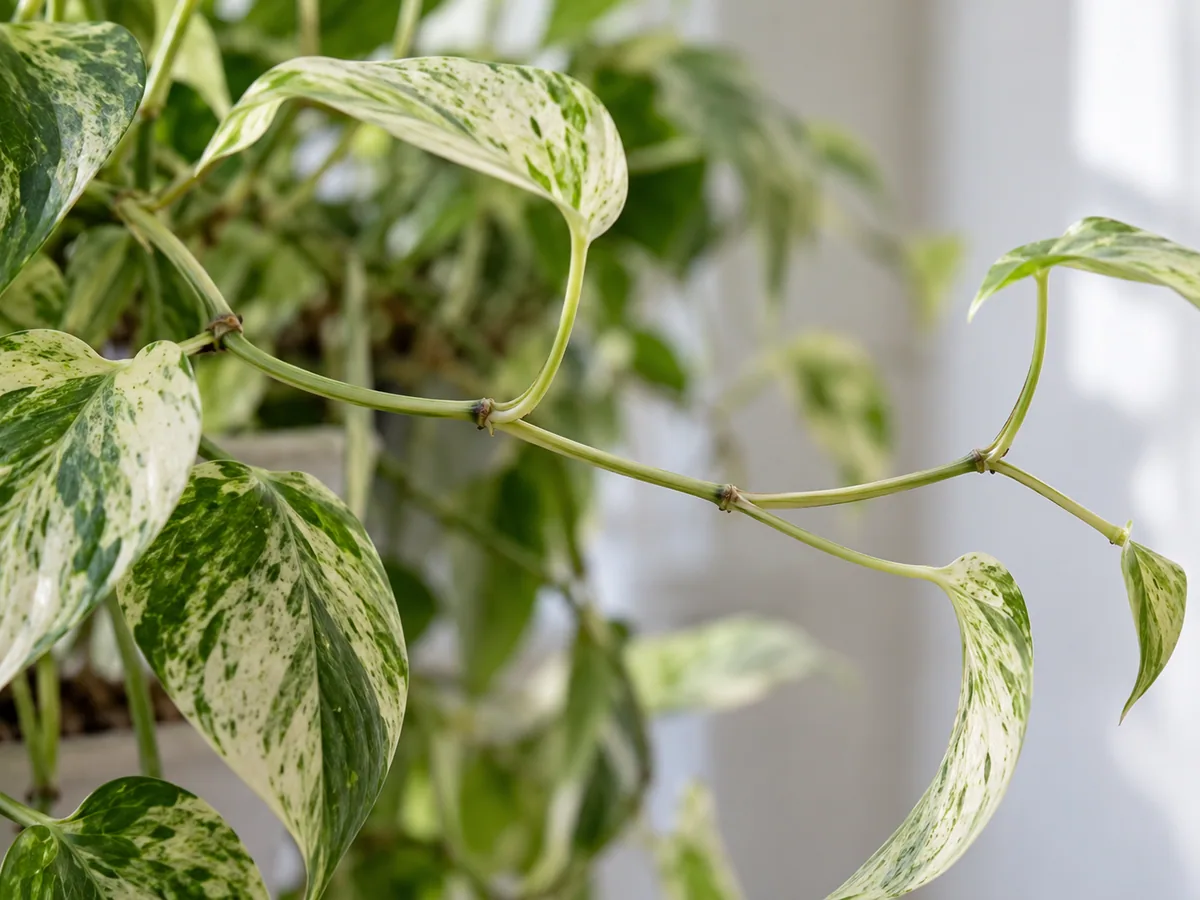
Weak stem detail on Marble Queen Pothos: thin vine, stretched internodes, and undersized leaves. Compare with firm older growth on the same plant.
Water-related weakness looks different and matters more. Stems soften at or just above the soil line or at nodes, leaves yellow while the pot still feels heavy, and the mix may smell sour. Root rot and blackening of leaf margins can occur with overwatering on this species, and Marble Queen’s slow growth means a wet pot stays wet longer than owners expect. Soft-at-the-node plus damp soil is a root-zone emergency, not a pruning project.
Why Marble Queen stems weaken faster than Golden Pothos
This is the section that makes this page specific to the cultivar. Golden Pothos tolerates a dim shelf for months and keeps building passable vines. Marble Queen in the same spot stretches sooner, greens out sooner, and recovers slower, for three connected reasons:
- Less chlorophyll per leaf. Large white zones photosynthesize little, so the plant runs an energy deficit in light levels where a green pothos still breaks even. Low light can cause loss of variegation, and each greening leaf is the plant admitting it cannot afford the white sections.
- Slower growth overall. Marble Queen builds tissue more slowly than Golden Pothos, so replacement compact growth after a fix takes weeks longer. Patience is part of the treatment.
- Lower water use. Less photosynthesis means less transpiration, so the same watering schedule keeps Marble Queen wetter than a Golden in the same pot. Chronic dampness softens stems from below while shade weakens them from above, a combination this cultivar meets often.
If you own both cultivars, do not water or place them identically. Marble Queen wants the brighter spot and the longer dry-down; treating it like a Golden is how weak stems start.
Climb or trail: support changes stem strength
In the wild, Epipremnum aureum climbs tree trunks with aerial rootlets and produces progressively larger leaves as it ascends. Indoors, a Marble Queen left to trail from a hanging basket will always have somewhat softer, smaller-leaved growth at the hanging tips than a plant given something to climb. That is normal vine behavior, not damage.
Support becomes a genuine fix in one situation: firm but unruly vines that flop because they are long, not because they are sick. A moss pole or trellis lets aerial roots grip, and leaves on climbed sections size up with better posture. But support is cosmetic scaffolding. It cannot firm up stems that are thin from shade or soft from wet soil, so correct light and watering first and add the pole second. When you do stake, tie loosely below nodes with soft ties and let new growth attach on its own. For cut placement when shortening vines before training them up, follow the Marble Queen pruning guide.
How to confirm the cause at home
Work through these checks in order before cutting or repotting:
- Bend test. Lift a weak vine. Shade-stretched stems are thin but still firm and springy; water-damaged stems feel soft, limp, or translucent, especially at nodes and near the soil.
- Light audit. Note the distance to the nearest window and which way vines lean. More than about 2 m from any window in a dim room points to light hunger. Compare new leaf size and marbling against older leaves on the same runner.
- Pot weight and soil check. Lift the pot and push a finger 3–5 cm into the mix. A heavy pot with damp mix days after watering, especially with yellowing lower leaves, implicates water. Marble Queen wants the top 3–5 cm dry before the next drink; see the Marble Queen watering guide for the seasonal rhythm.
- Node and root inspection. Unpot only if the soil stays wet, smells sour, or stems soften at the base. Healthy pothos roots are firm and pale; rotting ones are brown, slimy, and pull away easily. Small pots dry faster than large ones, so an oversized container is itself a suspect — compare with pot too large on Marble Queen.
If vines are firm, bare, and leaning with shrunken greenish new leaves, the verdict is shade stretch. If stems are soft with wet soil, the verdict is root stress. Treat the verdict you have, not both at once.
The first fix: light, then cut back to a node
Do one thing first: relocate to bright indirect light. An east- or west-facing window at 1–2 m, or a full-spectrum grow lamp 25–45 cm above the canopy for 12–14 hours daily, stops new stretch. Too little light produces tall, lanky, small-leafed plants, and no amount of staking reverses tissue already built in the dark.
Wait for proof before pruning. When two or three new leaves emerge closer together with restored white marbling, the spot works. Then cut each weak runner just below a node, removing up to a third of its length at a time. This mirrors standard practice for rangy vines: prune leggy pothos just below a leaf joint so dormant buds below the cut activate. NC State’s guidance is equally direct — prune stems back to maintain a bushy habit — and Missouri Botanical Garden advises to pinch stems to shape as needed. Sterilize shears between cuts and keep at least a few healthy leaves per vine so the plant keeps photosynthesizing.
For wet-soil cases, the first fix is different: stop watering, improve drainage, and let the top 3–5 cm dry fully. Unpot, trim mushy roots to firm tissue, and repot in fresh airy mix with 20–30% perlite only if rot is confirmed. Details match the root rot on Marble Queen walkthrough — follow that page when softness and damp soil dominate.
Node rescue: turning floppy runners into new plants
Pothos forgives hard pruning because every node is a potential new plant. Healthy sections of removed vines — firm stem, at least one node with an aerial root nub, one or two variegated leaves — root easily in water within two to four weeks. NC State likewise notes that vines easily root in water by their aerial roots.
Put cuttings in a jar with nodes submerged, keep them in bright indirect light, and pot them back into the mother container once roots reach a few centimeters. This single move converts the pruning waste from a leggy rescue into a fuller basket. Choose cuttings with strong white marbling so the replacement growth keeps the cultivar’s look, and discard any soft, dark, or foul-smelling pieces. Full method lives in the Marble Queen propagation guide. Keep freshly potted cuttings slightly more sheltered for two weeks, but resist overwatering — the most common way rescue cuttings die is a soggy restart.
Recovery timeline and what improves
Set expectations by tissue, because stretched vines never un-stretch:
- Weeks 1–2: No visible change except posture; leaning slows as light improves. Soft-from-water stems should stop declining once the pot dries.
- Weeks 3–6: New leaves emerge smaller gaps apart with better marbling. Pruned nodes push side buds. This is the signal your light fix worked.
- Months 2–4: Replacement growth fills in; rooted cuttings establish. Old bare sections remain bare until pruned or replanted around.
Existing stretched internodes will never shorten — recovery means new compact growth, not repaired old vines. Yellowed or mushy leaves will not green up again; remove them once new growth is underway. If new leaves still emerge small and green after six weeks of brighter placement, light is still too low or roots are still struggling — recheck the pot before pruning harder.
Lookalikes: rule these out first
| What you see | More likely | Where to go |
|---|---|---|
| Long bare vines, wide gaps, small green leaves, firm stems | Leggy stretch from low light | Leggy growth on Marble Queen for the etiolation deep dive |
| Thin new stems but plant otherwise healthy | Under-built new growth | Thin stems on Marble Queen for new-growth causes |
| Solid-green new leaves, fading marbling | Light too low for variegation | Not enough light on Marble Queen for placement fixes |
| Yellow leaves plus heavy wet pot | Overwatering | Overwatering on Marble Queen for dry-down rescue |
| Mushy roots, sour mix, collapsing base | Root rot | Root rot on Marble Queen for unpot-and-trim steps |
| Overall standstill, no new vines at all | Dormancy or stalled growth | Slow growth and no new growth on Marble Queen |
Weak stems overlap most with leggy growth — use this page when flop, bend, and loss of support are the complaint, and the leggy page when bare length and pruning strategy dominate. When variegation fade is the headline rather than structure, start with the light guide.
Mistakes that keep Marble Queen stems weak
- Pruning before fixing light. Cut vines regrow just as stretched in the same dim spot, wasting the plant’s slow energy reserves. Light first, proof leaves second, shears third.
- Feeding a floppy plant. Fertilizer pushes soft extension in dim conditions rather than strength. Hold feed until compact marbled growth resumes, then resume the schedule in the Marble Queen fertilizer guide.
- Staking instead of diagnosing. Ties hide stretch without correcting it and can strangle soft stems. Support only firm vines you intend to climb.
- Upsizing the pot for a weak plant. Extra wet mix around struggling roots deepens the problem. Repot only for confirmed rot or exhaustion, and check the Marble Queen soil guide for an airy mix and the repotting guide for timing.
- Changing everything on the same day. Light move plus hard prune plus repot plus feed is how stressed variegated plants collapse. Sequence the fixes and read the response between steps.
Marble Queen care cross-check
Weak stems rarely come from one mistake, so verify the baseline: bright indirect light at the leaves (see the Marble Queen overview for the cultivar baseline and the problems hub for the full issue list), top 3–5 cm dry before watering, airy perlite-rich mix with drainage, and temperatures in the 18–29°C comfort zone with 40–60% humidity. Winter deserves special attention: shorter days stretch new growth even in a previously fine window, so move the pot closer to the glass or add lamp hours from autumn onward rather than pruning the seasonal stretch in spring alone.
When handling pruned vines and cuttings, keep debris away from cats and dogs. All Epipremnum aureum cultivars are toxic to cats and dogs via insoluble calcium oxalate crystals that irritate the mouth if chewed.
Related Marble Queen Pothos guides
- Marble Queen overview — cultivar baseline, Golden Pothos comparison, and placement priorities
- Leggy growth on Marble Queen — use when bare length and internode gaps are the headline rather than flop
- Thin stems on Marble Queen — use when new growth is under-built but the plant still stands
- Not enough light on Marble Queen — use when green reversion and variegation fade worry you most
- Overwatering on Marble Queen — use when the pot stays heavy and lower leaves yellow
- Root rot on Marble Queen — use when stems soften at nodes with sour, wet mix
- Yellow leaves on Marble Queen — use when discoloration spreads alongside weakness
- Marble Queen light — window targets and grow-lamp setup that prevent recurrence
- Marble Queen watering — dry-down rhythm matched to this slower drinker
Weak Marble Queen stems are a light-and-architecture problem first and a water problem second. Brighter indirect exposure stops new stretch, pruning back to nodes resets the shape, and rooted cuttings refill the pot — while soft-at-the-node cases need drying and root triage before any shears come out. Judge the fix on the next flush of compact marbled leaves.
How we wrote and verified this guide: Recommendations were checked against NC State Extension, Oklahoma State Extension, Missouri Botanical Garden, Gardening Know How, Plants at a Glance, and ASPCA references cited inline. Author: sai-ananth. Reviewer: LeafyPixels Review Board. Methodology: plant problem guidance is reviewed against botanical references, extension resources, and LeafyPixels plant-care data before publication. Claims validation: claims-validator-v1 pass with inline external links documented below. Last reviewed: 2026-09-06.