Pot Too Large on Marble Queen Pothos: Causes, Checks & Fixes
Quick answer
Pot too large on Marble Queen Pothos means the container holds far more wet mix than this slow variegated vine can drink. First step: stop watering and run the root-ball fit test today.
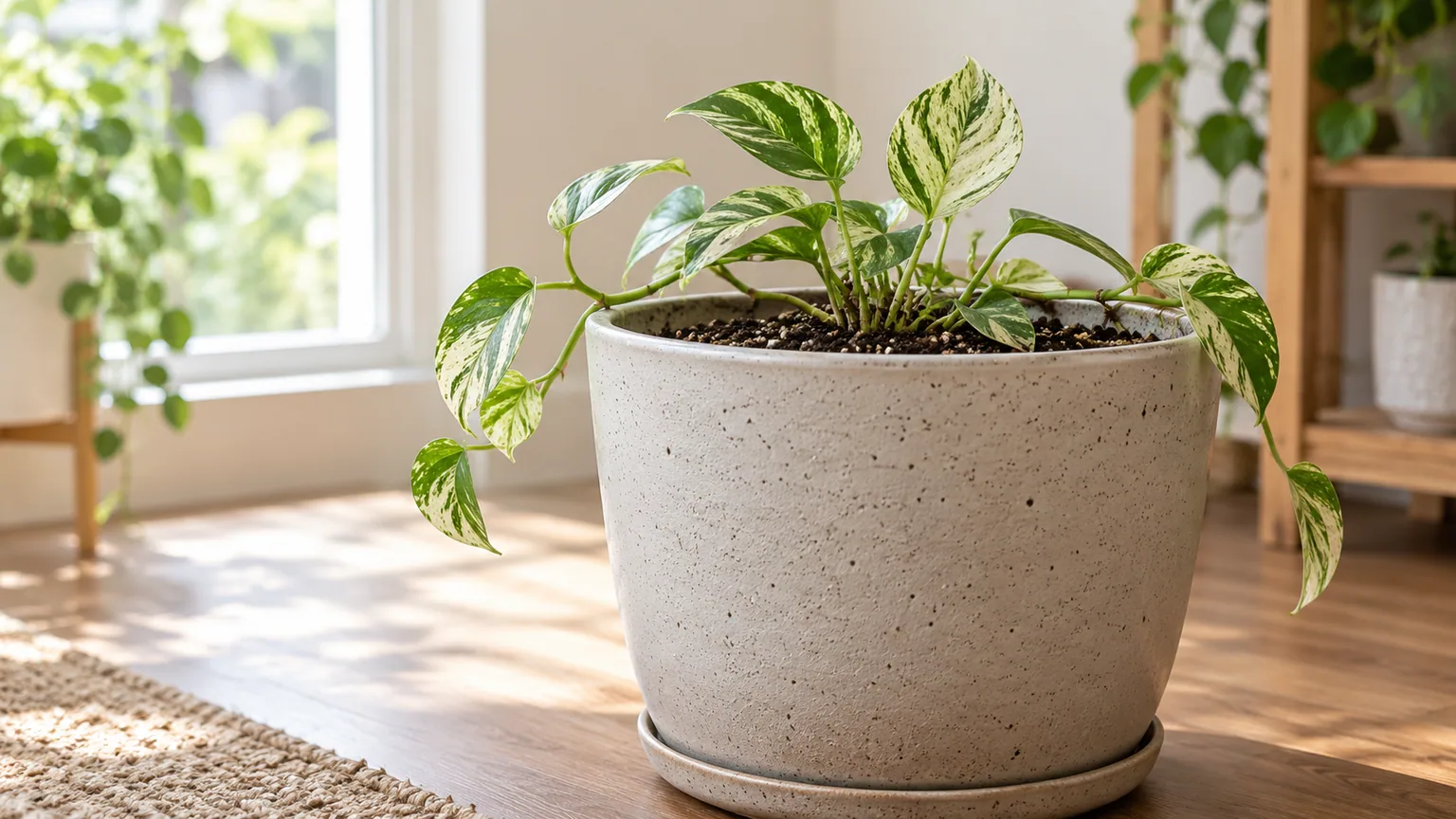
Pot Too Large on Marble Queen Pothos: Causes, Checks & Fixes
This guide covers pot too large on Marble Queen Pothos. See also the general Pot Too Large guide, watering, and light pages for this plant.
Pot Too Large on Marble Queen Pothos: Causes, Checks & Fixes
Quick answer
Pot too large on Marble Queen Pothos (Epipremnum aureum ‘Marble Queen’) means the container holds far more wet mix than this slow variegated vine’s roots can drink. Growth stalls, lower leaves yellow one by one, and the pot stays heavy for ten days or more after watering. First step: stop watering and run the root-ball fit test today — slide the plant out of its pot and compare the root ball to the container. If the roots fill less than half the pot, plan a downpot into a container sized to the roots. For day-to-day moisture rhythm once the plant is stable, see the Marble Queen watering guide; for cultivar baseline, see the overview.
Reviewed by the LeafyPixels Review Board against Clemson HGIC, NC State Extension, Penn State Extension, Missouri Botanical Garden, and Healthy Houseplants guidance before publication.
What pot too large looks like on Marble Queen Pothos
The signature pattern is a stalled vine in a heavy pot. New marbled tips stop emerging for weeks even in the growing season, while older lower leaves yellow and drop with a gentle tug. The vines may go limp even though the mix feels moist — damaged or oxygen-starved roots cannot move water, so the plant looks thirsty in wet soil. The pot feels cool and heavy many days after you last watered, and the surface may grow white mold or attract fungus gnats.
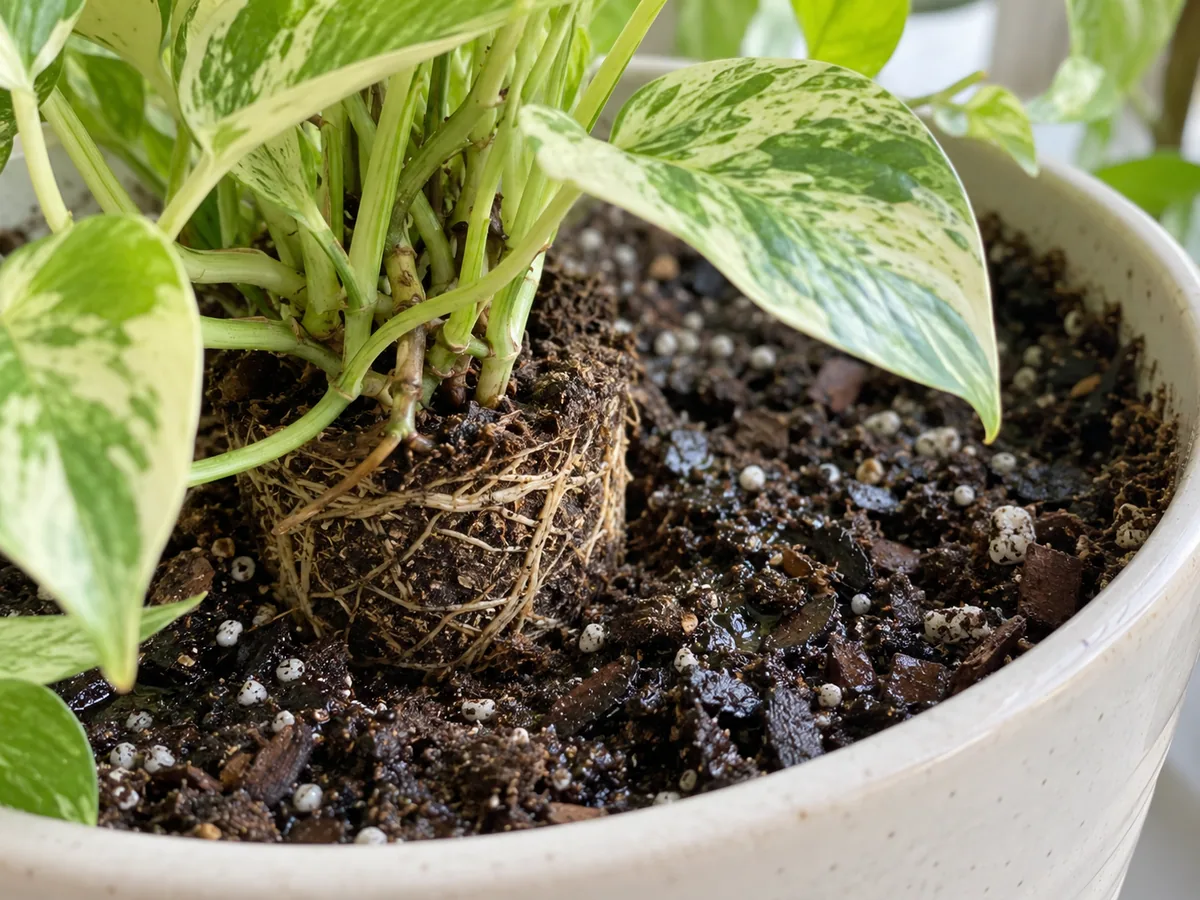
Small root ball surrounded by excess wet mix — the classic oversized-pot pattern on Marble Queen Pothos.
White-marbled sections often dull first, and new leaves may emerge smaller or greener as the plant struggles. Advanced cases bring a sour smell from the drainage holes and softening stems at the base — at that point rot has started and the root rot guide takes over. A healthy Marble Queen, by contrast, pushes firm variegated tips on schedule and its pot lightens noticeably within about a week of watering.
Why this slow variegated vine suffers most in big pots
Marble Queen is a moderate grower — slower than solid-green Golden Pothos because its white-marbled sectors carry less chlorophyll and therefore drive less water uptake. A weekly soak that a Golden Pothos drinks in five days can leave Marble Queen’s mix saturated for ten or more. Clemson HGIC notes that Marble Queen requires more light than other pothos varieties, and dim corners compound the mismatch: in shade the plant drinks even less while soil stays damp, and loss of variegation follows as the plant reverts toward solid green.
Pothos habit makes the trap worse. Buyers size the pot to the vines — long trailing stems spilling over a shelf practically beg for a big statement container — but the pot must fit the root ball, not the vine length. A two-foot trailer can have a root system the size of a teacup. When that small root system surrounded by a large volume of mix cannot use the moisture, the outer soil stays wet, oxygen drops, and roots decline instead of growing into the space.
The third accomplice is the setup around the pot: a nursery pot drowned inside a sealed decorative cachepot with no way to empty runoff, or a dense peaty mix with no perlite. For how excess container water damages roots in general, see our oversized-pot symptom hub. On Marble Queen, the pattern usually shows up as stalled marbled tips plus a heavy pot in a dimmer spot than the plant’s variegation demands.
How to confirm the cause
Work through these checks before changing several variables at once:
- Root-ball fit test — Slide the plant out of its pot. If the root ball fills less than half the container, or a thick outer ring of mix has no roots in it at all, the pot is oversized. This is the deciding test.
- Moisture ring — Probe the outer 5 cm of mix separately from the center. Wet outer mix around a small root ball confirms the roots cannot keep up with the container volume.
- Pot weight timeline — Note how many days the pot stays heavy. More than ten days in normal indoor warmth points to excess volume, not just a heavy hand with the can. Penn State Extension’s rule is to water when the soil is dry — a pot that never reaches dry is telling you something.
- Drainage path — Check for blocked holes, a full saucer, or a cachepot holding standing water. Drainage failure mimics oversizing and often overlaps with it.
- Light and variegation — Fading marbling plus a heavy pot means a dim corner is slowing water use. Cross-check the light guide before assuming the pot alone is at fault.
- Root condition — Firm pale roots mean downpotting will fix it. Brown mushy roots with a sour smell mean root rot can occur with overwatering has already begun — trim and treat per the root rot guide.
Lookalike symptoms
| Pattern | Leaf / vine look | Soil / pot | Likely cause | Next step |
|---|---|---|---|---|
| Stalled tips, heavy pot for 10+ days | Lower leaves yellow one by one | Root ball under half the pot | Pot too large (this page) | Downpot to root-ball size |
| Limp vines, wet soil, firm crowded roots | Bottom yellowing on a full pot | Right-sized pot, watered too often | Overwatering | Dry-down → overwatering |
| Dramatic droop, perks after a soak | Crisp margins | Light pot, mix pulled from edges | Underwatering | One deep soak → underwatering |
| Sour smell, fast-spreading yellow, soft base | Collapse from the base | Soggy, possibly any pot size | Advanced root rot | Unpot now → root rot |
| Leggy spacing, green new leaves | Older leaves yellow slowly | Any pot, dim corner | Low light slowing dry-down | Brighten → not enough light |
| Wilt right after moving to a bigger pot | Limp within days of repotting | Fresh oversized mix, soaked once | Repotting shock into excess mix | Downpot back → repotting stress |
First fix for Marble Queen Pothos
Stop watering and run the root-ball fit test today — if the roots fill less than half the pot, downpot within the week.
Do not fertilize, prune heavily, or repot into yet another large container on day one. One targeted correction first, so you can read the plant’s response.
Step-by-step recovery
- Let the mix dry — Hold all water until the top 3–5 cm dries. A saturated oversized pot can take two weeks; do not rush it with harsh direct sun, which scorches pale variegated tissue.
- Choose the smaller pot — Pick a clean container with open drainage holes only about 1–2 inches wider than the root ball itself, not the old pot. Penn State Extension recommends potting pothos up into just a slightly larger container each spring — the same restraint applies in reverse.
- Mix airy, not rich — Use standard potting mix with 20–30% perlite. Clemson HGIC recommends an airy, well-draining soil mix for pothos and repotting only when roots show through drainage holes or the plant turns root-bound.
- Unpot and inspect — Shake and rinse old mix from the roots. Trim brown or mushy roots with sterilized scissors, keeping firm pale ones. Wear gloves: all pothos parts contain calcium oxalate crystals that irritate skin and mouths, so keep cuttings and trimmings away from pets.
- Replant at the same depth — Settle the root ball into the smaller pot with fresh mix around it, water once lightly to settle, then stop. Excess water right after repotting adds avoidable stress to fresh roots.
- Save insurance cuttings — If the base looks doubtful, snip firm variegated nodes and root them as stem cuttings rooted in water before discarding anything. Pothos nodes root readily, so a failing pot never has to mean losing the cultivar.
- Hold fertilizer — Skip feeding until new marbled leaves have grown cleanly for two weeks. Fertilizer cannot compensate for a root zone that is still rebalancing.
Recovery timeline
Mild cases — firm roots, just stalled growth — often stabilize within two to four weeks of downpotting, with fresh marbled tips the proof. Judge success by new variegated growth and a pot that lightens within about a week of watering, not by old yellow leaves turning green again; they will not.
If you trimmed significant rot, recovery may take a full growing season, and vines may need pinching back to encourage bushy regrowth per the pruning guide. Warm bright indirect light shortens every timeline; cool dim rooms stretch them.
Mistakes to avoid
Do not jump from a 4-inch pot to a 10-inch decorative container — size up gradually, not dramatically. Do not water on a calendar schedule in an oversized pot; the mix sets the pace, not the weekday. Do not leave runoff standing in saucers or sealed cachepots for days. Do not repot into a bigger pot to “give roots room” when growth stalls — on Marble Queen, stalling plus a heavy pot means the container is already too generous. And do not stack downpotting, hard pruning, and fertilizing in the same week on a stressed vine.
Marble Queen care cross-check
Pair the corrected pot with the basics this cultivar needs: bright indirect light strong enough to hold white marbling, standard potting mix with 20–30% perlite, open drain holes, and reduced winter watering when growth slows. A trailing Marble Queen in a small hanging basket dries far faster than one in a deep cachepot on a dim shelf — adjust checks to your setup. Full rhythm detail lives in the watering guide, mix detail in the soil guide, and container method in the repotting guide.
How to prevent pot too large next time
Size every pot to the root ball, never to vine length. When roots circle the pot or water runs straight through a root-packed container, move up one size only. Always empty saucers and cachepot reservoirs within 30 minutes of watering. Refresh compacted mix every one to two years before it holds water like a sponge. If fungus gnats or surface mold appear, treat them as a moisture warning — see fungus gnats on Marble Queen and mold on soil — and lengthen the dry-down interval before reaching for sprays.
When to worry
Unpot immediately — do not rely on drying alone — if stems soften at nodes, several leaves yellow within a week, the mix smells rotten, or the base collapses. At that stage, follow the root rot guide and salvage variegated node cuttings in water as insurance. If the entire root ball is mushy, restarting from cuttings is more realistic than expecting the original pot to rebound.
Related Marble Queen problems
Use this page when the container dwarfs the root ball and the pot stays heavy. Follow the link that matches what you confirmed:
- Marble Queen overview — cultivar baseline and Golden Pothos comparison
- Marble Queen problems hub — browse all common issues on this species
- Root rot on Marble Queen — mushy roots, trim, and salvage cuttings
- Overwatering on Marble Queen — wet-soil stress in a right-sized pot
- Underwatering on Marble Queen — dry wilt versus wet-pot stall
- Yellow leaves on Marble Queen — symptom deep-dive and lookalike table
- Pot too small on Marble Queen — the opposite sizing error
- Poor potting setup on Marble Queen — drainage and container faults beyond size
- Marble Queen watering — prevention rhythm once rescue is complete
- Marble Queen soil — airy mix that forgives small sizing errors
Conclusion
On Marble Queen Pothos, an oversized pot is a volume mismatch on a slow variegated vine — not a death sentence while roots are still firm. Confirm with the root-ball fit test, downpot to a container 1–2 inches wider than the roots in airy mix, and pair drainage with enough light that the plant actually uses water. Recovery shows up in new marbled tips and a pot that dries on schedule.
How we wrote and verified this guide: Recommendations were checked against Clemson HGIC, NC State Extension, Penn State Extension, Missouri Botanical Garden, The Spruce, and Healthy Houseplants references cited inline. Author: sai-ananth. Reviewer: LeafyPixels Review Board. Methodology: plant problem guidance is reviewed against botanical references, extension resources, and LeafyPixels plant-care data before publication. Claims validation: claims-validator-v1 pass with inline external links documented below. Last reviewed: 2026-08-28.
When to use this page vs other Marble Queen Pothos guides
- Marble Queen Pothos watering guide — Use for routine moisture checks before assuming the pot itself is the main issue.
- Marble Queen Pothos problems hub — Browse all common issues on this species.
- Root Rot on Marble Queen Pothos — Different entry point when mushy roots or sour smell dominate.
- Yellow Leaves on Marble Queen Pothos — Different entry point when yellowing is the main symptom.
- Overwatering on Marble Queen Pothos — Different entry point when the pot size is right but watering is too frequent.
Related Marble Queen Pothos guides
- Marble Queen Pothos overview
- Marble Queen Pothos watering
- Marble Queen Pothos light
- Marble Queen Pothos soil
- Marble Queen Pothos repotting
- Root Rot on Marble Queen Pothos
- Overwatering on Marble Queen Pothos
- Yellow Leaves on Marble Queen Pothos
- Pot Too Small on Marble Queen Pothos
- Mold on Soil on Marble Queen Pothos
- Marble Queen Pothos problems
Related tool
Use the Plant Problem Diagnosis Tool to narrow causes for pot too large on this plant before changing multiple variables at once.