Thin Stems on Marble Queen Pothos: Causes, Checks & Fixes
Quick answer
Thin, spindly stems on Marble Queen Pothos usually mean the vine is stretching in weak light and has never been pruned back. First step: move the pot to bright indirect light within 1–2 m of an east or west window. After two to three new leaves emerge thicker with tighter spacing, prune thin runners just below a healthy node and root the tips to refill the pot.
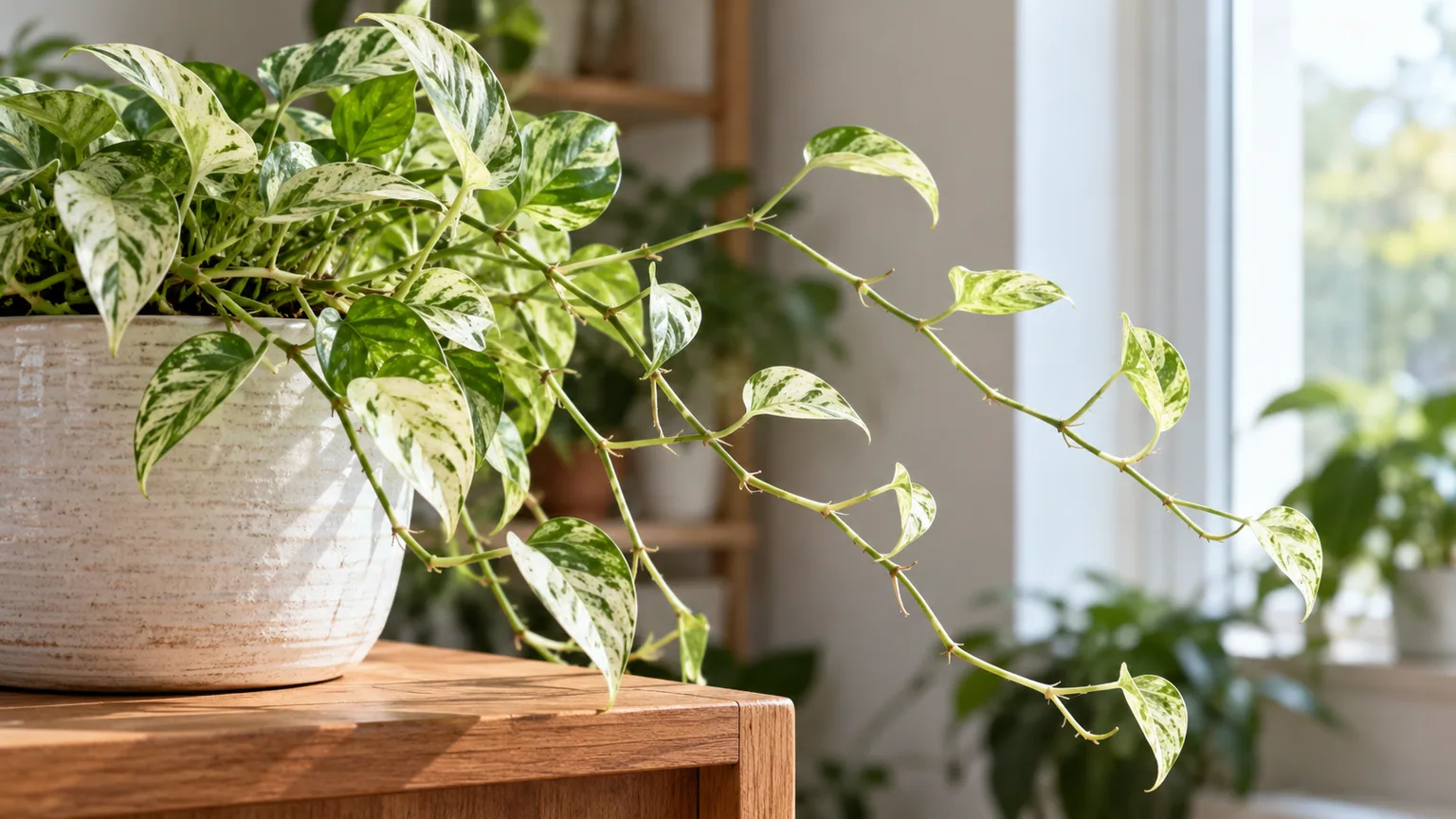
Thin Stems on Marble Queen Pothos: Causes, Checks & Fixes
This guide covers thin stems on Marble Queen Pothos. See also the general Thin Stems guide, watering, and light pages for this plant.
Thin Stems on Marble Queen Pothos: Causes, Checks & Fixes
Quick answer
Thin stems on Marble Queen Pothos (Epipremnum aureum ‘Marble Queen’) are spindly, pencil-thin runners that carry small, widely spaced leaves instead of the cultivar’s normally sturdy marbled vines. The usual story is a vine that has spent months reaching through weak light: internodes lengthen and stems stay narrow because there is not enough energy to build thick tissue, and the white-variegated sections make the deficit worse since they contain little chlorophyll and contribute less photosynthesis than green tissue.
First step: move the pot into bright indirect light — typically within 1–2 m of an east- or west-facing window, or under a full-spectrum grow lamp 25–45 cm above the canopy for 12–14 hours daily. Old spindly sections will never fatten on their own, so judge everything on new growth: after two to three thicker, closely spaced, marbled leaves confirm the brighter spot works, prune thin runners back and root the tips. This page covers stem caliber, vine vigor, and the prune-and-refill sequence; for the mechanics of light starvation in general, see our thin stems guide. On Marble Queen, the pattern usually shows up as thin pale runners with shrinking leaves and fading marbling on the same shelf where a Golden Pothos would still look acceptable. For window targets, use the Marble Queen light guide.
Thin stems vs leggy growth vs weak stems
Three problem pages describe overlapping vines. Use this page when stem thinness and flimsy vine caliber are the headline complaint.
| Your main question | Start here | Also check |
|---|---|---|
| Runners are pencil-thin with tiny sparse leaves | This page — stem caliber and vine vigor | Light guide for placement targets |
| Long bare gaps between leaves on otherwise normal stems | Leggy growth on Marble Queen — internode stretch | This page if stems are also spindly |
| Vines flop, kink, or cannot hold themselves up | Weak stems on Marble Queen — structural flop | This page if flop follows months of thin growth |
| New leaves losing white marbling, turning solid green | Not enough light on Marble Queen — variegation fade | This page if stems thinned first |
| Thin growth plus mushy nodes or sour soil | Root rot on Marble Queen — root failure | Fix roots before pruning |
| Growth is slow but stems stay sturdy | Slow growth on Marble Queen — pace vs vigor | This page if new stems keep narrowing |
Thin stems, stretch, and flop often arrive together on the same neglected vine — fix light first, then prune, whatever the label.
What thin stems look like on Marble Queen Pothos
On this cultivar, thin stems read as loss of vine substance: runners that used to feel firm between your fingers become wiry, and each new leaf arrives a little smaller than the last.
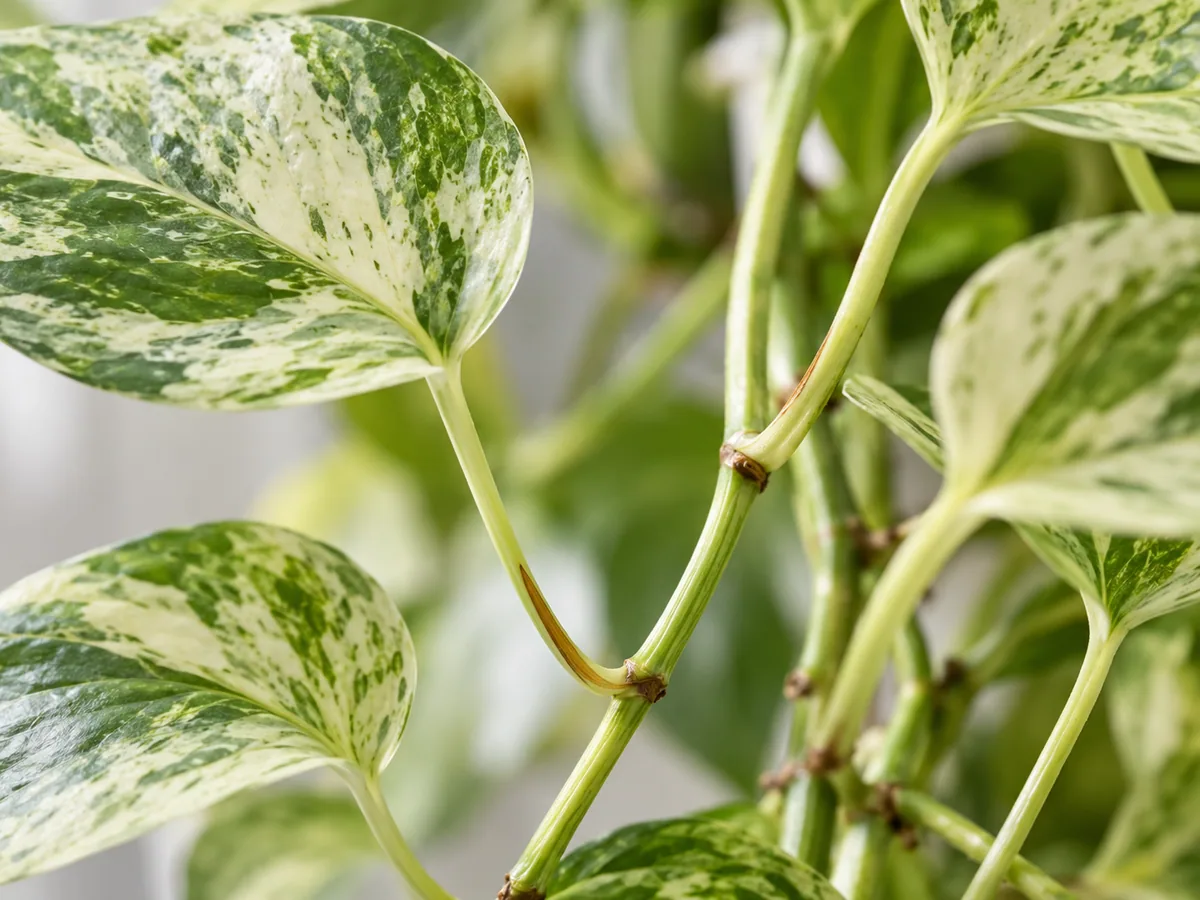
Spindly Marble Queen runners with small leaves and wide spacing — compare stem thickness against older growth near the pot.
Primary Marble Queen signals:
- Runners narrow visibly along their length — new sections are wiry compared with older stems near the soil line
- New leaves shrink and unfurl with less white marbling, sometimes mostly green as the plant chases chlorophyll
- Wide gaps between small leaves, with long stretches of bare wiry vine between foliage clusters
- Vines feel floppy rather than springy, draping flat instead of arching; tips may kink where they cannot support new leaves
- Lower leaves drop over time, leaving thin naked cords with tufts of small foliage only at the ends
- Pot dries slowly because thin, sparse growth transpires less — the mix stays damp long after watering day
What a healthy Marble Queen vine looks like for comparison:
A well-lit plant produces firm stems of even thickness along each runner, heart-shaped leaves with visible white sectors, and steady spacing from the pot outward — trailing length with substance, not wiry cords. See the Marble Queen overview for the cultivar baseline.
What normal aging looks like — different urgency:
A single old runner thinning at its far tip while the crown keeps producing sturdy marbled leaves is ordinary vine age, not a crisis. Worry when most new growth across several runners keeps emerging thinner than the growth it replaces.
Why Marble Queen vines grow thin
Dim light is the engine. Pothos vines elongate internodes and lean toward light when photons run short, and Marble Queen pays a variegation tax on top: its pale patches photosynthesize poorly, so the same dim corner that keeps a Golden Pothos merely slow pushes Marble Queen into spindly, small-leafed growth. All pothos prefer bright, indirect light, and low light can cause loss of variegation on this cultivar specifically. It can survive in low light for quite some time, but will eventually lose desirable leaf qualities such as variegation.
Three Marble Queen-specific amplifiers turn ordinary stretch into truly thin vines:
- Never-pruned runners. Without pruning, stems keep trailing and becoming thinner over time, growing into dimmer zones with sparse foliage and an uneven look. An uncut three-year vine is almost guaranteed to be wiry at its ends no matter the window.
- Crown exhaustion. Every runner draws from the same root system and the same aging mix. A pot-bound plant in depleted soil splits dwindling resources across meters of vine, so each new leaf gets a thinner stem. Marble Queen grows slower than Golden Pothos even in good light, which means it recovers from this deficit more slowly too.
- Water stress in either direction. Chronic underwatering starves new tissue of turgor, so stems emerge thin and leaves stay small. Chronic overwatering damages roots, which produces the same thin top growth from the opposite cause — check watering rhythm and overwatering signs before concluding light alone is responsible.
Hanging baskets hung high in a bright room are a classic trap: the ceiling zone reads dim to the plant even when the floor feels sunny, and vines dangle further into shade as they lengthen.
How to confirm the cause
Work through these checks before fertilizing, repotting, or pruning:
- Window distance and direction — Is the pot more than 1.5–2 m from the brightest glass? Light intensity decreases rapidly with distance from the window, and high-hung baskets are effectively farther than they look.
- Hand-shadow test at leaf level — On a clear day, hold your hand about 30 cm above the foliage. A soft, defined shadow means bright indirect light suited to Marble Queen; a faint or absent shadow means new stems will keep emerging thin.
- New stem vs old stem caliber — Pinch (gently) the newest runner section and compare it with stem near the pot. Progressive narrowing on fresh growth confirms a current deficit rather than old history.
- Leaf size trend — Are the three newest leaves on each runner smaller than mature leaves? Shrinking leaves plus thinning stems point to an energy shortage, usually light.
- Soil and root check — Push a finger 4–5 cm into the mix. Damp-for-days soil with thin soft growth suggests overwatering layered on low light; bone-dry mix with crispy thin vines suggests underwatering. If the pot is packed with circling roots, the plant is dividing scarce resources across too much vine — cross-check the soil guide.
- Pest screen — Inspect leaf undersides and nodes for mealybugs, spider mites, and sticky residue. Pests drain vigor and mimic thin stress growth; treat them before assuming placement alone is at fault.
If stems are firm, pests are absent, and only the newest sections are thin and small-leafed while soil dries normally, insufficient light with unpruned old vines is the most likely primary cause.
First fix for Marble Queen Pothos
Move the plant to bright indirect light — within 1–2 m of an east- or west-facing window, or a few feet back from south glass behind a sheer curtain so pale marbled zones do not scorch.
If no window delivers that, run a full-spectrum LED grow lamp 25–45 cm above the canopy for 12–14 hours daily on a timer, and raise the plant (not just the lamp’s brightness) so foliage actually sits in the beam. Do not fertilize, repot, or prune on moving day — one variable at a time, so new growth tells you whether light was the answer.
Step-by-step recovery
Once brighter placement is set, follow this order:
- Relocate and wait — Give the plant one to two weeks in the brighter spot. Nothing visible happens to old wiry sections; you are waiting for the newest tip growth.
- Rotate weekly — Turn the pot so all runners receive light. One-sided thinness usually means only the window-facing side was photosynthesizing.
- Reset watering to the new light level — Brighter plants drink faster. Return to the 4–5 cm dry test every few days instead of the dim-corner calendar schedule.
- Prune after confirmation — Once two to three new leaves emerge thicker with tighter spacing and restored marbling, cut thin runners just below a healthy leaf node — cutting below the node lets new growth sprout from that point instead of leaving bare stem ends. Full cut placement and tool hygiene: Marble Queen pruning.
- Root the tips back into the pot — Healthy tip cuttings root readily in water or moist mix, and replanting them into the same pot is the fastest way to rebuild a full crown over thin bases. Workflow: Marble Queen propagation. Pinching back stem tips keeps pothos from turning thin and stringy, and the trimmings become free new plants rather than waste.
- Repot only if root-bound — If roots circle the pot edge, move up just 1–2 inches in diameter with fresh airy mix in spring. Do not jump to an oversized pot; excess wet mix around thin roots invites rot.
- Hold fertilizer — Skip feeding until new growth looks sturdy for two weeks. Extra nitrogen on a stressed variegated plant pushes soft green tissue and can burn low-chlorophyll white sections.
Permanence rule: existing thin sections never thicken. Judge the fix solely on new stems — caliber, spacing, leaf size, and marbling on the freshest growth.
Recovery timeline
| Timeframe | What to expect on Marble Queen |
|---|---|
| Weeks 1–2 | No change on old wiry runners; lean toward the window may ease |
| Weeks 3–4 | Newest leaves emerge slightly larger with tighter spacing; marbling returns on fresh growth |
| Weeks 5–8 | New stem sections feel noticeably firmer; prune thin runners and root tips now |
| Beyond 8 weeks | If new growth still emerges thin and small, light is still too weak — move closer or strengthen the lamp |
Marble Queen’s slower cultivar pace means stem recovery lags solid-green pothos by a week or two in the same brighter spot. Do not declare failure at day ten.
Lookalike symptoms
| Pattern | Stem / leaf look | Soil / pot | Likely cause | Next step |
|---|---|---|---|---|
| Wiry runners, tiny sparse leaves, firm stems | Thins progressively toward tips | Normal dry-down | Low light + unpruned age | Brighten placement → this page |
| Long gaps but normal stem thickness | Stretch without narrowing | Any | Etiolation spacing | Leggy growth |
| Stems kink, flop, cannot hold leaves up | Bends and collapses | Any | Structural weakness | Weak stems |
| Yellow soft vines, sour smell | Mushy at nodes | Heavy, wet at 3–5 cm | Overwatering / root stress | Stop watering → overwatering |
| Thin growth plus stalled everything | Sturdy but tiny | Root-packed pot | Root-bound exhaustion | Repot 1–2 inches up in spring |
| Solid-green small leaves, no stretch | Thin but green only | Normal | Variegation reversion | Not enough light |
Overwatering in dim light is the most common overlap: thin growth plus soil that never dries. Pure light thinness keeps stems firm; root-involved thinness turns nodes soft and yellows leaves within days.
What not to do
- Feeding a thin vine to “fatten it up” — Fertilizer does not replace photons and can burn white leaf sections. Fix light first.
- Hard-pruning before light improves — Fresh cuttings and regrowth emerge just as thin if the photon deficit remains.
- Moving straight into harsh direct sun — Unfiltered afternoon sun scorches pale zones that formed in shade. Acclimate over several days behind a sheer curtain.
- Repotting into a much larger pot — A big leap in pot size holds moisture that thin, weak roots cannot use, sliding the plant toward rot.
- Keeping every runner for length’s sake — Meters of wiry vine drain the crown. Short, thick, marbled growth beats long, thin, bare length.
- Watering on the old schedule after brightening — Uptake speeds up in better light; recheck moisture instead of repeating dim-corner intervals.
How to prevent thin stems next time
Treat Marble Queen as a display cultivar with an energy budget, not a neglect-proof trailer. Bright indirect light with weekly rotation keeps each new stem section as thick as the last. Pinch runner tips once or twice a year so branching stays dense instead of extending one ever-thinner whip — regular pruning encourages branching and a fuller crown rather than long sparse cords. Refresh the mix every 1–2 years in spring before the pot becomes a root mass dividing crumbs among meters of vine.
Water by the 4–5 cm dry test matched to the plant’s actual light level, and expect a brighter plant to drink faster. For placement and lamp targets that prevent recurrence, keep the Marble Queen light guide linked below bookmarked.
When to worry
Thin stems are usually gradual, but act promptly if:
- Nodes soften or turn translucent while soil stays damp — possible early root rot layered on weak growth.
- Several leaves yellow and drop within a week without pest signs.
- The pot smells sour or the crown pulls loose with a gentle tug — unpot and address roots before chasing more light.
- New growth stays thin after six to eight weeks in a spot you believed was bright — placement or lamp intensity is still inadequate.
- The entire crown wilts despite moist soil — roots are no longer delivering, and light correction alone will not save it.
Marble Queen rarely dies from thin growth alone, but chronic low light plus wet mix rots the root system that every runner depends on. Fix light and watering together.
When pruning thin vines or handling cuttings, keep debris away from cats and dogs. All Epipremnum aureum cultivars, including Marble Queen, are toxic to cats and dogs via insoluble calcium oxalate crystals that irritate the mouth if chewed.
Related Marble Queen guides
- Marble Queen overview — cultivar baseline, variegation behavior, and Golden Pothos comparison
- Thin stems hub — general mechanics of spindly growth across houseplants
- Marble Queen light — foot-candle targets, windows, and grow-lamp setup
- Marble Queen watering — dry-down rhythm when light changes
- Leggy growth on Marble Queen — when internode gaps are the headline instead of caliber
- Weak stems on Marble Queen — when vines flop and kink
- Not enough light on Marble Queen — variegation fade deep dive
- Marble Queen pruning — where to cut thin runners
- Marble Queen propagation — root tip cuttings to refill the crown
- Overwatering on Marble Queen — wet soil behind thin soft growth
- Root rot on Marble Queen — mushy nodes and sour mix
- Slow growth on Marble Queen — when pace is slow but stems stay sturdy
Thin Marble Queen stems are a light-and-vigor problem first. Brighter indirect exposure restores thick marbled growth on new runners; pruning wiry sections after recovery — and rooting healthy tips back into the pot — rebuilds the full crown. If fresh stems keep emerging thin, light is still too low.
How we wrote and verified this guide: Recommendations were checked against Clemson Cooperative Extension, NC State Extension, Missouri Botanical Garden, Penn State Extension, University of Maryland Extension, RHS, Epic Gardening, and ASPCA references cited inline. Author: sai-ananth. Reviewer: LeafyPixels Review Board. Methodology: plant problem guidance is reviewed against botanical references, extension resources, and LeafyPixels plant-care data before publication. Claims validation: claims-validator-v1 pass with inline external links documented below. Last reviewed: 2026-08-27.