Wind Damage on Marble Queen Pothos: Causes, Checks & Fixes
Quick answer
Wind damage on Marble Queen Pothos shows as torn leaves, snapped trailing vines, and papery brown edges on the white-variegated zones after balcony, patio, vent, or transport exposure. First step: move the plant out of the wind immediately, then water only if the top 3–5 cm of mix is dry and trim only tissue that is fully crisp or split.
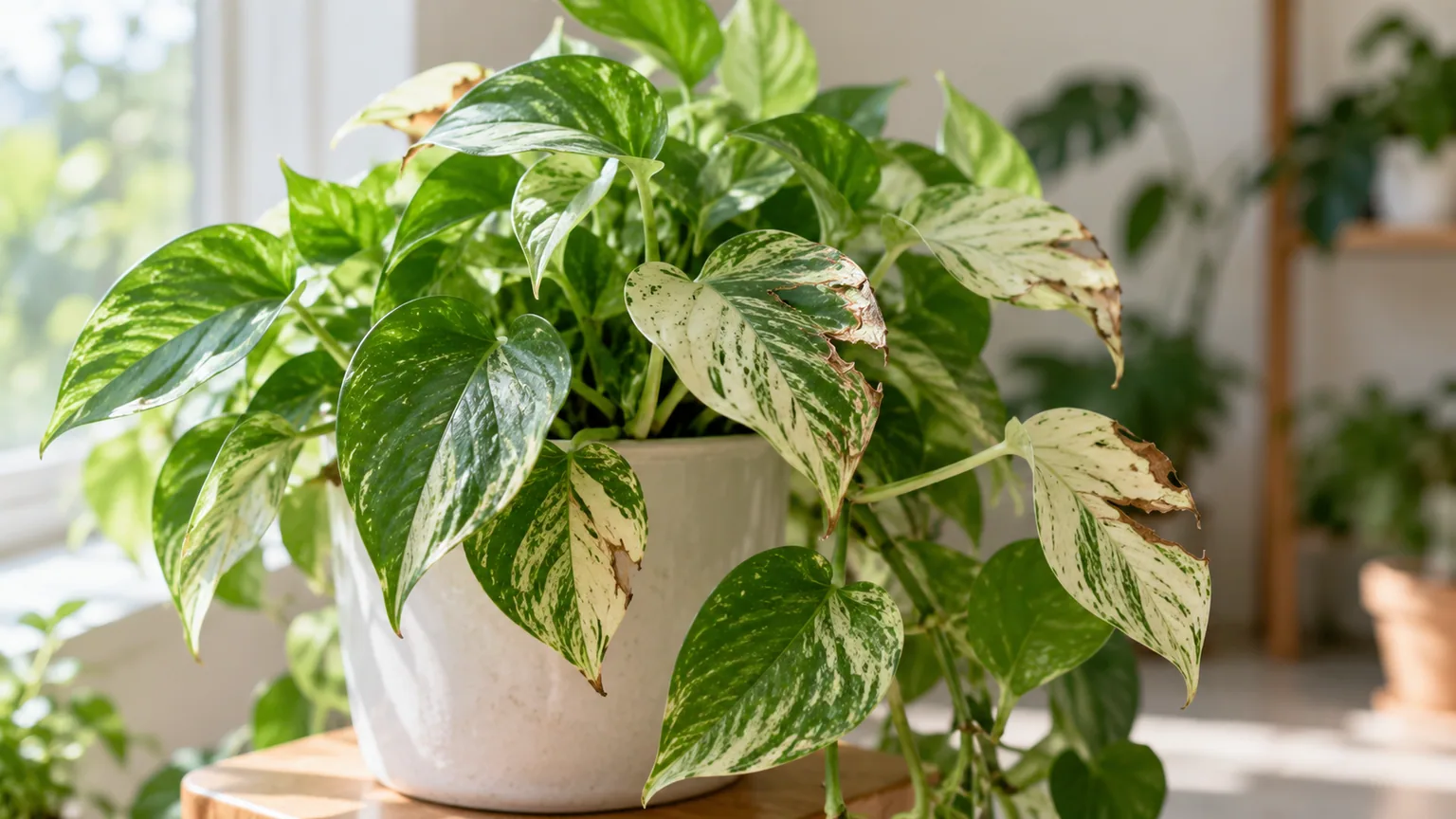
Wind Damage on Marble Queen Pothos: Causes, Checks & Fixes
This guide covers wind damage on Marble Queen Pothos. See also the general Wind Damage guide, watering, and light pages for this plant.
Wind Damage on Marble Queen Pothos: Causes, Checks & Fixes
Quick answer
Marble Queen Pothos (Epipremnum aureum ‘Marble Queen’) is a trailing vine in the arum family (Araceae) that belongs indoors or in still, sheltered air. After wind exposure — a balcony afternoon, a patio door draft, an AC vent, a desk fan, or a car ride with the windows down — the long vines whip and snag, leaves tear along the veins, and the creamy-white zones crisp into papery brown edges within a day or two.
First step: move the plant out of the wind right now. Carry it to still indoor air in bright indirect light, set it down where vines cannot swing, and only then assess. For the general mechanics of how moving air injures foliage, see our wind damage guide — the rest of this page covers what wind does specifically to Marble Queen’s trailing vines and thin white-variegated leaves.
What wind damage looks like on Marble Queen Pothos
Wind injury on this cultivar has two signatures at once: mechanical tearing plus rapid drying, and both show worst on the white tissue.
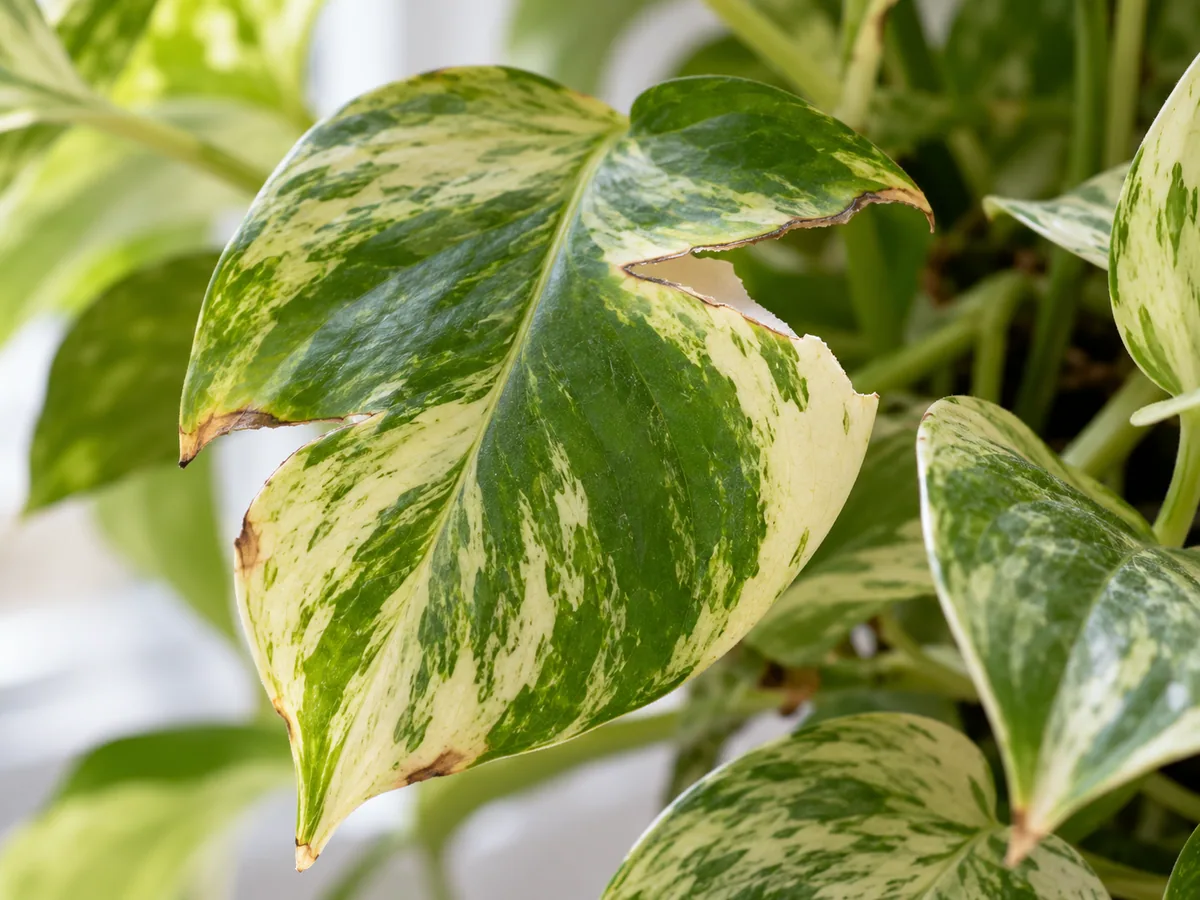
Wind damage detail on Marble Queen Pothos — note the split leaf blades and papery brown crisping concentrated on the white-variegated zones.
Expect:
- Slits or ragged tears in heart-shaped leaves, often starting at the margin and running toward the midrib
- Snapped or kinked trailing stems, usually at a node or where a vine caught on a railing edge
- White and cream sections turning tan, then papery brown and brittle, while neighboring green zones stay flexible longer
- Leaf edges curling and crisping on the windward side of the plant first
- A pot that dried out shockingly fast, with limp leaves even though you watered recently
- In toppled pots, exposed surface roots or mix spilled over the rim
Because this is a slow grower with less chlorophyll than all-green pothos, replacement foliage arrives slowly. Every torn mature leaf matters more here than on a fast Golden Pothos, so resist the urge to strip the plant bare.
Why Marble Queen Pothos suffers in wind
Three traits of this plant stack against it in moving air.
Trailing vines act like sails. Pothos climbs by brown aerial roots and trails long cascading stems indoors. Outdoors or near a vent, those dangling vines catch every gust, whipping against railings, walls, and each other until stems kink and leaves shred. A compact upright houseplant barely notices a breeze that can snap a two-foot Marble Queen vine.
White-variegated tissue dries first. The cream sections that make Marble Queen desirable contain almost no chlorophyll and lose moisture faster than green tissue. Marble Queen needs stronger light than green pothos types to hold its pattern, yet those same pale zones scorch and desiccate first when wind strips the boundary layer of humid air off the leaf. That is why wind crisping concentrates on the white margins while green centers look untouched.
Wind steals water faster than roots can replace it. Desiccation damage happens whenever a plant loses water faster than its roots and internal systems can replenish the leaves, and strong air movement accelerates that loss even in mild temperatures. A pot on a breezy balcony can go from moist to dry in a day, so leaves wilt and scorch while the owner assumes watering is on schedule. Pair that with Marble Queen’s preference for bright, indirect light rather than exposed sun, and a sunny windy railing becomes a double assault of light stress plus desiccation.
How to confirm the cause
Work through these checks before trimming or repotting anything:
- Replay the last 72 hours. Was the plant on a balcony, near an open car window, under an AC vent, beside a fan, or moved house? Wind damage follows the event by hours to two days.
- Map the damage direction. True wind injury is worst on the side that faced the airflow, with sheltered inner leaves relatively clean. Uniform damage on all sides points instead to underwatering or low humidity.
- Inspect the vines node by node. Run each trailer gently through your fingers. Kinks, partial snaps, and aerial roots ripped from a moss pole confirm mechanical wind stress rather than disease.
- Test the soil. Push a finger 3–5 cm into the mix and lift the pot. Wind-dried pots feel very light with mix pulling from the rim — a sign desiccation is compounding the tears.
- Check the pattern on the leaf. Torn or shredded leaves, broken stems, and brown scorched-looking foliage from windburn look ragged and one-sided. Round spots with yellow halos suggest black spots disease instead, and fine stippling with webbing means spider mites.
First fix for Marble Queen Pothos
Move the plant to still indoor air in bright indirect light, out of direct sun and away from every vent and fan. Set trailing vines where they hang free without swinging, and water only if the top 3–5 cm of mix is actually dry. One calm relocation tells you within days whether the plant stabilizes — stacking repotting, feeding, and heavy pruning on the same day only adds shock to injury.
Step-by-step recovery
Once the plant sits in calm air, work in this order:
- Stabilize the vines. Drape trailers over the pot rim or loosely clip them to a trellis so nothing pulls on kinked stems. Leave partially snapped but still-green vines alone for a week; the node below a kink often pushes a new shoot.
- Water to the pot’s actual need. If wind dried the mix, soak until water drains freely and empty the saucer. If the mix is still moist, wait — soggy recovery watering invites root rot, which pothos develops readily when soil stays wet.
- Trim only what is dead. Cut fully crisp brown edges and completely split leaves with clean scissors, but keep every leaf that is mostly green and supple. This slow grower needs its remaining chlorophyll to fund regrowth.
- Reroot clean breaks. A vine snapped at a node with at least one node intact can root in water, following the propagation guide once the parent stabilizes.
- Hold fertilizer. A wind-stressed plant cannot use extra salts, and Marble Queen’s pale zones burn easily. Resume half-strength feeding only after new leaves unfurl clean.
Recovery timeline
- Days 1–3: Wilting eases after shelter and correct watering. No torn tissue heals, but spread should stop.
- Weeks 1–2: Crisped edges stay crisp while remaining leaves firm up. Kinked vines either plump or declare themselves dead — trim the dead ones now.
- Weeks 2–4: New leaves unfurl from vine tips in the growing season; judge success by these, not by old scars fading. Winter recovery runs slower — allow six weeks before deciding a vine is finished.
Lookalike symptoms
| What you see | More likely | Where to go |
|---|---|---|
| Even brown crispy tips on many leaves, no tears, no wind event | Dry air or inconsistent watering | Brown tips and low humidity |
| Pale bleached patches after a sunny move, leaves intact | Direct-sun scorch without wind | Sunburn / scorched leaves |
| Whole vines limp with heavy wet mix | Overwatering or root failure | Drooping leaves and root rot |
| Fine stippling, dull leaves, webbing at stem joints | Spider mites, often after plant stress | Spider mites |
| Soft brown patches after cold nights on the balcony | Cold damage, common below 50°F | Heat stress for temperature extremes |
| One-sided tears plus a fast-dried pot after gusts | Wind damage — you are on the right page | Keep reading |
Mistakes to avoid
- Leaving it “one more day” on the balcony. Each additional windy day deepens desiccation and snaps more vines. Shelter is the treatment, not an overreaction.
- Misting as the rescue. A wet leaf in moving air dries in minutes and gains nothing, while damp foliage in still indoor corners invites fungus. Fix placement and soil moisture instead.
- Hard-pruning everything damaged. Stripping all torn leaves starves a slow variegated grower of the green tissue funding its comeback. Trim in stages over two weeks.
- Repotting on day one. Wind rarely damages roots unless the pot toppled. Repotting adds transplant shock; only repot spilled or root-exposed pots, per the repotting guide.
- Fertilizing the stress away. Salts on damaged roots and scorched white tissue make recovery worse. Feed only clean new growth.
Marble Queen care cross-check
Wind recovery only holds if baseline care suits this cultivar:
- Light: Bright indirect light protects variegation without the scorch risk of an exposed railing. Pothos tolerates low light but loses pattern there.
- Water: Water only when the surface dries — the top 3–5 cm test from the watering guide. Windy spots need double-frequency checks, not double water.
- Soil: An airy standard mix with perlite that drains fast but held moisture is ideal; pure peat that baked hard in wind needs a soak-and-drain reset.
- Temperature: Keep pothos between 65°F and 75°F and always above 50°F. Balconies that swing cold at night add chill injury on top of wind tears.
- Safety: Sap and leaves are toxic to cats and dogs, so when you move a wind-damaged trailer indoors, keep dangling vines out of pet reach.
How to prevent it next time
- Keep Marble Queen as an indoor trailer or hanging plant by default; treat balcony summers as the exception, in a corner blocked from prevailing wind.
- Use a heavy ceramic pot so gusts cannot topple long vines, and clip trailers short before any move or storm.
- Group it with other plants to slow air movement, never singly on an exposed railing edge.
- Redirect AC vents and fans away from foliage; even indoor drafts crisp white margins over weeks.
- Transport in a closed box with vines coiled inside, never loose in an open trunk or back seat with windows down.
- Bring balcony plants in before autumn winds arrive — cold plus wind kills faster than either alone.
When to worry
Move fast when the pot toppled and roots sit exposed, when most vines snapped near the base, or when limp leaves stay limp a day after correct watering — that combination signals root damage, not just leaf tears. A plant with firm vines, a few split tips, and moist roots is a cosmetic case; shelter it and let new growth do the talking.
Conclusion
Wind damage on Marble Queen Pothos is a placement injury, not a disease: trailing vines built for still understory air meet gusts they were never designed for, and thin white-variegated zones pay first. Move the plant to calm bright indirect air, water to actual soil dryness, trim only the truly dead, and let the next flush of leaves confirm the rescue. Prevention is simpler than repair — indoors by default, sheltered when out, and clipped before every move.
When to use this page vs other Marble Queen Pothos guides
This page covers mechanical wind injury and wind-driven desiccation after airflow exposure. Use it when tears, snapped vines, and one-sided crisping follow a balcony stay, vent blast, fan, or transport.
- Drooping Leaves on Marble Queen Pothos — use when whole vines go limp without tears, pointing to watering or root causes
- Underwatering on Marble Queen Pothos — use for dry-soil wilt and soak recovery without a wind event
- Sunburn / Scorched Leaves on Marble Queen Pothos — use for bleached patches after direct sun with intact leaf shapes
- Low Humidity on Marble Queen Pothos — use for gradual edge crisping in dry indoor air over weeks
- Marble Queen Pothos problems hub — browse all diagnosed issues when wind damage overlaps with other symptoms
Related Marble Queen Pothos guides
- Marble Queen Pothos overview — full care baseline: light, water, soil, and feeding rhythm
- Marble Queen Pothos watering — the 3–5 cm dry test and seasonal rhythm
- Marble Queen Pothos light — placement that protects white variegation
- Marble Queen Pothos soil — airy mixes that buffer fast dry-downs
- Drooping Leaves on Marble Queen Pothos — limp vines without tears
- Underwatering on Marble Queen Pothos — dry-soil wilt and soak recovery
- Low Humidity on Marble Queen Pothos — dry-air crisping vs wind tearing
- Sunburn / Scorched Leaves on Marble Queen Pothos — sun bleaching with intact leaves
- Marble Queen Pothos problems — browse every diagnosed issue for this plant