Sunburn & Scorched Leaves on Marble Queen Pothos: Causes
Quick answer
Sunburn on Marble Queen Pothos happens when its white-marbled leaves take unfiltered direct sun — usually a south or west window without sheers, a sudden outdoor move, or pushing a stretched vine into harsh rays. First step: pull the pot back to bright indirect light or filter the window with a sheer curtain; leave watering and repotting alone until no new bleaching appears for several days.
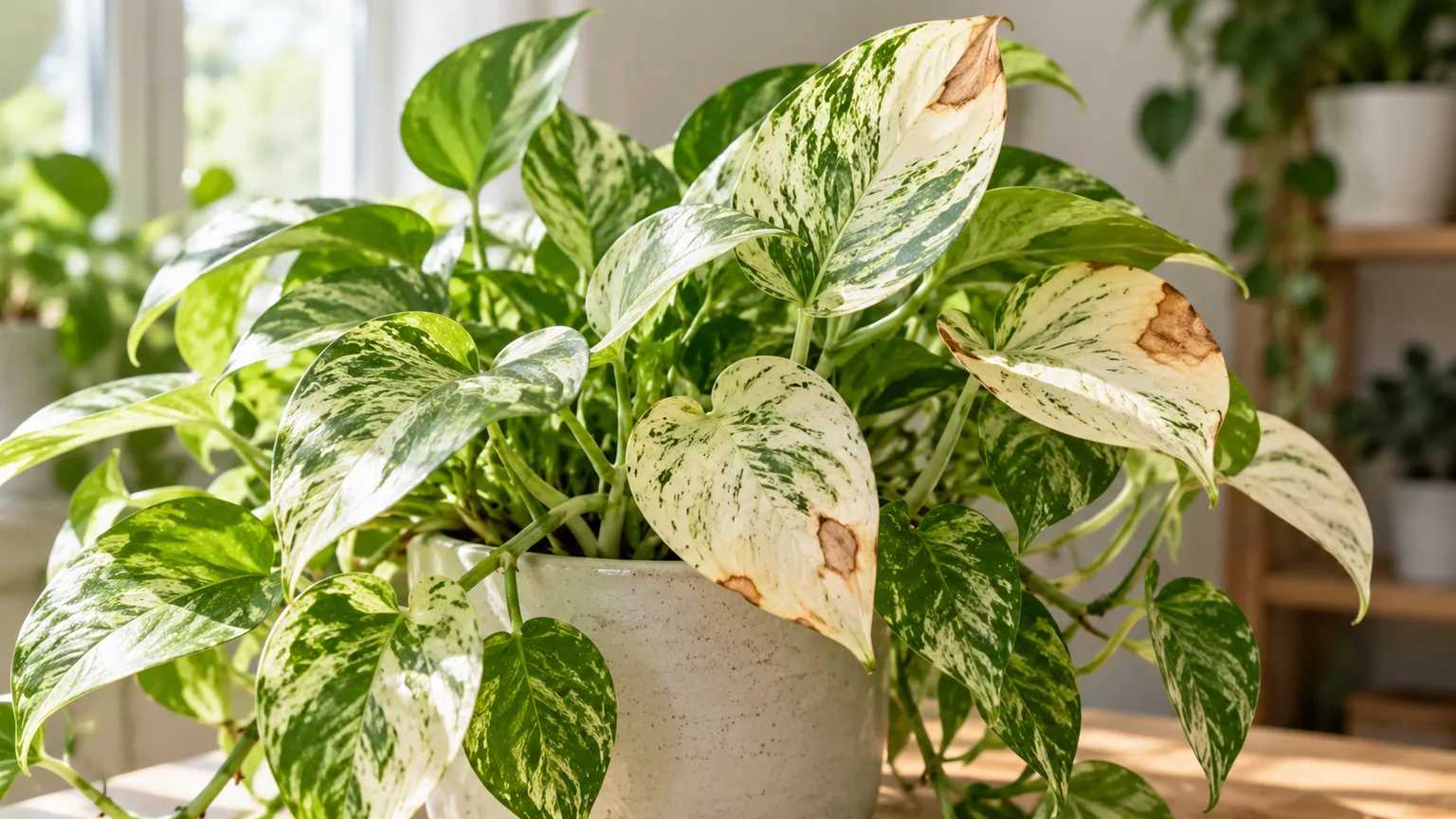
Sunburn & Scorched Leaves on Marble Queen Pothos: Causes, Checks & Fixes
This guide covers sunburn / scorched leaves on Marble Queen Pothos. See also the general Sunburn / Scorched Leaves guide, watering, and light pages for this plant.
Sunburn & Scorched Leaves on Marble Queen Pothos: Causes, Checks & Fixes
Quick answer
Sunburn on Marble Queen Pothos (Epipremnum aureum ‘Marble Queen’) happens when its heavily marbled leaves take more direct sun than they can handle — typically unfiltered south or west glass in summer, a sudden move outdoors, removed sheer curtains, or pushing a leggy vine into harsh rays to “fix” stretch. This cultivar burns faster than solid-green pothos because its white sectors carry less chlorophyll to handle excess light, so bleaching shows first where variegation is strongest.
First step: pull the pot back to bright indirect light or filter the window with a sheer curtain — and change nothing else until no new bleaching appears for several days.
For how intense sun damages leaf tissue in general, see our sunburn guide. On Marble Queen, the pattern usually shows up as one-sided white bleaching on the most variegated leaves nearest the glass, while shaded inner leaves stay green.
What sunburn looks like on Marble Queen Pothos
Healthy Marble Queen leaves are heart-shaped with creamy-white marbling over green. The white zones are thin and delicate by design, which is why scorch on this cultivar looks different from scorch on a Golden or Jade pothos: the white patches bleach first, then crisp.
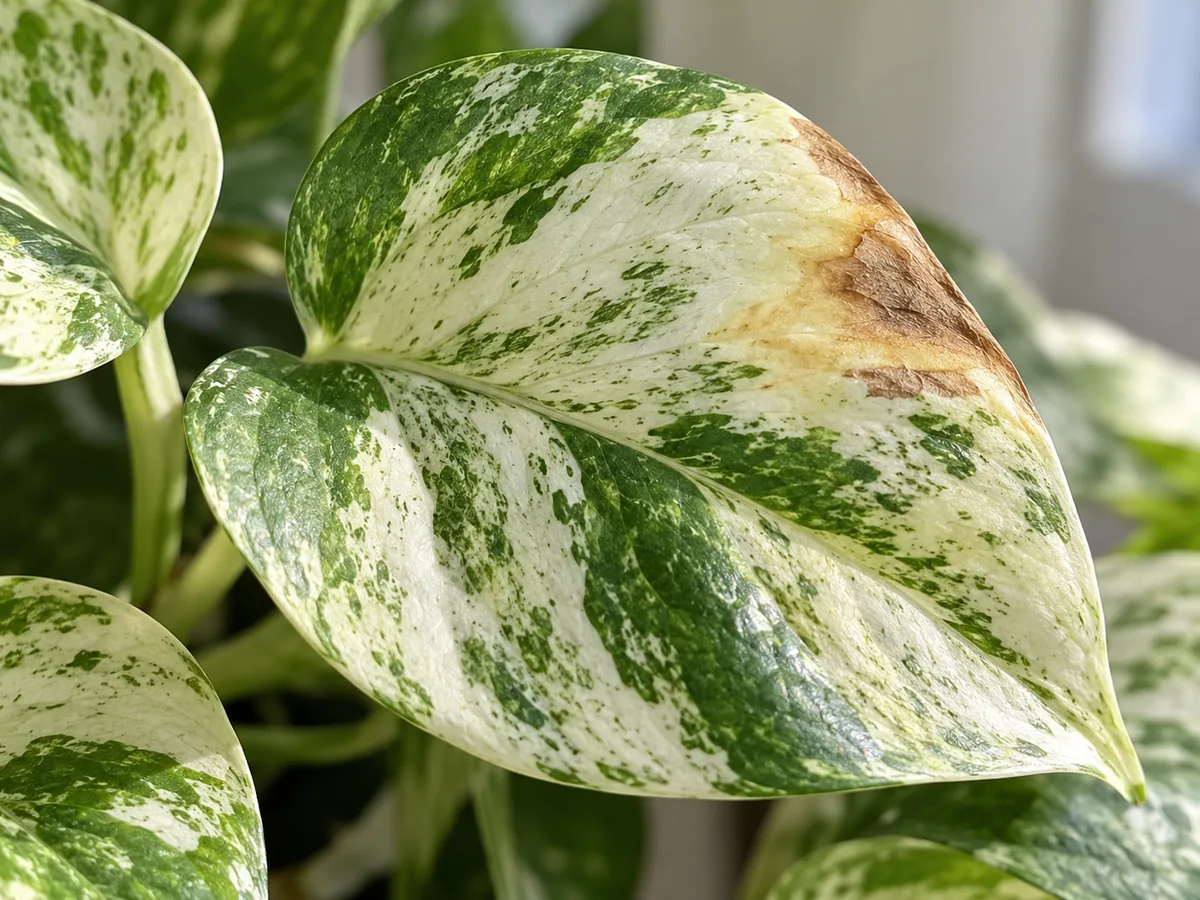
Bleached white sectors and papery tan scorch on a sun-facing Marble Queen leaf — shaded leaves on the same vine stay green.
Typical Marble Queen scorch pattern:
- Bleached white, silvery, or pale-tan patches on leaves facing the window, often starting inside the white marbled zones
- Dry brown or papery edges where bleached tissue crisped, feeling stiff and crackly rather than soft
- Damage concentrated on upper, outer, window-side leaves — vine tips nearest the glass burn first while inner shaded leaves look normal
- Sudden onset within one to three days of a light change: curtain removal, pot rotation, seasonal sun strengthening, or an outdoor move
- Firm stems and normal-weight pot despite ugly leaves — the root zone is usually fine
Scorch rarely starts at the soil line. If vine bases soften and turn dark with sour-smelling mix, suspect root rot on Marble Queen Pothos rather than pure sun damage.
Why Marble Queen Pothos gets sunburn
Pothos evolved as an understory climber that reaches toward canopy gaps while young leaves develop in filtered shade. Indoor leaves grown in dim rooms lack the protective pigments for harsh direct beams. Marble Queen is the least forgiving common pothos because it pairs that shade-grown anatomy with large chlorophyll-free zones.
White sectors burn first: why Marble Queen scorches before Golden Pothos
Clemson notes Marble Queen needs bright indirect light and that variegated selections carry less photosynthetic tissue than solid-green types. The practical result: a Marble Queen in the same south window as a Golden Pothos can bleach within hours on a hot afternoon while the green plant only pales. New leaves with extra-heavy white marbling are the most vulnerable because they have the least chlorophyll and the thinnest cuticle.
Trailing geometry: outer vines and window-side leaves take the hit
Marble Queen is a trailing vine, so the longest strands drape closest to the glass and catch the full beam while the crown sits back in relative shade. After a pot rotation, the previously shaded back side suddenly faces the sun with no acclimation — classic one-sided scorch. Hanging baskets near south or west windows are the highest-risk placement; the outer curtain of leaves acts as a sun shield and burns while inner leaves stay protected.
Slow drinker in harsh light: heat compounds the bleach
Marble Queen grows more slowly than Golden Pothos and uses less water, so a hot window dries the sun-side leaves faster than the roots can resupply. Leaf scorch and tip dieback as often caused by intense light alongside low humidity is the pattern Clemson describes — on Marble Queen, afternoon heat through glass turns pale bleaching into crispy brown margins within a day. This is also why scorched Marble Queen leaves feel papery-dry rather than limp: the damage is radiant, not wilt.
Common triggers on Marble Queen:
- Sudden light jump from a dim hallway or office straight to a sunny sill or patio
- South or west window without sheers in late spring and summer, when sun angle and heat rise sharply
- Curtain or blind removal for “more light” after leggy growth on Marble Queen Pothos stretched the vines
- Outdoor summer moves to porches or balconies without a gradual shade-to-sun ramp
- Grow lights hung too close, bleaching white sectors through intensity plus warmth
RHS guidance for Epipremnum is explicit: give bright light but not direct sun, and filter south-facing windows with sheer curtains because summer direct sun scorches the leaves.
How to confirm the cause
Work through these checks before repotting, fertilizing, or soaking the plant:
- Light history — Did the plant move, rotate, lose its sheer curtain, or go outdoors within the last one to two weeks? Did the same window get noticeably hotter as seasons changed?
- Damage direction — Sunburn hits the sun-facing leaf surface first. Bleaching only on the window side with green shaded leaves behind it fits scorch.
- Tissue texture — Scorched Marble Queen tissue stays firm, dry, and papery. Soft yellow leaves on a heavy wet pot point to overwatering on Marble Queen Pothos; evenly crisp leaves on a bone-dry light pot point to underwatering.
- Variegation map — White sectors bleaching before green sectors is a Marble Queen signature. Uniform browning that ignores variegation boundaries suggests brown leaves on Marble Queen Pothos from another cause.
- Stem and soil check — Firm stems and normal soil moisture support a light diagnosis. Mushy stems, blackening vine bases, or sour mix mean roots are involved — compare with root rot on Marble Queen Pothos.
If you pull the plant back to the Marble Queen Pothos light guide level of bright indirect light and no new bleaching appears within a week, light was the primary cause.
First fix for Marble Queen Pothos
Move the pot back to bright indirect light or add sheer filtering — one change only.
Set the plant 1–2 m back from harsh south or west glass, or hang a sheer curtain between glass and foliage. East windows with gentle morning sun are usually safe; unfiltered midday beams are not. Pothos does not tolerate much direct sunlight and does best in filtered light, so filtering beats relocating to a dark corner — Marble Queen still needs brightness to hold its variegation. Do not fertilize, repot, or prune on day one; let the plant stabilize so you can read whether bleaching has stopped.
Step-by-step recovery
- Filter the light today. Sheer curtain on, or pot moved to bright indirect light. Note the date so you can judge new damage versus old.
- Leave scorched leaves in place for now. Even bleached leaves still photosynthesize through their green zones and shade the vines behind them. Trim only leaves that are fully brown and crackly, using clean scissors and cutting back to the petiole — never tear tissue.
- Water normally, not extra. Keep the Marble Queen Pothos watering guide rhythm: top 3–5 cm dry before watering. Extra soaking does not repair scorch and risks root stress on this slow drinker.
- Watch for one week. No new white blotches means the light fix worked. Spreading crispness means the spot is still too harsh — filter further or move farther back.
- Prune for shape after stability. Once two to three new leaves emerge cleanly marbled, trim badly scorched vines back to a node with healthy variegated growth. Root the tip cuttings per the Marble Queen Pothos propagation guide to fill the pot rather than discarding good nodes.
- Acclimate future moves slowly. Shift toward brighter spots over one to two weeks — a few hours of morning sun first, then longer exposure — instead of a single jump.
Houseplant growers describe the same sequence: white blotches like bleached leaves that then turn brown, showing first on leaf tops most exposed to sun, with recovery judged by new unblemished growth after filtering.
Recovery timeline
- Days 1–3: No new bleaching after filtering. Old patches look unchanged — they will not re-green.
- Weeks 2–4: New leaves emerge with clean white-and-green marbling. Existing mild bleaching stays visible but does not spread.
- Weeks 4–8: Pruned vines branch from nodes below cuts; rooted tip cuttings establish. Variegation holds if light stays bright but indirect.
Judge progress by new growth and a stable spread pattern, not by old patches fading. If fresh leaves keep emerging bleached or crispy, the spot is still too intense.
Lookalike symptoms
| What you see | More likely | Check |
|---|---|---|
| Bleached patches only on sun side after a light change, firm stems | Sunburn | This page — filter light first |
| Uniform brown crispy edges, no light change, dry light pot | Underwatering or low humidity | Underwatering · Low humidity |
| Brown tips and margins plus white salt crust on mix | Fertilizer burn | Fertilizer burn on Marble Queen Pothos |
| Yellow soft leaves from the base up, wet heavy pot, sour smell | Overwatering / root rot | Overwatering · Root rot |
| Curling plus bleaching after a hot afternoon | Heat stress compounding scorch | Heat stress on Marble Queen Pothos |
| Fading variegation to green, long bare internodes, no crisp patches | Not enough light | Faded leaves · Leggy growth · Not enough light |
| Brown spots with yellow halos after wet foliage | Bacterial or fungal spot | Brown leaves · Black spots |
Mistakes to avoid
- Moving a scorched Marble Queen into a dark closet “to rest.” Deep shade stops scorch but triggers green reversion and leggy growth — filter harsh sun instead of removing brightness.
- Stripping every bleached leaf on day one. Partially green scorched leaves still feed the vine; mass defoliation on a slow grower stalls recovery for weeks.
- Fertilizing to “help it recover.” Salts stress damaged tissue; hold feed until new leaves look healthy for two weeks.
- Repotting plus pruning plus spraying on the same day. Sunburn is a placement problem, not a soil emergency — one correction first.
- Misting scorched leaves in hot sun. Wet tissue under a harsh beam heats faster and invites spot diseases; water the mix, not the foliage.
Marble Queen Pothos care cross-check
Scorch often follows a well-meant correction. A stretched vine gets shoved into direct sun; a slow-drying pot gets moved to the hottest sill to “dry faster.” Cross-check the basics from the Marble Queen Pothos overview: bright indirect light, standard potting mix with 20–30% perlite that drains freely, watering when the top 3–5 cm dries, and the Marble Queen Pothos soil guide mix that avoids compaction. Confirm drainage and the Marble Queen Pothos repotting guide timing only if the pot stays soggy — otherwise leave roots undisturbed.
When to use this page vs other Marble Queen Pothos guides
- Marble Queen Pothos watering guide — Use for routine moisture checks before assuming sunburn is the main issue.
- Marble Queen Pothos problems hub — Browse all common issues on this species.
- Brown tips on Marble Queen Pothos — Different entry point when crispy margins overlap with scorch.
- Curling leaves on Marble Queen Pothos — Different entry point when heat curl accompanies bleaching.
Related Marble Queen Pothos guides
- Marble Queen Pothos overview
- Marble Queen Pothos watering
- Marble Queen Pothos light
- Marble Queen Pothos soil
- Brown leaves on Marble Queen Pothos
- Brown tips on Marble Queen Pothos
- Curling leaves on Marble Queen Pothos
- Faded leaves on Marble Queen Pothos
- Heat stress on Marble Queen Pothos
- Yellow leaves on Marble Queen Pothos
- Marble Queen Pothos problems