Faded Leaves on Marble Queen Pothos: Causes, Checks & Fixes
Quick answer
Faded leaves on Marble Queen Pothos usually mean the plant is losing variegation in light that is too dim-new leaves emerge greener because white tissue cannot photosynthesize. First step: move the plant to bright indirect light near an east-facing window or behind sheer curtains, then prune all-green vines back to the last marbled leaf.
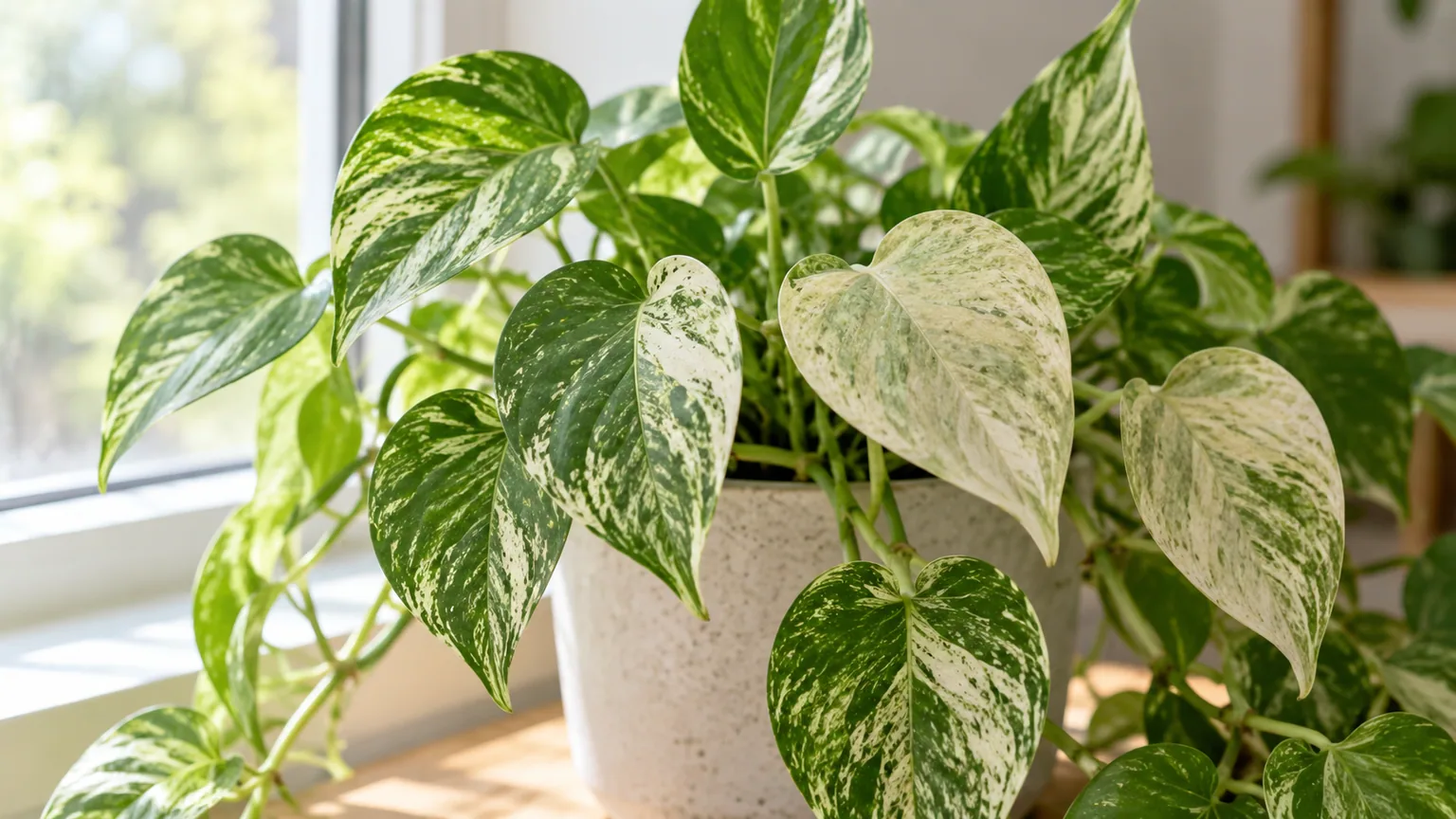
Faded Leaves on Marble Queen Pothos: Causes, Checks & Fixes
This guide covers faded leaves on Marble Queen Pothos. See also the general Faded Leaves guide, watering, and light pages for this plant.
Faded Leaves on Marble Queen Pothos: Causes, Checks & Fixes
Quick answer
On Marble Queen Pothos (Epipremnum aureum ‘Marble Queen’), faded leaves almost always mean the white marbling is washing out-new growth emerges progressively greener, or the cream sections look bleached and washed out. The white areas of each leaf contain little to no chlorophyll, so this cultivar photosynthesizes less efficiently than an all-green pothos and reacts to light problems faster than its cousins.
First step: move the plant to bright indirect light, such as near an east-facing window or a few feet back from a bright south or west window with sheer curtains. Penn State Extension advises placing pothos in moderate to bright light while avoiding direct sun, and warns that dim conditions make the plant lose its desirable leaf qualities-variegation included. For the cultivar baseline, see the Marble Queen overview; for placement detail, see the light guide.
What faded leaves look like on Marble Queen Pothos
Low-light fading creeps along the vines rather than striking all at once. The newest leaves unfurl with less cream marbling than older ones, and over weeks a vine that once showed balanced white-and-green patterning produces leaves that are mostly or entirely green. The foliage stays firm, glossy, and otherwise healthy-which is exactly why owners often miss the change until half the plant looks different.
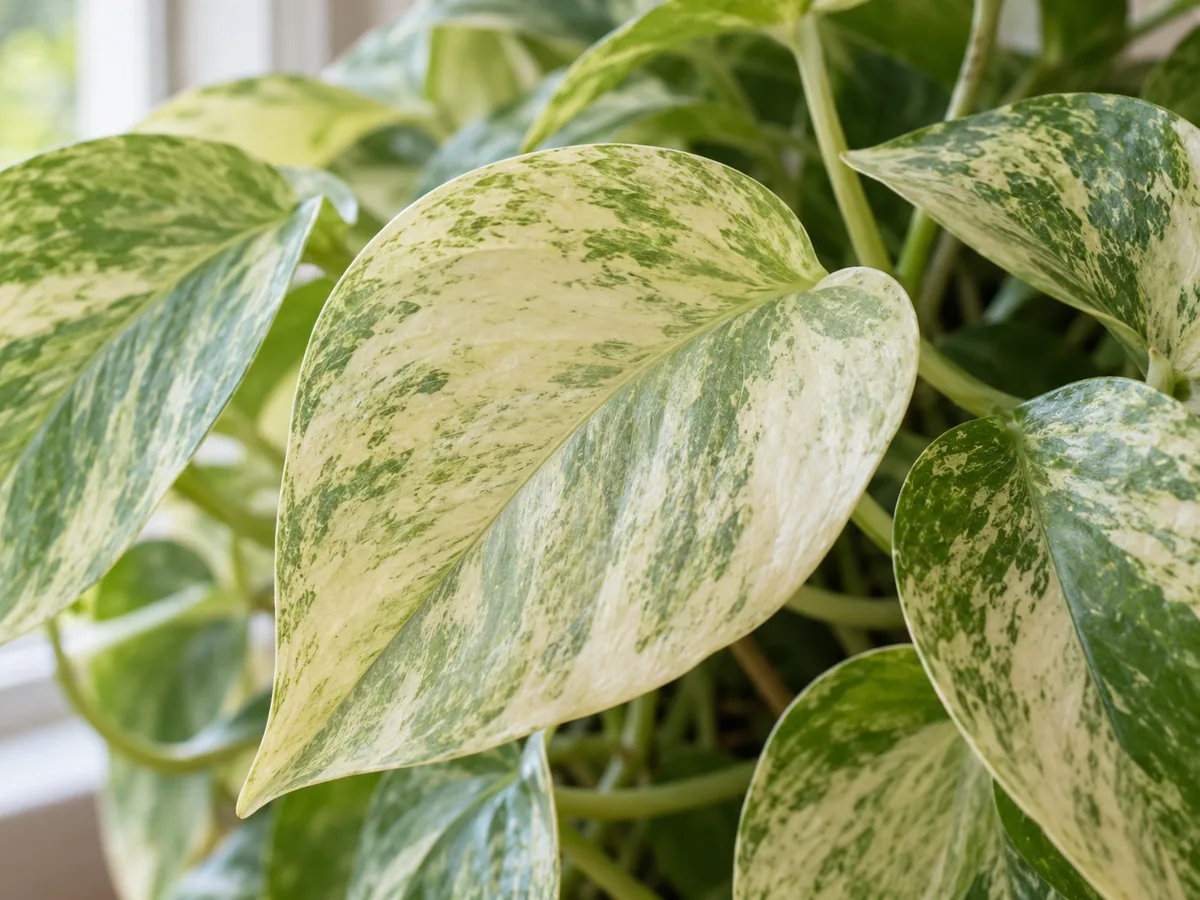
Faded variegation on Marble Queen Pothos - compare the washed-out new leaf against older marbled foliage on the same vine.
A second, sharper look is bleaching: the white sections turn papery pale or tan after a move into stronger sun, while green areas stay normal. Because Marble Queen carries so much unpigmented tissue, its pale sectors scorch before a Golden Pothos in the same spot would show any damage. Note which pattern you see-new-leaf greening versus white-sector scorch-because the fixes run in opposite directions.
Why Marble Queen fades: the chlorophyll tradeoff
Every cream splash on a Marble Queen leaf is tissue that cannot feed the plant. When light drops, the plant compensates the only way it can: it builds new leaves with more chlorophyll and less white, trading beauty for survival. Clemson Extension confirms that variegated pothos kept in lower light lose some of their coloring. Marble Queen is one of the quickest pothos cultivars to revert, because its heavy white variegation leaves it with the smallest photosynthetic margin.
Reverted green shoots then compound the problem. Green tissue photosynthesizes at full capacity, so an all-green vine outgrows its marbled neighbors-often several feet in a single season while variegated vines creep along. The Royal Horticultural Society notes that epipremnums need growers to avoid full sun and deep shade, and its reversion guidance for variegated climbers is to cut reverted shoots out before their extra chlorophyll lets them dominate the plant. For the mechanics of light stress in general, see our faded leaves hub; on Marble Queen, the pattern almost always shows up as vine-by-vine greening starting farthest from the window.
Too much direct sun causes the opposite fade. White sectors have no protective pigment, so harsh midday or afternoon rays bleach them to straw-colored patches that later crisp. The Missouri Botanical Garden recommends growing this species in bright indirect light or part sun with protection from afternoon sun-a warning that matters doubly for a cultivar this pale.
How to confirm the cause
Work vine by vine before changing anything:
- Compare newest versus oldest leaves. Leaves greening progressively toward the vine tips point to light-driven reversion. Uniform fading across old and new leaves alike suggests a whole-plant issue such as chronic underwatering, dust-blocked light, or nutrient shortage.
- Map each vine to the window. If the vines farthest from the glass are greenest while window-side vines stay marbled, placement is confirmed. Note that pothos leaves grow toward the light, so a plant that has sat unrotated for months fades on its dark side first.
- Feel the white sections. Firm green-leaning tissue means reversion. Dry, papery, tan patches confined to white areas mean sun scorch, and the fix is filtering the light rather than adding more.
- Check the dust layer. Run a finger across a mature leaf. A gray film that comes away on your skin is blocking meaningful light on an already light-hungry cultivar-wipe it off and reassess in two weeks.
- Rule out hunger only after light checks out. Pale, undersized new leaves on a plant already in good light during spring or summer can indicate the pot has gone too long without feeding. Light remains the first suspect; fertilizer never restores variegation to a plant sitting in a dark corner.
If stems are soft, leaves yellow rapidly, or the mix smells sour, stop and read the root rot guide instead-fading plus mushy stems is a root emergency, not a light project.
The first fix to try
Move the plant, nothing else. Set it where it receives bright indirect light for most of the day-an east window, a spot a few feet back from a bright south or west window with sheer curtains, or under a grow light run 12-14 hours daily. If the plant has lived in a dim corner, shift it in stages over a week so the pale sections adjust without scorching; a sudden jump from shelf gloom to direct rays burns exactly the white tissue you are trying to save.
Do not fertilize, repot, or prune on moving day. One variable at a time lets you read the response: the next two or three leaves to unfurl are your verdict, not the leaves already there.
Step-by-step recovery
Once the plant sits in better light, work through these in order:
Prune reverted green growth
Follow each all-green vine back to the last leaf that still shows good marbling, and cut just above that node. Experienced Marble Queen growers recommend cutting back to the first leaf with good variegation and discarding-rather than propagating-the green sections if keeping the cultivar pattern matters to you. Leave green leaves in place on a small or sparse plant that needs the photosynthetic energy; you can remove them once marbled replacement growth fills in.
Clean and rotate
Wipe every leaf top with a damp cloth so the plant captures the improved light fully. Then turn the pot a quarter-turn weekly so all vines receive even exposure and future growth stays balanced instead of leaning one-sided toward the glass.
Feed lightly in season
If the plant is actively growing in spring or summer and has not been fed in months, apply a balanced houseplant fertilizer at half strength every other month. Clemson Extension ties pale, low-fertility yellowing to missed feeding and recommends exactly that every-other-month spring-summer rhythm. Never fertilize a stressed, freshly moved, or dormant winter plant to chase variegation-food cannot substitute for photons.
Add supplemental light if the room cannot deliver
North-facing rooms and offices with only overhead fluorescents rarely hold Marble Queen patterning. A simple full-spectrum grow bulb 30-60 cm above the foliage closes the gap; watch new leaves for stronger marbling (enough light) versus bleached patches (too close).
Recovery timeline
Existing green leaves will not re-marble-budget no hope there. What changes is the pipeline: within three to six weeks of the light fix, newly unfurling leaves should show visibly more cream patterning than the faded set. Give the plant at least three new leaves before judging, since the first leaf after a move was already formed in the bud under old conditions.
Pruned nodes typically push replacement shoots within a month in the growing season. If fresh growth still emerges solid green after six weeks of genuinely brighter placement, that vine has likely stabilized as a revert-cut it back further or remove it so it stops draining energy from marbled sections.
Lookalike symptoms on Marble Queen
| What you see | More likely | Go here |
|---|---|---|
| Progressive greening of new leaves, firm tissue | True fading / reversion (this page) | Stay here; fix light first |
| Yellow soft leaves, wet heavy pot, limp vines | Overwatering | Overwatering |
| Long bare vines with tiny spaced-out leaves | Low light plus stretching | Leggy growth and not enough light |
| Tan papery patches only on white areas after a move | Sunburn | Sunburn / scorched leaves |
| Yellow leaves with green veins on newest growth | Iron deficiency | Iron deficiency |
| White powdery or cottony residue in the pattern | Pests or mildew, not fading | White spots |
| No new leaves at all for months | Stalled growth conditions | No new growth |
| Overall yellow cast starting on older leaves | Natural aging or watering imbalance | Yellow leaves |
Mistakes to avoid
Do not blast a faded Marble Queen with direct midday sun to “bring back the white”-the pale sections scorch faster than variegation returns, and you will trade greening for burns. Do not strip every green leaf at once on a small plant; those leaves are its engine room while replacements grow. Do not fertilize on day one, repot a plant that only needs better placement, or mist the foliage expecting color to return. And do not propagate the green cuttings back into the same pot if your goal is a marbled plant-each green cutting grows on as a green plant that competes with the pattern you want.
Marble Queen Pothos care cross-check
Fading is a placement report card, so verify the rest of the setup while the plant adjusts. Confirm the top 3-5 cm of mix dries between waterings per the watering guide, since a soggy pot slows everything and mimics light problems. Check that the mix stays airy with perlite as described in the soil guide; compacted soil starves roots and dulls new growth. Keep temperatures in the 18-29°C comfort zone and humidity around 40-60%-cold drafts near a bright winter window can stall the very recovery the light should trigger.
One safety note: all pothos parts contain insoluble calcium oxalate crystals that irritate mouths and stomachs, so keep pruning sessions and fallen cuttings away from cats, dogs, and children.
How to prevent it next time
Choose the brightest indirect spot available from day one and treat it as permanent-Marble Queen does not “get used to” dim shelves the way Golden Pothos does. Rotate the pot weekly, dust the leaves monthly, and prune any vine the moment it produces two consecutive mostly-green leaves rather than waiting for a takeover. Reassess placement with the seasons: a spot that holds variegation in June can fall below the threshold by December, when a grow light earns its place. For the full problem list on this cultivar, browse all Marble Queen problems.
When to use this page vs other Marble Queen guides
Use this page when leaves are firm but the white pattern is washing out or new growth runs green. Switch to not enough light when the whole plant stalls, stretches, and shrinks its leaves rather than just losing pattern. Switch to leggy growth when bare stems with wide-spaced nodes are the main complaint. Switch to sunburn when pale areas crisp within days of a move.
Related Marble Queen Pothos guides
- Marble Queen overview - cultivar baseline: variegation needs, growth pace, and placement before diagnosing anything.
- Light guide - exact brightness targets and window choices that hold the marbling year-round.
- Not enough light - whole-plant dim-light syndrome: stalling, stretching, and shrinking leaves.
- Leggy growth - bare stretched vines: when to pinch, prune, and reposition.
- Sunburn / scorched leaves - crispy pale patches after too much direct sun: triage and shading.
- Yellow leaves - yellowing from watering and root stress rather than pattern loss.
- All Marble Queen problems - full problem hub when symptoms overlap or the cause is unclear.
Related tool
Use the Plant Problem Diagnosis Tool to narrow causes for faded leaves on this plant before changing multiple variables at once.