Iron Deficiency on Marble Queen Pothos: Causes, Checks &
Quick answer
Iron deficiency on Marble Queen Pothos shows as yellowing between green veins on the newest leaves first. First, leach the pot with clean water and let the top 3–5 cm dry; only then consider a label-rate chelated iron product if new growth still emerges chlorotic.
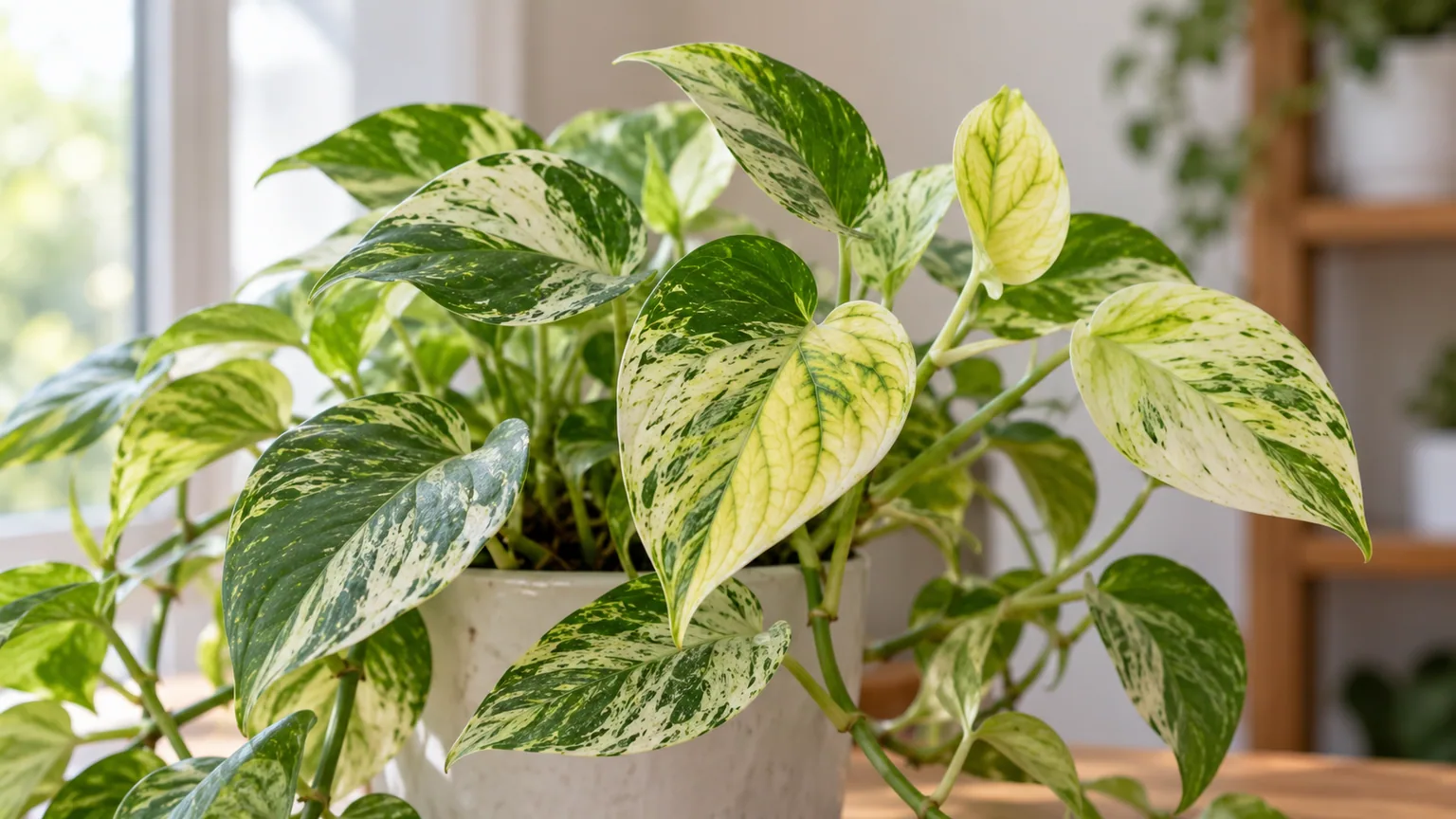
Iron Deficiency on Marble Queen Pothos: Causes, Checks & Fixes
This guide covers iron deficiency on Marble Queen Pothos. See also the general Iron Deficiency guide, watering, and light pages for this plant.
Iron Deficiency on Marble Queen Pothos: Causes, Checks & Fixes
Quick answer
Iron deficiency on Marble Queen Pothos (Epipremnum aureum ‘Marble Queen’) almost never means your potting mix contains no iron. It means the roots cannot reach the iron that is there. The signature is interveinal chlorosis on the newest leaves: tissue between the veins turns yellow while the veins stay green, and older foliage looks normal at first. For the general mechanics of iron chlorosis across houseplants, see our iron deficiency guide; on this plant, the pattern usually shows up after chronic wet mix, alkaline buildup from hard tap water, or heavy feeding locks iron out of a slow-growing variegated vine. First step: leach the pot thoroughly with clean room-temperature water, let the top 3–5 cm dry, and watch the next leaves before buying any supplement. For cultivar baseline, see the overview.
Reviewed by the LeafyPixels Review Board against NMSU Extension, Colorado State Extension, NC State Extension, Gardening Know How, and Marble Queen care data before publication.
What iron deficiency looks like on Marble Queen Pothos
New leaves emerge pale, with yellowing tissue between clearly green veins — the classic interveinal chlorosis where the leaf turns yellow and the veins remain green. Because iron is immobile inside the plant, symptoms first occur on the youngest leaves while older leaves hold their marbling. Growth slows, new vines look washed out, and in severe cases young blades turn nearly white or develop crisp brown margins before older foliage declines too.
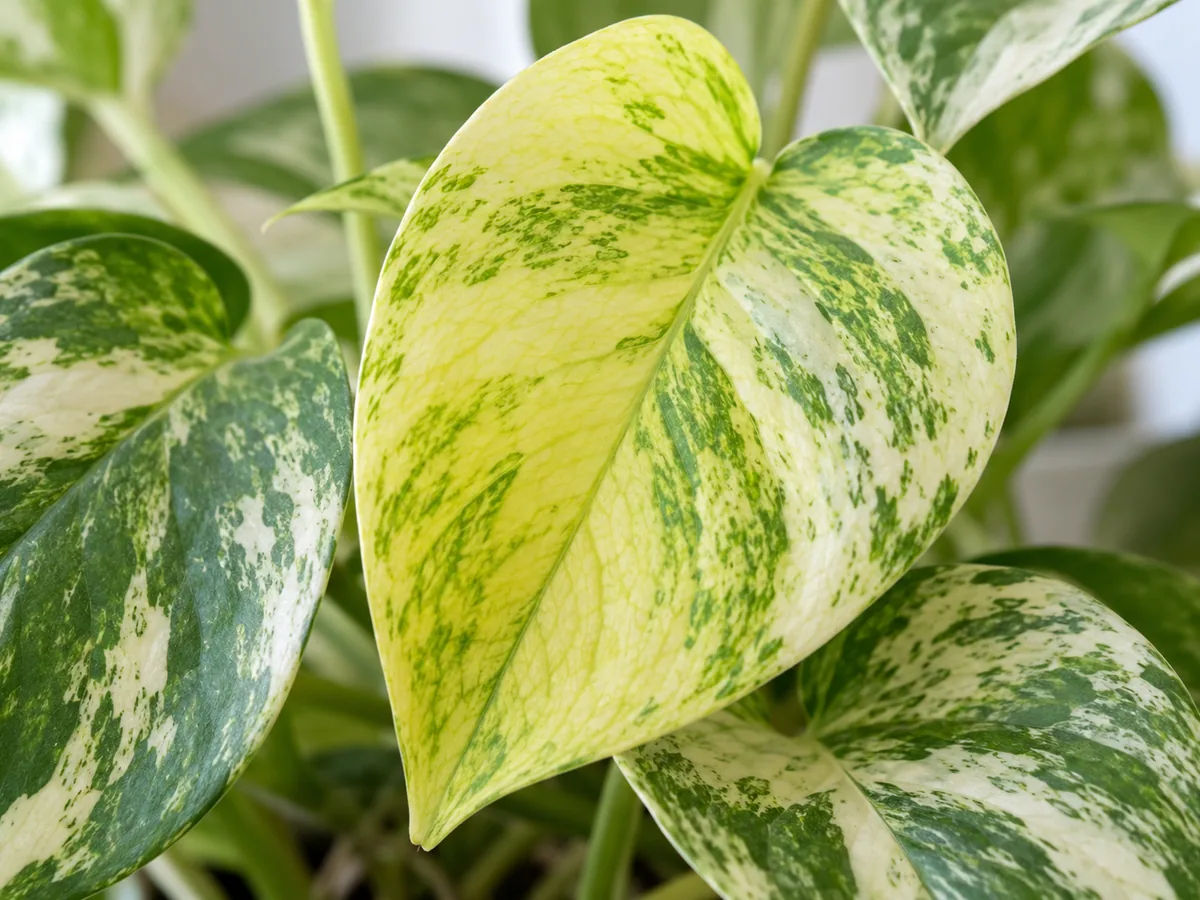
New Marble Queen leaves showing yellowing between green veins — compare with healthy marbled tissue on the same vine.
Marble Queen’s trailing habit makes the pattern easy to read along a vine: the tip end pales while the base end still shows green-and-cream marbling. Pothos is a low-maintenance cascading houseplant that normally pushes steady new tips in bright indirect light, so a vine whose newest three or four leaves all emerge chlorotic — while the pot, light, and watering have not changed — is telling you about root-zone chemistry, not light. If instead the whole vine including old leaves yellows at once, cross-check the yellow leaves guide and the overwatering guide before assuming iron.
White marbling vs true chlorosis: reading a variegated leaf
This is the section that separates Marble Queen from every solid-green pothos. Healthy Marble Queen leaves are marbled with cream-white sectors that contain little chlorophyll by design — that is variegation, not sickness. True iron chlorosis looks different: the yellowing sits in the green zones between veins, the veins themselves stay visibly darker green, and the palest new leaves lack the crisp cream-and-green edges of normal marbling, looking washed-out and uniform instead.
Two quick tests help. First, compare the suspect leaf against an older leaf on the same vine: normal variegation appears on leaves of all ages, while iron chlorosis concentrates on the youngest growth. Second, hold the leaf to bright indirect light — healthy white sectors look clean and opaque, while chlorotic tissue looks thin, yellowish-green, and veiny. New growers often mistake fading variegation for deficiency; if white areas are simply expanding or the plant is reverting, the light guide matters more than any nutrient. When low light and chlorosis overlap, fix the light placement first — a dim Marble Queen cannot use extra iron anyway.
Why Marble Queen locks out iron: the slow-drinker root zone
Marble Queen grows more slowly than solid-green Golden Pothos because its white sectors photosynthesize little, so it drinks less from the same pot on the same schedule. Watered like a fast grower, its mix stays wet for days — and symptoms get worse in heavy, poorly drained soils, while overly wet soil, compaction, and poor aeration all reduce iron availability. Soggy, airless mix damages the fine roots that absorb iron, so the plant starves amid plenty.
Alkalinity is the second lock. Iron may be plentiful in the mix but tightly bound to soil particles in high-pH conditions and unavailable for plant use, with problems typical once pH climbs past about 7.2 in alkaline soils. Marble Queen prefers pH 6.0–6.5, and two common indoor habits push pots above that: months of hard tap water leaving mineral deposits, and heavy or high-phosphorus feeding, since too much phosphorus can block iron uptake. A white salt crust on the surface, water that beads or drains slowly, and a pot that stays heavy a week after watering together describe the classic lockout setup. See the soil guide for the airy perlite mix this cultivar expects, and the fertilizer guide for its modest feeding rhythm.
How to confirm it before treating
Work newest growth backward. Check that the youngest two or three leaves show yellowing between green veins while older leaves are comparatively normal — that age pattern is the core of the diagnosis. Then inspect the root zone: push a finger 3–5 cm down, lift the nursery pot to judge weight, and look for salt crust, sour smell, or black-tipped roots at the drainage holes. Note your water and feed history over the last two months — hard tap water every time, monthly full-strength feeds through winter, or a bloom-booster fertilizer all raise the odds of lockout over true shortage.
If you can, test the mix pH with an inexpensive probe or test kit; readings consistently above 7.0 support the lockout theory on a plant that wants 6.0–6.5. Gardening Know How recommends having problem soil tested through your local extension service when pH is suspected, and that advice applies to a prized indoor pothos as much as a garden bed. Do not dose iron on guesswork: confirm the new-growth pattern plus at least one root-zone clue (wet/heavy mix, crust, high pH, or heavy feed history) before treating. When roots are clearly rotted — mushy stems, foul smell — treat that as root rot first, since dead roots cannot absorb any nutrient.
The first fix to try
Leach the pot and reset the dry-down rhythm — one intervention, then observe. Take the nursery pot to a sink, water slowly with clean room-temperature water (rainwater, distilled, or left-out tap water) until a generous volume drains freely, flushing accumulated salts and alkaline residue. Empty the saucer completely, return the plant to bright indirect light, and do not water again until the top 3–5 cm of mix feels dry — the same checkpoint in the watering guide. Hold all fertilizer until new growth looks healthy for at least two weeks.
This single reset addresses the two most common Marble Queen causes at once: salt/alkalinity buildup and chronic wetness. Iron is rarely actually absent from the soil, so freeing up uptake often restarts greener growth without any product. If the next two or three leaves still emerge with sharp interveinal chlorosis after the reset, a houseplant-labeled chelated iron product at label rate — a single soil application, not repeated doses — is the justified second step. Chelated iron chemistry matters in alkaline conditions: NMSU Extension notes that FeEDDHA is the best iron chelate for alkaline soils, that foliar sprays work best on young developing foliage, and that foliar applications should be avoided above 85°F to prevent leaf burn. Keep any iron product to one conservative application, keep the label, and never stack it with fertilizer in the same week.
Lookalikes and how to rule them out
| What you see | More likely | How to tell | Where to go |
|---|---|---|---|
| Oldest lower leaves yellow first, veins fade evenly | Nitrogen shortage or natural aging | Iron hits newest leaves; nitrogen hits oldest | Yellow leaves |
| Yellow lower leaves plus heavy wet pot, limp vines | Overwatering / root damage | Whole-plant wilt, sour mix, soft stems | Overwatering |
| Brown crispy margins after feeding, salt crust | Fertilizer burn or salt buildup | Burn follows a feed event; margins crisp first | Fertilizer burn |
| Older leaves yellow between veins, new growth okay | Magnesium or potassium issue | Opposite age pattern from iron | Potassium deficiency |
| Pale new growth plus stalled roots, high pH confirmed | Nutrient lockout | Multiple nutrients affected at once | Nutrient lockout |
| Uniformly pale soil, pH test reads high | Alkaline mix | Test-driven, not symptom-guessed | Soil too alkaline |
Iron matters because it drives chlorophyll production and enzyme function, so chlorosis from any cause looks vaguely similar — leaf age plus root-zone evidence is what separates iron from the rest. When in doubt, the problems hub at /plants/marble-queen-pothos/problems/ routes symptom to page.
Recovery timeline
Expect the problem to stop spreading before anything looks better: the next leaf should emerge less yellow than the last within two to four weeks of the leach-and-dry reset. Over the following month, new vines should show stronger green marbling and normal leaf size. Already-yellowed leaves rarely regreen fully, and bleached white growth may stay pale — prune those only once the plant is clearly pushing healthy tips, since they still photosynthesize weakly.
Warning signs mean reassess: new leaves emerging nearly white, spreading brown margins, or vines stalling entirely suggest severe chlorosis compounded by root failure, and untreated severe deficiency leads to dieback. At that point unpot, trim dead roots, repot into fresh mix per the repotting guide, and propagate insurance cuttings (below) rather than repeating iron doses into a dead root zone.
Node cuttings as insurance on bare vines
Because Marble Queen roots readily from nodes, a badly chlorotic vine is not a total loss even if its leaves never recover. Take 10–15 cm tip cuttings with at least one node and one reasonable leaf, and root them in clean water or moist perlite in bright indirect light — roots typically show in two to three weeks. This aroid-specific rescue beats nursing a leafless vine for months: fresh cuttings in fresh mix start with correct pH and no salt legacy, sidestepping the exact lockout that damaged the parent.
Keep one or two cuttings even when the parent seems to be recovering. If the mother plant relapses, you already hold clean variegated stock with known-good roots, and you can retire the exhausted parent without losing the cultivar. Log which vine the cuttings came from and whether their new leaves emerge clean — that record is itself a diagnosis of whether the parent’s pot was the problem.
How to prevent it next time
Keep the root zone where iron stays soluble: airy mix with 20–30% perlite, pH near 6.0–6.5, and a pot that dries to 3–5 cm between waterings. Feed monthly at half strength during spring and summer only, and stop feeding stressed, newly repotted, or dormant plants. If your tap water is hard, rotate in rainwater or distilled water and flush the pot freely every few months so salts never accumulate — prevention for iron is mostly prevention of alkalinity and sogginess.
Repot every one to two years in spring into fresh mix rather than topping up old, compacted medium indefinitely, since decomposed mix holds water longer and drifts alkaline. Inspect new growth monthly: the earliest sign of recurrence is faint interveinal paling on a single new leaf, which a prompt leach corrects far more easily than an established multi-vine chlorosis.
When to use this page vs other Marble Queen Pothos guides
Use this page when the youngest leaves yellow between green veins while older foliage stays comparatively normal, especially with hard-water history, salt crust, or heavy feeding behind it. Use the yellow leaves guide when old leaves yellow first or the whole plant pales at once. Use overwatering or root rot when the pot stays heavy, stems soften, or mix smells sour — fix roots before nutrients. Use nutrient lockout when several deficiencies seem present simultaneously, and soil too alkaline when a pH test confirms the chemistry. Day-to-day rhythms belong to the watering, light, soil, and fertilizer guides once the plant stabilizes.
Related Marble Queen Pothos guides
- Marble Queen Pothos overview — cultivar baseline: variegation, slow growth, and placement before diagnosing anything.
- Problems hub — route any symptom to the right fix when several pages seem to fit.
- Watering guide — the 3–5 cm dry-down checkpoint that prevents the wet-mix half of iron lockout.
- Yellow leaves — use when older foliage yellows first or the whole vine pales at once.
- Overwatering — use when a heavy pot, limp vines, or gnats point at roots rather than nutrients.
- Root rot — use when stems soften or smell turns sour; dead roots cannot take up iron.
- Nutrient lockout — use when high salts or pH seem to block several nutrients at once.
- Soil too alkaline — use when a pH test confirms alkalinity as the mechanism.
- Potassium deficiency — use when older leaves show edge yellowing and the age pattern runs opposite to iron.
- Fertilizer burn — use when symptoms trace to a recent feed and margins crisp first.
Related tool
Use the Fertilizer Dilution Calculator to mix any follow-up feed — including chelated iron products — at a safe, measured strength for iron deficiency on this plant instead of eyeballing doses into an already stressed pot.