Potassium Deficiency on Marble Queen Pothos: Causes, Checks
Quick answer
Potassium deficiency on Marble Queen Pothos shows as yellowing that browns inward from the edges of older, lower leaves while new tip growth still looks marbled. First step: leach the pot thoroughly with plain water and check feed history before adding any fertilizer, because salt buildup mimics the same scorched margins.
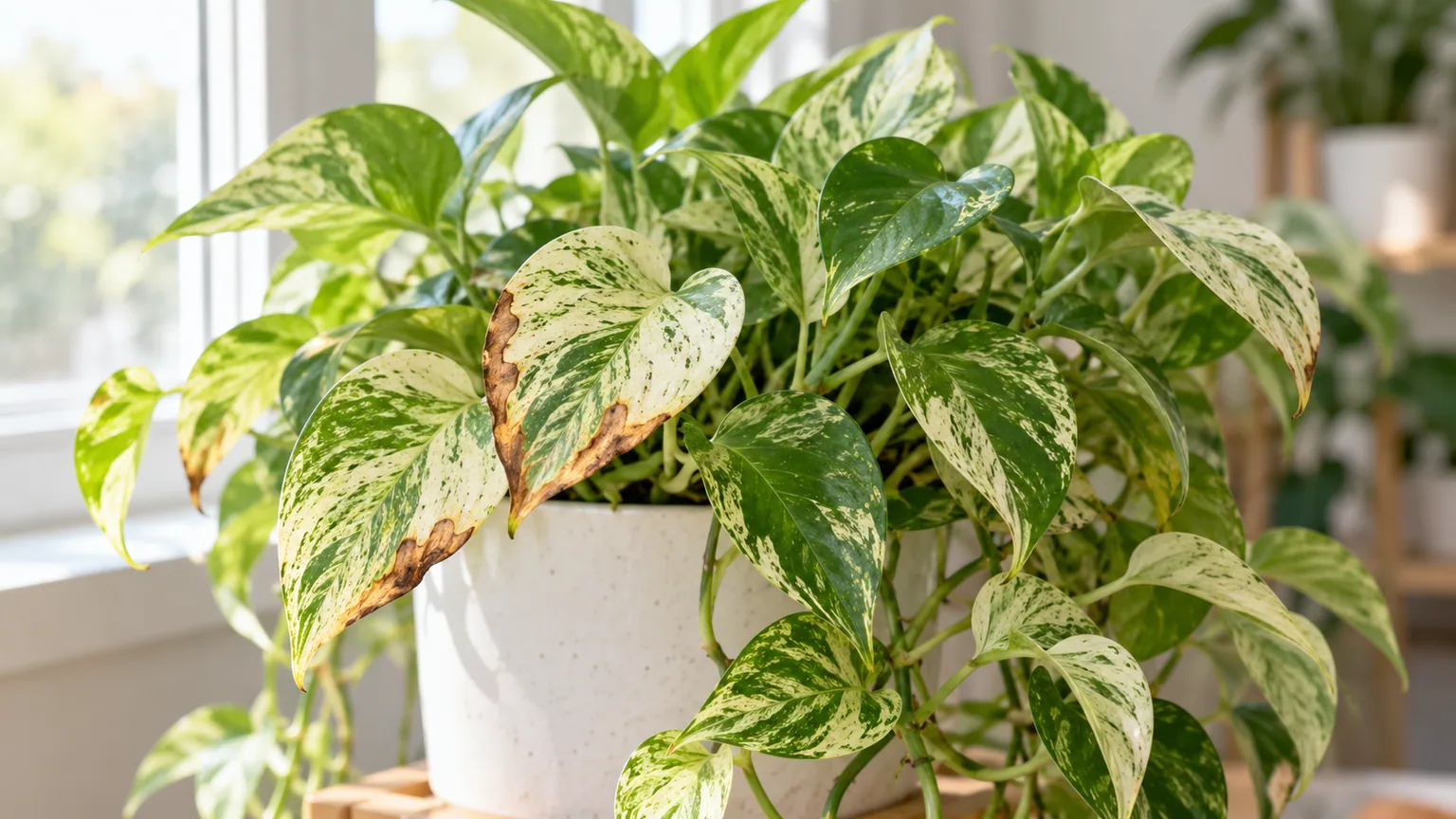
Potassium Deficiency on Marble Queen Pothos: Causes, Checks & Fixes
This guide covers potassium deficiency on Marble Queen Pothos. See also the general Potassium Deficiency guide, watering, and light pages for this plant.
Potassium Deficiency on Marble Queen Pothos: Causes, Checks & Fixes
Quick answer
Potassium deficiency on Marble Queen Pothos (Epipremnum aureum ‘Marble Queen’) shows as yellowing that turns brown and crisp starting at the edges of older, lower leaves, while new leaves at the vine tips still emerge marbled. Potassium is a mobile nutrient the plant shuttles from old tissue to new growth, so damage climbs upward from the base of the vine when supply runs out. See our potassium deficiency guide for how this mobile-nutrient pattern works across houseplants in general. On Marble Queen, read one trailing vine from pot to tip — scorched margins on leaves near the pot with clean marbled tips point to potassium before anything else.
First step: leach the pot thoroughly with plain room-temperature water and let it drain completely — then check feed history before adding any fertilizer. Salt buildup burns the exact same leaf edges, and feeding salt-stressed roots makes the damage worse. For the full cultivar baseline, see the Marble Queen overview; for dry-down rhythm detail, see the watering guide.
What potassium deficiency looks like on Marble Queen Pothos
True potassium shortage has a recognizable signature on this cultivar once you know what healthy marbled foliage looks like:
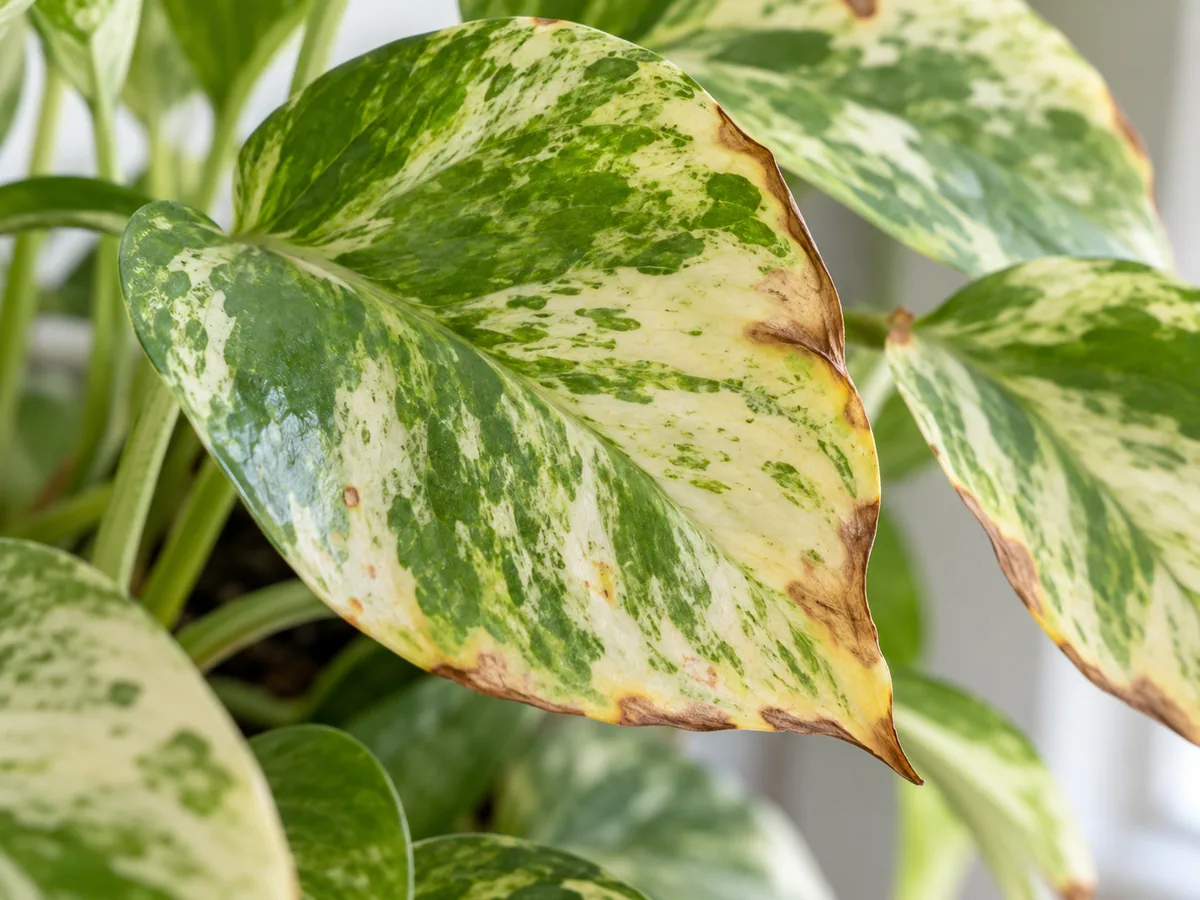
Potassium deficiency symptoms on Marble Queen Pothos — compare scorched older-leaf margins with healthy marbled tissue at the vine tip.
- Yellow margins on older leaves near the pot that turn brown and papery from the edge inward, while leaf centers stay green longest
- White and cream marbled zones scorch first — the pale tissue carries little chlorophyll and has no energy reserve to tolerate stress, so edges on highly variegated leaves crisp before greener leaves on the same vine
- A visible gradient along each trailing vine: worst damage at the base, progressively cleaner leaves toward the growing tip
- Weak, thin stems and smaller new leaves when the shortage has lasted months, with vines that stop extending
- Firm roots and appropriately moist mix when the cause is genuinely nutritional — if the pot smells sour or stems are mushy, suspect root rot on Marble Queen Pothos instead
The classic description matches extension references: browning that begins at the edges of mature leaves, sometimes with yellow or purple-red tints before the brown sets in. On Marble Queen, the variegation hides the early yellow stage — cream-white margins already look pale — so most owners first notice the brown crisping and assume underwatering.
Why Marble Queen Pothos runs short on potassium
This cultivar is set up for slow depletion rather than sudden collapse. It grows noticeably more slowly than solid-green Golden Pothos because its white sections photosynthesize less, so it needs feeding less often — NC State Extension advises to fertilize every other month except when the plant is dormant in the winter. That lean rhythm is correct, but it means a plant sitting in the same mix for two or three years quietly exhausts the available potassium while the owner changes nothing.
Repeated watering leaches potassium out of container mix faster than most owners expect — shortage is common where nutrients are easily washed away by leaching. A Marble Queen watered heavily every 7–10 days through two growing seasons without repotting or feeding is a textbook candidate. The plant-detail baseline for this cultivar (standard mix with 20–30% perlite, pH 6.0–6.5, repot every 1–2 years) exists precisely because old, compacted mix stops delivering nutrients even when fertilizer is added — cross-check the soil guide if your plant has not been repotted in that window.
Two indoor habits compound the problem. Watering for months with hard, alkaline tap water pushes mix pH above this cultivar’s preferred range, and off-pH mix locks potassium out of reach of the roots — review the soil too alkaline guide if white crust coats the pot rim. And a winter of no feeding is normal and correct, but if spring feeding never resumes while the plant pushes new vines, the potassium bill comes due on the oldest leaves first. Note that root stress such as under or over watering can induce nutrient deficiencies even when fertilizer is present, so chronically soggy or bone-dry roots can fake a deficiency on a plant that is technically being fed.
How to confirm the cause
Work along a single vine from the pot outward before touching any fertilizer bottle:
- Map the gradient. Potassium shortage is worst on the oldest leaves and fades toward the tip. If new tip leaves are equally scorched, or damage is worst on the sun-facing side only, you are likely looking at sunburn on Marble Queen Pothos or salt burn instead.
- Read the feed history. No balanced feed for 6+ months plus mix older than 18 months supports true deficiency. Regular full-strength feeding with white crust on the soil surface points the other way — toward fertilizer burn on Marble Queen Pothos.
- Check water and pH habits. Months of hard tap water, no leaching flushes, and a pot that drains slowly suggest lockout rather than absence — see nutrient lockout on Marble Queen Pothos for the full lockout workup.
- Feel stems and smell the mix. Firm stems with healthy aerial-root nubs keep deficiency on the table. Soft nodes, blackened leaf margins with a sour pot smell mean overwatering damage — compare with yellow leaves on Marble Queen Pothos before feeding.
- Rule out pests. Mealybugs and spider mites drain sap and stunt leaves, which redirects nutrients from leaves and mimics decline — inspect undersides and rule out spider mites on Marble Queen Pothos first in warm, dry rooms.
One caution from the RHS: overapplication of potassium fertilisers reduces magnesium uptake, trading one deficiency for another. That is why confirmation comes before correction — blindly dosing potassium into an unconfirmed plant risks inducing the magnesium problem described in iron deficiency on Marble Queen Pothos lookalike discussions.
The first fix to try
Leach the pot with plain room-temperature water until water runs freely from the drainage holes, let it drain fully, and only then decide whether to feed. Pour slowly and evenly so the whole root ball is rinsed, not just a channel down one side. Gardening Know How’s pothos guidance makes the same point from the other direction: it is important to water heavily and allow water to leach through the soil to prevent buildup of fertilizer, which diminishes plant health.
This single flush does two jobs at once: it washes out the salt crust that mimics potassium scorch, and it resets the root zone so that if you do feed next, the roots can actually take it up. Do not feed on the same day — let the pot reach its normal 3–5 cm dry-down first, then feed once at half strength if your history check still points to genuine depletion.
Step-by-step recovery
- Leach as above and empty the cache pot so the nursery pot never sits in runoff.
- Wait for the top 3–5 cm of mix to dry, following the Marble Queen watering rhythm.
- Apply one dose of balanced liquid houseplant fertilizer at half strength — fertilize only during the growing season and just every other month with a diluted formula. Monthly at half strength through spring and summer suits this slow cultivar; the fertilizer guide details the seasonal schedule.
- If the mix is older than two years, compacted, or drains poorly, repot into fresh standard mix with 20–30% perlite at the next spring window rather than feeding repeatedly into exhausted soil.
- Trim fully brown, papery leaf edges with clean scissors for appearance — dead margins never re-green. Keep trimmed tissue away from pets; Epipremnum aureum cultivars are toxic to cats and dogs.
- If vines are long, bare at the base, and stalled, prune back to a healthy node and root the cuttings in water — Marble Queen roots readily from node cuttings, and a fresh start in new mix often outgrows nursing a depleted old pot.
Recovery timeline
Mild cases — a few scorched older leaves on an otherwise extending vine — stabilize within two to three weeks of the flush-plus-feed correction: browning stops advancing and the next leaf at each tip opens with clean marbled edges. Moderate depletion with stalled vines needs one full growing season of correct feeding to replace damaged foliage; judge only by new tip leaves, which should emerge full-sized and marbled within four to six weeks. If browning keeps climbing toward new growth after six weeks of correct care, re-examine roots and pH rather than adding more fertilizer — persistent spread means the diagnosis, not the dose, was wrong.
Lookalike symptoms to rule out
| Pattern | Leaf look | Soil / pot | Likely cause | Next step |
|---|---|---|---|---|
| Yellow-to-brown edges, worst on oldest leaves, clean tips | Marginal scorch, centers green longest | Old mix, no feed for months | Potassium deficiency (this page) | Leach, then feed once at half strength |
| Uniform brown crispy edges plus white crust on soil | Burn on leaves of all ages | Crust, recent full-strength feeds | Salt buildup / fertilizer burn | Leach, hold feed → fertilizer burn |
| Brown patches only on sun-facing white sections | Bleached then brown pale zones | Any moisture | Sun scorch on variegation | Filter light → sunburn |
| Yellow between veins, veins stay green, older leaves | Interveinal chlorosis, less edge burn | Often after heavy potassium feeding | Magnesium shortage | Check feed balance → nutrient lockout |
| Crisp edges with light pot, wrinkled blades | Dry-feeling, thin leaves | Pulled from pot edges, very light | Underwatering | Deep soak → watering guide |
| One brown oldest leaf, firm vine, clean tips | Single basal leaf | Appropriate moisture | Normal aging — older leaves naturally turn brown and die back | No action |
Mistakes to avoid
- Feeding before flushing. Full-strength fertilizer on salt-loaded roots deepens marginal burn within days.
- Dosing potassium-only products. Excess potassium induces magnesium deficiency; use balanced feed and confirm the diagnosis first.
- Repotting, pruning, and feeding on the same day. A stressed Marble Queen reads one correction at a time — stack them and you cannot tell what worked.
- Blaming the white variegation alone. Pale sections do scorch first, but symmetric base-to-tip marginal browning is nutritional, not just “what white leaves do” — check the faded leaves guide only when marbling loss, not edge burn, is the main symptom.
- Feeding through winter dormancy. NC State’s every-other-month rhythm explicitly pauses when the plant is dormant; winter feeding into cold, slow mix creates the salt problem you are trying to fix.
Marble Queen Pothos care cross-check
Potassium problems rarely travel alone on this cultivar. Confirm bright indirect light — dim corners slow growth so much that any feeding schedule overshoots, while direct sun scorches the same white margins potassium shortage attacks. Verify the pot and mix against the soil guide and the repotting schedule: a root-bound plant in two-year-old mix cannot use added potassium no matter the dose. Browse the Marble Queen problems hub if more than one symptom pattern is active at once.
How to prevent it next time
Feed monthly at half strength with a balanced liquid fertilizer from spring through summer, pause in winter, and refresh the mix every one to two years so nutrients stay available at the right pH. Leach the pot with a deep plain-water flush two or three times a year, especially if you water with hard tap water — rainwater or filtered water reduces the crust that locks potassium out. Keep the dry-down rhythm steady: roots that swing between soggy and bone-dry cannot take up potassium even when it is present. New vines should hold their marbling with clean edges; the first yellow margin on a lower leaf is your early warning to check feed history, not to double the dose.
Conclusion
Potassium deficiency on Marble Queen Pothos is a slow-drain problem, not an emergency: months of leaching, old mix, or missed spring feeds show up as scorched margins climbing from the oldest leaves upward. Leach first, confirm with the vine-gradient check, feed once at half strength, and judge recovery by clean marbled leaves at the tips. Old brown edges will not heal, but the next flush of growth tells you whether the roots are eating again.
How we wrote and verified this guide: Recommendations were checked against RHS nutrient-deficiency and houseplant references, NC State Extension pothos culture, Gardening Know How pothos guidance, and ASPCA toxicity data cited inline. Author: sai-ananth. Reviewer: LeafyPixels Review Board. Methodology: plant problem guidance is reviewed against botanical references, extension resources, and LeafyPixels plant-care data before publication. Claims validation: claims-validator-v1 pass with inline external links documented below. Last reviewed: 2026-09-02.
When to use this page vs other Marble Queen Pothos guides
- Marble Queen Pothos fertilizer guide - Use for routine seasonal feeding schedules before assuming a specific deficiency.
- Marble Queen Pothos problems hub - Browse all common issues on this species when more than one pattern is active.
- Fertilizer Burn on Marble Queen Pothos - Different entry point when white crust and recent feeding point to excess, not shortage.
- Nutrient Lockout on Marble Queen Pothos - Different entry point when pH or old mix blocks uptake despite feeding.
- Yellow Leaves on Marble Queen Pothos - Different entry point when whole-leaf yellowing on wet soil suggests watering, not nutrition.
Related Marble Queen Pothos guides
- Marble Queen Pothos overview
- Marble Queen Pothos watering
- Marble Queen Pothos light
- Marble Queen Pothos soil
- Marble Queen Pothos fertilizer
- Fertilizer Burn on Marble Queen Pothos
- Nutrient Lockout on Marble Queen Pothos
- Iron Deficiency on Marble Queen Pothos
- Yellow Leaves on Marble Queen Pothos
- Marble Queen Pothos problems