Fertilizer Burn on Marble Queen Pothos: Causes, Checks &
Quick answer
Fertilizer burn on Marble Queen Pothos shows as crispy brown edges that hit white marbled sections first, often with white salt crust on the soil, within days of feeding. First step: leach the pot with plain water until it drains freely, discard the saucer water, and pause all feeding until new leaves open clean.
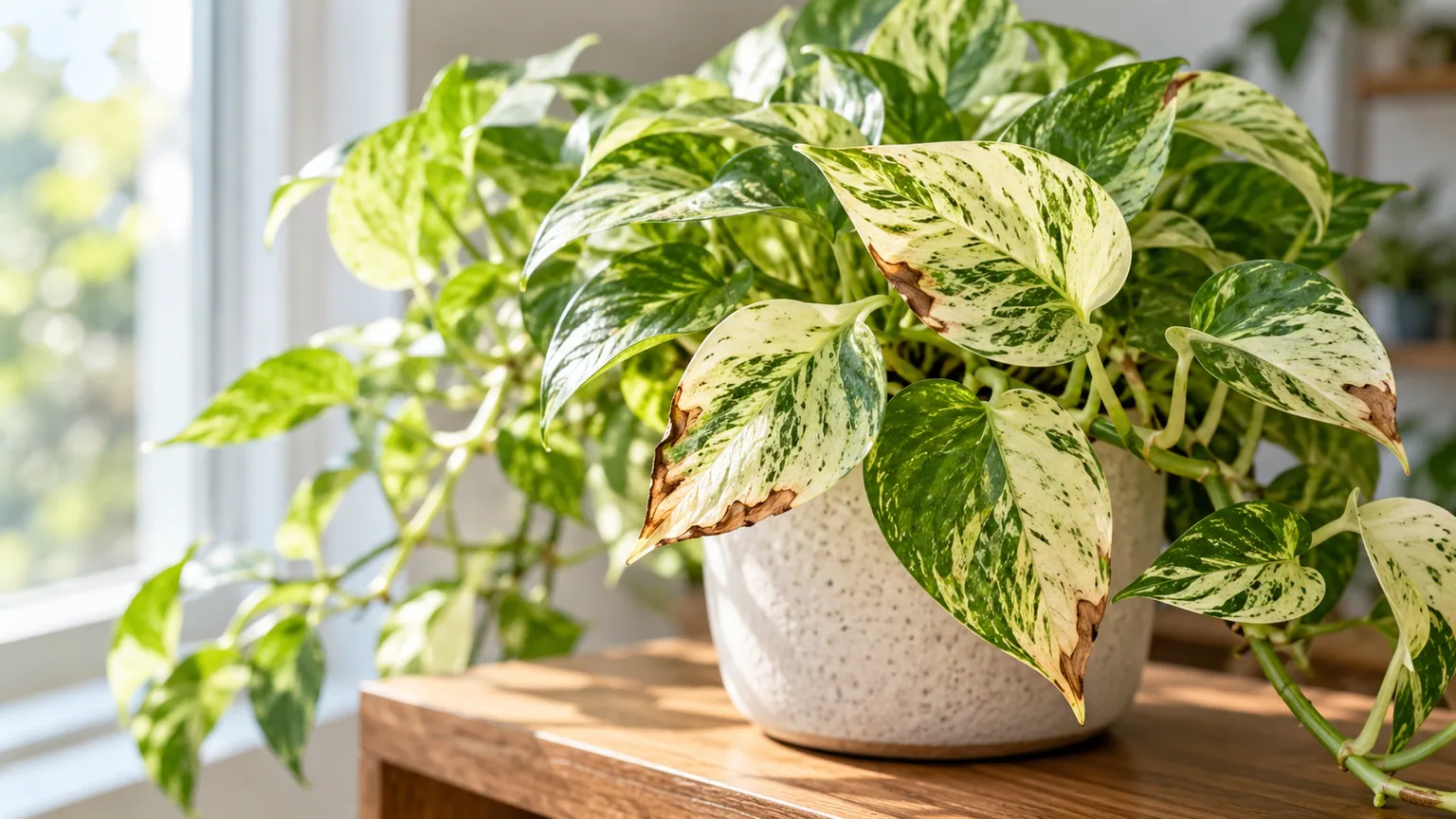
Fertilizer Burn on Marble Queen Pothos: Causes, Checks & Fixes
This guide covers fertilizer burn on Marble Queen Pothos. See also the general Fertilizer Burn guide, watering, and light pages for this plant.
Fertilizer Burn on Marble Queen Pothos: Causes, Checks & Fixes
Quick answer
Fertilizer burn on Marble Queen Pothos (Epipremnum aureum ‘Marble Queen’) is salt injury, not hunger. Dissolved fertilizer salts accumulate faster than this slow-growing variegated cultivar can use them, pulling water away from fine roots and crisping leaf margins — usually the white and cream marbled sections first, within days of an over-strong or badly timed feeding.
First step: leach the pot now. Run plain room-temperature water through the mix until it drains freely from the bottom, empty the saucer completely, and repeat two to three times. Then stop all feeding until new leaves open with clean marbling. For the general salt-injury mechanism behind what you are seeing, our fertilizer burn hub covers how excess salts damage roots; on Marble Queen, the pattern shows up first on pale variegated tissue, which is what the rest of this guide diagnoses.
What fertilizer burn looks like on Marble Queen Pothos
Burn on this cultivar has a signature that all-green pothos does not show as clearly:
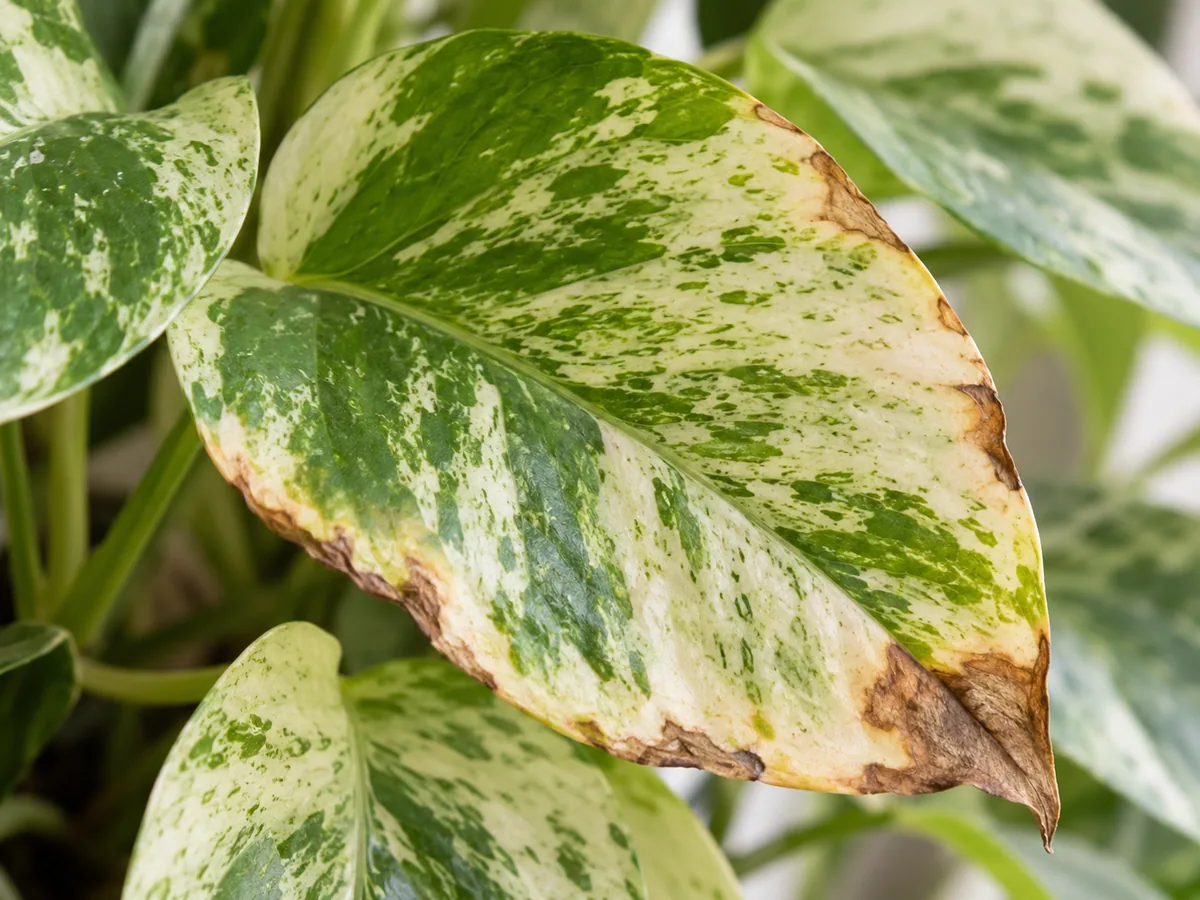
Fertilizer burn on Marble Queen Pothos — crisp brown margins starting on white marbled sectors; compare with firm green tissue on the same vine.
- Brown, papery margins and tips that start on white or cream sectors while neighboring green tissue still looks firm — the pale zones carry little chlorophyll and desiccate first
- Damage appearing days after feeding, sometimes after a single full-strength dose or a feeding applied to dry mix
- White or yellowish crust on the soil surface, pot rim, or drainage edge — visible salt deposits from accumulated minerals
- Wilting despite moist soil, because concentrated salts draw water out of roots through osmotic stress rather than drought
- Stalled new growth: unfolding leaves emerge smaller, with scorched edges already forming
- One plant burns while neighbors stay fine, because only that pot received the hot dose
Severity is usually moderate. A single overfeed crisps edges but leaves the vine alive. Repeated full-strength feeding without flushing, or feeding a dry, root-bound, or newly repotted plant, can damage feeder roots enough to collapse whole vines — treat that as urgent.
Why Marble Queen Pothos burns before other pothos
Marble Queen is a cultivar of Epipremnum aureum with heavy white and cream marbling, and those pale sectors change the feeding math. White tissue contributes almost no photosynthesis, so this cultivar grows more slowly and metabolizes nutrients at a lower rate than Golden Pothos in the same pot and light. Nutrients applied at Golden Pothos pace simply sit in the mix as soluble salts. Clemson HGIC notes that Marble Queen requires more light than other pothos varieties to hold its variegation — and in lower light, growth slows further while unused salts keep accumulating.
UF/IFAS commercial production guidelines describe how variegated Epipremnum develops burned, necrotic patches confined to variegated areas under stress. Excess soluble salts produce the same asymmetric pattern: thin variegated tissue crisps at margins while thicker green blades ride out the same salt load for another week. Wisconsin Extension confirms the mechanism from the other direction, noting that blackening of the leaf margins or tips can be caused by excess fertilizer because of buildup of salts in the soil.
The three triggers seen most on this plant:
Feeding a dry root ball. Liquid fertilizer poured onto dry mix reaches roots as a concentrated pulse instead of a diluted solution. Marble Queen in bright light dries its pot faster than owners expect, so the “water first, then feed” order matters more here than on faster-drinking green cultivars. Review your Marble Queen watering rhythm — if the top centimeters were bone-dry at feeding time, that alone can explain the burn.
Full-strength doses on a light feeder. Pothos is a light feeder by nature, and Marble Queen sits at the conservative end. The site’s Marble Queen fertilizer guide recommends half-strength balanced liquid every five to six weeks in the growing season; label-maximum rates, bloom boosters, or “a little extra for the variegation” overshoot what reduced-chlorophyll leaves can process. The Plant Manual’s pothos feeding guide warns that salt buildup from over-fertilizing shows as brown crispy leaf tips plus stalled growth, and that flushing with plain water is the remedy.
Stacked feedings without leaching. Even correct-strength fertilizer accumulates when every watering adds nutrients and none flushes through. Small pots, winter feeding when growth has paused, and slow-release granules dosed at outdoor rates all build the same invisible salt load. NC State Extension advises pothos owners to fertilize every other month except when the plant is dormant in the winter — feeding through dormancy is one of the commonest ways Marble Queen pots turn chemically hot.
How to confirm the cause
Work through these checks in order before treating — burn shares symptoms with sun scorch and dry-air tip burn, and the fix differs:
- Reconstruct feeding history. What product, what strength, and when? Damage within 3–10 days of feeding strongly implicates salts. Feeding dry mix, doubling up after a missed month, or using bloom-booster formula raises the probability further.
- Map which tissue browned. Burn starts on white and cream sectors and leaf margins. Uniform browning across green tissue, or damage only on the window-facing side, points instead to sunburn on Marble Queen Pothos.
- Look for salt crust. White deposits on the mix surface or pot rim confirm accumulation. No crust does not rule burn out — salts can injure roots before crusting visibly.
- Lift the pot and feel the mix. Wilting on moist mix is the classic osmotic-stress signal: roots cannot take up water despite its presence. Wilting on dry mix is plain underwatering — see underwatering on Marble Queen Pothos instead.
- Check new growth. Scorched edges on unfolding leaves confirm the injury is current and ongoing, not old cosmetic damage.
- Rule out pests. Flip leaves and inspect axils for webbing, stippling, or cottony clusters. Clean foliage with the timing-and-crust pattern above is salts, not mites — compare with spider mites on Marble Queen Pothos if you see stippled yellowing rather than marginal crisping.
First fix for Marble Queen Pothos
Leach the pot thoroughly with plain water today — that is the whole first fix. Use room-temperature water, pour slowly until a generous volume drains from the bottom, empty the saucer so the pot never sits in runoff, and repeat two to three times so dissolved salts wash out instead of resettling. University of Maryland Extension describes this exact remedy for indoor plants suffering fertilizer toxicity or high soluble salts: stop feeding and leach the mix with clean water.
After leaching, do one thing and nothing else for now: move the plant to bright, indirect light out of direct sun, and leave it alone. Do not repot, prune heavily, or apply tonics on the same day — a salt-stressed root system needs stable conditions, not a second shock. Resume feeding only when new leaves open clean, at half strength at the earliest four to six weeks later.
Step-by-step recovery
Once the emergency leach is done, recovery is mostly watchful waiting with one decision point:
- Scrape off visible crust. After the pot drains, remove white salt deposits from the soil surface and pot rim so the next watering does not dissolve them back into the root zone.
- Hold all fertilizer for four to six weeks. This includes liquid feeds, spikes, and slow-release top-ups. Burned roots cannot use nutrients; every addition raises the salt load again.
- Water normally on the dry-top-soil rhythm. Let the top 3–5 cm dry, soak until drainage, empty the saucer. Steady moisture without re-feeding lets damaged feeder roots regrow.
- Trim for cosmetics only after new growth looks clean. Snip dead brown edges with clean scissors; scorched tissue never re-greens. Keep trimmed leaves away from pets — all Epipremnum aureum cultivars are toxic to cats and dogs.
- Decide on repotting at week two. If new growth stalls, stems soften at nodes, or the mix smells sour, unpot and inspect: white firm roots mean keep waiting; brown mushy roots mean trim rot and repot in fresh mix per the Marble Queen repotting guide. Repotting is a second intervention for confirmed root damage, never a day-one reflex.
- Restart feeding conservatively. When two successive new leaves open with clean marbling, resume at half the label strength on moist soil — the schedule in the Marble Queen fertilizer guide is the maintenance target.
Node-cutting rescue for badly damaged vines
Pothos-specific biology offers a backup that most houseplants lack. If the root ball is severely damaged but vine tips still carry firm nodes with aerial-root nubs, snip 10–15 cm tip cuttings below a node and root them in plain water in bright indirect light — new roots typically appear in two to three weeks. Root cuttings only from clean, unscorched sections, and never feed the propagation jar. This preserves the cultivar’s exact marbling while the mother plant recovers, and it works because each cutting is a genetic clone of the parent vine.
Recovery timeline
- Days 1–3: Spread stops after a proper leach. No new crisping on previously healthy margins means the salt load is down.
- Weeks 1–2: The plant looks the same — burned edges stay brown. Success at this stage is simply no further collapse and firm stems.
- Weeks 3–6: New leaves begin opening. Clean marbling with intact edges confirms recovery; scorched unfolding leaves mean salts remain and a second flush is warranted.
- Weeks 6–10: Steady production of normally sized marbled leaves at the vine tips. Only now is it safe to resume half-strength feeding.
If the vine keeps declining after two proper flushes — spreading stem softness, successive leaves collapsing, no new growth in six weeks — the root system may be beyond rescue. Take healthy tip cuttings if any remain, then compost the rest rather than pouring more products on it.
Lookalike symptoms
| What you see | More likely | How to tell apart |
|---|---|---|
| Browning only on the window side, papery patches on pale areas | Sunburn on Marble Queen Pothos | Follows a move into direct sun; no feeding link, no salt crust |
| Crisp tips on firm leaves, dry air, winter heating | Brown tips on Marble Queen Pothos | Gradual over weeks, worst near heat vents; feeding history unremarkable |
| Yellow soft leaves on wet mix, sour soil smell | Root rot on Marble Queen Pothos | Stems soften at the base; check the overwatering pattern first |
| Uniform pale new leaves, no marginal burn | Nutrient deficiency or not enough light | Slow fade over months, not crisping days after feeding |
| Stippled yellowing plus fine webbing | Spider mites | Moving specks and webbing on leaf undersides; salts leave foliage clean |
What not to do
- Do not feed a stressed plant. Fertilizer is maintenance for actively growing Marble Queen, never a rescue tonic for burned, wilted, or newly repotted vines.
- Do not fertilize dry mix. Water first, let excess drain, then apply diluted feed to moist soil.
- Do not stack interventions. Repotting, hard pruning, and pesticide sprays on leach day compound root shock — one correction at a time.
- Do not feed through winter dormancy. When growth stalls in low winter light, skip feeding entirely until spring pushes new marbled leaves.
- Do not use bloom boosters or full label rates. Marble Queen is grown for foliage; high-phosphorus formulas add salts without matching what reduced-chlorophyll leaves consume.
- Do not mist scorched leaves to “rehydrate” them. Dead margins cannot absorb water, and wet foliage overnight invites secondary leaf-spot problems.
Marble Queen Pothos care cross-check
Burn often exposes a background care mismatch. Run this quick audit while the plant recovers: light should be bright indirect — within a couple of meters of an east window or behind a sheer curtain at a south window — per the Marble Queen light guide, since dim light slows nutrient uptake and makes every dose hotter. Soil must drain freely; dense or exhausted mix traps salts, so compare yours against the Marble Queen soil guide. Pot size matters too — oversized pots hold unused fertilizer in unreachable mix. Full baselines live in the Marble Queen overview.
How to prevent it next time
- Feed at half label strength, every five to six weeks, only from mid-spring through early fall while new marbled leaves are actively unfurling.
- Always apply to moist soil, and skip any feeding when the plant is dry, stressed, newly repotted, or dormant.
- Flush the pot with plain water two to three times whenever white crust appears on the surface, and as a routine reset every two to three months in the feeding season.
- Keep slow-release granules away from small pots, where a fixed dose concentrates salts fastest.
- Let the plant set the pace: firm new leaves with crisp white marbling mean the schedule is working; smaller, greener, or scorched new growth means pull back and add light before adding food. If yellowing returns without any feeding link, compare the yellow leaves guide and the slow growth guide before reaching for the fertilizer bottle.
When to worry
Treat as urgent if foliage scorches within days of feeding, the plant wilts on wet mix, stems soften at nodes, or several leaves fail at once — flush the same day. Escalate to unpotting if decline continues after a proper leach. If vines collapse entirely but a few firm tip nodes survive, the node-cutting rescue above preserves your plant’s exact variegation. Full-pot collapse with mushy stems and no firm nodes means the plant is spent.
Related Marble Queen problems
Use this page when damage follows feeding and hits white sectors first; follow the link that matches what you confirmed:
- Marble Queen overview — cultivar care baseline for light, water, and variegation
- Marble Queen fertilizer — safe feeding strengths and seasonal schedule
- Brown tips on Marble Queen — multi-cause tip-burn hub when feeding history is unclear
- Yellow leaves on Marble Queen — yellowing-first patterns and senescence vs stress
- Brown leaves on Marble Queen — whole-leaf browning beyond marginal burn
- Sunburn on Marble Queen — light-side scorch without a feeding link
- Root rot on Marble Queen — mushy roots and stem collapse from chronic wet mix
- Overwatering on Marble Queen — yellow soft leaves on saturated soil
- Marble Queen problems hub — symptom-first path across all issues on this cultivar
Conclusion
Fertilizer burn on Marble Queen Pothos is almost always a dosing or timing error on a light feeder, not a disease — and the white marbling that makes this cultivar beautiful is also the early-warning system, crisping before green tissue when salts spike. Leach once, pause feeding for a month or more, and judge everything by the next clean marbled leaves. Old brown edges will never heal, but new growth tells you whether the salt load is truly gone. Feed conservatively, water first, flush when crust appears, and the variegation largely takes care of itself.
How we wrote and verified this guide: Recommendations were checked against University of Wisconsin Extension, NC State Extension, Penn State Extension, UF/IFAS, University of Maryland Extension, Clemson HGIC, The Plant Manual, and ASPCA references cited inline. Author: sai-ananth. Reviewer: LeafyPixels Review Board. Methodology: plant problem guidance is reviewed against botanical references, extension resources, and LeafyPixels plant-care data before publication. Claims validation: claims-validator-v1 pass with inline external links documented below. Last reviewed: 2026-09-08.
When to use this page vs other Marble Queen Pothos guides
- Marble Queen Pothos fertilizer guide — Use for routine feeding strengths and schedules; use this page when feeding has already caused damage.
- Marble Queen Pothos problems hub — Browse all common issues on this species when the cause is still open.
- Brown Tips on Marble Queen Pothos — Different entry point when tip burn has no clear feeding link.
- Sunburn on Marble Queen Pothos — Different entry point when scorch follows a light change rather than a feeding.
- Root Rot on Marble Queen Pothos — Different entry point when stems soften and mix smells sour on chronically wet soil.
Related Marble Queen Pothos guides
- Marble Queen Pothos overview
- Marble Queen Pothos watering
- Marble Queen Pothos light
- Marble Queen Pothos soil
- Marble Queen Pothos fertilizer
- Marble Queen Pothos repotting
- Brown Tips on Marble Queen Pothos
- Yellow Leaves on Marble Queen Pothos
- Sunburn on Marble Queen Pothos
- Marble Queen Pothos problems