Soil Too Alkaline on Marble Queen Pothos: Causes, Checks &
Quick answer
Soil too alkaline on Marble Queen Pothos shows as pale new leaves with dark green veins, washed-out white marbling, and no response to fertilizer while older vines look normal. First step: test damp mix pH at mid-pot depth — if it reads above 7.0, stop feeding and repot into fresh slightly acidic mix with perlite.
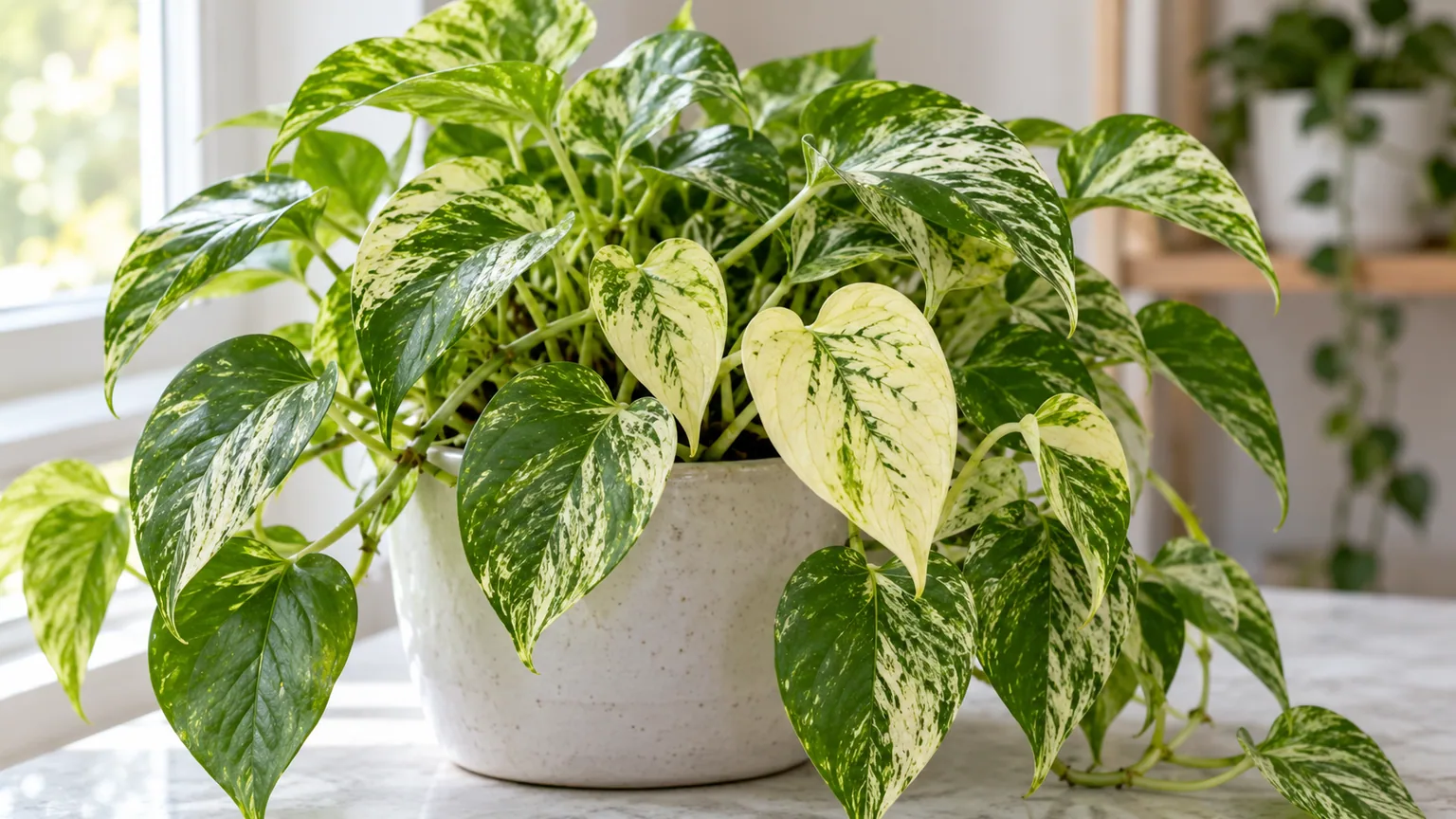
Soil Too Alkaline on Marble Queen Pothos: Causes, Checks & Fixes
This guide covers soil too alkaline on Marble Queen Pothos. See also the general Soil Too Alkaline guide, watering, and light pages for this plant.
Soil Too Alkaline on Marble Queen Pothos: Causes, Checks & Fixes
Quick answer
On Marble Queen Pothos (Epipremnum aureum ‘Marble Queen’), alkaline mix damage shows up first as pale new leaves with dark green veins, washed-out white marbling, and fertilizer that seems to do nothing. Marble Queen is a cultivar of Epipremnum aureum with heavy white variegation and slower growth than all-green pothos, so new leaves starve for iron while older trailing vines still look acceptable. When mix pH drifts above 7.0, iron becomes less available to roots even when iron is present in the pot.
First step: test damp mix pH at mid-pot depth with a probe or slurry kit. Above 7.0, stop all fertilizer and plan a repot into fresh slightly acidic mix around pH 6.0-6.5 as described in our soil guide. Mild cases often push one clean new leaf within three to four weeks; vines pale for months may need six to eight weeks.
For how high pH blocks iron uptake in general, see our soil too alkaline guide. On Marble Queen Pothos, the pattern usually shows up as bleached marbling between green veins on the newest leaf, not uniform yellowing of old leaves.
This page owns high-pH iron lockout on Marble Queen. Building the right aroid blend from scratch belongs on the Marble Queen Pothos soil guide. Opposite chemistry (sour mix below pH 5.5) behaves differently — see nutrient lockout when pH reads normal but feeding still fails.
What soil too alkaline looks like on Marble Queen Pothos
Alkalinity is a new-growth problem first. Older leaves on the same vine often keep their marbled pattern while the unfurling tip tells the story.
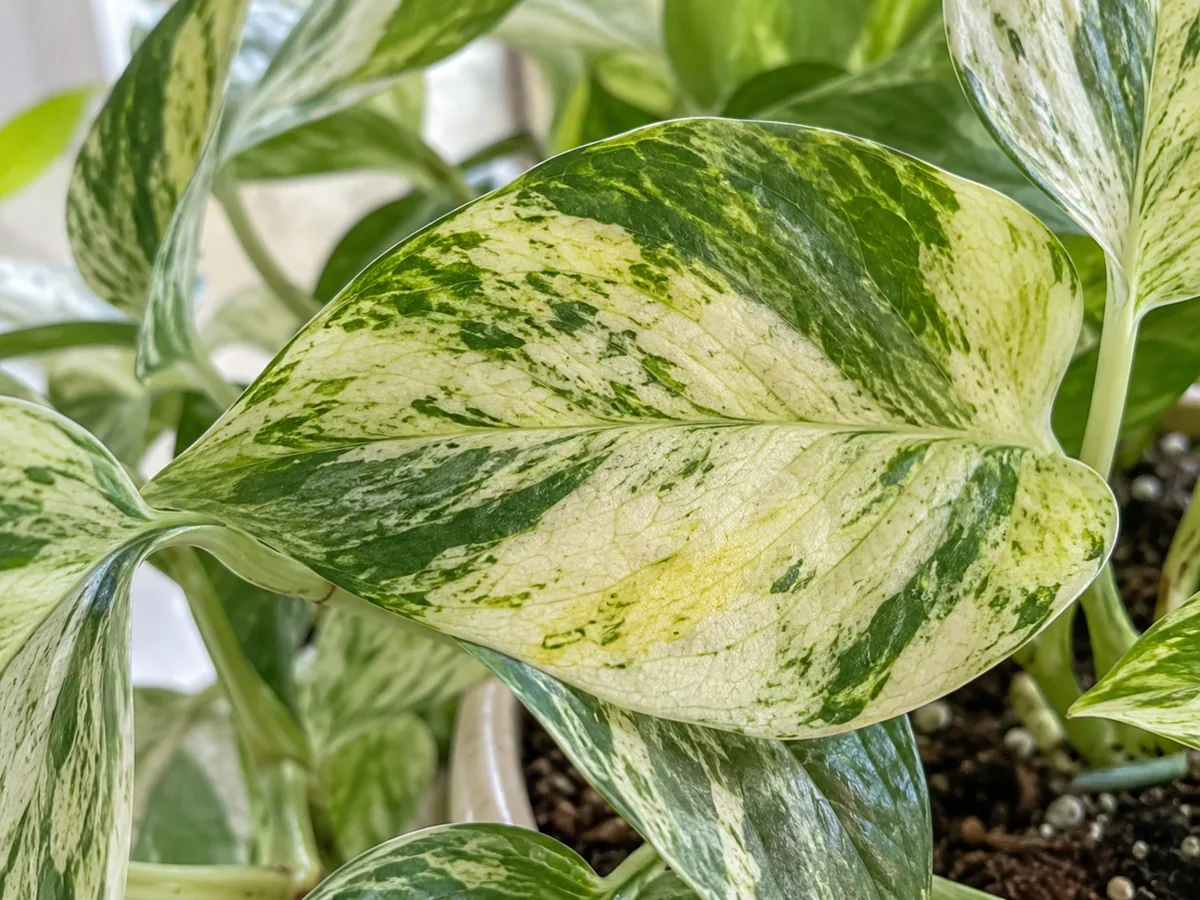
Interveinal chlorosis on a new Marble Queen leaf — pale tissue between dark veins with washed-out marbling.
Typical signs include:
- Interveinal chlorosis — yellow or pale tissue between dark green veins on young leaves, because iron is immobile and new growth suffers first
- Bleached, washed-out marbling on new leaves; white sectors look thin and papery rather than crisp
- Smaller new leaves that take longer than usual to unfurl fully
- No response to fertilizer even after a balanced liquid feed at half strength
- White or gray crust on the soil surface or pot rim from mineral and fertilizer salts
- Stalled vine tips while stems stay firm and soil moisture feels normal
What alkaline soil does not look like: whole lower leaves yellowing from the petiole outward in soggy mix (overwatering), long bare vines with solid green new leaves in a dim corner (not enough light), or soft black stems with sour-smelling mix (root rot).
How Marble Queen marbling shows chlorosis first
Marble Queen carries fine white-and-green marbling with large chlorophyll-free flecks, unlike the broad cream swirls of Manjula. On an all-green pothos, iron stress must yellow solid tissue before it is obvious. On Marble Queen, pale flecks bleach to yellow-white while the vein network stays forest green — a pattern easy to dismiss as “extra variegation” or faded leaves from bright light.
The tell is vein contrast on the newest unfurling leaf: hold it to the light and look for lemon-pale tissue between dark veins on the white-marbled zones, while a mature leaf two nodes back still shows crisp marbling. Check the leaf still opening at the vine tip, not a six-month-old blade. White sectors that also feel thinner than usual point toward chlorosis rather than healthy variegation.
Diagnostic visual checks
Use these two checks at home and photograph them if you want a before-and-after comparison:
Check 1 — pH probe at mid-pot depth: Push a digital meter into damp mix at the center of the root ball, not the dry dusty surface. A reading of 7.2-7.8 plus white crust on the rim on a Marble Queen that has not been repotted in two years strongly supports alkalinity. Cheap probes drift — calibrate yearly and retest with a distilled-water slurry if the number looks borderline.
Check 2 — newest-leaf vein pattern: Pale yellow-green tissue between dark veins on the newest leaf, with older leaves on the same vine still marbled normally, fits iron lockout better than nitrogen shortage (which yellows older leaves too) or iron deficiency from genuinely empty mix (rare indoors without a pH cause).
Why Marble Queen Pothos gets alkaline soil
Pothos roots are adaptable, but nutrient uptake depends on pH staying slightly acidic. Several ordinary indoor habits push Marble Queen mix toward alkalinity over months or years:
Hard, alkaline tap water. Irrigation water with high carbonate content gradually raises mix pH, especially in small pots that are watered often. Alkaline irrigation water plus fertilizer choice has the greatest effect on media pH over time. If you never flush and your region has hard water, alkalinity is far more likely than if you alternate with rainwater or filtered water.
Old, broken-down peat mix. Peat-heavy bagged mix compacts as organic matter decomposes, holding minerals and shifting chemistry. Plants not repotted for two or more years often sit in dense substrate — overlap with compacted soil is common when drainage also slows.
Wrong amendments. Garden soil, crushed limestone, shell grit, wood ash, or unbuffered coir without perlite can hold pH above what aroids tolerate indoors. Marble Queen needs the standard airy blend from the soil guide, not calcium-rich top-dressings.
Salt buildup from fertilizer and tap water. Repeated feeding without flushing leaves mineral crust on the surface. Growers see pale leaves, assume hunger, and feed again — accelerating the cycle. This is why alkaline lockout and nutrient lockout often arrive together.
Oversized pots with stagnant mix. Excess wet soil around a small root ball slows root activity and lets salts concentrate where feeding roots sit. See pot too large if the plant dries far slower than the watering guide suggests.
Marble Queen is not a heavy feeder. Because its white sectors photosynthesize weakly, it grows more slowly than golden pothos and needs moderate nutrients in the right pH window — not more fertilizer in mix that cannot deliver iron.
How to confirm the cause
Work through these checks in order so you do not repot a plant that only needs brighter light or drier soil.
- Test pH. Insert a probe into damp mix at mid-pot depth, or mix a slurry sample with distilled water and test strips. Above 7.0 supports alkalinity; 6.0-6.5 is the target for Marble Queen.
- Compare new versus old leaves. Alkalinity hits the newest one or two leaves per vine first. Uniform yellowing on lower leaves with wet soil points to overwatering instead.
- Check the soil surface. Thick white crust plus pale new growth suggests combined salt buildup and high pH. Scrape a little crust — if it returns within weeks, flushing alone will not be enough.
- Review water source. Straight hard tap water with no flushing makes alkalinity likely; rainwater or filtered water makes it less likely.
- Assess light. New leaves that are entirely green with long gaps between nodes mean increase light. Pale tissue between dark veins with the variegation pattern intact means pH or nutrients.
- Optional root peek. If mix smells sour or stems soften at nodes, slide the plant out and inspect for root rot before assuming chemistry alone. Many trees and plants suffer iron chlorosis induced by high alkaline soil pH, and a soil test confirms mineral versus pH causes when home probes disagree.
Alkaline versus acidic versus other lookalikes on Marble Queen
| Pattern | pH clue | Leaf pattern on Marble Queen | First routing step |
|---|---|---|---|
| Alkaline iron lockout | Above 7.0; white crust common | Pale tissue between dark veins on newest leaves; marbling bleaches first | This page — test pH, repot into acidic mix |
| Salt / nutrient lockout | pH may read normal | Crispy brown tips after feeding; white crust; pale growth despite feeding | Nutrient lockout |
| Overwatering / rot | pH often normal | Yellow from base of lower leaves; soft stems; wet sour mix | Overwatering / root rot |
| Low light reversion | pH normal | Solid green new leaves; long bare internodes | Not enough light |
| Natural variegation | pH normal | Crisp white marbling, firm texture, normal leaf size | Marble Queen Pothos overview — no fix needed |
First fix for Marble Queen Pothos
Make one correction first:
If pH reads above 7.0: Stop all fertilizer. Repot into fresh standard potting mix blended with 20-30% perlite, targeting pH 6.0-6.5 per the soil guide. Choose a pot only one size larger with a drainage hole, following Epipremnum growing conditions. Tease away the outer third of old mix without bare-rooting a healthy plant. Water thoroughly once, empty the saucer, and wait two weeks before any half-strength feed.
Do not top-dress with garden lime, wood ash, or crushed eggshells. Do not acidify blindly with vinegar drenches — they swing pH briefly and stress roots without stabilizing the mix.
If pH is only slightly high (7.0-7.3) with light surface crust and otherwise healthy roots, a double flush — water until excess runs free, wait thirty minutes, repeat — may buy time until spring repotting. Marble Queen sitting in the same mix for more than two years usually needs fresh substrate, not another flush.
Step-by-step recovery
After repotting into slightly acidic mix:
- Place the plant in bright indirect light so it can use nutrients and dry the pot on a predictable schedule. See the light guide for placement that protects white sectors from scorch.
- Resume watering when the top 3-5 cm of mix is dry — roughly every 7-10 days in summer, longer in winter per the watering guide.
- Wait until you see one clean new leaf with crisp marbling before applying balanced liquid fertilizer at half strength monthly in spring and summer. See the fertilizer guide for rates.
- Trim severely bleached leaves only after two newer leaves look healthy; damaged tissue will not re-green.
- Flush the pot every two to three months if you continue using hard tap water — water deeply until runoff is clear, following flushing guidance for pothos.
If chlorosis persists on new leaves six weeks after repotting despite pH 6.0-6.5 mix, consider a chelated iron foliar spray per label directions as a short-term bridge while roots re-establish. Fix the root zone first; sprays alone do not replace repotting.
Recovery timeline
Mild chlorosis on one or two vines often stabilizes within three to four weeks after repotting, once the next leaf unfurls clean. Vines pale for months may need six to eight weeks and several new leaves before marbling looks crisp again.
Old bleached tissue does not recover color. Judge success by new growth — clean marbling, normal leaf size, firm vine tips — not by older leaves re-greening.
Lookalike symptoms
| Pattern | Likely cause | Key difference |
|---|---|---|
| Yellow between veins on newest leaves only | Alkaline mix / iron lockout | pH above 7.0; fertilizer ineffective |
| Yellow from base of lower leaves, wet pot | Overwatering / root stress | Heavy soil days after watering; sour smell |
| Solid green new leaves, long gaps on vine | Not enough light | No interveinal pattern; pH normal |
| Uniform pale yellow on whole leaf, old leaves too | Nitrogen shortage | Affects older leaves first; pH usually in range |
| Brown crispy edges on white sectors only | Low humidity or salt burn | Margins only; newest veins stay normal |
Mistakes to avoid
Do not keep fertilizing a pale Marble Queen when pH is high — salts accumulate and burn the thin white margins. Do not repot into pure peat without perlite; it compacts and holds water against slow-growing variegated roots. Do not use garden soil indoors. Do not assume bleached marbling is “extra variegation” — compare vein color on the newest leaf. Do not stack repotting, hard pruning of every vine, and double fertilizer on the same day.
How to prevent alkaline soil next time
Refresh mix every one to two years in spring using the perlite-rich blend from the soil guide. If your tap water is hard, flush periodically or alternate with filtered or rainwater. Feed lightly during active growth per the fertilizer guide and skip fertilizer when the plant is stressed or newly repotted. Match pot size to the root ball per the repotting guide so unused mix does not stay wet and salty. Track pH once a year if chlorosis has happened before.
When to worry
Alkalinity is rarely an overnight emergency. Worry when every new leaf on multiple vines chloroses within a few weeks, growth stops entirely, or firm stems begin softening while mix stays wet — those signs may mean root rot or chronic overwatering on top of bad chemistry. A single pale new leaf on an otherwise vigorous trailing plant is a cue to test pH, not panic.
When to use this page vs other Marble Queen Pothos guides
- Marble Queen Pothos overview — start here for whole-plant context before deep-diving this chemistry issue.
- Marble Queen Pothos problems hub — jump here when this chemistry fix does not match your leaf pattern.
- Iron Deficiency on Marble Queen Pothos — use when new leaves show vein-contrast chlorosis but mix pH tests normal and the pot is fresh.
- Nutrient Lockout on Marble Queen Pothos — use when salt crust and feeding failure dominate and pH may still read in range.
Related Marble Queen Pothos guides
- Marble Queen Pothos overview — cultivar context and care map
- Soil guide — building pH 6.0-6.5 aroid mix; use this page when mix chemistry is already wrong
- Iron Deficiency — vein-contrast chlorosis when pH tests normal
- Nutrient Lockout — salt crust with pale growth when pH may still read normal
- Compacted Soil — aged peat that raises pH and slows drainage together
- Overwatering — yellow base leaves on wet mix; often overlaps with alkaline chemistry in old pots
- Root Rot — soft stems and sour mix after chronic wet plus salt stress
- Not Enough Light — solid green reversion without interveinal pattern
- Faded Leaves — variegation washout from light stress versus pH chlorosis
- Watering guide — dry-down rhythm after repot recovery
Related tool
Use the Plant Problem Diagnosis Tool to narrow causes for soil too alkaline on this plant before changing multiple variables at once.