Heat Stress on Marble Queen Pothos: Causes, Checks & Fixes
Quick answer
Heat stress on Marble Queen Pothos shows as limp variegated leaves, curling leaf edges, and brown scorched patches that hit the white marbled zones first. First step: move the pot out of direct heat into a stable bright-indirect spot around 18–29°C and check soil moisture before watering — a wilted plant in hot air is not always a thirsty plant.
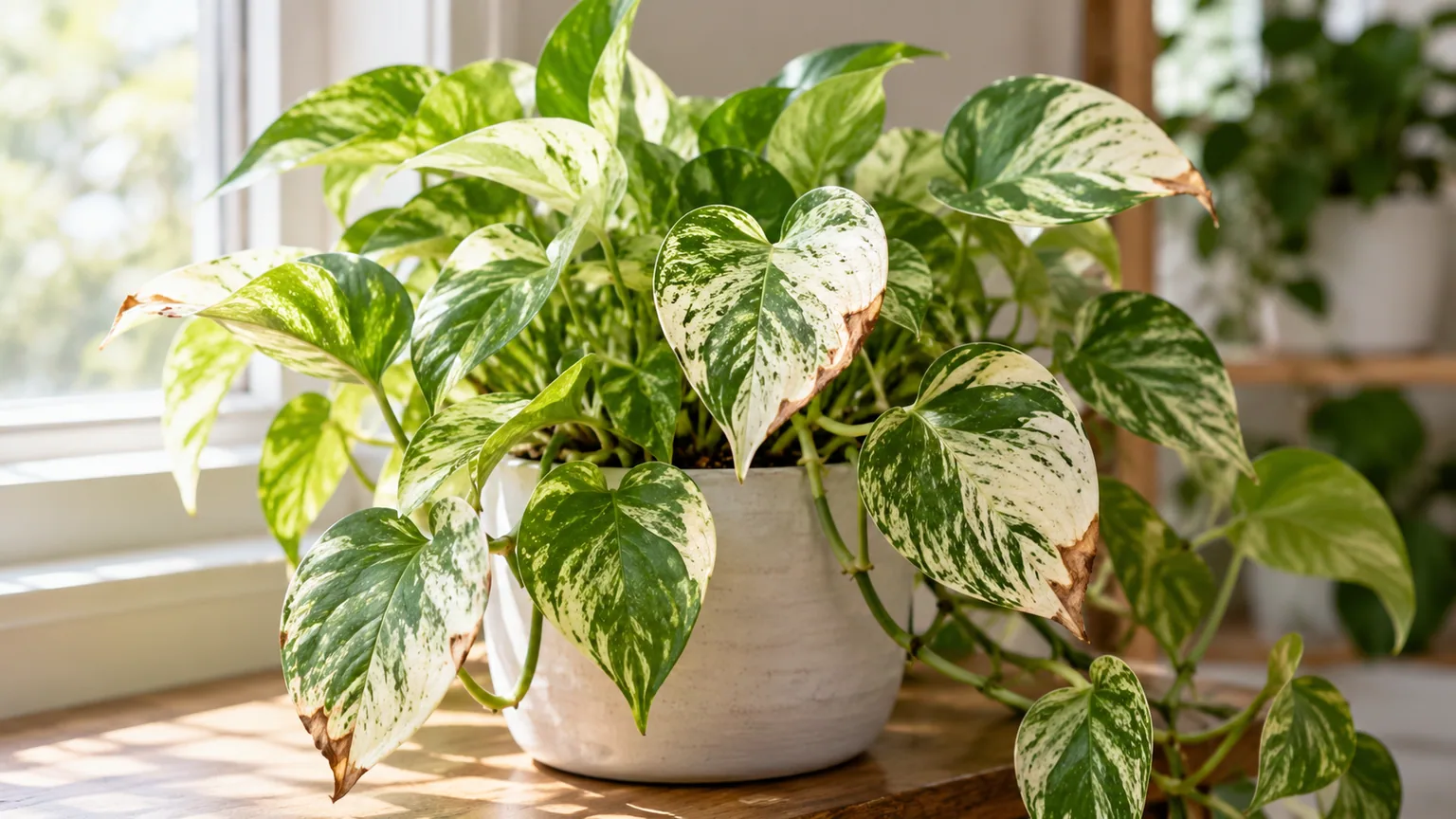
Heat Stress on Marble Queen Pothos: Causes, Checks & Fixes
This guide covers heat stress on Marble Queen Pothos. See also the general Heat Stress guide, watering, and light pages for this plant.
Heat Stress on Marble Queen Pothos: Causes, Checks & Fixes
Quick answer
Heat stress on Marble Queen Pothos (Epipremnum aureum ‘Marble Queen’) shows as limp variegated leaves that do not perk up after watering, edges curling inward, and brown papery patches concentrated on the white marbled zones. The plant loses water through its leaves faster than the roots can replace it in hot air, so foliage wilts even when the mix is damp. Marble Queen suffers visibly before solid-green pothos because its pale sections hold less chlorophyll and scorch first.
First step: move the pot out of the heat — away from hot window glass, radiators, heat vents, and sun-baked outward-facing walls — into a stable spot with bright, indirect light around 18–29°C (65–85°F). Then check the soil before adding any water. For how heat wilt works in houseplants generally, see our heat stress hub. On Marble Queen, the pattern usually shows up as scorched white margins plus limp vines while the nodes stay firm.
What heat stress looks like on Marble Queen Pothos
On this cultivar, heat damage reads as a two-part pattern: whole-plant wilt plus selective scorch of the palest tissue. Leaves feel soft and limp rather than dry-crisp at first, and the edges may cup or curl inward as the plant tries to slow water loss. Within a day or two of a heat event, the white and cream marbling develops tan-to-brown papery patches, often starting at leaf margins and tips, while the green zones on the same leaf can still look intact.
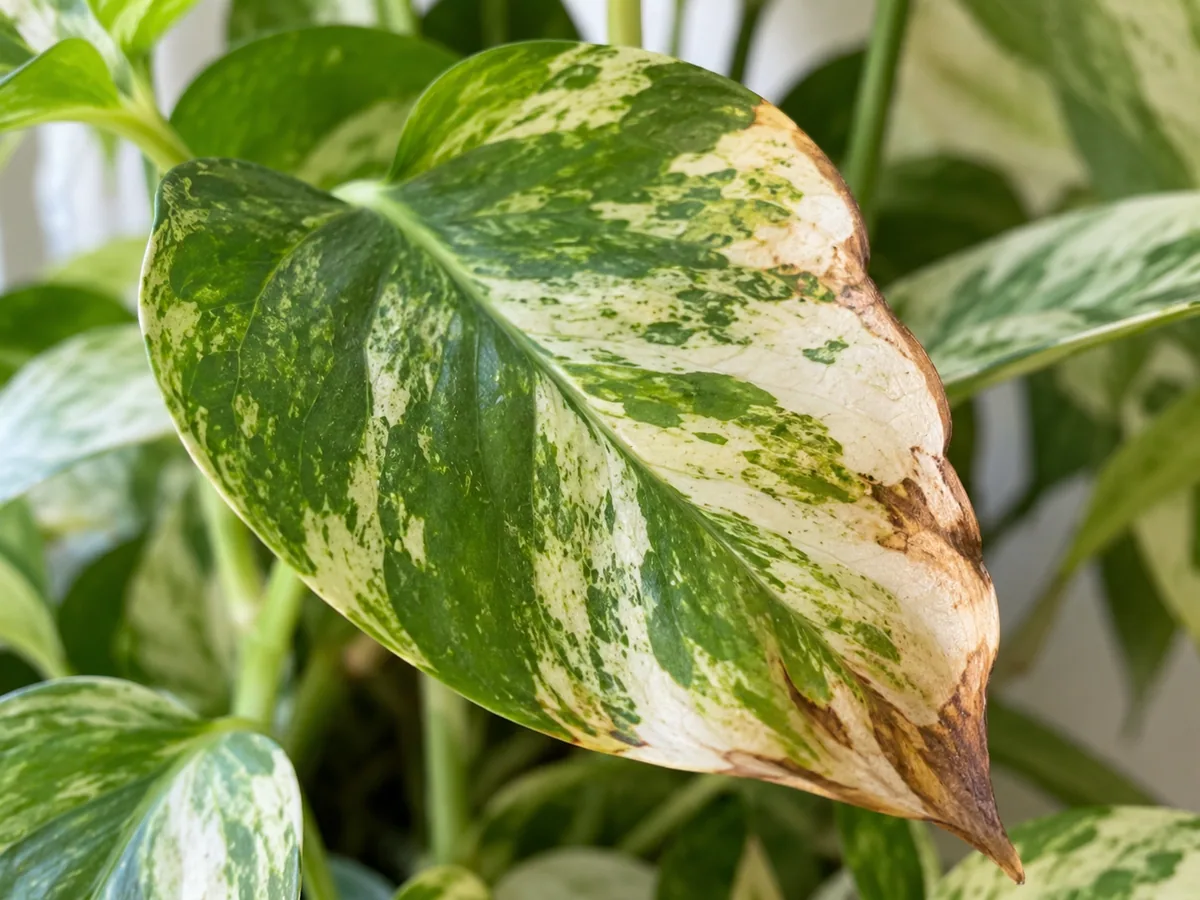
Scorched white margins and limp variegated foliage on Marble Queen Pothos during heat stress — compare damaged leaves with firm new growth at the vine tips.
Primary Marble Queen signals:
- Limp trailing vines that stay soft hours after watering, worst during the hottest part of the day
- Brown crispy patches on white zones first, with green sections of the same leaf damaged later or not at all
- Leaf edges curling inward and pale patches turning papery on leaves nearest the heat source
- Sudden leaf drop of older leaves after a heatwave, even though the stems still feel firm
- Aerial roots along the vines shrivelling to brown threads instead of staying plump and tan
- Soil drying much faster than usual, with the pot feeling light days earlier than its normal rhythm
What healthy summer growth looks like for comparison:
A comfortable Marble Queen holds its heart-shaped leaves flat and turgid, with crisp white marbling and steady new leaves from the vine tips. The pot dries on its familiar 7–10 day summer rhythm rather than going bone-dry in two days.
Why Marble Queen’s white zones scorch first
The white and cream sectors of a Marble Queen leaf contain little to no chlorophyll, so they photosynthesize poorly and overheat faster than green tissue under the same conditions. In still, hot air the pale zones cannot use incoming light energy efficiently, and the excess energy damages cell membranes — which is why scorch appears on the marbling while neighboring green tissue survives. This is a cultivar penalty: a Golden or Jade pothos in the same hot corner often wilts without the dramatic bleached patches.
Marble Queen’s slower growth rate compounds the problem. Because the cultivar builds new tissue more slowly than Golden Pothos, every scorched leaf represents a larger share of the plant’s productive canopy, and replacement takes longer. A plant already thinned by earlier pruning or leaf loss enters a heatwave with almost no buffer.
Where indoor heat actually hits this plant
Pothos prefers temperatures in the 65°F–85°F range (18°C–30°C), and trouble starts when the microclimate around the leaves leaves that band. The usual indoor culprits are specific to how Marble Queen is displayed:
- Hanging baskets near the ceiling, where hot air pools several degrees above the thermostat reading
- Pots sitting directly on or against sun-baked windowsills, where glass radiates heat onto the nearest leaves
- Trailing vines draped over radiators, cable boxes, or kitchen appliances that warm one runner while the rest stays cool
- Patios and balconies during heatwaves, where a plant moved outside for summer meets direct sun plus reflected heat from walls
- Closed rooms during travel or heatwaves, where stagnant hot air removes the plant’s ability to cool itself through transpiration
Because Marble Queen trails, one vine can cook while the pot sits in acceptable conditions — always inspect the full length of each runner, not just the leaves near the soil.
How to confirm the cause
Work through these checks before watering heavily, fertilizing, or pruning:
- Find the heat trigger — Was there a heatwave, a move to a sunnier sill, a radiator switched on, or a patio relocation in the last 1–3 days? Heat stress follows the event fast; drooping, crispy edges, and scorched spots arriving suddenly across the plant point to heat rather than a chronic care issue.
- Finger-test the soil at 4–5 cm — Marble Queen likes watering when the top couple of inches of mix is dry. Moist soil plus limp leaves strongly suggests heat wilt, not thirst. Bone-dry soil plus limp leaves means underwatering is the main problem — see underwatering.
- Squeeze nodes along each vine — Firm green nodes with limp leaves mean the plumbing is intact and the plant should recover. Soft, dark, or mushy nodes signal tissue death or secondary rot; cross-check root rot.
- Map which leaves are damaged — Scorch concentrated on white zones and on the side facing glass or a heat source fits heat stress. Uniform yellowing from the base upward fits overwatering instead.
- Check the pot weight and smell — A very light pot confirms the heat dried the mix fast. A heavy, sour-smelling pot after a heatwave warns that wet mix overheated around the roots, which is more dangerous than dry heat alone.
- Look at neighboring plants — Heatwaves hit whole shelves at once. If several plants wilted the same afternoon, the room is the diagnosis.
If the soil is moist, the nodes are firm, damage centers on white marbling, and a heat event preceded symptoms by a day or two, heat stress is the most likely primary cause.
First fix for Marble Queen Pothos
Move the plant into cooler, stable, bright-indirect conditions — typically 1–2 m back from hot glass, off the sill, and away from any radiator, vent, or heat-radiating appliance. The goal is leaf temperatures back inside the 18–29°C comfort band with gentle airflow, not a blast of cold air-conditioning directly on the foliage.
Do not water, fertilize, repot, or prune in the same hour as the move. Relocation is the single first action because every other correction reads wrong while the leaves are still sitting in heat — wet mix in a hot pot can cook roots, and pruning before recovery removes tissue the plant may still salvage.
Step-by-step recovery
Once the plant sits in a cooler stable spot, follow this order:
- Water only by the moisture test — If the top 3–5 cm is dry, water thoroughly until it drains. If it is still moist, wait; houseplants get thirstier in hot August weather, but a wilted plant in damp mix needs cooling, not more water. Overwatering invites the blackening of leaf margins and root rot that follow soggy mix.
- Raise humidity around the canopy — Group plants, set the pot on a pebble tray, or run a humidifier toward 40–60%. Moist air slows leaf water loss while damaged tissue stabilizes.
- Trim only the fully dead tissue — After 5–7 days, snip leaves that are entirely brown and crisp, cutting just above the nearest firm node. Leave partly green scorched leaves in place; they still photosynthesize and shade the node buds behind them.
- Watch the vine tips, not the scars — New leaves should emerge flat and marbled. If tips push bleached or stunted growth, light or temperature still needs adjustment — cross-check the Marble Queen light guide.
- Resume normal rhythm gradually — Return to the familiar check-based watering rhythm and hold fertilizer until new growth looks stable for about two weeks. Heat-stressed roots take up nutrients poorly, and salts can burn recovering white sections.
- Root tip cuttings as insurance — If one runner’s nodes went soft, take a firm variegated tip cutting with at least one node and root it in water. Full workflow: Marble Queen propagation.
Recovery timeline
| Timeframe | What to expect on Marble Queen |
|---|---|
| Day 1–2 | Limp leaves firm up in the cooler spot if nodes are alive; scorch marks do not fade |
| Week 1–2 | No new damage appears; fully dead leaves crisp completely and can be trimmed |
| Weeks 3–4 | Vine tips push new leaves — flat, marbled growth confirms the fix |
| Beyond 4 weeks | If new leaves still emerge bleached, stunted, or wilted, reassess light, pot size, and roots |
Marble Queen’s slower cultivar pace means visible recovery lags a Golden Pothos by a week or two in the same conditions. Judge progress only on new tip growth, never on whether old scorched patches improve — they will not.
Lookalike symptoms
| Pattern | Leaf / vine look | Soil / pot | Likely cause | Next step |
|---|---|---|---|---|
| Limp leaves in moist soil after hot days, white zones scorched | Soft wilt plus papery pale patches | Moist or fast-dried | Heat stress | This page — cool first, then water by test |
| Bleached white patches but plant otherwise turgid | Crisp pale burn, no wilt | Normal | Direct sun scorch without heat wilt | Filter light → sunburn guide |
| Limp leaves, bone-dry light pot, no scorch | Thin papery leaves, dry mix | Dry throughout | Underwatering | Deep soak → underwatering |
| Yellow lower leaves, soft stems, sour smell | Mushy nodes, may drop | Heavy, wet | Overwatering / root rot | Dry out → root rot |
| Curling plus webbing or stippled undersides | Patchy damage, fine webs | Any | Spider mites in hot dry air | Inspect and treat before assuming heat alone |
| Wilt plus droop with firm nodes, cool room | Whole-plant softness | Often wet | General wilt or droop | Wilting and drooping leaves triage |
Heat and sunburn overlap closely — heat adds wilt and sudden multi-leaf involvement, while pure sun scorch stays localized to the most exposed leaves. When both appear together, fix the heat position first; the sunburn pattern usually resolves with the same move.
What not to do
- Drowning a wilted plant on sight — Moist mix plus more water suffocates warm roots. Test at 4–5 cm first.
- Misting scorched leaves as the only fix — Surface misting evaporates in minutes and never cools the root zone or the room.
- Fertilizing to “help it recover” — Stressed roots cannot use feed, and salts burn recovering low-chlorophyll tissue.
- Hard-pruning all damaged vines on day one — Partly scorched leaves still feed the plant and shade recovering nodes.
- Moving it straight into deep shade — Marble Queen still needs bright indirect light; a dark corner trades heat stress for variegation loss.
- Repotting during the crisis — Fresh root disturbance plus heat doubles the shock unless the mix is sour or compacted.
Marble Queen Pothos care cross-check
Heat episodes expose whatever was already marginal. Verify the basics while the plant recovers: watering follows the Marble Queen watering rhythm of top 3–5 cm dry; placement matches the light guide for bright indirect exposure without hot glass; the mix stays airy per the soil guide so warm water drains instead of pooling; and the overview’s 18–29°C comfort band (Marble Queen overview) remains the long-term target. Plants in dry heated rooms should also be screened for the low humidity pattern, which mimics mild heat damage on leaf edges.
How to prevent it next time
Treat Marble Queen as a stable-climate trailing plant, not a sun-bathing patio vine. Keep it in bright indirect light but off heat-radiating sills; hold rooms near 18–29°C with 40–60% humidity through heatwaves; and water by the finger test, not the calendar, since hot weeks can halve the normal dry-down time. Acclimate gradually before any outdoor move — a week of lengthening shade exposure, never a jump from living room to full patio sun — and prune heat-damaged runners only after new growth proves the spot works (pruning guide).
When to worry
Heat stress is usually survivable, but escalate if:
- Whole vines collapse at once with soft dark nodes — tissue death, not temporary wilt.
- Several leaves yellow within days of the heat event while stems soften.
- The pot smells sour or roots feel mushy — overheated wet mix turning into rot.
- No new tip growth appears within four weeks of cooling and correct watering.
- Damage keeps spreading after relocation — inspect for secondary pests or root failure rather than assuming lingering heat.
Firm nodes with only scorched margins are a cosmetic problem with a good prognosis. Soft nodes plus spreading decline mean part of the plant is already lost — salvage firm tip cuttings before the rot travels up the vine.
Related Marble Queen Pothos guides
- Marble Queen overview — cultivar baseline, comfort range, and Golden Pothos comparison
- Watering — the 3–5 cm dry test to use after any heat event
- Light — bright-indirect targets that avoid hot-glass scorch
- Sunburn and scorched leaves — use when burn is localized and the plant never wilted
- Wilting — use when limp leaves persist in a cool room
- Underwatering — use when the pot is bone dry and leaves thin without scorch
- Root rot — use when nodes soften or mix smells sour after heat
- Drooping leaves — use for general droop triage across causes
- Low humidity — use when only leaf edges crisp slowly over weeks
- Pruning — where to cut heat-damaged runners after recovery
- Soil — keeping the mix airy so warm water drains freely
Heat-stressed Marble Queen Pothos recovers from the vine tips outward. Cool the canopy first, water only by the moisture test, and judge success on flat marbled new leaves — scorched white patches are permanent, but the next growth tells you the plant is safe.
How we wrote and verified this guide: Recommendations were checked against NC State Extension, The Sill, Costa Farms, Homes & Gardens, and houseplant heat-stress references cited inline. Author: sai-ananth. Reviewer: LeafyPixels Review Board. Methodology: plant problem guidance is reviewed against botanical references, extension resources, and LeafyPixels plant-care data before publication. Claims validation: claims-validator-v1 pass with inline external links documented below. Last reviewed: 2026-09-08.