Golden Pothos vs Marble Queen: Same Plant, Different Variegation
Golden pothos vs Marble Queen compared by variegation, light needs, growth speed, and care — both are Epipremnum aureum cultivars with different stripes.
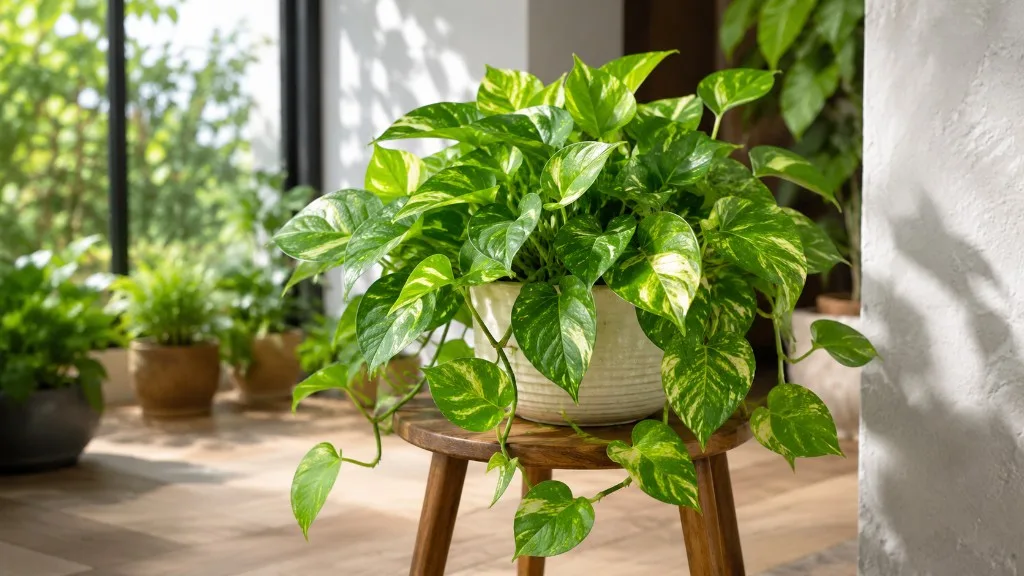
Golden pothos and Marble Queen are not two different plants — they are cultivars of the same species, Epipremnum aureum. The choice is not genus ID but variegation level and light budget. Golden types carry more green tissue and survive dimmer rooms. Marble Queen trades chlorophyll for cream-and-white marbling and asks for brighter indirect light to stay patterned.
Use the golden pothos hub and Marble Queen pothos hub for species-level care after you pick a cultivar. For the broader pothos cluster, see the pothos hub.
Quick Answer: Which Should You Buy?
Choose golden pothos if you want the most forgiving variegation, faster growth, and better low-light tolerance — ideal for offices, north windows, or inconsistent watering. See the golden pothos hub.
Choose Marble Queen if you want bold cream-and-white marbling and can place the pot in bright indirect light without harsh midday sun. See the Marble Queen pothos hub.
If pets chew plants, neither is safe — same toxicity profile. Review pothos toxicity before buying.
Same Species, Different Cultivar Goals
NC State Extension treats Epipremnum aureum as one low-maintenance vine with green or variegated leaves. Golden pothos is the classic yellow-splashed form. Marble Queen is a high-variegation selection with white and cream sectors that reduce total chlorophyll.
That chlorophyll gap drives every practical difference: light demand, growth speed, and how quickly pattern fades in a dim room. Clemson HGIC lists multiple Epipremnum cultivars under one care umbrella but notes variegated forms need brighter conditions to hold color.
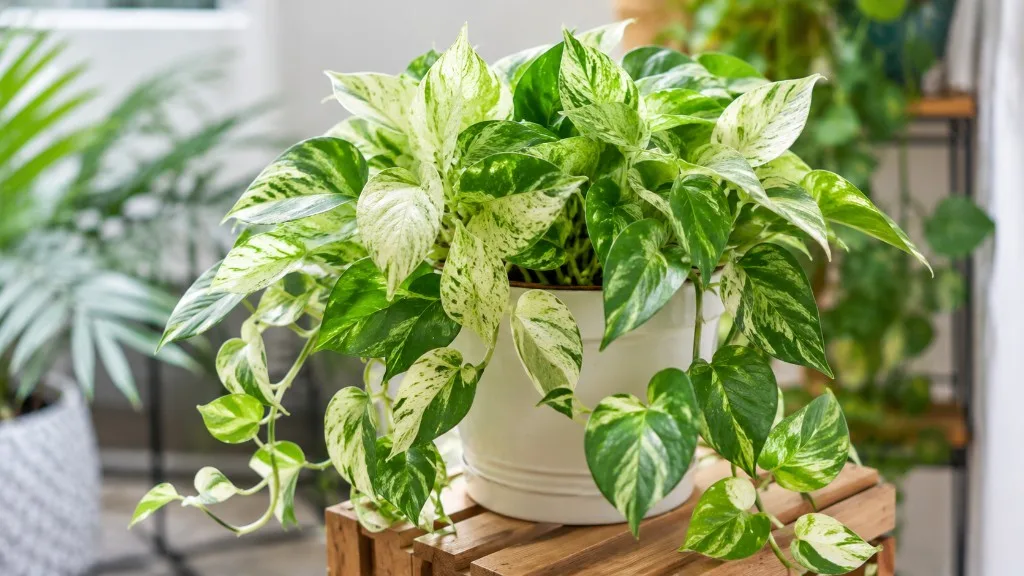
How to Tell Golden Pothos from Marble Queen at the Pot
Nursery tags swap these names constantly, and both vines share the same grooved petioles and heart-shaped juvenile leaves. You are not separating genera here — you are reading variegation pattern on mature leaves.
ID checklist (in order):
- Color of the variegation — golden pothos shows yellow or chartreuse splashes on a green background, often in irregular patches or streaks. Marble Queen marbles cream and white through the blade in a finer, more even speckle.
- How much white is on a typical leaf — golden keeps a green-dominant leaf with accents. Marble Queen often runs 40–60% pale sectors on healthy, well-lit plants.
- Newest leaf at the tip — on golden, new foliage usually opens with the same yellow-on-green look. On Marble Queen in good light, new leaves should show cream marbling immediately; if they open mostly green, light is too low for that plant.
- Confusion traps — solid jade pothos (no variegation) is sometimes labeled golden. Snow Queen is whiter than Marble Queen. Pearls and Jade has smaller leaves with green flecks inside white zones. Neon is uniform chartreuse without marbling.
Neither cultivar differs in petiole groove, aerial roots, or stipule pattern — those cues matter for pothos vs philodendron, not golden vs Marble Queen. When tags disagree, photograph the newest three leaves and compare against the plant portraits above rather than trusting a pot sticker.
Comparison at a Glance
| Factor | Golden pothos | Marble Queen |
|---|---|---|
| Species | Epipremnum aureum | Epipremnum aureum |
| Leaf pattern | Green + yellow/gold splashes | Cream/white marbling |
| Chlorophyll | Higher | Lower in heavy white sectors |
| Light | Bright indirect; tolerates low light | Bright indirect required |
| Low-light behavior | Slows but stays green | Reverts green; stretches |
| Growth speed | Faster | Moderate to slow in dim rooms |
| Water | Dry top 1–2 in between | Same dry-down rule |
| Propagation | Stem cuttings with node | Same; variegation may vary in offspring |
| Toxicity | Toxic (calcium oxalate) | Toxic (same species) |
Variegation Stability and Reversion
Variegation in pothos is not fixed forever — it responds to light, and individual stems can revert.
Golden pothos rarely loses its yellow splashes entirely in moderate indoor light. In very dim rooms, new leaves may show more green and less gold, but the plant usually keeps a recognizable pattern. An occasional all-green shoot can appear; prune it back to the last variegated node if you want to preserve the golden look.
Marble Queen is less stable in marginal light. NC State Extension notes that low light causes loss of variegation across pothos cultivars, and Marble Queen is one of the first to show it. Expect smaller white sectors on new leaves, then solid green leaves and longer internodes (stretching) within a few weeks in a dark hall.
Practical stability rules:
- Judge pattern on new growth only — old leaves will not regain lost white after you move the pot.
- Cut fully reverted green stems at a variegated node so the vine does not outcompete patterned growth.
- From stem cuttings, Marble Queen offspring can vary — some root with more green than the parent stem. Golden cuttings usually stay closer to the source pattern.
- A Marble Queen that keeps reverting after a bright-window move may be a mislabeled jade or a sport that wants more light than your room offers.
For deeper reversion troubleshooting, see Marble Queen light and the types of pothos guide.
Care Differences That Matter
Because both are E. aureum, watering, soil, and temperature match — but light and expectations diverge.
Light and Variegation Retention
RHS recommends bright indirect light and warns that deep shade reduces variegation and growth. Golden pothos keeps going in lower light; NC State notes variegation loss in low light but survival is still possible.
Golden pothos placement: east window, filtered west, or a few feet back from a south exposure. North rooms and office fluorescents are workable — growth slows, yellow may dull, but the plant stays alive. Penn State Extension lists pothos among houseplants that tolerate low light.
Marble Queen placement: treat bright indirect as the minimum, not the ideal. An east window or sheer-filtered south/west works. A north window across the room often fails the white-marble look within one growth flush. Avoid hot afternoon sun on cream sectors — white tissue scorches faster than green.
If you cannot add a window, a full-spectrum grow light 12–14 hours daily can hold Marble Queen pattern where ambient light cannot. Golden pothos may not need that boost.
Compare golden pothos light with Marble Queen light for room-specific placement.
Watering and Soil
Both prefer an airy, well-draining mix and dry-down between waterings. Clemson says allow soil to dry between waterings; UW–Madison Extension waters when the surface is dry.
Marble Queen does not want wet feet more than golden — the mistake is buying high white variegation and placing it in low light, then overwatering a slow plant in soggy mix. Follow pothos watering dry-down checks for both.
Growth and Propagation
Golden pothos fills a basket or pole faster. Marble Queen in good light still trails well but may produce shorter internodes when variegation is strong.
Both root from stem cuttings with at least one node. Variegation in new plants from Marble Queen cuttings can vary — some stems root with more green. See propagate pothos.
Pet Safety: Same Risk for Both Cultivars
Marble Queen is not safer because the leaves look paler. ASPCA lists golden pothos as toxic to cats and dogs, and every E. aureum cultivar — including Marble Queen — carries the same insoluble calcium oxalate crystals in leaf, stem, and root tissue.
Chewing releases microscopic needles that cause oral pain, drooling, pawing at the mouth, vomiting, and difficulty swallowing. Most pets stop after one bite because the burning is immediate. Serious cases involve airway swelling or dehydration from repeated vomiting — call your vet or ASPCA Animal Poison Control at (888) 426-4435 if symptoms persist.
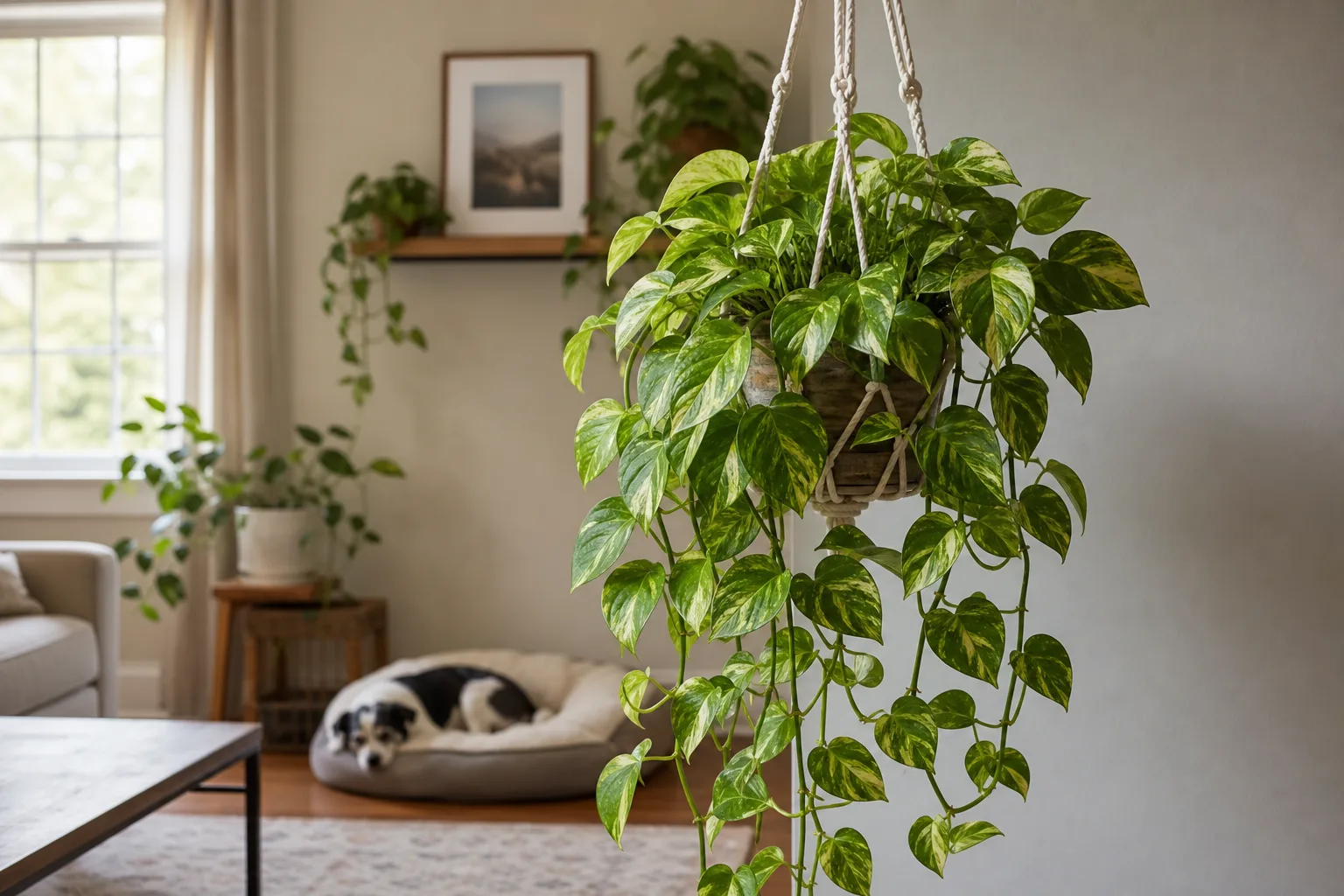
Safe placement for pet homes:
- Hang baskets high with no furniture cats can use as a launchpad.
- Trim trailing vines that reach dog height on shelves.
- Do not assume “out of sight” on a low coffee table — pothos vines grow toward light and gravity fast.
If chewing is likely, skip both cultivars and pick a non-toxic trailer from non-toxic plants for cats or non-toxic plants for dogs. Full mechanism and triage: pothos toxicity.
Which Cultivar to Choose
Beginner or office desk: golden pothos. More forgiving on light and speed.
Bright east or west window: Marble Queen for the look you want — if the window delivers real indirect brightness.
Low-light room: golden or jade types, not Marble Queen.
Pet household: neither — same ASPCA listing applies to both.
Matching an existing pothos: if your current vine is solid green in a dim spot, Marble Queen in the same place will disappoint. Move both to brighter indirect light or stay with golden.
Related Guides on LeafyPixels
- Golden pothos hub — cultivar care cluster
- Marble Queen pothos hub — variegation-specific notes
- Pothos hub — full species overview
- Pothos vs philodendron — if ID is the question, not cultivar
- Best low light indoor plants — when the room is the bottleneck
Conclusion
Same species: both are Epipremnum aureum.
ID: yellow splashes on green = golden; cream-white marbling = Marble Queen — check newest leaves, not the tag.
Choose: low light, speed, forgiveness → golden pothos. Cream marbling + bright window → Marble Queen.
Care: identical watering and soil; different light minimum for pattern retention. Neither is pet-safe.
Then follow the golden pothos hub or Marble Queen pothos hub — not a generic pothos tag.