Flowers Turning Brown on Marble Queen Pothos: Causes
Quick answer
A brown flower on an indoor Marble Queen Pothos is almost always a spent spathe reaching the end of its short life, not a plant emergency. This cultivar essentially never blooms indoors without hormone treatment. First step: snip the browned spathe off at its base with clean scissors and leave the vine alone, then confirm the rest of the plant is growing normally.
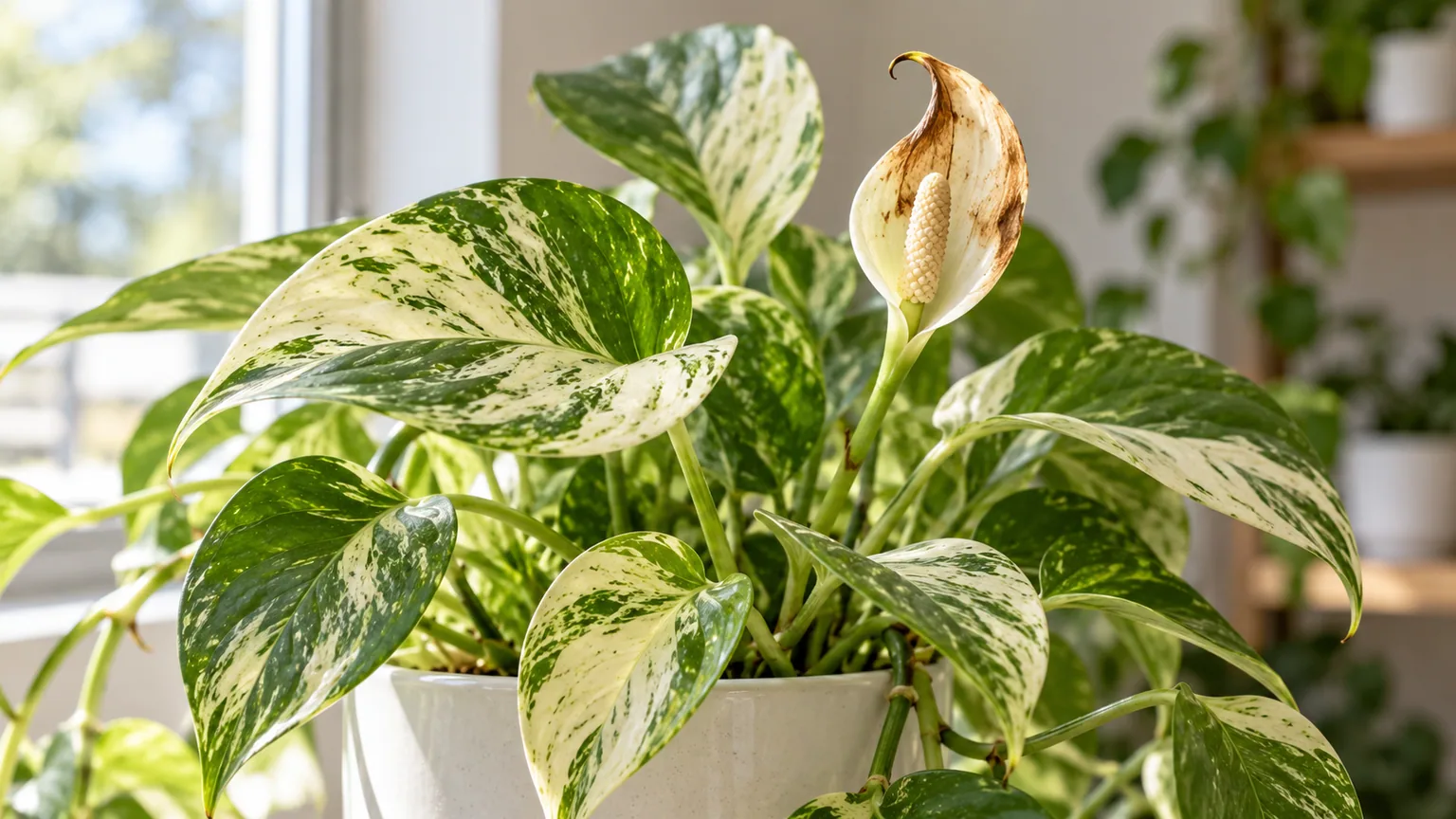
Flowers Turning Brown on Marble Queen Pothos: Causes, Checks & Fixes
This guide covers flowers turning brown on Marble Queen Pothos. See also the general Flowers Turning Brown guide, watering, and light pages for this plant.
Flowers Turning Brown on Marble Queen Pothos: Causes, Checks & Fixes
Quick answer
A brown flower on an indoor Marble Queen Pothos is almost always a spent bloom finishing its naturally short life — not a disease and not a reason to overhaul your care. This cultivar essentially never flowers as a juvenile houseplant, so any spathe you see is a rare, one-off event. First step: snip the browned spathe off at its base with clean scissors and leave the vine alone, then confirm new growth still looks normal.
For how browning blooms behave on flowering houseplants in general, see our flowering problems guide. On Marble Queen specifically, the pattern usually shows up as a cream spathe crisping from the edges while the leaves and vine tips stay healthy.
First: is it actually a flower?
Before diagnosing anything, confirm what you are looking at, because most “flowers” reported on indoor pothos turn out to be something else. A true Epipremnum bloom is a cream, boat-shaped spathe (a leaf-like bract) wrapped around a central flowering spike called a spadix, as described in Singapore’s national flora records for the species (spathe and spadix structure).
Things owners commonly mistake for blooms on Marble Queen:
- A new leaf sheath. Emerging pothos leaves push out inside a pale papery sheath that browns and splits as the leaf unfurls. This sits at the vine tip, not in a leaf axil.
- An aerial root tip. Brown nubs along the vine nodes are root primordia hunting for a surface, exactly what a trailing pothos is supposed to grow.
- A damaged unfurling leaf. On heavily white-variegated vines, a new leaf can emerge pale, crisp at the edges, and look flower-like before it greens up.
If the structure has a distinct hood or bract around a fleshy central spike and arose from a leaf axil on a long, mature vine, it is a genuine spathe. Everything else belongs on a different guide — compare against brown leaves or distorted leaves instead.
Why indoor Marble Queen blooms are so rare
This context matters because it sets the correct expectation: you are not trying to save a blooming cycle, only to tidy up after one. Epipremnum aureum is famously shy-flowering — researchers found it carries a deficiency in the gibberellin biosynthesis pathway that normally triggers flowering, and blooms could only be induced by experimentally spraying hormones (gibberellin deficiency study). No juvenile houseplant vine produces the conditions for a repeat show.
Marble Queen adds one more constraint: its large white sections contain little chlorophyll, so it grows more slowly than green pothos and runs a tighter energy budget. A vine that spent reserves pushing out a rare inflorescence will retire that spathe quickly. Browning within days to a couple of weeks is the normal program, not a failure you caused.
What browning looks like on a pothos spathe
A naturally senescing spathe browns in a recognizable sequence. The cream bract dulls to tan at the rim first, then the crisping spreads inward while the tissue stays dry and papery. The central spadix may darken and shrink. The stalk holding the bloom stays firm, and — critically — the vine, nodes, and neighboring leaves look unchanged.
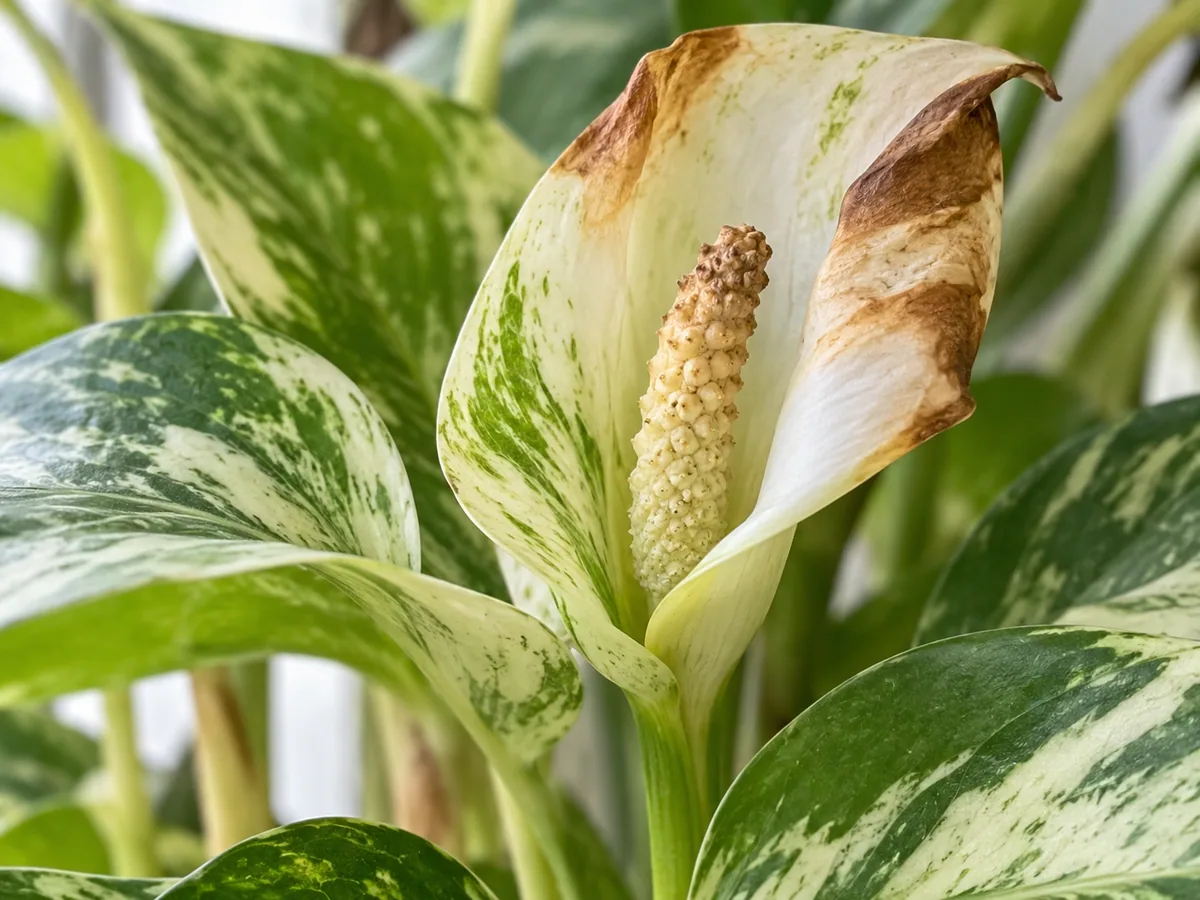
Close-up: dry tan edges on the cream spathe with a firm stalk and healthy variegated foliage behind it — the classic spent-bloom pattern.
Call it abnormal, and keep investigating, if you see any of these instead: a mushy or blackened stalk, a sour smell at the bloom base, wet translucent patches rather than dry crisping, or browning that spreads from the bloom into the vine stem. Those point to rot or injury, not senescence.
Why the spathe browned early
If a genuine bloom browned faster than the one-to-two-week norm, the usual accelerants on a Marble Queen are environmental rather than infectious:
Dry air. Pothos prefers humidity around 40 to 60 percent (humidity and temperature needs), and a thin spathe desiccates faster than a waxy leaf. A heating vent, a drafty windowsill, or a winter humidity crash will crisp a spathe days early while the foliage still looks fine.
Too much direct sun. Pothos thrives in bright indirect light but scorches under intense afternoon sun (light needs). On Marble Queen the white leaf sections burn first — if the spathe browned on a south-facing sill alongside pale leaf patches, check sunburn and scorched leaves rather than blaming disease.
Water stress during the bloom. A vine carrying a bloom uses slightly more water. Soil left soggy rots roots (soggy soil and root rot), while soil left bone-dry aborts the bloom to protect the vine. Either extreme shortens spathe life, and both show up first in the foliage — see overwatering or underwatering.
Natural energy economics. On an older or heavily variegated vine, the plant simply retires a costly structure it cannot sustain. This is most likely when the rest of the plant looks perfect: firm vine tips, clean new leaves, stable watering rhythm.
How to confirm the cause at home
Work through these in order; stop as soon as the picture is clear.
- Identify the structure. Spathe plus central spike from a leaf axil means genuine bloom — proceed. Anything at the vine tip or node without a bract is new growth or a root nub, not a flower.
- Feel the stalk and vine. Firm and dry means senescence. Soft, dark, or foul-smelling means tissue damage — inspect for root rot and check whether the pot stays wet.
- Read the neighboring leaves. Healthy variegated leaves with firm vine tips confirm an isolated spent bloom. Widespread yellowing or crispy white sections point to water or light problems instead — compare yellow leaves and brown tips.
- Check the environment. Note humidity, sun exposure, and when you last watered. Water pothos when the top 5 cm of soil is dry (watering depth); if the spathe crisped during a heat wave or a missed watering, you have your accelerant.
- Assess the pot. Lift it. Heavy and damp days after watering, or light and shrunken from the pot edges, both implicate the root zone — cross-check with compacted soil before changing anything else.
The first fix to try
Snip the spent spathe off at its base with clean, sharp scissors and leave everything else exactly as it is. Make the cut where the bloom stalk meets the vine, wipe the blades before and after, and discard the tissue. That is the whole intervention.
Do not follow the trim with fertilizer, repotting, or a new watering schedule on the same day. A spent bloom is finished tissue, not a symptom of deficiency, and stacking treatments on a healthy vine creates problems rather than solving them.
Step-by-step recovery
- Remove the browned spathe as described above.
- Return the plant to its proven spot — bright indirect light, per the light guide — and do not chase the bloom with extra sun.
- Water normally: when the top few centimeters are dry, water thoroughly and let excess drain (watering rhythm). Empty any cachepot saucer.
- Watch the next two vine tips for two to three weeks. Firm new leaves with clean marbling mean recovery is complete.
- If new growth stalls, yellows, or crisps, diagnose the foliage directly — no new growth and low humidity are the right next reads.
Browned spathe tissue never re-greens, so judge everything by what emerges after the trim, not by the removed bloom.
When to use this page vs other Marble Queen guides
- This page: a confirmed spathe-and-spadix structure browning while the vine stays healthy.
- Brown leaves: browning on the foliage itself rather than on a bloom.
- Brown tips: crisping confined to leaf edges, usually humidity or water quality.
- Sunburn and scorched leaves: bleached or papery patches after direct sun exposure.
- Root rot: soft stems, sour soil, or multiple leaves failing together.
- Problems hub: anything that does not match the patterns above.
Mistakes to avoid
- Force-feeding a blooming fertilizer. Phosphorus-heavy bloom boosters cannot restart a spathe and readily burn Marble Queen’s low-chlorophyll white sections. Feed only for foliage, only in the growing season.
- Moving the plant to harsh sun to “save” the flower. Extra light does not extend spathe life and scorches variegated leaves fast.
- Misting the bloom. Wetting a senescing spathe invites soft rot at the stalk; raise room humidity instead of spraying the flower.
- Tearing the spathe off by hand. A jagged wound on the vine heals slower than a clean scissor cut and gives pathogens an entry point.
- Repotting to fix a brown flower. Disturbing healthy roots over finished bloom tissue trades a non-problem for real transplant stress — see repotting stress.
Note on handling: all Epipremnum aureum varieties contain insoluble calcium oxalates that irritate mouths and skin (ASPCA toxicity data). Wash your hands after trimming, keep cuttings away from pets, and prune out of reach of cats and dogs.
How to prevent early browning next time
Honest framing first: you cannot schedule or reliably repeat a Marble Queen bloom indoors, so prevention here means keeping the vine vigorous enough that any future spathe lasts its full span. Hold the conditions this cultivar already wants — bright indirect light, watering when the top few centimeters dry, and a well-draining mix per the soil guide. Keep humidity from crashing in winter, keep the vine out of hot direct sun and heating drafts, and prune normally to favor strong vines, as described in the pruning guide. A strong vine with clean new leaves is the only bloom preparation that exists for this plant.
Recovery timeline and when to worry
There is no recovery period for a spent spathe — the event is over once you trim it. Expect the vine tip to keep extending within one to three weeks in the growing season; slower in winter is normal for this slow cultivar. Escalate to a root-zone diagnosis only if new leaves emerge small, distorted, or yellow, if stems soften, or if damage spreads across several leaves at once. A single finished bloom with healthy foliage behind it needs nothing further.
Related Marble Queen Pothos guides
- Marble Queen Pothos overview — full care baseline: light, water, soil, and growth habit.
- Problems hub — every diagnosed issue for this cultivar in one place.
- Brown leaves — use when the foliage itself is browning rather than a bloom.
- Yellow leaves — use when yellowing spreads across leaves alongside or after the bloom.
- Low humidity — use when crispy edges suggest dry air is the accelerant.
- Overwatering — use when soil stays wet and stems or leaves soften.
- No new growth — use when the vine stalls after the bloom finishes.
Related tool
Use the Plant Problem Diagnosis Tool to narrow causes for flowers turning brown on this plant before changing multiple variables at once.