How to Grow and Care for Snow Queen Pothos
Learn how to care for Snow Queen pothos with practical advice on light, watering, soil, pruning, propagation, variegation, pests, and pet safety.
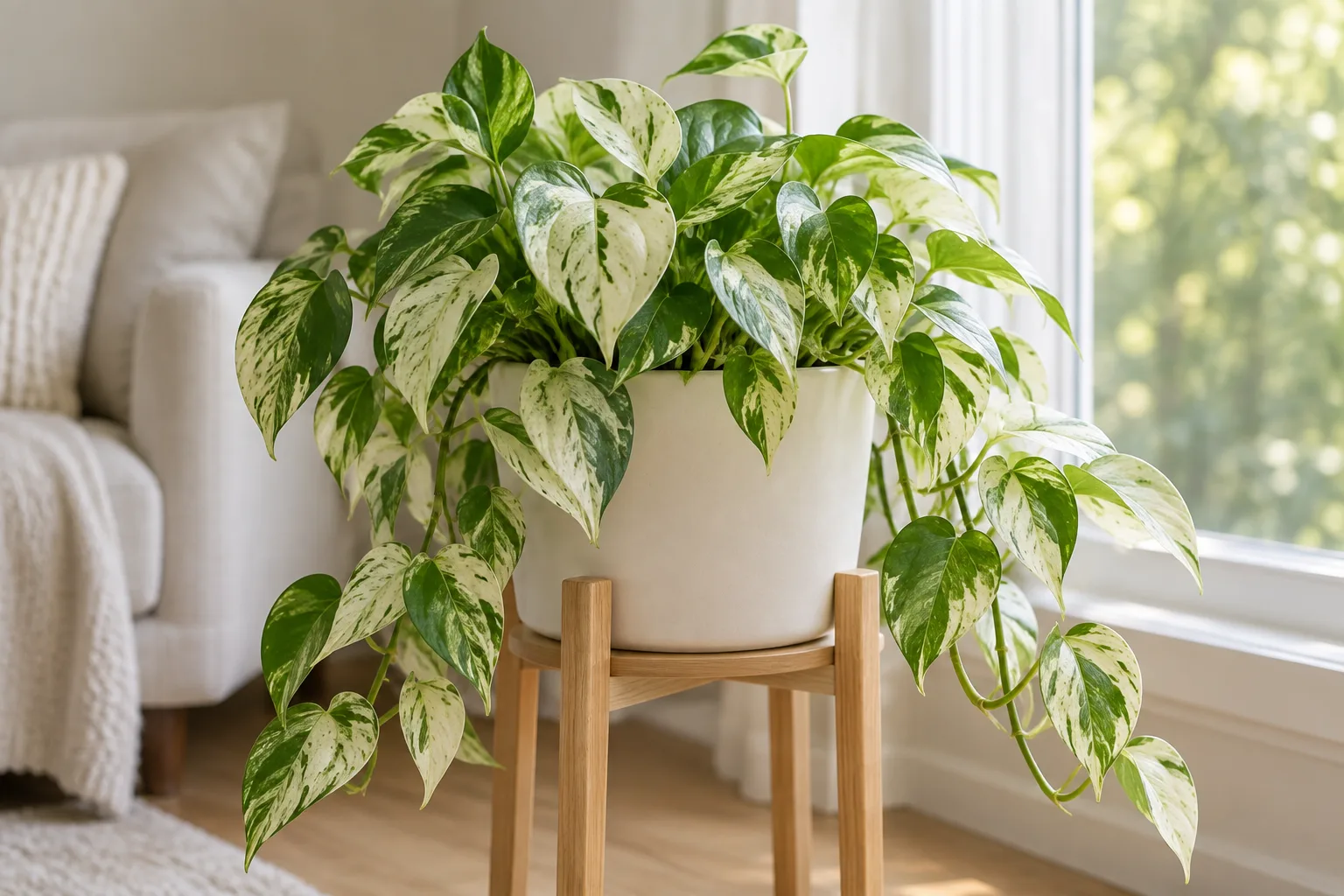
Snow Queen pothos is an indoor vining plant with heart-shaped leaves painted in green and generous white or cream variegation. It is grown for the foliage, not showy flowers, and it can trail from a shelf or climb a support. The care basics are straightforward: give it bright, filtered light, let excess water drain, and check the potting mix before watering again. Its pale leaves do make light and watering decisions worth watching closely.
The name usually refers to a highly variegated selection of pothos, botanically Epipremnum aureum. Labels are not always consistent, and young plants can have different proportions of white and green from one another. Treat the plant you have as a variegated pothos: protect it from harsh direct sun, avoid keeping the roots saturated, and make any light changes gradually.
This guide explains how to tune care to your room, propagate a cutting, and troubleshoot changing leaves.
Quick care answer
Place Snow Queen pothos near a bright window where light is filtered through a sheer curtain or reflected from a nearby wall. Water thoroughly when the upper portion of the mix has dried, then empty the saucer. Use a loose, well-draining houseplant mix in a pot with drainage holes, and keep the plant away from cold drafts and hot glass.
The practical rule is to respond to the plant’s conditions, not a fixed day of the week. A small pot in a warm, bright room dries faster than a large pot in a cool corner. Penn State Extension recommends moderate to bright light, room temperatures, and watering when the soil is dry; Wisconsin Extension likewise advises filtered light and allowing the medium to dry slightly between waterings. (Penn State Extension; University of Wisconsin–Madison Extension)
Identify Snow Queen pothos
Snow Queen pothos is a cultivar name used for a variegated form of Epipremnum aureum. Its leaves commonly show a high proportion of white or pale cream mottling against green, with some leaves carrying more green than others. The amount and pattern of variegation can vary by vine, light, and the plant’s own growth. A nursery tag is useful, but a label alone cannot predict exactly what every new leaf will look like.
Marble Queen pothos is the closest look-alike. Marble Queen tends to show more balanced green-and-cream marbling, while Snow Queen is commonly sold as the paler, more white-dominant selection. The boundaries are not universally applied in retail. NC State Extension lists both Snow Queen and Marble Queen among pothos cultivars, and horticulture publishers describe them as related variegated forms rather than different species. Compare the overall pattern on several mature leaves, not one new leaf, before deciding a plant was mislabeled. (NC State Extension; The Yard and Garden)
Like other pothos, it can trail or climb a support. White areas contain less chlorophyll than green tissue, so highly variegated growth may be slower than greener growth; that is not a reason to overfeed. (Ohio Tropics)
Give it bright, indirect light
Light is the most useful adjustment when a variegated pothos becomes greener or begins producing long spaces between leaves. Set the plant close to an east-facing window or a few feet from a brighter south- or west-facing window, adjusting for the season and your local sun. If the sun beam lands strongly on the leaves for hours, soften it with a sheer curtain or move the pot slightly back.
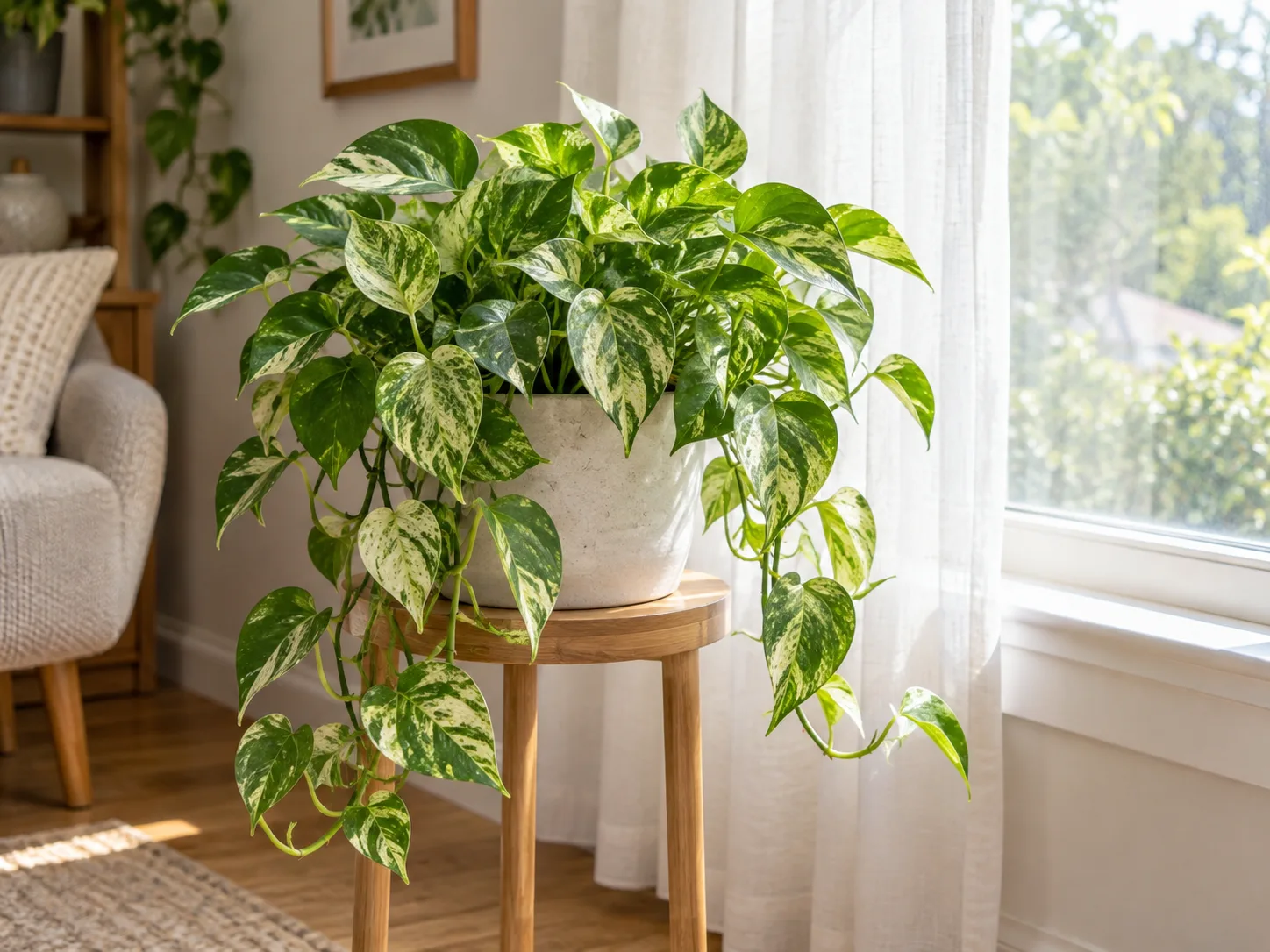
Low light can allow greener growth because leaves with more chlorophyll can capture light more effectively. In low light, the plant may also stretch toward the window and produce smaller leaves with longer bare sections between them. Ohio Tropics describes the slower growth of pale variegated foliage and recommends brighter placement for better pattern retention. Bright, indirect light supports a healthier balance, but no location can guarantee a fixed amount of white on each new leaf. (Ohio Tropics; University of Wisconsin–Madison Extension)
Bright light is not the same as intense, unfiltered midday sun. Direct rays through glass may scorch or bleach leaves, particularly after a plant has spent months in dim conditions. If you move it to a brighter place, shift it over several days and watch the newest growth. A plant that has lived in a dark room should not be placed suddenly in a hot, bright window.
Rotate the pot if it leans toward the window. A grow light can supplement limited natural light; follow the fixture’s distance and timing instructions. Judge the location by the newest leaves.
Water by checking the potting mix
Let the upper layer of potting mix dry before watering. Push a finger about an inch into the soil; if it feels cool and damp, wait and check again later. A light wooden skewer inserted near the edge can help in a deeper pot: damp mix clings to it, while dry mix leaves it mostly clean. With experience, you can also compare the weight of a freshly watered pot with a drier one.
When it is time, pour water evenly over the surface until it drains from the bottom. Empty a cachepot or saucer rather than letting the pot sit in runoff. A small amount of water at each watering can leave dry pockets deeper in the root ball; soaking the mix and then letting it drain is more consistent. Do not water only because the surface looks dry if the container is still heavy and the mix lower down is wet.
Snow Queen can be especially unforgiving of a persistently wet root zone when the container has poor drainage or the mix stays dense. Wisconsin Extension notes that pothos root rot is often associated with overwatering and that darkened leaf tips can have several causes, including excess water, insufficient water, or fertilizer salts. If your plant is in winter’s low light or a cool room, it may use water more slowly. (University of Wisconsin–Madison Extension)
There is no reliable universal interval: a plant may dry faster in summer than in a dim winter room. Use soil moisture and pot weight to decide when to water.
Choose an airy mix and a draining pot
A standard indoor potting mix can work if it does not compact or remain soggy. If yours holds water for a long time, blend in a coarse ingredient such as perlite or fine orchid bark to create more air space. The goal is an even balance: water reaches the roots when you irrigate, and surplus drains away so roots are not trapped in saturated soil. Penn State Extension recommends a well-draining soilless mix, while Wisconsin Extension calls for a well-aerated growing medium. (Penn State Extension; University of Wisconsin–Madison Extension)
Choose a pot with a drainage hole. A decorative outer pot is fine if the removable nursery pot can drain fully before you return it. Gravel at the bottom does not replace a drainage hole or improve dense soil.
Keep the container proportional to the root ball. A much larger pot holds more wet mix around a small root system, which can take longer to dry and can encourage root trouble. If you want a fuller display, plant several rooted cuttings together after they have established rather than choosing an oversized container for one small cutting.
Keep temperatures steady and humidity comfortable
Normal, comfortable indoor temperatures suit pothos. Keep Snow Queen away from chilly exterior doors, air-conditioning vents, and winter window glass, as well as from heaters that blast dry air across the leaves. Penn State Extension describes average room temperatures as appropriate, and Wisconsin Extension notes that pothos tolerates a range but dislikes drafts. It is a tropical foliage plant, so protect it from frost and cold exposure. (Penn State Extension; University of Wisconsin–Madison Extension)
Ordinary household humidity is usually workable. A humidifier may help in an exceptionally dry home, but it does not replace proper watering and airflow; a pebble tray will not humidify a whole room.
Brown, crispy tips do not prove the air is too dry. Check the watering pattern, salt buildup, direct sun, and recent temperature changes before adding humidity equipment. Clean the foliage now and then with a damp cloth so dust does not obscure the variegation or limit light reaching the leaf surface.
Fertilize lightly during active growth
Feed Snow Queen modestly when it is actively producing new leaves, typically during the brighter, warmer part of the year indoors. A balanced liquid houseplant fertilizer diluted according to its label is an easy option. Use a conservative dose if the plant grows slowly, and do not fertilize dry, stressed, or recently damaged roots.
Many potting mixes already contain starter fertilizer, and a pothos kept in low light will not use nutrients as quickly as one growing in bright conditions. Too much fertilizer can cause brown margins and leave mineral salts in the pot. Wisconsin Extension recommends periodic feeding during active growth and pausing in winter when pothos growth slows. The exact product and schedule vary; follow the label rather than combining several feeding methods at once. (University of Wisconsin–Madison Extension)
If a white crust forms on the mix or pot rim, flush the soil with plain water and let it drain, then pause feeding while you review the dose. Repotting is not automatically necessary. A balanced routine supports steady foliage; extra fertilizer will not turn a mostly green vine white.
Prune and train the vines
Prune to shorten a vine, remove damaged growth, or encourage a fuller look near the pot. Use clean scissors or bypass pruners and cut just above a node, the small joint where a leaf attaches to the stem. New growth may emerge from a node below the cut, but the exact number and timing of shoots are not guaranteed.
If one vine becomes predominantly green and you want to preserve a more variegated outline, inspect it from the tip backward. You can cut it back to a section that still has the pattern you want, leaving healthy leaves and at least one viable node on the portion attached to the plant. Selective pruning may encourage new growth from a different node, but the cultivar’s pattern can still vary. The Ohio Tropics variegation discussion uses this same practical approach for a Marble Queen vine producing greener leaves. (Ohio Tropics)
Train a vine by loosely guiding it along a support or allowing it to drape from a shelf or hanging planter. Use soft plant ties and avoid pinching the stems. Turn the pot so the plant does not grow entirely toward one side. Pruning is not necessary on a schedule; if you like the natural trailing shape, simply remove leaves that are dead or badly damaged.
Trimmed healthy stems can become cuttings. Do not compost diseased material or leave fresh trimmings where a pet or small child might chew them. Wipe the blades after cutting and wash your hands, especially if sap touches your skin.
Propagate from a healthy node
Pothos is usually propagated from a stem cutting that includes at least one node. A node is the slightly raised joint where a leaf stalk and often a small aerial root emerge. A section with a leaf but no node cannot make a new vine, so check the stem before cutting. Penn State Extension notes that pothos cuttings root readily during the growing season, and NC State Extension lists stem cutting as a propagation method. (Penn State Extension; NC State Extension)
Choose a healthy vine with a few leaves and visible nodes. With clean scissors, make a cut just below a node; the cutting should include one or more nodes, with at least one leaf above the water or soil line. If you are making several pieces from one vine, keep track of which end points toward the original plant. Remove a leaf from the lowest node if it would otherwise sit submerged or buried.
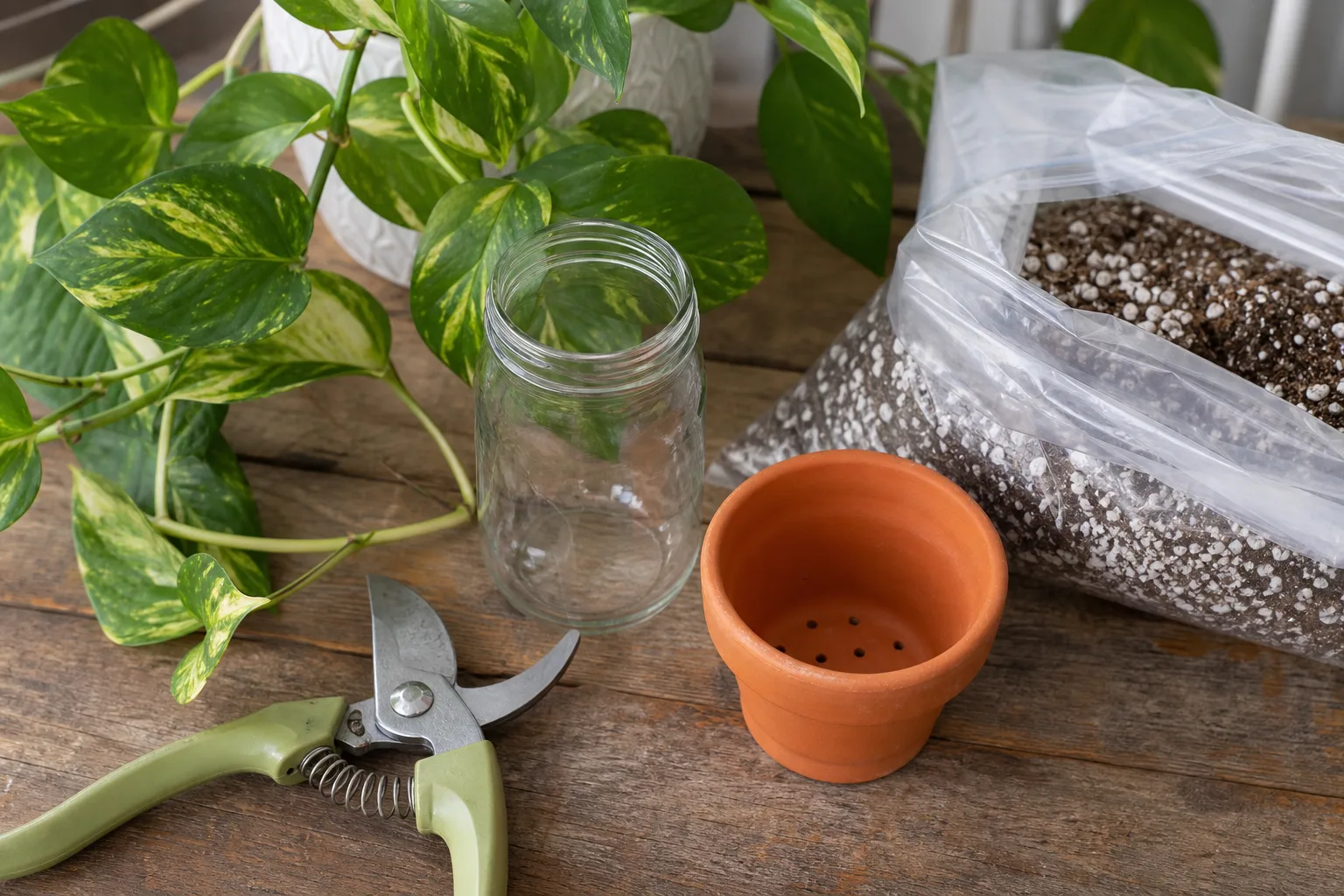
You can root a cutting in a small glass of water or directly in lightly moist potting mix. Keep the leaves above the rooting medium and place the cutting in bright, indirect light. Check it regularly without tugging; roots take time, and pulling the cutting up repeatedly can disturb new roots. Water propagation makes root growth easy to observe, while soil propagation avoids a later transfer from water to mix.
Root the cutting in water or potting mix
For water rooting, place the lower node under clean water and keep the leaves dry. Refresh the water if it becomes cloudy and top it up as it evaporates. When the roots are several inches long and branching, move the cutting into a small pot of airy mix, then keep the mix evenly damp—not waterlogged—while it adjusts. A water-rooted cutting may show brief transition stress because water-grown roots must adapt to soil.
For soil rooting, insert the node into a small pot of pre-moistened, loose mix and firm it gently so the stem stays in contact with the medium. Covering the pot with a clear bag is optional, not essential; if you use one, open it regularly for airflow and remove it once the cutting stays firm. Avoid placing the bag in direct sun, where it can overheat. Keep the medium lightly moist while the cutting establishes, then shift to the same dry-then-water routine as a mature plant.
When you see fresh leaves or roots holding the mix together, treat the new plant as a young pothos and increase pot size only when its roots have filled the starter container. A cutting that shrivels or turns mushy may have been damaged, kept too wet, or taken from unhealthy tissue. Starting with clean tools and a firm, healthy node improves the odds.
Repot when the roots need room
Repot when roots circle the inside of the pot, emerge from the drainage hole, or the mix dries unusually fast because roots occupy most of the container. A plant that has stopped growing may also be root-bound, but first check light, season, and root health; slow growth alone is not proof that it needs a larger pot. Pothos can remain in the same container while it is healthy and the mix still drains well.
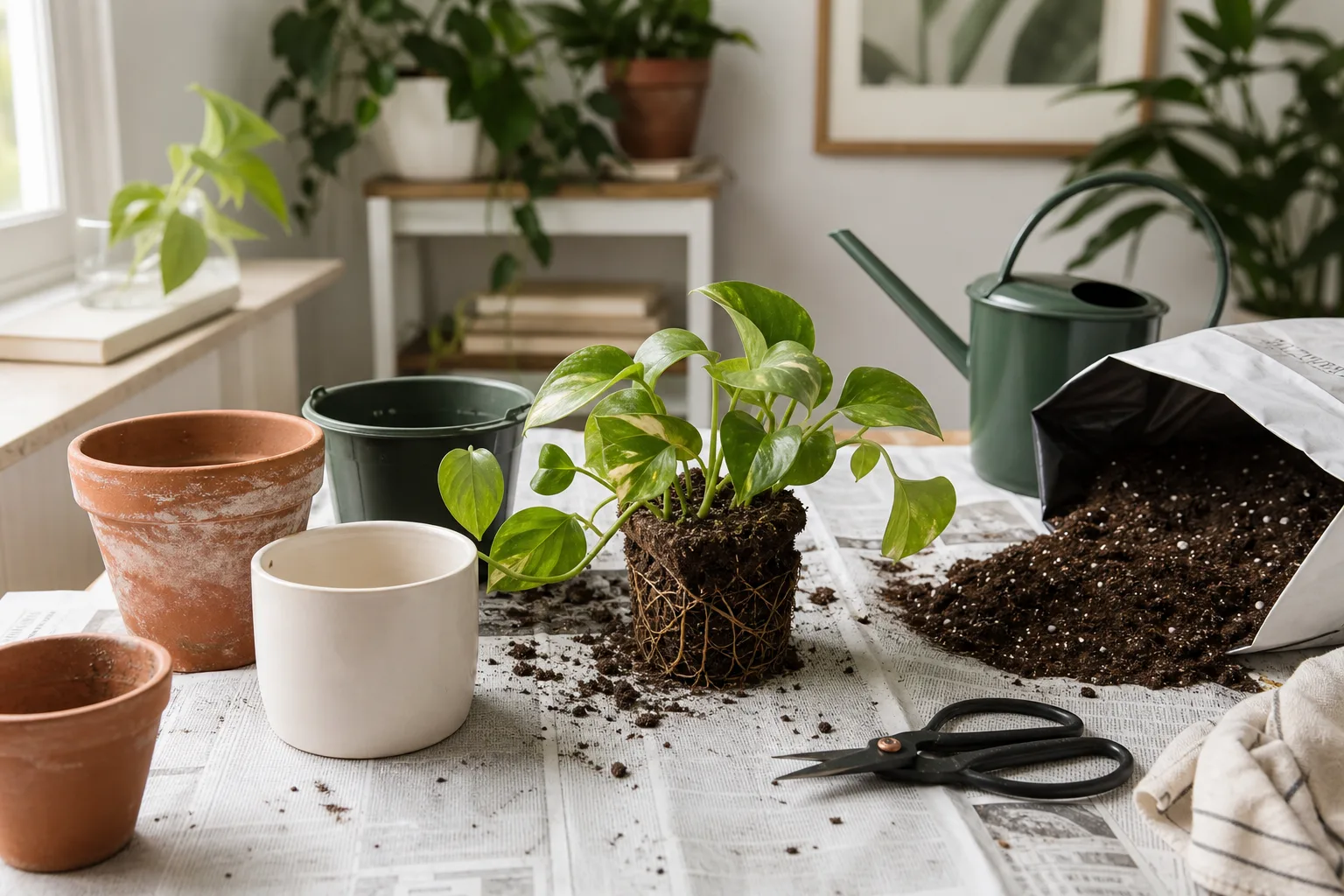
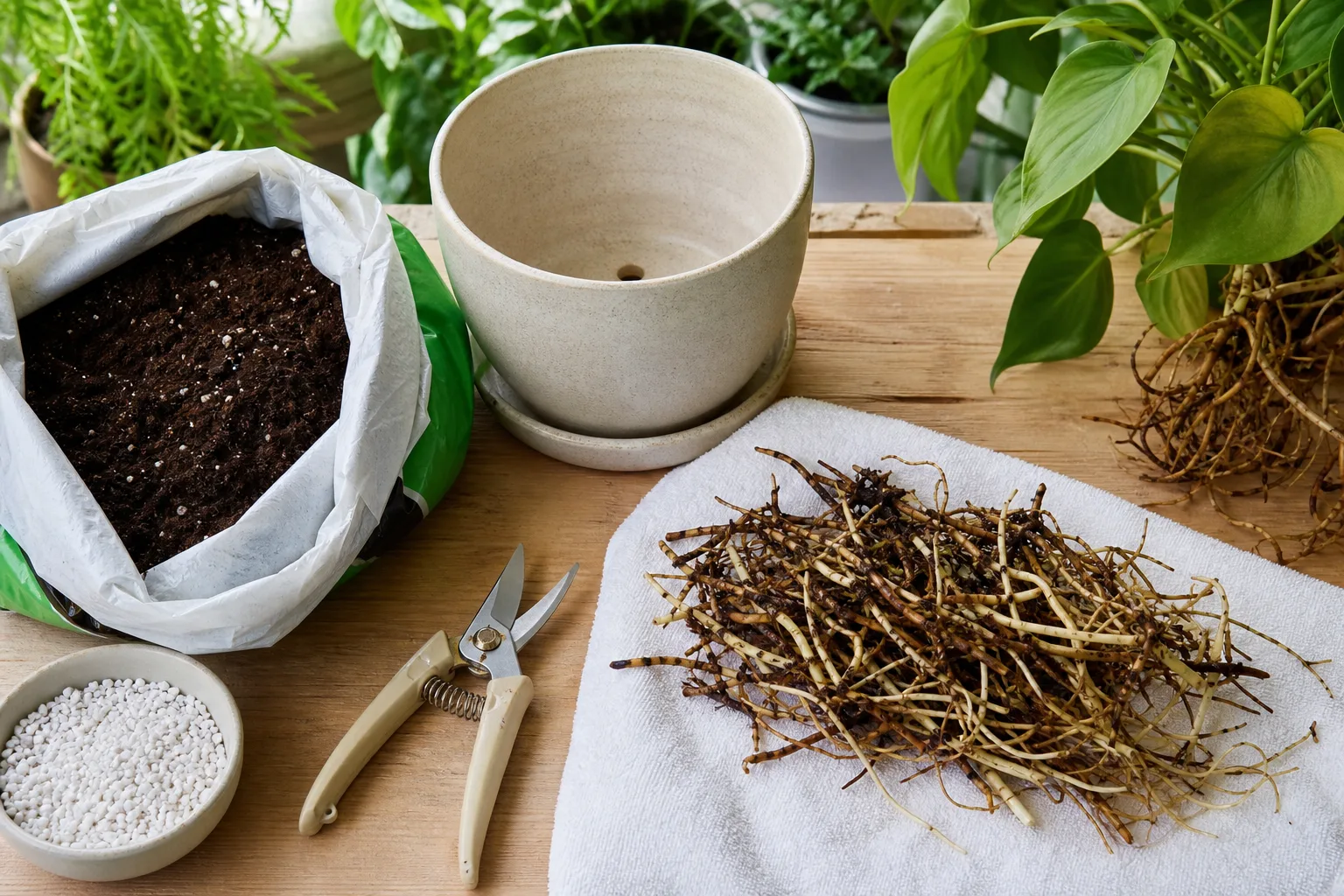
Choose a pot only one size larger, with drainage holes, and use fresh, airy potting mix. Slide the plant out carefully and loosen only the outer roots if they are tightly matted. Trim mushy or clearly dead roots with clean scissors; preserve firm, pale roots. Set the root ball at about the same depth it was growing before, fill around it, and water enough to settle the mix. Let excess drain fully.
A recently repotted plant may pause while it adjusts. Keep it in bright, indirect light and avoid adding fertilizer immediately; fresh mix may already contain nutrients. Do not overwater to compensate for transplant stress.
Troubleshoot changes in growth and leaf condition
Start by looking for a recent change: did the plant move to a dimmer window, was it watered more often, did the room get colder, or did fertilizer strength change? Compare the newest leaves with older ones and inspect the soil before treating the whole plant. One yellowing older leaf is different from several new leaves turning yellow while the mix remains wet.
Check the undersides of leaves, nodes, and stems for fine webbing, cottony clusters, small bumps, or sticky residue. Look at roots if the potting mix smells sour or the stem base feels soft. Work from the simplest explanation—light, moisture, temperature, or pests—and change one thing at a time so you can tell what helped.
The most helpful clue is often the pattern across the plant. A change limited to a few old leaves may be normal aging; symptoms appearing on many leaves at once deserve a closer look at watering and light. Avoid treating a symptom with fertilizer or pesticide until you have identified a plausible cause.
Diagnose green, yellow, and brown leaves
- New leaves are greener than expected: Check whether the plant is too far from a window or shaded by blinds and furniture. Move it toward brighter filtered light gradually. More light may support variegation in new growth, but older green leaves do not reliably regain white patches. If one vine stays mostly green, prune it back to a healthy patterned node and observe subsequent growth. Cultivar pattern can still vary naturally.
- Leaves turn yellow and the mix stays wet: Pause watering and confirm the pot drains. If the plant is limp, smells sour, or has brown, mushy roots, remove it from the pot, cut away dead roots with clean tools, and repot into fresh airy mix. Do not keep a rotting root ball saturated.
- One lower leaf yellows occasionally: An older leaf may age and fall off. Remove it once it comes away easily, and watch whether the pattern spreads. If many leaves yellow in sequence, investigate soil moisture, light, and temperature rather than assuming normal aging.
- Leaf tips or margins turn brown: Check for inconsistent watering, direct hot sun, cold contact with a window, and fertilizer or mineral buildup. Adjust only the likely cause; adding a humidifier without checking the roots may miss the problem.
- Leaves scorch in patches: Move the plant out of the strongest direct rays and keep it in a stable bright location. Scorched areas generally do not turn green again, so judge recovery by new leaves.
- Stems are long with few leaves: Increase usable indirect light and rotate the plant occasionally. Pothos naturally has spaces between leaves, but very stretched growth often means it is reaching for more light. Prune only after improving the growing position if the vine’s shape needs correction.
Pothos problems can share symptoms. Wisconsin Extension notes that leaf discoloration and darkened tips may follow different moisture or fertilizer issues, so check the root zone and recent care before deciding on a treatment. (University of Wisconsin–Madison Extension)
Check for common indoor pests
Inspect a new plant before placing it among other houseplants. Mealybugs look like small white cottony deposits around leaf joints; scale may appear as tan or brown bumps on stems; spider mites can cause fine stippling and webbing. Thrips may leave silvery scarring and tiny dark specks. Pests are easier to contain when you catch them early.
Isolate an infested plant, rinse leaves where practical, and wipe stems and leaf undersides. Repeat inspections every few days because eggs and hidden insects may remain. If you use an insecticidal soap or another labeled treatment, test it on a small area first and follow the product instructions; some leaf surfaces can be sensitive. Keep treated plants away from pets and children until the label says they can safely return.
Wisconsin Extension identifies mealybugs, scale, and occasional spider mites among pests that affect pothos indoors. It also notes that severe infestations can leave plants stunted; if an infestation is extensive and treatment would risk nearby plants, discarding the plant may be the simplest option. (University of Wisconsin–Madison Extension)
Place the plant safely around pets and children
Pothos is toxic if chewed. The ASPCA identifies golden pothos as toxic to dogs and cats because it contains insoluble calcium oxalates; chewing may cause oral irritation, intense burning in the mouth, drooling, vomiting, or difficulty swallowing. NC State Extension also lists pothos as poisonous to humans, cats, and dogs. The white-variegated Snow Queen is a pothos selection, so use the same precaution and keep leaves and cuttings out of reach. (ASPCA Animal Poison Control; NC State Extension)
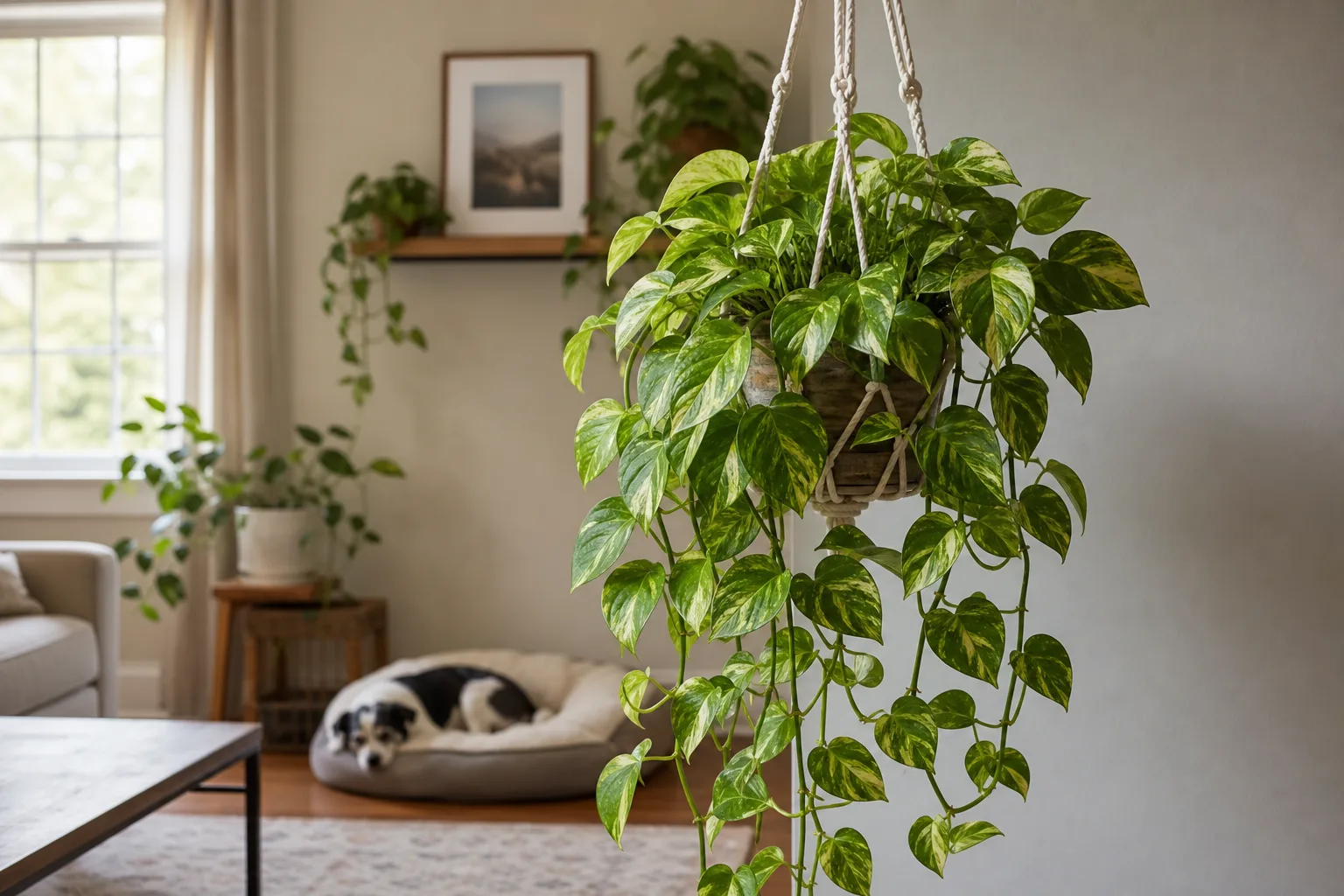
Put the pot on a stable, high shelf or in a hanging planter that a curious animal cannot reach, and sweep up fallen leaves. A hanging basket is not automatically safe if vines can dangle into reach. Wear gloves if you are sensitive to plant sap, wash your hands after pruning, and keep propagation jars away from children and pets.
If a pet may have chewed the plant, contact a veterinarian or animal poison-control service promptly; do not wait for symptoms or try a home remedy. For suspected ingestion by a person, contact local poison-control or medical services for individual guidance. Keep the plant label or a photograph available to help identify it.
Adjust care through the seasons
In brighter, warmer months, the plant may grow faster and use water more quickly. Check the mix more often, feed modestly while new growth is active, and prune or propagate if the vines need shaping. If you move it outdoors for a warm season, place it in shade or filtered light, acclimate it gradually, and bring it inside before temperatures fall. Pothos is not frost-hardy. UF/IFAS Extension warns that pothos can escape cultivation in warm landscapes, so keep it in a container and prevent vines or clippings from reaching outdoor soil or natural areas. (UF/IFAS Extension)
In fall and winter, indoor light often weakens and growth slows. Move the plant closer to a bright window if needed, while keeping leaves away from cold glass and drafts. Water less often only because the mix dries more slowly—not because a calendar says to reduce water. Pause or reduce fertilizer when there is little new growth, then resume gradually as growth returns.
Seasonally, check new leaves, soil moisture, runoff, and stems for pests; let those observations guide changes.
Conclusion
Grow Snow Queen pothos in bright, filtered light and use the soil’s moisture—not a weekly schedule—to decide when to water. An airy mix, a pot with drainage, modest feeding during active growth, and clean pruning take care of the basic routine. If the foliage turns greener, improve the light gradually and judge the next leaves rather than expecting older ones to recolor.
Check nodes before propagating, inspect roots and leaf undersides when symptoms appear, and keep the plant and trimmings away from pets and children. With those small habits, Snow Queen can remain a healthy, attractive trailing houseplant without demanding a complicated care calendar.