Variegated Pothos Care: 13 Types to Grow
Learn variegated pothos care, how light affects reversion, and how to choose among 13 types by color, growth habit, tolerance, and availability.
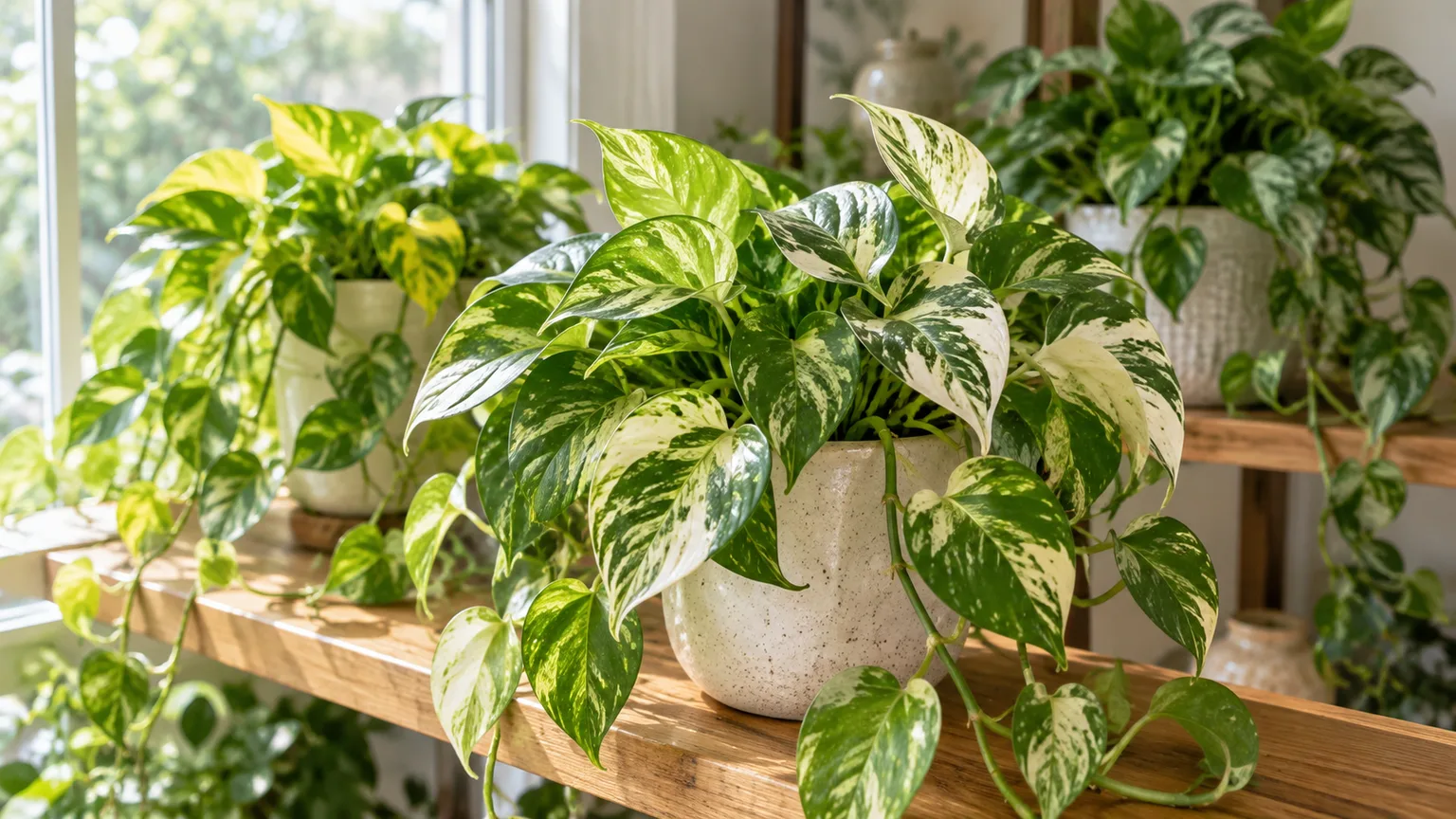
Variegated pothos is the plant for anyone who wants an easy trailing houseplant with a little visual unpredictability. The leaves may be flecked yellow, marbled cream, edged in white, streaked silver, or marked green on green—but that color is not just decoration. The more pale tissue a leaf has, the more carefully you need to balance light, watering, and growth expectations.
The useful rule is simple: give variegated pothos more usable light than a solid-green pothos in the same room, but filter harsh midday sun. Then let the soil dry between thorough waterings, keep the pot airy, and choose a cultivar that suits your window instead of trying to force a low-light corner to support a nearly white plant.
Variegated Pothos at a Glance
Pothos is Epipremnum aureum, a tropical evergreen vine in the arum family, Araceae. It is often grown in its juvenile form as a hanging basket or shelf plant, although it can climb a support and produce larger leaves when it has warmth, light, and something to grip. NC State Extension describes the species as native to the Society Islands and capable of long trailing or climbing growth, while its common houseplant form keeps smaller, whole leaves. Read the NC State plant profile for the species-level description.
| Care factor | Reliable starting point | What to watch first |
|---|---|---|
| Light | Bright, indirect light; gentle morning sun is usually easier than hot afternoon sun | New leaves lose pattern, stretch, or scorch |
| Water | Water when the top 1–2 inches of mix are dry, then soak and drain fully | Heavy wet pot with yellow lower leaves means pause |
| Soil | Airy houseplant mix amended with perlite, bark, or another drainage ingredient | Sour smell, fungus gnats, or slow dry-down |
| Humidity | Average home humidity is workable; roughly 40–60% is a helpful target | Crispy edges on the palest sections |
| Temperature | Warm rooms around 65–85°F; avoid cold drafts and hot vents | Curling, sudden droop, or stalled new growth |
| Feeding | Half-strength balanced fertilizer during active growth, not a stressed plant | Salt crust or brown tips after heavy feeding |
| Growth form | Hanging for trailing vines; moss pole or trellis for larger leaves | Bare internodes from too little light |
| Safety | Keep away from pets and children who chew plants | Mouth irritation, drooling, or vomiting after ingestion |
Treat the table as a starting range, not a watering calendar. A small pot in a bright, warm room may dry in a week; a large pot in dim winter light may stay wet for much longer. The plant’s newest leaf and the moisture in its root zone are better indicators than a fixed schedule.
What Pothos Variegation Means
Variegation means that a leaf has areas with different coloration, usually a mix of green and pale green, yellow, cream, or white. In true pothos, the familiar patterns are commonly associated with cultivar-level mutations and chimeral tissue: neighboring cell groups do not all behave the same way. The result can change from leaf to leaf.
The color difference matters because green tissue contains chlorophyll and is the plant’s main photosynthetic work surface. A peer-reviewed study of variegated Hosta—not a pothos trial—also found measurable differences in chlorophyll and photosynthesis-related activity between green and pale regions. Use that as background, not a promise that every pothos cultivar responds identically. Read the study through PubMed Central.
In practical terms, a heavily white or cream plant has less green leaf area contributing energy. It may grow more slowly and need a brighter position than a mostly green plant. That is why Snow Queen or Harlequin can struggle where Golden pothos looks fine.
Chimeral Variegation and Reversion
Reversion is the production of greener leaves or stems by a plant that normally shows variegation. Low usable light is a common trigger because the plant is trying to produce enough chlorophyll-bearing tissue to support new growth. The first sign is usually not an old leaf changing color; it is the next leaf emerging with much less pattern than the leaves behind it.
Use new growth as your light meter. If two or three successive leaves are noticeably greener, move the plant closer to a bright window or add a grow light gradually. If one entire vine has become solid green, prune that vine back to a node on the last section that still shows variegation; otherwise, its faster, greener growth can dominate the pot.
Do not promise yourself that brighter light will repaint an old green leaf. Existing leaves generally keep the pattern they have. Better light can influence future growth, but the response is cultivar- and tissue-dependent, and some reversion is effectively permanent once the variegated stem section has been lost.
The opposite extreme also deserves restraint. A stem with almost no green may be slow because it has little photosynthetic tissue. Keep enough healthy green growth to power the plant.
Light Is the Care Lever That Protects Color
Place variegated pothos in a bright room without turning the leaves into a hot window decoration. An east-facing window is a forgiving starting point. South- or west-facing windows can work a few feet back or behind a sheer curtain; north-facing windows may need a grow light for highly variegated types.
Direct sun through glass is different from bright ambient light. Pale sections can scorch into tan or brown patches close to strong midday or afternoon rays, especially after a move from a dim room. Increase light in stages and use a curtain or distance to reduce intensity.
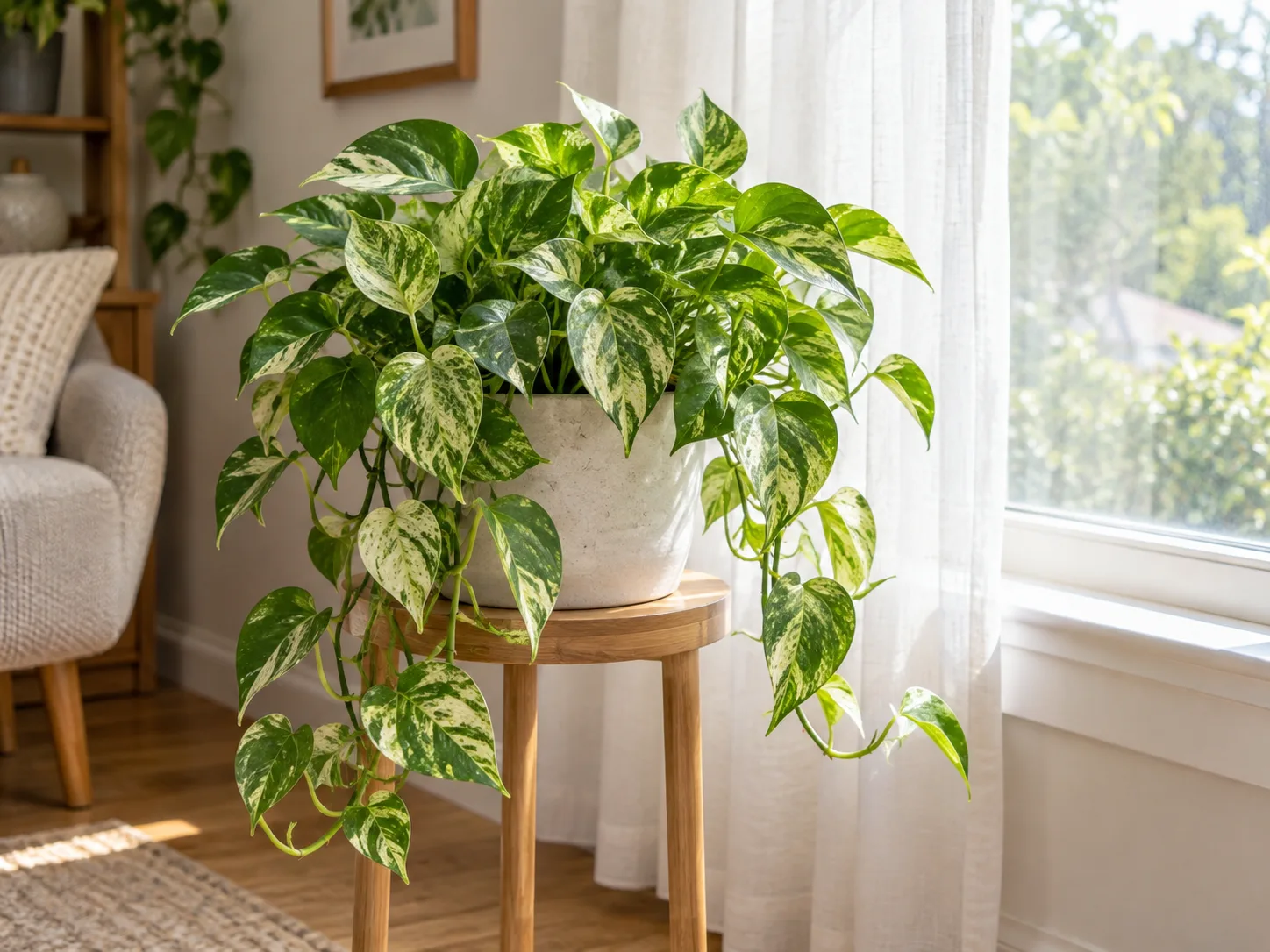
The pattern and the plant’s architecture provide useful placement clues. Long gaps between leaves, a vine leaning hard toward the window, and smaller new leaves suggest insufficient light overall. Brown bleached patches on the window-facing side suggest too much intensity. Green new leaves with otherwise healthy texture suggest the plant needs more usable light but not necessarily more water or fertilizer.
Clemson Cooperative Extension summarizes the trade-off well: pothos tolerates lower light, but lower light may cost variegated cultivars their color. Its warm-room, dry-down, and 50–70% humidity guidance is a useful guardrail, not a greenhouse prescription. See the Clemson pothos factsheet.
Water When the Mix Dries, Not by Date
Check the top two inches of potting mix before watering. Push in a finger, use a wooden skewer, or lift the pot to learn its dry weight. When that layer is dry and the plant is actively growing, water until some drains from the bottom, then empty the saucer.
The goal is a wet-to-dry cycle, not drought. Letting a variegated plant become bone dry repeatedly can cause limp leaves, crispy edges, and root loss at the fine tips. Keeping the root ball constantly wet is more dangerous: it removes air from the mix and raises the risk of root rot, especially when low light has already slowed water use.
A variegated plant with smaller leaves or a heavily white pattern may dry more slowly than a vigorous Golden pothos. Winter heating can make the air dry while short days keep the soil wet, which is exactly when calendar watering causes trouble. If tap water leaves a white crust or brown margins persist, flush the pot occasionally and investigate water quality—but do not use new water to mask poor drainage or direct sun.
Build Air Into the Soil and Pot
Use a quality indoor potting mix that holds some moisture but drains quickly. A practical starting blend is two parts houseplant mix to one part perlite, with a little fine orchid bark if the base mix collapses. The exact recipe matters less than giving roots both water and air while excess water can leave.
Choose a pot with a real drainage hole and only move up one size when repotting. A pot that is dramatically larger than the root ball stores more wet mix than the plant can use. The same symptom—slow dry-down and yellowing—can come from overwatering, a dense mix, a container that is too large, or a dim location, so check all four before blaming the fertilizer.
Repot when roots circle tightly, emerge from the drainage hole, or the mix has broken down into a dense mass. There is no prize for repotting a healthy nursery plant immediately. Give it time to adjust, and avoid combining repotting, heavy pruning, a new window, and strong fertilizer in the same week.
When you repot, loosen only tightly circling outer roots, set the plant at the same depth, and backfill without compressing the mix. Water just enough to settle roots, then wait before feeding because fresh mix may contain starter nutrients.
Warmth, Humidity, Feeding, and Grooming
Pothos prefers a warm indoor range, roughly 65–85°F, and dislikes air-conditioning blasts, cold glass, or heating vents. Penn State Extension describes average room temperatures around 60–80°F as workable and recommends rotating the container for balanced growth. Read Penn State’s pothos overview.
Humidity is a support, not the main care lever. If your home is dry, group plants, run a clean humidifier nearby, or use a correctly built pebble tray with the pot above the waterline. Misting makes leaves wet briefly but does not reliably raise room humidity.
Feed only when the plant is actively growing. A balanced liquid fertilizer at half strength every four to six weeks in spring and summer is a reasonable start; slow, heavily variegated cultivars may need less. Skip a plant with wet roots, cold damage, transplant shock, or active pests because fertilizer is not first aid.
Prune to shape the plant and manage its pattern. Cut a trailing stem just above a node with clean scissors, leaving enough nodes on the parent plant for new shoots. Light tip pruning encourages branching over time, while a hard cutback is best divided into stages so a pale, slow-growing cultivar is not asked to rebuild its entire canopy at once.
The 13 Types, Grouped by Look and Effort
No nursery list predicts the exact next leaf. Light, maturity, propagation history, and labeling affect appearance. Use these groups to narrow your choice, then buy from a seller who shows the actual plant or mother plant.
Golden, Jessenia, and Hawaiian: Gold-Toned Classics
Golden pothos is the dependable starting point: medium- to dark-green heart-shaped leaves with yellow flecks and streaks. It tolerates lower light better than the palest cultivars, although bright filtered light produces stronger color and fuller growth. If you want a variegated pothos that can survive a less-than-perfect window while you learn its rhythm, Golden is the sensible first pick.
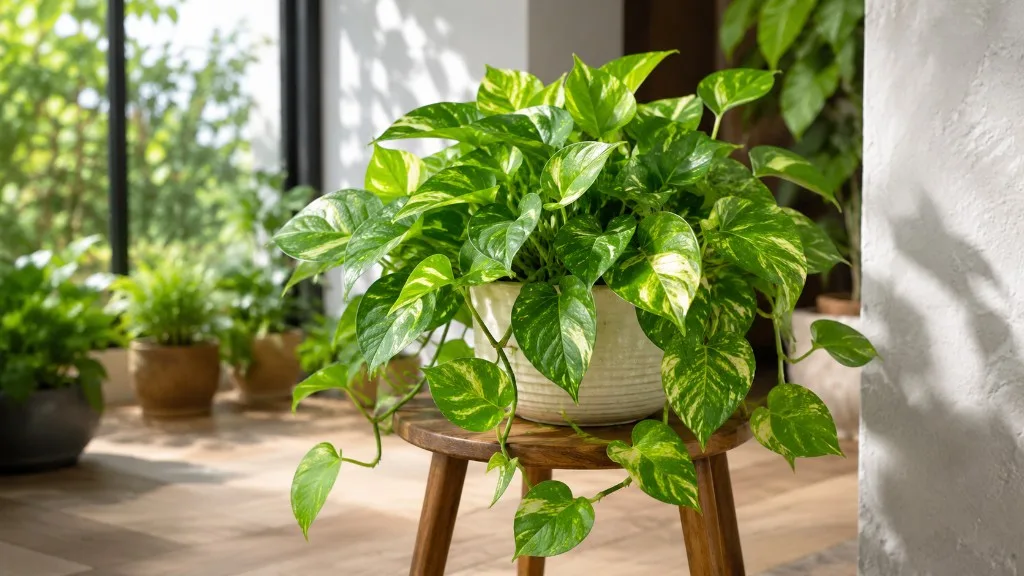
Jessenia pothos has darker green leaves marked with lime and yellow-green marbling. It can resemble Golden from a distance, but its color often reads greener and more blended rather than simply yellow-splashed. Give it medium to bright indirect light and expect a more distinctive pattern without the extreme light demand of a nearly white plant.
Hawaiian pothos is sold for larger, deeper-green leaves with yellow speckles and stronger contrast. The name is not always used consistently, so look at the mother plant and the seller’s description rather than paying a premium for a label alone. It is a good choice for someone who wants visible gold but also likes a robust, leafy vine.
Marble Queen, Snow Queen, and Manjula: White and Cream
Marble Queen has green leaves swirled with cream and white. It is widely available, but it usually grows more slowly than Golden because much of each leaf is pale. Give it bright indirect light; if the newest leaves become mostly green, the plant is asking for a brighter position, not a larger dose of fertilizer.
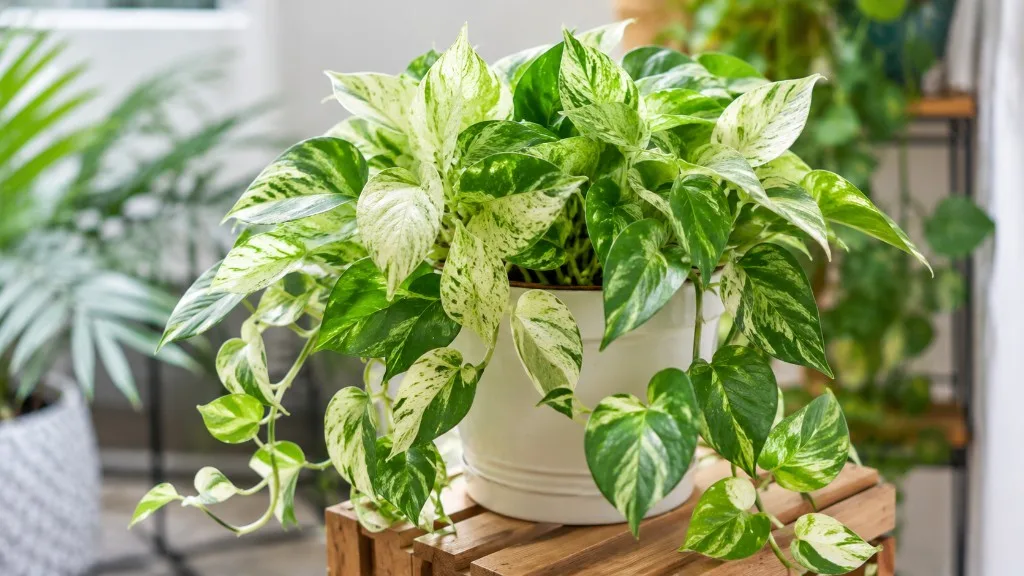
Snow Queen resembles Marble Queen but generally presents a whiter background with smaller green areas and sharper contrast. That makes it striking and less forgiving of a dim room. Put it close to a bright filtered window, acclimate it to any increase in light, and accept that the palest leaves may grow more slowly.
Manjula pothos has broad, often slightly wavy leaves with irregular cream, silver, pale green, and dark-green marbling. The leaf shape is a useful identification clue, and its slower, sometimes less aggressively trailing growth can be an advantage if you want a fuller pot instead of a fast cascade. It belongs in the brightest indirect-light group, but never in unfiltered hot sun.
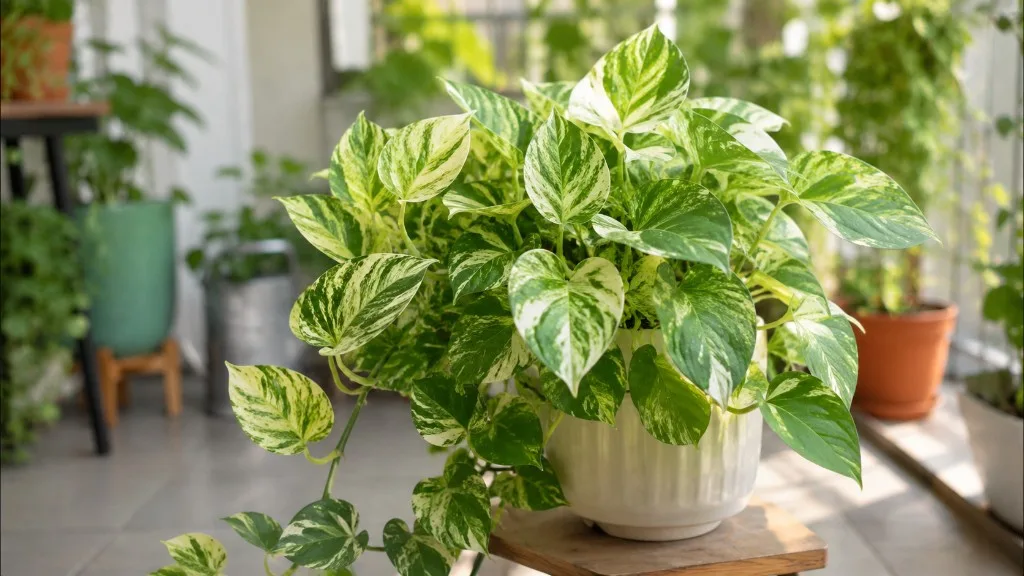
N’Joy, Pearls and Jade, and Glacier: Crisp Small-Leaf Types
N’Joy pothos is recognized by smaller leaves with larger, cleaner white sections, often concentrated near the margins. It is commonly confused with Pearls and Jade. N’Joy’s pale sections typically look cleaner, while Pearls and Jade is known for green speckling inside its white areas.
Pearls and Jade pothos has compact leaves with white or cream edges, green-on-green variation, and fine green flecks across the pale sections. Clemson lists it as a distinct cultivar and notes its smaller, speckled leaves and need for plenty of light to keep its coloring. It is a rewarding choice for a shelf where you can see the pattern up close, not a plant to hide in a dark corner.
Glacier pothos has rounded leaves with irregular white markings and a silvery cast. It is easy to mistake for a small white-variegated cultivar in a shop, so inspect the leaf shape and any shimmer across the green tissue. Treat it like the other heavily patterned types: bright indirect light, careful acclimation, and a slower dry-down than a vigorous green pothos.
Global Green, Emerald, and Lemon Meringue: Green-on-Green
Global Green makes its pattern from shades of green rather than dramatic white. It often shows darker margins around lighter central areas, giving the leaves a layered, almost painted look while retaining more chlorophyll than a predominantly white cultivar. That makes it a good middle-ground choice for a bright room where you want pattern without the maintenance anxiety of a white-heavy plant.
Emerald pothos is frequently compared with Global Green because both are green on green. The commonly used distinction is that Emerald tends to reverse the emphasis, with lighter edges and darker centers. Because these names are not always applied consistently in retail, buy for the actual leaf pattern and growth habit you like rather than assuming a label guarantees a precise color arrangement.
Lemon Meringue pothos combines green leaves with bright yellow or lemon-colored variegation. It offers more contrast than a green-on-green cultivar but usually reads warmer and yellower than Marble Queen. Give it strong filtered light and let the newest leaves tell you whether the spot is preserving the color you bought.
Variegated Neon and Harlequin: Special Finds
Variegated Neon pothos starts with the electric chartreuse color associated with Neon and adds contrasting green or yellow patterning. The look can shift as leaves mature, so a young cutting may not perfectly predict the adult plant. Ohio Tropics recommends brighter light for variegated Neon and shows the practical propagation sequence: a node cutting, bright placement, and potting once roots are established. See the Ohio Tropics variegated Neon guide.
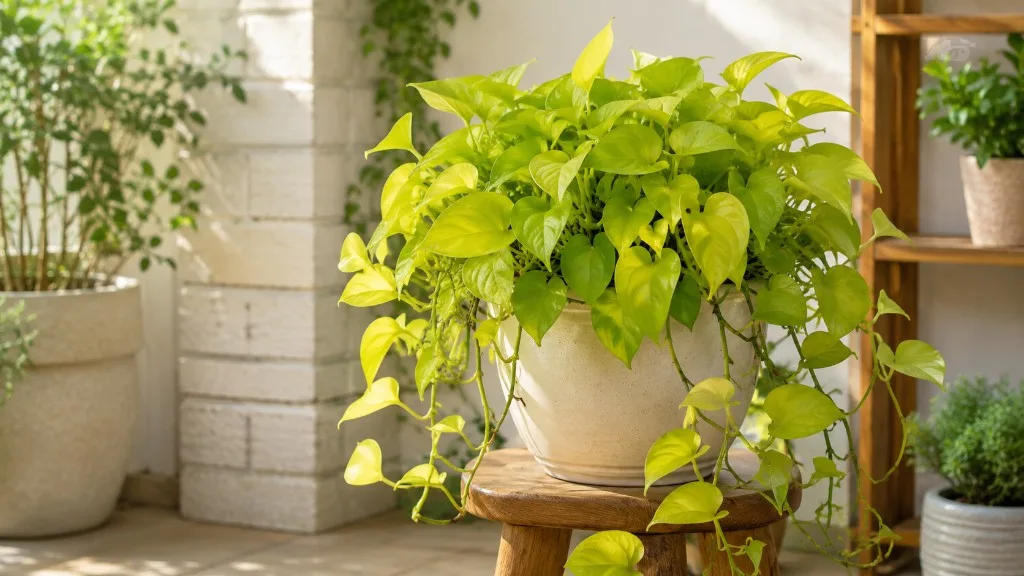
Harlequin pothos is a highly variegated, sought-after type with broad areas of white, cream, light green, and dark green. It is beautiful precisely because the pattern is irregular, but that also means it can be slower, more variable, and harder to verify from a listing photo. Ask for current photographs, confirm that the cutting includes a variegated node, and do not choose it for a dim room or if you need rapid coverage.
How to Tell Lookalikes Apart Before Buying
Start with the botanical identity. True pothos is Epipremnum aureum. “Satin pothos” is usually Scindapsus pictus, a different genus with silver markings and a more textured, slower-growing appearance. Clemson Extension specifically notes that satin pothos is not a true pothos and that the two groups differ in growth and watering tolerance. If the seller’s plant has a distinctly silvery, velvety surface, check the label before you copy a pothos care schedule. Compare it with this satin pothos guide.
For white-and-green cultivars, use a short inspection sequence:
- Look at several leaves, not one: variegation changes along a vine, and a single unusually white leaf can mislead you.
- Check the leaf edge: Manjula often has a wavier margin; Marble Queen is generally smoother; N’Joy and Pearls and Jade tend to have smaller leaves.
- Study the pale tissue: green flecks in white areas point toward Pearls and Jade; clean white blocks are more characteristic of N’Joy.
- Compare the whole plant: a seller’s close-up may hide a long green runner, pest damage, or a thin cutting with only one impressive leaf.
- Ask for the node and mother-plant story: a beautiful leaf without a viable node is not a reliable propagation purchase.
The best price is not always the best value. A healthy, well-labeled Golden or Marble Queen is usually a safer buy than a rare name attached to a stressed cutting. Inspect leaf undersides and nodes for pests or soft tissue, and quarantine every new plant before placing it beside your collection.
Propagation, Pruning, and the Reversion Question
Variegated pothos is easy to propagate, but easy to root does not mean guaranteed to clone the exact pattern. A stem cutting makes a new plant from the tissue it contains. If you take a cutting from a green-only runner, it may root vigorously and continue producing green leaves; brighter light cannot reliably invent a variegated section that was not in the cutting.
Keep at least one healthy green section in the parent plant. A plant that has been pruned down to mostly white leaves may have too little photosynthetic tissue to recover quickly. For slow cultivars, take a few well-chosen cuttings rather than stripping every attractive tip from the mother plant.
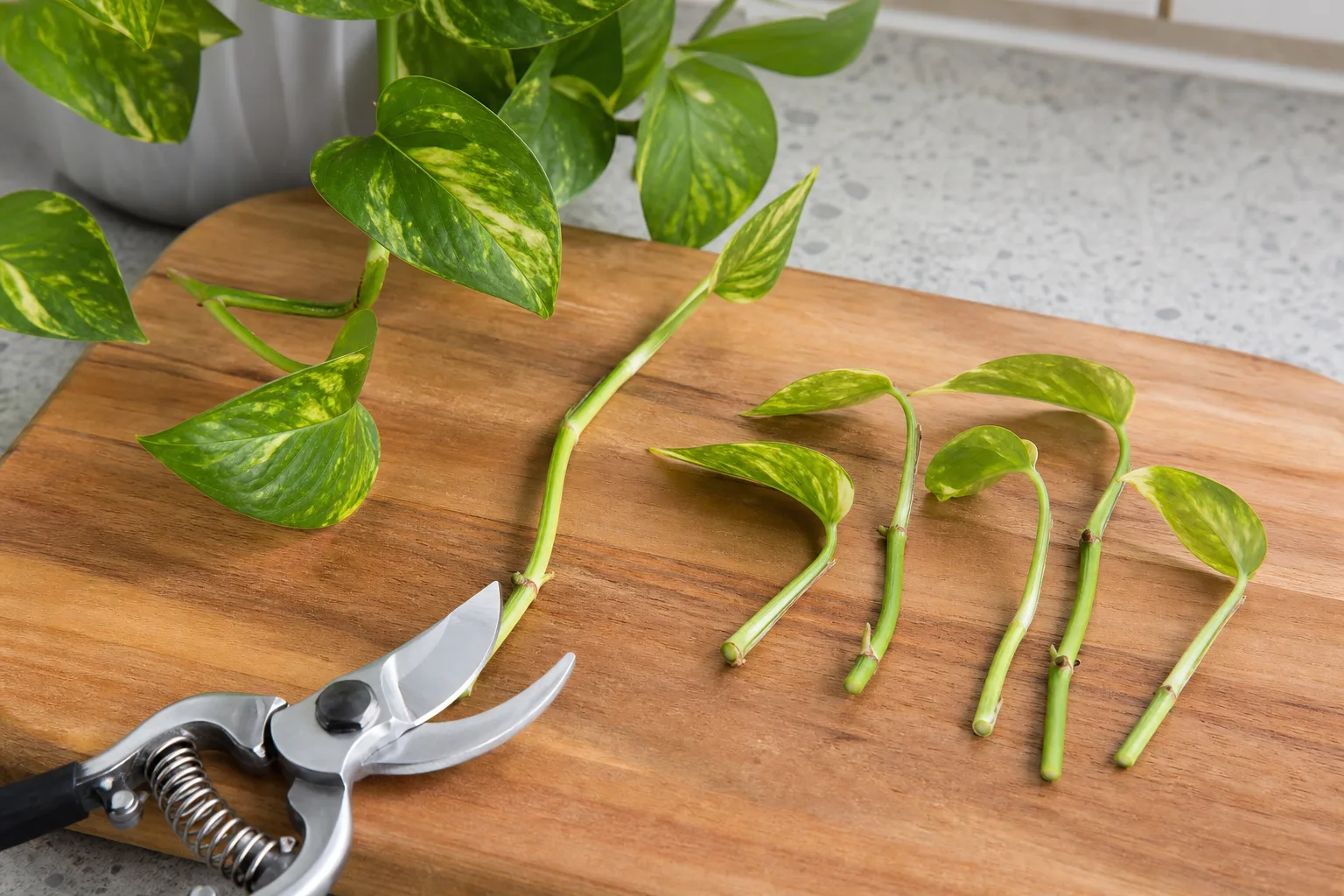
Penn State Extension and Clemson both describe stem cuttings as a practical pothos propagation method, with the node as the essential structure for rooting. Penn State also notes that pothos forms aerial roots at nodes and can be trained onto a support. See the full LeafyPixels pothos propagation guide for a step-by-step cutting workflow.
How to Propagate a Cutting Without Losing the Node
Choose a healthy stem with one or more leaves and a visible node—the small joint where a leaf or aerial root emerges. With clean scissors, cut just below the node, leaving enough stem above it to handle the piece without damaging the growing point.
For water propagation, remove any leaf that would sit underwater and place the node below the waterline while keeping the leaves dry. Set the glass in bright indirect light, refresh the water when it becomes cloudy, and pot the cutting when it has several firm roots rather than a single fragile thread.
For soil propagation, place the node just below the surface of a lightly moist, airy mix. Keep the pot warm and bright but out of harsh sun, and resist tugging on the cutting every day. New leaf growth is better evidence of establishment than a small root you may break by checking.
Group several compatible cuttings in one pot if you want a fuller plant quickly, but keep their nodes oriented into the mix and do not pack the container so tightly that it stays wet. Water-rooted cuttings also need a gradual transition to soil; move them once roots are established, then allow the mix to dry slightly between waterings while new soil roots form.
Troubleshooting Brown, Yellow, or Plain-Green Leaves
Start with the damage pattern, then check soil moisture and light before adding anything. One yellow lower leaf may be normal aging; several yellow leaves in wet mix are a root-zone warning. Brown on the window-facing side suggests scorch, while brown tips may point to moisture, humidity, salts, or water quality.
| Symptom | First checks | What to do next |
|---|---|---|
| New leaves are mostly green | Light level, distance from window, and whether one stem is all green | Move to brighter filtered light; prune a fully green vine back to the last variegated node |
| Leaves are yellow and the soil is wet | Drainage hole, pot size, dense mix, and roots | Stop watering until the mix dries; inspect roots if yellowing continues |
| Brown bleached patches face the window | Recent move, hot glass, and time of day | Move back or filter the light; damaged tissue will not turn green again |
| Brown crispy tips or margins | Dry mix, low humidity, fertilizer salts, softened or hard water | Correct the root-zone rhythm first; then raise humidity or flush salts if indicated |
| Leaves droop or curl | Soil moisture, cold draft, hot vent, and pests | Fix the matching environmental stress; do not water a heavy, wet pot |
| Fine stippling or webbing | Leaf undersides and stem joints | Isolate the plant, rinse foliage, and use only a product labeled for the pest and plant |
| White cottony clusters or hard bumps | Nodes, petioles, and leaf undersides | Isolate, remove visible pests, and monitor repeatedly rather than treating once |
Root rot is a process, not a diagnosis you can make from one yellow leaf. Slide the plant from the pot only when the wet-soil pattern persists or the stem base is soft. Healthy roots are firm and pale to tan; damaged roots are soft, brown, or foul-smelling. Trim only clearly dead material with sterilized scissors, repot into fresh airy mix, and wait for the root zone to dry appropriately before watering again.
Do not cut every brown leaf at the first sign of stress. Remove tissue that is mostly dead or diseased, but leave useful green area while the plant rebuilds. A variegated pothos with fewer leaves may need weeks of steady conditions before it produces a convincing new leaf, and repeated moves can create more stress than the original problem.
Pet Safety and Smart Placement
Keep every pothos—variegated or green—away from cats, dogs, and children who chew plants. The ASPCA lists Golden pothos as toxic to cats and dogs because it contains insoluble calcium oxalates; chewing can cause oral irritation, intense burning of the mouth, drooling, vomiting, and difficulty swallowing. If a pet may have ingested part of the plant, contact your veterinarian or the ASPCA Animal Poison Control Center at (888) 426-4435 rather than waiting to see what happens. Check the ASPCA plant entry.
Hanging baskets are not automatically safe: a cat can reach a trailing vine that hangs near furniture, and fallen leaves remain accessible on the floor. Put the plant in a room pets cannot access, use a genuinely unreachable shelf, or choose a non-toxic alternative if you cannot control the placement. Avoid letting a vine trail into a child’s play area or across a walkway where leaves can be pulled down.
Keep variegated pothos indoors. In Florida, UF/IFAS identifies pothos as a high invasion-risk non-native plant and says it is no longer recommended for outdoor planting. Outdoor warmth may produce vigorous growth, but that is not a reason to release a container vine into a landscape; keep the pot contained, remove prunings responsibly, and follow local guidance. Read UF/IFAS’s pothos identification note.
Conclusion
Choose a variegated pothos by matching its pattern to your light. Golden, Jessenia, Hawaiian, and green-on-green types suit ordinary bright rooms; Marble Queen, Snow Queen, Manjula, N’Joy, Pearls and Jade, Glacier, variegated Neon, and Harlequin reward brighter placement. Global Green, Emerald, and Lemon Meringue sit between those groups, but labels and leaves vary.
Care is mostly about keeping the root zone airy and the light steady. Water after the top layer dries, drain completely, feed lightly during active growth, prune above nodes, and treat new green growth as an early warning. In that order, variegated pothos stays colorful without becoming high-maintenance.