Philodendron Silver Sword Soil Mix: Drainage, Bark & Repot
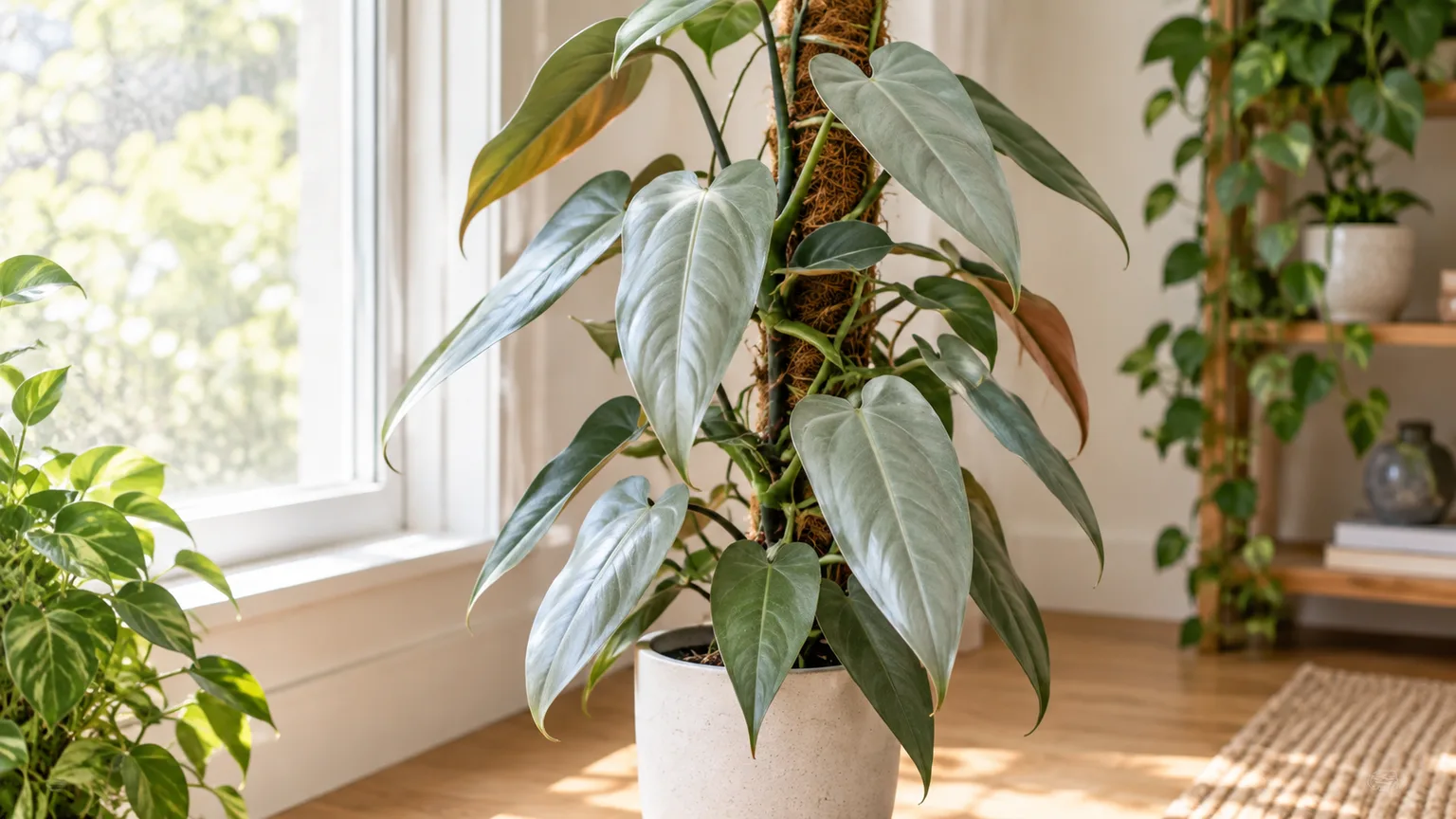
Philodendron Silver Sword Soil Mix: Drainage, Bark & Repot Recipe
Philodendron Silver Sword Soil Mix: Drainage, Bark & Repot Recipe
Philodendron Silver Sword soil is the foundation that lets a climbing vine hold moisture without drowning its roots. Philodendron hastatum — the species behind the Silver Sword cultivar — is a tropical climbing herbaceous perennial from Southeast Brazil with metallic silver-blue arrow leaves that only reach full size when the plant climbs a moss pole or trellis. Indoors, that biology means the mix must stay chunky, well-drained, and rich in organic matter while the pot must accommodate vertical roots and a support stake — not the wide shallow geometry crawlers like Gloriosum need.
Soil decides how much oxygen reaches roots between waterings on the Silver Sword watering guide. Heavy peat kept constantly wet suffocates hastatum even when you water carefully, producing yellow lower leaves and soft petioles long before you notice a problem on the foliage. This page is your mix-and-diagnostics hub: recipe ratios, mixing steps, drainage tests, moss-pole potting workflow, and links to the repotting guide when you need procedural detail beyond a soil refresh.
Quick Answer: Chunky Aroid Mix for a Climbing Vine
For most indoor Philodendron Silver Sword in a 15–20 cm (6–8 inch) pot with a drainage hole and moss pole, start with 40 % quality indoor potting mix, 30 % perlite, and 30 % medium orchid bark by volume:
| Component | Share | Role |
|---|---|---|
| Peat- or coco-based indoor potting mix | 40 % | Moisture and nutrient buffer |
| Perlite | 30 % | Aeration, faster dry-down |
| Medium orchid bark | 30 % | Chunky pore channels, anti-compaction |
Pre-moisten, blend thoroughly, and confirm water exits the drainage hole within 30–90 seconds of a full soak. Target pH 5.5–6.5 — NC State lists hastatum as acid-tolerant with soil pH below 6.0 and high organic matter with good drainage; the RHS hastatum profile recommends a loose, well-drained potting mix with well-drained moisture conditions.
Support: install a moss pole or trellis at repot time and firm mix around the base without burying aerial roots against saturated peat. Top-dress with bark if the pole shifts after the first watering.
Why Silver Sword Soil Differs From Generic Philodendron Advice
Most philodendron soil articles assume either a self-heading rosette or a horizontal crawler. Silver Sword is a clinging climber — NC State notes it needs a moss pole or trellis and can reach 10–15 feet indoors when supported. The RHS philodendron growing guide explains that many philodendrons are hemi-epiphytic: in habitat they climb trees while roots access both bark and forest-floor organic matter.
The soil job for Silver Sword is twofold: keep oxygen at the root zone between thorough soaks, and provide enough organic buffer that vertical stems and aerial roots do not dry to dust in bright rooms on the light guide. A tall narrow pot with dense peat compacts at the bottom while the surface looks dry — the profile extension container guides warn against when water cannot drain freely and roots lack adequate air.
Climber Biology and Southeast Brazil Native Context
In Brazilian rainforest understory, hastatum grows in partial shade on organic-rich forest floor material and climbing surfaces. NC State describes leaves that emerge arrow-shaped and elongate with maturity, with copper-toned undersides — a growth pattern tied to vertical ascent, not horizontal spread. Treating Silver Sword like a tabletop self-header or burying nodes deep in wet mix stalls the metallic blade color and stretches internodes.
Unlike Philodendron gloriosum, which advances on a surface rhizome, hastatum roots along a vertical vine. That changes pot shape priorities but not the core aroid rule: never let roots sit in stagnant water. Clemson HGIC notes root rot usually follows a soil mix that does not drain quickly or overly frequent watering. For full species context — humidity, support, toxicity — see the Silver Sword overview.
Best Soil Mix for Philodendron Silver Sword (Recipe Card)
The reliable baseline is 40 % potting mix, 30 % perlite, 30 % orchid bark — airy enough for a climber, moist enough for metallic foliage in typical home humidity. Iowa State Extension recommends growing philodendrons in all-purpose potting soil amended for container life; for hastatum, amendment means perlite and bark, not extra peat.
Standard batch (enough for one 18 cm repot with pole):
- 2.4 liters (about 2.5 quarts) indoor potting mix
- 1.8 liters perlite
- 1.8 liters medium orchid bark
Texture target: squeeze a handful — it should hold shape briefly, then crumble. Not a wet brick, not dusty rubble.
Equal-thirds alternative: one third each potting mix, perlite, and bark matches common aroid collector practice and the RHS philodendron suggestion of roughly two parts orchid compost to one part peat-free ericaceous mix — a slightly bark-heavy variant of the same principle.
Avoid raw garden soil, pure peat, or straight cactus mix as the whole recipe. NC State’s container handbook recommends soilless substrates with perlite and pine bark rather than field soil for houseplants.
Optional Add-Ins: Coco, Charcoal, and Pumice
Once the base recipe works in your room, optional upgrades improve long-term structure:
| Add-in | Typical share | When it helps |
|---|---|---|
| Coco coir (replace up to ⅓ of peat base) | 10–20 % of total mix | Dry indoor air; slightly slower dry-down than perlite alone |
| Horticultural charcoal | 5–10 % | Humid cabinets; mild odor and salt buffering |
| Pumice (swap for half the perlite) | 15–20 % | Heavy-handed waterers; adds weight so mix stays put when watering |
Do not stack every add-in at maximum on the first repot. Change one variable, run the drainage test, then adjust. In dim, cool rooms, extra bark without matching light can dry the mix faster than roots can drink — watch leaf firmness, not the calendar.
Mixing Your Aroid Blend Step by Step
- Measure by volume, not weight — use a scoop or bucket.
- Pre-moisten potting mix and bark in separate tubs until evenly damp (not dripping). Dry perlite dust is irritating; wet it down per NC State handling guidance on perlite in soilless mixes.
- Combine potting mix, perlite, and bark in a large tub. Mix with gloved hands until particles are distributed evenly.
- Test a batch before potting: fill a small cup with the blend, water until runoff, and confirm drainage within one minute.
- Set the moss pole in the pot center before backfilling — stake depth should reach the bottom third of the pot for stability.
- Position the plant with roots spread around the pole base; backfill lightly without compressing.
- Water once to settle, drain fully, top up if subsided, and tie the vine loosely to the pole.
Drainage Speed and the One-Minute Drainage Test
Drainage is a performance metric, not a marketing label. Test after every repot and whenever new silver leaves stall despite reasonable watering checks.
Full-soak test: water until runoff exits the drainage hole. On fresh Silver Sword mix in a proportional pot, excess water should leave within 30–90 seconds and the surface should not hold a glossy puddle beyond a few minutes. If water pools for ten minutes, add perlite or bark before the next repot — waiting longer between drinks does not fix structure.
Drainage holes are non-negotiable. NC State’s container chapter states drainage holes prevent roots from standing in water and developing root rot. Decorative pots without holes are cachepots only.
Root-Zone Smell Test and Compaction Checks
Smell test: healthy mix smells earthy. Sour, swampy, or stagnant odor at the drainage hole means anaerobic breakdown — roots may already be stressed while upper leaves still look acceptable.
Compaction check: yearly, probe with a bamboo skewer. Sudden resistance or mud smeared on the stick means peat collapsed — top-dressing alone will not fix a compacted core. Plan full refresh at repot.
Hydrophobic dry pockets: if water runs down the sides while the core stays dry, the mix has turned hydrophobic — soak the pot bottom-up for twenty minutes, then reassess structure at the next repot.
Pot Choice and Moss-Pole Integration
Soil and pot shape are one system on a climbing hastatum. The right mix in an oversized deep cylinder still holds a wet column the upper roots never use; the right moderate pot with exhausted peat still fails.
Choose a container 2–4 cm wider than the current root ball — not dramatically larger. Iowa State notes philodendrons do well when slightly pot-bound because mix dries predictably between waterings. An oversized pot still holds excess wet substrate around unused space.
Good shapes: standard nursery pots with drainage, plastic or terracotta, 15–20 cm for young plants scaling up with the vine. Poor shapes: closed glass terrarium bases, deep floor cylinders with no pole anchor, cachepots that trap runoff.
Terracotta dries faster; plastic retains moisture longer. Match material to your watering habits and room humidity.
Vertical Climbers vs Horizontal Crawlers: Pot Geometry
| Factor | Silver Sword (climber) | Gloriosum (crawler) |
|---|---|---|
| Growth direction | Vertical vine on support | Horizontal rhizome across surface |
| Pot priority | Moderate depth; pole-integrated | Wide and shallow |
| Stem placement | Nodes root along buried sections on pole | Rhizome must stay above grade |
| Mix emphasis | Aeration + moisture buffer | Maximum surface aeration |
| Typical failure | Compacted core in deep pot | Buried rhizome tip rot |
Same aroid family, different geometry — do not copy Gloriosum’s wide-shallow pot advice for Silver Sword without adjusting for vertical growth.
pH, Organic Matter, and Salt Management
Philodendron Silver Sword usually does best when the mix stays in a practical indoor band around pH 5.5–6.5. NC State lists hastatum as acid-tolerant below pH 6.0; the RHS philodendron guide recommends a slightly acidic, loose, free-draining compost — a useful cross-check, not a mandate to lab-test every bag.
High organic matter supports the rich, moist-but-not-soggy profile NC State describes. That does not mean pure peat — it means quality potting mix amended with bark and perlite so organic content does not collapse into mud.
Salt dynamics: fertilizer and hard-water minerals concentrate in the upper root zone where you water and feed. If leaf tips burn, white crust rings the pot, or new silver blades emerge smaller despite good light, flush the mix with room-temperature water until 2–3 pot volumes exit the drainage hole, then drain fully. Apply fertilizer only to already-moist soil on the fertilizer guide — dry chunky mix plus full-strength feed concentrates salts at the roots.
When to Refresh or Repot the Mix
Refresh Silver Sword mix when structure fails, not on a rigid calendar alone.
Refresh triggers:
- Water channels down the sides while the core stays dry
- Mix smells sour at drainage holes
- Skewer meets compacted mud in the center
- Salt crust and tip burn despite conservative feeding
- Roots circle densely at the pot wall with little fresh bark visible
- Visible breakdown — no perlite or bark particles, uniform peat mud
Top-dress vs full repot: replacing the top 3–5 cm with coarse bark or perlite helps when the pole loosens but the root ball is still healthy. It does not fix a compacted core.
Full repot: plan every one to two years for active climbers, or two to three years for slow specimens — aligned with the repotting guide. Best timing is spring through early summer when light and temperatures rise. Avoid winter repot unless mix is actively failing or rot is present.
| Situation | Action |
|---|---|
| Pole wobbly, mix otherwise healthy | Re-firm base mix; top-dress with bark |
| Slow drainage, sour smell | Full repot into fresh 40/30/30 mix |
| Roots dense at wall | Repot one size up; refresh all mix |
| Only surface algae, no smell | Scrape top layer; fix overwatering |
Potting a Climber: Moss Pole and Root Placement
This is the procedural core many generic soil articles skip. When repotting or potting a new purchase:
- Water lightly the day before so roots are pliable, not brittle.
- Choose a clean pot 2–4 cm wider with drainage; pre-moisten fresh mix.
- Insert the moss pole to the bottom third of the pot before adding mix.
- Mound mix at the bottom — do not fill to the rim.
- Set the root ball beside the pole with aerial roots directed toward the support.
- Backfill lightly around roots; do not pack wet peat against the stem collar.
- Tie the vine loosely with soft ties — nodes should contact the pole, not sink below the mix line in saturated peat.
- Water once to settle, drain fully, keep bright indirect light, hold fertilizer for 3–4 weeks.
If the nursery buried the lowest nodes too deep, raise the planting depth during repot so the stem base sits at grade — aerial roots need air between waterings.
For propagation-rooted cuttings transitioning from moss or water, follow the same pole-first geometry on the propagation guide — roots in chunky mix, support installed from day one.
Common Philodendron Silver Sword Soil Mistakes
Using heavy peat store mix straight from the bag. Compresses within one season; climbers stall before leaves yellow. Amend or rebuild with the 40/30/30 recipe.
Skipping the moss pole at repot. Silver Sword is not a self-supporting tabletop plant — weak mix plus no vertical structure stretches internodes and dulls silver tone.
Gravel or pot shards in the bottom. NC State Extension warns that a layer of coarse material at the bottom hinders rather than helps drainage by creating a saturated zone above the interface. Use the same airy mix from top to bottom.
Oversized pot “for faster growth.” Extra volume holds wet mix the root system cannot use — same mechanism Clemson describes for root rot in poorly draining mix.
Treating Silver Sword like Gloriosum. Wide shallow pans and rhizome-above-grade rules do not apply to vertical hastatum culture.
Cachepot water traps. Outer decorative shells that hold runoff recreate bog conditions. Empty after every watering.
Changing light, fertilizer, and soil simultaneously when leaves stall. Inspect mix drainage and pole stability first — Iowa State advises checking root condition before changing light or fertilizer.
Silver Sword vs Gloriosum and Other Aroids: Soil Differences
| Trait | Philodendron Silver Sword | Philodendron Gloriosum | Self-heading philodendrons |
|---|---|---|---|
| Growth | Climbing vine | Horizontal crawler | Upright rosette |
| Pot | Moderate depth + pole | Wide shallow | Standard depth |
| Mix | 40/30/30 chunky aroid | Equal-thirds, max aeration | Peat-based indoor mix + perlite |
| Support | Moss pole required | Open horizontal space | Optional |
| Failure mode | Compacted deep core | Buried rhizome tip | Waterlogged center |
The metallic hastatum look is a light and support signal as much as a soil signal — but no amount of brightness fixes anaerobic peat at the roots.
Troubleshooting: Wrong-Soil Symptom Diagnostic
| Symptom | Likely soil cause | First fix |
|---|---|---|
| Yellow lower leaves, heavy pot | Waterlogged compacted mix | Check drainage; repot into 40/30/30 |
| Silver tone fading, long internodes | Secondary — but check pole + pot first | Install pole; confirm mix is not pure peat |
| Water runs down sides | Hydrophobic or compacted core | Bottom soak; plan full repot |
| Sour smell at drain hole | Anaerobic breakdown | Repot immediately; trim mushy roots |
| Crispy tips, white crust | Salt buildup in organic mix | Flush; reduce fertilizer strength |
| Aerial roots shriveling | Mix too dry / too bark-heavy | Add modest potting mix fraction at repot |
| Fungus gnats persistent | Peat-heavy surface staying wet | Increase bark; let top 3–5 cm dry |
When to Use This Page vs Other Silver Sword Guides
Use this soil page when you are building or refreshing mix, testing drainage, choosing pot size relative to a moss pole, or diagnosing whether yellow leaves trace back to structure rather than watering rhythm.
Use the watering guide when the mix drains well but you need help with check-first soak timing and seasonal intervals.
Use the light guide when silver blade color fades or internodes stretch despite healthy roots.
Use the repotting guide for step-by-step transplant timing, root inspection, and post-repot recovery.
Use the propagation guide when transitioning cuttings from water or moss into their first chunky pole pot.
Related Philodendron Silver Sword Guides
- Overview — species identity, growth habit, toxicity, and how Silver Sword differs from lookalikes.
- Watering — check-first rhythm tied to this mix’s dry-down speed.
- Light — brightness targets that preserve metallic foliage on supported vines.
- Fertilizer — feeding without salt buildup in organic aroid mix.
- Repotting — when to upsize, root-trim rules, and pole reinstall.
- Propagation — first pot and mix for new stem-cut plants.
Conclusion
Philodendron Silver Sword rewards a chunky, acidic, well-drained aroid mix — roughly 40 % potting soil, 30 % perlite, and 30 % orchid bark — in a moderate-depth pot with drainage and a moss pole installed at repot time. NC State’s hastatum profile and the RHS cultivation notes both point to loose, organic-rich, well-drained conditions; your job indoors is to keep that structure intact as peat ages.
Run the one-minute drainage test after every repot, smell the root zone before assuming thirst, and refresh mix when bark decomposes into fines — not on an arbitrary calendar. When symptoms confuse you, fix soil structure and pole placement before stacking light and fertilizer changes. With honest mix and support in place, the watering and light guides become much easier to apply.