Spider Mites on Philodendron Silver Sword: Causes, Checks &
Quick answer
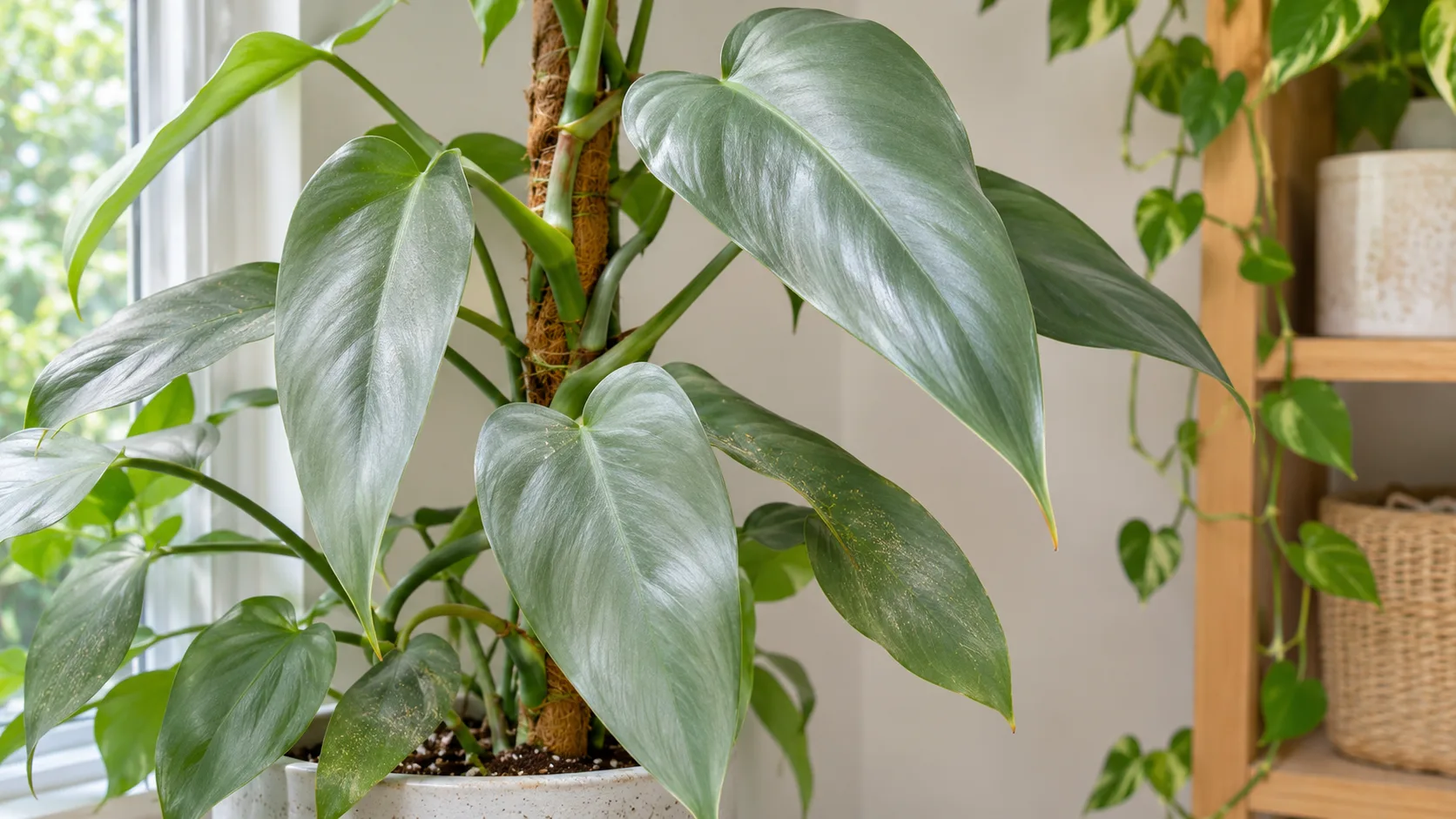
Pale stippling and dull patches on Silver Sword's metallic blades, worst on lower leaves, usually mean twospotted spider mites feeding on leaf undersides. First step: isolate the plant and shower the undersides of every leaf with a firm stream of lukewarm water, then repeat the rinse every few days for at least three weeks to catch newly hatching mites.
Spider Mites on Philodendron Silver Sword: Causes, Checks & Fixes
This guide covers spider mites on Philodendron Silver Sword. See also the general Spider Mites guide, watering, and light pages for this plant.
Spider Mites on Philodendron Silver Sword: Causes, Checks & Fixes
Quick answer
Pale pinprick dots spreading across the metallic blades of a Philodendron Silver Sword, usually starting on the lowest leaves, point to twospotted spider mites draining individual leaf cells from the underside. First step: isolate the plant and shower the undersides of every leaf with a firm stream of lukewarm water, washing mites, eggs, and webbing off physically before any spray is considered.
For how spider mites behave on houseplants in general, see our spider mite guide. On Silver Sword, the pattern usually shows up as stippled dull patches that mute the silver-blue sheen, fine webbing along leaf edges and the copper-toned undersides, and damage that worsens fast in hot, dry, dusty indoor air.
What spider mites look like on Philodendron Silver Sword
Spider mites are arachnids, not insects, and adults are less than 1/20 inch long with eight legs, an oval body, and two eyespots — to the naked eye they read as tiny moving dots. The usual indoor culprit is the twospotted spider mite, Tetranychus urticae, recognizable under a hand lens by the two dark spots on the back of its yellow-green to amber body. Colonies live mostly on leaf undersides, and a single colony can hold hundreds of mites.
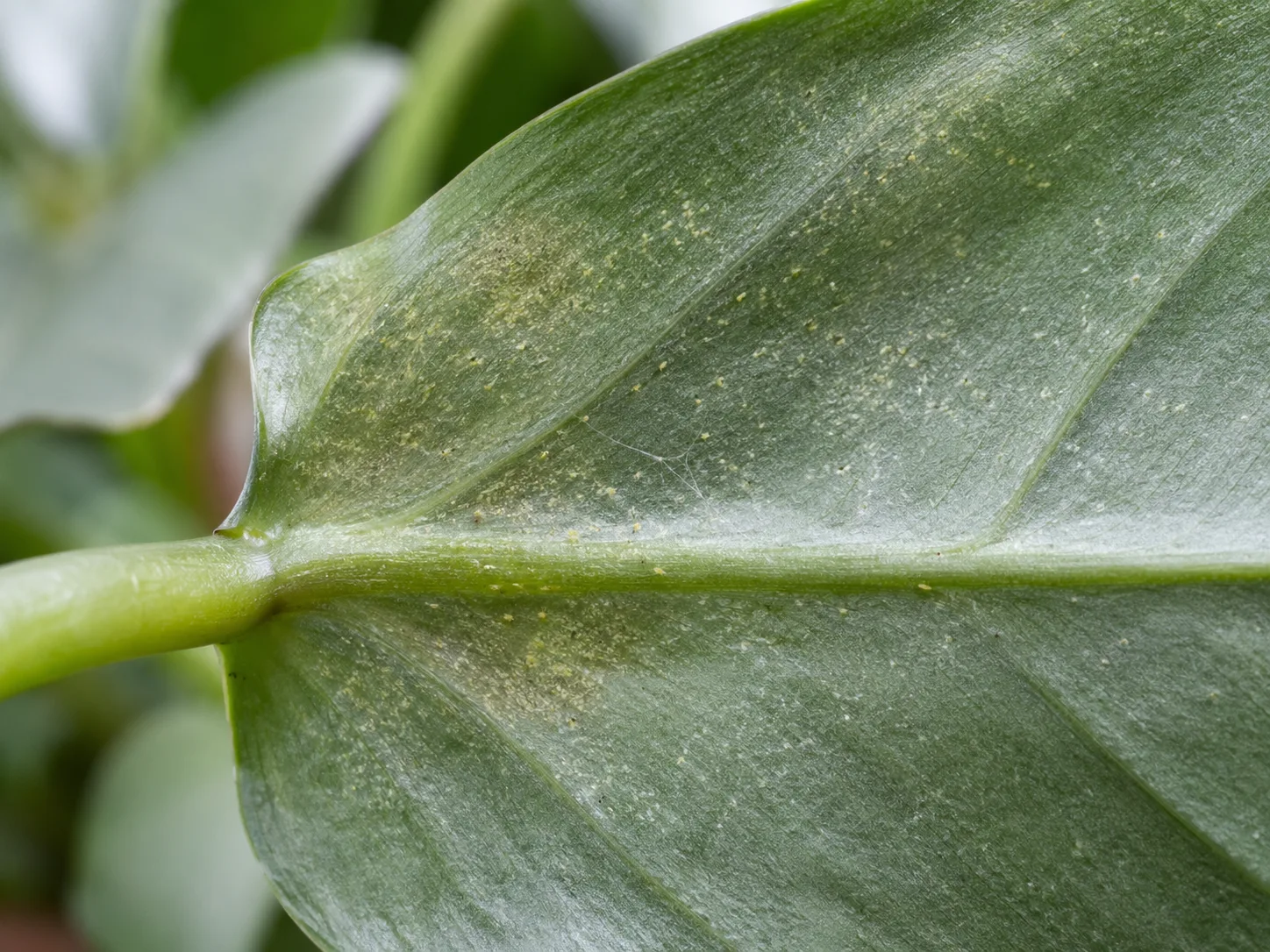
Fine stippling and sparse webbing on leaf undersides can reveal mites before broad bronzing develops.
Damage shows first as stippling: tiny light dots where mites have sucked out cell contents. Illinois Extension describes exactly this progression on ornamentals — stippling that turns leaves brown and dieback under severe infestation — and on Silver Sword the metallic finish makes early stippling unusually visible. Leaves take on a dusty, sandblasted look, then a bronzed cast; heavily infested blades yellow and drop. When numbers climb, mites spin the fine silk webbing that encloses attacked houseplant leaves, strung along leaf edges, between the blade and petiole, and across the unfurling new leaf.
Why Silver Sword draws spider mites
Mite damage is worst in hot, dusty conditions and on water-stressed plants, and a climbing Silver Sword in a typical home hits all three triggers at once. Its broad arrow blades collect household dust that shelters colonies and hides early stippling. Summer placement near a bright window or winter beside a heating vent bathes the vine in exactly the warm, dry air mites breed fastest in. And because Silver Sword likes its chunky mix to dry between drinks, owners who stretch the dry interval a watering too far hand mites a drought-stressed host — UC IPM warns that drought stress increases both mite numbers and mite damage.
Growth habit compounds the problem. Silver Sword is a true clinging climber that can reach 10 to 15 feet indoors on support, per NC State Extension — a tall column of overlapping leaves with sheltered undersides at every level. A poled vine also traps still, warm air behind its foliage, so check the leaves facing the wall and the pole, not just the display side.
Where mites hide on a climbing Silver Sword vine
Work bottom to top, underside first. Mites colonize the lowest, oldest, dustiest leaves earliest, then climb toward tender new growth as populations build.
Check in this order:
- Undersides of the lowest three or four leaves, especially along the midrib — the founding colonies.
- The newest unfurling leaf and its sheath, where mites web the tender rolled blade and stunt its expansion.
- Leaf edges and tips, where silk strands anchor first and show up against the light.
- Vine nodes and aerial-root junctions near the moss pole, where webbing bridges stem to support.
- The tops of blades for the sandblasted stippling pattern that maps where feeding happened below.
Keep the vine at the bright filtered light Silver Sword needs while you inspect — dim corners slow replacement growth and make it harder to tell whether new leaves are coming in clean.
How to confirm mites, not thrips, scale, or dust
Stippling plus dull foliage has several lookalikes, so confirm with the tap test before committing to weeks of treatment. Hold a sheet of white paper under a suspect leaf, tap the blade sharply three or four times, and watch for specks that crawl. Smear one with a fingertip: plant-feeding mites streak green or rust-red, while dust just brushes away dry.
- Hand-lens check: mites show oval bodies and eight legs; thrips are elongated, fast-moving slivers that leave black varnish-like specks instead of silk.
- Webbing check: fine silk along edges and undersides fits spider mites; cottony white tufts in axils fit mealybugs, and hard immobile bumps fit scale.
- Pattern check: stippling spread evenly across the blade fits mites sucking cells; silvery scraped patches with black dots fit thrips, and yellowing from the petiole outward with sticky honeydew fits aphids or mealybugs.
- Dust check: wipe a dull patch with a damp cloth. Dust wipes clean and stays clean; mite stippling is embedded in the leaf and fresh silk reappears within days.
First fix: isolate and shower the leaf undersides
Do one thing first: move the vine away from other houseplants and rinse every leaf underside with a firm stream of lukewarm water, supporting each blade from above so petioles do not crack at the nodes. UC IPM prescribes exactly this opening move — apply a water spray to the undersides of leaves at least once a day when plants are infested — because the jet physically removes mites, eggs, and webbing without chemicals.
Technique matters on Silver Sword’s long blades. Lay the pot on its side in a shower or sink so runoff carries mites away from the mix rather than into it. Angle the spray upward into the undersides, working lowest leaves first so dislodged mites fall onto already-rinsed foliage. Unfurl the newest leaf gently and rinse inside its curl. Let the vine drip-dry in good airflow with no direct hot sun on wet blades, and correct any underwatering at the same time, since a plant that stays drought-stressed invites the population straight back.
Step-by-step follow-up over three to four weeks
One rinse never finishes the job because eggs keep hatching on the undersides. A female lays up to one hundred eggs in her lifetime, eggs hatch in about three days, and summer generations can complete in under a week — so plan repeat passes timed to the hatch cycle.
- Days 1–3: shower undersides daily, wiping dust off upper blades with a damp cloth so fresh stippling stays visible.
- Day 7: recheck every underside with a hand lens. If live mites persist, apply insecticidal soap or horticultural oil strictly per label, coating the undersides completely until runoff — UC IPM stresses to completely cover the undersides of leaves and to confirm mites are present before treating.
- Days 14 and 21: repeat inspection plus rinse, reapplying soap or oil only where live mites remain. Never spray a wilted plant or in very hot conditions; UC IPM warns not to spray when plants are water-stressed or in very hot weather.
- Week 4: if no new stippling, webbing, or tap-test mites have appeared for two full weeks, return the plant to its spot but keep weekly underside checks for another month.
Prune only blades that are fully bronzed, crisp, or yellowed past function — they will not recover, and removing them lets you read new damage clearly. Avoid repotting during treatment unless the mix has genuinely failed; tearing apart a chunky aroid mix that is otherwise draining well adds root stress on top of cell loss.
What not to do
Do not reach for a broad-spectrum pyrethroid or organophosphate spray first. These products are weak against mites, kill the predatory insects and mites that suppress them, and routinely trigger worse flare-ups — UC IPM notes spider mites frequently become a problem after applying certain insecticides such as pyrethroids. Do not blast the whole vine with full-strength alcohol or spray oils in hot direct sun; diluted soap or oil on a calm, mild morning after a patch test is the safer path.
Do not fertilize a heavily stippled vine to “help it recover.” Extra nitrogen pushes soft growth while the plant is losing photosynthetic area, and feeding belongs back on the normal Silver Sword routine only after clean new leaves resume. Do not stack repotting, heavy pruning, and spraying on the same day — make one targeted move, then read the next leaf.
How to prevent spider mites on Silver Sword next time
Water by checking the top few centimeters of mix rather than by calendar so the vine never sits drought-stressed through a hot spell. Wipe the broad blades with a damp cloth monthly — dust removal is pest control on this plant, since clean metallic leaves show stippling days earlier. Hold moderate humidity with airflow rather than a constantly soaked moss pole; damp stagnant crevices grow mold that hides mite silk.
Quarantine every new plant for two to four weeks before it joins the collection, tapping its lower leaves over white paper on arrival day and again a week later. During hot dry spells, make underside checks part of the weekly routine: three tapped leaves per vine takes a minute and catches colonies while a rinse alone still solves them.
When to worry
Treat as urgent if webbing sheets across most of the vine, new leaves abort or unfurl already bronzed and stunted, or blades yellow and drop faster than replacements emerge despite correct watering. A vine that keeps producing stippled distorted leaves after three full weekly treatment cycles is chronically infested — cut back to the lowest clean node with firm tissue, root a healthy tip cutting separately if the mother vine is collapsing, and consider a local extension diagnosis before any stronger product. Very high populations can defoliate sensitive hosts outright, so prolonged heavy feeding is not cosmetic.
Severity note: This issue is marked medium for Philodendron Silver Sword — a triage clue, not a guarantee.
Related tool
Use the Pest Identifier Tool to narrow causes for spider mites on this plant before changing multiple variables at once.