Leggy Growth on Philodendron Verrucosum: Causes, Checks &
Quick answer
Leggy growth on Philodendron Verrucosum means long bare internodes and small pale leaves caused by too little light plus missing climbing support. First step: move the plant into bright indirect light with its lead vine tied to a moist moss pole, then wait for tighter new growth before pruning the stretched sections.
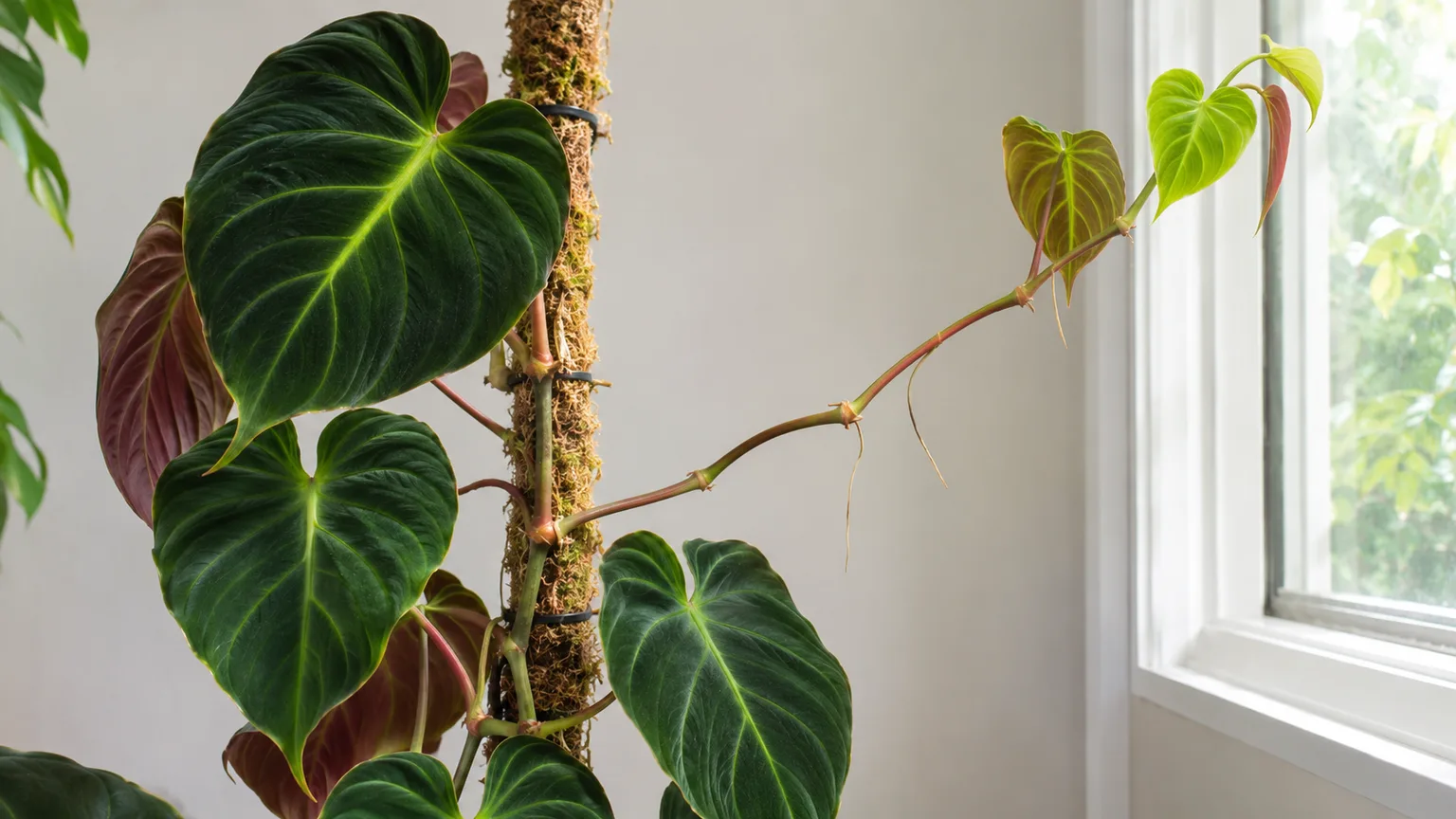
Leggy Growth on Philodendron Verrucosum: Causes, Checks & Fixes
This guide covers leggy growth on Philodendron Verrucosum. See also the general Leggy Growth guide, watering, and light pages for this plant.
Leggy Growth on Philodendron Verrucosum: Causes, Checks & Fixes
Quick answer
Leggy growth on Philodendron Verrucosum is the vine stretching toward brighter conditions without anything to climb: internodes lengthen, new velvet leaves arrive smaller and paler, and the lead stem leans hard toward the nearest window instead of climbing upward. On this species the pattern almost always combines two deficits, dim placement and a missing or dry support, rather than hunger or disease. For how stretch works across houseplants in general, see our leggy growth guide. On Verrucosum, read internode length, newest leaf size, and pole contact together before cutting anything.
First step: move the pot into bright indirect light and tie the lead vine loosely to a moist moss pole. Give the plant two weeks in the new spot, then prune the worst bare sections only if fresh leaves are emerging closer together.
What leggy growth looks like on Philodendron Verrucosum
A healthy Verrucosum climbs with heart-shaped velvet leaves stacked fairly close along a stout stem, each new blade opening near full size with golden veining over deep green and a burgundy reverse. The vining growth habit means upward movement is normal; legginess is upward movement done badly.
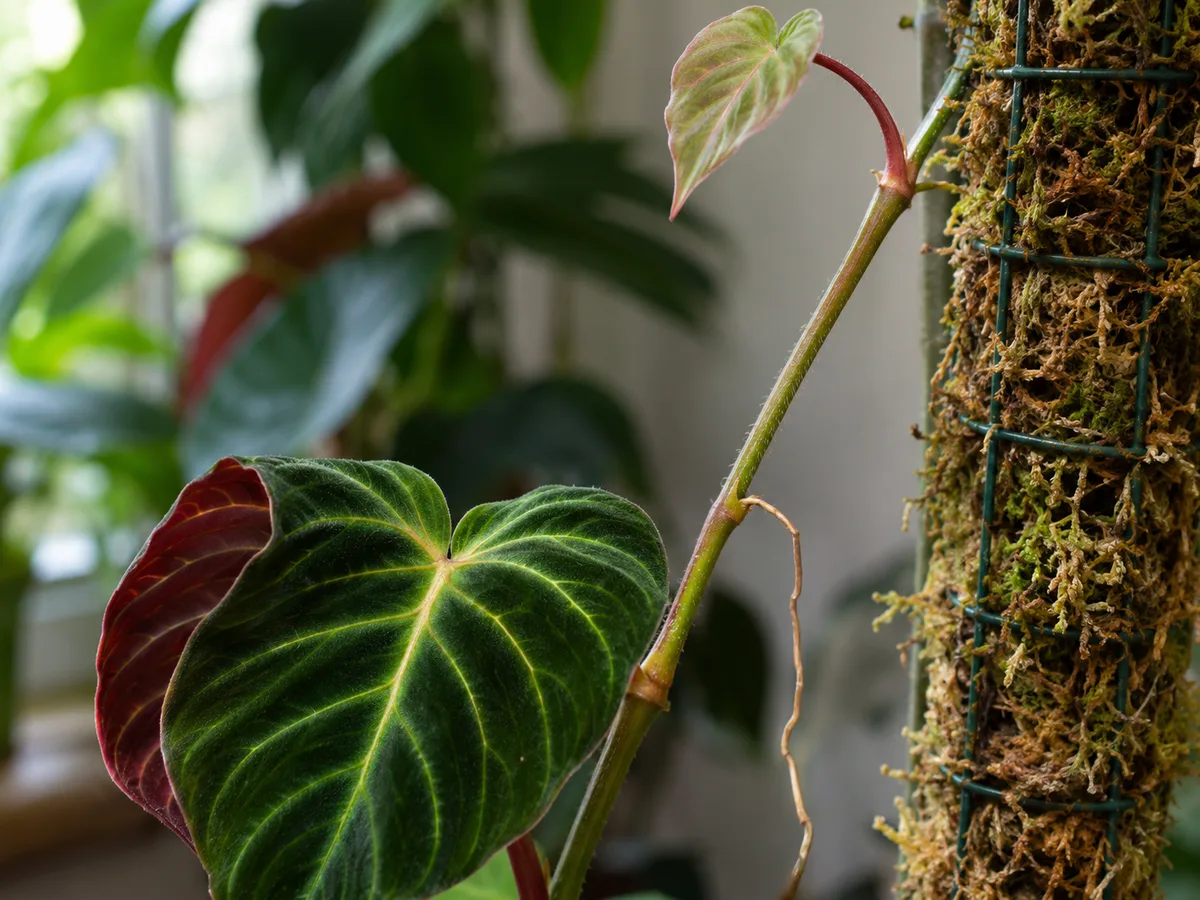
Low light and missing pole contact can leave the lead vine with stretched bare gaps and smaller new leaves.
Typical signs include:
- Long bare gaps between leaves along the lead stem, often several inches where well-lit growth keeps nodes tight
- Smaller, paler new leaves that feel thinner and less velvety than mature foliage, sometimes staying bronzy without ever developing full size
- A hard lean toward one window, with the tip bending sideways instead of climbing vertically
- Aerial roots waving in air instead of gripping a pole, sometimes browning at the tips in dry room air
- Trailing or flopping vines that tangle over the pot rim because nothing vertical was ever offered
- Bare lower stem where older leaves dropped while the tip keeps reaching
Fast extension in a dim corner is etiolation, not vigor. The vine can look busy while every new leaf gets weaker.
Why Verrucosum gets leggy
Too little light drives the stretch
Verrucosum evolved as a cloud-forest understory climber that reaches toward filtered canopy brightness, so in a dim room it does what its genes say: it lengthens each internode to carry the growing tip toward a brighter zone. Botanists call this process etiolation, and on Verrucosum it shows as sparse small leaves on overlong red petioles. Philodendrons will tolerate low light without dying, but tolerance is survival mode, and survival mode looks leggy. Verrucosum-specific guidance agrees that too little light leaves the plant weak and leggy as it stretches toward the nearest source.
Rooms more than a couple of meters from a bright window, north-facing corners in winter, and shelves where taller plants shade the pot are the usual triggers. Human eyes adapt to dim interiors; the plant cannot. Compare your placement against the Verrucosum light guide before assuming the vine is simply a fast grower.
No climbing support keeps leaves juvenile and spaced
This is the Verrucosum-specific half of the problem. The species is a hemiepiphytic climber that roots onto tree trunks as it ascends, and climbing philodendrons benefit from moss pole support indoors. Without a textured pole to grip, the vine trails horizontally, each node puts energy into reaching rather than sizing up leaves, and new blades stay small and widely spaced even when light is adequate. A dry decorative stake that aerial roots cannot penetrate gives shape but not the root contact that drives mature velvet foliage.
Check whether the lead stem actually touches support. If aerial roots dangle past a smooth bamboo cane or the vine has never been tied up at all, support failure is contributing no matter how bright the window is.
Secondary contributors
Uneven light without weekly rotation stretches one side while the shaded side stalls. Heavy feeding in dim conditions pushes soft elongated growth the plant cannot support, since philodendrons want only dilute water-soluble fertilizer during active growth. Overcrowding from neighboring plants shades one face of the vine. These matter, but they sit behind light and support in the queue.
How to confirm the cause
Work through these checks before changing anything:
- Measure internodes. Compare the gap between the two newest leaves with gaps on older, fuller sections. New gaps roughly double the old ones or longer, paired with smaller blades, confirm active stretch.
- Read the lean. A strong bend toward one window means the vine is hunting photons. A vine that flops outward in all directions with no lean points more toward missing support.
- Inspect pole contact. Are aerial roots gripping the pole, tied loosely at nodes with roots facing the support? Dangling roots and an untied lead stem confirm the support deficit.
- Check newest leaf quality. Small, thin, pale blades with weak veining signal light shortage. Normal-size bronze juvenile hearts that simply need time to darken are development, not etiolation.
- Feel the pot. Leggy plants in dim corners transpire slowly, so a pot that stays heavy and damp days after watering signals overlapping overwatering risk. Review rhythm against the Verrucosum watering guide when wet soil pairs with stretch.
- Season check. Stretch that began in late fall or winter, when daylight shortened, implicates light even if nothing else moved.
If long internodes, small pale new leaves, and window lean appear together, insufficient light is confirmed. If the vine also has zero pole contact, both causes are active and both need fixing.
First fix for Philodendron Verrucosum
Move the plant within bright indirect reach and secure the lead vine to a moist moss pole.
Set the pot near an east window or a few feet back from a filtered south or west window, tie the lead stem loosely at one or two nodes with the aerial roots pressed to the damp pole, and water the pole when you water the pot. Do not prune, repot, or fertilize on day one. One placement correction lets you read the response: the next unfurling leaf should emerge closer to the previous node and feel firmer within two to three weeks.
Step-by-step recovery
- Brighten without scorching. Aim for the bright indirect light near an east-facing window this species prefers. Filter midday sun with a sheer curtain, since direct beams scorch velvet blades.
- Install or repair support. Add a textured moss or coco pole while the vine is still manageable, tie stems loosely at nodes, and keep aerial roots facing the pole. Mist the pole lightly at watering time so roots can grip; a soaking-wet pole rots stem bases.
- Watch new nodes for two weeks. Tighter spacing and a firmer, larger new blade confirm the placement works. No change means the spot is still too dim.
- Prune stretched sections after proof. Cut leggy stems just above a node, removing up to one-third of total length per session. Clemson notes that vining types can be held to their support by training and pruning, and node cuttings with aerial roots root readily in moist airy mix once light is fixed.
- Propagate the best cuttings. Healthy tips with two or three leaves and an aerial root node back up the mother plant. Root in chunky mix under high humidity; cuttings taken from a still-dim plant stretch again, so fix light first.
- Adjust water and feed. Brighter light dries pots faster, so recheck the top 3 to 5 cm before each soak instead of keeping the old calendar. Resume light feeding only after compact new growth holds for two weeks.
Recovery timeline
Existing elongated internodes never shorten. Judge everything by new growth at the tip and fresh side shoots.
| Phase | What to expect |
|---|---|
| Weeks 1–2 | Little visible change; watch for a firmer tip and faster pot dry-down |
| Weeks 3–4 | Newest leaf opens larger and closer to the previous node, with stronger velvet texture |
| Weeks 5–8 | Side shoots break from nodes below pruning cuts during active growth; aerial roots grip the pole |
| Winter | Slower rebound; supplement with a grow light 12 to 18 inches above the crown rather than waiting |
Worsening signs: new leaves stay tiny and pale after six weeks in clearly brighter placement, lower leaves yellow in a pot that never dries, or stem bases soften. Recheck window distance, add artificial light, or inspect roots for rot layered under the stretch.
Lookalike check
- Normal bronzy juvenile leaves on a compact tip are development, not etiolation; worry only when new blades stay small, pale, and widely spaced.
- Soft yellow lower leaves in a heavy wet pot point to overwatering overlapping the stretch; dry the root zone in the same week you brighten placement.
- Dusty stippled leaves with fine webbing mean spider mites on velvet undersides, not light hunger; rinse and treat rather than pruning.
- Crispy brown edges with green centers signal dry air below the 60 to 80 percent this species wants; run a humidifier instead of extra water.
- Bleached patches facing the glass right after a move mean sun scorch from too abrupt a jump; filter the light rather than retreating to the dim corner.
What not to do
Do not prune a leggy Verrucosum before fixing light and support; cut stems stretch right back in the same dim corner. Do not jump from deep shade to unfiltered south-window sun, since velvet blades scorch within days. Do not fertilize a stretched plant in a dim spot, because nutrients cannot replace photons and push weak tissue. Do not mist velvet leaves as a humidity fix, since beaded water spots the pubescent surface while a humidifier does the real work. And do not stack repotting, heavy pruning, and spraying in one session; make one targeted correction so the response stays readable.
How to prevent it next time
Keep the Verrucosum formula steady: bright indirect light year-round, a moist textured pole installed while the plant is small, chunky bark-perlite mix watered by finger-test depth, and 60 to 80 percent humidity for clean unfurling. Refresh guidance in the Verrucosum soil guide when the mix compacts, since failing drainage slows everything and mimics decline. Rotate the pot a quarter turn weekly so the lead vine climbs straight up the pole instead of leaning, and add a grow light in winter before short days stretch the vine. A weekly glance at internode spacing, newest leaf size, and pole grip catches the next episode while it is still one long gap, not five.
When to worry
Stretch alone is cosmetic and reversible through light and support correction. Escalate when legginess pairs with a sour-smelling mix, mushy roots, collapsing petioles, or several leaves yellowing within days; unpot and inspect, keeping firm white roots and trimming only brown mush with clean scissors. If pests spread to neighboring aroids, isolate the plant the same day. A vine that keeps stretching after a genuine light upgrade plus pole contact for more than six weeks is still photon-starved; move it closer or add artificial light rather than waiting.
Related tool
Use the Plant Problem Diagnosis Tool to narrow causes for leggy growth on this plant before changing multiple variables at once.