Potassium Deficiency on Pilea Peperomioides: Causes, Checks
Quick answer
Pilea peperomioides does not have a well-established visual signature for potassium deficiency. Older leaves with yellowing or browning margins can raise the question, but first compare affected lower leaves with the newest growth and check the root zone before adding fertilizer.
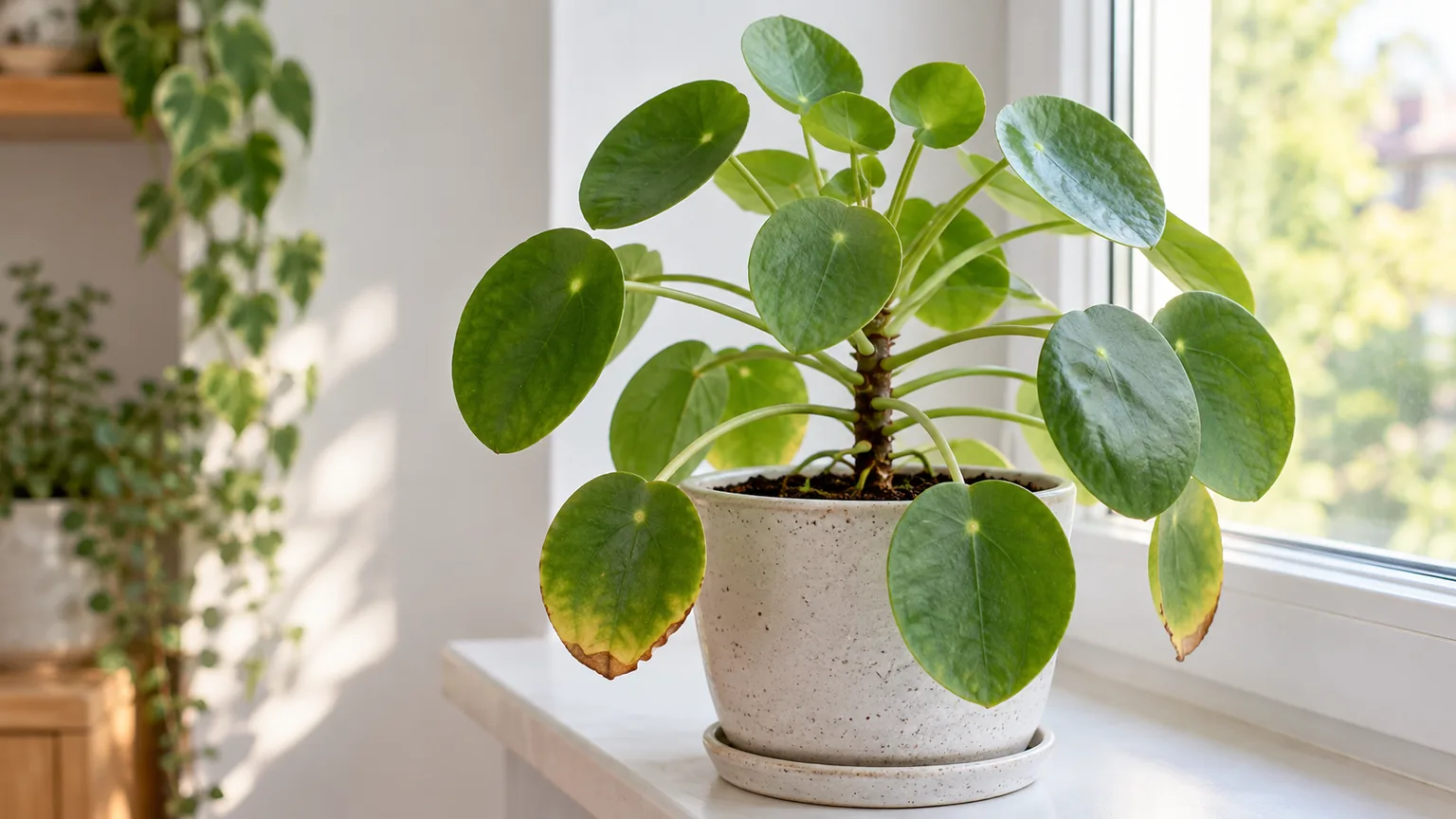
Potassium Deficiency on Pilea Peperomioides: Causes, Checks & Fixes
This guide covers potassium deficiency on Pilea Peperomioides. See also the general Potassium Deficiency guide, watering, and light pages for this plant.
Potassium Deficiency on Pilea Peperomioides: Causes, Checks & Fixes
Quick answer
Pilea peperomioides does not have a well-established, species-specific visual signature for potassium deficiency. Yellowing or browning that begins on an older leaf’s edge can fit a general potassium-deficiency pattern in broadleaf plants, but it can also result from water stress, direct sun, root trouble, fertilizer salts, or normal aging. The safest first step is to compare one affected lower leaf with the newest leaves near the center of the plant before changing the fertilizer.
The round leaves and upright stem of a Pilea make that comparison practical: you can see which leaves are oldest and whether the newest growth is affected. If you want the broader nutrient explanation, our potassium-deficiency guide covers the general symptom pattern. This page narrows the question to what the pattern means on a potted Pilea. For the plant’s full baseline, use the Pilea peperomioides care overview.
What potassium deficiency can look like on Pilea’s coin-shaped leaves
Pilea peperomioides has round, coin-shaped leaves carried on long petioles. Each leaf attaches near its center, rather than at the edge, so damage around the blade’s perimeter can look like a thin yellow or brown ring around a green disc. That leaf shape is a useful way to describe where the damage sits, but it does not make the damage unique to potassium deficiency. The Spruce’s Chinese money plant guide describes the plant’s distinctive coin-shaped leaves and its tendency to show several kinds of stress through foliage.
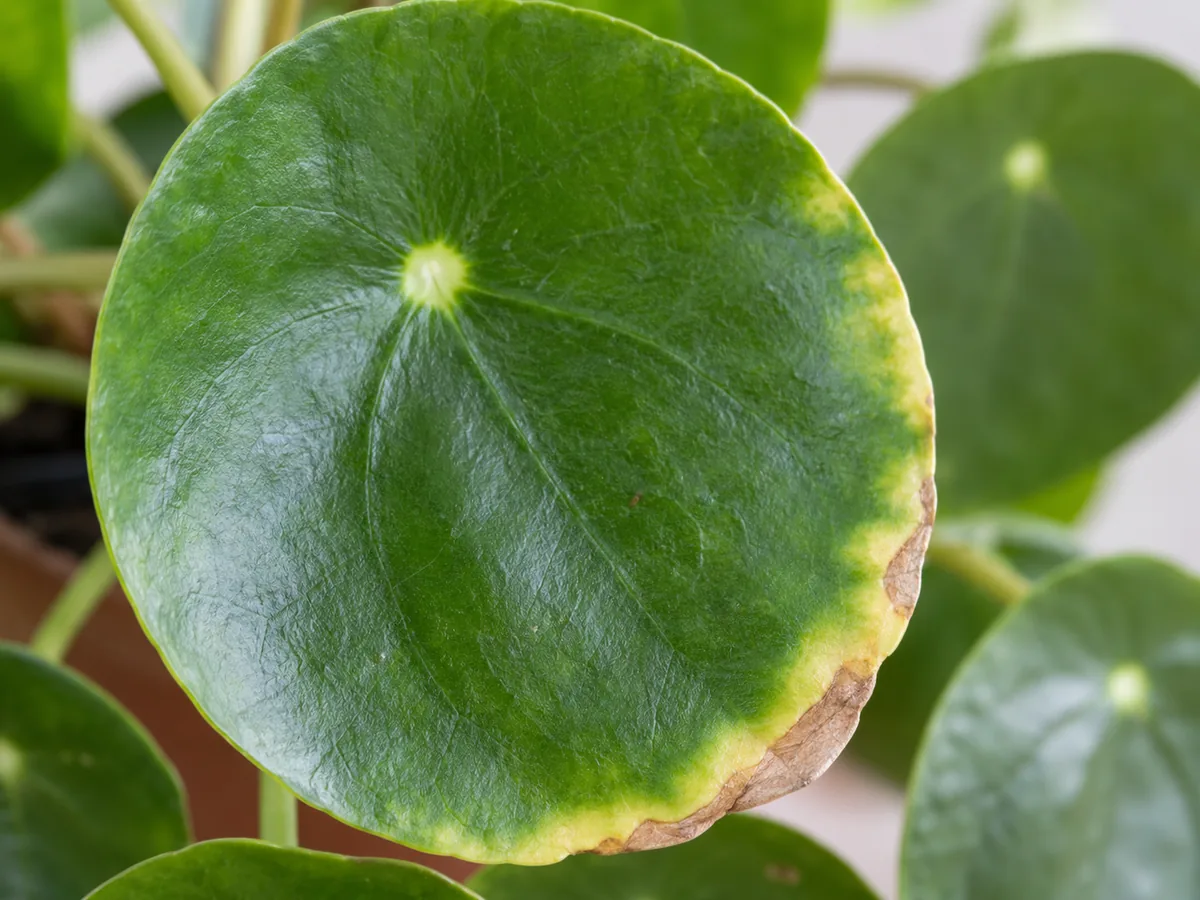
Yellowing and a dry edge on an older Pilea leaf are a clue to investigate, not proof of potassium deficiency.
In plants generally, potassium can move from older tissue toward newer growth when supply is limited. A deficiency therefore often shows first on older leaves; broadleaf plants may develop yellowing that turns brown at the tips or margins. Those are general patterns, not a confirmed Pilea-specific diagnostic key. NC State Extension explains potassium’s mobility and the tendency for mobile-nutrient symptoms to appear on older leaves, while UC IPM describes marginal yellowing and browning on older leaves in broadleaf plants.
On a Pilea, a possible pattern would be older leaves lower on the stem showing progressively duller or more scorched margins while new leaves at the growing tip remain comparatively clean. More widespread decline, yellow leaves falling, soft stems, or a plant that wilts while its mix stays wet points toward a broader root-zone or care problem. One browned edge, one yellowing lower leaf, or slow growth by itself cannot identify potassium as the missing nutrient.
Read the age pattern up Pilea’s central stem
A Pilea usually grows as a central upright stem with leaves of different ages arranged along it. Use that structure as a simple map: start with the leaf showing the clearest damage, then compare it with a leaf higher on the stem and with the newest leaves near the growing point. Note whether the damage is confined to one old leaf, repeats on several older leaves, or is appearing on the newest growth too.
A single lower leaf is weak evidence. It may simply be an older leaf being shed as the plant continues growing; The Spruce notes that losing one or two older leaves can be normal, while heavier leaf drop can signal overwatering or root rot. A repeated pattern across several old leaves is more interesting, but it still needs to fit the plant’s recent care and root-zone condition.
Pilea peperomioides also produces basal offsets, often called pups. When several offsets share a pot with the parent, look at the parent and pups separately: are the parent’s oldest leaves affected while the pups and new central leaves look sound, or is every growth point losing color? A crowded pot can make moisture and dry-down harder to judge, so check the mix in more than one spot. The presence of pups alone does not mean the plant is short of potassium, and dividing them is not a nutrient treatment.
Why Pilea leaf edges can change without a potassium shortage
A nutrient-deficiency label is easy to over-apply because a leaf’s appearance records stress, not its exact cause. Pilea-specific references describe yellowing, curling, browning, and leaf drop in connection with water, light, and humidity conditions. The same plant may show curled edges after too much or too little water, and direct sun can leave brown areas. The Spruce’s Pilea problem notes are useful reminders that several environmental stresses affect this plant’s leaves.
The pot matters as much as the leaf. Potassium can be present in the mix but difficult for roots to take up when drainage, aeration, irrigation, or pH are unsuitable; damaged roots can also limit nutrient uptake. Container-grown plants can run short of macronutrients, but a nutrient-like symptom does not prove the mix itself lacks potassium. UC IPM’s nutrient-deficiency overview explains how container conditions, root health, irrigation, drainage, and pH affect nutrient availability.
A second lookalike is excess fertilizer. If leaf-edge browning began soon after feeding, or a pale crust has appeared on the potting mix, more fertilizer could make the problem worse. On Pilea, an extra dose is not a safe diagnostic test: excess salts can stress roots and create more edge damage. Bob Vila’s Pilea care guidance recommends balanced, diluted feeding during the growing season and identifies a white soil crust as a warning sign of overfeeding. That is a reason to review what has already gone into the pot, not to assume that a particular nutrient is missing.
Check Pilea’s root zone before its fertilizer bottle
Before deciding that a Pilea is hungry, write down the last few changes in its care: when it was watered, whether the pot dried between waterings, when it was last fed, whether the mix or pot changed, and whether the plant was moved into stronger light. A simple timeline often explains why the damage appeared. If you cannot remember the last feed, that is useful context, but it still does not identify potassium as the specific gap.
Check the pot without disturbing the roots first. Lift it to judge whether it feels unusually heavy for a Pilea that is due to dry, feel the surface and the mix a little below it, and confirm that water can drain freely. A Pilea that stays wet for a long time in a dense mix has a root-zone problem to solve before it receives any extra nutrients. Review the plant’s watering guide alongside its soil and drainage guidance; use the observed dry-down in your room instead of treating a calendar interval as a diagnosis.
If the mix dries normally and the plant is firm, look for a pattern among leaves. Potassium deficiency is more plausible when the affected leaves are older and the margins show a repeated yellow-to-brown progression. It is less convincing when damage appeared suddenly after a fertilizer application, appears only on leaves facing a sunny window, or coincides with limp growth and persistently wet mix. Those clues do not rule potassium out, but they change which cause should be checked first.
For a stronger confirmation, ask a local extension office or plant diagnostic lab whether it can assess container media or leaf tissue from an indoor ornamental. Testing is particularly useful when several leaves keep deteriorating despite corrected watering and light, or when you are considering a potassium-only product. Soil and plant analysis are used alongside visual symptoms in formal nutrient diagnosis, and species can express nutrient stress differently. The field crop examples in NC State Extension’s potassium guide are not a Pilea recipe; their useful lesson here is that visual diagnosis has limits and needs to be interpreted with plant and soil evidence.
The first fix: compare Pilea’s lower leaves with its new center
First, compare one affected lower leaf with the newest leaves at the center of the Pilea before adding anything to the pot. If the new growth is healthy and only one old leaf is changing, leave the fertilizer alone and watch the plant. If several older leaves show a similar advancing edge pattern, review the root-zone checks above and the feeding history before deciding that potassium is deficient.
Do not use a potassium supplement as a trial dose. The plant may have enough potassium already but be unable to use it because its roots are stressed; an excess of one nutrient can also interfere with the balance of others. UC IPM cautions that excess fertilizer can contribute to salinity and nutrient imbalance. A fast response is not guaranteed, and damaged leaf margins are not a reliable scorecard for a new treatment.
If the mix is wet, drainage is poor, or the plant is declining across several leaves, correct that root-zone issue first. Resume a normal Pilea watering pattern only after the cause is clear; do not simultaneously repot, prune, and feed unless the plant has an urgent structural problem that requires repotting. If the mix drains well and the plant is actively growing but has gone a long time without a complete feed, a cautious return to a balanced houseplant fertilizer is more sensible than a concentrated potassium product. Choose a product labeled for houseplants and follow its label directions. Savvy Gardening’s houseplant-feeding guidance ties fertilizer use to active growth and notes that plants do not give a reliable visible signal that it is time to feed.
A verified deficiency may require a targeted correction recommended by a lab or extension specialist. Without that confirmation, a complete fertilizer supplies a broader nutrient balance, while a potassium-only amendment can oversupply potassium or leave the real issue untouched. This distinction matters in a small indoor pot, where an unnecessary dose stays close to the Pilea’s roots rather than being spread through a large garden bed.
Lookalikes to rule out on a Pilea
Use this table to decide which Pilea guide to check next. It is a routing aid, not a way to diagnose potassium from a photograph.
| What you notice | Why it may point away from potassium | Next check |
|---|---|---|
| The pot stays heavy and the mix remains wet; leaves yellow or drop | Pilea leaf yellowing and drop can accompany excess water and root trouble. | Check the overwatering guide and Pilea root-rot guide. |
| The plant leans toward a window, stretches, or produces smaller leaves | Pilea structure changes when light is inadequate, while harsh direct sun can brown leaves. | Compare the Pilea light guide and leggy-growth guide. |
| Edge damage is concentrated on the window-facing side after a placement change | Direct sun and changing exposure can injure Pilea foliage without proving a nutrient shortage. | Review the Pilea brown-leaves guide and adjust exposure gradually. |
| Browning followed a recent feed, or there is a crust on the mix | Excess fertilizer can damage roots and mimic deficiency symptoms. | Pause feeding and review the Pilea fertilizer guide and fertilizer-burn guide. |
| One older leaf yellows while the central leaves and stem remain firm | Normal aging is possible, particularly if the plant is otherwise growing steadily. | Track the next leaves rather than feeding immediately; see the Pilea yellow-leaves guide. |
| Yellowing appears between veins, or several leaves show different patterns | More than one nutrient issue or root-related uptake problem may be involved; visual patterns overlap. | Compare the Pilea magnesium-deficiency guide and nitrogen-deficiency guide, then seek testing if the distinction affects treatment. |
Help Pilea recover without losing the growth point
A leaf with a dry brown margin is not expected to regain green tissue after the underlying cause is corrected. Leave a partly green leaf attached while it is still useful to the plant. If a leaf becomes fully brown or drops on its own, remove it cleanly; trimming the brown edge is cosmetic and does not correct a nutrient problem.
Judge progress by what happens next on the central stem. Take a dated photo now, then compare the next few leaves as they unfold. Improvement means the marginal damage stops appearing on newly matured leaves, the central growth stays firm, and the pot follows a more predictable dry-down. A leaf that was already damaged may continue to look damaged even if the plant is recovering.
Pilea growth slows when days are short or indoor light is weak, so a correction made during a slow season may take longer to evaluate than one made during active growth. Avoid setting a fixed deadline based on weeks alone. If new growth is not developing, or if more leaves decline, return to the root-zone, light, and feeding timeline rather than repeating a fertilizer application. You can use the Pilea problems hub to compare the other symptoms that are actually present.
Pilea peperomioides forms pups from its base. If the parent plant is weak but a pup remains firm and is producing leaves, preserve the pot’s overall stability while you diagnose the parent; do not divide offsets just to “reset” its nutrients. If the base of the stem softens, the plant repeatedly collapses despite a drying mix, or decline reaches the newest growth, treat the issue as more serious than a cosmetic leaf-edge problem and inspect the roots or get a local diagnosis.
Prevent a repeat with Pilea’s light and dry-down rhythm
Give the plant bright indirect light so it can maintain steady growth without exposing its coin leaves to strong direct sun. Rotate it periodically because Pilea leaves orient toward the window; a plant that grows sharply to one side can make it harder to compare old and new foliage. If it is in a dim spot, correct the light first and allow the plant to settle before interpreting pale or stretched growth as a nutrient signal. Use the Pilea light guide to adjust placement gradually.
Use a free-draining potting mix and a container with open drainage. The project’s plant-care guidance pairs a standard mix with perlite; in practice, the useful test is whether the pot dries at a reasonable pace for your light and room. A pot that remains wet for a long stretch can keep the Pilea’s roots under stress, while a root ball packed with several offsets can make watering uneven. If the plant has outgrown its container or the mix has become compacted, use the Pilea soil guide and repotting guide to plan a measured change.
Feed according to growth, not because the leaf edge looks alarming. A healthy Pilea making new leaves in spring or summer can use a balanced houseplant fertilizer according to the label. Reduce or pause feeding when growth slows and light levels fall, and never compensate for weak light or unhealthy roots with more fertilizer. For species-specific routine and product timing, see the Pilea fertilizer guide. If pale leaves, poor growth, or damaged margins return despite a steady care pattern, document the change and request a nutrient diagnosis before adding a single-element supplement.
When to use this page versus other Pilea guides
Use this page when a repeated pattern of yellowing or browning begins on older Pilea leaves and you are trying to determine whether potassium shortage is plausible. Use the Pilea yellow-leaves guide for general yellowing, the brown-leaves guide for sun or environmental damage, and the magnesium-deficiency guide or nitrogen-deficiency guide when the discoloration pattern suggests a different nutrient question. If the mix stays wet or the plant droops, start with overwatering or root rot instead.
Related Pilea Peperomioides guides
- Pilea care overview: use for the complete baseline before changing feeding.
- Pilea watering: use when the pot’s dry-down or watering rhythm is uncertain.
- Pilea soil: use when the mix stays wet, drains poorly, or has compacted.
- Pilea fertilizer: use for routine feed timing and product amount after the plant is stable.
- Pilea magnesium deficiency: use to compare another mobile-nutrient question.
- Pilea problems hub: use to route symptoms that do not match this possible potassium pattern.
Related tool
Use the Plant Problem Diagnosis tool if you are still comparing leaf damage, watering, light, and root symptoms.