Faded Leaves on Prayer Plant: Causes, Checks & Fixes
Quick answer
A prayer plant can look faded because direct sun is bleaching its patterned leaves, but pale silver-green markings may be normal for its cultivar. First compare the affected leaf with mature leaves and check its window exposure. If bleaching appeared after direct sun, move the plant into bright filtered light and assess new growth before changing water or fertilizer.
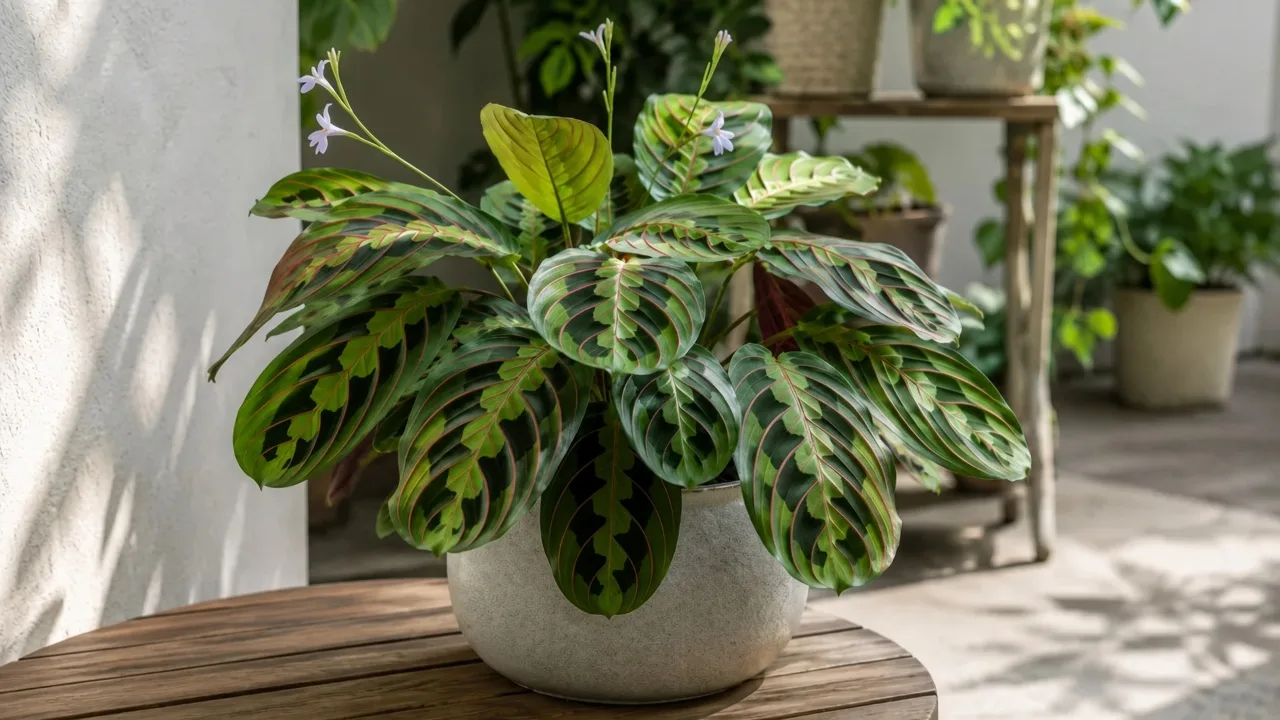
Faded Leaves on Prayer Plant: Causes, Checks & Fixes
This guide covers faded leaves on Prayer Plant. See also the general Faded Leaves guide, watering, and light pages for this plant.
Faded Leaves on Prayer Plant: Causes, Checks & Fixes
Quick answer
A prayer plant (Maranta leuconeura) can look washed out when strong direct sun bleaches its patterned leaves. But pale silver or chartreuse sections are also part of the normal pattern on some cultivars, so color alone does not prove a problem. Before changing care, compare the affected leaf with mature leaves on the same plant and note whether the pale area faces a window.
If the color loss is irregular and began after a move into direct sun, move the pot into bright filtered or indirect light. Keep watering and fertilizer steady while you watch the next new leaf. If pale dots, fine webbing, limp growth, or persistently wet soil accompany the change, investigate pests or root stress instead.
What faded leaves mean on a Prayer Plant
Prayer plant foliage is naturally patterned. The amount and shade of green, silver, cream, or red can differ between cultivars; for example, NC State lists named forms with distinct colors and markings. The RHS profile describes the species’ silver lines running from the midrib toward the leaf edge. Those regular markings are not the same as damage. Compare a pale section with the plant’s own healthy leaves rather than with a photograph of another cultivar.
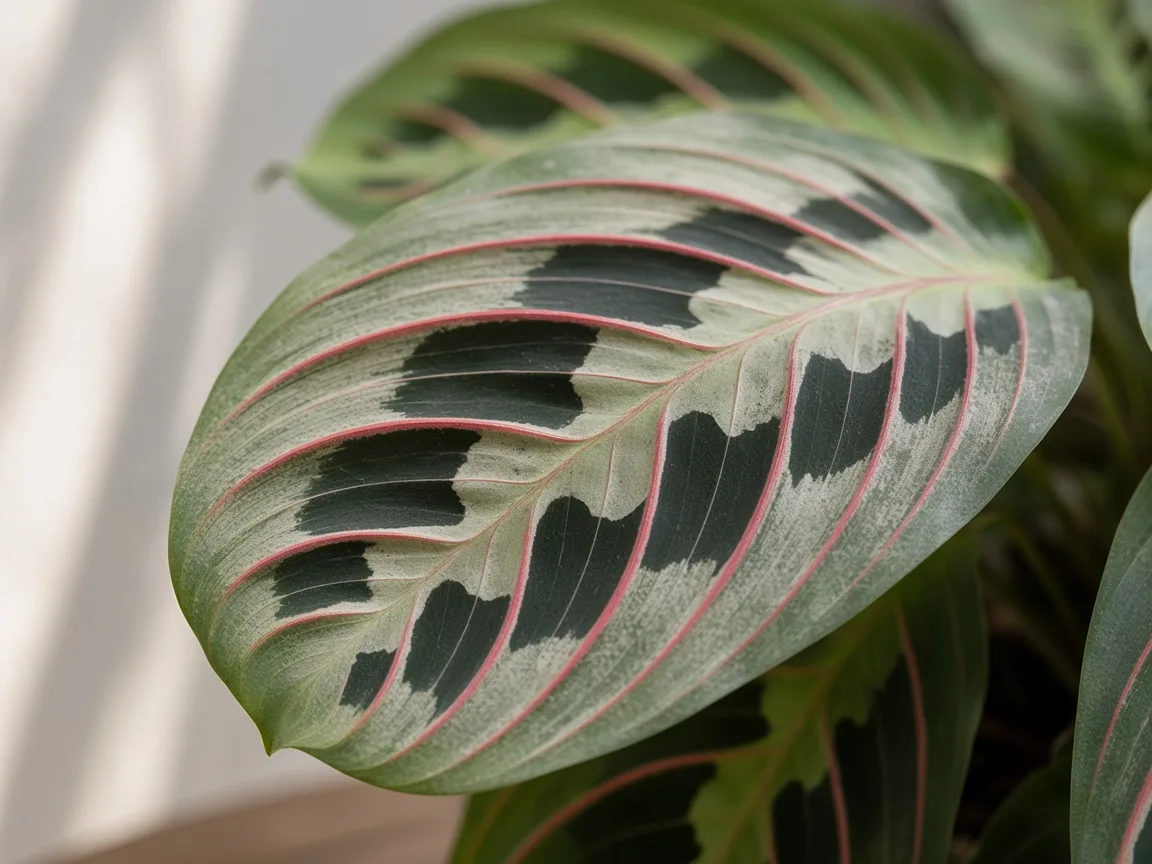
This close-up shows pale fields within the leaf pattern; compare them with mature leaves on your plant before treating them as sun damage.
True fading usually looks like a change from the plant’s previous pattern. It may affect the whole leaf or one exposed section, reduce the contrast between markings, or leave irregular washed-out areas. A change limited to the oldest outside leaf deserves observation, while fading across several leaves or on fresh growth calls for a closer check. One leaf does not identify a cause by itself.
A prayer plant is adapted to filtered light. The RHS recommends bright filtered or indirect light, and NC State lists dappled sunlight for Maranta leuconeura. Direct midday sun can bleach or scorch the foliage, while a very dim position can leave new patterning dull. These are different light problems: move away from harsh sun, but do not solve bleaching by placing the plant in a dark corner.
First action: compare the pattern and check the light
Look at the leaf from above and below, then trace the light it received over the last few weeks. Was the pot moved closer to a south- or west-facing window, placed outside, or left behind uncovered glass during a bright afternoon? A pale area concentrated on the window-facing side after that change supports light stress. PlantMe’s care guidance notes that direct sun can bleach Maranta’s pattern and low light can dull its colors.
If direct exposure fits, move the plant a little back from the window or filter the light with a sheer curtain. Keep it in a bright room, not a dark one. Do not rotate through multiple locations every day; a stable position makes it easier to see whether new leaves develop normally. Hold off on fertilizer, extra watering, and repotting until the light check is complete.
Match the leaf pattern to the likely cause
| What you see | What it points toward | What to do next |
|---|---|---|
| Broad, washed-out areas on the window-facing side after a move or a bright spell | Sun exposure is plausible, especially if the tissue is dry or scorched rather than dotted | Filter the light or move the pot back; keep other care steady |
| The whole plant looks dull in a dim corner, with weaker color on new growth | Light may be too low for strong foliage color | Gradually move it toward brighter indirect light and compare the next leaf |
| Many tiny pale dots, stippling, or bronzing; fine webbing may appear underneath | Check for spider mites rather than treating this as a light issue | Inspect undersides with a magnifier; UC IPM describes stippling, bronzing, and webbing as mite clues |
| Several leaves become yellow or limp while the pot stays heavy and the mix remains wet | Root-zone stress may be involved | Check drainage and moisture; follow the prayer plant overwatering guide if the pattern fits |
| One old outer leaf fades while the rest of the plant and new growth remain stable | A single aging leaf may not justify a care change | Photograph it and monitor the next leaf before feeding or repotting |
| Brown, crisp margins appear with the color change | This is more consistent with edge stress than uniform fading | Compare with the brown-tips or low-humidity guide and check water and room conditions |
The table is a triage aid, not a diagnosis. Spider mites feed on leaf cells and often leave pale speckling or bronzing; UC IPM recommends checking leaf undersides when stippling or webbing appears. A broad, smooth pale field without dots is a different pattern. If the plant also droops or yellows in wet mix, look at the roots and drainage rather than assuming a nutrient deficiency; Epic Gardening’s prayer-plant guide explains why both too little and too much water can produce foliage symptoms.
Confirm the cause before treating
- Compare like with like. Look at several mature leaves and the newest fully opened leaf. If their pale areas repeat in the same orderly pattern, the color may belong to the cultivar. Use the Prayer Plant overview to compare the plant’s identification and normal care traits.
- Map the light. Note the window direction, distance, curtain, and whether sun lands directly on the leaves. Maranta grows best in filtered light; the Prayer Plant light guide can help distinguish bright indirect placement from direct exposure.
- Inspect both leaf surfaces. Use a phone camera zoom or a hand lens. Look for tiny moving specks, fine webbing, and clusters of pale dots, especially underneath. If you find those signs, isolate the plant from nearby foliage and use the Prayer Plant spider-mites guide for pest-specific steps.
- Check the root zone without watering by habit. Feel the top layer of mix and lift the pot to judge whether it is still heavy. Confirm that water can drain and that the pot is not sitting in a cachepot full of runoff. If several leaves yellow while the soil remains wet, see overwatering on Prayer Plant. If the mix is dry through the root ball and leaves curl, compare with the underwatering guide.
- Review recent changes. Record when fading began and whether the plant was moved, repotted, fed, or exposed to a temperature or watering change. Change one confirmed factor at a time so the next leaf gives you useful feedback.
Avoid a blind fertilizer dose. Nutrient deficiency is not established by a pale leaf alone, and fertilizer will not reverse light damage or remove mites. Likewise, do not repot solely because color has changed. Prayer plants prefer moisture-retentive but well-drained conditions; unnecessary disturbance can make it harder to tell whether the original problem has improved.
Recovery: judge the next leaf, not the old patch
Pale tissue that has been scorched or otherwise damaged may not regain its former color. The practical sign of recovery is that new leaves open with the usual pattern and the fading stops spreading. This can take time because a prayer plant must produce another leaf before you can compare its color. Growth also slows when conditions are less favorable, so avoid treating a short wait as proof that the first adjustment failed.
Keep the pot in stable, bright indirect light. Water according to the mix’s moisture rather than a fixed calendar, and let excess water drain freely. The Prayer Plant watering guide covers the plant’s moisture routine. Do not increase humidity, water more often, fertilize, and repot all at once; that makes cause and effect difficult to read and can create fresh stress.
If pale stippling expands or webbing appears, switch from light troubleshooting to pest control. If leaves become soft, multiple stems collapse, or the mix remains soggy, treat the root condition as the priority and review the Prayer Plant problems hub for the closest match. Seek help from a local extension service if the plant continues declining after the likely cause has been corrected or if symptoms do not fit these patterns.
Preventing repeat fading
Keep Maranta out of direct hot afternoon sun while giving it enough filtered light to show its normal pattern. When moving it between rooms or seasons, make the change gradually and check how the new position affects the leaves. Compare new growth with the same plant’s mature leaves; cultivar photos online can show different patterns and lead to unnecessary treatment.
Inspect the undersides of leaves during routine watering, especially after bringing a new plant home or placing one near other houseplants. Do not spray for mites unless you have found signs that support the diagnosis. Keep the pot’s drainage open and empty standing water after watering. A steady routine makes it easier to tell a real color change from a normal marking or one aging leaf.
When to use this page vs other Prayer Plant guides
Use this page when patterned leaves are losing contrast or developing irregular pale areas. If the main sign is tiny stippling and webbing, start with spider mites. If the margins are brown and crispy rather than washed out, compare brown tips or low humidity. Use the watering and light guides when the care pattern points to those conditions. For symptom-level context across different plants, see the faded-leaves symptom guide.
Related Prayer Plant guides
- Prayer Plant overview for identification and normal care.
- Prayer Plant light if the pot receives direct sun or sits in a dim spot.
- Prayer Plant watering if soil moisture or drainage is part of the pattern.
- Spider mites for stippling, moving specks, or fine webbing.
- Overwatering for pale leaves combined with persistently wet mix or declining roots.
- Brown tips for dry, crispy margins rather than widespread color loss.
Related tool
Use the Plant Problem Diagnosis Tool to compare the observed pattern with likely causes before changing multiple parts of the plant’s care.