Salt Build-Up on Prayer Plant: Identify and Fix White Crust
Quick answer
On Prayer Plant (Maranta leuconeura), a hard white or tan crust on potting mix or the pot rim can be soluble salts from irrigation water, fertilizer, or the mix. First confirm the pot drains freely; then remove the crust and flush only a well-draining pot, while stopping excess fertilizer and checking water quality. Brown tips alone do not confirm salt build-up.
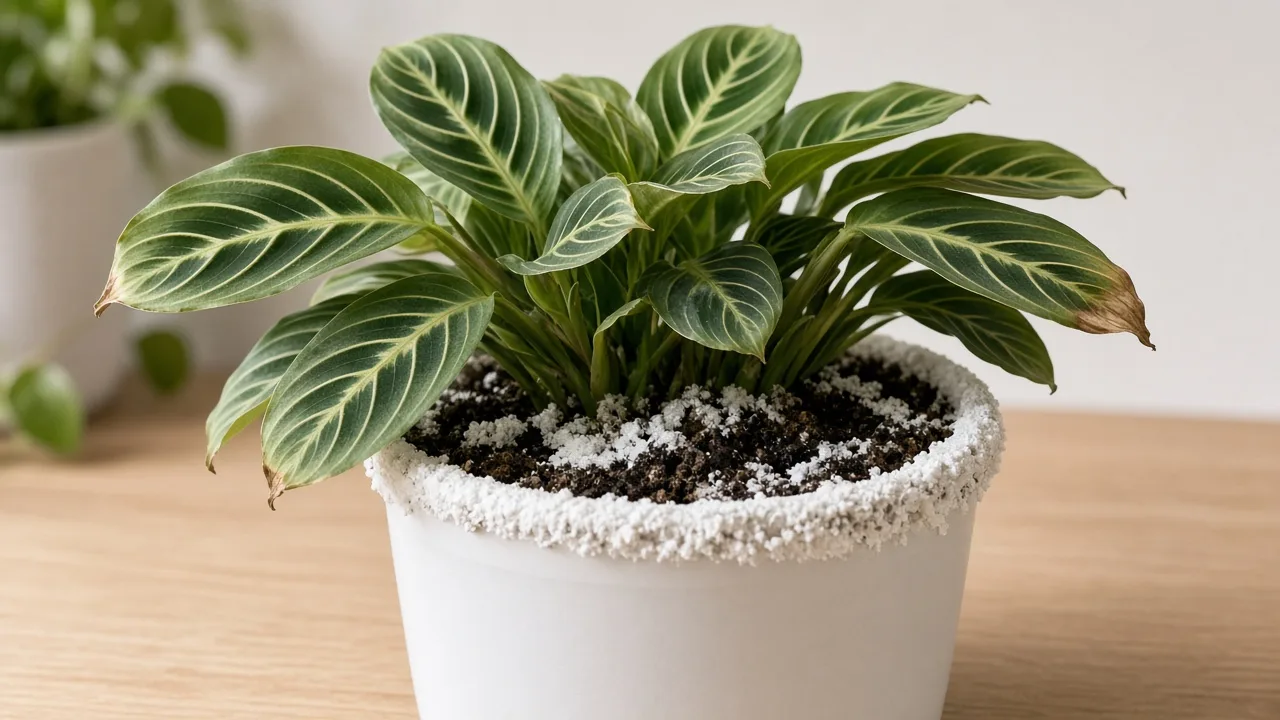
Salt Build-Up on Prayer Plant: How to Identify and Remove Mineral Crust
This guide covers salt build-up on Prayer Plant. See also the general Salt Build-up guide, watering, and light pages for this plant.
Salt Build-Up on Prayer Plant: How to Identify and Remove Mineral Crust
Quick answer
On Prayer Plant (Maranta leuconeura), salt build-up is most convincing when a white or tan, hard-looking crust appears on the potting mix, pot rim, or around drainage holes. A few brown tips by themselves are not enough to diagnose it. Soluble salts may come from irrigation water, fertilizer, or the mix; as water evaporates, residue can collect at the surface. Colorado State University Extension describes these crusts and their common sources.
First check that the pot drains freely. If the residue is crystalline and water exits the drain holes promptly, remove the saucer and leach the mix once with low-mineral water. If water pools, the pot has no drain hole, or the mix remains heavy and wet, do not keep flushing: correct the drainage problem or repot into fresh, airy mix first. Prayer Plant likes evenly moist soil, but poorly drained soil can lead to root rot on this species, so a salt treatment should not leave its root zone waterlogged (NC State Extension).
This guide is about visible salt or mineral residue around the root zone. For general symptom patterns, start at the salt build-up symptom hub; for this plant’s overall routine, use the Prayer Plant care overview.
What salt build-up looks like on Prayer Plant
Look at the pot as well as the leaves. Salt deposits may form a white-to-tan crust on the mix, a ring at the inside or outside of a pot rim, or residue near drainage holes. The crust is usually dry and granular or crystalline rather than a living coating. Salt-related stress can also show up as wilting, yellowing, or burned leaf tips and margins, though those leaf symptoms overlap with other problems (Colorado State University Extension).
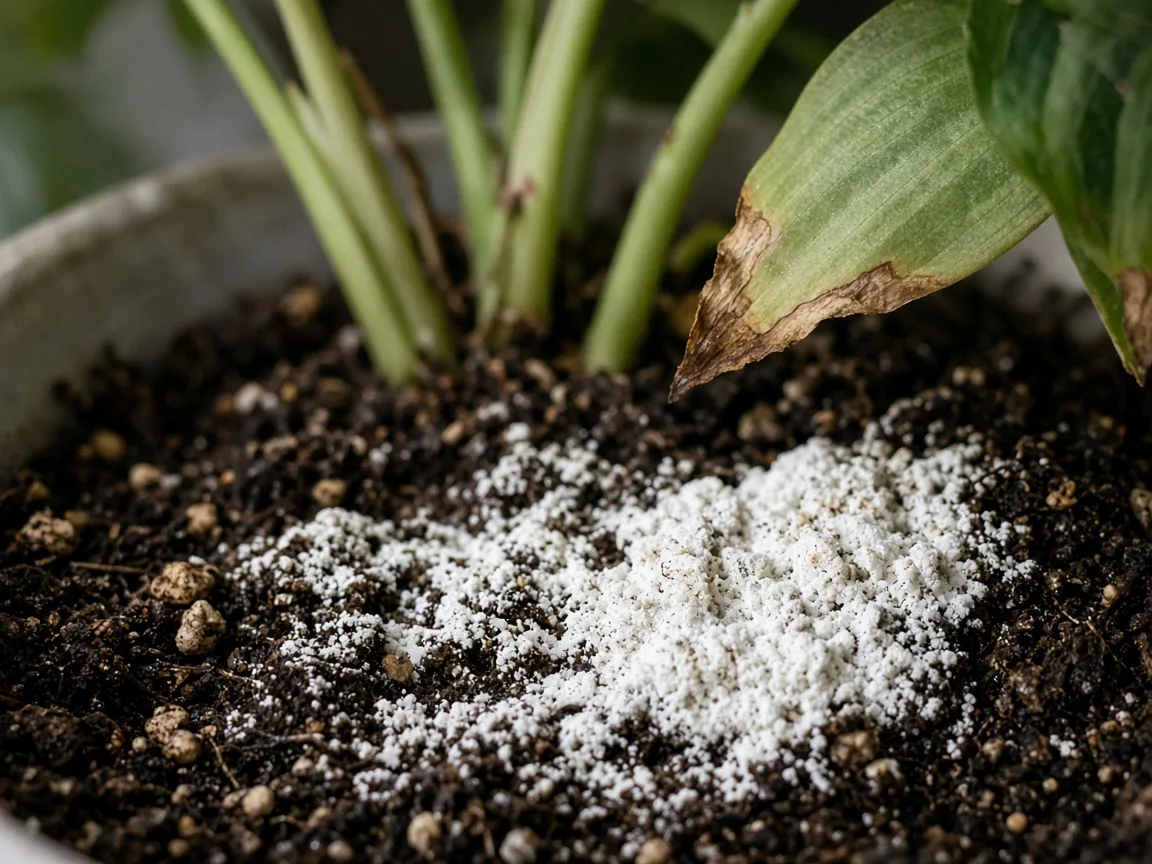
The photo shows two clues to compare, not a stand-alone diagnosis: residue at the soil surface and a damaged leaf edge. Check whether the crust can be lightly lifted from the mix, whether a similar ring sits on the pot, and whether the damage began after a water-source or fertilizer change. Avoid digging into the root ball just to inspect; unnecessary scraping can disturb Maranta’s rhizomes.
Separate residue from look-alikes
- Normal markings: Prayer Plant naturally has patterned leaves, including dark paired markings and prominent veins. Those markings follow the leaf pattern; they do not form a crust on the soil or pot. These are characteristic features of Maranta leuconeura (NC State Extension).
- Possible fungal surface growth: If a white layer looks fluffy, raised, or threadlike instead of hard and gritty, treat it as a separate surface-growth question. Do not assume that it is mineral residue or flush the pot solely because the surface is white. Compare it with the Prayer Plant mold-on-soil guide.
- Pests: Salt residue sits on the growing medium or pot; insects are found on plant tissue. Inspect leaf undersides and stems for visible insects, fine webbing, or clusters. Spider mites and mealybugs can affect Prayer Plant (NC State Extension). If you find pest signs, use the spider-mite guide or mealybug guide instead of trying to solve them with a soil flush.
- Brown tips without crust: Tip or edge burn has several possible causes. Maranta can be sensitive to fluoride and over-fertilization, while bright light can also burn its foliage; use the Prayer Plant brown-tips guide if no residue is present. NC State Extension notes fluoride and excess fertilizer can burn Maranta leaves, and Gardening Know How outlines other tip-burn look-alikes.
Why salts collect around a Prayer Plant
Water leaves minerals behind
Hard water contains dissolved minerals that may accumulate in potting mix over repeated waterings. A single watering rarely explains a crust by itself; the useful clue is a residue pattern that returns over time, especially on the mix, pot rim, or drainage area. In a local Ask Extension response about Maranta, the expert notes that some Prayer Plants are sensitive to fluoride, hard-water minerals, and sodium associated with some softened water; purified water may help when water quality fits the pattern. Read the Maranta-specific water-quality response.
Do not assume that every filter removes every dissolved component; a local extension expert notes that some pitcher filters may leave fluoride or calcium and magnesium in the water (Ask Extension). If the residue recurs, check your municipal water report or ask your water supplier about hardness and fluoride. If your home has a water softener, avoid using softened water for this plant unless you know how its output is treated; sodium in some softened water can add another concern for sensitive Maranta. Test a low-mineral or purified source for several waterings and watch new growth, rather than changing light, humidity, fertilizer, and potting mix all at once.
Fertilizer and potting mix can add soluble salts
Many fertilizers are salt based, and the starting mix can also contribute soluble salts; Colorado State recommends applying fertilizer at its label rate to help avoid accumulation (leaching guidance). Maranta foliage can burn with over-fertilization, so a recent concentrated feed plus fresh crust and new edge burn is a stronger pattern than a brown tip alone (NC State Extension).
Trace the last few months of care: product and dilution, feeding frequency, water source, and whether drainage water has been allowed to sit under the pot. As moisture evaporates, salts remain at the surface; water held in a saucer may be reabsorbed by the mix (Colorado State University Extension). The Prayer Plant fertilizer guide can help you reset feeding to the plant’s normal growth and label directions. If you recently overfed, compare the pattern with overfertilization symptoms before adding any more fertilizer.
How to remove confirmed salt crust safely
1. Decide whether a flush is safe
The pot needs open drainage holes, and the mix should not already be waterlogged. Move it to a sink or another place where runoff can drain away. Remove the saucer and check that the holes are not blocked. If the pot has no drainage, or water sits on top instead of passing through, do not flush it in place; move the plant into a pot with drainage and fresh, well-draining mix. Follow the Prayer Plant soil guide for a moisture-retentive mix that still drains.
2. Lift off the surface crust
Use a clean spoon to remove visible crust and only a thin layer of the mix immediately beneath it. Do not scrape into the root ball or pull at rhizomes. Colorado State’s leaching instructions advise removing the surface crust and a small amount of mix without damaging roots (leaching instructions). Wipe residue from the outside of the pot and wash the saucer so old deposits do not sit beneath the plant.
3. Leach through the pot, then discard runoff
If hard or fluoridated tap water is a plausible source, use purified, low-mineral water for this rinse instead of repeating the suspected source. Slowly fill the potting mix to the rim, let it drain completely, and repeat the rinse once. Keep the plant out of the collected runoff. Colorado State University Extension gives this two-rinse sequence and emphasizes free drainage between rinses.
Afterward, empty and clean the saucer. Let the pot drain fully before returning it to its usual spot. Do not add fertilizer during this corrective rinse. Resume watering based on the mix’s moisture, not on a fixed schedule: Prayer Plant should not be kept standing in drainage water, and a persistently wet pot needs a drainage or root-health check, not another flush.
4. Repot if the crust returns or drainage is poor
If fresh crust returns quickly after you have stopped excess feeding and changed a suspected water source, or if the mix is compacted and slow to drain, replace it rather than repeatedly leaching it; Colorado State notes that soil may need changing in severe cases (leaching guidance). Use a clean pot with drainage and fresh, airy mix; keep the root ball intact as much as possible. Remove only soft, decayed roots if present, and do not fertilize immediately after repotting. Read the Prayer Plant repotting guide for handling and aftercare.
Recovery and prevention
Salt stress can interfere with water uptake and may damage roots or leaf tissue (Colorado State University Extension). Do not judge recovery by whether old brown margins disappear; instead, watch whether new damage stops and new leaves emerge clean. Keep a simple note of water source and fertilizer dates for the next few weeks. If a plant continues wilting while the mix stays wet, compare it with the Prayer Plant root-rot guide rather than assuming more salt is the only issue.
Prevent recurrence with a small number of consistent habits:
- Follow fertilizer label directions and avoid feeding a dry or stressed root ball. When the plant is not actively growing, do not compensate for slow growth by increasing the dose.
- Water thoroughly enough for excess to drain, then empty the saucer. Do not leave the pot standing in runoff; salts can be reabsorbed when drainage water remains underneath (Colorado State University Extension).
- Reassess water quality if crust returns. Maranta can respond poorly to fluoride, hard-water minerals, or sodium in some softened water, but the visible crust does not identify which component is involved.
- Keep the mix evenly moist but freely draining. The Prayer Plant watering guide covers the plant’s moisture rhythm; use it alongside the soil guide rather than watering extra to “wash” a pot that drains slowly.
- Treat the crust, not just the brown tissue. If only tips are affected and no mineral residue appears, compare yellow leaves and brown tips before changing water or fertilizer.
For a broader cross-check, use the Plant Problem Diagnosis Tool, then browse the Prayer Plant problems hub. The general salt build-up symptom hub covers how this issue appears across different plants; this page applies those checks to Maranta’s sensitivity to water quality and over-fertilization.
Related Prayer Plant guides
- Prayer Plant overview — start here for the plant’s full care profile.
- Prayer Plant soil — choose a mix and drainage setup that supports moist but aerated roots.
- Prayer Plant watering — use this if the mix stays wet, dries too far, or the watering routine needs adjusting.
- Prayer Plant fertilizer — use this to check feeding strength and timing before restarting fertilizer.
- Brown tips on Prayer Plant — use this when leaf edges burn but the pot has no mineral crust.
- Mold on Prayer Plant soil — use this when the white growth looks fuzzy rather than crystalline.
- Root rot on Prayer Plant — use this when the pot remains wet and roots or stems soften.