Underwatering on Rose: Causes, Checks & Fixes
Quick answer
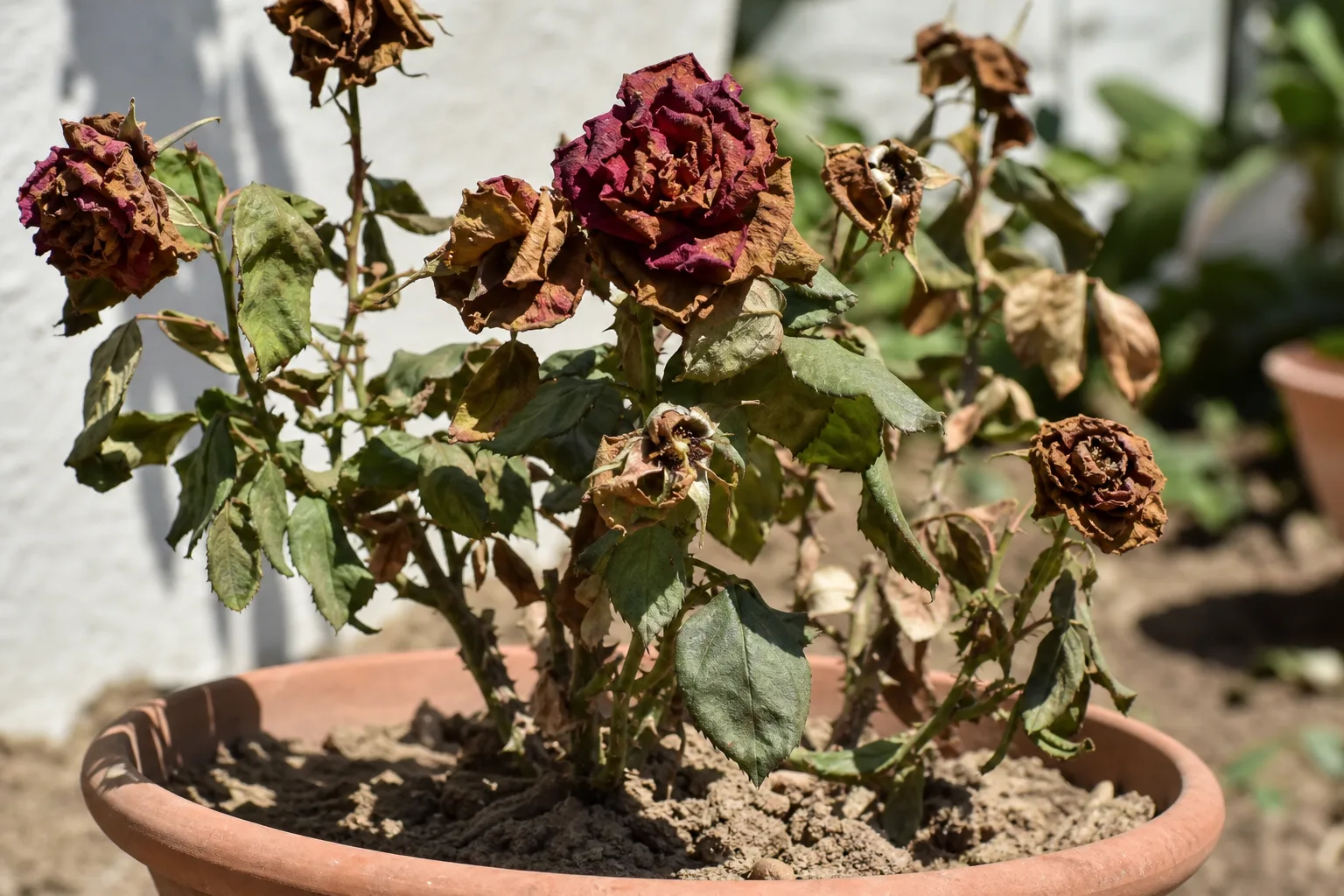
Underwatering on Rose wilts canes in full sun, shrinks blooms, and leaves the pot light with dry mix 3–4 cm down. First step: soak the root zone at the base until water runs from drainage holes, then resume checks when the top layer dries.
Underwatering on Rose: Causes, Checks & Fixes
This guide covers underwatering on Rose. See also the general Underwatering guide, watering, and light pages for this plant.
Underwatering on Rose: Causes, Checks & Fixes
Quick answer
Underwatering on Rose (Rosa × hybrida and related garden hybrids) shows up as dramatic midday wilt, drooping canes, and small pale blooms-especially on sunny terraces where pots dry in hours. Repeat-flowering hybrid teas and floribundas abort buds during bud swell when the root zone crashes dry, even before lower leaves yellow.
This page is your confirmed drought rescue guide-you have dry soil at depth and need the right soak volume, recovery steps, and prevention rhythm. If you are not sure whether wilt means drought or failing roots on wet mix, start with the wilting guide diagnostic fork first.
First step: soak the root zone at the base until water runs freely from drainage holes. One slow deep drink beats several surface sprinkles. After the soak, empty the saucer within 30 minutes and do not water again until the top 3–4 cm of mix approaches dry.
What underwatering looks like on Rose
Midday wilt, pale blooms, and soil pull-away
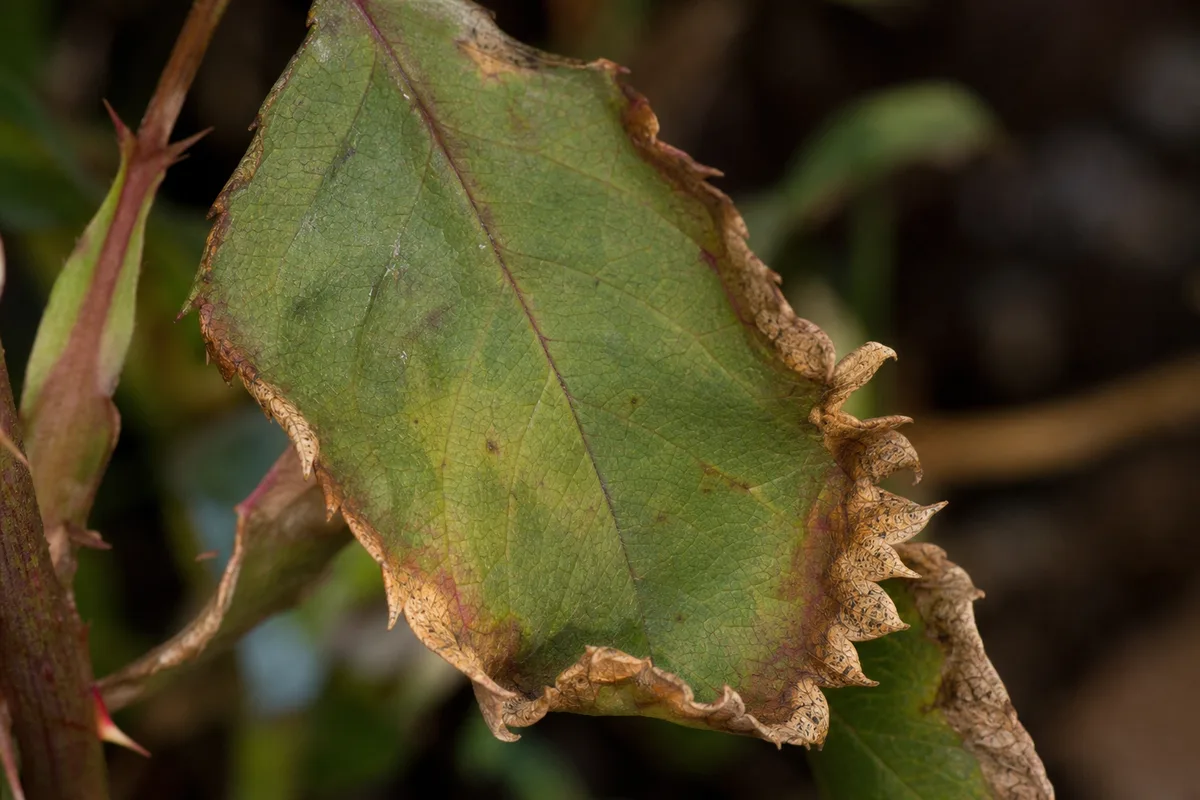
Underwatering symptoms on Rose - compare with healthy tissue on the same plant.
Roses in Rose light guide transpire heavily through large leaves and open flowers. When the mix dries too far, the bush cannot move water fast enough-outer canes hang limp, often worst on the afternoon-sun side. Flower necks bow, buds hang closed, and repeat-flowering types produce small, pale blooms instead of full-sized flowers.
Dry mix shows visually: the surface looks dusty or pale, soil may pull away from the pot edge, and the container feels dramatically lighter when lifted. Leaf margins may turn crispy brown after repeated dry cycles; lower leaves can drop before the whole bush collapses.
Unlike chronic overwatering, underwatered roses have dry soil 3–4 cm down, no sour smell, and canes that stay firm at the base rather than soft and black at the graft union.
Firm canes vs. rot-related collapse
The stem test matters on grafted hybrid teas. Drought-stressed canes feel limp from lack of turgor but the wood stays firm when you bend a lower cane gently. root rot on Rose or crown rot on wet soil produces soft, dark tissue at soil level and a bush that stays collapsed despite moisture present.
If canes soften at the graft or base while mix is dry, you may be seeing advanced desiccation damage-not the simple same-day wilt that perks up after one soak.
Why Rose gets underwatered
Full sun and repeat-flowering water demand
Modern garden roses are selected for repeat flowering, and that flush demands steady moisture paired with six or more hours of direct light daily. More sun means faster transpiration. A patio hybrid tea in peak bloom can exhaust a small pot in a single hot afternoon-far faster than an in-ground shrub with a wider root zone.
Clemson HGIC notes roses need consistent moisture during active growth and wilt when water is insufficient. Container roses on balconies and terraces depend entirely on you; there is no deep groundwater buffer.
Fear of black spot and skipped base watering
Many growers reduce watering to keep foliage dry after a black spot scare. That backfires. Roses still need moisture at the root zone-NC State Extension recommends soaker delivery to roots while keeping foliage dry-not zero irrigation. Withholding all water stresses the plant and invites spider mites during hot, dry weather while doing nothing to cure existing leaf spots.
The fix is base watering in the morning, not drought. See the black spot guide for foliage disease steps; do not starve roots to prevent infection.
Small pots, wind, and terrace heat
Miniature and patio roses in shallow pots dry fastest. Terracotta and dark-colored containers heat up and lose moisture quicker than glazed ceramic. Wind on exposed balconies accelerates evaporation. Root-bound plants circling a dry root ball can wilt daily even when you think you watered-the center never re-wet.
Hybrid teas in 25–30 cm pots need smaller but frequent deep soaks; large shrub roses in 40–50 cm containers may need 5–10 litres per session in a heat wave once the top layer dries-enough that moisture reaches the bottom of the root ball, not just the surface crust.
Calendar watering vs. the 3–4 cm finger test
Watering every Sunday regardless of weather is a common underwatering trigger. Cool weeks stretch intervals; July heat on a south-facing terrace does the opposite. Established in-ground roses often align with roughly one inch of water per week when rain is absent-but container roses in full sun may need attention every one to three days. The finger test at 3–4 cm depth bridges both; the rose watering guide covers seasonal schedules in detail.
How to confirm the cause
Work through these checks in order before you soak:
- Pot weight - Lift the container right after a thorough watering and notice the weight. A pot that feels feather-light compared with that baseline strongly suggests drought.
- Moisture at depth - Push your finger or a skewer 3–4 cm into the mix near the pot edge, not against the crown. Dry, crumbly soil at that depth confirms thirst. Damp soil at depth with surface dust may mean you only need to wait-or that hydrophobic mix is repelling water.
- Recovery soak test - For dry soil only, apply one slow base soak directing water onto soil, not foliage. Partial firming within two to four hours confirms underwatering. No change on wet soil means stop-inspect roots for overwatering or root rot instead.
- Heat wilt vs. true drought - Note the time pattern. Afternoon droop that recovers by evening on moist soil 3–4 cm down is often heat stress-do not double-soak. Wilt into the next morning with dry depth is drought.
- Root peek (if wilt persists on wet mix) - Tip the plant carefully out. Firm pale roots in dry mix support drought. Brown mushy roots in wet mix mean rot-do not soak harder.
- Hydrophobic mix check - Water slowly and watch absorption. If water channels straight to the saucer while the pot stays light, the peat-based mix has gone hydrophobic after prolonged dryness.
Confirmation decision table
| Check result | Likely diagnosis | Next move |
|---|---|---|
| Dry 3–4 cm down + light pot + firm canes | Underwatering | Deep base soak |
| Moist 3–4 cm down + evening recovery | Heat stress | Hold water; ensure even depth moisture |
| Wet soil + limp canes + yellow lower leaves | Overwatering / root failure | Stop watering; see overwatering guide |
| Dry soil + no perk after soak | Hydrophobic mix or severe root damage | Bottom-water or repot; inspect roots |
| Dry soil + stippling + webbing | Spider mites on drought-stressed rose | Rehydrate + pest control |
First fix for Rose
Soak the root zone at the base until water runs freely from drainage holes-then stop until the top 3–4 cm dries again.
Direct water onto the soil surface, not leaves and blooms. Use a watering can, trickle hose, or soaker aimed at the root ball. For a typical 30 cm patio pot in peak heat, roughly 3–5 litres in one slow pass often recharges dry mix; larger 45 cm containers may need 5–10 litres-watch for drainage, not a fixed number.
David Austin Roses advises checking about 5 cm deep and watering when dry-consistent with the 3–4 cm probe used throughout LeafyPixels rose guides. Empty saucers within 30 minutes so roots are not re-saturated from below.
Do not mist foliage, do not fertilize a wilted bush, and do not repot on day one unless roots are clearly rotted on wet soil.
What not to do on day one
- Do not sprinkle the surface daily without soaking the root ball center
- Do not withhold all water to prevent black spot-dry stressed roses invite mites
- Do not assume afternoon droop on moist soil means drought-avoid double-soaking
- Do not hose leaves and flowers when trying to fix thirst-wet foliage raises disease pressure
Step-by-step recovery
Mild drought (firm roots, perks after one soak)
- Apply one thorough base soak until drainage runs; wait 10 minutes and repeat if water ran through too fast on hydrophobic mix.
- Move the pot out of the hottest afternoon beam temporarily if wilt repeats daily despite proper depth moisture-heat and drought stack on small terraces.
- Resume watering only when the top 3–4 cm dries; expect turgor within hours.
Moderate drought (repeated dry cycles, bud abort, crispy edges)
- Soak twice in one session if the first pass channels to the saucer without weight gain.
- Top-dress with compost mulch, keeping material a few centimetres clear of canes.
- Remove only fully necrotic leaves after the plant firms-living wilted tissue often recovers.
- Hold fertilizer until new leaves look firm for two weeks.
Hydrophobic mix and bottom watering
When dry peat repels water:
- Place the pot in a basin of water so the mix wicks from the bottom for 20–30 minutes until the surface darkens.
- Lift, let drain fully, and empty the saucer.
- Refresh or repot into compost-rich mix with perlite if hydrophobic cycles repeat every heat wave-see repotting guidance during cooler weather, not mid-crisis unless roots are exposed.
In-ground deep weekly soak
Established border roses with dry soil at depth benefit from a slow deep soak rather than daily sprinkles. Illinois Extension IPM recommends thorough weekly irrigation during drought so soil is moist eight to twelve inches deep. NC State notes supplemental irrigation when rainfall does not deliver a weekly soaking-often a soaker hose at the root zone with dry foliage. Mulch beds two to three inches deep, pulled back from the stem, to slow evaporation.
Mulch and saucer management
Mulch container surfaces in summer to reduce dry-down. Never leave saucers full-standing water re-wets roots and mimics overwatering within hours. Dark cachepots without drainage are a common underwatering/overwatering trap: the inner pot dries while you cannot see it.
Recovery timeline
Mild underwatering: Canes and leaves often perk within two to four hours of a deep soak; full turgor may return overnight. Crispy leaf margins and scorched petal edges stay blemished.
Moderate stress with bud abort: New buds should size up within one to two weeks once moisture stays steady. The aborted buds will not reopen.
Severe chronic drought: Fine feeder roots may die back; expect three to six weeks before the bush fills out and bloom flush returns. Judge progress by new firm leaves and stable canes, not by rehabilitating old crispy foliage.
Heat-stress afternoon droop only: Recovery by evening without extra water-adjust expectations, not soak volume.
Lookalike symptoms to rule out
| What you see | Likely cause | Quick check |
|---|---|---|
| Wilting + dry, light pot | Underwatering | Dry 3–4 cm down; perks after soak |
| Wilting + wet soil | Overwatering / root rot | Finger test; inspect roots |
| Afternoon droop + moist soil + evening recovery | Heat stress | No soak needed if depth moist |
| Fine stippling + webbing on dry-stressed bush | Spider mites | Underside inspection |
| Yellow lower leaves + wet soil | Overwatering | Pot weight; sour smell |
| Small pale blooms + steady moisture | Nutrient or light issue | Not drought if soil wet at depth |
The critical split for roses is dry soil versus wet soil when canes droop. Both extremes wilt the plant; only the moisture test at depth tells you which direction to move.
Mistakes to avoid
- Surface sprinkles that never reach the root ball center-especially on root-bound patio roses
- Withholding water to prevent black spot instead of switching to base morning irrigation
- Double-soaking heat-stress droop on moist soil-creates overwatering risk
- Calendar watering through heat waves without lifting the pot or probing depth
- Ignoring hydrophobic runoff after vacation dry-out-the plant stays thirsty while the saucer fills
- Fertilizing a wilted rose hoping to revive it-feed only after turgor returns
- Repotting on day one for simple drought wilt-adds shock when a soak suffices
How to prevent underwatering on Rose
Build rhythm around checks, not memory:
- Finger or skewer test 3–4 cm deep before every major watering in active growth
- Water at the base until a little drains; skip overhead sprays for routine care
- Daily pot checks in peak summer on sunny balconies; weekly deep soaks for established in-ground shrubs when rain is absent
- Mulch containers and beds; refresh tired peat that collapses and dries fast
- Match pot size to the plant-miniatures in soup-sized pots need twice-daily attention in heat; upsize before root-bound dry-down becomes daily wilt
- Six or more hours of direct sun with consistent depth moisture supports predictable drying rates
- Scout weekly during hot dry weather for spider mites on drought-stressed roses
Container roses in hot climates may need water every one to three days when the top layer dries; the same plant on a cool February balcony may go a week between drinks. The finger test bridges both seasons-details in the rose watering guide.
When to worry
Escalate if:
- Canes soften or darken at the graft union despite recent soaking
- The whole bush stays limp more than 48 hours after one correct deep soak on confirmed dry soil
- Repeated dry cycles abort every bud during peak bloom season with no recovery between soaks
- Soil stays bone dry in the center after two bottom-water sessions-root ball may be severed from mix or pot-bound beyond rescue
- Wilt persists on wet soil after you stop watering-treat as root failure, not drought
At that stage, inspect roots and follow the root rot recovery path. Mild drought with firm canes and dry soil almost always responds to one proper soak and a corrected schedule.
Rose care cross-check
Underwatering often exposes a mismatch between Rose overview’s needs and current conditions. Roses want full sun, base watering when the top 3–4 cm dries, rich well-draining mix, and dry foliage whenever possible. A rose in too small a pot on a blazing terrace wilts from drought by midday; one recovering from black spot fear may be chronically dry at the roots while leaves still show old spots.
If dry-down happens every single day in a heat wave, increase soak volume and mulch-not just frequency of shallow splashes. If you rarely dry out but still see pale blooms, reassess light and feeding on the rose overview before blaming water alone.
Conclusion
Underwatering on roses is usually fixable when you catch it before canes desiccate at the base. Dry soil at depth, a light pot, and firm wood point to drought-soak slowly at the base until drainage runs, then wait for the top 3–4 cm to dry before the next drink. Heat-stress afternoon droop on moist soil is a different problem; so is wilt on wet mix, which belongs on the overwatering and wilting guides instead.
Judge recovery by new firm leaves and the next clean bloom flush-not by perfect old petals. Once rhythm stabilizes, the rose watering guide keeps daily checks and seasonal adjustments straightforward.
When to use this page vs other Rose guides
- Rose watering guide - Use for routine moisture checks before assuming underwatering is the main issue.
- Rose problems hub - Browse all 7 common issues on this species.
- Yellow Leaves on Rose - Different entry point when symptoms overlap with underwatering.
- Leaf Drop on Rose - Different entry point when symptoms overlap with underwatering.