Leaf Miners on Rubber Plant: Causes, Checks & Fixes
Quick answer
Leaf miners on Rubber Plant leave pale serpentine tunnels inside thick glossy leaves—visible when you hold a blade to light. First step: isolate the plant and prune off every mined leaf with clean scissors; contact sprays rarely reach larvae feeding between leaf surfaces.
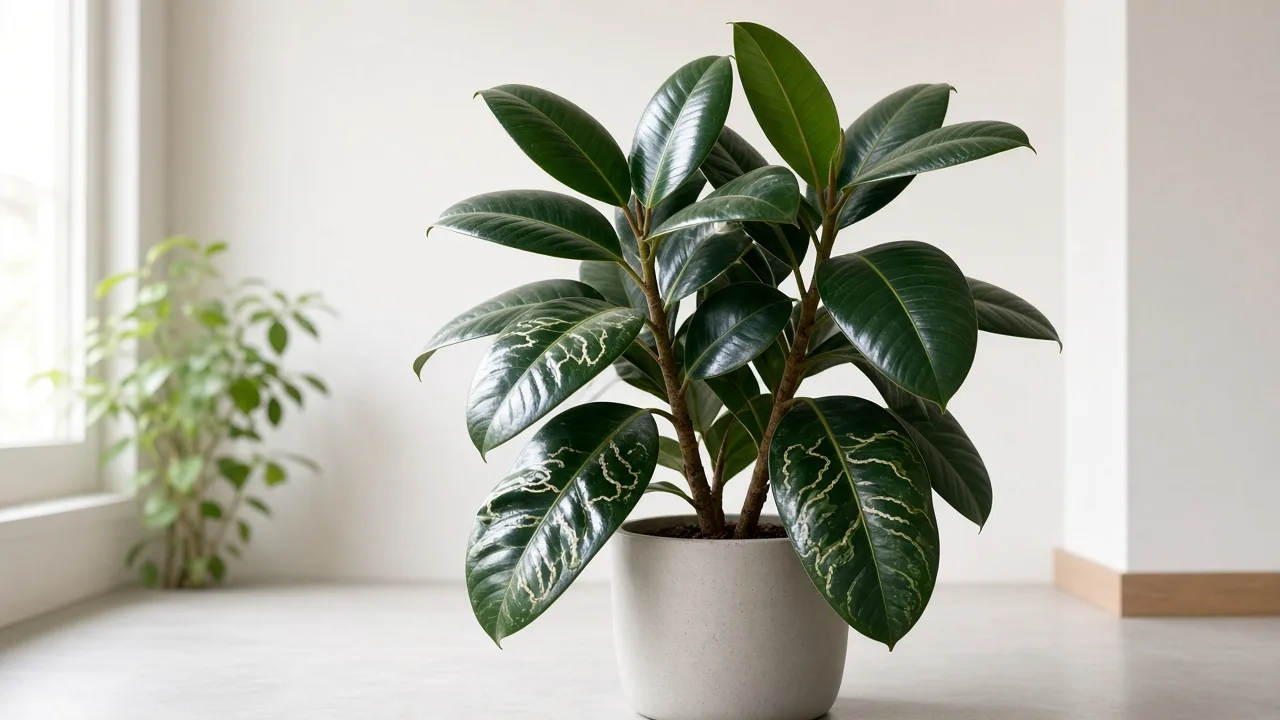
Leaf Miners on Rubber Plant: Causes, Checks & Fixes
This guide covers leaf miners on Rubber Plant. See also the general Leaf Miners guide, watering, and light pages for this plant.
Leaf Miners on Rubber Plant: Causes, Checks & Fixes
Quick answer
Pale winding tunnels inside Rubber Plant leaves mean fly larvae feeding between the upper and lower epidermis—not a watering mistake or light stress. Contact sprays rarely reach larvae tucked inside thick Ficus elastica blades. For how mines form and why insecticides underperform, see our leaf miners guide. On Rubber Plant, hold glossy foliage to light and inspect red sheaths at stem tips before you treat.
First step: isolate the plant and prune off every mined leaf with clean scissors.
When to use this page vs other Rubber Plant guides
| Pattern | Read next |
|---|---|
| Pale tunnels inside leaf tissue | This page |
| Fine dots + webbing on undersides | Spider mites |
| Silvery streaks, black frass, no internal tunnel | Thrips |
| Cottony wax clusters in leaf axils | Mealybugs |
| Ragged holes through the blade | Caterpillars |
| Even yellowing across many leaves, no tunnels | Overwatering or yellow leaves |
What leaf miners look like on Rubber Plant
Rubber Plant carries large, thick, glossy oval blades—often 8 to 12 inches long on mature specimens. That waxy cuticle makes leaf miner damage easy to spot once you backlight a leaf: mines read as translucent serpentine trails crossing the dark green surface, often with a dark frass line down the center of the tunnel.
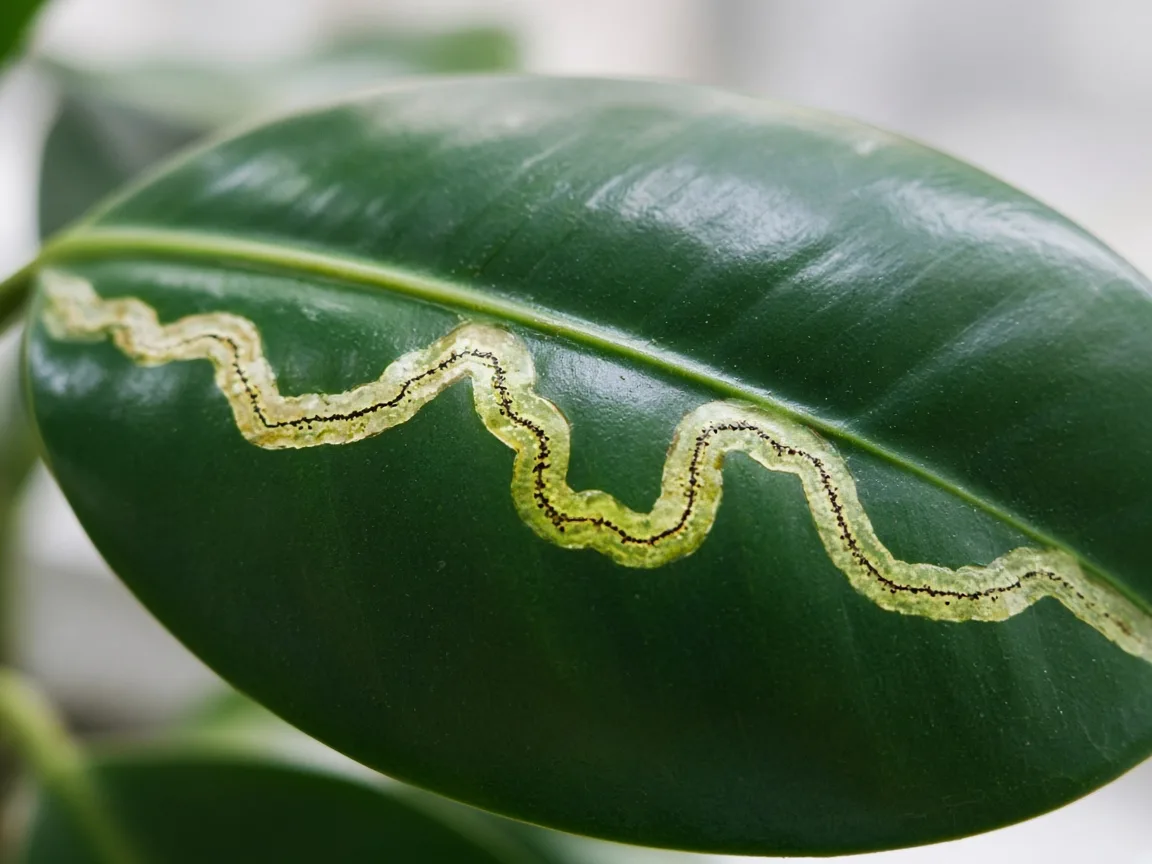
Pale bordered tunnel inside Rubber Plant leaf tissue—hold the blade to light and look for a dark frass line inside the mine.
Early signs:
- White stippling from adult fly punctures before mines widen—can look like dust on glossy tops
- A short pale trail on one lower mature leaf that lengthens over several days as the larva feeds
- One or two mines while the upper canopy and newest red-sheathed growth still look clean
Active infestation:
- Multiple serpentine mines across several large blades, sometimes branching at the midrib
- Brown, seedlike pupae on the soil surface after larvae exit the leaf
- New leaves unfurling from red sheaths with mines already inside the opening blade
Unlike spider mites, leaf miners do not produce webbing or moving specks on paper taps. Unlike scale insects, damage stays inside the leaf—no raised brown bumps or sticky honeydew on stems.
Why Rubber Plant gets leaf miners
Leaf miners are small fly larvae—commonly Liriomyza species on ornamentals—that hatch inside leaf tissue and feed in the mesophyll between surfaces. In warm indoor rooms the life cycle can complete in about two weeks, and houseplants lack the parasitic wasps that control miners outdoors.
Rubber Plant-specific risk factors:
- Thick glossy blades — mines show clearly when backlit, but dust on waxy tops can hide early stippling until tunnels widen
- Large lower canopy — adult flies often lay eggs on accessible mature leaves before climbing to newer growth
- Red protective sheaths — new foliage emerges from bright red cylinders at stem tips; eggs laid before a blade opens leave mines on the first unfurled inches
- Tree-like upright habit — tall specimens on crowded shelves let adult flies walk between pots on shared watering days
- Nursery hitchhikers — inspect new stock before mixing it into a collection; miners on begonia, impatiens, and other ornamentals use the same indoor hosts
Red sheaths and thick blades: where Rubber Plant hides miners
Ficus elastica unfurls new leaves from bright red protective sheaths at woody stem tips. Adult leaf miner flies can puncture and lay eggs on tissue still inside that cylinder—damage appears on the glossy surface only after the blade opens, often several days after feeding started.
Work systematically during treatment: inspect each red sheath with bright light, check glossy undersides along thick petioles where they meet upright stems, and backlight lower mature blades where the canopy is densest. A quick pass over the top leaves alone misses the sheltered zones where miners establish on rubber plants.
Lookalike symptoms
| Pattern | Check | Likely cause |
|---|---|---|
| Bordered internal tunnel when backlit | Frass line inside mine | Leaf miner |
| Fine dots + webbing on undersides | Paper tap test | Spider mites |
| Silvery streaks, no tunnel inside blade | Shake over white paper | Thrips |
| Ragged holes through leaf | Night inspection | Caterpillars |
| Even yellowing, no mine | Soil moisture, light | Overwatering |
How to confirm
- Isolate the plant before touching others on the same shelf.
- Hold suspect blades to a window or lamp—mines appear as pale tunnels with a dark center line.
- Inspect red sheaths at stem tips, glossy undersides along petiole bases, and the lower mature canopy with a hand lens.
- Check the soil surface for brown pupae after larvae exit leaves.
- Scan neighboring pots for matching mines before returning any plant to a shared display.
First fix for Rubber Plant
Isolate the plant and prune off every mined leaf with clean scissors, bagging and discarding clippings outside the home.
Clip off and remove infested leaves—this is the most reliable control because larvae live inside tissue sprays cannot penetrate. Wear gloves when cutting: Rubber Plant latex sap is irritating and the plant is toxic to cats and dogs. Sterilize scissors between cuts if mines span multiple stems.
Do not reach for insecticidal soap or horticultural oil as the opening move. Insecticides are not very effective against leaf miners once larvae are inside leaves, and heavy oil films are hard to rinse from thick waxy blades.
Step-by-step recovery
- Complete the first fix on every mined blade, including partially damaged leaves still inside red sheaths.
- Place yellow sticky traps near the pot to catch adult flies—punctures and new egg laying often precede visible mines.
- Vacuum or wipe pupae from the soil surface; larvae drop to pupate in the mix after exiting leaves.
- Re-inspect red sheaths and lower canopy every three to four days through at least two fly generations (~four weeks in warm rooms).
- Return the plant to a shared shelf only after two clean weeks with no new mines on unfurling blades.
Mistakes to avoid
- Do not spray mined leaves first—contact products miss larvae between surfaces and leave residue on glossy Ficus elastica tissue.
- Do not assume a single mine means the problem is over; warm conditions support multiple generations per year indoors.
- Do not fertilize a stressed Rubber Plant to “push new growth” while flies are still active—tender blades emerging from red sheaths are easier targets.
- Do not handle pruned material without gloves if pets might contact cut stems or sap.
- Do not confuse adult fly stippling with spider mite stippling—mites add webbing and moving specks; miners add internal tunnels within days.
Recovery timeline
Pruning shows results within days when only a few leaves are affected. Full control takes two to four weeks through multiple life cycles. Mined blades will not regain their original glossy color—judge success by clean new foliage unfurling from red sheaths, firm woody stems, and no fresh tunnels for fourteen days.
Prevention
- Quarantine new plants two to three weeks and inspect red sheaths before placing them near existing Rubber Plants.
- During weekly care, backlight one lower leaf and check the newest sheath—early mines are easiest to prune.
- Avoid crowding tall specimens on shared shelves; leave air space between pots.
- Keep baseline watering and light steady so stress does not mask new mines on pale cultivars like ‘Tineke’.
- Monitor houseplants routinely and discard heavily infested specimens rather than risking a collection-wide outbreak.
Related Rubber Plant guides
Conclusion
Leaf miners on Rubber Plant are a physical-removal problem—backlight thick glossy blades to confirm internal tunnels, isolate, and prune before reaching for sprays that cannot reach larvae inside Ficus elastica tissue.
Related tool
Use the Pest Identifier Tool to narrow causes for leaf miners on this plant before changing multiple variables at once.