Scale Insects on Spider Plant: Causes, Checks & Fixes
Quick answer
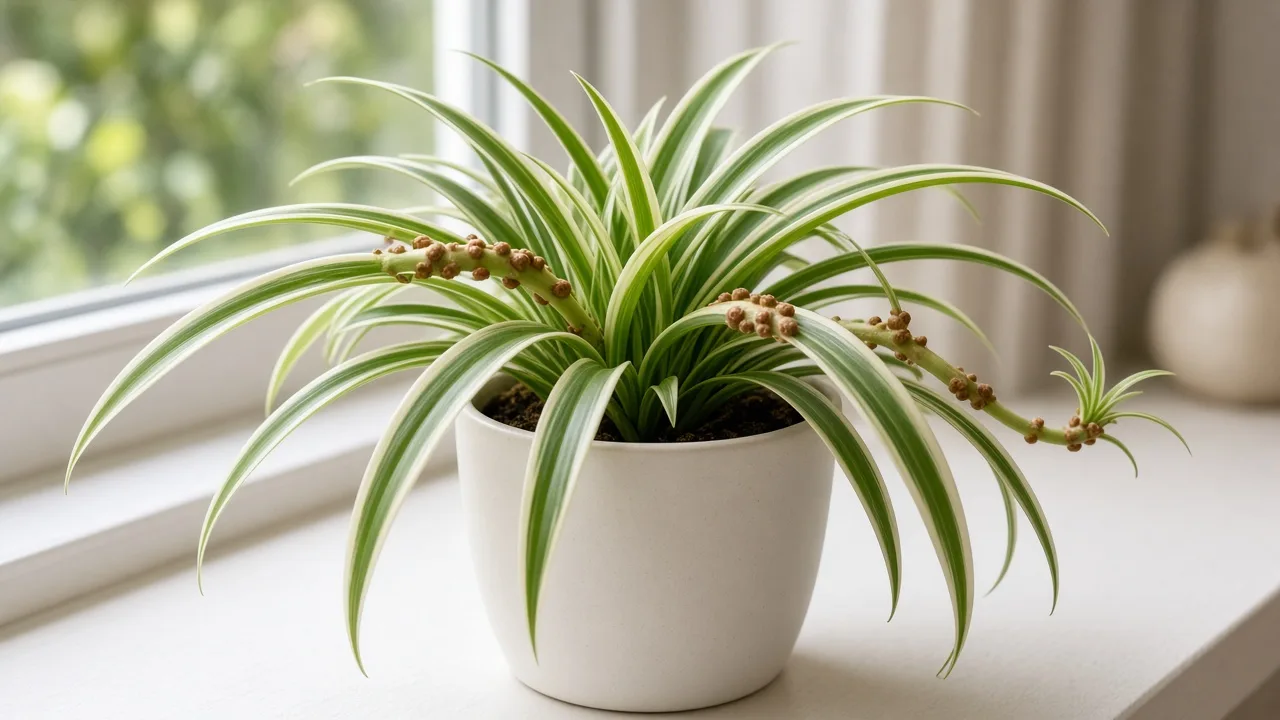
Scale insects on spider plant look like small tan or brown bumps glued to bases of arching leaf clumps, runner nodes bearing spiderettes, and the sheltered crown where leaves emerge—often mistaken for normal stem texture until leaves turn sticky or yellow. First step: isolate the plant and scrape every visible bump with a cotton swab dipped in 70% isopropyl alcohol.
Scale Insects on Spider Plant: Causes, Checks & Fixes
This guide covers scale insects on Spider Plant. See also the general Scale Insects guide, watering, and light pages for this plant.
Scale Insects on Spider Plant: Causes, Checks & Fixes
Quick answer
Scale insects on spider plant (Chlorophytum comosum) show up as small, immobile tan, brown, or bark-colored bumps glued to bases of arching leaf clumps, runner nodes bearing spiderettes, and the sheltered crown where leaves emerge. They pierce tissue, drain sap, and—on soft scale species—excrete sticky honeydew that can lead to black sooty mold on the grass-like blades below.
For general scale biology indoors, see our scale insects guide. On spider plant, bumps often hide at runner nodes and crown bases behind arching foliage—places quick top-down watering checks miss on a hanging basket.
First step: isolate the plant and scrape every visible bump with a cotton swab dipped in 70% isopropyl alcohol.
Why spider plant gets scale insects
Spider plant is a fast-offsetting houseplant with arching leaves and hanging stolons that create protected feeding sites at every leaf base and runner node. Scale are common sap-sucking pests on houseplants that arrive on nursery stock, shared tools, or nearby infested specimens—not because spider plant is uniquely prone, but because its growth habit gives pests sheltered crevices casual checks miss.
Spider plant-specific risk factors:
- Runner and spiderette bridges - Stolons draping from hanging baskets touch neighboring pots, giving crawlers a walkway between plants before you notice bumps on the mother clump.
- Crown and leaf-base crevices - Grass-like leaves arch outward from a tight crown; scale settles where petioles meet the central stem.
- Hanging basket blind spots - Upper foliage looks fine while undersides of arching blades and runner nodes stay uninspected.
- Rapid offset production - Spiderettes root easily; propagating an infested baby spreads scale to every new pot on the shelf.
- Indoor warmth - Indoor ornamentals lack natural enemies that would control scale outdoors.
Warm rooms suit scale year-round. A recent nursery arrival, summer patio time, or a spider plant pushed into a dim corner with slow growth often coincides with the first visible bumps along runner nodes.
What scale insects look like on spider plant
Scale insects are protected by a waxy or shell-like cover that makes adults essentially immobile. On spider plant they are easy to miss until colonies build:
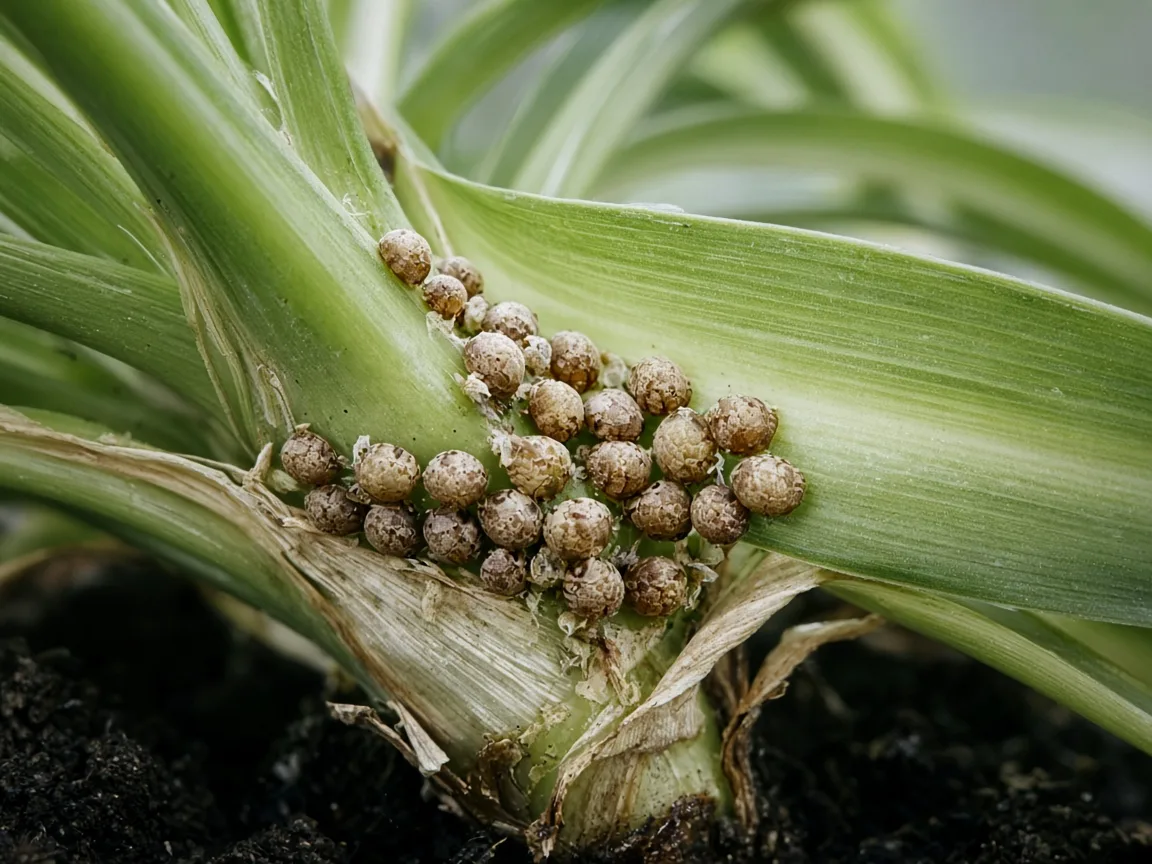
Scale insect symptoms on spider plant—compare bumps with healthy tissue on the same arching leaf base.
- Flat or dome-shaped bumps on green crown stems, leaf petiole bases, and along arching leaf undersides
- Bark-colored disks that blend with stem texture—tan, brown, or gray—until you look closely and see individual scales in rows
- Sticky, shiny honeydew on lower arching blades and on shelves beneath hanging baskets (typical of soft scale)
- Black sooty mold on sticky leaf surfaces; it wipes off but returns until insects are controlled
- Ant trails on pot rims, saucers, or basket chains—ants harvest honeydew and protect scale colonies
- Yellow leaves and stalled new growth when feeding is heavy on the crown or runners
Do not mistake normal aging for pest damage. Spider plant sheds an occasional lower yellow blade in dim light while the crown stays firm and keeps producing offsets. Scale stress shows bumps at multiple nodes, stickiness, and stalled new growth—not one cosmetic old leaf at the base of an otherwise vigorous clump.
Press a suspect bump with a fingernail or toothpick. Scale should flake off with gentle pressure; mealybugs smear waxy cotton instead. Mealybugs look like white fluffy clusters in leaf axils. Spider mites leave fine webbing and stippling in hot dry air, not hard bumps.
How to confirm the cause
Do not treat from one brown speck on a stem. Use this inspection order:
- Isolate first - Move the spider plant away from other plants before handling so crawlers do not walk to neighboring pots or shared propagation water.
- Crown and leaf bases - Inspect where arching leaves emerge from the central clump with bright light, including the sheltered crown interior.
- Runner nodes and spiderettes - Follow every stolon from the mother plant to each baby plantlet; scale often colonizes nodes before spiderettes show yellow tips.
- Leaf undersides - Check the undersides of arching grass-like blades where soft scales often concentrate along veins.
- Soil line and pot rim - Lift outer leaves and check where stems enter the mix and along unglazed terracotta rims.
- Scrape test - Pry a bump with a knifepoint or toothpick. Scale shells lift to reveal insects or eggs beneath; natural stem texture stays green and attached.
- Neighbor check - Inspect plants that shared a shelf, windowsill, or propagation station for bumps or honeydew.
If stems are firm, soil smells neutral, and the only issue is immobile bumps with stickiness, soft scale fits. If the pot stays heavy for days, soil smells sour, and crown bases soften while mix stays wet, rule out root rot from chronic overwatering before spraying.
Lookalike symptoms to rule out
| Sign | Likely cause |
|---|---|
| Immobile bumps + honeydew | Scale (this page) |
| Cottony wax in axils | Mealybugs |
| Stippling + webbing | Spider mites |
| Uniform yellow, wet soil | Overwatering |
First fix for spider plant
Isolate the plant and scrape every visible scale with a cotton swab dipped in 70% isopropyl alcohol.
That single action removes adults you can reach and confirms the pest is alive—not dust or stem texture—before you commit to sprays. Clemson HGIC notes that early scale infestations can be removed by scraping; alcohol dissolves the waxy cover on contact. Test a hidden leaf base first and wait 24 hours before treating the whole plant.
Once isolated and scraped:
- Work crown-to-runner systematically rather than spraying the whole plant on day one
- Wipe away honeydew from arching leaves below colonies with a damp cloth
- Inspect and treat—or discard—every spiderette before rooting it
- Check neighboring plants you have not yet isolated
Do not reach for systemic insecticides or repot on day one unless scale is confirmed at drainage holes with declining roots. Do not fertilize a pest-hit spider plant hoping to push new growth—that produces more tender tissue crawlers prefer.
Step-by-step recovery
After the initial alcohol scrape:
- Repeat scrapes every five to seven days for at least three cycles to catch newly hatched crawlers before they settle under a new shell. Adult scales are relatively protected from insecticides by their waxy covering, so physical removal plus repeat treatment matters.
- Apply horticultural oil or insecticidal soap if bumps persist after several scrape rounds. Cover leaf undersides, crown bases, and runner nodes thoroughly; oils suffocate insects by blocking their breathing pores and must contact the pest directly. Repeat at label intervals through one full pest generation.
- Shower the plant in a sink or outdoors on warm days to knock down crawlers on arching foliage—let leaves dry in indirect light the same day.
- Manage ants if they protect colonies on pot rims or basket chains.
- Wash sooty mold off leaves with plain water once honeydew production stops.
- Consider a systemic drench only for persistent soft scale after manual and spray efforts fail. Mississippi State Extension notes that soil treatments containing imidacloprid usually control brown soft scale but are less effective on armored scales—identify whether honeydew is present before choosing this route.
Keep the spider plant isolated until you see no new scale for at least two weeks after the last treatment.
Recovery timeline
Alcohol scrapes show results within a few days when colonies are moderate. A full oil or soap course may take two to three weeks with label-interval repeats. Sooty mold fades as honeydew dries up; expect cleaner new arching leaves within two to four weeks once insects stay gone.
Old yellowed or stippled blades rarely regain perfect color—judge recovery by a firm crown, new leaves opening without bumps, and no fresh scale at runner nodes. Spider plant rebounds faster in bright indirect light than in dim corners where offset production stays slow.
Runners and spiderettes: pest bridges on spider plant
Spider plant (Chlorophytum comosum) produces arching stolons with baby plantlets that touch neighboring pots and shelves. Pests on one mother plant walk onto spiderettes before you notice damage on the main clump. Hanging baskets put leaf backs at eye level but hide scale along runner nodes where stolons bend.
During treatment, detach or treat every spiderette rather than leaving infested babies hanging on the mother plant. Do not root spiderettes for propagation until the parent has been clean for two weeks—scale under a waxy cover on a tiny offset is easy to miss and spreads fast through a collection.
Work systematically crown-to-runner during treatment rather than one rushed pass over visible upper leaves only.
Mistakes to avoid
Do not ignore a few bumps at one runner node—they multiply quickly along stolons and spiderettes. Do not spray the entire plant with undiluted alcohol; spot-scrape or use diluted solutions per extension guidance. Do not return an isolated spider plant to a shared shelf after one treatment round—crawlers hide in crown crevices you missed.
Do not propagate spiderettes from an infested mother without treating them first. Do not increase nitrogen feeding during an active infestation. With severe scale infestations, it is often better to discard the plant and start over with clean spiderettes once neighbors are safe—spider plant is easy to replace from a clean offset.
How to prevent scale insects on spider plant
Scout crown bases and runner nodes during weekly care, especially on hanging baskets where undersides stay hidden. Quarantine new spider plants—and any spiderettes you plan to root—for two to three weeks before placing them near existing plants.
Keep spider plant in bright to medium indirect light so arching foliage grows vigorously and you notice problems early. Avoid excess fertilizer that pushes soft, pest-friendly new tips. Missouri Botanical Garden recommends isolating newly acquired plants for two to three weeks to limit introducing pests indoors.
Improve airflow around crowded plant shelves. Separate hanging baskets so trailing stolons do not touch. Sterilize pruning shears with rubbing alcohol between plants when trimming multiple spider plants.
When to worry
Treat as urgent when bumps encircle multiple runner nodes, ants swarm stems or saucers, new crown growth stalls for more than a week despite good light, or sticky residue coats furniture beneath a hanging basket. Severe infestations can cause plant parts to die even on hardy spider plants.
Replace severely declining plants rather than fighting endless reinfestation—starting fresh from a clean spiderette is often faster than repeated chemical cycles when scale has spread to most nodes along every stolon.
A single small cluster on one stem with a firm crown elsewhere is manageable with isolation and scrapes—not an emergency, but act within days before crawlers spread to spiderettes.
Conclusion
Scale insects on spider plant hide on crown bases and runner nodes that arching foliage creates, so a quick glance at upper leaves is not enough. Isolate first, scrape visible bumps with alcohol, repeat on a schedule until crawlers stop settling, and judge recovery by clean new arching blades—not old damaged foliage. Treat every spiderette before propagation—that path protects neighboring plants and keeps even a tough spider plant from slowly losing vigor to sap loss and sooty mold.
When to use this page vs other Spider Plant guides
Use this page for immobile tan or brown bumps glued to stems and leaf bases with optional honeydew. Use sibling guides for mealybugs (cottony wax), spider mites (stippling and webbing), or cultural stress pages when pest signs are absent.