Protea Flower: The 2026 "It" Bloom Florists Love
Thinking about protea flowers for a bouquet or garden? Get practical buying, arranging, vase-care, climate, soil, and pet-safety advice in one guide.
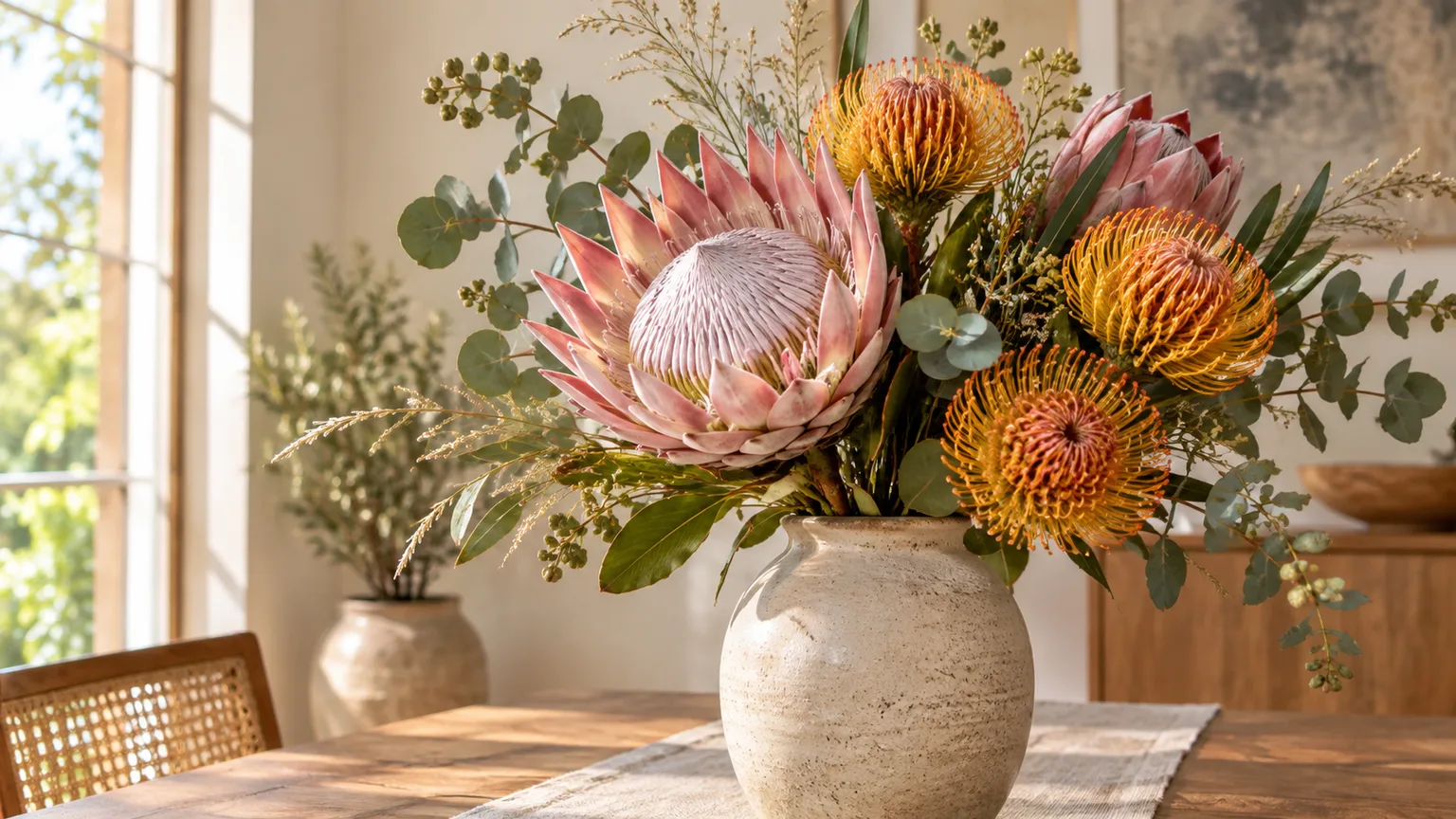
If one flower is positioned to move from florist favorite to familiar centerpiece in 2026, it is the protea. Its flowerheads look part artichoke, part starburst, and part prehistoric botanical experiment—exactly the kind of shape that can make a simple arrangement feel designed rather than merely filled.
The useful distinction is that “the next It flower” describes a design forecast, not a promise that every shop will stock every cultivar. Protea availability is seasonal and regional, and the plant itself has very specific growing needs. You can enjoy the trend in a vase almost anywhere; growing the shrub successfully requires the right sun, drainage, and winter conditions.
The Next “It” Flower Is Protea
Protea is a genus of evergreen shrubs in the Proteaceae family, native to southern Africa. Florists use several kinds, but the two most recognizable are the enormous king protea (Protea cynaroides) and the smaller, bristly pincushion protea, often a Leucospermum species rather than a true Protea.
The Royal Horticultural Society describes king protea as a sparsely branched evergreen shrub with leathery leaves and bowl-shaped flowerheads about 15–30 centimeters across. That scale makes the answer to “what should be the focal flower?” almost automatic: one king protea can carry the visual weight that a whole handful of smaller blooms would otherwise need. (RHS king protea profile)
As a cut flower, protea earns attention for a second reason: the display holds its shape while softer petals around it begin to collapse. A cut-flower supplier lists roughly 10–12 days of vase life with proper care, while a horticultural guide describes cut proteas lasting up to about two weeks; treat that as a useful range, not a guarantee, because cultivar, harvest stage, shipping, and room temperature all matter. (Bloomingmore orange pincushion proteas; Lawn.com.au protea growing guide)
Why Protea Feels Fresh Again
Roses and tulips can be romantic, but they are visually familiar. Protea gives a bouquet an immediate point of view: a large outline, leathery foliage, papery or velvet-like bracts, and a palette that works equally well with blush, terracotta, rust, cream, olive, and muted pink.
That flexibility is why the flower works for two apparently opposite design moods. A single stem in a quiet vase reads as minimalist sculpture, while a group of proteas with grasses, orchids, berries, or dried elements can anchor a maximalist display without getting lost among the texture.
There is also a practical sustainability angle, although it should be stated carefully. A durable cut stem can reduce the urge to replace an arrangement every few days, and a protea can be dried after its fresh display. That does not make every protea bouquet automatically low-impact: growing location, air freight, packaging, and disposal still matter. Ask where the stems were grown if sourcing is part of your decision.
The “Flower” Is Really a Sculptural Flowerhead
What looks like a single flower is a dense terminal flowerhead made of many small flowers surrounded by showy, stiff bracts. The bracts do most of the visual work, which explains why proteas can keep their silhouette after the tiny central flowers are no longer at their peak. (RHS protea botanical details)
This structure also changes how you judge freshness. Do not reject a stem simply because the central cluster is not fully open; some proteas are sold in a tighter stage so they can travel and open gradually. Look instead for firm stems, hydrated foliage, bracts without widespread browning, and a flowerhead that feels intact rather than crushed or slimy.
The bracts are not a license to handle the flower roughly. Their stiffness makes the head look tough, but bent edges, bruising, and heat damage show quickly. Carry stems upright, support the heads in transit, and do not wedge them tightly into a crowded grocery bouquet.
Which Proteas Florists Will Use Most
The word “protea” covers a range of silhouettes. If you tell a florist only that you want protea, you may receive a bold king head, a glowing pincushion, or a smaller cultivar chosen for season and availability. Naming the design job is more useful than naming a color alone.
King Protea Is the Oversized Focal Point
King protea (Protea cynaroides) is the showstopper. Its rounded, artichoke-like head can be pink, red, cream, or white, and the bracts often create a layered cup around the central flowers. In a bouquet, it works best as one clear focal point with supporting stems placed lower and farther out.
Choose king protea when you want one flower to define a table, ceremony arrangement, or large vase. It can look awkward in a small, tightly packed posy because the head needs visual breathing room and a vase with enough weight to counterbalance its stem.
The living shrub is smaller than the cut flower’s drama suggests: the RHS lists a mature king protea around 1–1.5 meters tall and wide, with full sun, shelter, and well-drained acidic or neutral soil. That makes it a realistic feature plant in the right mild climate, not a casual windowsill plant. (RHS king protea profile)
Pincushion Protea Brings Warm Texture
Pincushion proteas have radiating styles that make the head look like a glowing pin cushion. Orange, yellow, coral, and red tones are especially effective in fall-inspired bouquets, desert palettes, and arrangements that need strong texture without the full scale of king protea.
Use pincushion stems in threes or fives when you want rhythm, or use one as a bridge between a large focal flower and fine filler. Their rounded outline pairs well with loose grasses and airy foliage; placing several in a rigid row can make the arrangement look like a collection of identical ornaments.
The common name can blur plant identity. Many pincushion flowers sold to florists belong to Leucospermum, a close Proteaceae relative. That distinction matters to gardeners because the genus, cultivar, climate range, and mature form may differ even when the cut-flower look is similar.
Other Proteas and Protea Relatives to Know
Smaller king-protea cultivars, including compact forms sold for containers, can bring the look to a patio without the full footprint of a mature shrub. Other true proteas include Protea compacta, with pink-to-red goblet-like heads, and Protea repens, the common sugarbush, with cup-shaped flowers in red, pink, or white. (Lawn.com.au: How to grow proteas)
You may also see “blushing bride,” pink ice, queen protea, banksia, grevillea, or leucadendron in the same design conversation. Some are relatives rather than true proteas, but they share the architectural quality that florists want: strong stems, unusual flower structures, and foliage that can carry a composition after delicate petals have faded.
For a garden purchase, read the botanical name on the label. For a bouquet, ask the florist what is actually in the stem and whether the head is expected to open further. Common names are useful for shopping inspiration; they are not precise enough for plant care or safety decisions.
Choose Protea by Color, Scale, and Season
Blush king protea is the obvious romantic choice, but it is not the only color story with momentum. Golden-orange pincushion protea feels warmer and more graphic, especially with rust, apricot, ochre, eucalyptus, and dried grasses. Cream and white king protea create a calmer arrangement when the texture is already doing the talking.
Choose color after choosing scale. A giant pale head can dominate a small room just as thoroughly as a bright orange one, while a group of small pincushions may disappear in a tall, open space. Photograph your vase or event table next to a ruler before ordering; the finished stem length and flowerhead width matter more than a product thumbnail.
Season is part of the choice, too. Individual protea species do not share one universal bloom calendar. A study of 25 Protea species found peak flowering spread across much of the year, with timing varying across South African climates; more than half of the species in that dataset had flowering observations in all 12 months. In other words, “protea season” depends on the species and growing region rather than a single global date. (Protea flowering phenology study)
How to Buy Fresh Protea for a Bouquet
Start with the job you need the flower to do: one oversized focal stem, a set of warm textural accents, or a durable ingredient for a dried arrangement. Tell the florist your vase height, event date, desired color range, and whether the bouquet must be pet-conscious; that information is more actionable than asking for “something exotic.”
When choosing stems in person, check five things:
- Stem strength: It should feel firm enough to support the head without bending sharply.
- Foliage: Leaves should look hydrated and attached, not limp, blackened, or dropping at the slightest touch.
- Bracts: A few dry outer edges can be normal, but avoid broad bruising, wet brown patches, or a collapsed center.
- Opening stage: Tighter heads travel well; partly open heads give you more immediate impact. Ask which stage you are seeing.
- Timing: For a major event, buy or schedule delivery early enough to condition the stems, but not so early that they sit in a warm room for a week.
If you are ordering online, ask for the exact stem type and average vase-life guidance rather than relying on the word “tropical.” A protea grown for cutting may be sold by stem length or head size, and a substitute may be a close relative with a different shape. Confirmation prevents an expensive surprise when you expected a king protea and received pincushions.
How to Decorate With One Protea or a Cluster
For a home display, begin with one king protea in a heavy, simple vase. Cut the stem so the head sits above the rim with room around it, then add only one or two supporting elements if the composition feels empty. The negative space is part of the design; filling every gap removes the reason the protea was chosen.
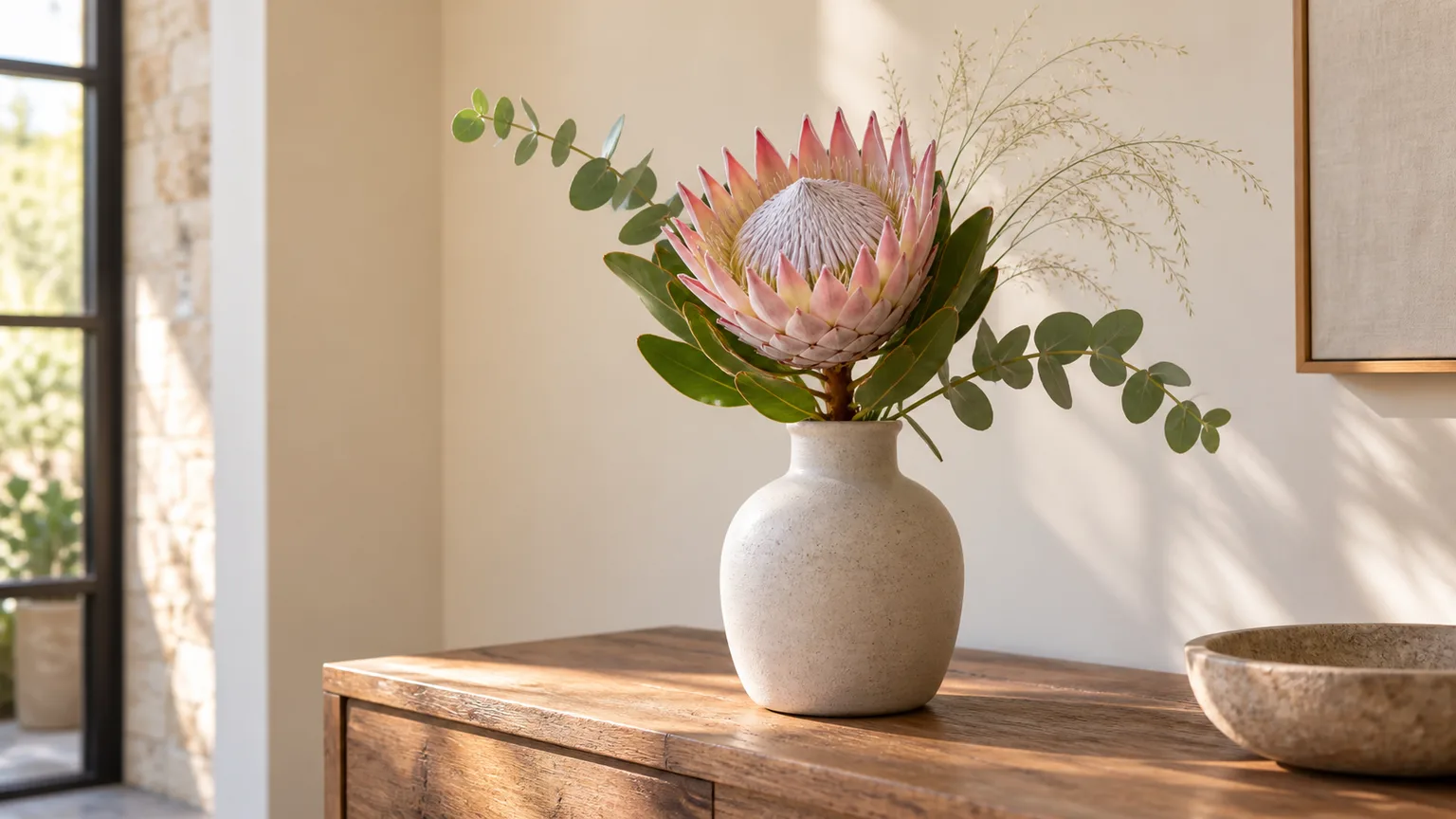
For a low bowl or event centerpiece, cluster two or three heads at slightly different heights and let the supporting flowers sit below their widest point. This keeps the proteas visually connected without making them look like a row of identical balls. A shallow vessel needs a stable flower frog or enough branching stems to hold the arrangement securely.
Proteas also suit installations, arches, and hanging arrangements because the heads read clearly from a distance. Use them where guests will not brush against the bracts, and keep heavy stems structurally supported rather than relying on a thin wire hidden at the base. Outdoor heat can accelerate water loss, so an installation needs a realistic hydration plan and should not be placed in a hot, sealed car before setup.
Pair Protea With Flowers That Give It Room
The strongest companions repeat one quality and contrast another. Pair a king protea’s large round outline with slender foliage, airy grasses, or small flowers; pair an orange pincushion with cream roses, pale mums, seed heads, or silvery-green leaves. The goal is not to find a flower that looks identical but to create a hierarchy the eye can read immediately.
A useful proportion rule is one focal layer, one supporting layer, and one line or texture layer. The focal layer might be a king protea; the supporting layer might be roses or chrysanthemums; the line layer might be eucalyptus, grasses, or a branch. If every ingredient is spiky, round, orange, or oversized, the arrangement loses contrast.
Dried elements can work beautifully, but check their condition before mixing them with fresh stems. Dusty, brittle pieces shed into the water, and a crowded vase makes it harder to remove fading flowers. Keep dried and fresh sections separate when you want to preserve both for more than a few days.
How to Keep Cut Proteas Fresh
Condition the stems as soon as they arrive. Wash a vase thoroughly, remove any leaves that would sit below the waterline, recut the stems on a slant with a sharp clean blade, and place them in water immediately. A florist care guide recommends warm water and regular water changes for proteas, while general cut-flower guidance emphasizes clean water, angled cuts, cool placement, and removing submerged foliage. (Fabulous Flowers cut-flower care guide)
Use a simple care plan:
- Fill a clean, stable vase with fresh water and follow the florist’s care card if it supplies a protea-specific preservative.
- Keep the leaves out of the water; submerged foliage breaks down and feeds bacterial growth.
- Place the vase away from direct sun, radiators, hot appliances, air-conditioning blasts, and strong drafts.
- Check the water daily because a large arrangement can drink faster than expected.
- Refresh the water every two to three days, clean the vase if it feels slimy, and recut the stem ends if they have sealed.
Do not improvise a strong sugar, bleach, or vinegar recipe because it worked for another flower. Cut-flower suppliers and florists do not all give the same advice for proteas, so clean water and careful temperature control are the dependable baseline; use a commercial product only as directed for the specific flowers in the arrangement.
Keep the bouquet away from a bowl of ripening bananas or apples. A florist guide flags fruit as an ethylene source that can speed flower aging, and the same separation is easy to use for any long-lasting centerpiece. When the fresh heads begin to dry naturally, remove them from water and hang them upside down in a dry, dark, airy place rather than waiting for the stems to become slimy.
Can You Grow Protea at Home?
Yes, but “at home” usually means a sunny outdoor bed, a patio container, a greenhouse, or a protected conservatory—not a dim living-room corner. The RHS recommends full light, sparse winter watering under glass, and a frost-free, sheltered outdoor position with poor-to-moderately fertile, well-drained soil. (RHS king protea cultivation guidance)
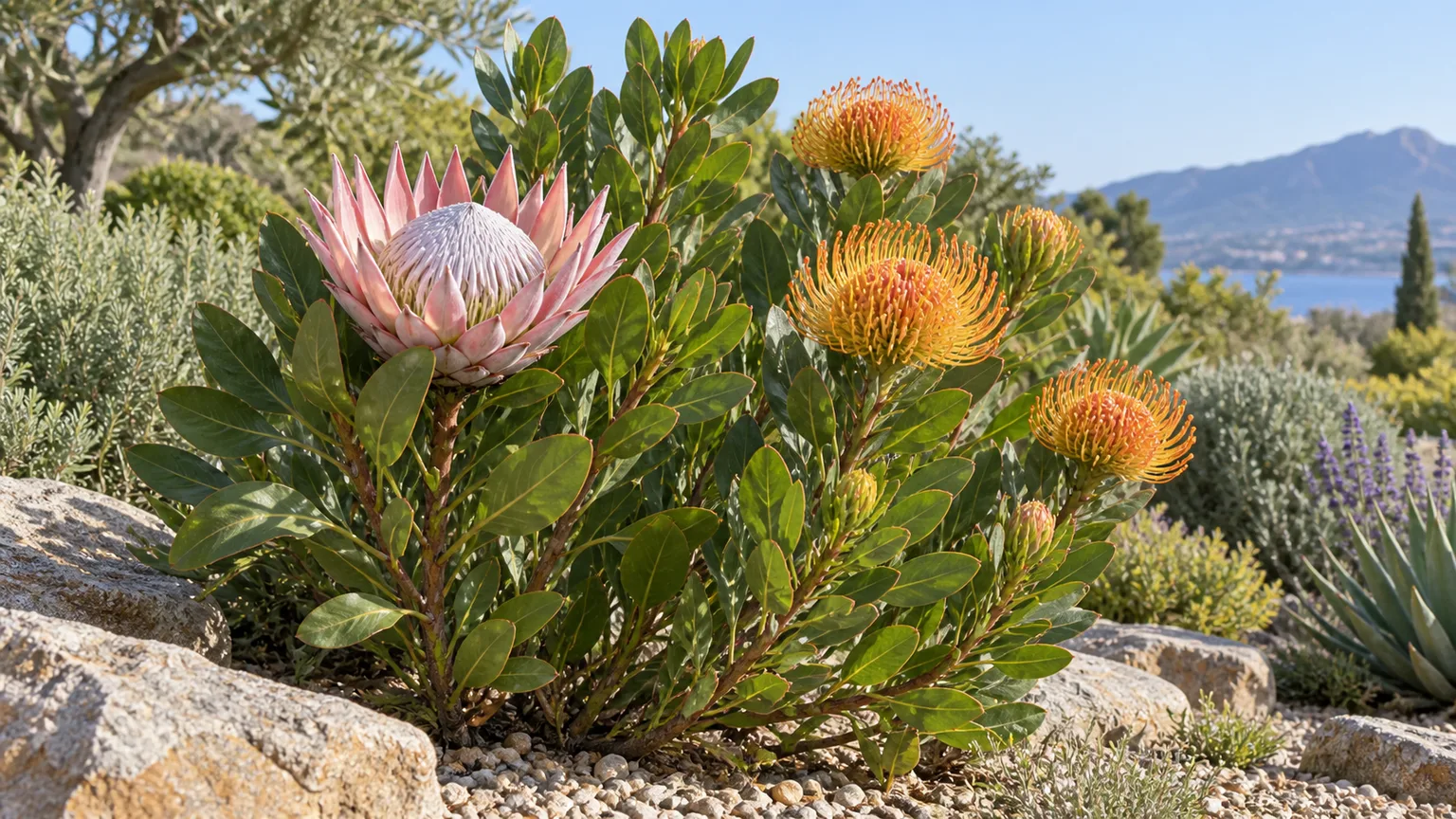
Buy a young, correctly labeled plant rather than starting with a florist stem or an unknown seed packet. Cut stems are for display, not reliable propagation, and proteas can be unforgiving when their roots are disturbed. Before you buy, look at the mature height and width, the coldest temperatures at your site, and how quickly water leaves the soil after rain.
Start With Climate and Light
Give a protea at least six hours of strong direct sun where possible, with open air movement around the foliage. Mild Mediterranean-type conditions—cooler, wetter winters and warmer, drier summers—are a natural fit, while prolonged humidity, waterlogged soil, or repeated hard freezes create a much harder growing problem. (Lawn.com.au: Protea growing conditions)
In a cold climate, a container can buy flexibility but does not turn protea into an easy houseplant. Move it before frost into the brightest protected space you have, reduce watering as light and growth fall, and acclimate it gradually when it returns outdoors. A warm room with weak light may keep the leaves alive while producing few or no flowerheads.
Get the Soil and Drainage Right
Drainage is the make-or-break decision. The RHS lists well-drained loam or sand and acidic-to-neutral conditions for king protea, and it notes that dieback or general failure can signal a rooting medium that is too rich. Avoid the instinct to improve the planting hole with a large dose of compost or manure; a rich, wet pocket around a drought-adapted root system can be worse than lean soil. (RHS king protea profile)
Test heavy clay rather than guessing. If water remains in the hole after a day, use a raised bed or a large container with an airy, coarse mix instead of hoping an amendment will permanently fix a perched water table. Choose a fertilizer labeled for low-phosphorus use if feeding is needed, and never apply a strong bloom booster just because the plant is not flowering.
When planting, disturb the root ball as little as possible. Set the top of the root ball level with or slightly above the surrounding soil, water deeply once to settle it, and keep mulch away from the stem. The objective is moisture around new roots without creating a constantly wet collar.
Water, Feed, and Prune With Restraint
Water a newly planted protea consistently while it establishes, allowing the surface to dry slightly between thorough soakings. Once the root system is established, the plant can tolerate dry periods, but drought tolerance is not the same as “never water”: heat, wind, a small container, and flowering can all increase demand.
Feed lightly, if at all. Proteas evolved in nutrient-poor soils, so lush soft growth is not automatically a sign of health, and high-phosphorus fertilizer can cause serious trouble. If foliage yellows or growth weakens, check drainage, root health, light, and the actual soil test before adding nutrients.
Prune after flowering to shape the plant and remove spent heads, leaving healthy green growth below each cut. Do not cut repeatedly into bare old wood and expect it to resprout, and do not remove half the plant in one enthusiastic session. Light tip pruning on young plants can encourage branching, but every cut should serve a clear size or structure goal.
The Mistakes That Ruin Proteas Fast
Most failures are a mismatch between ordinary flower-garden habits and protea biology:
| Common mistake | Better move |
|---|---|
| Adding rich compost, manure, or bloom booster | Start with lean, well-drained soil and test before feeding |
| Watering on a fixed weekly schedule | Check the root zone, then soak and let excess drain |
| Planting in a low spot that stays wet | Use a raised bed, slope, or container with an airy mix |
| Treating a container protea like a low-light houseplant | Give it the brightest light possible and expect fewer flowers indoors |
| Roughly teasing or washing the root ball | Transplant gently and keep the root system intact |
| Pruning all the way back after a weak season | Remove spent stems while preserving leafy, living growth |
| Buying by color without checking the plant name | Match the botanical name to your climate and mature size |
If leaves brown after a move, do not immediately add water or fertilizer. First check whether the plant was exposed to a sudden change in sun, whether the pot is staying wet, and whether the roots were damaged. A protea that is stressed by poor drainage may look thirsty even while its roots are unable to function.
Are Protea Flowers Safe Around Pets?
Do not assume that an unusual flower is either safe or poisonous based on internet shorthand. The ASPCA’s current protea page returns no specific plant entry in its searchable list, and the organization also cautions that eating any plant material can cause vomiting or gastrointestinal upset in dogs and cats. That is not a toxicity clearance for every protea species, cultivar, florist treatment, or bouquet companion. (ASPCA Poison Control: Protea)
For a pet household, keep protea arrangements and fallen leaves out of reach, and identify every other flower mixed into the vase. The companion flower may carry the more serious risk, and vase water can contain plant debris or preservatives. If a pet chews or swallows part of an arrangement, save the label or take a photo, then contact a veterinarian or an animal poison-control service rather than waiting for symptoms.
Around young children, use the same practical rule: ornamental flowers are for looking at, not tasting. Avoid placing a large arrangement where it can tip, and remove dry bracts and fallen foliage promptly so they do not become tempting loose pieces.
Conclusion: Buy the Bloom, Match the Plant to the Site
Protea has a credible claim to the next “It” flower because it solves several design problems at once: it is bold without needing many stems, textured without looking fussy, and durable enough to transition from fresh display to dried keepsake. King protea is the oversized focal point; pincushion protea brings warm, graphic texture; close relatives expand the palette when the exact species is unavailable.
For a bouquet, choose the head size and opening stage first, then build around its shape with restraint. For a living plant, reverse the order: choose the site first, and buy protea only if you can provide strong sun, sharp drainage, lean soil, and suitable winter protection. That is the difference between enjoying the trend and turning a dramatic flower into a preventable gardening disappointment.



