Alder Tree Types: Which One Fits Your Yard?
Need a tree for a damp yard? Compare alder species by mature size, climate, wildlife value, and spread, then check which one fits your region before planting.
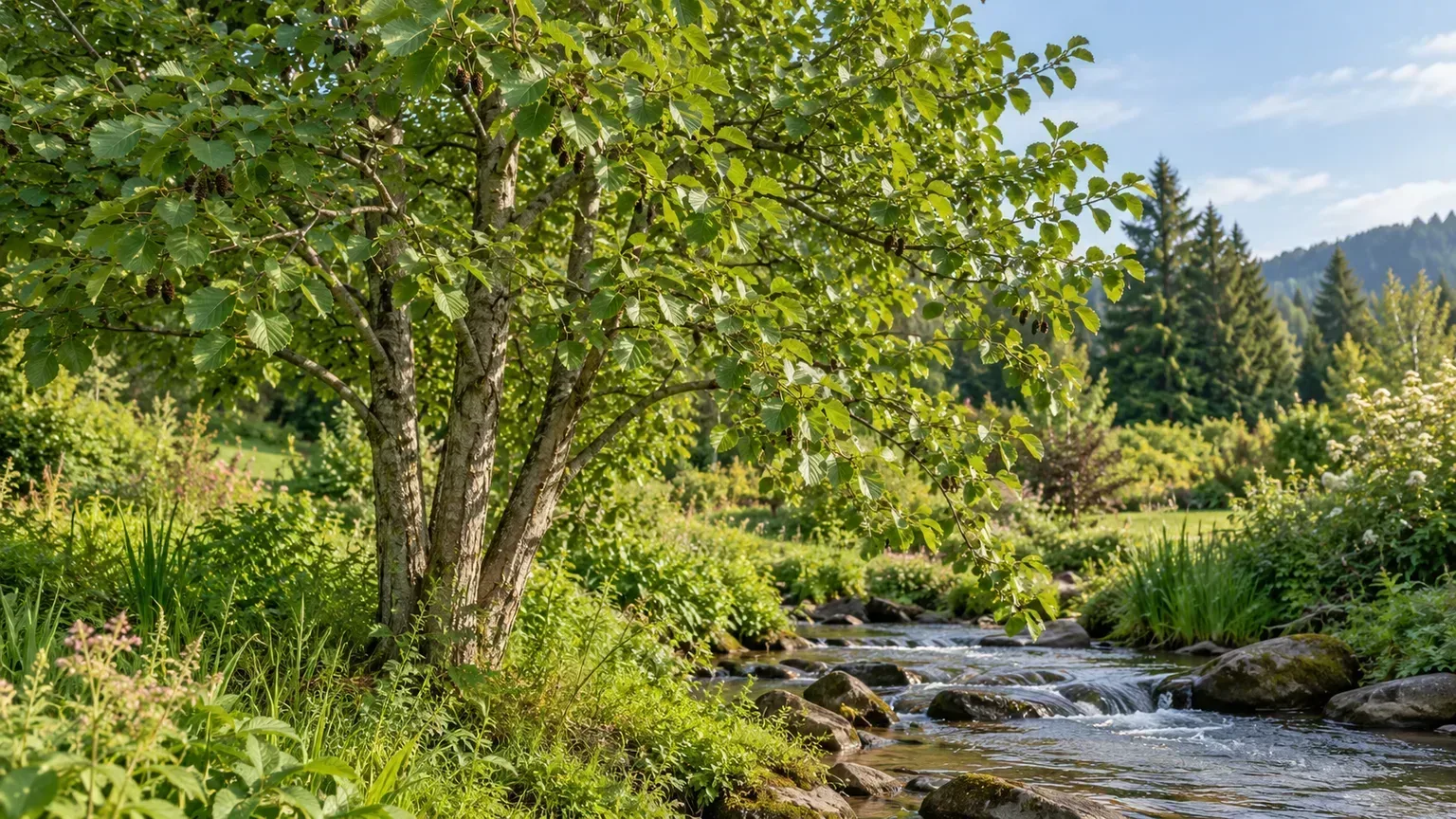
Alders can turn a persistently damp corner into shade, cover, and wildlife habitat, but the genus includes much more than one kind of waterside tree. Some species become large canopy trees; others remain shrubs, spread by suckers, or suit climates far from a typical North American yard.
The right choice starts with four checks: your region, the site’s moisture, the plant’s mature footprint, and whether that alder is native or prone to naturalizing locally. The 12 species below range from North American streambank natives to alder trees best considered in specialist collections.
Start with the job and the site
Use an alder where its strengths solve a real site problem: a wet edge, a wildlife planting, or a spacious naturalized area. A tree that thrives beside a creek may become a maintenance burden beside a driveway, patio, or small foundation bed. Before shopping, measure the open canopy space and decide whether you can accept catkins, woody seed structures, seasonal leaf drop, and possible suckers.
Then match the species to local climate and ecology. In much of the United States, the strongest starting point is a regionally native alder, such as red alder in the Pacific Northwest or hazel alder in the East. A nonnative species may be suitable in a managed landscape, but check your state’s invasive-plant list and local extension guidance; “tolerates wet ground” does not mean “appropriate everywhere.”
Alder labels can also vary. Green alder is often listed under the older name Alnus viridis, while current references may use A. alnobetula.
Gray alder and speckled alder names can refer to different subspecies or regional forms of A. incana. Confirm the scientific name and provenance on a nursery label instead of relying on a common name alone.
How to identify an alder
Look for a combination of traits, not one leaf. Alders are members of the birch family, Betulaceae. Their leaves are arranged alternately along the twig and are usually oval, toothed, and marked by straight side veins; shape and leaf-edge details vary among species.
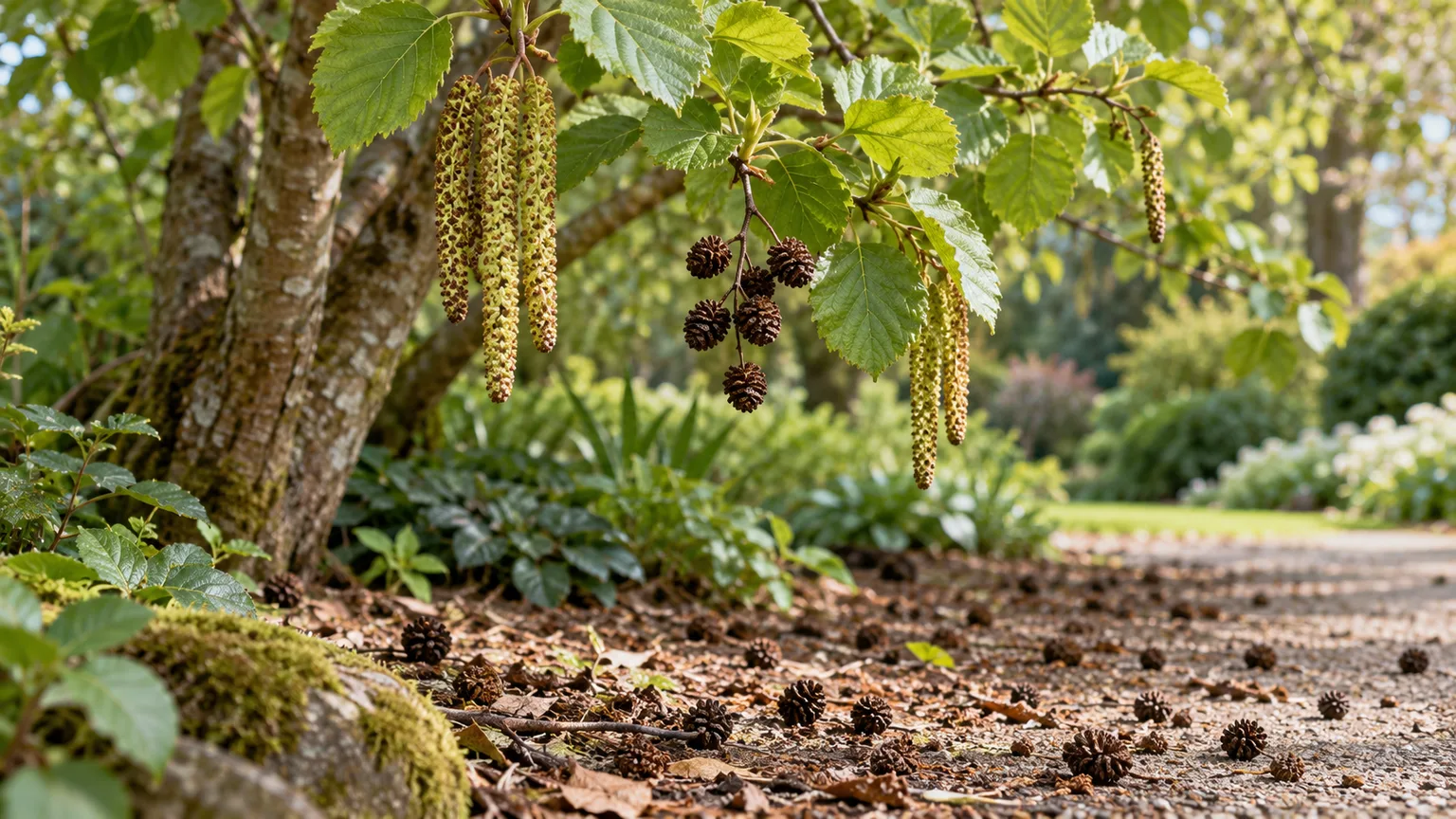
The most helpful winter clue is the small, woody structure often called an alder cone or strobile. It develops from a female catkin, but it is not a conifer cone.
Many stay attached after the seeds disperse, so a bare twig with persistent brown strobiles can point you toward Alnus. Male catkins are longer and hang in clusters; female catkins are smaller before they develop into strobiles. Oregon State University’s alder identification guide highlights the woody structures, alternate toothed leaves, and moist habitat as useful field marks.
LeafyPlace’s illustrated alder identification guide compares how leaf shape, bark, and strobiles vary among red, white, black, gray, green, and hazel alder. Use photographs as a cross-check with local range and the scientific name, not as a replacement for botanical identification.
Habitat helps, but it cannot make the identification by itself. Many alders favor streambanks, ponds, swamps, and wet forest edges, yet species differ in their tolerance of drier soils and in the climates they can handle. Bark ranges from pale gray or speckled to darkening, fissured bark on mature trees; unlike many birches, alder bark is not characteristically peeling in papery sheets.
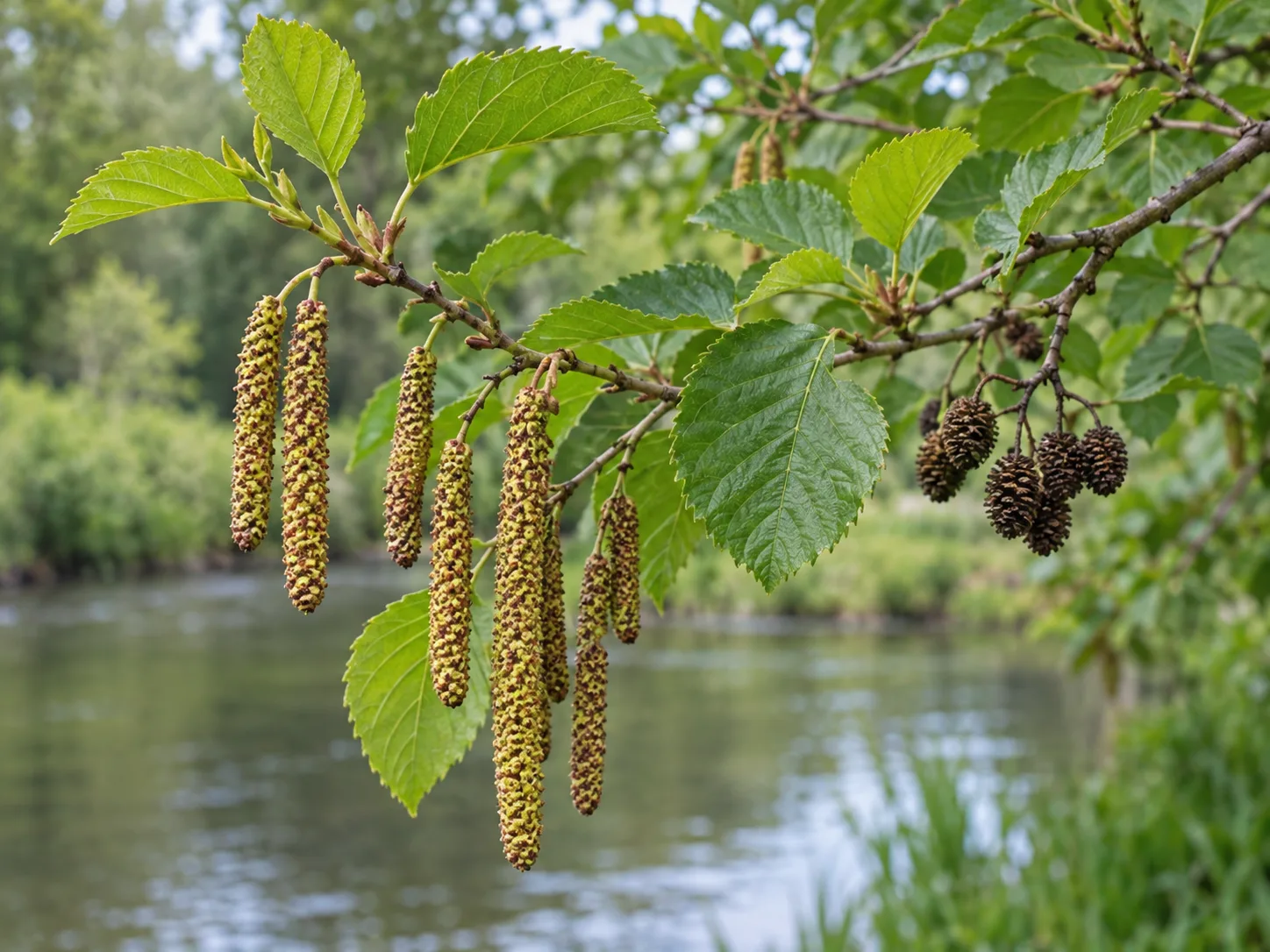
If you are identifying a tree outdoors, compare several clues: leaf arrangement and margins, winter strobiles, bark, overall form, and where the plant is growing. For a western alder, one especially useful distinction is that red alder leaf margins curl under, while white alder margins do not, according to Oregon State’s regional tree guide.
12 alder species and where they fit
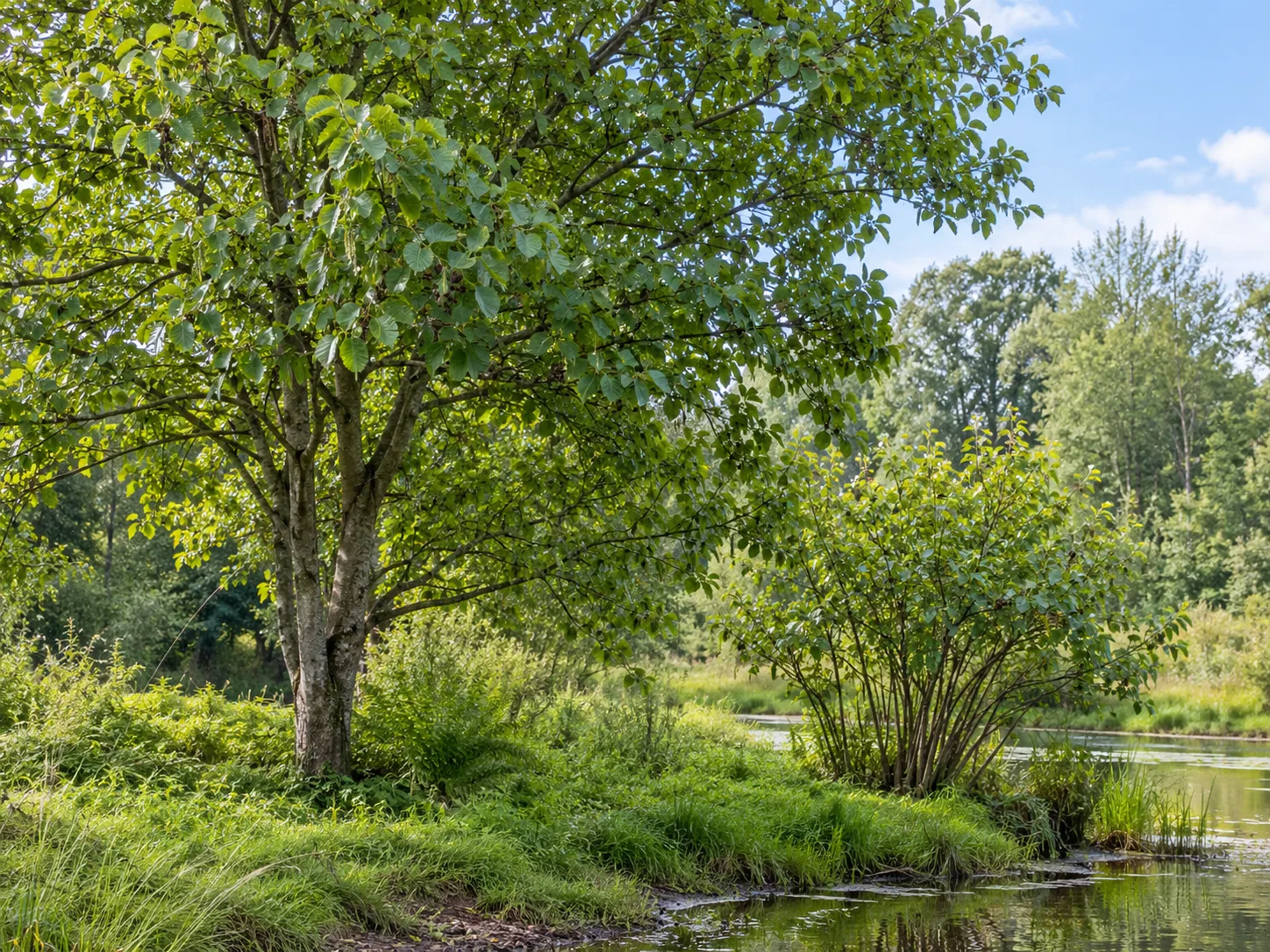
The table is a first-pass filter, not a planting prescription. Mature dimensions vary with climate and growing conditions, and some labels represent subspecies or older botanical names.
| Alder | Typical landscape role | What to check |
|---|---|---|
| Red | Large western native tree | Needs ample room |
| White | Large western streamside tree | Match it to a suitable regional site |
| Speckled or gray | Thicket or small tree | Regional form and suckering |
| Hazel | Moist-soil shrub or small tree | Can spread into a colony |
| Black or common | Medium to large European tree | Local naturalization status |
| Green | Cold-climate shrub or small tree | Often best in a naturalistic setting |
| Italian | Medium to large specimen | More adaptable soil, still needs room |
| Seaside | Small, unusual native tree | Protect local populations and provenance |
| Japanese | Asian tree for mild, moist climates | Confirm hardiness and availability |
| Mexican | Highland Central American tree | Match elevation and frost tolerance |
| Oriental | Eastern Mediterranean tree | Verify climate fit and species identity |
| Himalayan | Mountain-region tree | Large scale; suited to appropriate climates |
1. Red alder (Alnus rubra)
Red alder is the familiar fast-growing broadleaf tree of many Pacific Northwest stream corridors and recently disturbed sites. It can reach roughly 40 to 80 feet in a landscape, so it is better for a roomy lot, restoration planting, or naturalized creek edge than for a compact suburban yard. Oregon State notes that the rolled-under leaf edges help distinguish it from white alder.
Choose it when your climate and site match its western range and you want a canopy tree that establishes quickly. A small tree planted near a building does not stay small because the lot is wet; choose the final location based on full-grown height and spread.
2. White alder (Alnus rhombifolia)
White alder is a western North American tree associated with rivers and moist woodland. The pale gray bark and leaves without red alder’s rolled-under margins help separate the two when they grow in overlapping parts of the West. Horticultural references give variable mature dimensions, but this is not a miniature alder: allow room for a broad crown.
It suits a suitable regional site where the goal is shade and streamside cover. If you are choosing between red and white alder, use the leaf margins and local range as checks, then compare nursery-provided dimensions for the exact stock.
3. Speckled or gray alder (Alnus incana)
Gray alder is a species with regionally distinct forms across northern Europe and North America. In North American plantings, the name speckled alder often refers to the eastern A. incana subsp. rugosa, while western mountain forms may be called thinleaf alder. Their size and habit vary, so a single height estimate is not useful for every plant sold under “gray alder.”
Expect a smaller, often multi-stemmed shrub or tree for damp margins and cool regions rather than a formal, narrow street-tree shape. The bark’s pale, speckled appearance and toothed leaves can help with identification, but check the subspecies if mature size matters.
4. Hazel alder (Alnus serrulata)
Hazel alder, also called tag or smooth alder, is one of the more practical choices for a smaller wet site in eastern North America. NC State Extension’s profile describes it as a thicket-forming large shrub or small tree, about 10 to 15 feet tall and wide, for full sun to partial shade and moist to wet soil. It stabilizes stream, pond, and bog edges and supports wildlife.
Its spreading habit is the key trade-off. Give it space to become a naturalistic group, or plan to remove unwanted suckers; do not plant it where you expect a single tidy specimen to remain unchanged. NC State also notes deer browsing and possible canker, powdery mildew, and leaf problems, so “native” does not mean maintenance-free.
5. Black or common alder (Alnus glutinosa)
Black alder, also known as common or European alder, is native to Europe and parts of western Asia and northern Africa. It grows into a substantial tree with rounded, glossy leaves, reddish-brown catkins, and persistent egg-shaped strobiles. The University of Connecticut Plant Database gives a typical landscape range of about 40 to 60 feet tall and 20 to 40 feet wide.
Treat this as a species that needs a local check, not an automatic choice for a wet yard. UConn reports an invasive tendency in Connecticut, and NC State Extension’s black alder profile notes that the tree can form dense thickets and has spread aggressively in some states. Its cultivars, including narrow forms and dissected-leaf selections, do not remove the need to verify local status or mature size.
6. Green alder (Alnus alnobetula)
Green alder is usually a shrub or small tree of cool northern and mountain regions. It is often sold or described under the older name A. viridis; Oregon State University’s genus database lists A. alnobetula and its subspecies, making the label important when comparing plants.
This is a better candidate for a cold-climate naturalistic edge or slope than for a broad, formal canopy. Some forms spread into thickets, so check the expected width and whether suckering is welcome. Do not assume that every plant called green alder has the same height or habitat needs.
7. Italian alder (Alnus cordata)
Italian alder is native to southern Italy and Corsica. Its rounded, heart-shaped leaves are a distinctive feature, and it is noted in horticultural references for tolerating a broader range of soil conditions than many moisture-loving alders, including some relatively dry or alkaline sites once established.
That flexibility makes it a potential specimen tree where its climate tolerance and full mature size fit. It is not a compact substitute for a shrub: trees can reach several dozen feet, and a young plant’s narrow upright growth can disguise the eventual canopy. Confirm the cultivar and regional hardiness with a local nursery or extension service.
Harvest to Table’s alder growing guide also describes Italian alder as adaptable to varied soils. Treat that flexibility as a relative advantage within the genus, not proof that the tree will thrive in every climate or a restricted planting space.
8. Seaside alder (Alnus maritima)
Seaside alder is unusual because it blooms in late summer or fall, while many alders produce catkins before or around spring leaf-out. It is a small tree or shrub from a notably disjunct native range that includes parts of the Delmarva Peninsula, Georgia, and Oklahoma. The name can mislead: “seaside” does not mean it is a general-purpose salt-tolerant coastal tree.
This species is most compelling in a native planting or collection where its local provenance and habitat are understood. Because populations are geographically restricted, buy from a reputable nursery that propagates plants rather than collecting from wild stands, and do not assume it suits any yard near the ocean.
9. Japanese alder (Alnus japonica)
Japanese alder is native to Japan, Korea, and parts of China. It is generally a medium to large tree with relatively narrow, toothed leaves and an affinity for moist sites; descriptions of height and evergreen behavior vary by growing climate and reference.
Consider it only where a local nursery can confirm winter hardiness and mature dimensions for your region. A mild-climate plant’s semi-evergreen behavior should not be generalized to colder gardens, and “Asian alder” on a label is not specific enough to verify the species.
10. Mexican alder (Alnus jorullensis)
Mexican alder is associated with Mexico and Central American uplands, where climate and elevation can differ sharply from a hot lowland garden or a cold northern winter. It may be evergreen or semi-evergreen in mild conditions, but foliage retention depends on climate; it is not a dependable evergreen screen everywhere.
This is a specialist choice for a climate that resembles its highland origin. Use the scientific name on the label and ask about the seed source, because common names and botanical treatment can vary. Before planting outside its native region, check whether local authorities list it as invasive or recommend native alternatives.
11. Oriental alder (Alnus orientalis)
Oriental, or Syrian, alder comes from the eastern Mediterranean and nearby western Asian regions. Its wedge-based toothed leaves and tree form distinguish it from the smaller shrub-like alders, but published mature sizes vary with site and taxonomy.
It may suit a warm-temperate garden where the tree is available through a knowledgeable nursery. Treat “fast growing” as a reason to plan space, not an endorsement for small yards, and check heat, drought, and winter tolerance for your exact location instead of relying on a hardiness-zone number copied from a distant climate.
12. Himalayan alder (Alnus nitida)
Himalayan alder is native to the western Himalaya and adjoining parts of South Asia. It is a large tree associated with mountain environments and is grown in some regions for shade, soil stabilization, or timber. Those origins make it a poor generic recommendation for a cold northern courtyard or a low-elevation, hot site.
Choose it only if your climate, space, and local nursery expertise match the species. Its mature scale can be considerable, and the scientific name matters: another Himalayan alder, A. nepalensis, is a different species and may appear under the same broad regional common name.
Planting and establishing an alder
Plant an alder when the soil is workable and the weather is mild—often spring or fall in temperate climates—so roots have time to establish before heat or hard freezes. Set the root flare at soil level and make the planting hole no deeper than the root ball. Water thoroughly after planting, then keep the root zone evenly moist during establishment; wetland tolerance does not mean a newly planted tree can be left to dry out.
Choose the location before you dig. Allow for the listed mature height and width, overhead lines, paths, utility easements, and the natural spread of a multi-stemmed shrub. A streamside location should be stable and legally plantable; on a steep or actively eroding bank, use locally recommended native species and planting methods rather than assuming one tree will solve erosion.
Alders often need little supplemental fertilizer once established, especially where root nodules have formed with nitrogen-fixing bacteria. Still, nitrogen fixation is not a free fertilizer application to every neighboring plant. The amount and availability of nitrogen depend on species, site, root activity, and decomposition; do not skip a soil test or use alder leaves as proof that a vegetable bed has every nutrient it needs.
If you are growing common alder from seed, timing and moisture matter. The Conservation Volunteers’ alder seed-growing instructions recommend collecting partly browned cones as seeds begin to disperse, cold-moist pretreatment, a very thin covering, and steady moisture while seedlings emerge. Their method is specific to A. glutinosa and a temperate propagation calendar; use local guidance for a different species or climate.
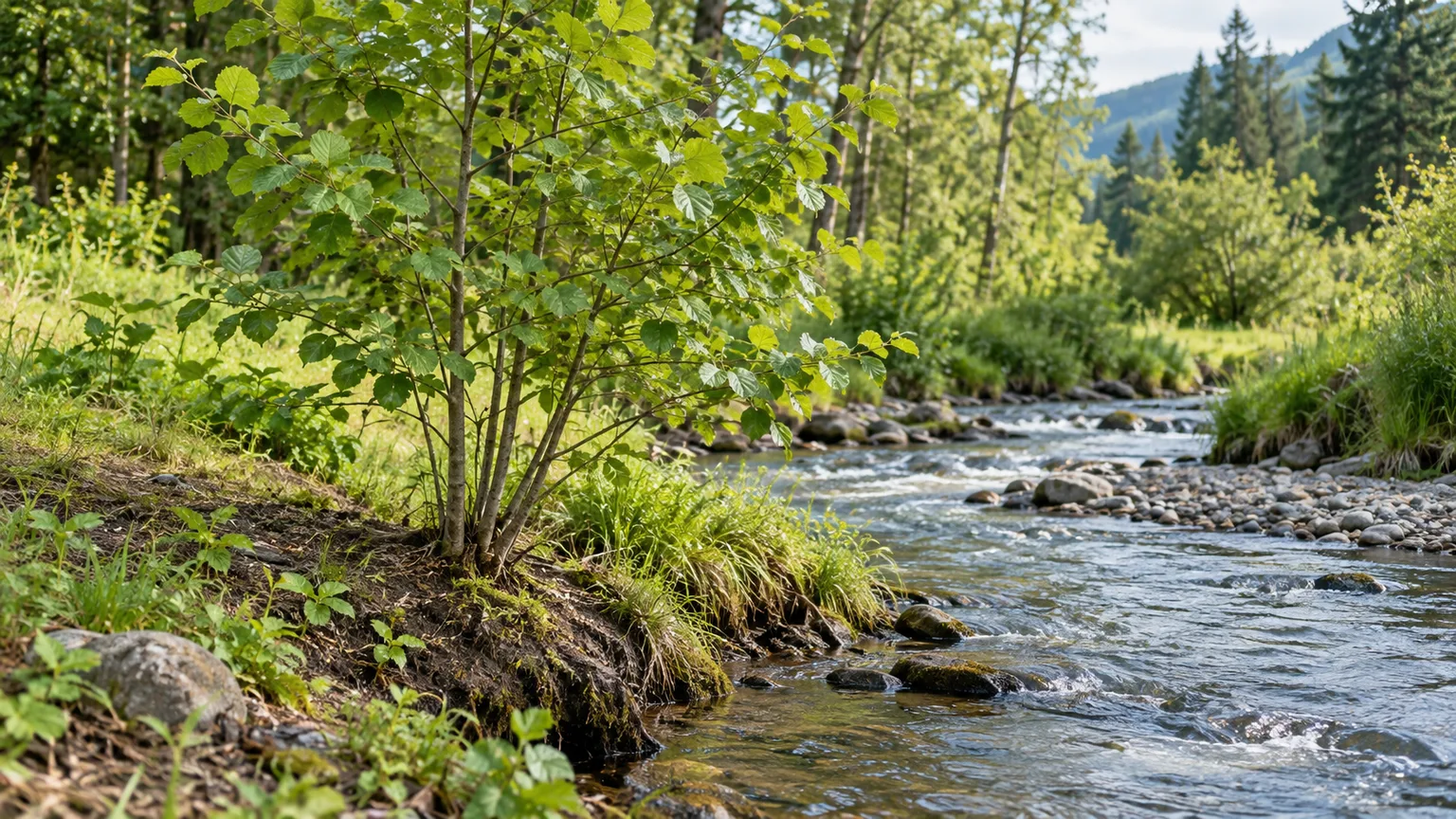
For a nursery-grown tree, do not use a fixed spacing borrowed from a forestry manual. A landscape tree’s spacing should reflect its mature crown and purpose. A single small specimen can be planted as a focal point; a thicket-forming shrub may work better as a loose group with room to fill in.
Manage the trade-offs before they become problems
The same traits that make alders useful in a wetland can complicate a small ornamental garden. Fast growth means a larger tree sooner, not a permanently small tree. Multi-stemmed and suckering types can widen into a colony; if you need a narrow, low-maintenance plant, choose a cultivar or another species whose mature form is naturally compact instead of planning to shear a large alder into shape.
Male catkins release pollen, and female catkins develop into woody strobiles that can persist on branches. Leaves may fall without dramatic autumn color, and a tree close to a patio or pond can leave debris in places where it is unwelcome. These are predictable maintenance costs, so consider them before choosing a high-traffic spot.
Local ecological fit deserves equal attention. Nonnative black alder is reported as invasive or aggressive in some U.S. jurisdictions, including Connecticut; its status is not identical everywhere.
Check your state or county invasive-plant resources and ask whether the species is recommended locally before you order it. Do not plant an alder that has been restricted or flagged in your region simply because a catalog lists a broad hardiness range.
Prune for structure while a young tree is small and easy to inspect. Remove crossing, damaged, or competing branches with clean cuts, and preserve a strong framework rather than repeatedly topping the crown. If a shrub-form alder is spreading beyond its intended area, remove suckers at their point of origin; cutting them repeatedly at soil level may not prevent regrowth.
What alder roots add to a landscape
Many alder species form a partnership with Frankia bacteria in root nodules. The bacteria fix atmospheric nitrogen into forms the plant can use, and the tree’s roots and leaf litter can contribute to soil development. Oregon State University’s alder genus overview describes this genus-level relationship, while the NC State Extension black alder profile notes that the tree may be used to improve poor soils and establish vegetation on cleared ground.
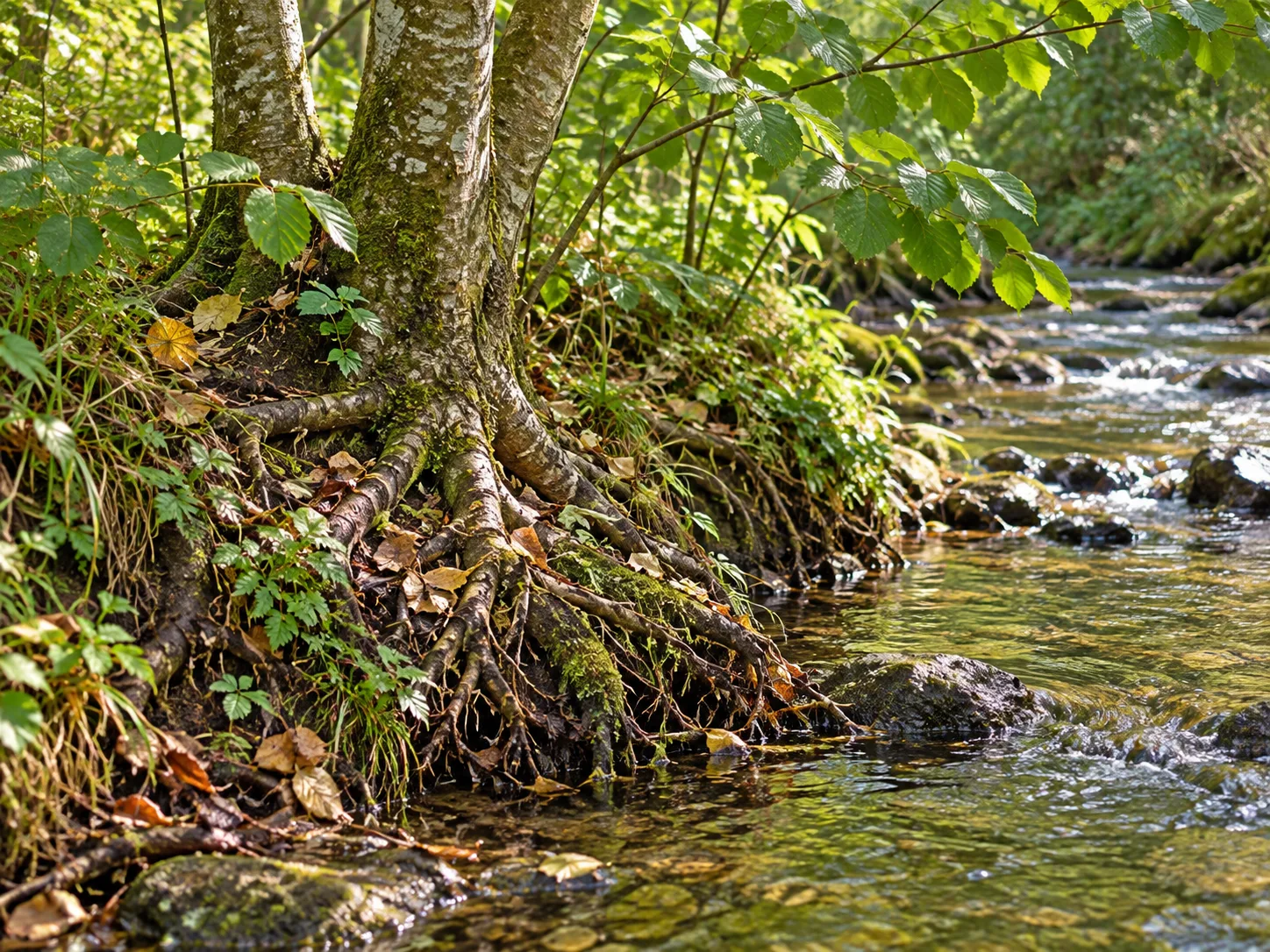
For gardeners, the useful takeaway is modest: alders can help occupy moist, low-fertility ground and provide cover, but they are not a quick soil amendment. Do not add an alder solely to fertilize a lawn or vegetable plot, and do not count its nitrogen as immediately available to nearby plants. Pair the tree with a site-appropriate planting plan, keep water needs in view, and manage its mature footprint.
Their habitat value can be a stronger reason to plant. Catkins provide pollen, persistent strobiles hold seeds, and a dense thicket can add cover along a wet edge. A locally native alder matched to its region can support that habitat role without importing a species whose spread needs ongoing control.
Conclusion
An alder can be a useful tree when the site is damp, the climate matches the species, and there is room for its real mature form. For many North American gardeners, a regionally native tree or shrub—such as red alder in the Northwest or hazel alder in the East—is a safer starting point than a distant species selected from a generic list.
Before buying, confirm the scientific name, local native or invasive status, mature height and width, and whether suckering is part of the plant’s habit. Then decide whether pollen, persistent seed structures, leaf drop, and wildlife cover fit the way you use the yard. That short check is what turns a wet-ground tolerant tree into a good garden choice.



