Are Joro Spiders Bad for Your Garden?
Joro spiders do not feed on plants, but their large webs can block paths and catch pollinators. Use this practical guide to decide what to do.
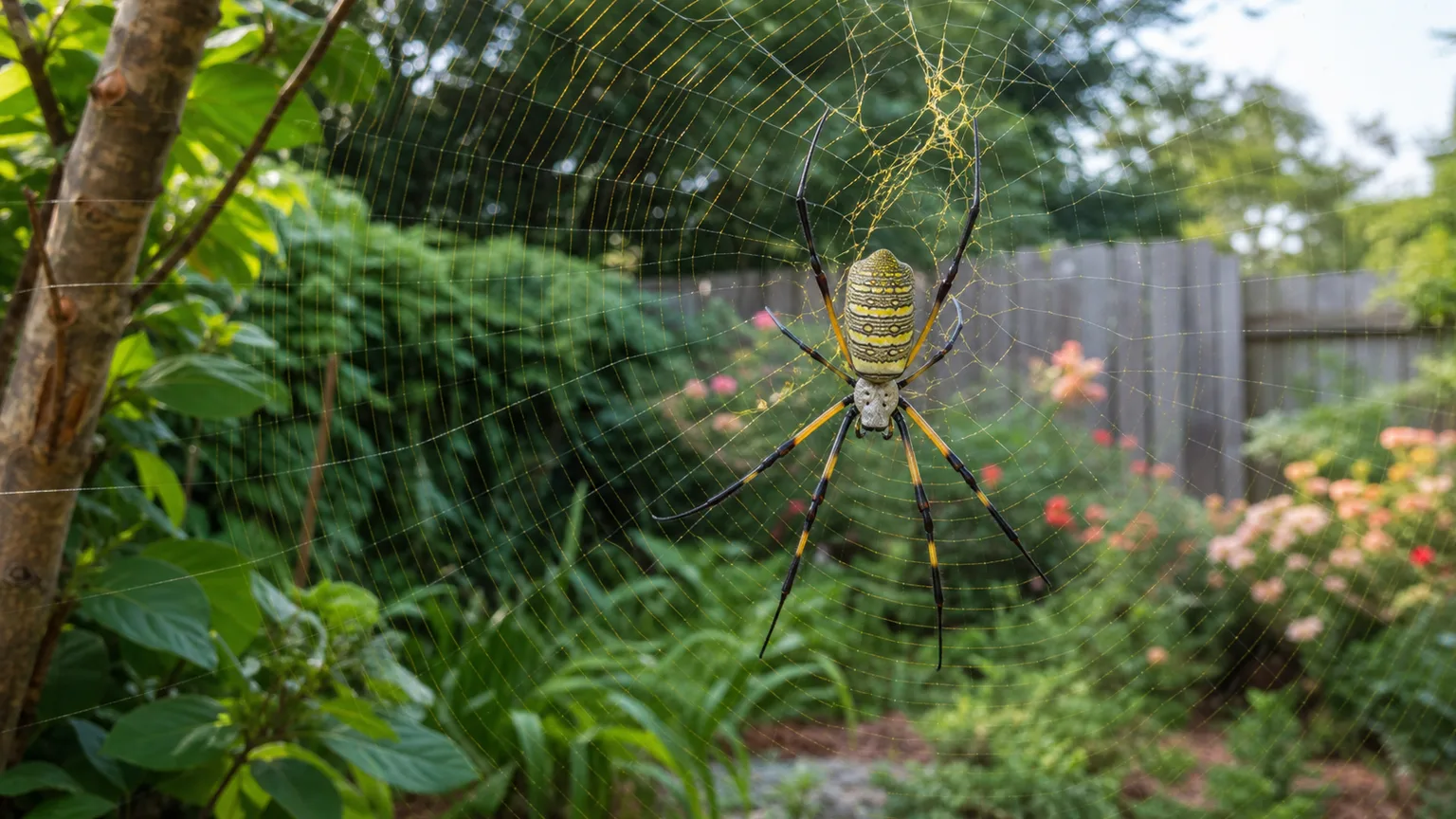
If you see a large, brightly marked Joro spider in the garden, the answer to the plant question is reassuring: Joro spiders do not eat garden plants. They are orb-weaving predators that catch insects and other arthropods in silk webs, so they do not chew leaves, suck sap, bore into stems, or spread a plant disease.
That does not make every Joro web welcome everywhere. A web stretched across a walkway can put a person face-first into sticky silk, and a web built beside a pollinator garden or bee hive can trap insects you want to protect. The species is also introduced, so its long-term effects on native spiders and insects are still being studied. Treat the spider as a location-specific management decision, not as a plant pest and not as an automatic emergency.
The short answer: Joros do not eat plants
Joro spiders are predators, not herbivores. Their relationship with a garden is indirect: they may catch plant-eating insects, but they also catch other flying insects that happen to hit the web. Penn State Extension describes them as introduced spiders whose environmental impact is not yet known, while noting that their large webs can become a nuisance around homes and frequently used spaces (Penn State Extension’s Jorō spider guide).
Use this quick rule when you find one:
- In a shrub border or high in a tree, away from traffic: leave it alone if the web is not interfering with a pollinator area or hive.
- Across a doorway, path, porch, deck, or window: remove the web and spider from the immediate space so people do not walk into it.
- Beside blooming plants or a bee hive: move or remove it, because a large web can intercept flying insects even though the spider is not attacking the plants.
- Near a vegetable or ornamental plant: do not remove the plant or treat the soil; decide based on the web’s position and the insects it may be catching.
This is a better threshold than “kill every non-native spider” or “never disturb any spider.” It protects the places where the web creates a real problem while leaving room for a predator that is not feeding on your crops.
What a Joro spider actually is
The Joro spider is Trichonephila clavata, a large orb-weaver native to parts of East Asia. The species was first documented in the United States in northeast Georgia in 2014, and Penn State’s updated range information lists established or expanding populations across northern Georgia and nearby parts of Alabama, North Carolina, South Carolina, and Tennessee, with an established population also reported around Elkridge, Maryland. A single sighting in a new state does not necessarily mean the species has established there (Penn State Extension’s current distribution notes).
The adult female is the spider most people notice. She has a body up to about 1 inch long, a leg span that can reach roughly 4 inches, silver or gold hairs on the front section of the body, yellow and blue-gray bands on the abdomen, and red, yellow, and black patterning underneath. Adult males are much smaller and dull brown, so a cluster of tiny brown spiders in a female’s web may be males rather than a different species.
Joro webs are another strong clue. Mature females build large, golden or yellowish webs that can span many feet between trees, shrubs, posts, fences, or other supports. University of Georgia Extension notes that support strands may stretch far beyond the main web, which explains why a web can seem to appear across a yard overnight (UGA Extension’s landscape management circular).
Why people call them parachuting spiders
Adult Joro spiders do not fly. The “parachuting” or “flying” nickname refers to young spiderlings that release silk threads and let wind carry them through the process called ballooning. Under the right conditions, spiderlings can travel tens or even hundreds of miles, while storms and accidental transport on vehicles or plant material can help move them farther than ordinary crawling would allow.
The distinction matters because a gardener who sees silk drifting in the air is not watching a giant adult spider attack the yard. The airborne stage is a dispersal strategy of tiny spiderlings. Once mature, the females settle into webs supported by nearby vegetation or structures.
How to identify a Joro in the yard
Size alone is not enough. Several native or long-established orb-weavers are also large, colorful, and common in late summer, and a blurry photograph of a web can make an ordinary garden spider look like a Joro.
Start with the combination of the spider, the web, and the location. A mature female Joro is strongly yellow, blue-gray, black, and red; her web is often golden and lacks the bold zigzag pattern called a stabilimentum that is common in black and yellow garden spiders. A web without a zigzag is not proof of a Joro, but a zigzag web is a useful reason to slow down before declaring a sighting.
Female and male appearance
The female’s abdomen is elongated and cylindrical rather than short and rounded. Look for yellow and blue-gray bands across the top, black-and-yellow banded legs, and the red marking visible on the underside. She may sit motionless in the center of a strong web, especially when disturbed.
The male is much easier to miss. He is smaller, slender, and brown, with a body around a third of an inch long. If the web is large but the spider is tiny and brown, do not use the male’s appearance to rule out a Joro; check the web and look for a larger female nearby.
Joro vs. similar garden spiders
The black and yellow garden spider, Argiope aurantia, is a common look-alike across much of North America. It also has a large female, silver hairs, and an eye-catching web, but it is generally smaller in leg span and often incorporates a conspicuous zigzag stabilimentum. The banded garden spider, Argiope trifasciata, is another possible match.
The golden silk orb-weaver, Trichonephila clavipes, is a closer relative found in the Southeast. Penn State Extension describes its female as having a more orange-to-tan abdomen with yellow spots and distinctive fuzzy leg tufts, rather than the Joro’s blue-gray bands and red underside. If identification matters for a report, photograph the spider from above and below without handling it, and include the full web and supports in a second image.
Where and when you are most likely to see them
Joros favor open, sunny spaces where a web can be suspended between two or more supports. In a home landscape, that can mean the gap between a tree and a fence, the edge of a shrub bed, a porch post, a light or utility line, or the space above a garden path. The web may be more visible in early morning when dew outlines its strands.
The seasonal pattern is more useful than a calendar date. UGA Extension reports that eggs overwinter in silk-covered masses, spiderlings emerge in spring, and the spiders grow through summer before females become especially recognizable in late summer and fall. In temperate areas, there is one generation per year; the exact appearance dates vary with temperature and latitude.
Egg sacs, spiderlings, and one generation
Adult females place egg sacs on leaves, bark, or structures in fall. Sources describe egg masses ranging from several hundred to more than 1,000 eggs, while Penn State reports a single sac commonly containing roughly 400 to 500 eggs. The numbers differ because egg production varies and field observations are not identical; the practical point is that one adult can leave a substantial next generation.
When the young emerge, they are small and much less colorful than the adult female. They may disperse by ballooning before settling into the vegetation. Later in the season, the female’s bright colors and larger web make identification easier, but they also make the spider more likely to be noticed by people who never saw the early life stages.
What Joros catch in their webs
A Joro web is a passive insect trap, not a feeding structure attached to a plant. The spider waits for prey to hit the silk, then bites and consumes the trapped animal. Common prey can include moths, grasshoppers, beetles, stink bugs, and other insects; what gets caught depends on the web’s size, height, position, and the insects moving through that particular part of the yard.
That can be useful when the prey is a plant-eating insect, but it is not a targeted pest-control service. A web cannot tell the difference between a leaf-chewing beetle and a bee flying to a flower. Joros are predators, but “predator” does not mean “beneficial in every location” or “safe to encourage beside every bloom.”
The real garden concerns are web placement and ecology
The immediate concern is usually where the web is built, not what the spider is doing to the plant. A strong web over a narrow path can be a daily nuisance. A web against a window, door, or porch light can collect insects and silk where people need to pass. A web between flowering plants can interrupt the flight path of pollinators even if the plant itself remains untouched.
The longer-term concern is harder to answer. Joros are an introduced predator, and researchers do not yet know whether their numbers will alter native spider communities, reduce insect biomass enough to matter, or compete meaningfully with native web-builders. Penn State Extension specifically describes these effects as unresolved rather than claiming that Joros are either harmless to ecosystems or certain to cause major damage.
When a web can interfere with pollinators
Bees, butterflies, moths, and other flying insects can become prey if they strike a web. That does not mean every Joro web is a threat to a pollinator garden; web height, placement, density of flowers, time of day, and local insect activity all change the chance of an encounter.
Use a lower tolerance for webs directly across a flower bed, beside a hive, or between the main approach to a flowering plant and its support structure. UGA Extension recommends not allowing Joro webs to remain around pollinator or flower gardens and bee hives, while leaving higher webs or webs in less-used shrubbery can be reasonable when they are not in the way. The goal is targeted management, not broad pesticide use.
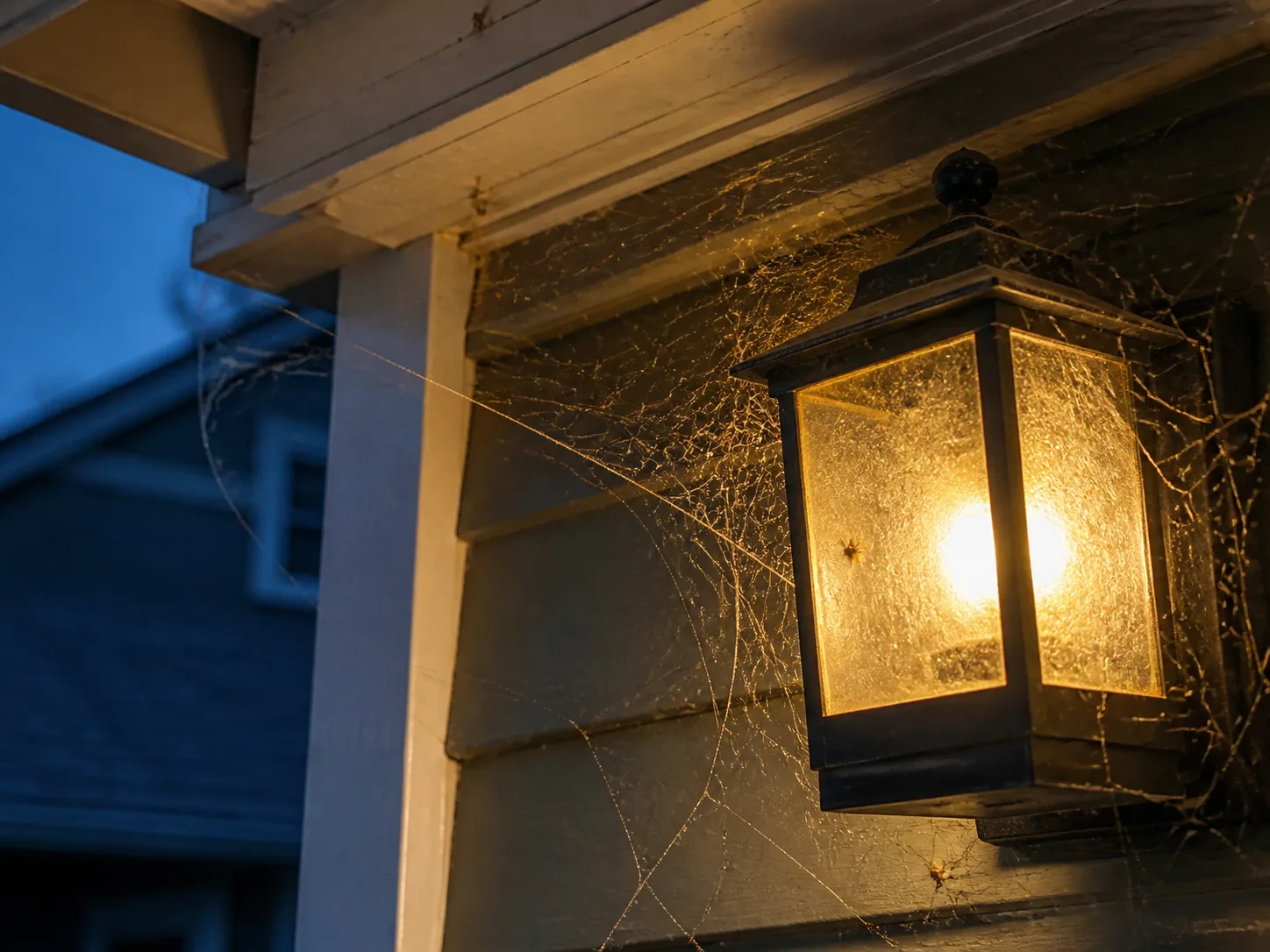
A web beside a light or doorway deserves a different response from one high in a tree: manage the placement, not the plant.
What researchers still do not know
The word “invasive” describes a non-native species that spreads and may cause harm; it does not tell you exactly how much harm has occurred in your yard. Joro spiders have persisted and expanded in parts of the Southeast, but the ecological effects of their new range require time, repeated observations, and comparisons with native spider and insect communities.
That uncertainty is a reason to document sightings and avoid unnecessary movement of egg sacs, not a reason to panic. Joro Watch, a monitoring program supported by the University of Georgia and partner institutions, collects reports and photographs to improve knowledge of the species’ distribution (Joro Watch’s reporting and distribution program).
A simple decision rule for any Joro web
Before reaching for a spray or a broom, ask four questions:
- Is the web touching a place people must use? If it crosses a path, doorway, porch, deck, or window, remove it from that space.
- Is it beside a pollinator garden or bee hive? If yes, use a lower threshold for removal or relocation because flying insects may enter the web.
- Is it high, peripheral, and out of the way? If yes, leaving it alone is usually the least disruptive option.
- Are you certain it is a Joro? If no, photograph it first. A native garden spider may be doing the same kind of pest-catching work, and indiscriminate killing makes identification impossible.
This rule also prevents a common overreaction: removing a web in a remote shrub border and then fogging the entire yard. The web may rebuild, but a broad spray can affect many more organisms than the one spider you noticed.
How to move or remove a problem web
For a web at shoulder height or below, work from the side rather than walking straight into it. Wear glasses if the web is thick, keep children and pets away while you work, and use a broom, rake, or long-handled brush to gather the web and spider together. A short, deliberate removal is safer than repeated swatting that scatters the spider and leaves silk on the path.
If you want to relocate the spider instead of kill it, move it a good distance from the traffic area and from the flowering bed. A nearby shrub may not be far enough; UGA Extension notes that a moved spider can return if it is placed too close to the original problem. Do not handle a large spider with bare hands simply to prove that it is timid.
After removing the web, inspect the supports. If the same gap remains attractive, a branch, string of lights, fence wire, or overhanging plant may be giving the spider an easy anchor. Adjusting the support or changing a light that attracts night-flying insects can reduce repeat web construction more reliably than knocking down the same web each morning.

Clear the walking route and check the supports after removing a web so the same obstruction does not return overnight.
When to leave the long-handled tool down
Do not reach above your head under a roof edge or into a tree canopy to chase a spider. UGA Extension recommends concentrating on webs in places people use and leaving webs more than about 10 feet up alone when they are not near a sensitive location. The risk of pulling a spider or debris onto yourself rises as the web gets higher, while the benefit of removing a remote web usually falls.
If the web is attached to electrical equipment, a roof, a high branch, or a structure that requires a ladder, hire a professional or leave it in place. Never climb while holding a rake, spray can, or broom. A high web is not a good reason to trade a minor garden nuisance for a fall.
Why broad spraying is the wrong first move
A pesticide can kill a Joro if it contacts the spider, but spraying an entire yard is a blunt response to a web that may be confined to one doorway. UGA Extension warns that area-wide sprays and fogging can kill pollinators, beneficial predators, and beneficial parasites, and may allow some pests to increase after natural enemies are removed.
If a pesticide is genuinely necessary, choose a product whose label allows the intended site and pest, follow the label’s protective-equipment and reentry directions, and avoid blooming plants and active pollinator traffic. Do not copy a concentration from an old article or assume that a product labeled for one outdoor use is legal on flowers, vegetables, hives, or structures. For one accessible web, physical removal is usually the more proportionate first step.
Planting mint, sage, citronella, or other plants marketed as spider repellents is also not a dependable answer to a Joro web. These plants may be useful for other garden reasons, but a web-building spider chooses a place based on supports, prey movement, shelter, and weather—not on a simple scent barrier. Correct the web’s location and monitor before redesigning the bed around a repellent claim.
How to report a suspected Joro
If the spider is new to your area or you want a reliable identification, take clear photographs instead of collecting it. Capture the top of the female, the underside if you can do so without handling her, and the full web with its attachment points. Add the date, county or nearest town, and the habitat; a photo of a golden web alone may not be enough to separate a Joro from a native orb-weaver.
Submit the record through Joro Watch or the linked EDDMapS reporting system. In North Carolina, NC State Extension also recommends contacting the county Cooperative Extension center or the Plant Disease and Insect Clinic for help with a suspected sighting (NC State’s Joro spider facts). Avoid transporting a live spider, web, or egg sac to another county to “see what happens”; accidental human movement is one way introduced species can reach new places.
Conclusion
Joro spiders are not bad for your garden in the simplest plant-care sense: they do not feed on leaves, flowers, roots, or fruit. Their webs can still be a problem when they cross paths, doorways, porches, pollinator beds, or bee hives, and their possible effects on native ecosystems are not settled.
Leave an out-of-the-way web alone when it is high and harmless, remove a web that interferes with people or pollinators, and skip the broad spray unless a specific, labeled need remains after physical management. When identification matters, photograph the spider and report it through Joro Watch. That approach protects your plants, reduces unnecessary pesticide exposure, and treats a striking newcomer with the amount of caution the evidence actually supports.