33 Garden Fence Ideas for Every Style and Budget
Find garden fence ideas for flower beds, vegetables, privacy, and curb appeal, with practical notes on materials, gates, animal barriers, and maintenance.
A garden fence can mark a flower bed, keep a dog out of young plants, block a neighbor’s view, or protect vegetables from wildlife. Those jobs overlap sometimes, but no single fence style handles all of them equally well. A low picket border looks welcoming; it will not stop a rabbit, and it certainly will not exclude a deer.
Use the ideas below as a design menu, then choose by purpose. Check the fence’s height, openings, bottom edge, gate, and upkeep before settling on its color or trim. A pretty fence that misses its main job becomes an expensive garden ornament.
Match the fence to the job
Start by writing down the one result you most need. If you want a clean edge around perennials, a low fence or short wall may be enough. If you are enclosing a vegetable garden, ask which animals are actually entering and how they get in; deer jump, rabbits squeeze through gaps and dig, and a gate left ajar can undo the rest of the installation.
| Main job | Fence direction | Check before you buy |
|---|---|---|
| Define a bed or path | Low picket, woven branch, stone, or metal edging | Will it be visible without blocking plants or mowing? |
| Keep rabbits out | Small-aperture mesh with a secure lower edge | Are openings, corners, and gates closed to ground level? |
| Reduce deer browsing | A tall, sturdy enclosure or a site-appropriate exclusion design | Can you manage an eight-foot barrier and a secure gate? |
| Add privacy | Close-set boards, panels, or a layered screen | Will the solid surface catch wind or shade nearby beds? |
| Support climbing plants | Wire, lattice, or a separate trellis | Can the fence carry plant weight and stay accessible for pruning? |
The styles that follow can be mixed. For example, a simple mesh enclosure can do the protective work while a handsome picket panel at the entrance gives the garden character. Separating the working barrier from the decorative detail often makes a yard easier to use and less costly to build.
Cottage and classic garden fences
Traditional profiles work especially well where the fence should frame planting rather than dominate it. Their value is often visual: they create a threshold, repeat the lines of the house, or make a loose cottage border look intentional. Unless the boards or mesh are close-set and tall enough, treat these as decorative boundaries rather than animal barriers.
Pickets and cottage profiles
1. White picket fence. The familiar white picket suits front gardens, cottage beds, and homes with traditional trim. Use a modest height and spacing that feels in scale with the house; a tall perimeter of pickets can look more suburban than garden-like. Wood needs periodic attention, while vinyl avoids painting but has a more manufactured finish.
2. Low picket edging around a flower bed. A short run of pickets gives a curved bed a clear outline without enclosing the whole yard. Keep the profile low enough that the flowers still read as the main event, and leave room to edge the lawn or reach in to weed. It is a visual cue, not a dependable barrier for hungry wildlife.
3. Scalloped-top pickets. A gentle dip between posts softens a straight line and adds a small design detail without introducing another material. This works best in short runs around an entry bed or path. Repeating the scallop across a huge fence can feel busy, so use it where people see it up close.
4. Board-and-batten farmhouse fence. Narrow battens over vertical boards make a fence read as an architectural backdrop. Paint it to echo a shed or house trim, then soften the plane with a border planting. Solid boards bring privacy, but they also cut views and create a larger wind-catching surface than open pickets.
Open rails, natural wood, and entrances
5. Split-rail fence. Two or three rough rails set a relaxed boundary for a meadow-style yard, orchard, or broad perennial border. It preserves long views and uses a light visual hand, but the open rails do not contain pets or exclude rabbits. Add mesh behind it only if wildlife protection matters, and choose a mesh finish that does not make the fence look cluttered.
6. Crisscross or X-braced fence. A timber X pattern adds cottage character and makes a low divider feel crafted. It is useful between a patio and planting area where you want separation but not a wall. The open pattern is easy to see through and easy for small animals to pass, so add a proper barrier if exclusion is part of the brief.
7. Weathered reclaimed-wood fence. Salvaged boards can give a new garden an established, relaxed look. Use sound, straight boards with known treatment history; skip wood that is rotten, contaminated, or coated in an unknown chemical. Varying board widths can look intentional when you repeat a simple rhythm rather than making every bay different.
8. Arbor gate in a low boundary. A simple arbor makes a vegetable or cutting garden entrance feel like a destination. Let the gate be wide enough for a wheelbarrow and make sure the arbor’s posts are independent of a lightweight fence panel. A climbing plant can soften the entry, but leave hinges and the latch clear so growth does not make the gate difficult to operate.
Modern and privacy-focused styles
Modern fences use proportion, spacing, and contrast as their decoration. A dark or close-board fence can visually recede behind planting, while a screen panel can become a focal point. Think about the view from both sides: the garden-facing finish, the neighbor-facing finish, and what the solid surface will do to light and airflow.
Lines and open metalwork
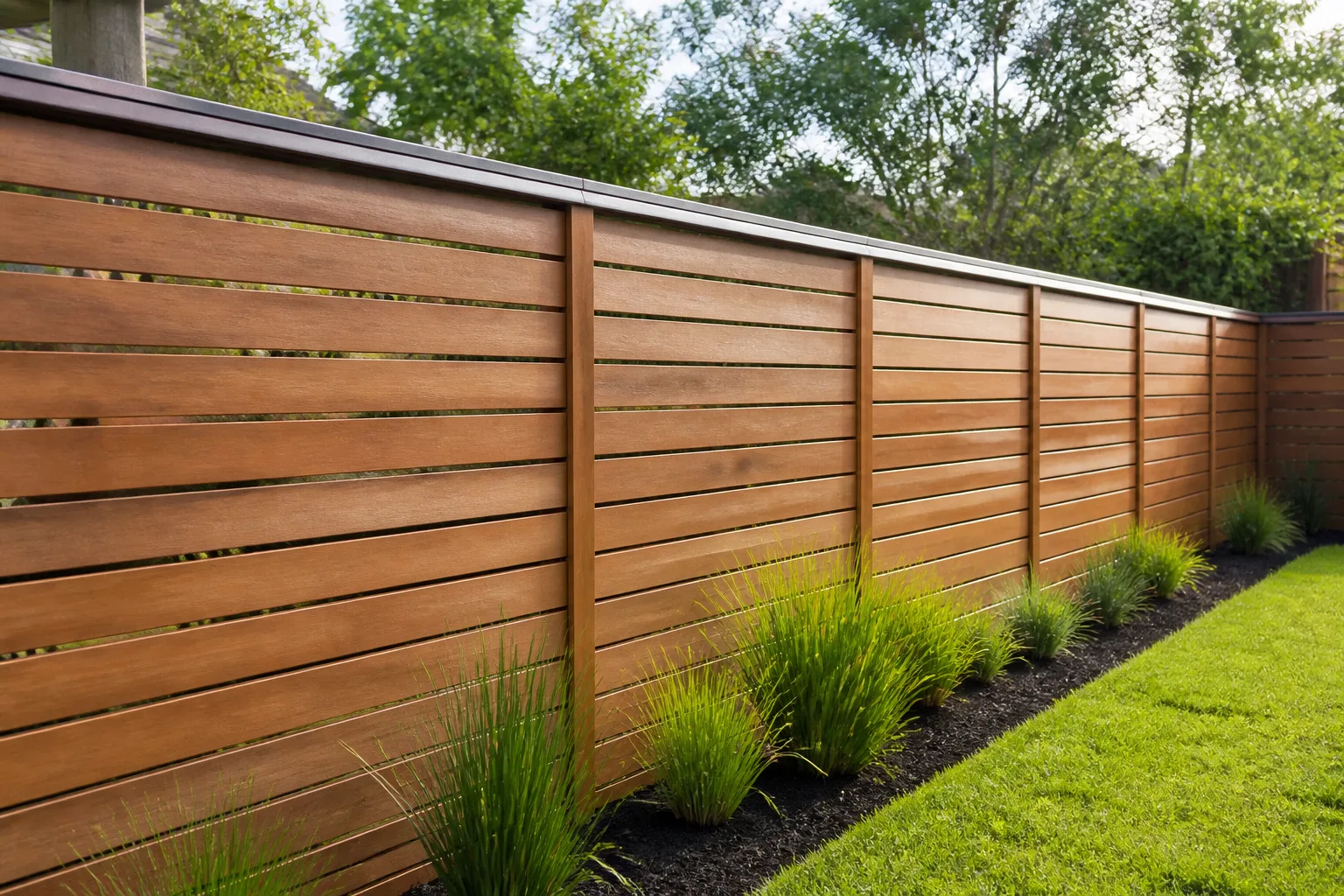
9. Horizontal cedar or stained-wood slats. Long lines make a compact patio feel wider and bring a calm, contemporary look. Narrow gaps keep some air and light moving; tight boards offer more privacy but look heavier and catch more wind. Leave space between the boards and soil so splash-back and damp planting do not keep the wood wet.
10. Geometric slat pattern. Alternate the direction or spacing of a few boards to create a focal bay without paying for a full run of custom panels. Keep the pattern simple and repeat it at gates or seating areas. A decorative panel should not compromise the fence’s posts or rails, which carry the structural load.
11. Black metal mesh panels. Dark mesh almost disappears from a distance, giving a garden boundary without hiding flowers or the view beyond. It suits contemporary beds and can be paired with warm wood posts for contrast. Check the opening size against your actual pest problem: “mesh” alone does not tell you whether it will stop rabbits.
12. Ornamental iron with restrained finials. Metal pickets give a formal border while preserving sightlines across a front garden. Choose a simple profile if the house has quiet architecture; ornate caps can complement a more decorative façade. Measure the gaps at ground level and around the gate if children, dogs, or small animals need to stay on one side.
Screens and architectural accents
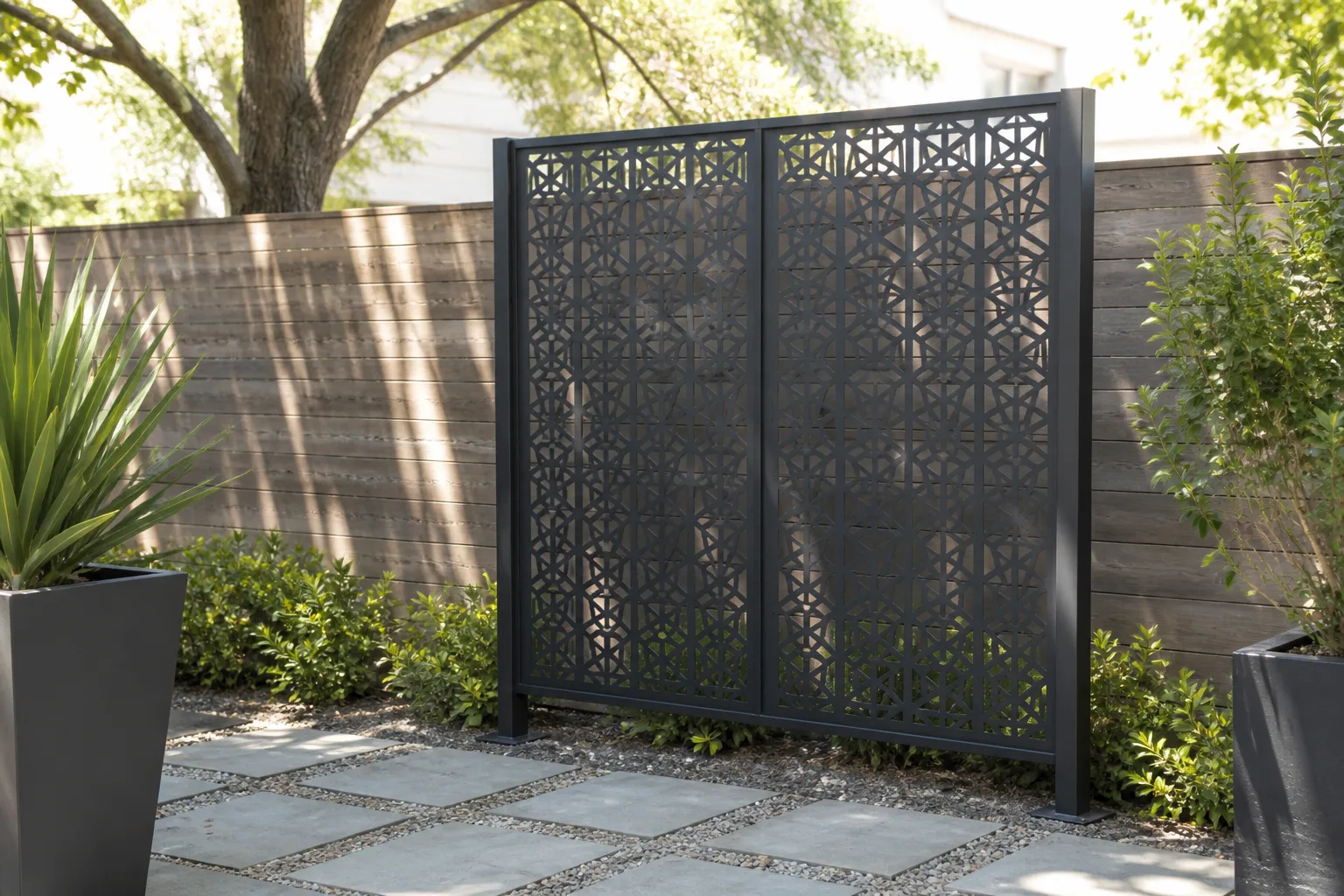
13. Laser-cut screen panel. A patterned panel adds privacy and shadow play without requiring every fence bay to be solid. Put one or two panels near a dining area or entrance, where the detail can be appreciated. A small accent screen may cost less and look more considered than covering the whole boundary in decorative metal.
14. Brick piers with metal infill. Masonry posts lend weight at an entry, while slim metal panels keep the boundary visually open. This combination can echo brick or stone already used on a house. It needs a sound base and careful layout, so treat it as a planned landscape feature rather than a quick weekend substitute for lightweight garden fencing.
15. Low stone wall with a metal topper. A short wall gives a crisp edge to a sloping or formal bed; open metal above adds height without making the wall feel massive. Do not assume a decorative garden wall can retain soil. If it must hold back a grade, drainage and structural design matter as much as its finish.
16. Lattice-topped privacy fence. A solid lower panel blocks seated views while an open lattice top lets in more light and gives climbers somewhere to go. This can make a patio boundary feel less monolithic than a wall of boards. Place the lattice where vines can be maintained from either side, and avoid using it as a substitute for a tall animal-exclusion fence.
Fences for beds, pets, and wildlife
Animal barriers work when height, openings, ground contact, and gates fit the animal. Cornell Cooperative Extension notes that deer tastes vary, and recommends planning on a fence for vegetable protection; its guidance gives a minimum height of 8 feet for a wire boundary deer fence. That is a very different design brief from a low flower-bed border. (Cornell Cooperative Extension)
Wire mesh and deer strategies
17. Wood frame with welded-wire infill. This is a versatile choice for a vegetable patch: the frame gives the enclosure a finished outline while open wire preserves light and airflow. Select mesh openings for the smallest animal you need to exclude, and secure the lower edge. A wire fence will not look invisible at close range, but planting on the outside can soften it without concealing gaps.
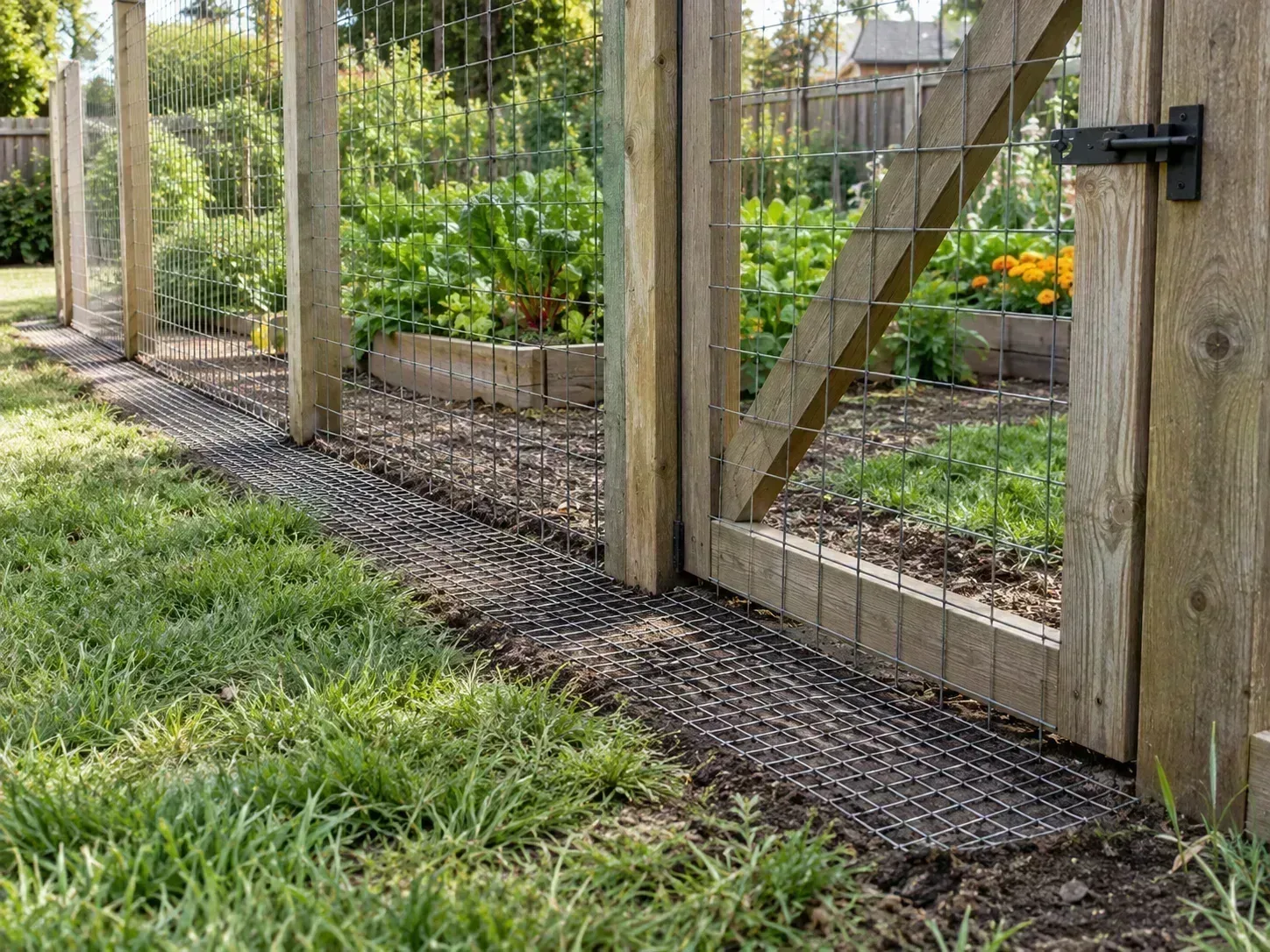
18. Rabbit fence with a ground apron. Use small-opening galvanized mesh along the lower portion of the enclosure, then turn the bottom outward along the ground or bury it where digging is likely. The key is continuity: connect corners, seams, and the gate threshold instead of leaving a neat-looking gap at the most vulnerable point. Inspect after frost heave or soil work.
19. Tall deer mesh enclosure. A high, sturdy perimeter is the straightforward approach for serious deer pressure where space and local rules allow it. Cornell’s eight-foot recommendation is a useful planning benchmark, not a guarantee that every fence of that height will work; weak corners, a low gate, or nearby objects that aid a jump can still create an entry point. (Cornell Cooperative Extension)
20. Double-row deer fence. Two parallel barriers can make a boundary harder to cross without building one visually solid wall. The spacing and layout need to fit the site, and this approach consumes more land and material than a single fence. Ask a local extension or wildlife office whether it makes sense for your deer pressure before committing to the footprint.
Protect each bed or plant
21. Removable panels for raised beds. Lightweight mesh panels that clip to bed corners are practical for renters or gardeners who only need seasonal protection. They can come off for harvesting and pollination access. Use a stable frame rather than loose netting that can sag onto plants, and store panels dry so they are ready next season.
22. Hinged mesh tunnel over a bed. A hinged cover turns the bed itself into a small protected growing zone. It is especially convenient for seedlings or crops that need temporary protection, and it opens for tending instead of requiring a gate around the whole garden. Make sure the cover is secured against wind and does not trap heat on warm days.
23. Individual wire guards for young trees. A mesh cylinder around a single sapling can protect bark and shoots without surrounding an entire border. Leave enough room that branches do not press against the wire as they grow, and check the guard periodically so it does not rub or constrict the trunk. This is a targeted solution for a valued plant, not a garden perimeter.
24. Fence a compact kitchen garden, not the whole yard. A small, complete enclosure can protect vegetables with less material than a yard-wide barrier. Put it near the door for easier harvesting and include a gate wide enough for a cart. A tidy rectangle is often easier to close securely than a long, irregular outline with many corners.
Living, natural, and budget-friendly ideas
Plants can make a boundary feel softer and more connected to the garden, but a hedge is not an instant substitute for a built fence. Living fences take time to fill in, need pruning, and have seasonal changes in density. Gardenista’s examples show how climbers can spill over pickets or cover walls; treat the plant and the supporting structure as two parts of the design. (Gardenista)
Train plants vertically
25. Trellis fence for climbing crops. A wire or lattice panel can define the edge of a bed while supporting pole beans, peas, or flowering vines. Keep the trellis sturdy enough for the mature plants and harvest load, and set it where it will not shade shorter crops. If the panel is attached to a solid fence, use an independent support when the fence was not built to carry that weight.
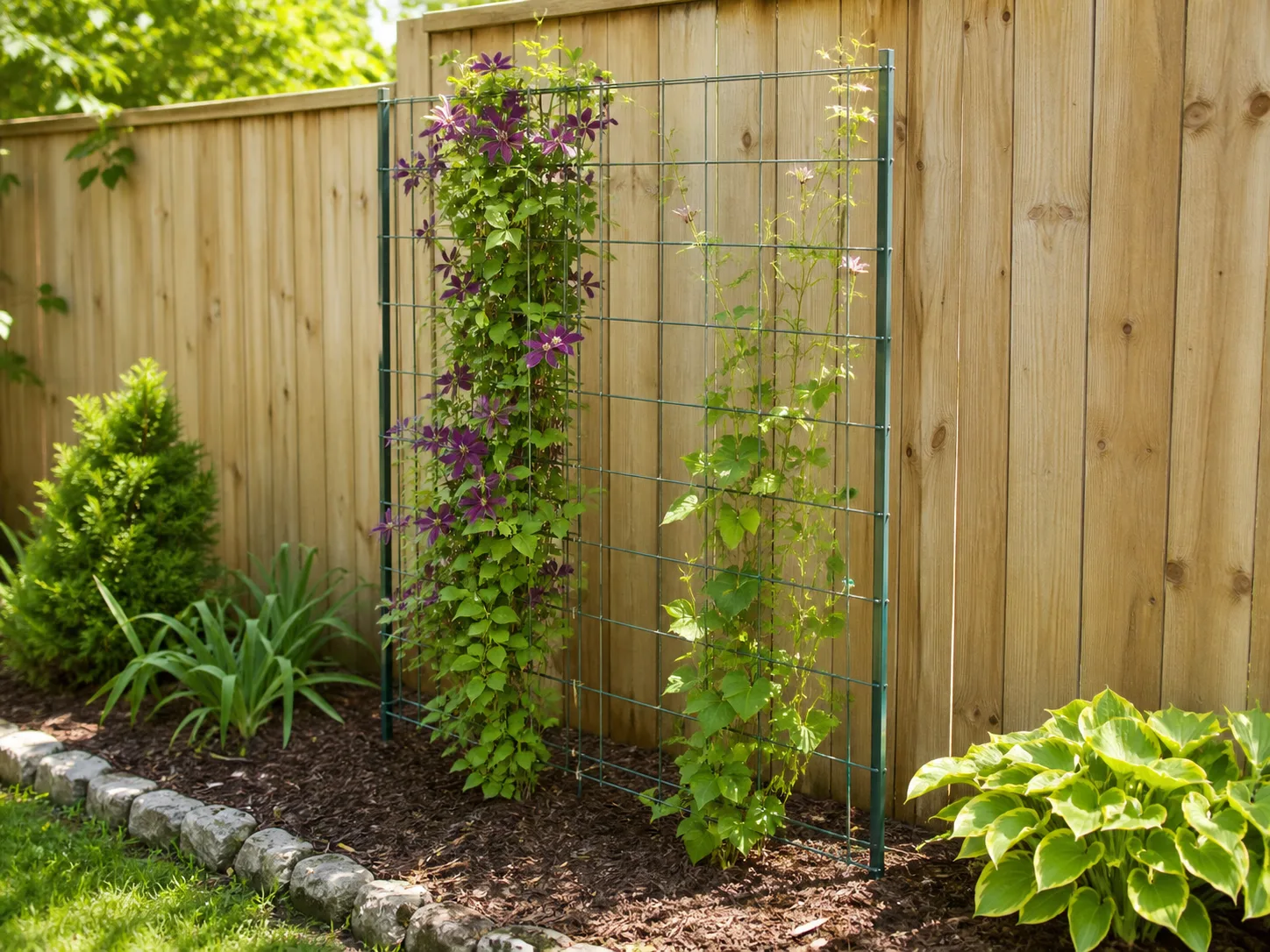
26. Rose climber on a wire panel. A climbing rose can soften a plain boundary and bring flowers up to eye level. Mount a wire panel or sturdy trellis slightly off the wall so you can tie in stems and reach behind them for maintenance. Gardenista highlights roses on trellises and picket fences, but the plant’s mature size and thorny growth make access planning important.
27. Espaliered fruit along a fence. A sunny wall or sturdy wire system can train fruiting branches into a flat plane, giving a useful harvest in a narrow space. This is a long-term planting project that requires pruning and a species suited to the local climate. Keep the support independent if the fence will eventually need repair or replacement.
Green, salvaged, and layered boundaries
28. Clipped evergreen hedge. A hedge creates a quiet green boundary and can screen views without a manufactured finish. It takes time to reach useful height, and the mature width needs room on your side of the property line. Choose plants for your climate and desired density, and consider how much annual trimming you are willing to do.
29. Hedge above a low stone wall. The wall gives immediate structure while shrubs grow into a softer screen. This layered edge works well along a front walk or patio, where a tall solid fence might feel severe. Plan drainage and plant spacing before building, and use the wall only as a retaining structure when it is designed for that purpose.
30. Bamboo screening attached to a simple frame. Rolled bamboo or reed screening can dress up an existing fence quickly and bring a warm, informal texture. It works as a visual screen, not a strong animal barrier. Secure it to a stable frame, check how it handles wind and weather in your climate, and leave a way to replace sections as they age.
31. Decorative layer in front of a plain privacy fence. Keep the sturdy boundary simple, then add one short run of a more attractive fence or screen in front of the seating area. This concentrates the feature where it will be seen and avoids paying for elaborate materials around the entire lot. Keep a gap or access point so you can inspect and maintain both surfaces.
32. Reclaimed pallet fence. Pallets can create a low-cost rustic screen when they are sound and their treatment history is clear. Avoid painted, stained, or chemically treated pallets of unknown origin, especially around edible crops. Because pallet dimensions vary, design around a repeated module and anchor every panel so it cannot tip in wind.
33. Fence with post-cap lights or string lights. A few low-voltage post lights or carefully hung outdoor string lights can make a basic boundary useful after dusk. Keep fixtures and cords rated for outdoor use and away from moving gates. Lighting adds atmosphere; it does not make a weak fence safer or provide meaningful animal exclusion.
Choose a fence material that suits the site
Wood is easy to cut, paint, and customize, but it needs inspection and periodic finish work. Naturally durable species and treated wood differ in cost and appearance; verify the product is appropriate for its use, particularly near food crops. Composite and vinyl reduce painting, but they can cost more upfront, have limited repair options, and still need cleaning. Metal mesh is practical for visibility and crop protection, while ornamental metal can be a design feature. Masonry can last a long time but costs more to install and is not a casual DIY retaining wall.
| Material | Strongest fit | Tradeoff to plan for |
|---|---|---|
| Wood | Custom shapes, pickets, privacy, mixed materials | Finish, rot, and board replacement |
| Galvanized or coated wire | Vegetable beds, animal barriers, open sightlines | Visible mesh, sharp cut ends, and secure edges |
| Ornamental metal | Formal borders and durable open views | Cost and spacing that may not exclude small animals |
| Vinyl or composite | Low-paint maintenance and consistent panels | Higher purchase cost, limited repair, and a manufactured look |
| Stone or brick | Low boundaries and architectural entrances | Weight, footing, drainage, and higher installation demands |
| Hedge or climbers | Soft, green screening | Time to establish, pruning, and seasonal gaps |
Compare the whole installation, not just a price per foot. A cheap roll of wire still needs posts, fasteners, a gate, and a way to hold the bottom in place. A living hedge has no panel delivery but does need years of watering, replacement plants, and pruning before it screens a view.
Plan height, layout, gates, and safety before buying
Walk the proposed fence line and mark the corners, gate, slopes, and places where you need to reach beds. A gently sloping run may be stepped in level panels or follow the ground; the choice changes the gaps underneath and how the top line looks. On a slope, make sure the lower edge remains close enough to the ground for the barrier to work, while the gate still swings freely.
Do not copy a universal post-spacing number from a photo gallery. The right span depends on panel stiffness, post size, soil, wind exposure, and manufacturer instructions. Close posts may add cost and labor; posts too far apart can let panels flex or sag. For a long, heavy, or exposed fence, use the panel system’s instructions or ask a qualified installer to size the structure.
Before you dig in the United States, contact 811 or your state’s one-call center so underground utilities can be marked; fence-post holes count as digging even when the project seems small. (811 Before You Dig) Check local rules for fence height, corner visibility near driveways, permits, historic districts, and HOA requirements. Confirm your property line and any easements rather than assuming an old fence sits on the boundary.
Size the gate for how you actually garden. A wheelbarrow, compost cart, or mower may need a wider opening than a person, and a heavy gate needs posts and hinges designed for its weight. For pet containment, check the latch and ground clearance; for rabbits, close the threshold; for deer, keep the gate as high and secure as the adjoining barrier.
Keep a garden fence useful and attractive
Trim plants back from hinges, latches, and the base of panels so you can see damage before it becomes a gap. Clear soil or mulch away from wood that is not intended to stay buried, and watch for pooling water around post bases. After storms, look for loose fasteners, leaning posts, torn mesh, or a gate that no longer closes flush.
Climbers need occasional training and pruning so their stems do not hide fasteners or overload a light trellis. Leave an inspection path where a fence touches a hedge, and keep the plants’ mature spread in mind. Country Living’s garden-design examples emphasize gates, hedges, and structures as part of the garden layout; the practical version is to make sure those attractive features still leave clear paths for watering, mowing, and repairs. (Country Living)
Avoid three common missteps: using a decorative low border as if it were wildlife-proof, choosing a solid privacy fence without considering shade and wind, and planting a climber before deciding how you will maintain the fence behind it. Good design comes from giving each section a clear job and allowing for upkeep before the plants and weather complicate access.
Conclusion
The best garden fence is the one that solves the problem you have without making the rest of the yard harder to use. Choose the job first—edging, privacy, plant support, pet containment, or wildlife exclusion—then select a style and material that suit the site and the amount of maintenance you will do.
Before buying, sketch the fence line, gate, slope, and planting space; verify rules and property lines; and contact 811 before digging in the U.S. If you need several things from the fence, combine solutions: a sturdy, plain enclosure can protect vegetables while a gate, trellis, or short decorative panel supplies the character.