Deadly Nightshade: Identification, Toxicity & Removal
Belladonna is toxic in every part. Compare its key features with look-alikes, get the right response after ingestion, and plan careful, proportionate removal.
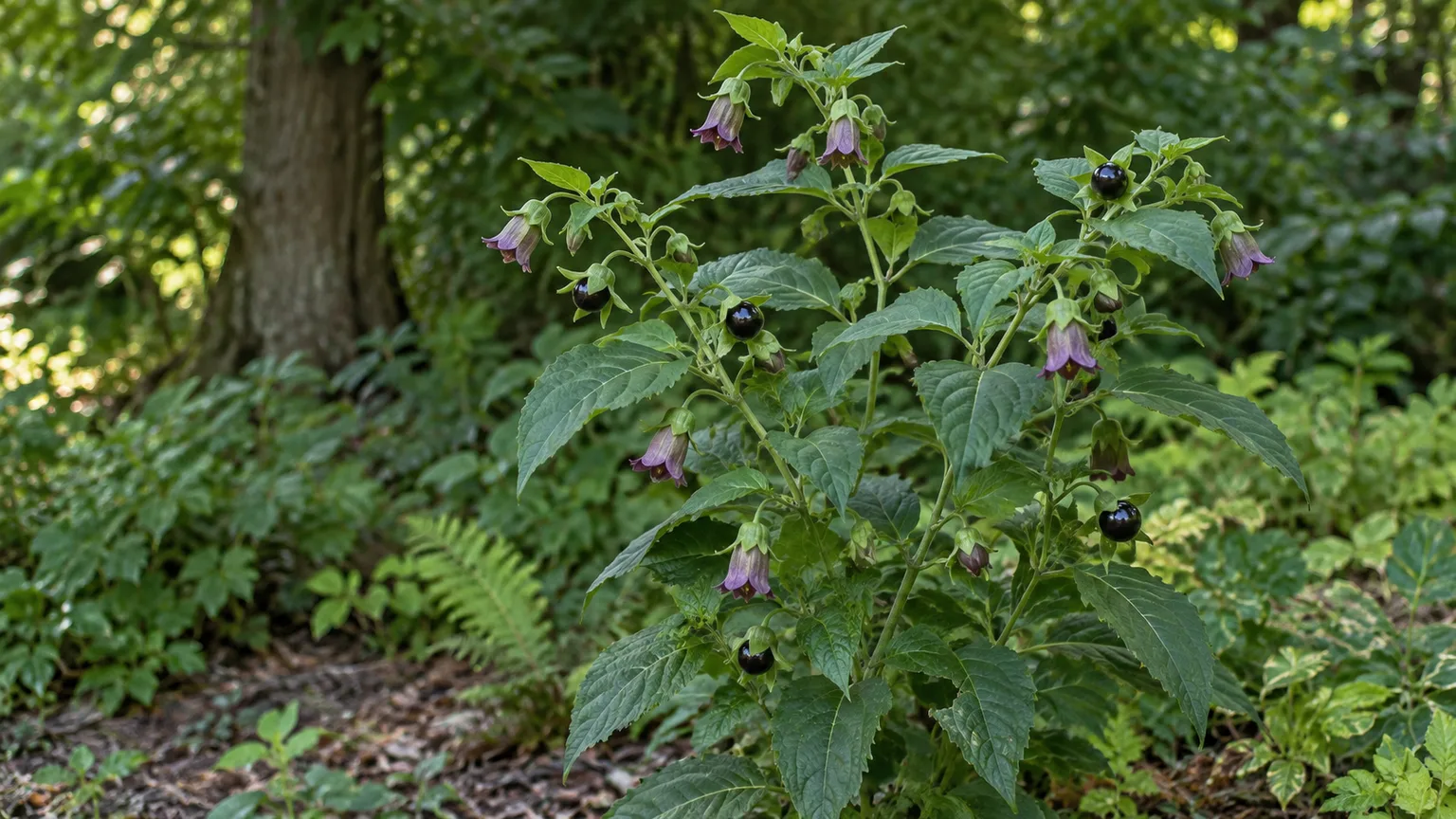
If a plant with shiny black fruit has appeared near a path, play area, or pet run, do not taste it or rely on the fruit alone to identify it. Deadly nightshade is Atropa belladonna, a toxic, branching perennial; the safest next step is to compare several traits, keep people and animals away, and get expert advice if anyone may have swallowed any part.
If ingestion is possible, call a poison center or veterinarian before you start gardening. If no one has been exposed and the plant is small and clearly identified, you can decide whether careful removal is reasonable; a tall, tangled, inaccessible, or uncertain plant is a better job for a qualified professional.
If someone may have eaten belladonna, act now
Treat a possible bite, swallowed berry, leaf, flower, seed, or root as a time-sensitive exposure. In the United States, call Poison Control at 1-800-222-1222 or use its online tool; its guidance says not to wait for symptoms. If the person is hard to wake, having a seizure, struggling to breathe, or rapidly worsening, call 911. Outside the United States, contact your local poison information service or emergency number. (Poison Control; webPOISONCONTROL)
Do not try to induce vomiting, give a home remedy, or decide that the exposure is harmless because the amount looks small. Have the plant name if known, a clear photo taken from a safe distance, the part that may have been swallowed, the approximate time, and the person’s age ready for the specialist. If pieces remain in the mouth, do not handle them barehanded; follow the poison center’s instructions for what to do next.
For a pet, contact a veterinarian or animal poison service promptly and say that belladonna may be involved. The Pet Poison Helpline lists all parts of belladonna as toxic to pets and says the possible signs can involve the gastrointestinal, cardiovascular, nervous, and respiratory systems; an animal’s size and the amount eaten affect the case, so a web page cannot determine a safe wait-and-see period. (Pet Poison Helpline)
What deadly nightshade is
Deadly nightshade is the common name for Atropa belladonna, a member of the nightshade family, Solanaceae. It is not an edible berry shrub or a garden crop: NC State Extension describes it as a branching herbaceous perennial with thick roots and notes that it should not be planted in home landscapes because its parts are poisonous. A mature plant is often about 3 to 4 feet tall and similarly broad, though size varies with growing conditions. (NC State Extension Plant Toolbox)
The scientific name matters because “nightshade” is used for several unrelated-to-this-guide garden plants in the same broad family, and common names overlap. “Black nightshade,” “bittersweet nightshade,” and “deadly nightshade” should not be treated as interchangeable labels. If you are looking at a plant you did not grow, identify the species from its whole structure and flowers, not the name someone attached to a photo or the color of one berry.
Belladonna can be attractive: its flowers are subdued purple, and the dark fruit can look familiar to someone who knows cultivated berries. That visual appeal does not make it safe to sample. Do not bring berries into a kitchen, cut a stem to smell or taste it, or let a child “test” whether a berry is ripe.
How to identify belladonna
Look for a combination of growth habit, leaves, flowers, and fruit. No single trait proves an identification, and the plant may not have flowers and mature berries at the same time; when a key feature is missing, treat your conclusion as tentative and ask a local extension office or botanist to review a distance photo.
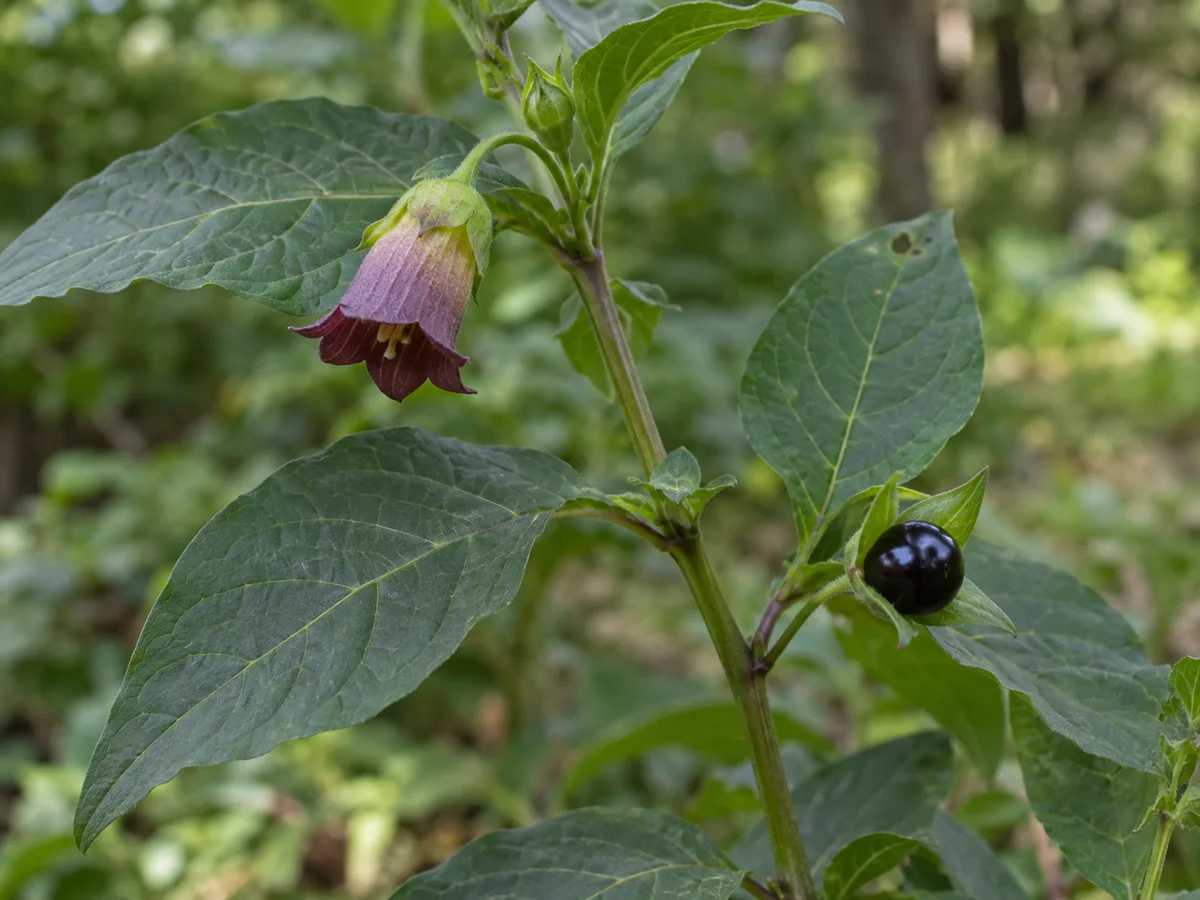
The NC State Plant Toolbox describes belladonna as upright and multi-stemmed, with oval leaves, drooping tubular flowers, and glossy purple-black berries. Farmer’s Almanac’s identification summary likewise emphasizes the plant’s overall form and single dark fruit, but a garden article or image search should not substitute for a local expert when a mistake could expose a child or pet. (NC State Extension Plant Toolbox; Farmer’s Almanac)
Leaves and stems
The plant forms several upright, branching stems rather than a trailing vine. Its leaves are simple, oval, and dark green, with smooth-looking edges; NC State describes them as roughly 3 to 10 inches long. The arrangement is a useful clue: leaves are alternate along the stem, but the upper growth often carries leaves in pairs, while leaves lower down are more often solitary.
Check more than one node. A pair of leaves can appear to emerge close together, and a damaged or crowded plant can make the arrangement hard to read. If your candidate is a woody shrub, has a climbing or twining stem, or its leaves do not fit the description, stop before pulling it and ask for a positive identification.
Flowers and berries
Belladonna’s flowers hang down from the leaf axils, the points where a leaf joins the stem. They are tubular or bell-shaped, have five fused lobes, and are usually a muted reddish purple or lavender with a greenish tinge. NC State records bloom from summer into fall; regional weather and plant condition can shift the calendar, so color and shape are more useful than a date alone.
The fruit is a glossy purple-black berry smaller than an inch. A berry is not enough to call the plant belladonna, but a dark berry attached singly near a drooping purple bell, on the paired upper leaves of an erect perennial, is a stronger group of clues. Never use a taste test, berry count, or phone app as a safety check.
Where it grows and when to look
Belladonna is native to parts of Eurasia and the Mediterranean region. NC State reports it naturalized in disturbed ground in New York and on the West Coast in Washington, Oregon, and California, and notes its association with road edges and waste sites. Those examples are not a complete range map; county and state records can change, so check your local extension or invasive-species listings rather than assuming it cannot occur in your area.
Look for it in neglected beds, woodland edges, road margins, and other disturbed places, particularly where the ground has been left unmanaged. As a perennial, the top can die back in cold weather while the rooted plant returns in a later growing season; a bare winter patch is not proof that the plant has disappeared. Wildlife can eat the fruit, so berries that vanish do not mean the plant is safe or gone. (NC State Extension Plant Toolbox; Homes & Gardens)
Belladonna vs. look-alike berries
A comparison should include how the plant grows and how its flowers and fruit attach. For example, twinberry honeysuckle can also have dark berries, but King County’s native plant guide describes it as a deciduous shrub with paired yellow tubular flowers and two black berries held in red bracts. Belladonna is an herbaceous perennial with drooping purple flowers and glossy dark fruit; the surrounding red “nest” of bracts is a clue to look elsewhere. (King County Native Plant Guide; NC State Extension Plant Toolbox)
| Feature to check | Belladonna | Twinberry honeysuckle |
|---|---|---|
| Growth habit | Upright, branching herbaceous perennial | Woody, deciduous shrub |
| Flowers | Drooping, dull purple tubular bells | Paired, small yellow tubes |
| Dark fruit | Glossy purple-black berries, generally seen singly | Two berries within conspicuous red bracts |
| Safer decision | Confirm the whole plant before removal | Do not treat black fruit alone as proof of belladonna |
The table is a field comparison, not a permission to taste either plant. Many species carry dark fruit, and damaged or fruitless plants may hide the best identifying marks. If the plant does not match cleanly, take several photos from a distance—whole plant, leaf arrangement, flower or fruit attachment—and get a local identification before handling it.
Twinberry honeysuckle vs. belladonna
The useful contrast is not simply “one berry versus two.” Twinberry honeysuckle is a shrub, and the pair of dark berries sits inside enlarged red bracts; its yellow flowers also differ from belladonna’s drooping purple bells. A young shrub may look different from a mature specimen, so use the combined habit, bracts, leaves, and flowers rather than counting fruit alone.
Twinberry is native in parts of western North America and may be planted deliberately for wildlife habitat. Do not remove it just because someone called it nightshade, but do not assume a plant is twinberry because it has paired berries. The two species have different growth forms and floral features; a local native-plant guide or extension identification can help you sort them without touching or sampling the fruit.
Why “nightshade” names create confusion
Common names such as black nightshade, bittersweet nightshade, and deadly nightshade overlap across regions and sources. A page titled “nightshade” may refer to a different genus or species than Atropa belladonna, so check the scientific name rather than transferring its toxicity, edibility, or control advice to another plant.
Solanaceae includes both familiar food crops and toxic wild species. Family membership alone does not tell you whether a particular plant or plant part is edible, and “it looks like a tomato relative” is not a safe identification rule. When the name is uncertain, avoid contact with the mouth and eyes, keep children and pets away, and ask an expert to identify the actual plant.
What makes belladonna toxic
NC State lists all parts of belladonna—bark, flowers, fruit, leaves, roots, seeds, and stems—as poisonous to humans. The plant contains tropane alkaloids, including atropine and related compounds; these affect normal nervous-system signaling. The amount of alkaloid can vary by plant part and condition, which is one reason a visual guess cannot produce a reliable “safe amount.” (NC State Extension Plant Toolbox)
This is not a situation where removing the berries makes the rest of the plant safe. Leaves or roots can also be poisonous, and home drying, cooking, or making a tea is not a way to control the dose. Do not use garden belladonna as a remedy, tincture, or homeopathic preparation; medicines involving related compounds require professional oversight and standardized dosing, not guesswork from a plant.
Symptoms after ingestion
The clinical pattern can include a very dry mouth, flushed or hot skin, dilated pupils, a fast heartbeat, difficulty swallowing, confusion, agitation, delirium, hallucinations, poor coordination, or seizures. NC State lists serious neurologic and cardiovascular effects; a 2024 clinical case review indexed by PubMed describes accidental leaf ingestion followed by dry mouth, dilated pupils, tachycardia, and delirium. Symptoms may vary with the exposure, and their absence at first does not establish safety. (NC State Extension Plant Toolbox; PubMed case review)
Do not try to decide whether the amount was “enough to matter” by counting berries. The poison specialist needs the person’s age, time, plant part, and best estimate of what was swallowed to give an individualized recommendation. If you are outside the United States, use the poison service for your country; call emergency services for severe or rapidly developing symptoms.
Is belladonna dangerous to touch?
Ingestion is the clearest documented household hazard, and NC State’s Plant Toolbox marks the plant as poisonous to humans while listing “causes contact dermatitis” as no. The same page separately warns about contact with an open wound, without explaining how that risk was assessed. That combination is not a sound basis for promising that every kind of skin exposure is harmless or for claiming that a brief brush against intact skin is equivalent to eating a berry. (NC State Extension Plant Toolbox)
For ordinary garden work, avoid barehanded handling, keep plant material away from eyes and mouth, wear gloves, and wash skin and tools after contact. If sap or plant pieces reach an eye, mouth, or open cut—or if a person develops symptoms—call Poison Control for case-specific guidance. If you only brushed intact skin, wash it with soap and water and do not panic; seek advice if the exposure involved broken skin or you are unsure what happened.
How to remove a small plant safely
Do-it-yourself removal makes sense only when the identification is solid, the plant is small enough to manage without reaching into face-height foliage, and children and pets can be kept out of the area. The aim is to remove the plant and contain its parts, not to make contact with every stem while trying to save a flower bed. A named landscape expert quoted by Homes & Gardens recommends lifting as much root as possible, protecting arms and hands, and returning to check for new shoots. (Homes & Gardens)
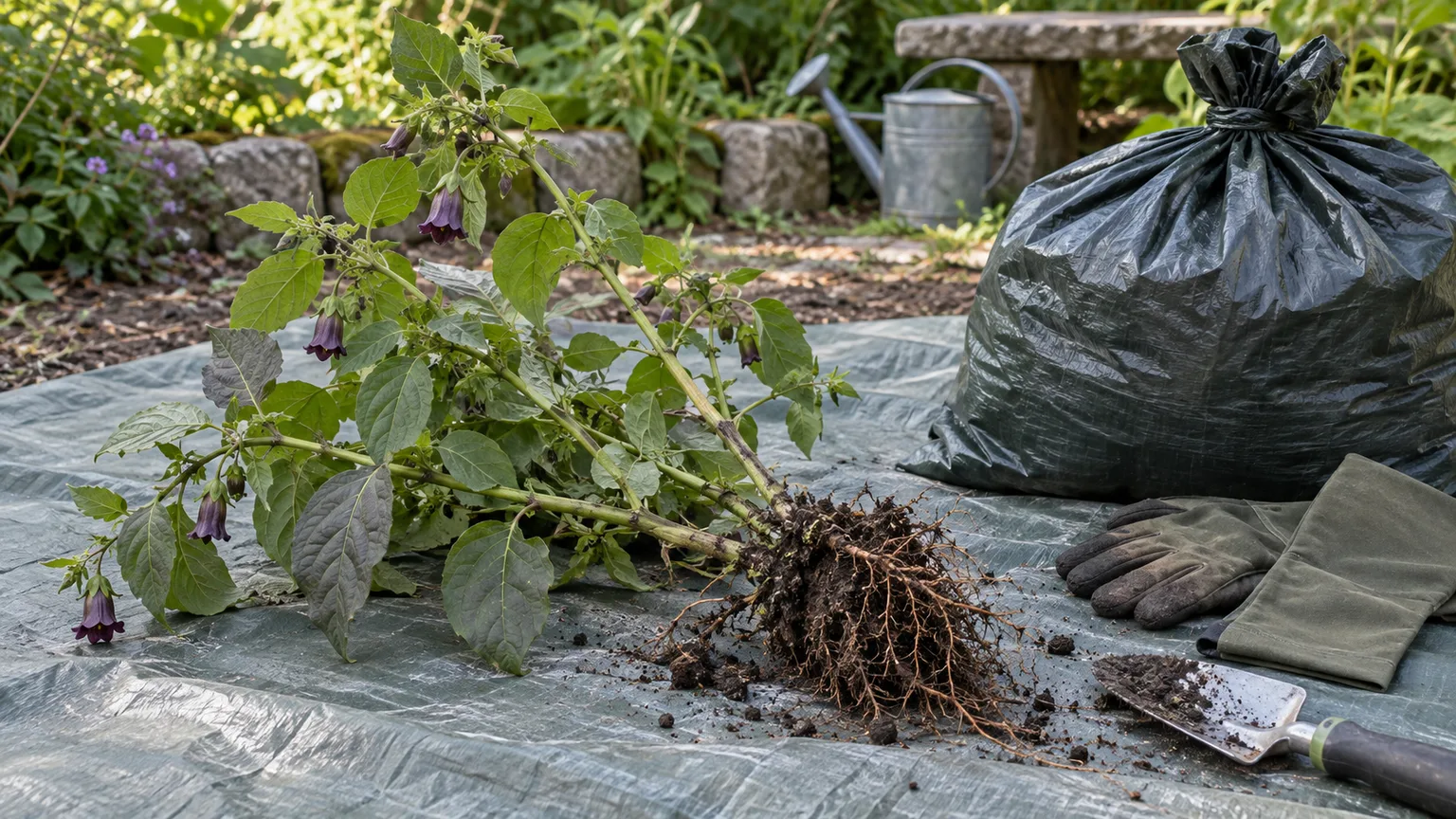
Before starting
Do not start if you are not confident about the species, the patch is large, the stems are too tall to control, the plant is entangled with valuable vegetation, or reaching it would put your face or body into the foliage. Keep children and pets indoors or behind a barrier, and choose a calm day when you can see the plant clearly. If it is fruiting, avoid shaking, dragging, mowing, or cutting it where berries can scatter.
For one small, confirmed plant, use long sleeves, long pants, closed shoes, and sturdy gloves. A tarp placed beside the plant can catch loose leaves or fruit; keep a durable bag open nearby so you do not have to carry exposed stems across a play area. Eye protection is sensible if you must reach through or cut dense growth, but a face respirator is not a routine requirement for simply digging a small plant.
Dig, contain, clean, then monitor
Use a hand trowel or narrow spade to loosen soil around the base and lift the root crown with as much of the root system as practical. Work slowly instead of yanking the top, which can snap stems and leave you searching through loose debris. Put the plant, fallen berries, and visible fragments directly into the bag; do not leave them on the ground for a child or animal to investigate.
Seal the bag and follow your local waste service’s instructions for toxic or invasive plant material. Do not put belladonna in a home compost pile; local green-waste programs differ, so check with the municipality before putting it in curbside yard waste. Clean soil and plant residue from tools outside, wash reusable gloves according to their care instructions, and wash your hands and work clothes after finishing.
Check the spot through the next growing season for new shoots or seedlings, especially if the plant had fruit. Pulling the top once is not the same as confirming the rooted perennial is gone. If new growth appears, repeat the same cautious removal only when it remains small and clearly identified; otherwise call for help.
When to call a professional
Bring in a qualified local gardener, invasive-plant contractor, or other professional when the plant is large, growing in a dense or hard-to-reach patch, mixed through valued planting, or returning after repeated careful removal. Professional help is also the right call if you cannot make a confident identification, if you would need a ladder or overhead cutting, or if you cannot keep children and pets away while the work is underway.
Ask how the person will identify the plant, protect nearby people and animals, contain berries and cut material, and dispose of the debris under local rules. If they propose an herbicide, ask which product label allows that exact site and use and how desirable plants, water, and public access will be protected. A careful plan is more important than a fast promise.
Does herbicide help?
There is no one-size-fits-all herbicide recommendation for a plant identified only from a photo. Product labels, allowed sites, nearby plants, local rules, and the size of the infestation all matter, and a nonselective treatment can injure plants you want to keep. Homes & Gardens presents chemical treatment as a last resort and recommends professional advice when a quick chemical solution is being considered; that is a more proportionate starting point than reaching for a specific active ingredient without checking the situation. (Homes & Gardens)
If you choose a pesticide, use only a product whose current label expressly permits that plant and site, and follow every label direction. Do not use a lawn, ditch, vegetable bed, or water-edge product where its label does not allow it; do not increase a rate or mix products to compensate for uncertainty. If you cannot find a clearly applicable label or protect nearby people, pets, and desirable plants, skip the application and ask your county extension service or a licensed applicator for local guidance.
How to reduce spread and regrowth
A confirmed plant is easiest to manage before fruit ripens. If you cannot safely remove it right away, keep children and pets away, avoid moving through the patch, and ask a professional about containing the fruiting stems. NC State notes that birds and some small animals use the fruit as food, so fruit can be moved away from the original plant; that is a reason to monitor nearby ground, not a reason to interfere with wildlife or to treat every black berry as belladonna. (NC State Extension Plant Toolbox)
After removal, inspect the same place during the growing season and again after winter dieback. Remove small new plants only when you can identify them confidently; a blanket spray or broad digging pass can create more problems in a mixed garden than a targeted follow-up. If seedlings recur across a wide area, or the patch is spreading beyond a home bed, contact your local extension service or county weed program for site-specific guidance.
Conclusion
Deadly nightshade is Atropa belladonna, a toxic perennial with branching stems, alternate oval leaves that often appear paired near the top, drooping purple bells, and glossy purple-black berries. Confirm those traits together; a single dark berry or a common name is not enough, and look-alikes such as twinberry honeysuckle have different growth habits, flowers, and fruit structures.
If anyone may have swallowed a part of the plant, call Poison Control or a veterinarian promptly rather than waiting to see what happens. For a small, confirmed plant, wear basic protective clothing, lift and bag it carefully, follow local disposal rules, and monitor the site. If identification, access, scale, pesticide choice, or disposal is uncertain, pause and bring in a qualified local professional.