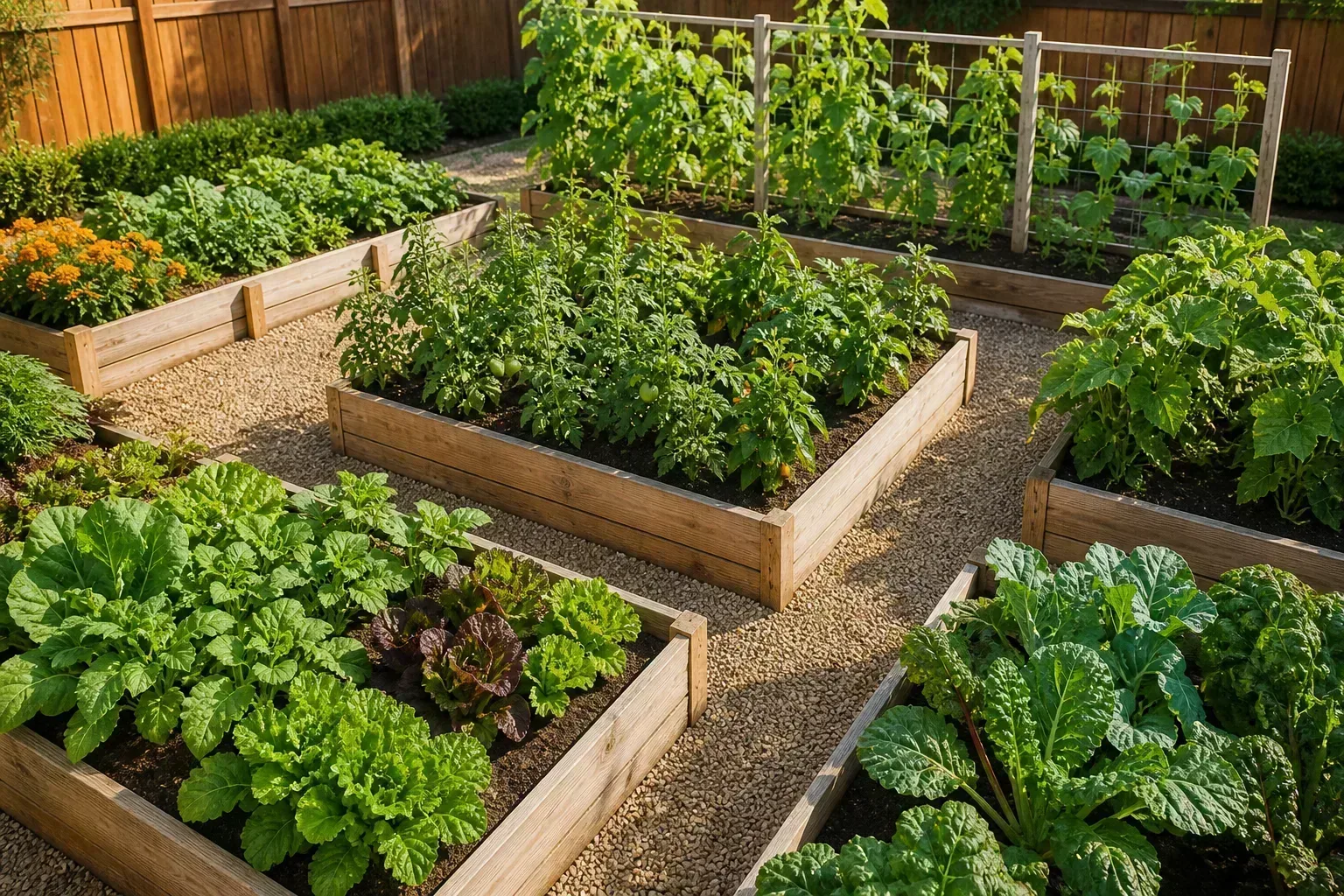
7 Best Built-In Coffee Machines for 2026
Compare seven built-in coffee machines by plumbing, drink range, grinders, milk systems, cabinet fit, cleaning, and the daily work each one requires.
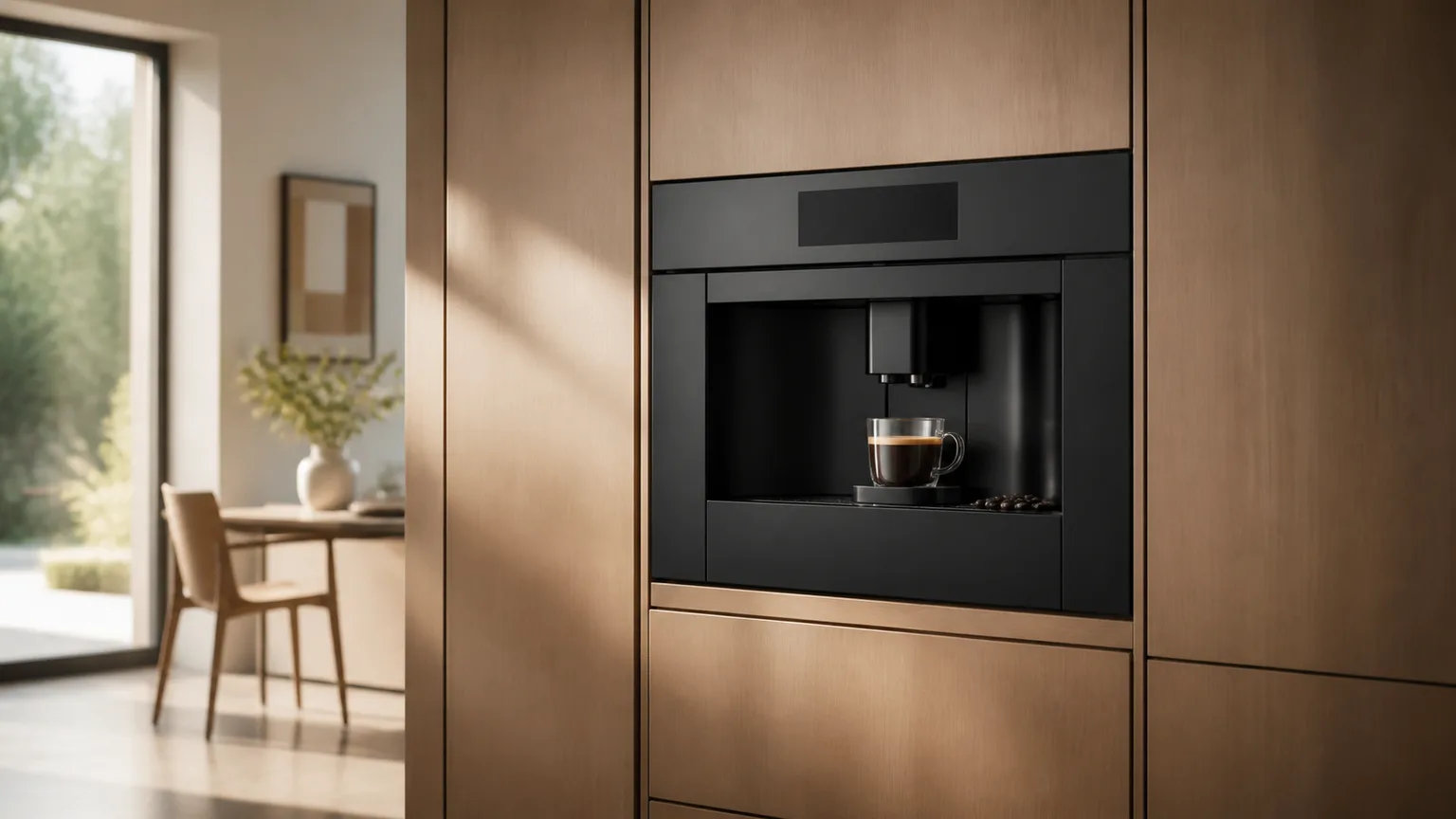
A built-in coffee machine is a major kitchen purchase, not simply a countertop brewer with a nicer door. The right model can grind beans, brew espresso or a longer coffee, froth milk, save household preferences, and disappear into an appliance column. The wrong one can leave you with a hard-to-reach water tank, a door that cannot open against a wall, or a daily cleaning routine you never wanted.
The seven picks below are matched to different priorities rather than ranked by feature count. Miele’s CVA 7845 is the strongest plumbed luxury choice; Bosch’s BCM8450UC is the better fit when you want a removable tank; and Fisher & Paykel’s EB30PSX1 offers a particularly clear balance of drink choice, capacity, and price in a 30-inch layout. JennAir, Fulgor Milano, Wolf, and Gaggenau each make more sense for a specific combination of controls, milk drinks, design, or installation goals.
How to choose without getting trapped by the “built-in” label
This is a source-based buying guide, not a hands-on lab test of all seven machines. I compared current manufacturer product pages and installation details, then used the decision criteria emphasized by Good Housekeeping’s coffee-appliance testing program and Ideal Home’s bean-to-cup testing methodology: drink quality and consistency, grinder flexibility, ease of programming, milk performance, cleaning, and how the machine behaves in a real kitchen.
Model pages and prices change, and some specifications vary by region or retailer. Treat the dimensions and features below as a shortlisting tool, then confirm the exact installation guide, electrical requirements, warranty, included accessories, and price for the model sold in your market.
What counts as built-in
A built-in coffee machine is designed for a cabinet niche, usually beside or above other wall-oven-style appliances. It has a finished front, a fixed installation position, and access requirements that matter even when the machine itself is fully automatic. Some models are connected to a water line; others look equally integrated but use a removable reservoir behind the door.
That distinction changes the ownership experience. A plumbed machine reduces refills but adds water-line planning, filtration or hardness considerations, and a service connection that should remain accessible. A removable-tank machine is more flexible during a remodel, but someone must refill it and carry out the tank, grounds container, and drip tray without scraping the surrounding cabinet.
Plumbed or removable-tank: the decision that changes installation
Choose a plumbed model when the machine will be used heavily, the kitchen is already open for plumbing work, and you value uninterrupted morning service more than installation simplicity. Choose a removable-tank model when you are retrofitting an existing cabinet, do not want a water line, or want the option to move the appliance later. Neither approach automatically makes better coffee.
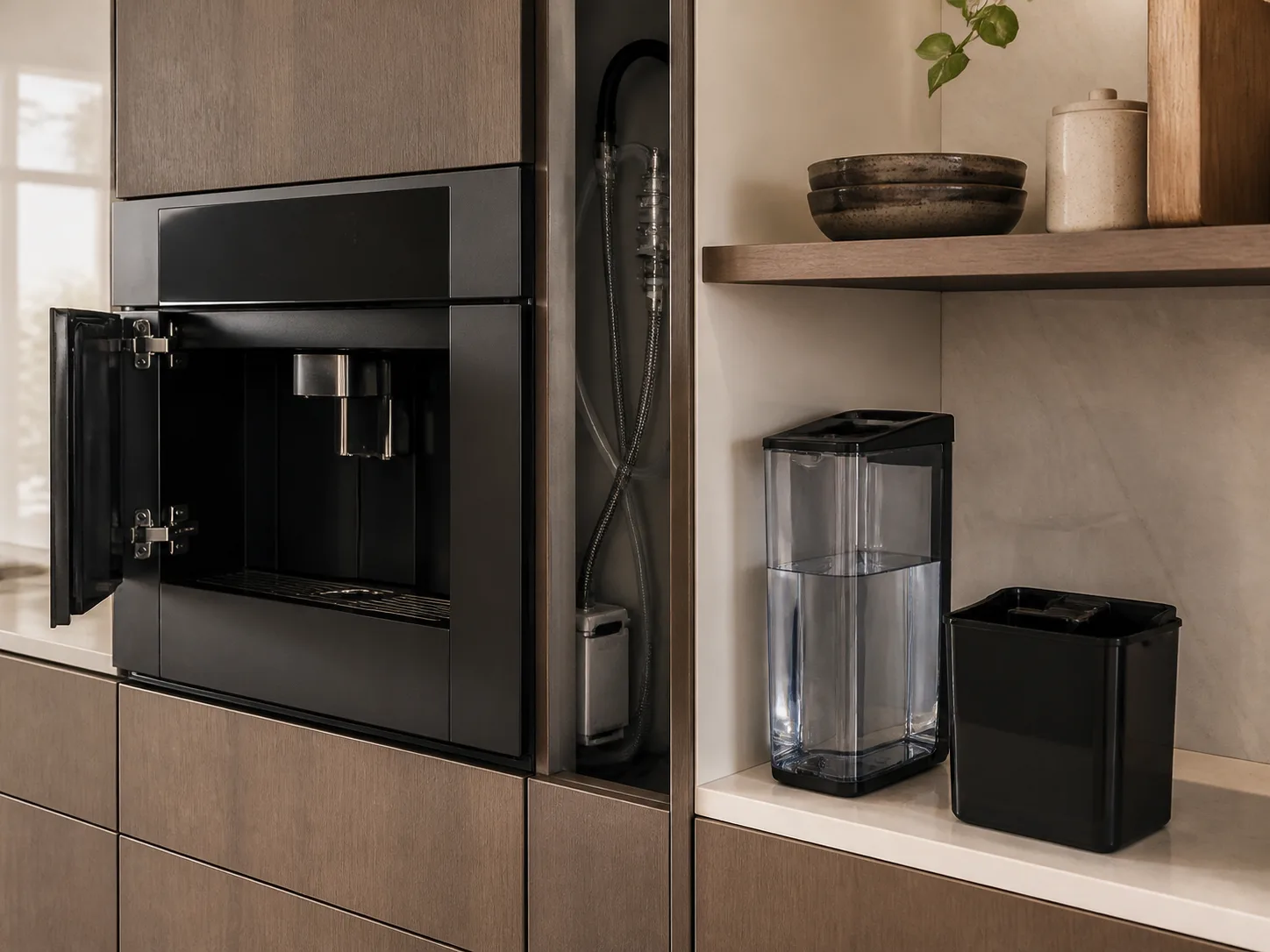
There is a third practical question: where does the machine get serviced? A built-in unit may slide forward on rails or open its entire front, but the surrounding cabinet still needs to allow that movement. Fulgor Milano’s retailer listing, for example, specifically describes telescopic rails for accessing the bean and water containers; Gaggenau warns that its water connection must remain accessible and that the door’s hinge is not reversible. Those are installation facts, not decorative details.
The 7 best built-in coffee machines at a glance
| Machine | Best for | Water setup | Standout reason | Main trade-off |
|---|---|---|---|---|
| Miele CVA 7845 | High-volume luxury kitchens | DirectWater | Three bean containers, profiles, AutoDescale, and a coffee-pot mode | Highest price and professional installation planning |
| Bosch BCM8450UC | Non-plumbed convenience | Removable tank | 11 beverages, two-cup brewing, touchscreen, and integrated milk hose | Reservoir refills and regional availability should be checked |
| Fisher & Paykel EB30PSX1 | A 30-inch appliance column | Removable tank | 13 drinks, 13 grind positions, self-cleaning, and useful capacity | Large footprint and no automatic descaling program listed |
| JennAir JJB6424HL | Personalization and storage | Removable tank | Full-color touch controls, dual spouts, and concealed storage | Requires careful niche and service planning |
| Fulgor Milano F7BC24B1 | Milk drinks and hard-water awareness | Non-plumbed | Milk system, five strength settings, hardness adjustment, and automatic cleaning | Retailer-listed specifications and availability can change |
| Wolf EC3050CMB | Touchscreen drink range | Removable tank | Six profiles, one-ounce espresso through a 25-ounce pot, and milk options | 30-inch class, heavy, and still needs milk-system cleaning |
| Gaggenau GC461720 | Design-forward kitchens | Fixed water connection | Barista mode, ceramic grinder, 10 profiles, and integrated cleaning | Fixed connection, side-opening clearance, and complex installation |
Miele CVA 7845: Best overall for high-volume households
The Miele CVA 7845 is the best overall choice when a household wants a premium machine that can support several coffee preferences without constant refilling. Miele lists DirectWater, three bean containers, up to 10 user profiles, OneTouch for Two, adjustable beverage settings, automatic descaling, automatic cleaning, and a coffee-pot function. The stainless-steel model was listed at $6,999 during this research check.
The three containers are more useful than a long menu of named drinks if people in the house use different beans. You can keep a darker espresso roast, a regular morning blend, and a decaffeinated option available without emptying one hopper every time. The machine also accepts programmable water quantity, temperature, ground quantity, grind level, milk amount, and milk froth, so a saved profile can reflect how someone actually drinks coffee rather than only selecting a preset icon.
The cost is not limited to the purchase price. Miele specifies a tight niche range, a 15-amp electrical connection, DirectWater, and a door-open depth that is much greater than the closed appliance depth. That makes this a project for an appliance installer and cabinet designer, not a late-stage insert. Pick it when the kitchen can support the plumbing and the household will use the extra bean management, automatic descaling, and larger drink workflow often enough to justify the premium.
Bosch BCM8450UC: Best non-plumbed option
The Bosch BCM8450UC is the practical answer for a homeowner who wants a truly integrated appearance without committing to a water line. Bosch identifies it as an 800 Series built-in machine with a removable water tank, 11 beverage options, an integrated milk system with hose, a large color touchscreen, personalized beverages, and OneTouch DoubleCup preparation. Bosch listed it at $3,999 during this research check.
Its appeal is workflow. Two people can make drinks at once, and the screen keeps the machine closer to an appliance than a small espresso station with a learning curve. The removable tank also makes the model easier to consider in a renovation where plumbing is not available behind the cabinet. You still need to confirm that the tank, bean container, brew unit, and grounds bin can be reached comfortably after the machine is installed.
The compromise is capacity and ownership attention. A reservoir eliminates the need for a supply connection but does not eliminate water management; you will still fill it, empty the drip tray, and maintain the milk hose. Bosch’s product page links to installation instructions and a CAD file, so use those documents to verify the exact niche before ordering. This is the best pick here for a household that wants one-touch variety and a built-in look while keeping the installation comparatively straightforward.
Fisher & Paykel EB30PSX1: Best value in a 30-inch layout
The Fisher & Paykel EB30PSX1 earns the value pick because its published specification is unusually clear about the parts that affect daily use. Fisher & Paykel lists 13 drink functions, five coffee-temperature settings, 13 grind positions, a stainless-steel conical burr grinder, one- or two-cup brewing, a 0.75-pound bean container, a 14-cup grounds container, and a self-cleaning function. Its U.S. page listed a starting price of $4,599 during this research check.
The machine is 29 13/16 inches wide, 18 1/2 inches high, and 19 1/8 inches deep, so it belongs in a 30-inch appliance plan rather than a narrow 24-inch coffee niche. That larger format brings useful capacity for a busy household and leaves room for a cup warmer shelf and accessory storage. Its display also reports refills, cleaning, and maintenance, which is more valuable than a decorative screen when multiple people use the machine.
The limitation is that a self-cleaning function does not mean maintenance-free. Fisher & Paykel lists a removable drip tray, grounds container, cleaning reminders, and a water-tank indicator; it does not present the EB30PSX1 as an automatically descaling model in the way Miele does for the CVA 7845. Choose this machine when you have a 30-inch opening, want strong bean-to-cup flexibility, and prefer an excellent everyday specification set over the most elaborate smart features.
JennAir JJB6424HL: Best for customization and concealed storage
The JennAir JJB6424HL RISE 24-inch Built-In Coffee System is a good fit for a kitchen where the details of the front panel and storage matter as much as the beverage list. JennAir lists a full-color LCD electronic touch control, dual dispensing spouts, whole-bean grinding, ground-coffee compatibility, concealed storage trays, adjustable coffee strength, temperature customization, a removable brewing unit, and alerts for water, beans, and the waste container.
Its 2.4-liter capacity is useful for a non-plumbed machine, but the 24-inch class is more compact than the 30-inch Fisher & Paykel and Wolf systems. JennAir publishes a 21.063-inch cutout width, a 17.75-inch cutout height, and a 21.688-inch cutout depth, along with a net weight of 54.45 pounds. Those numbers show why the cabinet opening—not the 23.4375-inch exterior width—should drive the design.
This is the pick for someone who wants a polished, flush installation with the option to use pre-ground coffee for a different roast or a decaffeinated drink. It is not the one to buy from a product photo alone. Download JennAir’s dimension guide and installation instructions, confirm the latest documents for your market, and plan how you will remove the brewing unit and empty the containers once the machine is fixed in place.
Fulgor Milano F7BC24B1: Best for milk drinks and water-hardness controls
The Fulgor Milano F7BC24B1 is the strongest match for a household that prioritizes cappuccinos, lattes, and water-quality settings in a 24-inch built-in format. The current authorized-retailer listing identifies a non-plumbed machine with a milk system, hot-water dispenser, built-in filter, automatic cleaning, five coffee-strength settings, 13 grinder adjustments, a 1.8-liter tank, and a 25-fluid-ounce milk container. It was listed at $4,399 during this research check.
The water-hardness setting is useful because it lets the machine’s maintenance schedule reflect the water going into it. That does not make hard water harmless or remove the need to replace filters and run the recommended cleaning program, but it is a more thoughtful ownership feature than a generic “self-cleaning” label. The listing also describes telescopic rails, which should make filling the beans and water less awkward than reaching blindly into a fixed cabinet cavity.
The trade-off is documentation confidence. The manufacturer’s public page was not accessible during the research crawl, so the product details above are attributed to the authorized retailer listing and should be checked against the latest manual before purchase. Choose the Fulgor when milk drinks and limescale awareness are central, but do not treat a retailer’s current price, stock count, or feature wording as permanent.
Wolf EC3050CMB: Best touchscreen and drink range
The Wolf EC3050CMB 30-inch M Series Contemporary Coffee System is the most compelling choice for a household that wants a large, straightforward screen and a broad range of drink sizes. The current product specification describes a non-plumbed 30-inch system with an 84.5-fluid-ounce water reservoir, six independent user profiles, whole-bean or ground-coffee compatibility, an insulated milk container, and drink sizes from a one-ounce espresso shot to a 25-ounce coffee pot.
That range makes the Wolf more versatile than a machine focused only on espresso and milk drinks. A household can save a short espresso, a strong cappuccino, and a larger morning coffee without pulling out a separate brewer. The dual spout can dispense two cups, and the machine exposes strength, temperature, quantity, and milk preferences through the touchscreen rather than hiding them behind a specialist menu.
The machine is also a substantial piece of equipment. The specification lists a 76-pound weight, 29.875-inch width, 17.875-inch height, and 19-inch depth, plus a standard opening depth of 21.5625 inches. Wolf’s automatic cleaning system reduces friction but does not make the milk container or its tubing self-maintaining forever. Choose this model when the 30-inch niche is already planned, the household will use the saved profiles and larger sizes, and the complete operating weight is acceptable.
Gaggenau GC461720: Best design-forward splurge
The Gaggenau GC461720 Expressive series fully automatic coffee machine is the design-led choice for a kitchen where the appliance front, lighting, and control experience are part of the architecture. Gaggenau lists smoked glass, a stainless-steel control ring, Classic and Barista modes, a ceramic grinding unit, remote control and monitoring, up to 10 user profiles with 10 individualized beverages each, and automatic cleaning and descaling with cartridges.
Its Barista mode is a meaningful differentiator for an automatic machine. It exposes water and coffee quantity, grinding level, contact time, brewing temperature, and milk ratio, while Classic mode reduces the number of decisions for a fast one-touch drink. That lets the same appliance work for the person who wants a dependable cappuccino and the person who wants to tune a bean more precisely.
The installation demands are the reason this is not the default pick. Gaggenau specifies a fixed water connection, a side-opening door with a non-reversible hinge, a minimum wall distance that changes with the door angle, and a water connection that must not sit directly behind the appliance. It also recommends careful planning when stacking the taller housing with other appliances. Select it for a fully integrated design and the willingness to involve a careful installer, not simply because its drink menu is long.
Compare the seven by plumbing, width, and daily upkeep
| Decision | Best matches | What to watch |
|---|---|---|
| You already have a water line and use the machine all day | Miele CVA 7845 or Gaggenau GC461720 | Confirm filtration, hardness settings, shutoff access, and service clearance before cabinets are closed |
| You are retrofitting a cabinet without plumbing | Bosch BCM8450UC, JennAir JJB6424HL, or Wolf EC3050CMB | A tank still needs a clear path for removal; measure the door-open position, not just the niche |
| You want a 30-inch companion appliance | Fisher & Paykel EB30PSX1 or Wolf EC3050CMB | The larger opening brings capacity but also more weight, cost, and cabinet commitment |
| You mostly drink espresso, lattes, and cappuccinos | Fulgor Milano F7BC24B1 or Miele CVA 7845 | Milk systems need rinsing and cleaning even when the machine has an automatic cycle |
| Several people use different beans or recipes | Miele CVA 7845, Wolf EC3050CMB, or Gaggenau GC461720 | Count useful profiles and hopper separation, not just the number of preset drinks |
| You care about straightforward value | Fisher & Paykel EB30PSX1 or Bosch BCM8450UC | Compare the complete install, filter, cleaner, and service cost—not only the sticker price |
The most important comparison is not 13 drinks versus 19 drinks. It is how many decisions and chores the machine removes without adding a new annoyance. A big menu is wasted if everyone in the house drinks one black coffee and the hopper or milk container is difficult to clean.
Check the cabinet opening before you order
Built-in coffee machines are installed by dimensions, not by the width printed in the product name. “24-inch” and “30-inch” are shorthand for the appliance family; the actual cutout, niche depth, door swing, power outlet, water connection, trim overlap, and service access must come from the model-specific documents.
Measure the niche, not the face frame
Measure the clear opening at its narrowest point: width, height, and depth. Then measure the path the machine will take to reach that niche, including the cabinet door, trim, neighboring wall, and any shelf or drawer below it. A machine may fit inside the opening and still fail when its door needs to open, its tank needs to slide out, or its brew unit needs to be removed.
Write down these six checks before choosing a finish:
- Clear cutout width and height: Use the manufacturer’s niche range, not a retailer’s rounded headline.
- Usable depth: Account for the back of the cabinet, power cord, water hose, and the machine’s required protrusion.
- Door swing: Check the hinge side, wall clearance, and whether the hinge can be reversed. Gaggenau explicitly says its hinge is not reversible.
- Reservoir path: For a non-plumbed model, confirm that the water tank and grounds container can come out fully.
- Electrical access: Check voltage, amperage, outlet location, and whether a dedicated circuit is required.
- Service route: Ask how the machine is pulled forward and where a technician will stand if the appliance needs repair.
Plan service and cleaning access
Do not bury a machine behind a decorative panel or install a shelf that blocks the top of the bean hopper. Even the most automated model needs water filters, cleaning cartridges or tablets, milk-system parts, grounds disposal, and occasional access to the brewing unit. If you cannot explain how each consumable will be reached, the cabinet plan is not finished.
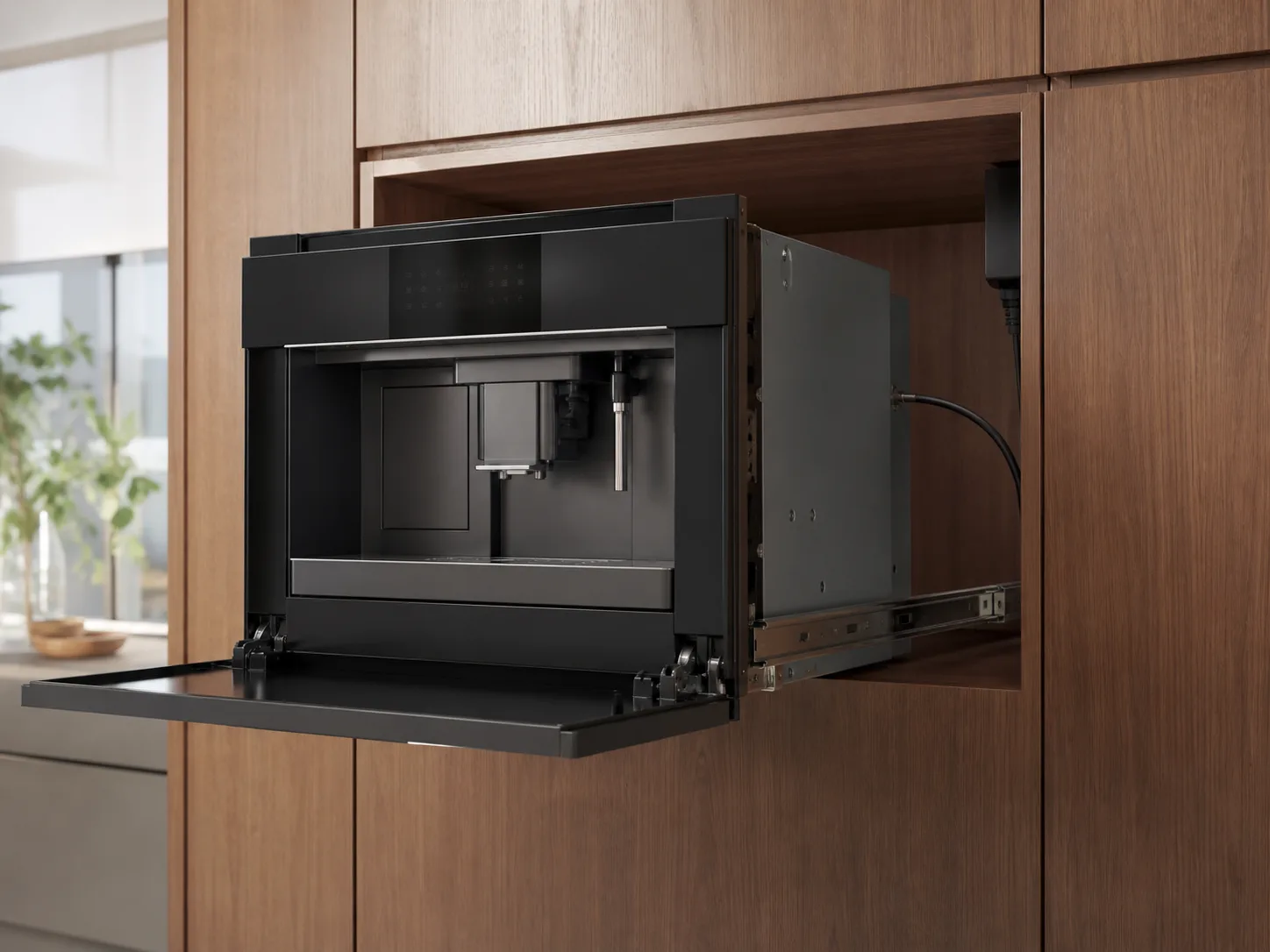
This is where the difference between a 24-inch and 30-inch machine becomes practical rather than visual. A wider appliance can hold more beans and water, but it may weigh more and require a deeper opening. A 24-inch model may fit a smaller wall but leave less room for hands and containers behind the door. Design the service routine while the cabinet is still a drawing, not after the stone and trim are installed.
Decide which drink workflow fits your household
Start by listing the drinks people make during a normal week, not the drinks shown in the machine’s promotional menu. If everyone drinks espresso or an Americano, prioritize grinder adjustment, temperature control, cup clearance, and the ease of switching beans. If milk drinks dominate, prioritize the milk container, tubing, automatic rinsing, the ability to keep milk cold, and how quickly the parts can be removed.
For a family with different beans, separate bean containers can be more useful than 20 beverage icons. Miele’s three-container system is unusually well suited to that use, while machines with one hopper may require purging or changing beans when someone wants decaf. If you use pre-ground coffee occasionally, JennAir, Wolf, and Fisher & Paykel explicitly list that compatibility; confirm the same feature for any model not used that way in the manual.
Think about regular coffee, too. Some built-in systems make a long coffee or Americano, but that is not always the same workflow as brewing a full pot. Miele, Wolf, and Gaggenau list coffee-pot functions, while other machines are better understood as one- or two-cup systems. Choose based on cup size and quantity, not the word “coffee” in a menu.
Make maintenance part of the purchase
Automatic cleaning is a benefit, not an exemption from cleaning. A realistic routine usually includes a rinse after brewing, a milk-system rinse or steam-clean cycle after milk drinks, frequent emptying of the drip tray and grounds container, wiping the dispensing area, and periodic cleaning of the brew unit or removable parts. Water filters and descaling cartridges or tablets also have a replacement cost.
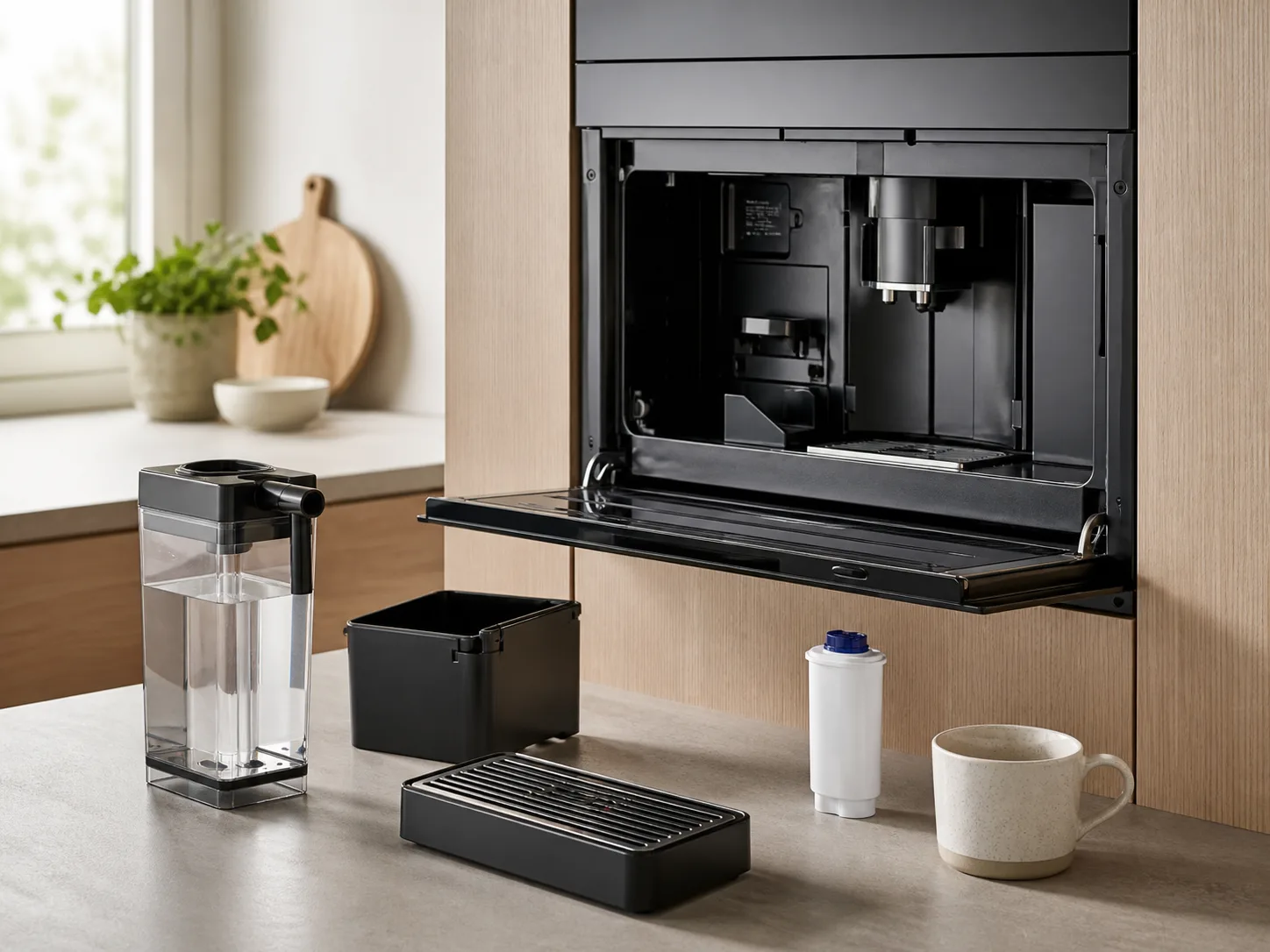
Before buying, ask four ownership questions:
- Can the water tank, drip tray, grounds container, and milk parts be removed without tools?
- Does the machine tell you what needs attention, or do you have to track it yourself?
- Does the “self-cleaning” cycle rinse milk lines, descale, or simply flush coffee residue?
- Can the machine accommodate the water hardness in your home through a test, setting, filter, or maintenance interval?
Hard water deserves special attention because mineral buildup can affect both performance and maintenance intervals. A hardness setting, such as the one listed for the Fulgor Milano, helps the machine schedule care more intelligently; it is not a substitute for the manufacturer’s filter and descaling directions. If a machine has a milk hose, plan for daily attention even when the screen says the rest of the appliance is clean.
When a built-in machine is the wrong choice
A countertop bean-to-cup machine is probably the better purchase if you are renting, may move soon, do not want a cabinet niche, or are still learning which coffee workflow you enjoy. It costs less to replace, can be moved closer to a water source, and makes it easier to compare another machine later. You also avoid locking a large appliance into the kitchen’s service plan.
A built-in machine is also a poor fit when only one person makes one drink a day. The cabinet work, electrical planning, filters, cleaning products, and service logistics may never repay the convenience of a flush front. The visual payoff is real, but it is a design decision as much as a coffee decision.
Buy built-in when the appliance column is already part of the kitchen, the household uses the machine often, and you value a controlled, integrated workflow enough to plan around it. If the answers are not clear, choose a countertop model now and leave the cabinet niche for a later project.
Conclusion
The best built-in coffee machine depends on the problem you need it to solve. Choose the Miele CVA 7845 for premium plumbed convenience, three bean choices, profiles, and automatic descaling; the Bosch BCM8450UC for a removable-tank installation with one-touch variety; and the Fisher & Paykel EB30PSX1 for a strong 30-inch value balance. The JennAir JJB6424HL is the compact customization pick, the Fulgor Milano F7BC24B1 suits milk drinks and water-hardness awareness, the Wolf EC3050CMB offers the most useful large-screen drink range, and the Gaggenau GC461720 is the design-forward splurge for a carefully planned water connection.
Before placing an order, download the exact installation guide, measure the niche and door swing, confirm the water and electrical plan, price the filters and cleaners, and decide who will handle the daily milk and grounds routine. A built-in coffee machine earns its cabinet space when its workflow matches the people who will use it—not when its feature list is merely the longest.