7 Best Squirrel-Proof Bird Feeders for Any Yard
Compare seven squirrel-proof bird feeders by mechanism, bird type, capacity, setup, and trade-offs so you can choose the right fit for your yard.
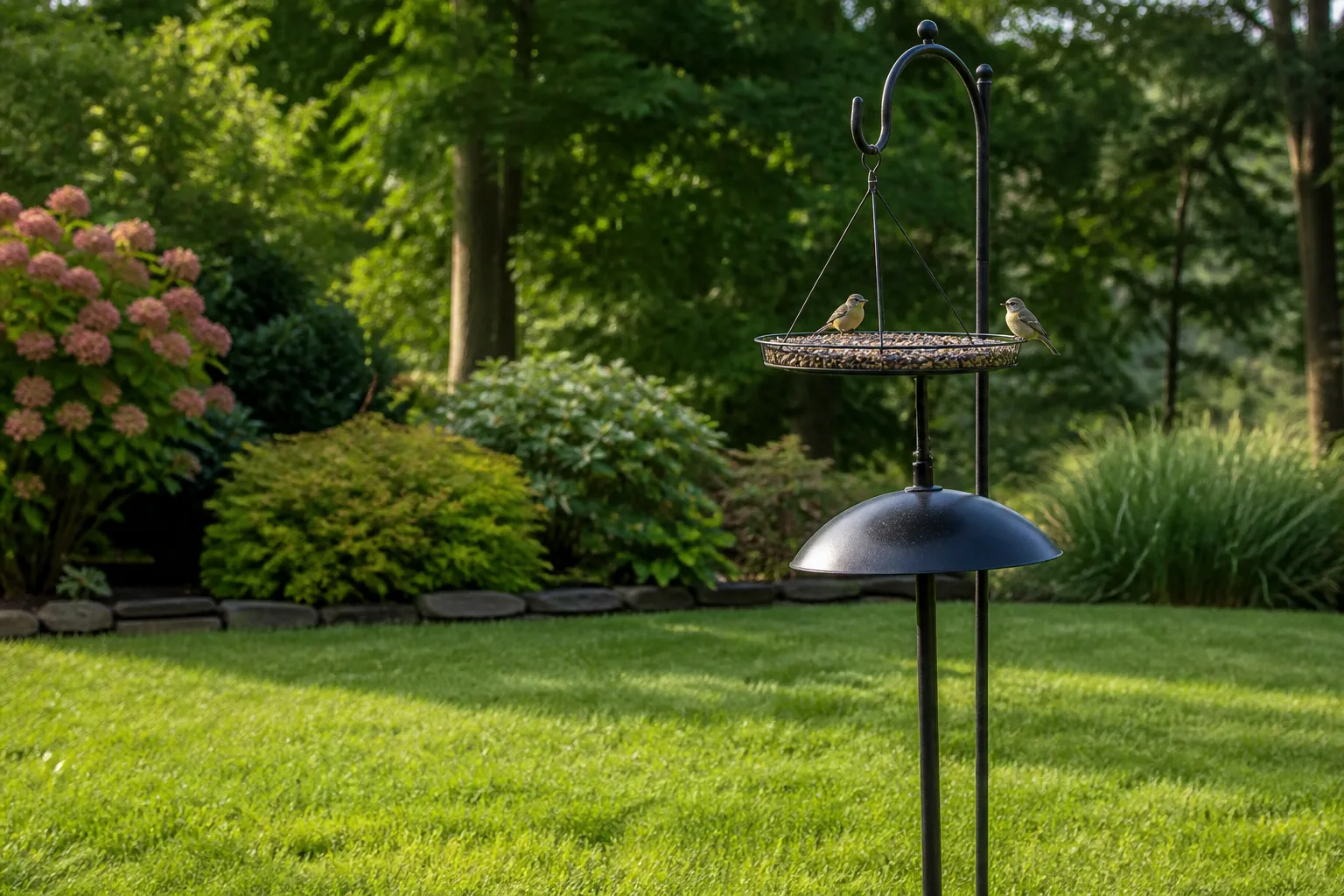
The best squirrel-proof bird feeder is not necessarily the one with the most dramatic mechanism. It is the one whose barrier matches your yard: a weight-triggered tube feeder for a branch with open space around it, a cage for small birds and suet, or a baffled pole when you can create a genuinely isolated feeding station.
There is an important reality check before you shop. “Squirrel-proof” usually means squirrel-resistant under the right conditions, not immune to every mammal that can climb, jump, chew, or knock something over. Cornell Lab’s All About Birds says there is no foolproof way to defeat squirrels, while Audubon’s recent guidance shows that careful placement can make a well-designed setup work extremely well (Cornell Lab’s guidance; Audubon’s placement advice).
This guide compares seven current options by mechanism, bird access, capacity, setup, and failure mode. The recommendations use published specifications and current birding guidance rather than pretending that one controlled test in one backyard predicts what will happen in every yard. Prices and package contents change, so verify the exact model and included battery, charger, pole, or hanger before ordering.
Quick answer: which feeder fits your yard?
Choose the Brome Squirrel Buster Plus if you want the best all-around tube feeder, a large seed supply, and a weight-triggered shroud that closes the ports when a heavier animal lands. Choose the Perky-Pet Squirrel-Be-Gone if you want a lower-cost caged, weight-activated design and can accept more questions about long-term plastic durability.
Choose the Brome Squirrel Buster Standard for a compact feeder that still accommodates both clinging and perching birds. Choose the Brome Squirrel Buster Mini when you feed a small amount of seed, have limited hanging space, or want to empty and clean a smaller feeder more frequently. For suet, the Kingsyard metal caged feeder gives squirrels a physical barrier around the cakes; for a large pole setup, the Squirrel Stopper System makes the pole and baffle the primary defense.
| Feeder | Best fit | Mechanism | Published capacity or setup detail | Main trade-off |
|---|---|---|---|---|
| Brome Squirrel Buster Plus | Most yards | Weight-activated shroud | 5.1 lb; six ports | Higher price and less suitable for some clinging birds |
| Perky-Pet Squirrel-Be-Gone | Budget shoppers | Caged, weight-activated ports | 2 lb in the tested model | Plastic and spring parts need careful handling |
| Brome Squirrel Buster Standard | Small birds in a compact feeder | Adjustable weight-activated shroud | 1.3 lb; four ports | Smaller capacity means more refills |
| Brome Squirrel Buster Mini | Tight spaces and light use | Weight-activated shroud | 1 lb; four ports | Not adjustable and easy to outgrow |
| Droll Yankees Yankee Flipper | Hands-off squirrel drama | Battery-powered spinning perch | Up to 5 lb | Needs charging and a secure lid/placement |
| Kingsyard metal caged suet feeder | Suet and clinging birds | Physical cage | Holds suet cakes; model varies | Access can be awkward for smaller birds |
| Squirrel Stopper System | A full feeding station | Floating, moving baffle | Eight-foot pole; up to eight feeders | Needs open ground and is a substantial purchase |
How these feeders stop squirrels (and where they fail)
The word “squirrel-proof” describes a design strategy, not a species-level guarantee. The most dependable setups remove one of the squirrel’s advantages—weight, grip, or access route—and then make sure the animal cannot bypass the mechanism from a nearby branch, roof, fence, or deck rail.
Weight-activated tube feeders
In a weight-activated feeder, the perch or outer shroud is connected to a spring or lever. A lighter bird can land and keep the seed ports open; when a heavier squirrel lands, the mechanism shifts the shroud over the ports or pulls the feeding openings closed. Brome describes this action on its Squirrel Buster models, and Audubon explains the same general principle for weight-activated feeders (Brome’s Squirrel Buster Plus specifications; Audubon’s mechanism explanation).
This design works only if the squirrel has to put its weight on the trigger. If the feeder is close enough to a trunk or branch for a squirrel to brace itself and reach around, it may steal seed without activating the closure. A feeder that performs perfectly in an open hanging position can fail when moved five inches closer to a tree.
Weight-activated feeders also make a useful distinction between bird size and bird behavior. The mechanism may keep out a squirrel and some large birds, but a small woodpecker or nuthatch may prefer to cling to a surface rather than sit on a conventional perch. If those are the birds you want, look for a wire shroud or tail prop, or choose a suet feeder designed for clinging access.
Cages and suet feeders
A cage keeps paws and teeth outside the food chamber. The openings are sized so small songbirds can reach the seed or suet while a squirrel cannot wrap its body around the food. This is a simple, passive design: there is no spring to adjust and no battery to charge.
The compromise is bird access. A tight cage can also exclude larger birds, and even the birds that fit may need time to learn how to enter, turn, or reach a partially eaten suet cake. That is not a flaw if your goal is to favor chickadees, finches, or other small visitors, but it is a poor match for a yard where cardinals, jays, or woodpeckers are the main attraction. The cage concept is also common in suet feeders, where the food is already a solid cake rather than loose seed (BBC Gardeners’ World feeder guide).
Baffles and feeding stations
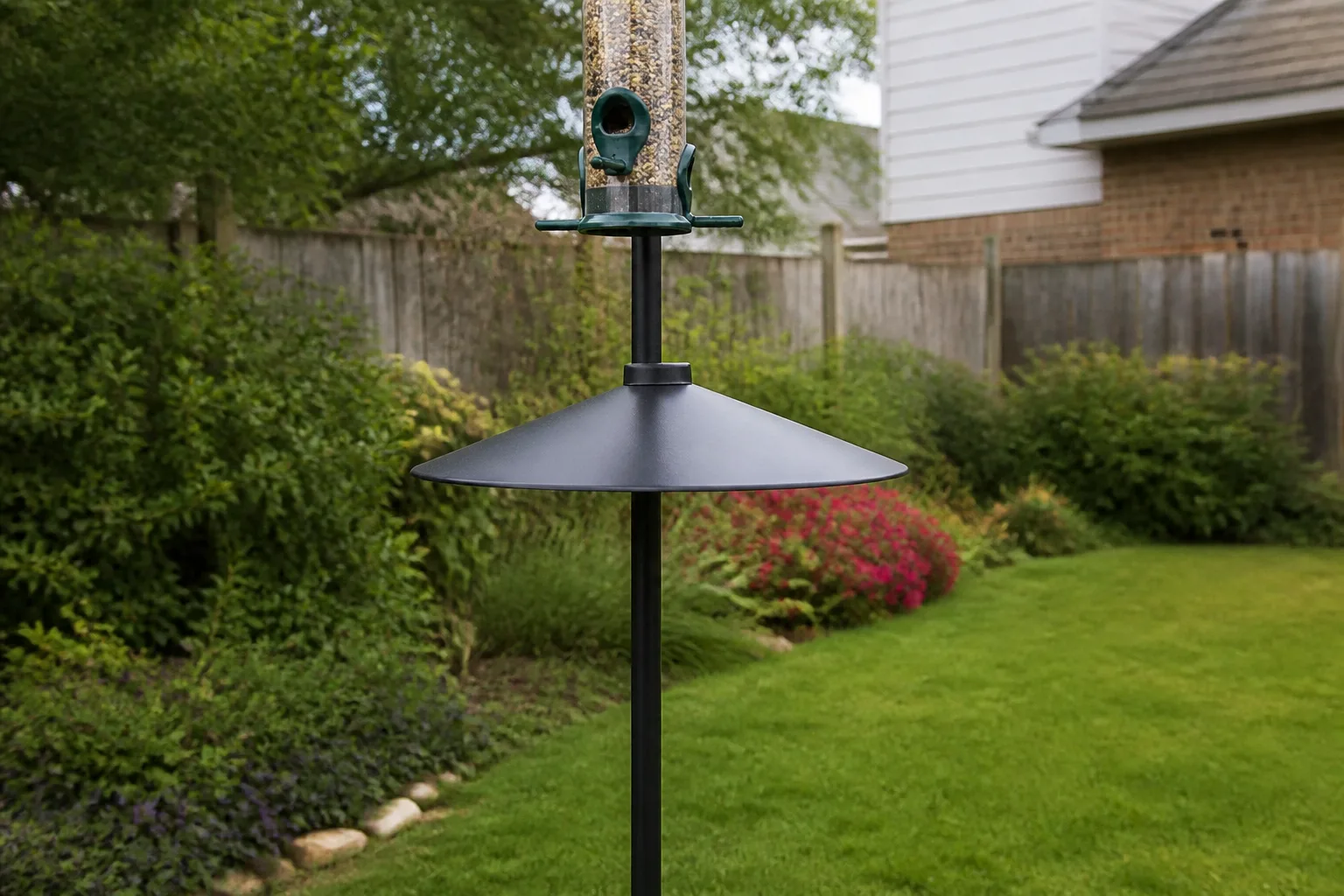
A baffle protects the entire feeding station by interrupting a squirrel’s route up a pole or down a hanging line. The strongest setup is a feeder pole placed in open ground, with a smooth metal baffle between the ground and the feeders. Audubon recommends keeping the pole 8 to 10 feet from solid jumping points and placing the baffle about 4 to 5 feet above the ground; Birds & Blooms gives similar clearance advice (Audubon’s pole guidance; Birds & Blooms baffle guide).
This approach has two advantages. You can use the feeder style your birds prefer, and the baffle protects several feeders at once. It also has two obvious requirements: enough open space and a pole that is stable in wind, rain, and the weight of full feeders. If you cannot create the clearance, a baffle may become an expensive ornament while the squirrels use the nearby fence as a bridge.
The 7 best squirrel-proof bird feeders
1. Brome Squirrel Buster Plus — Best overall
The Brome Squirrel Buster Plus is the best all-around choice when you want a large-capacity tube feeder without adding a separate baffle immediately. Brome lists a 5.1-pound capacity, six feeding ports, a weight-adjustable closing mechanism, chew-resistant exposed parts, UV-resistant components, and a detachable design that can be taken apart without tools (Brome’s Squirrel Buster Plus specifications).
Its most useful feature is not the capacity; it is the combination of a weight-triggered shroud and a cardinal ring. The ring gives broad-bodied cardinals a more comfortable feeding position, while the six ports spread out smaller birds. The same design is less compelling for birds that want to cling to a mesh surface, and its price makes more sense when your yard consumes enough seed to justify fewer refills.
The Plus is also unusually honest about limitations. Brome says its feeder is not intended to deter juvenile squirrels, chipmunks, possums, bears, deer, or raccoons. Treat that warning as part of the buying decision, not a footnote: if raccoons or bears visit your yard, bringing the feeder in at night or using a different wildlife plan may matter more than the model name.
Buy it if: you want the most versatile high-capacity tube feeder and can hang it with clear space around it. Skip it if: your main visitors are clinging birds, your yard has large mammals, or you rarely use enough seed to benefit from the size.
2. Perky-Pet Squirrel-Be-Gone — Best budget pick
The Perky-Pet Squirrel-Be-Gone is the value choice for someone who wants a caged feeder with a weight-activated closure. In Birds & Blooms’ recent testing, the caged Squirrel-Be-Gone model held about 2 pounds of seed, arrived ready to hang, and closed its ports when squirrels climbed the cage (Birds & Blooms’ feeder testing).
The cage makes the mechanism easy to understand and gives a squirrel less exposed plastic to chew than a plain plastic tube. It also lets smaller birds approach from several sides. The drawback is durability at the price: the tester noticed chipmunks beginning to chew the plastic after a few weeks, and the springs can be fiddly to reconnect after cleaning.
Use this feeder when you want a reasonably compact, low-commitment starting point. Hang it where squirrels cannot use the cage as a bridge, inspect the plastic and springs during every refill, and do not assume the budget design will survive a persistent population of chipmunks as well as a metal-heavy feeder.
Buy it if: you want a lower-cost weight-activated cage and mostly see small songbirds. Skip it if: chipmunks chew everything in your yard or you want a feeder to leave unattended for long stretches.
3. Brome Squirrel Buster Standard — Best compact feeder for mixed small birds
The Brome Squirrel Buster Standard is a better fit than the Plus when you want Brome’s weight-activated design in a smaller package. Brome lists a 1.3-pound capacity and four seed ports, plus a weight-adjustable shroud, detachable components, chew-resistant parts, and a wire shroud that gives clinging birds somewhere to hold (Brome’s Squirrel Buster Standard specifications).
That last detail is why the Standard earns a place in this list instead of being treated as a smaller version of the Plus. Perching birds can use the ports, while birds such as nuthatches and some woodpeckers can use the outer structure. The smaller reservoir means more frequent refilling, but that can be a benefit if you prefer to put out fresher seed in smaller quantities or need a feeder that is easier to lift down for cleaning.
The adjustable weight setting is useful when you are trying to admit the birds in your area without leaving the trigger so sensitive that the feeder closes under every large visitor. Adjust it cautiously and watch what actually happens; the correct setting depends on the bird community and the feeder’s mounting stability.
Buy it if: you want one compact feeder for both perching and clinging birds. Skip it if: your birds empty a feeder quickly and you do not want frequent refills.
4. Brome Squirrel Buster Mini — Best for a small yard or light feeding routine
The Brome Squirrel Buster Mini is the sensible choice for a balcony, small yard, or household that sees only a modest amount of bird traffic. Its current product page lists a 1-pound capacity and four ports, with weight-activated closure, a wire shroud for clinging birds, chew-resistant squirrel-facing parts, and tool-free disassembly for cleaning (Brome’s Squirrel Buster Mini specifications).
Small capacity is not automatically a disadvantage. A little seed is easier to monitor for dampness, easier to rotate, and less likely to sit in the tube while you are away. It also keeps the physical load low on a small hook or branch. The clear limitation is that an active flock can empty it quickly, turning a “low maintenance” feeder into a daily refill chore.
The Mini is non-adjustable, so there is less tuning available if a particularly heavy bird triggers the closure or a smaller squirrel finds a way to hang from the wrong point. It is best treated as a simple, manageable feeder for light use rather than as a scaled-down answer to a serious wildlife problem.
Buy it if: you want a small, easy-to-clean feeder and do not need much capacity. Skip it if: you feed large flocks, want adjustable sensitivity, or regularly host chipmunks.
5. Droll Yankees Yankee Flipper — Best motorized option
The Droll Yankees Yankee Flipper is for people who want a visible, mechanical response when a squirrel lands. Its motorized perch ring spins the squirrel away from the feeding position, while the feeder remains usable when a bird lands. The manufacturer describes the tube as holding up to 5 pounds of seed, and Birds & Blooms’ recent tester reported that the rechargeable battery powered the squirrel-flinging mechanism while cardinals, finches, chickadees, and bluebirds continued to use the feeder (Droll Yankees’ feeder overview; Birds & Blooms’ feeder testing).
The mechanism is entertaining, but the real reason to buy it is that it adds another defense when a conventional weight-triggered feeder is not enough. The trade-off is maintenance: a battery must be charged, the moving parts should stay clean, and the feeder still needs intelligent placement. If the squirrel can reach it from a branch or roof, a motor cannot correct a bad feeding station.
Birds & Blooms also notes that the feeder still works when the battery is not charged, but you may need a baffle or other defense. That makes it less fragile than a feeder that becomes unusable without power, yet it is still a poor choice if you do not want one more rechargeable item in your yard routine.
Buy it if: you have persistent squirrels, want a large tube, and do not mind charging. Skip it if: you prefer passive hardware, have no protected place for a battery-powered feeder, or want the quietest possible setup.
6. Kingsyard Metal Caged Squirrel-Proof Suet Feeder — Best lower-cost suet cage
The Kingsyard metal caged suet feeder is the best match when your target birds prefer suet and you want a physical barrier rather than a weight-triggered seed tube. Kingsyard describes its caged suet designs as durable metal feeders intended for high-energy food and birds such as woodpeckers and nuthatches; the current caged model family is built around keeping squirrels outside the food chamber (Kingsyard’s caged suet feeder listing).
The cage is straightforward: squirrels can climb on the exterior, but the suet cakes sit behind a grid that limits paw access. Small and medium birds can work their way through or cling to the mesh. That is also the weakness. A bird that prefers a wide perch or an easy-to-reach edge may ignore it, and a smaller squirrel or chipmunk may still find a route to the cake if the grid is generous or the feeder is poorly placed.
Suet also changes your maintenance routine. Fat-based food can soften in warm weather, and crumbs collect below the feeder. Keep the cage dry, inspect it for bent wires, and clear the ground so fallen suet does not become an attractant for rodents or mammals.
Buy it if: you want to offer suet to clinging birds and prefer a passive metal barrier. Skip it if: you mainly feed seed, want a clear view of the remaining food, or need guaranteed access for larger birds.
7. Squirrel Stopper System — Best full feeding station
The Squirrel Stopper System is the right kind of overkill for a yard that needs a complete station rather than another hanging tube. Duncraft’s current listing describes an 8-foot steel pole, a moving 27-inch baffle, no-tool assembly, and capacity for up to eight feeders with a screw-in auger holding the station in the ground (Duncraft’s Squirrel Stopper System listing).
The advantage is flexibility: add a seed tube, suet cage, or other feeder to the arms and let the station’s baffle protect the whole arrangement. The baffle is designed to move when an animal tries to climb past it, so there is no need to buy a separate baffle for each feeder. This can be a better long-term plan than repeatedly replacing feeders that are being reached from a tree.
The station needs open ground, careful anchoring, and a location where a squirrel cannot jump from a fence or branch onto the upper arms. Duncraft currently marks the listing unavailable, so treat this as a model to compare against when it is in stock rather than an instruction to wait for one particular product. A conventional pole with a correctly sized metal baffle can solve the same design problem.
Buy it if: you want several feeders on one pole and have room for proper clearance. Skip it if: you have a balcony, a narrow deck, or no safe way to anchor a tall station.
Choose by birds and yard
Small birds versus clinging birds
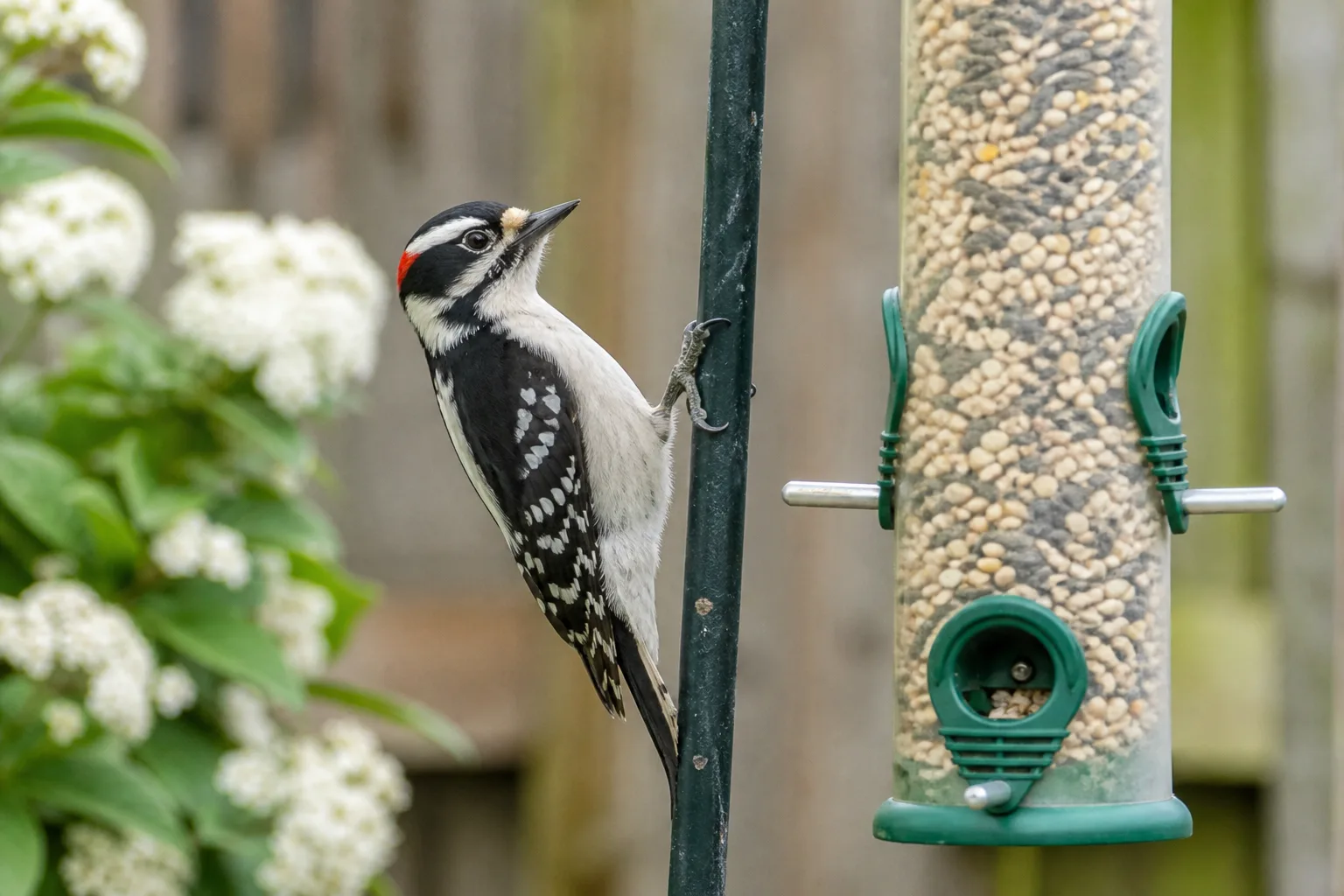
Start with the birds you want to feed, not the squirrel mechanism. Tube feeders with ordinary perches are a comfortable fit for many finches, sparrows, chickadees, and cardinals. A cage or wire shroud is more useful when you want to favor small birds or give clinging birds a surface to hold, but it can also discourage larger birds.
Suet is usually the better format for woodpeckers, nuthatches, and other birds that cling while feeding. A suet cage is not a substitute for a seed feeder; it is a different menu and a different access pattern. If your goal is a diverse yard, one weight-activated seed feeder plus one caged suet feeder may work better than trying to force every species onto a single design.
Seed choice can reduce pressure but should not be treated as a replacement for hardware. Audubon notes that many birds eat safflower while squirrels generally dislike its taste (Audubon’s feeder guidance). Test a small amount first, because local birds may prefer a different seed and a change in food does not prevent a squirrel from investigating a feeder it can physically reach.
Hanging feeder versus pole station
A hanging feeder is the easiest option when you have a strong branch or bracket and can maintain clearance from jumping points. It is also simpler to bring indoors at night if raccoons, deer, or other mammals are emptying it. Check the hook, cable, and branch periodically; a squirrel-resistant body is not helpful if the support bends or drops the feeder.
A pole station is better when you can place it in open ground and want to use multiple feeders. It is also easier to protect with a properly positioned baffle than a feeder hanging from a tree in a dense canopy. The cost is installation: the pole must be stable, the baffle must be high enough to prevent a jump onto it, and the entire station must sit beyond the squirrel’s launch distance.
Install it so the mechanism can work
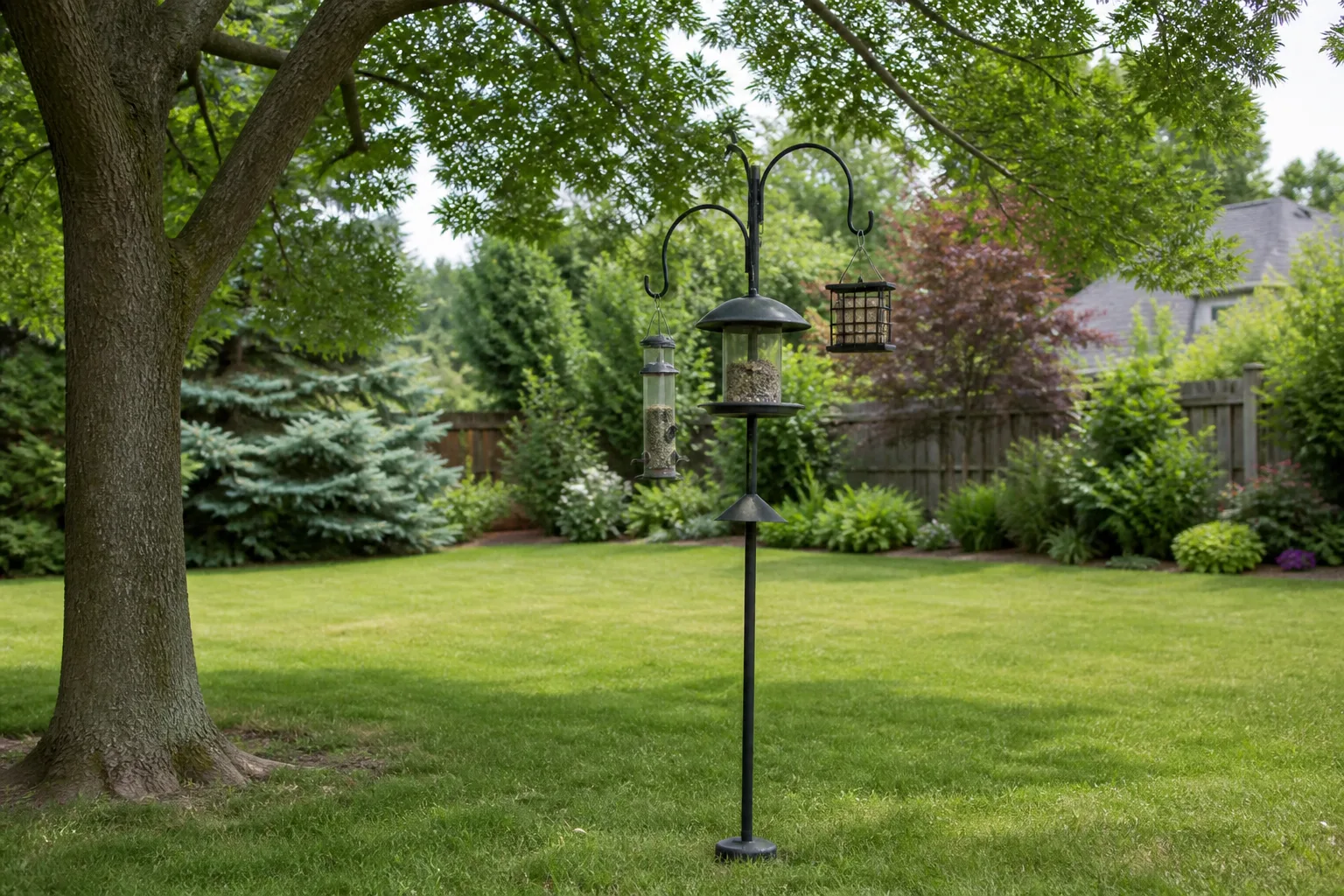
The best feeder can fail in the wrong spot. Before filling it, use this setup sequence:
- Measure the nearest launch point. For a pole and baffle, keep the station about 8 to 10 feet from trees, fences, roofs, and other solid objects. A hanging feeder needs enough space that a squirrel cannot reach from the supporting branch or a nearby trunk.
- Make the trigger unavoidable. A weight-activated feeder should hang or stand so a squirrel has to land on the perch or cage. Do not place it close enough for the animal to brace its hind feet elsewhere and reach over the opening.
- Set the baffle at the right height. A pole baffle that sits too low can become a launch pad; one that sits too high may be bypassed from the ground or pole. Follow the baffle maker’s instructions, using the 4-to-5-foot guidance as a starting point rather than a substitute for measuring your specific yard.
- Stabilize the support. Fill the feeder only after checking that the branch, hook, shepherd’s pole, or auger can support the loaded weight. Wind can turn a full feeder into a pendulum and move it toward a branch.
- Watch the first day. Look for the actual route squirrels use. If they approach from a roof, cable, railing, or neighboring tree, move the feeder or remove the bridge instead of blaming the mechanism.
One more detail matters for birds: keep the feeder near enough to cover that birds can retreat quickly, but not so close to dense shrubs that cats can hide beside it. A clear view and nearby escape cover are a better compromise than placing the feeder directly inside a thicket.
Keep the feeder safe and worth using
Squirrel resistance is only half the job. A feeder with old, wet seed can harm birds even when no squirrel reaches it. Audubon recommends cleaning seed feeders about every two weeks, increasing that frequency if disease is suspected, and cleaning with a nine-parts-water-to-one-part-bleach solution after visible debris is scrubbed away. The feeder should dry completely before it returns outside (Audubon’s disease-prevention guidance).
Use a routine that matches the feeder’s design:
- Empty stale, wet, or clumped seed before taking the feeder apart.
- Remove the cage, shroud, perch, or battery compartment according to the manufacturer’s instructions; do not force a spring or motor housing.
- Scrub seed dust and droppings from seams, ports, and trays before disinfecting when needed.
- Rinse thoroughly, let every part dry, and refill with only as much food as the birds will use before the next check.
- Rake or scoop hulls, suet crumbs, and wet seed from below the feeder so the ground does not become a rodent or disease hotspot.
If you see a sick bird, stop concentrating birds at that location and contact a local wildlife rehabilitator or wildlife-health authority rather than trying to treat the bird yourself. Multiple feeders spaced apart can reduce crowding, but they do not remove the need for cleaning. Gardeners’ World also highlights current guidance about moving and cleaning feeders regularly and avoiding flat surfaces where contaminated food can collect (BBC Gardeners’ World Magazine feeder guidance).
Avoid greasing a pole or coating a feeder with a sticky substance. It can foul feathers, harm other wildlife, and turn a manageable placement problem into a wildlife-safety problem. A smooth, correctly placed baffle, a cage, a weight trigger, a species-appropriate seed, or simply moving the feeder is easier to inspect and safer to maintain.
Conclusion
For most yards, the Brome Squirrel Buster Plus is the strongest all-around starting point because it combines high capacity, adjustable weight sensitivity, and a bird-friendly perch layout. The Perky-Pet Squirrel-Be-Gone is a practical budget alternative, while the Brome Standard and Mini make more sense when you want smaller, easier-to-manage feeders. Choose the Droll Yankees Yankee Flipper for a motorized response, the Kingsyard cage for suet and clinging birds, or the Squirrel Stopper System when a properly isolated pole is the real solution.
Whichever you buy, measure the yard before you fill the hopper. Keep launch points out of range, give the target birds a comfortable way to feed, clean the feeder and ground regularly, and treat “squirrel-proof” as a design goal with limits—not a promise that overrides geometry, wildlife behavior, or maintenance.



