Bordeaux Mixture for Roses: Uses, Timing, and Safety
Bordeaux mixture may protect roses before infection, but it cannot heal spotted leaves. Check label timing, copper risks, PPE, and safer disease controls.
The short answer: use it only when the current label fits
Bordeaux mixture may help prevent some fungal infections on roses when a product is authorized for that exact plant, disease, location, and growth stage. It is a copper-based protectant, not a cure for leaves that already have black spots, and no calendar date makes every Bordeaux product appropriate for every rose.
Before spraying, answer two separate questions: does the rose have a disease that a fungicide can help prevent, and does the current label allow this product to be used on roses for that disease under today’s conditions? If either answer is no or uncertain, skip the spray while you improve sanitation, airflow, and watering practices or ask a local Extension office for diagnosis.
There is no safe universal Bordeaux ratio or annual schedule for home gardeners. A product’s formulation and label determine whether it can be used, how it must be prepared, what protective equipment is required, and how often it may be applied. Do not treat an online recipe—or the words “copper fungicide”—as permission to mix or spray a pesticide.
What Bordeaux mixture is—and what it is not
Bordeaux mixture refers to a copper sulfate and lime fungicide formulation. That name describes a family of mixtures, not one standardized home-garden product. Commercial products, where available, can have their own ingredients, concentration, uses, precautions, and legal directions.
It is not interchangeable with every product containing copper. Copper hydroxide, copper octanoate, copper-ammonia complexes, and other copper formulations have different labels and plant-safety profiles. Cornell’s copper-fungicide guidance explains that copper products vary in active ingredient, application rate, crop, re-entry interval, and preharvest interval; even products in the same broad category are not interchangeable. A horticulture overview also distinguishes Bordeaux mixtures from other copper fungicide types, but neither general explanation authorizes a particular product on roses. (Cornell University; Epic Gardening)
The lime in the name also does not mean you can substitute garden lime from the shed. More importantly, knowing the ingredients does not tell you whether a homemade mixture is registered, labeled, or suitable for a rose in your jurisdiction. The Royal Horticultural Society advises UK gardeners against homemade pesticide products because they are unregulated and usually untested. Follow the rules where you live and use only a product whose own label covers the intended use. (RHS)
What it can prevent and what it cannot cure
Copper works where the spray deposit contacts a pathogen before it enters plant tissue. Cornell describes copper fungicides as having no post-infection activity: they may protect an exposed surface against a new infection, but they do not move through the plant to repair infected tissue. That is why a fungicide can sometimes reduce new disease while leaving old spots, yellowing, and damaged leaves unchanged. The Cornell guidance is written for vegetable crops, so its crop rates and intervals do not apply to roses; the preventive-versus-curative distinction is the relevant point here. (Cornell University)
Rose black spot is caused by Diplocarpon rosae. Its spores spread in wet conditions, and infections can be established before a gardener sees the characteristic dark lesions. Wisconsin Extension specifically describes fungicide treatments as preventative and says they may be worth considering when a rose has a history of severe black spot and wet growing weather is expected. Spraying an already spotted leaf cannot erase the infection that produced the mark. (Wisconsin Extension)
Think of treatment as possible protection for susceptible new growth, not a rescue for a sick-looking bush. When symptoms are visible, first remove infected debris, reduce leaf wetness, and assess whether the disease is spreading. If you later consider a fungicide, choose one labeled for the confirmed disease and use it only at the stage and interval the label allows.
Decide whether the rose needs treatment
A few spots do not automatically justify a pesticide. Wisconsin Extension says that when a rose has little or no defoliation and the weather is dry, no treatment may be necessary. Its suggested decision threshold is more specific: consider preventive fungicide only when there is a history of severe black spot and the growing season is expected to be wet. (Wisconsin Extension)
That threshold helps avoid spraying a healthy, resistant rose just because a neighbor’s plant has a problem. A single dry spring, a rose with no past disease, or a few old leaves with limited damage may call for observation and cleanup rather than copper. By contrast, a susceptible cultivar that repeatedly loses leaves during wet springs may merit a prevention plan—but cultural controls still come first, and any pesticide option remains label-dependent.
Ask whether the plant is losing enough foliage to weaken it, whether the same disease has recurred, and whether the forecast is likely to keep leaves wet. Then ask whether a product is specifically labeled for roses and black spot in your location. Do not use disease severity alone to justify a product whose label, timing, or environmental restrictions do not fit.
Recognize rose black spot before choosing a spray
Black spot usually begins as dark brown, purplish, or black lesions on leaves, often with feathery or irregular edges. Yellowing may spread around a spot, and affected leaves can drop early; reddish-purple to black lesions may also appear on canes. The disease often starts on lower leaves and moves upward as rain or overhead watering splashes spores. (Washington State University Hortsense; Wisconsin Extension)
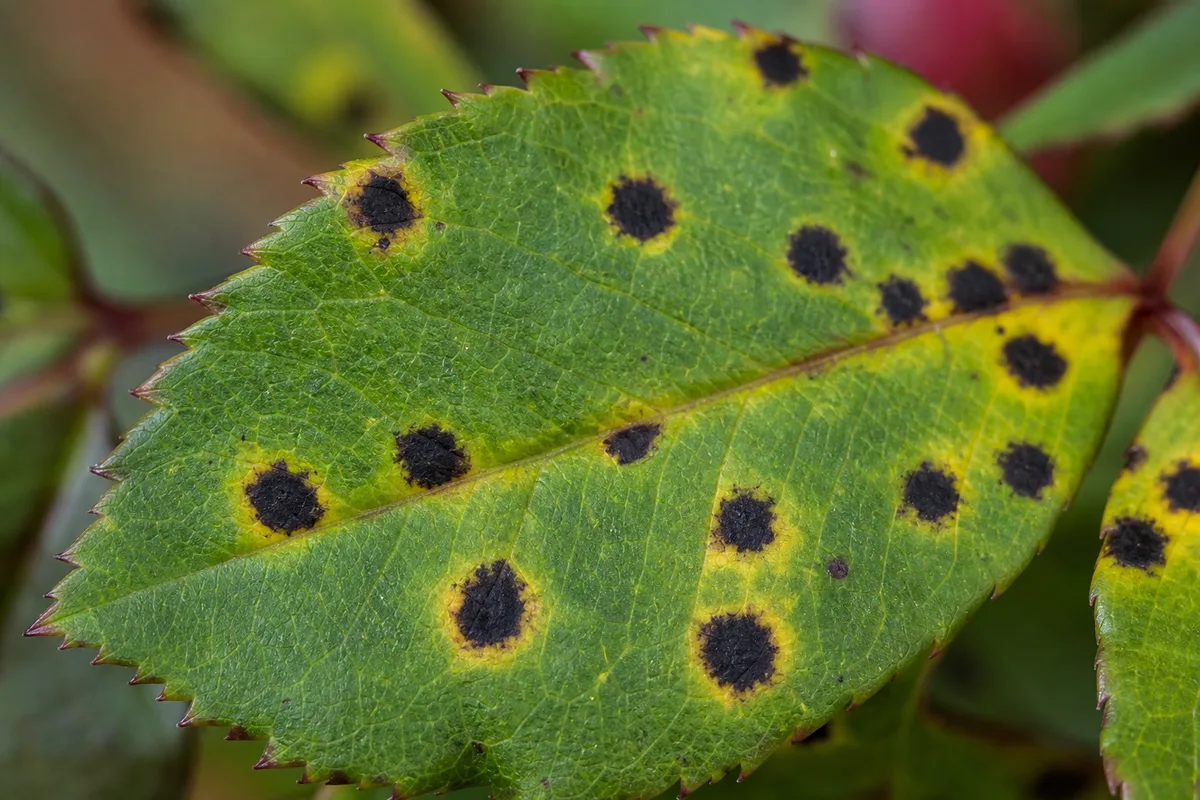
Look at the pattern across the plant, not just one mark. Multiple roughly circular lesions, leaf yellowing, and early leaf drop after wet weather fit black spot better than a single damaged leaf, but an image-based guess is not always enough to identify a disease.
Rule out look-alike problems
Rose leaves can yellow or spot for reasons other than black spot, including drought stress, nutrient problems, insects, spray injury, and other diseases. If the discoloration appeared soon after another treatment, began on new growth, or lacks the typical spreading dark lesions, adding another spray may make the problem worse rather than solve it.
Washington State University’s current Hortsense page describes black spots and cane lesions, links symptoms to rain and overhead watering, and lists state-specific management options. Wisconsin Extension cautions that visual diagnosis can be difficult and provides a plant disease clinic for uncertain cases. Use a local Extension diagnostic service when symptoms do not fit cleanly, especially before starting a repeated pesticide program. (WSU Hortsense; Wisconsin Extension)
What to do before any spray
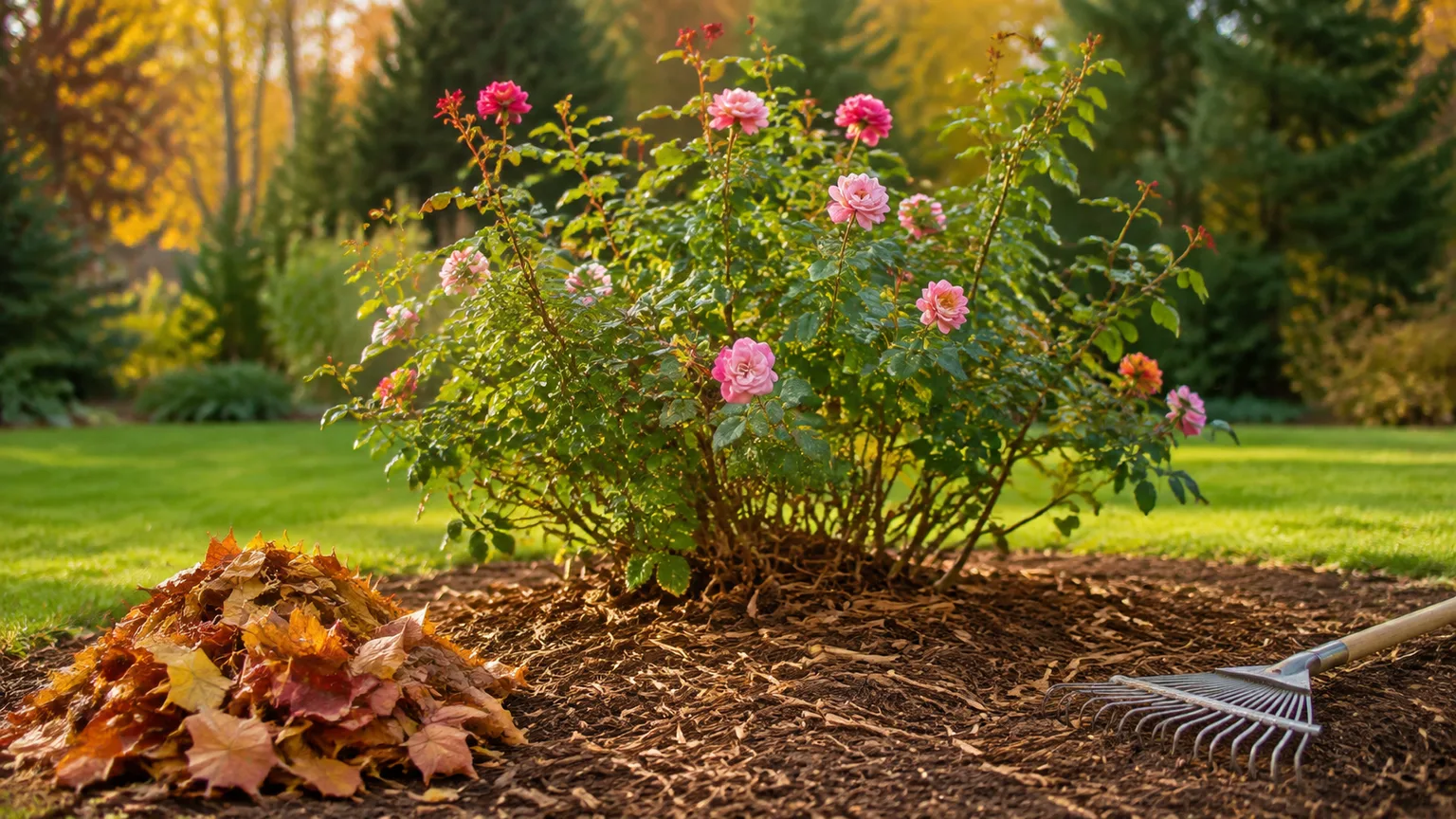
Reduce the conditions that help black spot spread. Pick up fallen rose leaves and remove diseased leaves or canes; do not put infected material in a home compost pile unless your local guidance confirms the pile reaches conditions that destroy the pathogen. Prune to open the plant and improve air movement, and water at the soil rather than wetting foliage. If overhead watering is unavoidable, do it early enough for leaves to dry quickly.
Washington State University lists these nonchemical steps as the first choice: avoid overhead watering, improve spacing and air circulation, remove diseased leaves and canes, rake fallen leaves, and choose resistant varieties. The RHS likewise puts cultivation, cultivar selection, and garden hygiene ahead of chemical treatment; its advice applies to UK gardeners and recommends against fungicides for rose black spot because of wider environmental effects. The details differ by region, but both sources support starting with prevention rather than a routine spray. (WSU Hortsense; RHS)
These steps are not a guarantee that spores will never reach the plant. Wind-driven rain can bring spores in from elsewhere, and sanitation is less effective when neighboring roses are infected. Even so, keeping leaves drier and removing overwintering debris can lower pressure without adding more copper to the garden. If the rose stays healthy after these changes, there may be no reason to spray.
Spring timing depends on whether foliage has emerged
“Spring” is not a useful application instruction by itself. In one garden, spring may begin while the rose is dormant; in another, leaves may already be open. The label’s permitted growth stage and the plant’s actual condition matter more than the month on the calendar.
Bordeaux mixture is often discussed as a dormant-season treatment, but that generalization is not a current product label. The Bordeaux-specific UC IPM page surfaced in this research is explicitly archived and was last revised in 2010. It lists winter use examples that include rose black spot and warns that applying Bordeaux after dormancy can injure leaves. Treat that page as historical Extension context and a reason to be cautious—not as current authorization, a recipe, or a schedule for a product you own. (Archived UC IPM Bordeaux guidance)
Current rose disease guidance may discuss fungicide programs during wet spring weather, but that does not mean every copper formulation is suitable after leaf-out. WSU Hortsense’s page was reviewed in August 2026 and lists examples of fungicides for black spot in Washington; it also warns that copper fungicides may discolor foliage or blooms. Its state-specific product list is not a Bordeaux recipe or a nationwide approval. Check the exact label for the product you have. (WSU Hortsense)
Dormant rose versus rose in leaf
If the rose is dormant, do not assume a dormant Bordeaux use is automatically lawful or safe. The product must still list the site, target disease, and application stage, and your state or country must allow its use. If no current label covers the use, do not apply it simply because an older Extension page described a similar treatment.
If buds have opened or leaves are present, be even more cautious. Tender foliage can be more vulnerable to copper injury, and the archived Bordeaux guidance specifically warns about leaf damage after dormancy. If the label does not clearly permit use on emerged rose foliage for black spot, skip Bordeaux. A separately labeled product may have different directions, but do not substitute it by guessing from the word “copper.”
Check the exact product and the law where you garden
In the United States, pesticide labeling is not optional advice. Federal regulations require directions for use to identify the application site, target pest, dosage, method, timing and frequency, worker-protection information, storage and disposal instructions, and restrictions such as harvest intervals or warnings for certain sites. The required label statement says that using a product in a manner inconsistent with its labeling violates federal law. (40 CFR § 156.10)
For an EPA-registered product, use the EPA Pesticide Product Label System to locate official label information, then check with your state pesticide regulator about local registration or restrictions. The National Pesticide Information Center explains that state agencies work with EPA and can answer whether a product is registered in a particular state. Outside the United States, follow your own national and local pesticide authority; a U.S. label is not approval in another country. (NPIC state pesticide agencies)
Read the whole label, not just the active ingredient
Before buying or opening a product, verify each of these items on the current label:
- Site and plant: Does it cover outdoor home gardens and roses, or only another crop, ornamental site, greenhouse, or commercial setting?
- Disease: Is black spot or the relevant disease listed for that site? “Copper fungicide” is not itself a rose-use direction.
- Growth stage and timing: Does the label allow use on dormant plants, new growth, or fully leafed-out roses? Are temperature, rain-free, or seasonal limits specified?
- Mixing and application: What exact dilution, equipment, coverage, maximum number of applications, and interval does this formulation require? Do not transfer directions from a different copper product.
- Protection and access: What PPE, first aid, re-entry interval, and restrictions for children, pets, or workers apply?
- Food and environment: Are edible crops or rose hips covered? What preharvest interval, buffer, drift, runoff, pollinator, storage, and disposal directions apply?
The label’s ingredient statement alone is not enough. Cornell notes that copper products differ in copper amount, crop rates, re-entry intervals, and preharvest intervals; its factsheet covers vegetables, not roses, so it cannot supply a rose rate. NPIC’s label guide also points gardeners to the directions, PPE, first aid, environmental hazards, and storage sections. If the label is missing, unreadable, outdated, or silent about the use you have in mind, do not improvise. (Cornell University; NPIC, Reading Pesticide Labels)
If the label permits use, apply conservatively
Only proceed after the disease, label, plant stage, and local registration all match. The label is the source for the amount, dilution, timing, equipment, coverage, and repeat interval. This guide intentionally gives no homemade recipe or converted rate: a ratio from another product or an old article can put too much copper on a rose, violate the label, or injure foliage.
Do not add dish soap, a spreader, fertilizer, oil, or another pesticide unless the product label specifically permits that combination. Do not use leftover mix on a different plant or crop just because it is nearby. If the label calls for an application window that has passed, wait for an explicitly permitted future window or choose nonchemical controls.
Prepare the site and protect yourself
Read the full label before mixing, not while the sprayer is open. Wear every item of PPE the label specifies; this may include chemical-resistant gloves, eye protection, protective clothing, or respiratory protection, and the material requirements can vary by product. Do not substitute ordinary gloves for a label-specified chemical-resistant type. Keep children, pets, and other people away for the full period stated on the label.
Choose only the weather and application conditions allowed by the label. Avoid drift onto people, neighboring plants, edible beds, ponds, drains, and other restricted areas. Do not spray in gusty conditions or when rain is likely to carry the deposit away unless the label specifically addresses those conditions. If the product requires a dry period before rain or irrigation, honor that interval rather than relying on a generic rule.
Follow coverage and equipment directions
Use only equipment named or permitted on the label, and do not assume every sprayer material is compatible with a copper-lime formulation. Apply the product only to the listed site and at the labeled coverage; “coat every part of the plant” is not a safe substitute for the actual direction. Avoid unnecessary runoff onto soil or hard surfaces, and stop if wind or overspray moves the product outside the target area.
Observe the label’s maximum number of applications and minimum interval. Repeated spraying every year—or after each rain—should never be automatic. The product label controls when another application is permitted and whether the rose or surrounding crop can tolerate it. Follow the labeled cleanup, residue removal, storage, and disposal instructions for the sprayer and any unused product; do not pour leftovers into a storm drain, pond, or sink.
Protect soil, water, wildlife, and edible harvests
Copper is an element, so it does not break down in soil like many organic compounds. Cornell’s copper-fungicide factsheet warns that intensive use over years can build copper in soil and that copper products can injure plants when copper enters their tissues. NPIC reports that copper sulfate can persist in surface soil and is highly to very highly toxic to fish and other aquatic life. A “natural” or “organic” description does not remove those risks. (Cornell University; NPIC copper sulfate fact sheet)
Keep spray and runoff away from ponds, streams, storm drains, and water that may support fish or aquatic invertebrates. Do not spray a rose in a way that carries residue into an edible bed, and do not assume that an ornamental-use label covers rose petals or hips you plan to eat. A food crop needs an explicit label use and any required preharvest interval; if the label does not cover that harvest, do not treat it as edible-safe.
Pollinator precautions also depend on the exact product and its label. Cornell’s vegetable-focused copper guidance notes that copper sulfate can be more toxic to native bees than some other copper forms, while copper products vary in formulation and use restrictions. Avoid spraying open blooms or visiting pollinators unless the label expressly permits the timing and method. Use the product-specific environmental directions rather than assuming all copper products have the same effect. (Cornell University; 40 CFR § 156.10)
Monitor the rose instead of spraying on autopilot
After cleanup or any properly labeled application, watch new growth and weather rather than judging success by old spots. Existing lesions and yellowed leaves can remain even when no new infections develop. Note whether spots appear on new leaves after prolonged wet weather, whether leaf drop increases, and whether the same pattern returns next season.
If disease remains limited, continue sanitation and base watering instead of adding an unplanned second product. If it worsens, ask a local Extension office or plant disease clinic to confirm the diagnosis and identify locally labeled options. Where a pesticide program is justified, keep the product label and application date; do not increase the amount, shorten the interval, or switch to another copper product without checking its own directions.
Conclusion
Bordeaux mixture may have a place in a rose disease-prevention plan, but it is not a cure for black spot and it is not a universal spring spray. Confirm the disease, reduce leaf wetness and infected debris, then use Bordeaux only if a current local label specifically fits the rose, target disease, and growth stage. If that match is missing, skip the mixture and choose sanitation, monitoring, or a locally recommended labeled alternative.