How to Grow and Care for Bunny Ear Cactus Indoors
Learn how to grow bunny ear cactus with practical light, water, soil, winter, and propagation advice, plus safer ways to handle its detachable glochids.
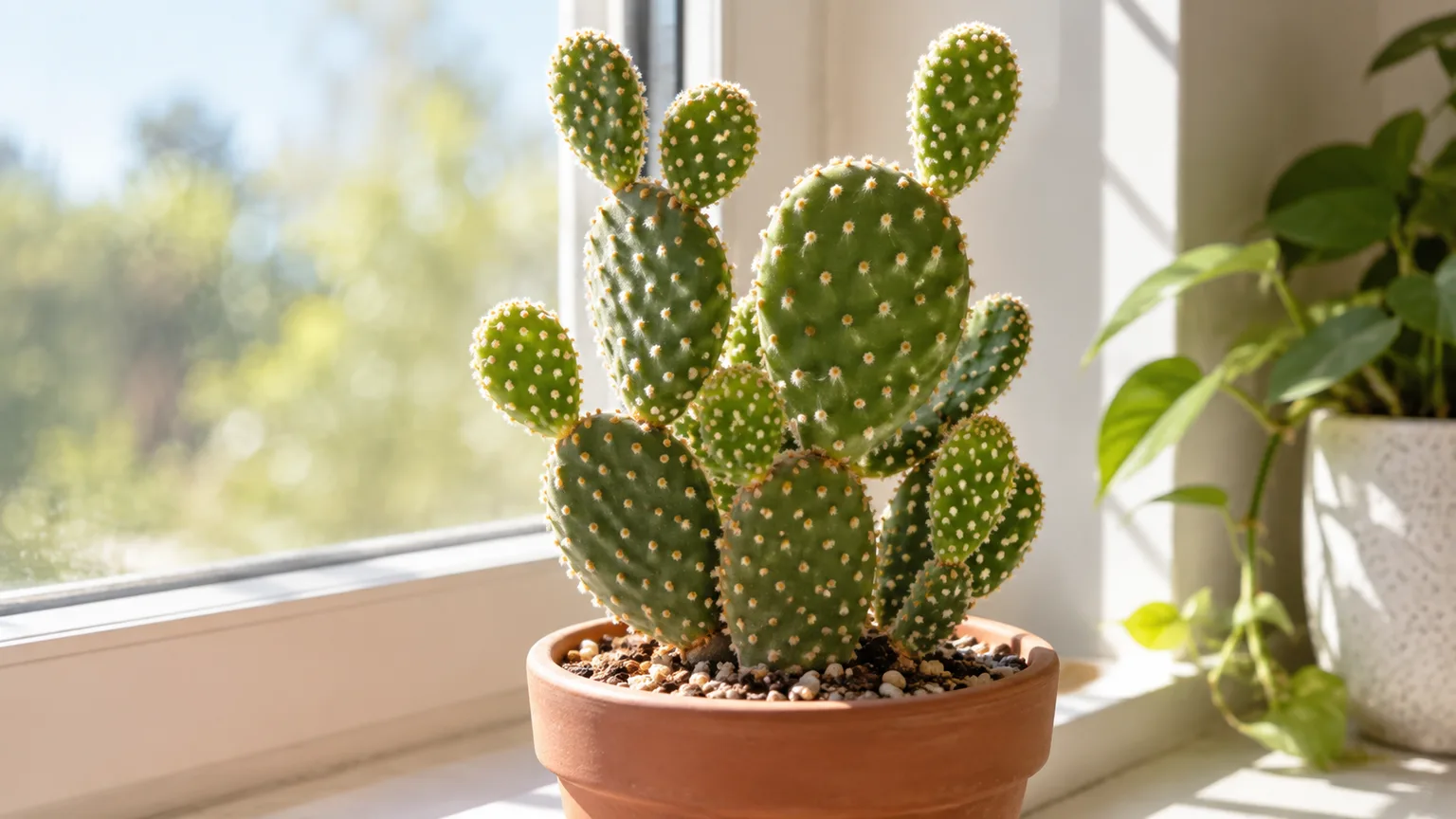
Bunny ear cactus is easiest to keep healthy when you solve two things together: give it strong light and keep its roots from staying wet. Water it thoroughly only after the mix has dried through, and treat the tiny dots on its pads as detachable glochids, not soft fuzz.
The cactus is forgiving about missed waterings, but it is not a harmless plant to handle. Put it where people and pets will not brush against it, and use tongs or folded paper whenever you move, prune, or propagate it.
Know what you are growing
Bunny ear cactus, Opuntia microdasys, is a pad-forming cactus native to northern Mexico and nearby desert regions. It is also sold as angel’s wings, bunny ears, golden-bristle cactus, or polka-dot cactus. Mature plants can form broad clumps; NC State Extension gives a potential size of about 2 to 3 feet tall and 4 to 5 feet wide, though a container-grown plant usually remains more compact.
Its oval, flattened pads are modified stems, not leaves. New pads often appear in pairs, creating the “ears,” while small areoles across the surface hold the white, yellow, or reddish bristles called glochids. The NC State Extension species profile and RHS profile for Opuntia microdasys both describe these bristle-covered pads and yellow flowers. The bristles may look less threatening than long cactus spines, but they detach easily and can irritate skin and eyes.
| Care factor | Practical target |
|---|---|
| Light | Several hours of direct sun; brightest safe window indoors |
| Soil | Fast-draining cactus mix with a mineral component |
| Water | Soak only after the root ball is dry through |
| Temperature | Warm growing season; protect from frost |
| Handling | Keep out of traffic and use tools or a paper barrier |
Choose the right place: indoors or out
Indoors is the simplest option if winters are cold or wet. Set the plant near the brightest available window, ideally one that receives direct sun, and keep it away from curtains, walkways, and low shelves where someone might brush a pad. A plant that is safe on a high, sunny sill can become an injury risk on a desk or beside a doorway.
In a warm, dry climate, you can grow bunny ear cactus outdoors in a container or a sharply drained rock garden. A pot gives you more control over water and lets you move the plant before cold weather; NC State Extension also notes that container growing helps control its spreading habit. Avoid a low spot where rain collects, and do not set the pot outside for a full day of intense sun immediately after it has spent months indoors.
Give it direct light, but acclimate it
This cactus wants far more light than a typical foliage houseplant. Place it in the sunniest practical indoor position, often near a south- or west-facing window in the Northern Hemisphere. If the room is dim, a grow light can supplement daylight, but turning the plant toward the window or adding a lamp will not compensate for a cold, persistently wet root zone.
Acclimate it gradually whenever you move it from a shop, a shaded room, or indoors to the patio. Start with a few hours of gentler morning sun, then add exposure over roughly one to two weeks. Sudden hot afternoon sun can bleach or scorch pads that were grown under shade, even though an established plant can eventually take brighter conditions.
Watch the newest pads rather than expecting old growth to change shape. Thin, unusually long pads that lean toward the window point to insufficient light; pale, dry patches on the sun-facing side after a move suggest sun stress. Rotate the pot occasionally so new growth does not all bend in one direction, but do not keep shifting the plant between very different light levels.
Choose a mineral, fast-drying mix and a draining pot
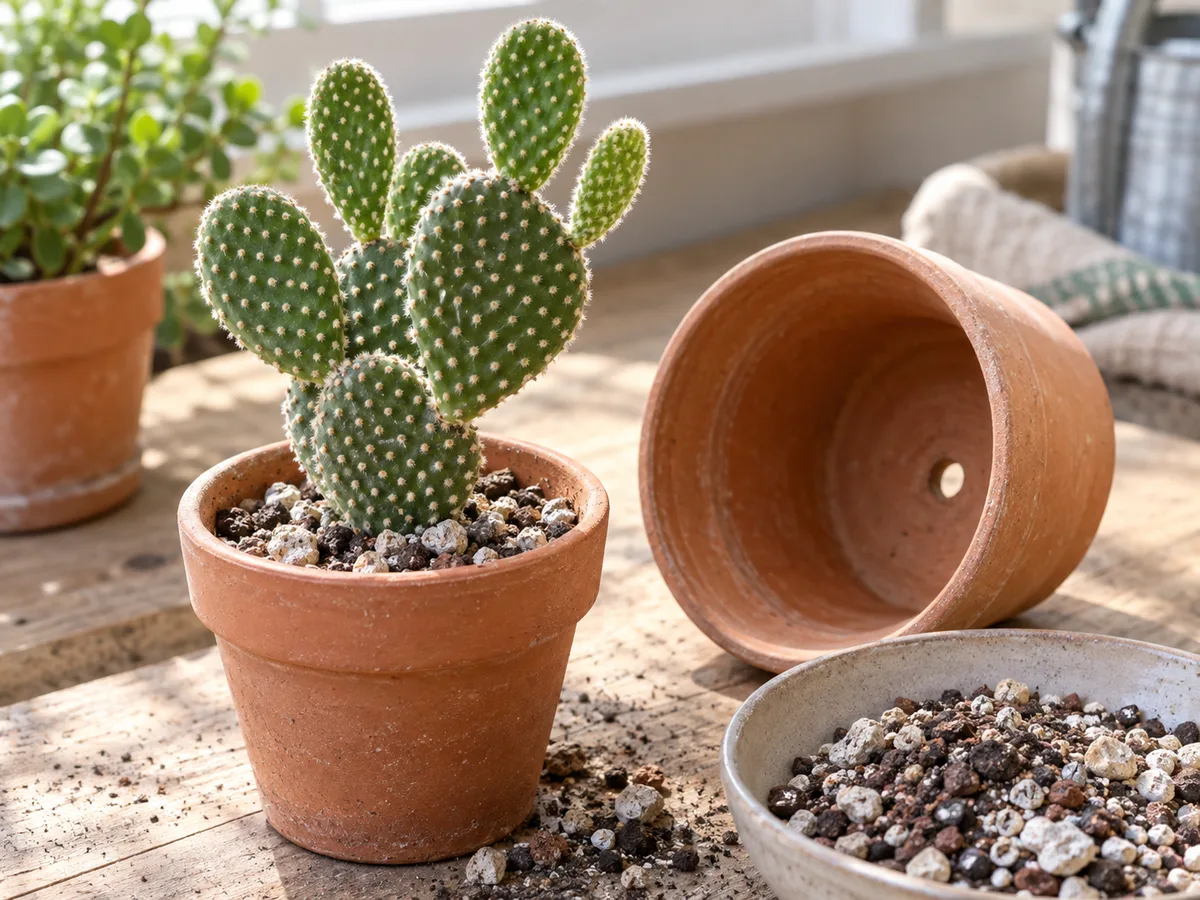
Use a cactus or succulent mix that drains freely, not ordinary potting soil by itself. Many bagged mixes contain enough fine organic material to stay damp too long indoors, so loosen a slow-drying mix with coarse pumice or perlite. The goal is a root ball that wets when watered and then returns to an airy, dry state—not a pot that stays soggy and not a jar of dry stones with no support for roots.
Avoid fine play sand as a shortcut. Fine particles can pack into gaps and make a mix denser; coarse mineral particles create better air space. Our cactus soil guide explains how to judge a mix by its structure and drying behavior rather than the label on the bag.
Choose a pot with an open drainage hole. A small terracotta pot can help the root zone dry evenly, while a wider or heavier pot may be useful for a top-heavy plant; either way, do not jump several pot sizes up. Extra unused soil holds extra water around a small root ball. A pot only modestly larger than the roots is usually easier to manage.
Water after the mix dries through
Do not water bunny ear cactus by a weekly reminder. The interval changes with window exposure, pot size, pot material, mix, room temperature, and season. Instead, check the mix to the bottom with a dry wooden skewer, lift the pot to compare its weight, and look at the pads. Water when the root ball is dry through and the pads remain firm or are just beginning to lose a little plumpness.
When it is time, wet the mix thoroughly until water runs from the drainage hole, then empty the saucer. Small sips leave some roots dry while keeping the top layer damp, which makes it harder to judge when the next watering is due. The RHS cultivation guidance likewise recommends letting the compost dry before watering during active growth.
Expect longer dry gaps in winter, when light and growth slow. Do not water again just because the calendar says it has been two or three weeks: in a cool room, a plastic pot, or a low-light corner, the plant may still be wet. On the other hand, a small terracotta pot in a hot, sunny room can dry faster. The pot and the plant’s condition—not a universal schedule—decide.
Keep it warm and let winter growth slow
Bunny ear cactus prefers warm, bright growing conditions and does not tolerate frost. If you keep it outdoors in a container, bring it into a bright, protected space before freezing temperatures. Do not leave it outside in a cold, rainy winter simply because it can tolerate a short cool spell; cold roots and wet soil together are a poor combination.
In winter, give it the brightest light available and reduce watering as growth slows. NC State Extension describes a cooler rest around 50 to 65°F with very little water for wintering plants. You do not have to force a cool rest in a warm home, but avoid placing the cactus over a heater or in a dark corner and continuing summer watering. Normal dry indoor air is suitable; a terrarium or humidity tray is unnecessary.
Feed lightly during active growth
Fertilizer is optional if the plant grows slowly and the potting mix is fresh. When you see new pads in spring or summer, use a balanced liquid fertilizer or a cactus formula at the label’s conservative rate. The RHS recommends a few feedings during the growing period and withholding fertilizer in winter; more fertilizer will not compensate for weak light.
Do not feed a plant with soft, discolored pads or a mix that stays wet. First correct drainage and light, then wait for the plant to resume firm growth. Heavy feeding in cool weather can leave salts in a pot that is barely using water, while high-nitrogen doses may encourage soft growth that is harder to support.
Repot only when the root zone needs it
Repot when roots fill the container, the plant tips over, the mix has compacted, or water no longer moves through it normally. A calendar interval of two or three years can be a reminder to inspect, not a requirement. If the cactus is stable and the mix still drains, leave it alone; unnecessary repotting creates handling risk without improving growth.
Work when the old mix is dry. Prepare the new pot and soil first, then slide a folded newspaper collar around the pads or use long tongs to hold the root ball or pot—not the glochid-covered surfaces. Ease the plant out, remove loose old mix, trim only dead or mushy roots with a clean blade, and set it at its previous depth in the new pot. The Fine Gardening cactus repotting demonstration shows how a broad barrier can keep hands away from a spiny plant; with bunny ear cactus, pair that barrier with tools because fine glochids can catch in fabric.
Use dry or barely damp mix and wait several days after repotting before watering, especially if roots were disturbed. Keep the pot out of harsh direct sun during recovery, then return it to its normal bright position. For a fuller container checklist, see our cactus repotting guide.
Handle glochids safely
The “dots” are areoles bearing glochids: tiny, barbed bristles that can detach with light contact. NC State Extension notes that they are thin and barbed, and the RHS lists this cactus as a skin and eye irritant and advises protective equipment. That makes placement part of care: keep the plant away from children’s play areas, pets’ usual routes, sleeves, and frequently used shelves.
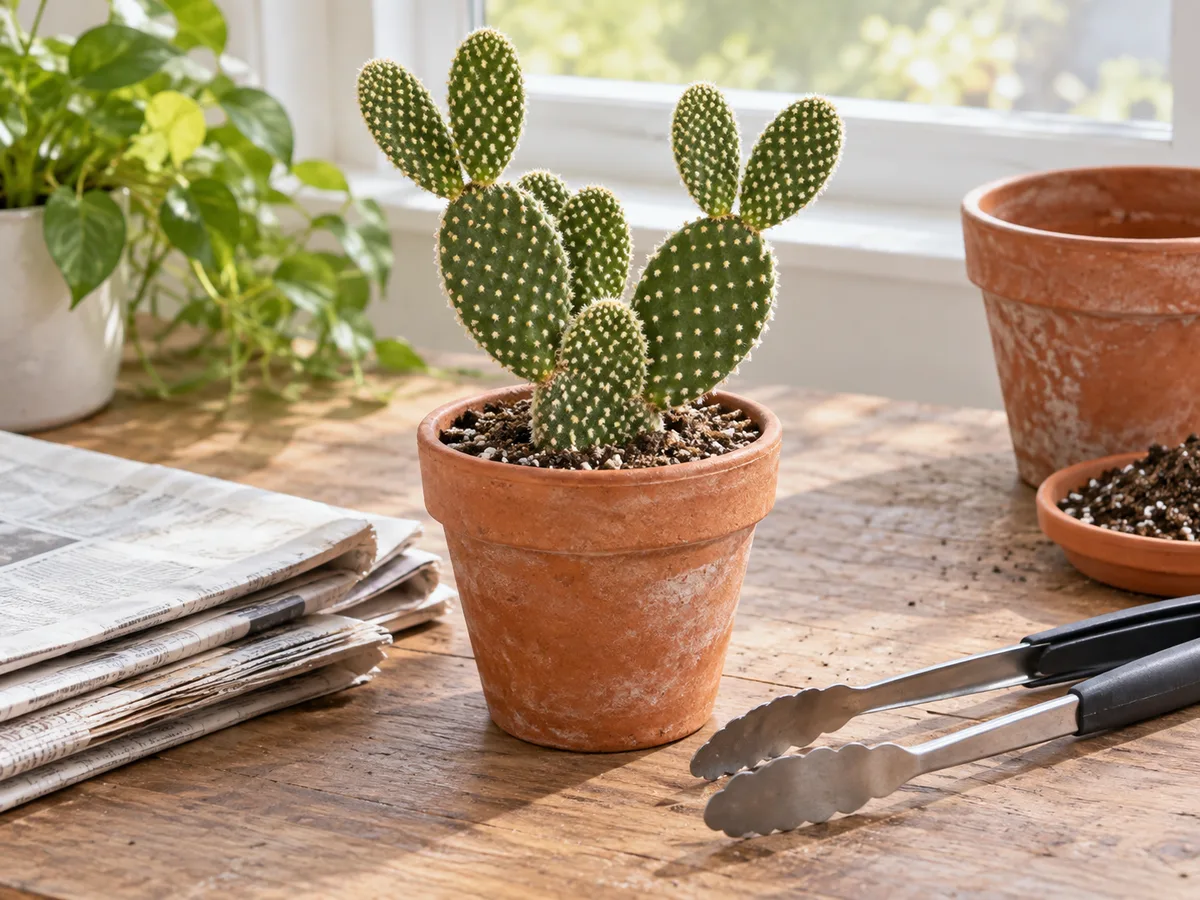
Wear sturdy gloves, but do not rely on gloves alone to grip the pads. Use long tongs to move the pot or root ball, or support the plant with folded newspaper while keeping your fingers well clear of the surfaces. Work over a cleared, easy-to-clean area; keep loose pads and paper contained, and do not shake or brush the cactus where glochids could spread to clothing or furniture.
Prune only when needed
Routine pruning is not necessary. Remove a pad only if it is broken, dead, diseased, or making the plant unstable. Use tongs or a paper barrier to position it, then cut cleanly at the joint with a disinfected blade; do not twist a pad while holding it in your hand.
If a healthy plant has outgrown its space, remove only a few pads at a time and let the cut surfaces dry before returning it to normal watering. A fresh pruning wound should not be pressed into wet soil. Healthy removed pads can be saved for propagation, provided you can handle them without spreading glochids.
Propagate from a pad
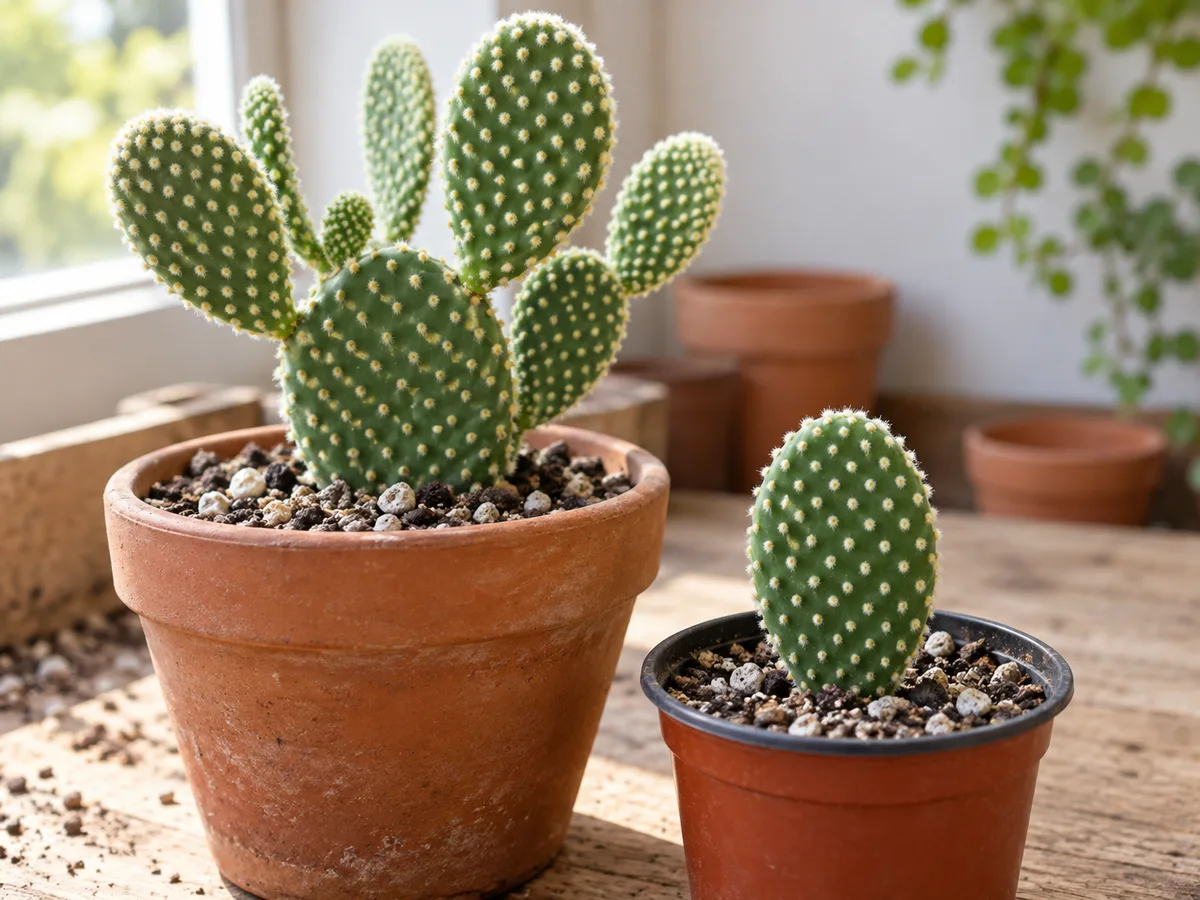
Pad propagation is more practical than seed for a home grower. Choose a firm, healthy pad and separate it at the narrow joint with tongs and a clean blade, or use the joint’s natural break point while keeping your hands away. Spring or summer is a good time because warmth and active growth help the cutting establish; the RHS recommends rooting stem segments in summer.
Let the cut end dry in a warm, shaded, airy spot until it forms a dry callus. That may take several days, and a thick pad may need longer; do not plant a fresh, wet cut into damp soil. Once sealed, set the pad’s base shallowly into dry cactus mix, firm it enough to stand upright, and keep the pot warm in bright light while roots form.
Pad-cutting steps
- Choose a firm pad with no soft spots, black tissue, or pest clusters.
- Put on gloves, clear the work area, and use tongs or folded newspaper to hold the cactus.
- Separate the pad cleanly at its joint and leave it in dry shade until the cut surface is sealed.
- Place the callused end about an inch into dry, gritty mix in a small pot with drainage.
- Keep the pot warm and bright but out of punishing midday sun; do not keep the mix wet while the pad has no roots.
- After several weeks, check for gentle resistance rather than pulling repeatedly. Once rooted or producing new growth, begin watering lightly and let the mix dry between drinks.
The cutting may wrinkle slightly while it uses stored water, so do not respond by soaking it every few days. If the base turns dark or soft, remove the pad, let any healthy tissue dry, and restart in fresh, dry mix. Rooting speed varies with temperature, pad size, and light, so a firm cutting without visible growth is not necessarily a failure after only a week or two.
Check for scale and mealybugs
Scale insects and mealybugs are the main pests to watch for. Inspect the joints between pads, the base near the soil, and the protected side of the plant. Mealybugs look like small cottony deposits, while scale can appear as fixed, shell-like bumps; the naturally spaced areoles are part of the cactus, so inspect for new clusters or sticky residue before treating it.
Isolate a pest-covered plant from nearby houseplants and remove visible pests with a tool or cotton swab, not bare fingers. If you use a horticultural soap or other product, check that its label permits use on cacti and test a small area first; keep the cactus out of harsh direct sun until any spray has dried. The RHS lists scale and mealybugs as possible pests, while NC State Extension also flags both for this species.
Troubleshoot drooping, soft, or pale pads
One symptom rarely identifies one cause by itself. Before watering, fertilizing, or moving the cactus, check three things: whether the soil is dry all the way down, whether the pads are firm or soft, and whether the newest growth is receiving enough light. Those checks prevent the common mistake of adding water to a plant that is already losing roots in wet soil.
Separate rot from dehydration
If the pads are wrinkled but still firm and the pot is very light with completely dry soil, give one thorough watering and let the excess drain. The pads may take several days to plump; repeated watering before then can overshoot. A dry, wrinkled plant should improve gradually, not overnight.
Soft, yellowing pads, a dark or mushy base, sour-smelling soil, or a pot that remains damp point toward excess water or root damage. Stop watering and inspect the roots. If they are brown and mushy, remove wet soil and cut away only the damaged parts with a clean blade; let cuts dry before resetting the plant in fresh, fast-draining mix. The RHS notes that wet or poorly drained soil can lead to root rot.
Tell sunburn, low light, and corking apart
Sunburn often begins as a bleached, tan, or dry patch on the side exposed to a sudden jump in direct sun. Move the cactus to bright shade while it recovers, then acclimate it to stronger light more slowly; damaged tissue will not turn green again, so judge success by firm pads and healthy new growth.
Low light usually affects new growth: pads may come in thinner, longer, or angled toward the nearest window. Move the plant toward stronger light gradually and keep watering restrained while it adjusts. By contrast, a dry, tan, firm layer at the base can be age-related corking; it is less concerning than tissue that is soft, dark, wet, or spreading upward. When in doubt, inspect the base and potting mix before cutting healthy pads away.
Flowering and outdoor growth
Mature plants can produce yellow, bowl-shaped flowers, but indoor plants rarely bloom unless they receive very strong light and a clear seasonal rhythm. The RHS records summer flowers, while NC State Extension describes spring flowering; local climate and growing conditions can shift the season. Lack of flowers indoors is not evidence that the cactus is unhealthy.
In suitable warm outdoor conditions, a plant can form a broad clump and may produce fruit after flowering. That size is part of the appeal in a rock garden, but it can be inconvenient in a small space. Because detached pads can root and NC State Extension describes the plant as fast-spreading, use a container if you want to limit its footprint, and check local guidance before adding any spreading cactus to a landscape.
Conclusion
Give bunny ear cactus the brightest light it can safely acclimate to, a pot with a drainage hole, and enough time for the entire mix to dry between deep waterings. Cut back winter water as growth slows, feed only during active growth, and repot or prune only when there is a clear reason. Most of all, remember that the dotted pads carry detachable glochids: use tools and keep the plant where nobody will brush against it.