20 Boxwood Shrubs for Landscaping: Sizes and Uses
Compare 20 boxwood shrubs by mature size, shape, hardiness, and landscape use, then learn how to plant, prune, space, and protect them from blight.
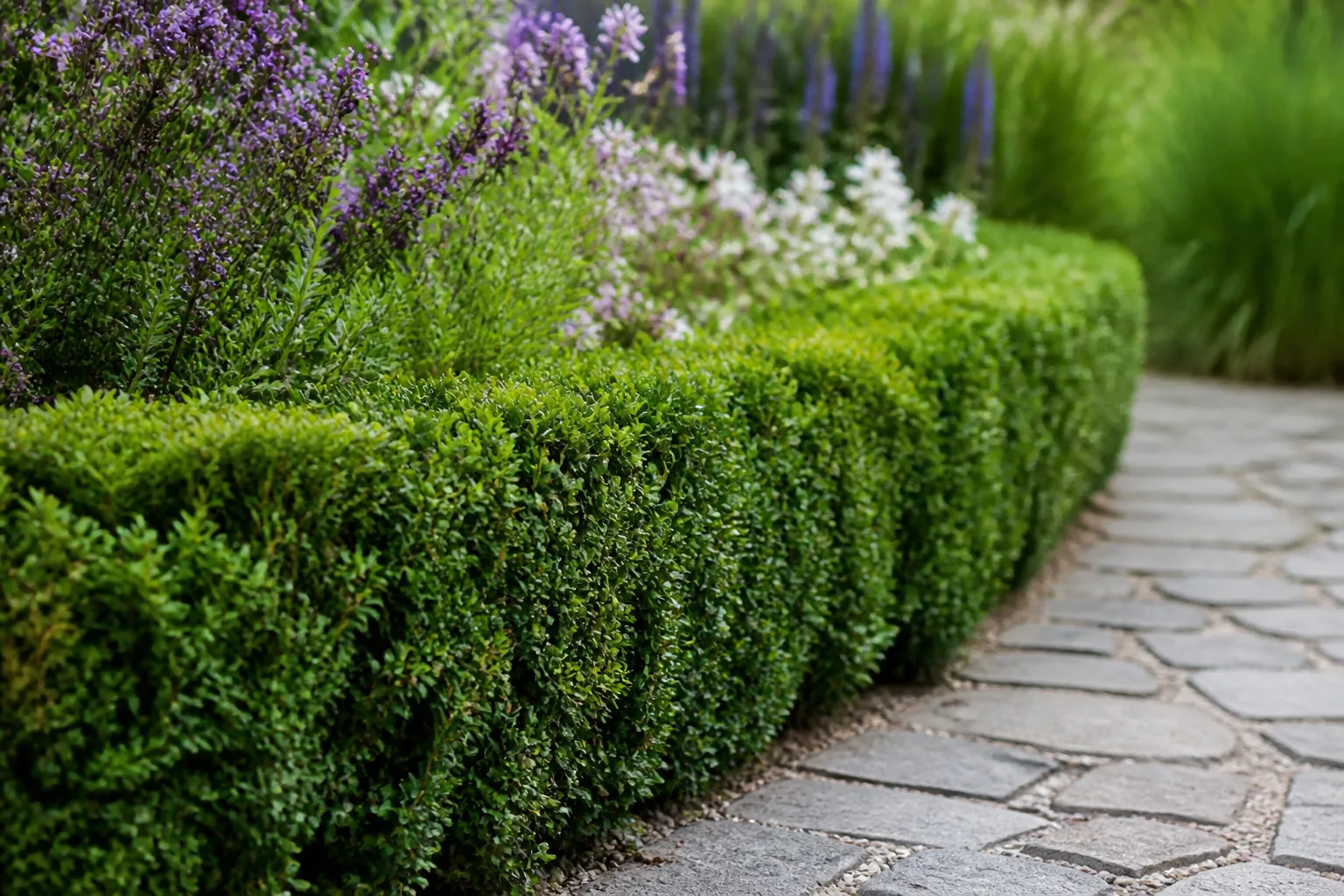
Boxwood gives a landscape something that flowers cannot: a dependable evergreen outline. A low row can frame a path, a rounded plant can anchor a foundation bed, and a narrow cultivar can add height beside a doorway without taking over the walkway. The useful word is cultivar, though. “Boxwood” describes a large group of plants with very different mature sizes, habits, growth rates, and tolerances.
The 20 types below include traditional species, dwarf selections, hybrids, variegated forms, and upright cultivars. Start with the table to eliminate plants that are too large or too tender for your site, then read the profiles for the trade-offs behind each choice. The American Boxwood Society notes that boxwoods vary widely in size, shape, leaf character, growth rate, and hardiness, which is why a plant tag is more useful than a generic boxwood label (American Boxwood Society).
What to Check Before Buying a Boxwood
The best boxwood is not the one with the most impressive photograph. It is the one that can reach its natural size in the space you actually have, receive the light your yard provides, and survive the stressful parts of your local winter or summer without constant rescue.
Measure Mature Width, Not Nursery Size
Write down the bed’s usable width before visiting a nursery. Then compare that measurement with the cultivar’s mature spread, not the width of the container plant on the sales bench. A two-foot-wide young shrub can be the juvenile stage of a boxwood that eventually wants eight feet of room.
For a formal hedge, you can plant centers closer than the ultimate spread so the canopies knit together. That is different from planting an individual specimen, which needs room on every side for air movement, pruning access, and the shape you want to see. A large cultivar repeatedly cut back to fit a narrow foundation strip will usually demand more work than a compact cultivar planted correctly once.
Match Habit, Light, and Climate to the Job
Choose a mounding or rounded type for a low border, foundation grouping, or clipped globe. Choose an upright or columnar type for a narrow entry, corner, or vertical accent. Choose a spreading type when width is useful and height would block a view, and choose a pyramidal type when you want an architectural cone without turning every pruning session into topiary surgery.
Light and exposure narrow the list further. Most boxwoods tolerate full sun to partial shade, but hot afternoon sun, reflected heat, drying winter wind, and deep shade are not equivalent conditions. Meadows Farms’ Mid-Atlantic selection guide makes the practical distinction well: American and English forms are often given winter shelter, while Japanese selections are valued for adaptability and heat tolerance (Meadows Farms). Those are useful tendencies, not guarantees; the exact cultivar and your microclimate still matter.
Boxwood Types at a Glance
Use this table as a first-pass filter. Sizes are approximate landscape dimensions, and labels can differ by nursery, growing region, age, and pruning history. When a cultivar’s hardiness is close to the edge of your zone, give greater weight to wind exposure, winter sun, drainage, and whether the plant is newly installed.
| Type | Approximate mature size | Common zones | Habit | Best landscape job |
|---|---|---|---|---|
| Common boxwood | 5–20 ft. tall | 5–8 | Large, rounded | Tall hedge or specimen |
| Wintergreen | 2–4 ft. tall, 3–5 ft. wide | 4–9 | Dense, rounded | Low hedge |
| Japanese boxwood | 6–8 ft. tall, wider spread | 5–9 | Broad, dense | Warm-climate hedge |
| Korean boxwood | 2–10 ft. tall, often wider | 4–9 | Low, spreading | Cold-climate edging |
| Dwarf Korean ‘Nana’ | About 1–2 ft. tall | 5–8 | Compact, spreading | Short border |
| ‘Winter Gem’ | 2–4 ft. tall and wide | 5–9 | Rounded | Hedge or topiary |
| English ‘Suffruticosa’ | 2–3 ft. tall | 5–8 | Slow, rounded | Formal edging |
| Variegated ‘Elegantissima’ | About 3–5 ft. tall | 6–8 | Rounded, variegated | Accent or small group |
| Golden-edged ‘Aureomarginata’ | 4–10 ft. tall | 6–8 | Rounded | Evergreen color accent |
| Columnar cultivars | 5–15 ft. tall, narrow | 5–9 | Upright | Tight vertical space |
| Pyramidal ‘Pyramidalis’ | 6–12 ft. tall, 2–3 ft. wide | 5–8 | Cone-shaped | Entry or driveway |
| ‘Green Velvet’ | 3–4 ft. tall and wide | 5–8 | Mounded | Low hedge or foundation |
| ‘Green Mountain’ | About 5 ft. tall | 5–9 | Upright, pyramidal | Accent or medium hedge |
| ‘Sprinter’ | 2–4 ft. tall and wide | 5–9 | Rounded, vigorous | Faster low hedge |
| ‘Vardar Valley’ | 2–3 ft. tall, wider spread | 5–8 | Low, spreading | Edge or mass |
| Bigleaf ‘Rotundifolia’ | About 8–12 ft. tall | 5–8 | Large, upright | Large hedge or screen |
| ‘Glencoe’ | 3–4 ft. tall and wide | 4–9 | Dense, globular | Cold-climate foundation |
| ‘Highlander’ | About 7 ft. tall | 5–9 | Upright, triangular | Faster tall hedge |
| Tree boxwood ‘Arborescens’ | 8–15 ft. tall | 5–8 | Large, upright | Informal screen |
| Littleleaf ‘Compacta’ | About 1–2.5 ft. tall | 6–9 | Tiny, mounded | Small border or container |
20 Boxwood Shrubs for Landscaping
1. Common boxwood (Buxus sempervirens) — This is the large, traditional “American” or common boxwood behind many historic hedges. Given time and room, it can become a substantial rounded shrub, often 5 to 20 feet tall depending on climate and age. Its dense branching handles formal pruning, but its eventual scale makes it a poor choice for a narrow bed. Use it for a tall hedge, spacious formal garden, or large specimen where waiting for slow growth is acceptable.
2. Wintergreen boxwood (Buxus sinica var. insularis ‘Wintergreen’) — Wintergreen is a compact Korean selection that usually stays in the 2- to 4-foot range and spreads a little wider. It is a strong choice when cold hardiness and a dense low outline matter more than rapid height. The foliage can still bronze under severe exposure, so protect young plants from drying wind rather than treating the zone rating as a promise of perfect winter color.
3. Japanese boxwood (Buxus microphylla var. japonica) — Japanese boxwood is broader and often more heat-tolerant than traditional English forms, which makes it useful for warm-climate hedges and large foundation masses. It can become much wider than its nursery size suggests, so measure the bed before planting. In hot regions, morning sun with afternoon protection may produce a better result than a reflective, all-day-sun site beside pavement.
4. Korean boxwood (Buxus sinica var. insularis) — Korean boxwood is a useful family of low, cold-hardy forms rather than one perfectly uniform plant. Many selections develop a spreading outline that works for edging, low hedges, and slopes. Compare the exact cultivar tag because height and width vary considerably, and leave enough room for the plant to widen instead of shearing it into a smaller shape every few weeks.
5. Dwarf Korean boxwood ‘Nana’ — ‘Nana’ is for the front edge of the planting, not for a privacy screen. Its low, spreading form generally stays around 1 to 2 feet tall, making it useful below windows, along a walk, or in a small formal border. It is easier to maintain when allowed to mound gently; aggressive shearing can create a hard outer shell while leaving the interior shaded and thin.
6. ‘Winter Gem’ (Buxus ‘Winter Gem’) — Winter Gem is a versatile rounded boxwood for low hedges, foundation beds, and simple topiary. It fills in faster than the slowest dwarf types, but that advantage also means more frequent touch-up pruning when a crisp outline is the goal. Bronze winter foliage can be normal seasonal stress, especially in exposed beds; inspect for live buds and spring recovery before replacing a plant.
7. English boxwood (Buxus sempervirens ‘Suffruticosa’) — The classic English boxwood is a slow-growing dwarf with a compact rounded habit. It suits knot gardens, miniature parterres, containers, and low edging where patience is available. Slow growth limits weekly maintenance, but it also slows recovery from a hard cut, broken branch, or disease pocket. Provide excellent drainage, avoid crowding, and use it where the site’s winter exposure is manageable.
8. Variegated boxwood (Buxus sempervirens ‘Elegantissima’) — This cultivar brings creamy-edged foliage to the same evergreen structure that makes boxwood useful. NC State Extension describes it as a compact, rounded shrub around 5 feet tall and 4 feet wide, preferring part shade or morning sun and well-drained soil (NC State Extension Plant Toolbox). Treat it as an accent or small group, and avoid burying its pale leaves behind taller shrubs.
9. Golden-edged boxwood (Buxus sempervirens ‘Aureomarginata’) — Golden-edged boxwood uses yellow margins to break up a wall of green. It can be maintained as a medium rounded shrub or allowed to develop more height where space permits. The color is most useful as contrast against dark foliage or masonry, but variegated plants still need enough light to hold a strong pattern. Make room for its mature spread before deciding it belongs in a narrow foundation strip.
10. Columnar boxwoods (‘Graham Blandy’, ‘Dee Runk’, and ‘Fastigiata’) — Columnar boxwood is a group of narrow cultivars rather than a single plant. ‘Graham Blandy’ can become tall and very slim, ‘Dee Runk’ forms a narrow cone, and ‘Fastigiata’ offers upright structure with bluish-green foliage. These are useful beside a doorway, at a property-line corner, or where a vertical accent is needed without a broad hedge. Check the exact height and width because “columnar” does not mean maintenance-free or equally cold hardy.
11. Pyramidal boxwood (Buxus sempervirens ‘Pyramidalis’) — This cultivar naturally tapers from a broad base to a narrower top. Its cone-like outline creates an architectural focal point at a gate, driveway, or formal entry without requiring every branch to be clipped into place. It still needs enough space around the base and even light on all sides. Selective cuts that preserve the pyramid are usually more forgiving than repeatedly flattening its natural silhouette.
12. ‘Green Velvet’ (Buxus ‘Green Velvet’) — Green Velvet is a dense, broadly mounded hybrid that stays in a convenient 3- to 4-foot range. It is a good fit for repeated foundation shrubs, rounded accents, and low hedges where you want a soft outline rather than a razor-edged rectangle. Let the plant establish before shearing, then make small corrections. Its natural shape does much of the design work.
13. ‘Green Mountain’ (Buxus × ‘Green Mountain’) — Green Mountain is more upright and pyramidal than Green Velvet, with enough height for an entry accent or medium hedge. It can be left to develop a structured outline or trimmed lightly for a more formal effect. Use matched plants when symmetry matters, and do not plant it where a mature 5-foot form would cover a window or press against a path.
14. ‘Sprinter’ (Buxus microphylla ‘Bulthouse’) — Sprinter is a vigorous compact boxwood selected for faster fill-in than many traditional dwarf cultivars. That makes it useful when you want a low hedge to knit together sooner, but faster growth means a greater trimming commitment if the line must remain precise. Plant it with room for its rounded width, and keep the foliage dry when possible because vigor does not equal immunity to disease.
15. ‘Vardar Valley’ (Buxus sempervirens ‘Vardar Valley’) — Vardar Valley is a low, wide selection with a spreading habit that suits edging, slopes, knot-garden geometry, and low evergreen masses. Its mature width is an advantage when you want coverage without height. Do not crowd plants to speed up the effect; the slow growth makes an overplanted row difficult to correct, and tight spacing reduces airflow around the interior branches.
16. Bigleaf boxwood (‘Rotundifolia’) — Bigleaf forms are useful when ordinary fine-textured boxwood feels too visually small or you need a substantial hedge. ‘Rotundifolia’ can grow into a large shrub, commonly around 8 to 12 feet tall with a broad spread. Its scale belongs in a large bed or screen, not a two-foot foundation strip. Pairing its larger leaves with fine-textured perennials can create intentional contrast instead of a wall of identical texture.
17. ‘Glencoe’ (Buxus ‘Glencoe’) — Glencoe is a rounded hybrid often selected for colder landscapes, with a dense form around 3 to 4 feet tall and wide. It is a sensible candidate for a foundation bed where winter hardiness is a priority, but the site still needs protection from drying wind and bright winter sun. Leave enough space for a full globe, and do not confuse a hardy label with resistance to every disease.
18. ‘Highlander’ (Buxus sempervirens ‘Highlander’) — Highlander is an upright, relatively fast-growing common boxwood for gardeners who want height sooner than a slow dwarf can provide. It can work for a medium hedge or larger topiary, but the trade-off is more frequent pruning and a greater need to plan for its width. If your goal is low maintenance, choose a slower cultivar or let Highlander keep its natural triangular form.
19. Tree boxwood (Buxus sempervirens ‘Arborescens’) — Tree boxwood is the large-scale option on this list, capable of reaching roughly 8 to 15 feet. It can form an informal evergreen screen or a tall hedge when given genuine room to mature. It is a poor impulse purchase for a small foundation bed because size-control pruning becomes a permanent chore. Plant it where its height is useful and where you can reach the canopy safely.
20. Littleleaf boxwood (Buxus microphylla ‘Compacta’) — ‘Compacta’ is for miniature landscapes, tiny formal edges, and large containers where very slow growth is an asset. It may remain close to a foot tall for years before gradually reaching roughly 2 to 2.5 feet. That patience is the appeal: it rarely overwhelms a small design. Use a fast-draining container mix, water when the root zone begins to dry, and prune lightly because recovery takes time.
Planting and Care Priorities That Prevent Regret
Boxwoods are often called low maintenance, but that label describes an established shrub in a suitable site. It does not mean a newly planted evergreen can be ignored, or that poor drainage and crowding will be harmless. Proven Winners summarizes the useful baseline: boxwood spans a wide range of forms, prefers good drainage, benefits from partial or dappled shade, and needs consistent moisture while young (Proven Winners).
Light and Microclimate
Aim for bright light with protection from the harshest local stress. Many boxwoods grow in full sun to partial shade, but hot afternoon exposure beside concrete can be much harder than open morning sun. In colder regions, winter sun and wind can pull moisture from evergreen leaves while frozen soil limits replacement, so a sheltered east or north-facing position may outperform an exposed south or west-facing one.
Deep shade is not automatically safer. Too little light can produce looser growth and a less dense hedge, especially when the cultivar is being clipped tightly. Walk the site at several times of day before planting and note reflected heat, roof runoff, salt exposure, and tree-root competition rather than recording only “sun” or “shade.”
Drainage, Roots, Water, and Mulch
Plant the root ball with its crown level with or slightly above the surrounding soil. A planting hole that leaves the crown buried can hold moisture where the stem meets the soil and encourages decline. Boxwoods have relatively shallow roots, so avoid deep cultivation around the trunk and do not pile mulch against the stems.
Water slowly and thoroughly during establishment, checking the root zone rather than following a fixed calendar. The goal is evenly moist soil, not a permanently wet bed. Once the shrub is rooted in, deep watering during an extended dry spell is more useful than frequent shallow sprinkling. Direct irrigation to the soil in the morning when possible, and avoid repeatedly wetting dense foliage.
A moderate mulch layer helps buffer temperature and moisture, but it should be spread like a flat blanket with a small gap around each stem. Excessive mulch can keep the crown damp, conceal a problem, and encourage roots to stay too close to the surface. If the bed stays saturated after ordinary rain, fix the drainage or choose another shrub; no cultivar label can compensate for standing water.
Fertilizer and Establishment Timing
Do not fertilize automatically because a boxwood looks slightly pale. Uniform yellowing of older interior leaves can have several explanations, and fertilizer will not repair root damage, winter burn, salt injury, or disease. The American Boxwood Society recommends using a soil test and plant symptoms to guide fertilizer decisions rather than following a universal schedule (American Boxwood Society).
Planting timing is also regional. Early fall can give a hardy shrub time to root before summer heat, while spring is safer for a marginally hardy boxwood or an exposed site approaching winter. The nursery root ball should never be allowed to dry out after planting, and a newly installed broadleaf evergreen deserves more monitoring than an established one even when the calendar says the season is favorable.
Pruning for the Shape You Want
Prune the form you bought. A rounded cultivar is easiest to keep as a rounded mound, a columnar cultivar is easiest to keep narrow, and a spreading cultivar is easiest to use where width is welcome. The most expensive pruning job is trying to force a large, vigorous boxwood to remain permanently smaller than its genetic habit.
Shearing Versus Selective Thinning
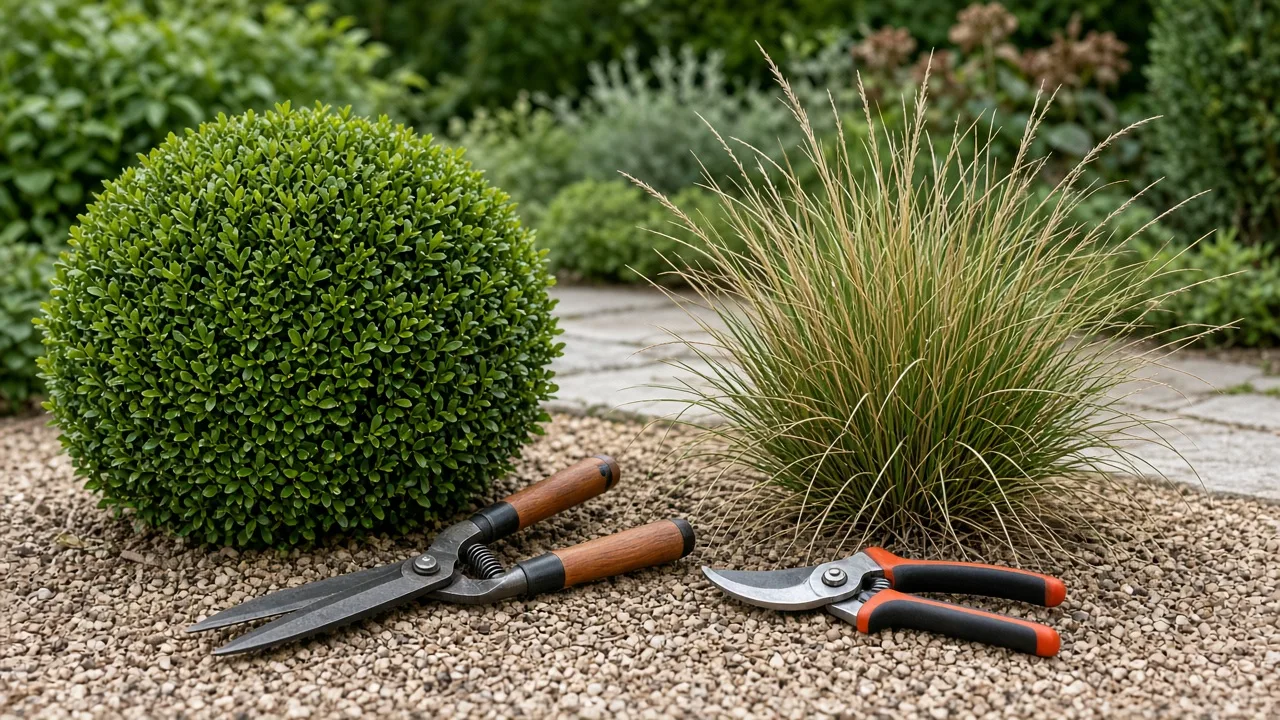
Shearing trims the outer surface and is useful for a formal hedge or geometric topiary. Selective thinning removes individual branches to open the interior, correct a crossing stem, or preserve a natural outline. A hedge that is slightly wider at the base than the top receives more light and tends to stay fuller all the way down.
Use clean, sharp tools and avoid working through wet foliage when disease is suspected. Light shaping after the last hard frost is a reasonable starting point in many regions, while touch-up shearing can follow active growth. Avoid a severe late-season cut in a cold climate, when tender regrowth may enter winter poorly hardened. If you remove a diseased branch, clean the tool before touching another shrub.
Containers, Topiary, and Recovery Time
Dwarf, slow-growing, and naturally rounded cultivars are the easiest choices for containers and topiary. Use a pot with drainage, a fast-draining planting mix, and enough volume that the root ball does not heat and dry out every afternoon. Container-grown evergreens need more frequent checks than in-ground plants because the root zone has little thermal or moisture buffer.
Topiary is not one maintenance category. A naturally conical ‘Pyramidalis’ may need occasional correction, while a perfect spiral or lollipop requires repeated shaping and a stable water supply. Slow-growing English boxwood can hold a design neatly, but a mistake takes longer to disappear. Fast-growing Sprinter or Highlander fills a framework sooner and also grows beyond it sooner.
Disease, Pests, and Winter Damage
Dense evergreen foliage can hide trouble, so inspect the interior rather than judging only the outer surface. Common issues include leafminer, mites, psyllid, scale, root disorders, winter injury, and fungal diseases. Similar-looking browning does not prove that a pest or pathogen is responsible.
Boxwood Blight Is a Sanitation Problem
Boxwood blight, caused by Calonectria pseudonaviculata, can produce leaf spots, rapid browning and leaf drop, and dark lesions on stems. The University of Maryland Extension describes defoliation that often begins in the lower or inner canopy, while the Virginia Boxwood Blight Task Force emphasizes that all boxwoods can be infected even though cultivars differ in tolerance (University of Maryland Extension; Virginia Cooperative Extension Boxwood Blight Task Force).
No boxwood is immune. A cultivar described as tolerant or resistant may show fewer symptoms, but it can still carry or spread the pathogen under favorable conditions. If blight is confirmed, do not casually move clippings, fallen leaves, soil, shoes, tarps, or tools from that planting to healthy boxwoods. The task force recommends sanitation, careful disposal of infected material, and local guidance for management decisions; pesticide products and timing must follow the current label and regional extension advice.
When buying, ask how nursery stock is produced and handled, inspect the inner canopy for suspicious leaf drop or webbing, and avoid bringing a visibly stressed plant home. A clean starting plant plus sensible spacing, morning irrigation, and good airflow is a more durable strategy than choosing a cultivar on a vague “disease-proof” promise.
Use Pattern and Timing to Read Look-Alikes
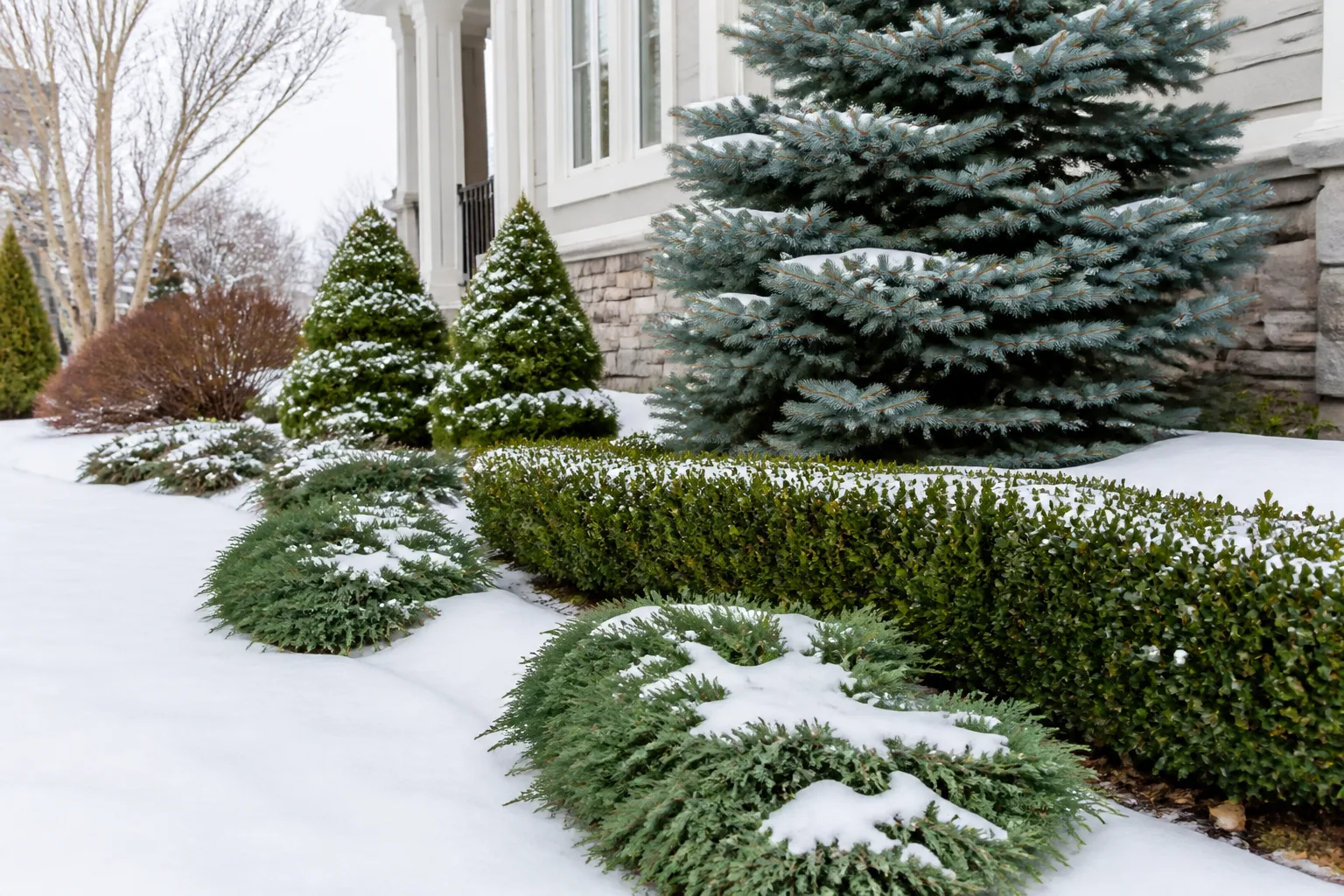
Winter burn often appears on the windward or sun-exposed side, after a cold, dry, or windy season. Seasonal bronze coloration can be normal in some Korean and Japanese selections, especially when buds and stems remain alive. Wait for spring growth before removing every discolored branch.
Disease is more suspicious when damage spreads quickly through the interior or lower canopy, appears with distinct leaf spots, or is paired with dark streaks on green stems. Root trouble is more likely when the bed stays wet, the whole plant declines slowly, or browning is not limited to the exposed side. Mites can create dull stippling and bronzing, while leafminers leave hollowed or blistered leaves. Map the pattern, check soil moisture several inches down, look inside the canopy, and seek an extension or diagnostic service when symptoms are spreading or uncertain.
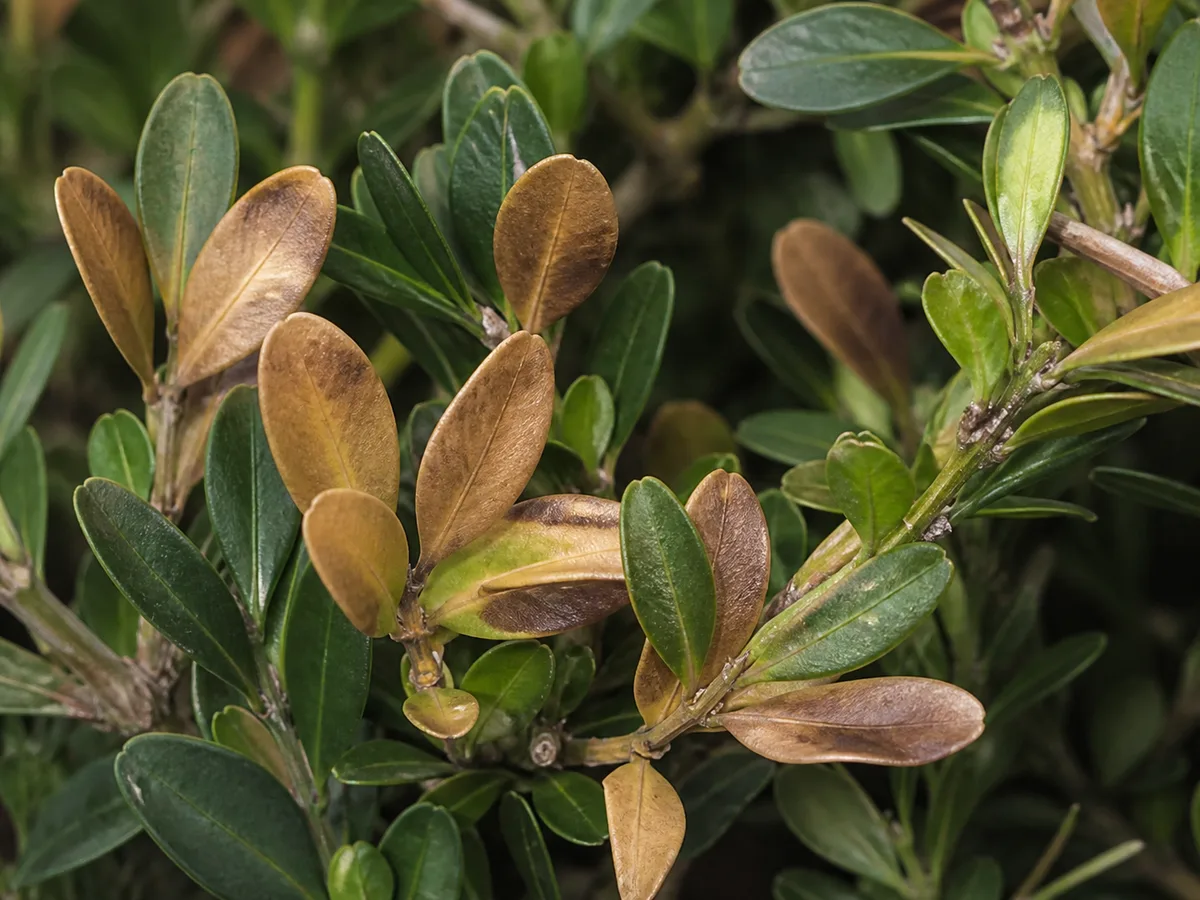
For a step-by-step pattern check, use the related guide on why boxwood turns brown. The important rule is simple: do not treat a color before you identify its pattern, timing, and likely cause.
Buying and Spacing Mistakes to Avoid
The first mistake is choosing from a photograph instead of a planting plan. “Small,” “upright,” and “fast-growing” are relative words; write down the mature height and width of the exact cultivar before you buy. The second is placing a boxwood directly under a roof downspout or in a low pocket because the plant is described as adaptable. Adaptable still requires drainage.
The third is treating a hedge as a single solid wall on planting day. Proven Winners suggests spacing hedge plants at roughly half their mature width as a starting rule, while individual specimens should have more room for air and maintenance. That rule is a planning estimate, not a substitute for the cultivar tag or local growing conditions. Overcrowding may create a faster visual fill, but it also raises pruning pressure and keeps the canopy damp longer.
The fourth is assuming a hardy boxwood is a blight-resistant boxwood, or that a resistant one is immune. Ask for the cultivar name, inspect the stock, and choose a reputable nursery with good sanitation practices. If the landscape has a history of blight, compare tolerant cultivars and non-boxwood alternatives with local extension guidance before installing another continuous hedge.
The last mistake is using shears to solve a site problem. Pruning cannot turn deep shade into good light, rescue roots in standing water, or permanently shrink a large cultivar into a tiny border. If the plant’s natural size and the bed’s conditions disagree, moving or replacing it early is usually kinder to the shrub and cheaper than years of corrective maintenance.
Conclusion
The most useful way to compare boxwood shrubs is by the job they need to do. Choose ‘Compacta’, ‘Nana’, English boxwood, or a compact hybrid for a low edge; look to ‘Green Velvet’, ‘Winter Gem’, or ‘Sprinter’ for rounded foundation work; choose a columnar, pyramidal, ‘Highlander’, or ‘Tree boxwood’ when height matters; and reserve common, Japanese, and bigleaf forms for beds that can absorb their mature width.
Before planting, confirm the exact name, mature dimensions, hardiness range, light exposure, drainage, and disease history of the site. Give the new shrub steady root-zone moisture, sensible spacing, and enough airflow to grow into its shape. A boxwood is low maintenance when it is matched to the place—not when a mismatched plant is forced to behave.