Does Baking Soda Really Kill Ants? Why It Falls Short
Does baking soda kill ants? Learn what the sugar mix can—and cannot—do, why it rarely reaches the colony, and which bait-based IPM steps work better.
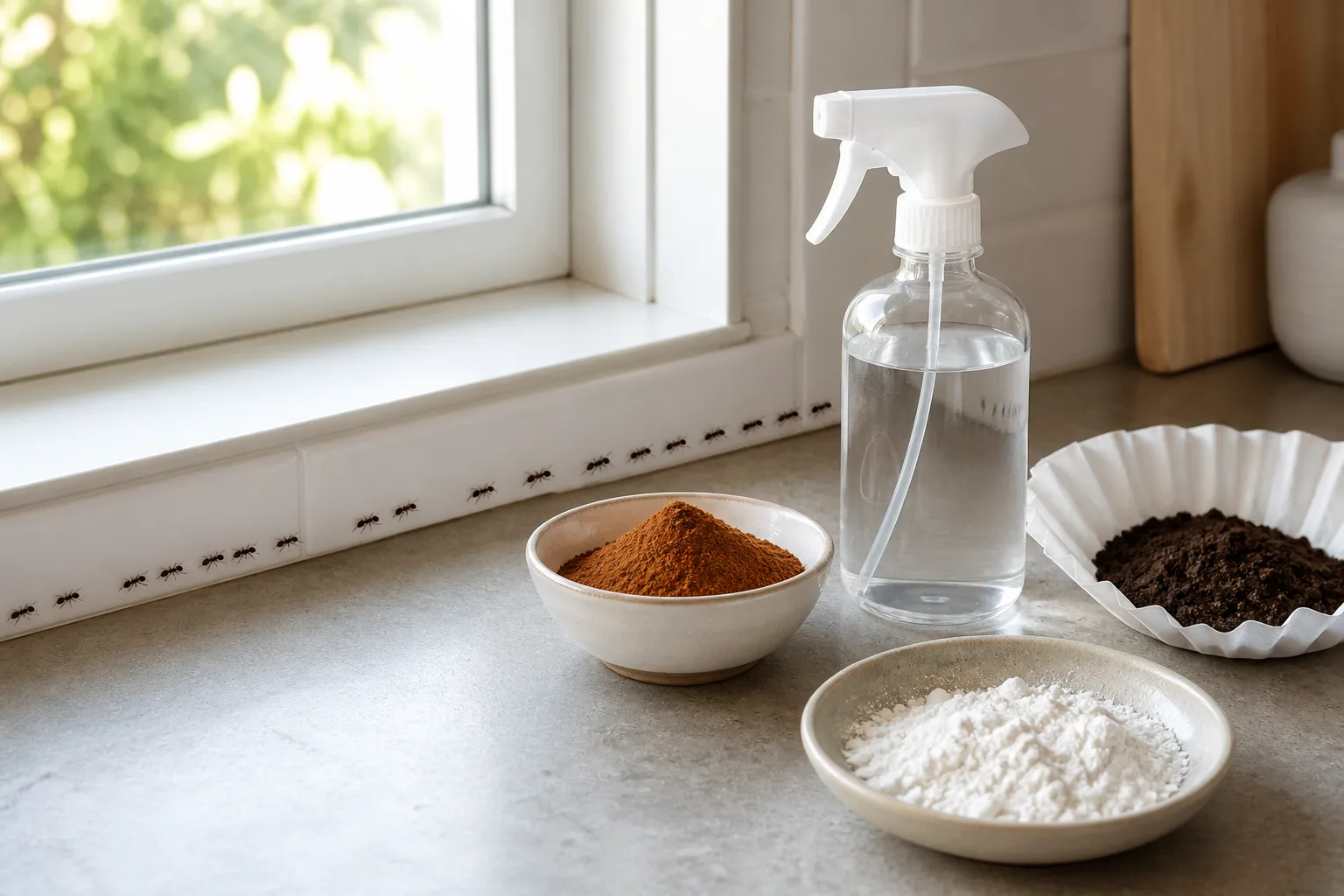
If you are watching ants cross a counter, a bowl of baking soda can look like an obvious answer. It is inexpensive, already in the pantry, and often paired online with powdered sugar as a homemade bait. The problem is that a recipe can be easy to mix and still be a poor way to control the colony that keeps sending ants inside.
Here is the useful answer: baking soda is not dependable colony control. An ant may be affected if it eats enough of it, but plain baking soda is not a reliable attractant, the amount an ant consumes is unknown, and there is no established home recipe that tells you which species will carry it home, how much will reach the nest, or how long control should take. The familiar “ants explode” explanation is a plausible-sounding story, not a substitute for ant-control evidence.
That does not mean you need to reach for a room-filling spray. A better response is an Integrated Pest Management (IPM) sequence: identify what the ants are using, remove food and water competition, erase the trail, close the entry, and use a slow-acting bait in a protected station when the problem warrants it. The CDC’s IPM guidance describes the same logic as inspection, identification, multiple control measures, and follow-up evaluation.
The short answer: baking soda is not dependable colony control
The answer changes depending on what “kill ants” means. If you mean “can a single ant die after contacting or ingesting baking soda?” the honest answer is possibly. If you mean “will a sugar-and-baking-soda pile reliably eliminate the nest and stop new ants from arriving?” the answer is no—not as a method you can count on.
| Question | Realistic answer |
|---|---|
| Does plain baking soda attract ants? | Usually no. Ants select food based on the colony’s current needs, and sodium bicarbonate is not a dependable lure. |
| Does powdered sugar make it more likely that ants investigate? | Yes, sugar can make a mixture more attractive to some sweet-feeding ants. That still does not validate the baking soda as a colony treatment. |
| Can the mixture kill every ant that eats it? | There is no predictable dose or species-wide result for a pantry recipe. Some ants may die; others may ignore it or carry too little to matter. |
| Can it reach the queen? | You cannot assume that it will. Reliable colony baits are deliberately formulated to be accepted, slow-acting, and transferred before the worker dies. |
| Is it a good first choice for a recurring indoor trail? | No. Sanitation, exclusion, and a labeled bait station are more controllable choices. |
This distinction matters because killing the visible workers is not the same as controlling the source. UC Statewide IPM explains that most household ant management works by combining exclusion and sanitation with baiting when necessary. It also warns that sprays can kill foragers temporarily while leaving the nest and queens untouched.
Why the sugar-and-baking-soda trick sounds plausible
The recipe has two parts that appear to solve two different problems. Powdered sugar supplies a sweet odor and an easy-to-carry food, while baking soda is supposed to act after ingestion. That division makes the idea feel more scientific than simply sprinkling a white powder along a baseboard.
The weak point is not whether an ant might taste the sugar. It is everything that has to happen afterward: the right species must accept that food at that moment, the worker must take enough of the mixture, the worker must survive long enough to return, the material must be shared with susceptible members of the nest, and the quantity must be enough to change colony numbers. A 1:1 ratio copied from a household tip does not establish any of those conditions.
The popular gas story has the same limitation. Baking soda reacts with acids in many familiar kitchen situations, but ants are not miniature baking projects, and the claim that the mixture generally creates a lethal internal gas buildup is not a field-tested explanation for household ant control. Treat it as an anecdotal hypothesis, not as a verified mechanism or a guaranteed result.
What the kitchen test can and cannot prove
If ants gather around the sugar mixture, you have learned only that those workers found part of it interesting. You have not proven that the ants will carry a useful dose home, that the nest is nearby, or that the trail will stop rather than move to another food source. If the ants disappear, you still need to ask whether they were disturbed, the food was removed, the trail was broken, or the colony was actually reduced.
The strongest evidence against casual home-remedy certainty comes from testing the whole control claim rather than trusting a dramatic anecdote. In a 2024 paper in Insects, researchers tested several widely recommended natural remedies against Argentine ants in laboratory trials. Tansy, cucumber peel, and soybean extract did not deter the ants from a preferred moist harborage, even when the quantity was increased four- to tenfold; fresh rosemary and spearmint did show deterrence, while peppermint oil was the strongest treatment in that particular test. The study did not test baking soda, so it cannot prove baking soda fails. It does show why “a natural ingredient worked for someone” is not enough to predict performance across ant species and situations. Read the peer-reviewed study for the methods and limitations.
Trusted gardening publications often preserve these remedies because they are familiar and low-cost. For example, Farmers’ Almanac’s natural ant-remedy list includes baking soda, borax, vinegar, oils, and physical barriers. That kind of article is useful for understanding what homeowners try, but a remedy list is not the same as a pesticide label, a species-specific trial, or a colony-control protocol.
Identify the ant and the reason it is indoors
Before choosing bait, look at the ants for a minute instead of treating every small brown insect as the same pest. Size, color, body shape, location, time of day, and what they are eating can change the best response. The Penn State Extension IPM guide starts with identification because a carpenter-ant problem does not have the same stakes as a few outdoor foragers following a crumb.
Also inspect the invitation. Ants may be entering for sugar, grease, pet food, water, shelter, warmth, or a plant-related food source. A trail beside a sink points you toward leaks and dampness; ants clustered around a plant may point you toward aphids or scale insects producing honeydew; a line at a window may indicate a gap rather than a dirty room.
Small trail ants versus carpenter ants
Small ants moving in an orderly line along a counter or baseboard are often nuisance foragers from an outdoor nest or a wall void. They may be Argentine ants, odorous house ants, pavement ants, Pharaoh ants, or another local species. Their appearance overlaps, so do not force a confident identification from color alone. A local extension office or ant-identification key can help if the treatment keeps failing.
Carpenter ants deserve a different response. They are generally larger, and you may find them near damp or damaged wood, window frames, wall voids, or structural joints. Fine sawdust-like frass, repeated activity from a wall, winged ants emerging indoors, or a large number of ants despite cleaning are reasons to investigate the building rather than keep experimenting with pantry ingredients. Carpenter ants do not eat wood like termites, but their nesting galleries can be a property concern.
Stinging or biting ants outdoors also change the risk calculation. Do not kneel into an unfamiliar mound or scatter loose powders where children, pets, birds, or beneficial insects can contact them. Identification is not a delay; it is the step that prevents a low-stakes kitchen trail from being confused with a structural or stinging-pest problem.
When ants are coming from a plant or moisture
Ants in a pot are not necessarily feeding on the plant. They may be nesting in dry, protected potting mix, following honeydew from aphids or scale, or using a plant stand as a bridge to a window. BBC Gardeners’ World’s guidance on ants in pots highlights both nesting and aphid-farming as reasons ants show up around containers.
Inspect leaf undersides, stems, and new growth for sticky honeydew, curled leaves, clusters of aphids, or cottony scale. Treating only the ant trail can leave the food source in place, so the ants return. Move a heavily infested potted plant away from the rest of the collection, correct the plant pest separately, and avoid sprinkling baking soda or borate powders into the potting mix. Salt-like residues and concentrated household powders can damage roots or soil life without solving the ant colony.
Moisture deserves the same attention. Check under sinks, around hose bibs, near dishwashers, beside pet bowls, and around leaky windows. Ants need water, and a damp void can be more important than the crumb that first made the trail visible.
A 30-minute first response for ants indoors
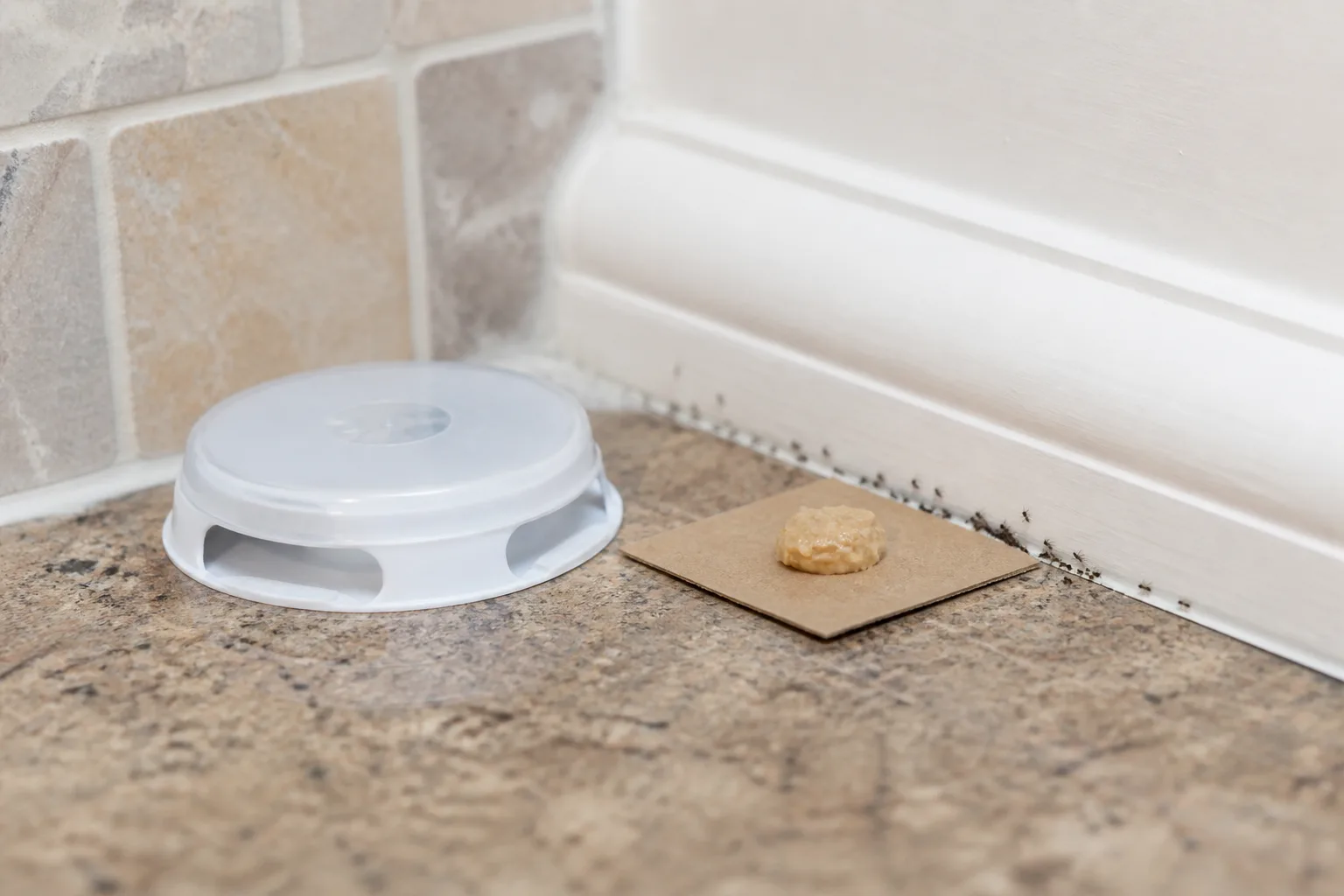
You can make meaningful progress before choosing any insecticide. The sequence below is designed to remove the conditions that let a trail rebuild while preserving the option of baiting if ants keep returning.
Remove food and water competition
Start by putting away the foods ants commonly find: sugar, syrup, honey, fruit, bread, grease, meat, and pet food. Wipe the outside of jars and bottles, rinse sticky recycling, empty food-waste bins, clean under appliances, and wash pet bowls and the floor around them. Do not rely on a quick pass over the center of the counter; ants often follow a thin residue along a seam, backsplash, cabinet edge, or appliance foot.
Next, address water. Dry the sink overnight, repair drips, empty plant saucers, and check whether condensation or a slow plumbing leak is keeping a cabinet damp. These steps are not merely “natural repellents.” They remove competing resources, making later bait placement easier to interpret.
Erase the trail and find the entry
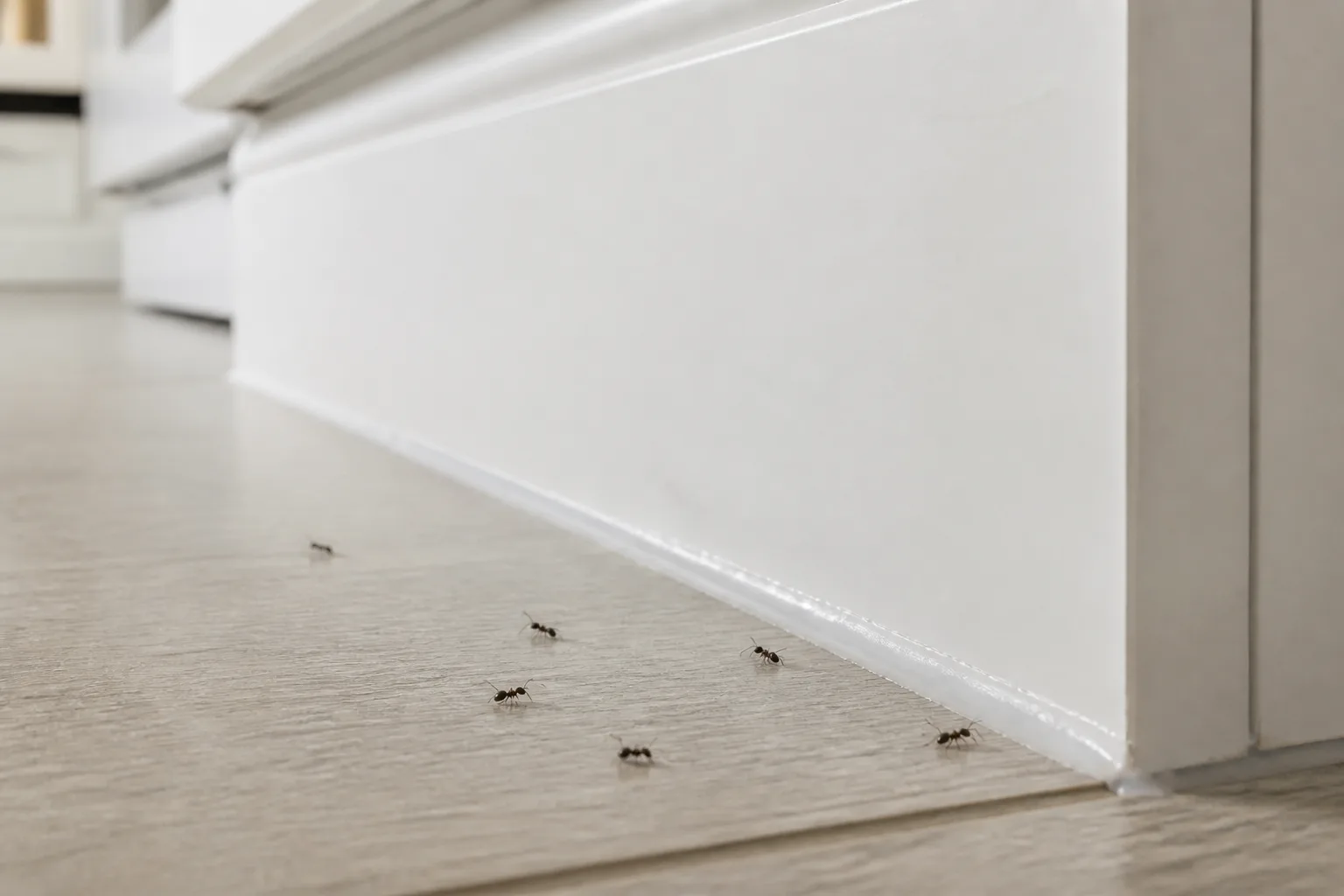
Vacuum the visible ants or collect them with a damp cloth, then wipe the entire route with soapy water. The purpose is to remove the chemical trail that helps later workers follow the same path. A diluted vinegar-and-water wipe may also disrupt the route on a compatible, washable surface, but it is a trail-cleaning measure—not a colony treatment.
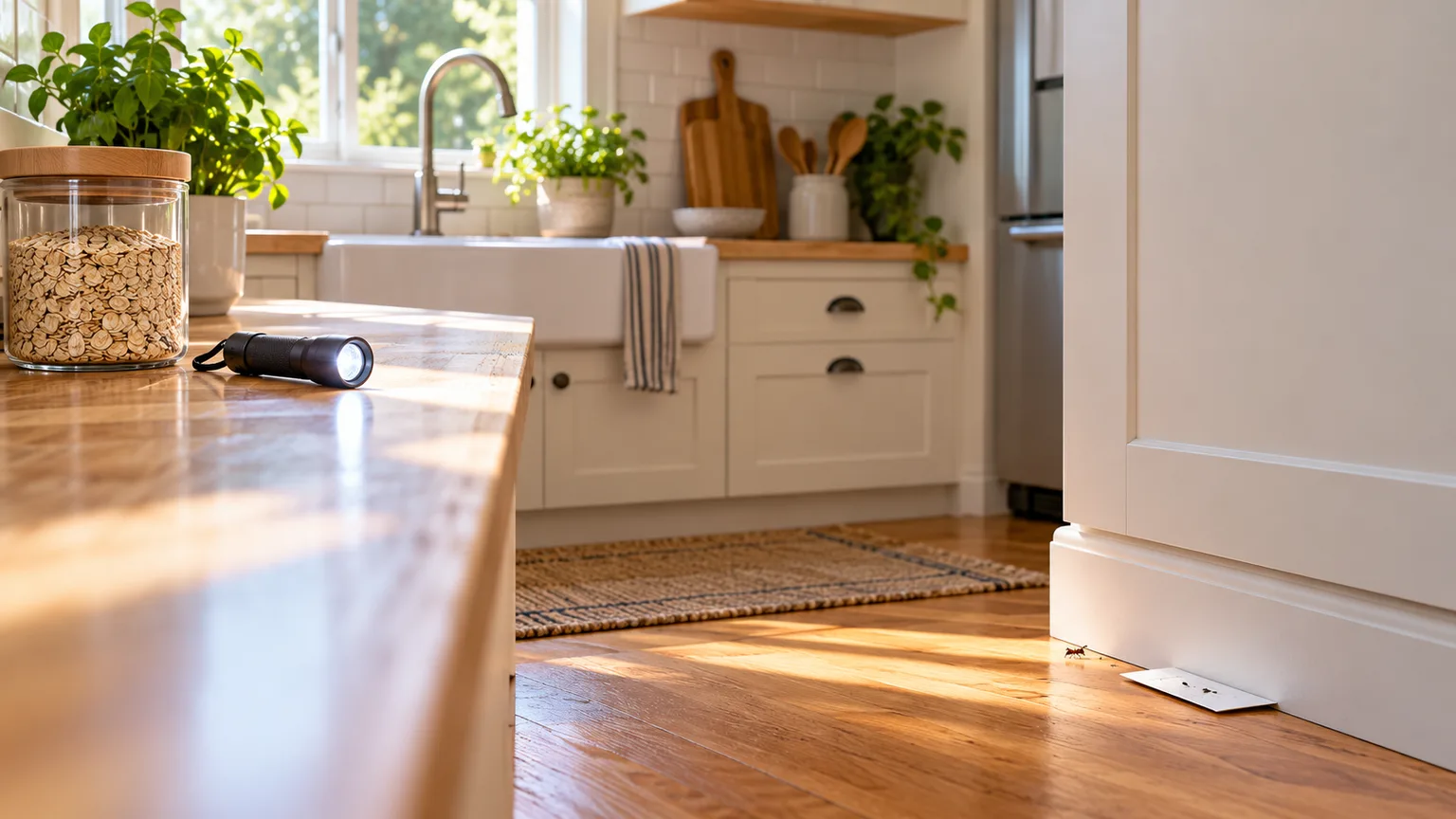
Follow the remaining line in both directions. Look behind the backsplash, along baseboards, around pipe penetrations, under the sink, at window corners, under doors, and where cables enter the wall. Put a small piece of removable tape beside the suspected gap if you need to monitor it after cleaning. If the line reappears at the same spot, you have found a useful control point.
The sealing step that prevents the rebound
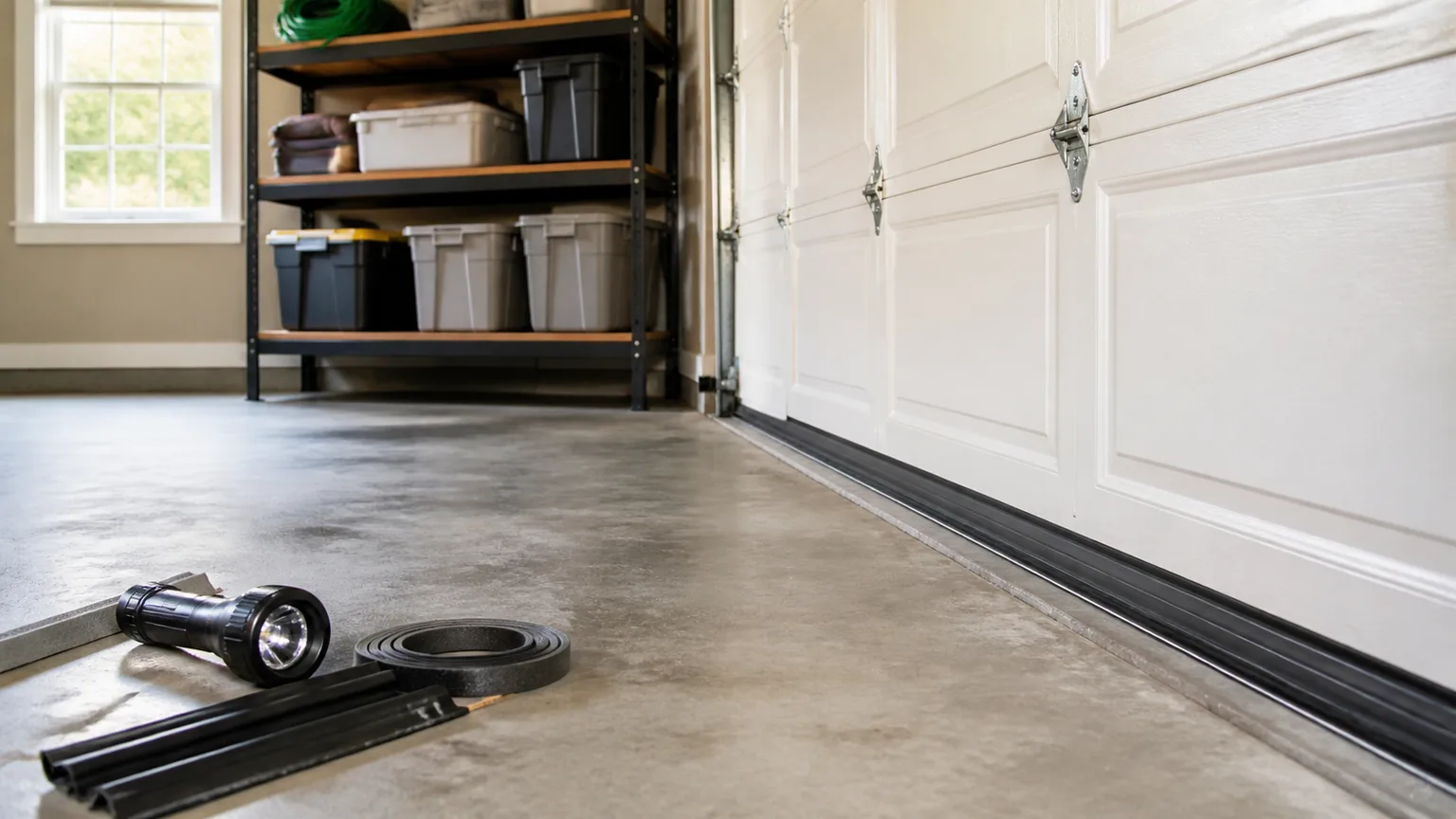
Once the trail is no longer active, seal the crack with the appropriate caulk or weatherstripping for the surface. Do not seal a suspected structural nest blindly if ants are emerging from a wall or damaged wood; sealing the visible opening can redirect them into another room. In that situation, document where they appear and arrange an inspection.
Outside, look for branches or vines touching the wall, mulch and dense vegetation tight against the foundation, overflowing gutters, ripe fruit, and plants with honeydew-producing pests. UC IPM’s ant guidance recommends combining food cleanup, fixing leaks, caulking openings, and managing the outdoor conditions that bring ants toward a building. The most effective barrier is often a series of small maintenance decisions rather than a continuous band of powder or spray.
If you try baking soda, set a clear stopping rule
It is reasonable for a homeowner to want a low-cost experiment before buying a product. If you choose to test baking soda and powdered sugar, treat the test as an observation of a small trail, not a proven colony treatment. Use only a tiny amount in a shallow disposable container, keep it away from food-preparation surfaces, children, and pets, and do not scatter it across a floor, plant pot, or outdoor flower bed.
Record three things: whether ants actually feed, whether they return after the mixture is removed, and whether activity is still steady after the food source and trail have been cleaned. If the ants ignore it, stop. If they feed but the same traffic continues after a short observation period, stop. If ants are coming from a wall, a potted plant, or a location you cannot inspect, stop. A failed kitchen experiment should not become a reason to add more powder.
How a limited sugar test differs from a real ant bait
A real ant bait is not simply “something sweet plus something that might be toxic.” It is a formulated food matrix with an active ingredient, a concentration, and directions intended for a particular use. The goal is delayed action: workers must have time to carry the bait back and share it before they die. UC IPM explains that slow action and food sharing are central to colony-level baiting, while Penn State Extension recommends enclosed, tamper-resistant indoor stations when pesticides are needed.
That difference also explains why more baking soda is not a sensible escalation. A higher powder ratio may make the mixture less attractive, increase the chance of a visible mess, and still tell you nothing about colony reach. Do not combine baking soda with commercial insecticides, sprays, cleaners, or essential oils in the same bait. Mixing products can change how they behave and creates an exposure problem without improving the evidence.
The evidence-backed bait strategy
When ants survive cleaning and exclusion, bait is usually the most useful next tool for a recurring nuisance trail. It works with ant behavior instead of trying to kill every worker in sight. The goal is a controlled route from forager to nest, not a dramatic pile of dead ants on the countertop.
Choose bait by ant feeding preference
Do not assume “sugar ant” describes every ant or that sweetness works all year. UC IPM notes that bait attractants may be carbohydrates, proteins, oils, or combinations, and that preferences vary by species and season. Argentine ants may take sweet bait consistently but can also change what they accept; thief ants and Pharaoh ants may prefer protein or greasy foods; fire ants often respond to oil-based baits.
If a labeled bait is ignored, do not keep refreshing the same station indefinitely. Remove competing food first, confirm the station is along an active route, and try a different labeled formulation if its directions allow. Ants may also be drinking rather than feeding, or the colony may be using a different entrance. An ignored bait is information about the match, not proof that all baiting has failed.
For indoor nuisance ants, choose a ready-to-use product labeled for indoor ant control and use the included station or gel exactly as directed. Active ingredients found in ant baits can include boric acid or borates, fipronil, hydramethylnon, and avermectin or abamectin, but availability and permitted uses vary by location and product. The label, not a generic online recipe, controls the legal application rate and placement.
Place, protect, and monitor the bait
Put the station beside an active trail or near the entry point—not randomly in every room. Keep it out of reach of children and pets, away from food-contact surfaces, and where it will not be washed, kicked, or contaminated with cleaners. Avoid spraying insecticide over the trail while ants are taking bait; a contact spray can kill the workers before they transport the slower bait.
Expect patience. A bait that is designed to reach a colony will not necessarily produce an instant drop in activity. UC IPM says it can take five to ten days to see fewer ants with some bait programs, and full control can take longer depending on species, nest size, weather, competing food, and station maintenance. Keep cleaning up food and water while monitoring, but do not move a station every few hours if ants are actively feeding.
Check the station on the schedule the label gives. Replace dried, empty, spoiled, or contaminated bait. If activity does not decline after a properly placed, accepted bait has had time to work, reassess the ant’s identity and whether more than one colony is involved. Persistent traffic can also mean that an outdoor food source, moisture problem, or inaccessible nest is still active.
Safety is part of control. NPIC’s boric-acid fact sheet explains that boric acid and sodium borate salts are pesticides and that exposure can occur through eating, inhalation, skin, or eye contact. Boric acid products can be low in toxicity in some exposures, but that does not make loose borax or homemade powder safe to leave where a child or pet can reach it. If anyone may have swallowed a pesticide bait, follow the product’s first-aid directions and contact Poison Control at 1-800-222-1222.
Baking soda, borax, boric acid, vinegar, and diatomaceous earth compared
These ingredients often appear in the same “natural ant killer” list, but they have different jobs and different evidence. “Natural” is not a performance rating or a safety guarantee.
| Method | What it can realistically do | Main limitation | Safer-use boundary |
|---|---|---|---|
| Baking soda | May affect individual ants that ingest it; powdered sugar can attract some sweet-feeding workers. | No dependable recipe, dose, species response, or colony-control timeline. | Use only as a contained, optional experiment; do not scatter it or put it in plant soil. |
| Boric acid or borate bait | A registered active ingredient in many ant baits; can work through ingestion when formulated and placed correctly. | Product concentration and ant acceptance matter; not instant and not harmless if eaten. | Use a labeled product, preferably in a protected station, and follow all directions. |
| Borax | A sodium borate salt used in some pest products and home recipes. | It is not automatically interchangeable with boric acid, and homemade concentration is uncontrolled. | Keep away from children and pets; do not treat laundry borax as a ready-made ant pesticide. |
| Vinegar | Can help remove or disrupt a scent trail on a compatible washable surface. | It does not reliably eliminate a nest and can damage stone, finishes, or plants. | Use as a surface-cleaning choice, never as proof of colony control; do not mix with bleach. |
| Diatomaceous earth | A dry, labeled insecticidal dust can abrade and absorb oils from an insect’s outer body. | It works only while dry and in contact; dust can irritate eyes and airways and may affect non-target insects. | NPIC advises following the product label and minimizing dust exposure; choose a product labeled for the setting and pest. |
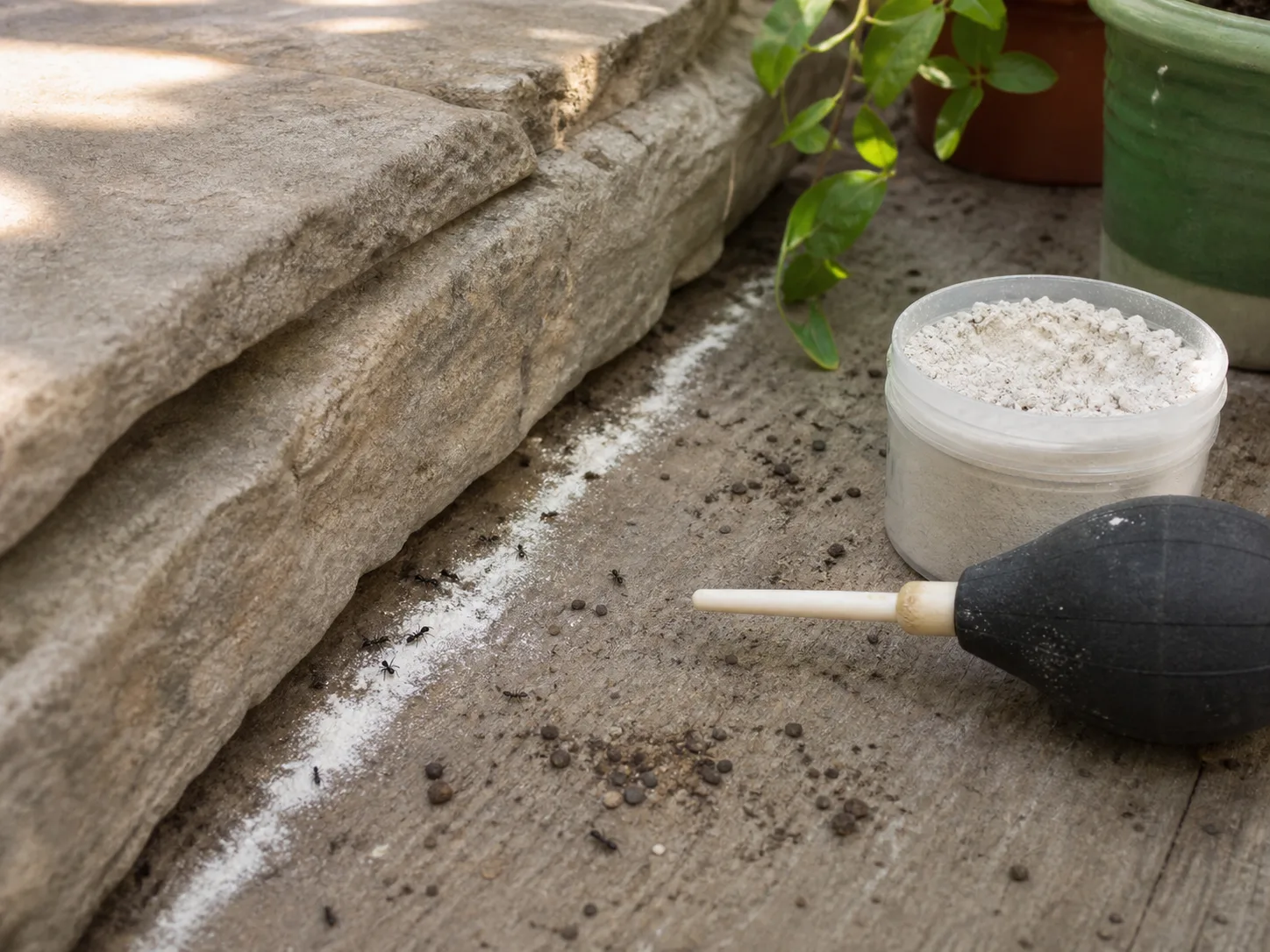
Essential oils, cinnamon, citrus peels, and chalk may alter a trail temporarily, but repellency is not the same as colony reduction. A strong scent can push ants into a different route or make a bait less acceptable. If you use a scent-based deterrent at all, use it as a short-term barrier while you solve the entry, moisture, and food problem—not as a replacement for baiting or inspection.
The cleanest comparison is this: baking soda and vinegar are pantry tools with limited, situation-specific roles; a labeled slow-acting bait is a colony-control tool; exclusion and sanitation are the conditions that make either approach last.
When to stop DIY and call a professional
Call for an IPM-oriented inspection when the ants keep returning after you have removed food, cleaned trails, sealed accessible gaps, and correctly used an accepted bait. Ask what species the technician suspects, where the nest or route is, which treatment is being proposed, and whether spot treatment or baiting can replace a blanket perimeter spray. A professional should be able to explain the plan rather than simply offer a stronger-smelling product.
Escalate sooner when you see large ants associated with damp or damaged wood, sawdust-like frass, winged ants indoors, ants emerging from electrical or wall voids, or a trail that spreads through multiple rooms. Also get help for fire-ant mounds, aggressive stinging ants, an infestation in a food-service area, or a home with infants, crawling children, pets that can reach floor-level bait, or a resident with significant pesticide sensitivity.
Do not make “natural” the only filter. Loose powders can be inhaled, transferred by hands, washed into soil, or carried into places where pollinators and pets contact them. Penn State’s IPM recommendations favor prevention and exclusion first, then enclosed bait traps rather than indoor sprays, foggers, or liquid concentrates. That is a useful safety principle whether the product came from a pantry, a garden center, or a pest professional.
Conclusion
Baking soda may kill an individual ant under some conditions, but a sugar-and-baking-soda mixture is not a dependable way to eliminate an ant colony. The recipe has an attractant, an appealing story, and plenty of anecdotes; it does not have a predictable dose, species match, or verified timeline that lets you promise the nest is controlled.
For a small indoor trail, start with the boring steps that do the real work: remove food and water, wipe away the scent route, follow the ants to their entry, and seal the gap after activity has settled. If the trail persists, choose a labeled, slow-acting bait in a protected station, match the bait to what the ants accept, leave time for worker-to-nest transfer, and monitor the result. When carpenter-ant signs, stinging ants, wall activity, or repeated failure enter the picture, an IPM-trained professional is a better next step than adding more baking soda.