5 Bugs That Eat Wood and How to Identify Them
Found holes or sawdust in wood? Use this field guide to identify five common wood-boring insects and decide what to inspect or do next.
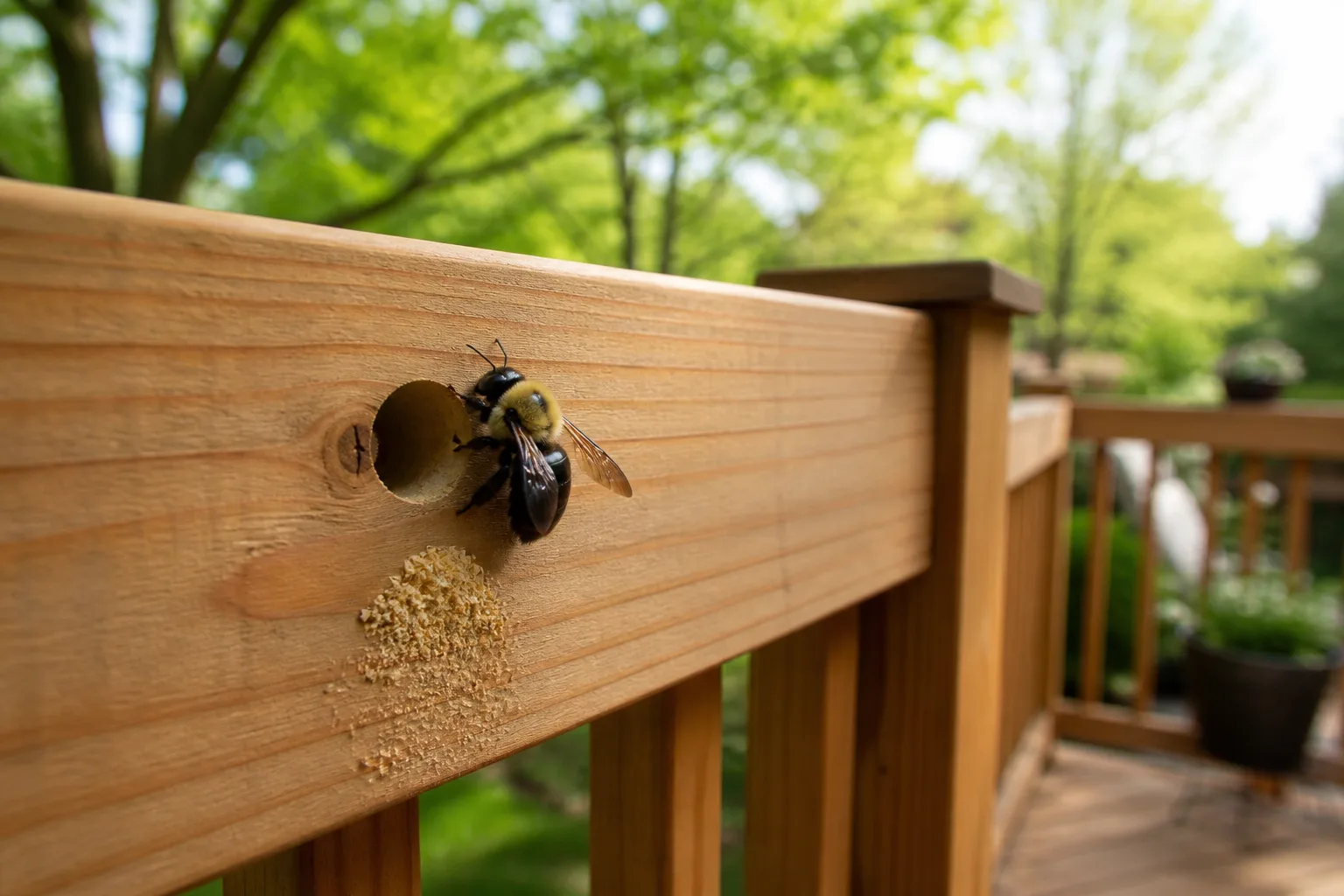
“Something is eating my wood” usually begins with one unsettling clue: a hole in a deck rail, a dusty pile beneath furniture, or a few winged insects at a window. The important distinction is that the insect may be feeding on the wood, excavating it to make a nest, or emerging from wood that was infested before it entered your home.
Those behaviors leave different evidence. Mud, powder, pellets, coarse shavings, smooth galleries, moisture, and hole shape are more useful for narrowing the possibilities than the insect’s color alone. Use this guide to identify the most likely culprit and decide whether you need monitoring, moisture correction, repair, or a professional inspection.
“Wood-eating” is not one behavior
Termites digest cellulose and can consume sound wood. Powderpost and furniture beetle larvae also feed inside wood, often leaving the most obvious sign only when an adult chews its way out. Carpenter ants and carpenter bees are different: they remove wood to create nesting galleries but get their food elsewhere.
That difference changes the response. A termite colony in a building or beetle larvae inside structural members call for a different assessment than a carpenter bee using an exposed, nonstructural fence board. Even carpenter ants are often a moisture problem with an ant symptom: they prefer damp, softened, or decaying wood, although a mature colony can expand into sound wood.
Start with the damage, not the insect
Begin where the evidence is easiest to preserve. Do not immediately fill the hole, spray the visible insect, or sweep away every shaving; take a close photo with a ruler or coin for scale, note the room or structure, and record whether the wood is painted, unfinished, damp, or touching soil.
The most useful first comparison is simple:
| What you see | More consistent with | Why it matters |
|---|---|---|
| Mud tubes or soil-colored shelter lines | Subterranean termites | The insects use mud to maintain moisture while traveling between soil and wood. |
| Coarse, fiber-like shavings with insect fragments | Carpenter ants | Ants excavate galleries and push the waste out; they do not eat the wood. |
| One or more smooth, round holes about the width of a finger | Carpenter bees | A female bee drills a clean entrance into exposed wood, then turns with the grain. |
| Very fine flour- or talc-like dust beneath tiny round holes | Powderpost beetles | Larvae reduce hardwood to fine frass inside their feeding galleries. |
| Small, clean exit holes and gritty fine frass in old timber or furniture | Furniture beetles | Larvae may remain hidden for years; adult emergence is the visible stage. |
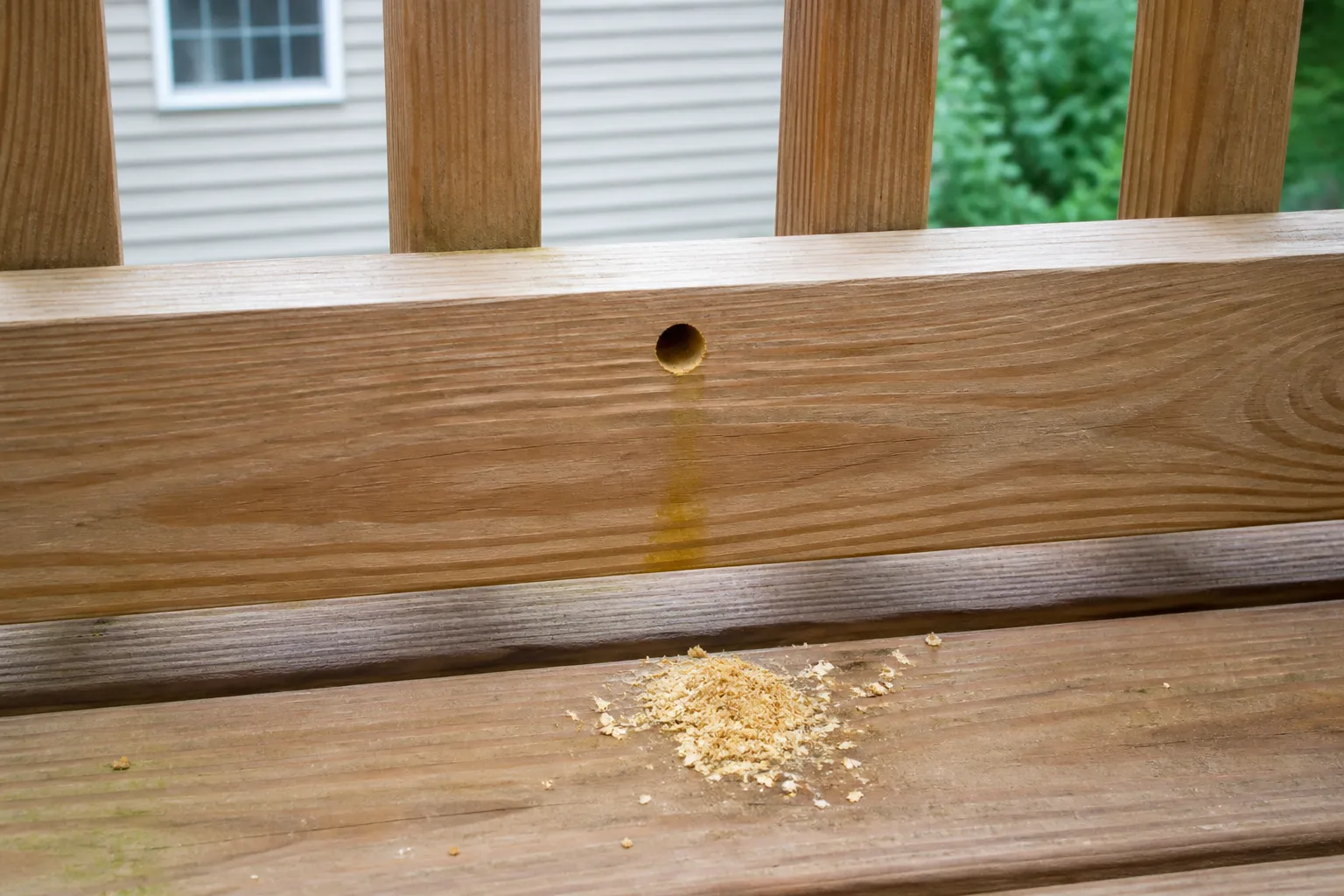
A clean round hole with coarse shavings is a useful clue, but the wood’s location and the presence of a live bee still matter.
Hole, frass, and location checks
Hole shape: A nearly perfect, smooth-edged hole is a strong carpenter-bee clue. Tiny, fairly uniform exit holes point more toward beetles. Termite evidence is often less about a neat surface opening and more about weakened wood, shelter tubes, blistering, or hidden galleries.
Frass texture: “Sawdust” is not a diagnosis. Carpenter-ant debris is often coarse and fibrous and may include insect parts. Powderpost frass feels like flour or talc, while termite pellets are harder and more granular. Rubbing an unknown sample between gloved fingers can help, but do not touch potentially contaminated material with bare hands and do not rely on texture alone.
Location: A damp sill, leaky roof edge, crawl space, or wood-to-soil contact raises the odds of termites or carpenter ants. Unfinished hardwood flooring, bamboo, molding, or furniture raises the odds of powderpost beetles. An exposed, weathered softwood rail, fascia, pergola, or fence cap is classic carpenter-bee territory.
Freshness: An old hole can remain long after an insect is gone. Clean the debris from a safe, movable item and recheck it after a short interval; fresh frass, a new adult, discarded wings, or continuing moisture is stronger evidence of current activity than the hole itself. Do not disturb load-bearing wood to run a home experiment.
A practical comparison from Lawn Love’s wood-pest guide makes the same useful point: wing shape and body structure can separate ants from termites, while hole and frass patterns help distinguish both from beetles and bees. Treat that kind of visual comparison as a starting point, because species and damage patterns vary by region.
1. Termites
Termites are the group to rule out first when the evidence involves a foundation, sill, joist, porch support, or other structural member. They are social insects; workers are the soft-bodied forms that feed on wood, while winged reproductives swarm to start new colonies. Purdue Extension’s termite guidance explains why soil, moisture, and shelter tubes are so central to subterranean termite activity.
Clues that point to termites
Subterranean termites commonly enter from soil or from wood that touches soil. Look along foundations, crawl-space walls, plumbing penetrations, porch supports, and slab cracks for mud or earthen shelter tubes. A tube may be narrow and easy to miss, especially where a sill plate meets masonry.
Winged termites can be confused with flying ants. A termite has straight antennae, a broad waist, and four wings that are similar in length; an ant has elbowed antennae, a pinched waist, and forewings longer than its hindwings. Shed wings on a windowsill or near a foundation are a reason to inspect further, not proof that every piece of nearby wood is infested.
Damage can be hidden behind a thin outer shell. Termites may remove softer springwood and leave a surface that looks intact until it blisters, sounds hollow, or breaks. Drywood and dampwood termites behave differently from subterranean species, so the absence of a mud tube does not eliminate every termite possibility; it only makes that one clue unavailable.
If termites are plausible in a building, do not start by pouring a home-made chemical barrier around the foundation. Treatment depends on species, construction, soil, access, local labels, and the extent of damage. Keep the area accessible, photograph the evidence, and arrange a qualified termite inspection with a written explanation of the proposed work.
2. Carpenter ants
Carpenter ants are large ants in the genus Camponotus. They do not eat wood; they chew it away to make nesting galleries, then forage for sugars, insects, honeydew, and water. NC State Extension notes that carpenter ants are strongly associated with moisture, decaying wood, leaks, clogged gutters, and damp crawl spaces.
You may find workers near sinks, dishwashers, downspouts, roof edges, windows, or tree limbs touching the house. A few ants outdoors or in a kitchen do not prove that the colony is inside. Concern rises when there are repeated indoor workers, winged ants emerging indoors, rustling or chewing noises, or piles of debris below an enclosed void.
How carpenter-ant galleries differ from termite damage
Carpenter-ant galleries tend to be smooth, clean, and sanded-looking, often following the softer parts of the annual rings. The ants push out coarse fibers and frass, sometimes mixed with insect fragments, through slit-like openings. Termite galleries are more likely to contain mud-like material in subterranean infestations or hard pellets in drywood infestations.
This is one of the most useful distinctions in the guide: ants remove wood and leave it behind; termites digest it and leave different waste behind. A University of Maine Extension answer gives the same practical warning from an entomologist: concise, well-defined holes suggest beetles, while extra cratering and gouging in soft, moisture-affected wood can point toward carpenter ants.
If you see carpenter ants, look for the condition that made the wood attractive. Repair leaks, clear clogged gutters, improve crawl-space ventilation, replace rotten trim, move firewood away from the house, and prune branches that create a bridge to the roof. If ants are nesting in a wall or structural member, surface spraying may only redirect foragers; locating the nest and assessing the wood are more important than killing the ants you can see.
The Utah State University structural-pest guide recommends identifying the ant, finding primary and satellite nests where possible, removing water-damaged wood, sealing entry points, and using baits carefully when nests are difficult to locate. Keep any pesticide or bait away from children, pets, food, and pollinators, and follow the current label rather than a generic internet recipe.
3. Carpenter bees
Carpenter bees are large, mostly solitary bees that excavate wood for nest galleries. They feed on pollen and nectar, so they are not “eating” a deck in the termite sense. The Ohio State University Extension fact sheet describes the familiar eastern carpenter bee as a robust bee with a shiny, mostly bare abdomen and a hairy yellow, orange, or white thorax.
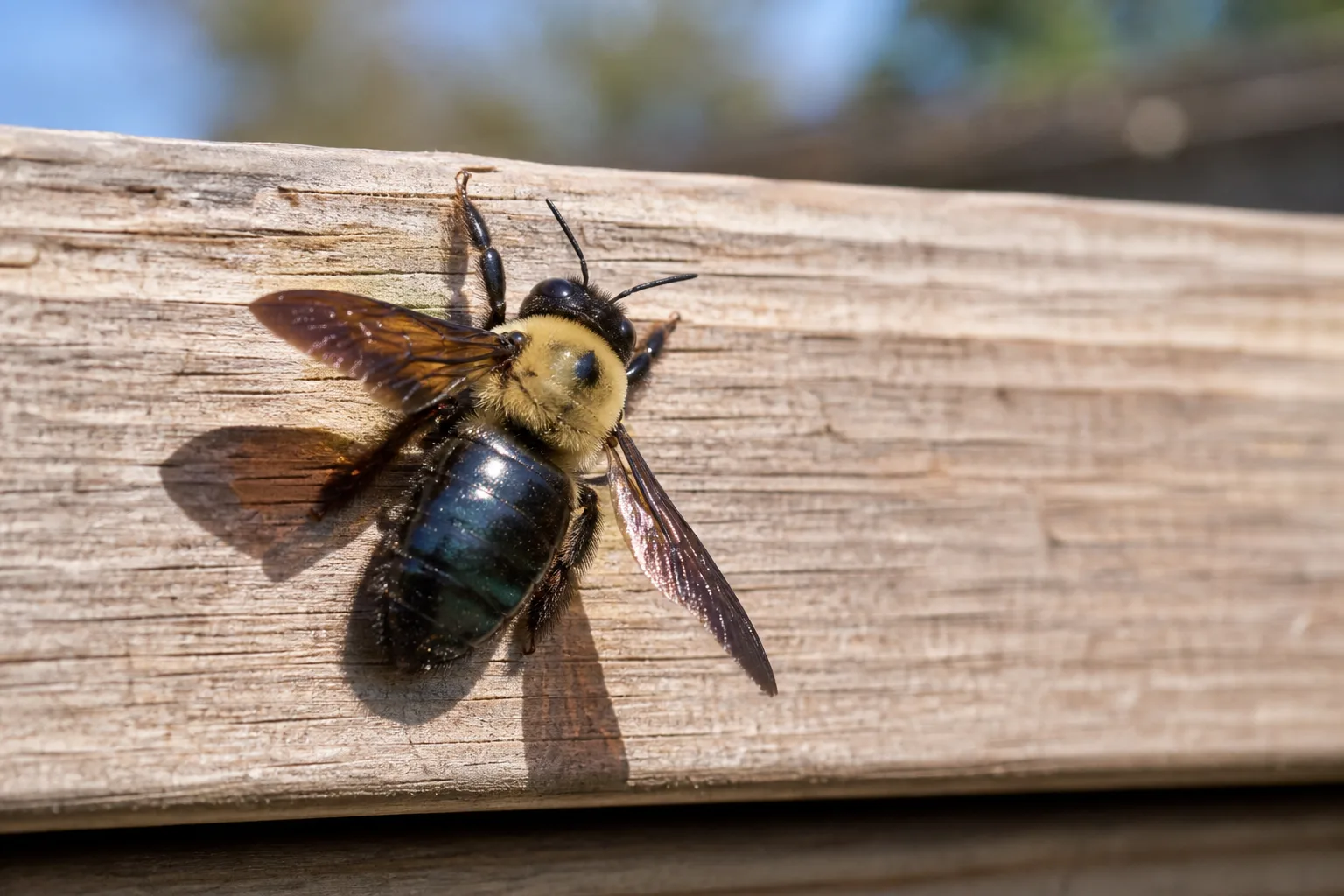
A carpenter bee’s smooth, shiny abdomen helps distinguish it from a bumble bee’s fuzzy, banded abdomen.
The round entrance-hole clue
The entrance is usually the giveaway: a smooth, nearly round hole roughly the diameter of the bee’s body, often close to half an inch in eastern species. The female first drills across the grain, then turns and excavates along it, so the visible doorway can hide a longer gallery. Coarse sawdust below the opening, yellow-brown staining, pollen, or a bee repeatedly entering the same spot strengthens the diagnosis.
Males often hover and dive near the nest entrance but cannot sting. Females can sting if handled or trapped, so do not poke a hole, put a finger over it, or seal an active entrance blindly. Carpenter bees are pollinators, and a nest in a nonstructural fence board is a different management decision from a network of galleries in a porch post or roof fascia.
One season of activity is often limited damage, but repeated reuse can enlarge old tunnels. Woodpeckers may also open the timber while searching for overwintering bees. Inspect the hidden faces of fascia, rail ends, exposed saw cuts, and unpainted softwood; the Ohio State guidance specifically highlights staining and coarse sawdust as clues when the entrance is hard to see.
For prevention, protect exposed wood with a sound exterior coating and maintain it as it weathers. Paint generally offers more protection than a penetrating stain because it forms a film, but no coating is a substitute for repairing rotten wood. If a nest is active in structural timber or close to people, ask a local professional or extension office about a pollinator-conscious control and repair sequence before plugging the opening.
4. Powderpost beetles
“Powderpost beetle” describes a group of wood-boring beetles whose larvae feed inside wood. They are especially associated with unfinished hardwoods such as oak, ash, hickory, mahogany, and walnut, and bamboo can also be vulnerable. UC IPM’s peer-reviewed wood-boring beetle notes emphasize that the larvae do most of the damage and adults create the round exit holes when they emerge.
The hallmark is very fine, powdery frass, often compared with flour or talcum powder, beneath small round holes. The holes can be the only visible sign, and the adult may be attracted to light and turn up dead on a windowsill. New-looking dust under an otherwise clean hole is more informative than a line of old pinholes in an antique cabinet.
Fresh powder versus old holes
To check a movable furniture piece, vacuum or brush away loose frass, photograph the holes, and place the item where new debris will be easy to notice without spreading it to other wood. Do not move suspect firewood from room to room or stack it beside clean lumber. The goal is to establish whether the material is still producing evidence, not to prove a species with a household test.
Powderpost beetle risk depends on the beetle group, the wood species, its moisture and starch content, the finish, and the item’s history. A new piece of hardwood flooring, imported bamboo, old furniture, or firewood can introduce larvae or adults. If the holes are in flooring, framing, joists, or inaccessible paneling, a pest professional should identify the group before anyone applies a treatment; different beetles do not respond identically.
5. Furniture beetles and “woodworm”
Furniture beetles are a useful fifth category because “woodworm” is a common name, not a single diagnosis. In the United Kingdom and parts of Europe, “common furniture beetle” often refers to Anobium punctatum and its larvae, which tunnel through timber before adult beetles emerge. In North America, related anobiid or deathwatch beetles may be more relevant depending on the region and building conditions.
The usual clues are numerous, small, clean exit holes—often around 1 to 2 millimeters for common furniture beetles—plus fine or slightly gritty frass. Adults may appear at windows because they fly toward light. Peter Cox’s practical woodworm guide explains the key timing point: the larval stage causes most of the hidden feeding damage, while the adult exit hole is the part a homeowner can see.
Why the common name can mislead
A furniture beetle is not the same as every insect called a woodworm. Deathwatch beetles, false powderpost beetles, and other wood borers can leave different hole sizes, frass textures, wood preferences, and moisture associations. UC IPM separates these groups because a precise identification affects whether the infestation is likely to be confined to one object, associated with damp timber, or capable of continuing in structural wood.
Do not assume that a piece of furniture is safe because the holes are old, or that every hole is active because the object is antique. Look for fresh frass, new adult beetles, or changes after cleaning, then have valuable furniture or structural wood assessed before sanding, sealing, fumigating, or discarding it. A finish may hide future egg-laying sites, but it will not undo damage already inside the wood.
What to do in the first 24 hours
The first response should preserve evidence and lower the conditions that help the pest. Work through this sequence:
- Photograph the insect and damage. Include a ruler, the whole piece of wood, the hole close-up, and the surrounding room or structure.
- Record what is fresh. Note live insects, shed wings, new frass, staining, mud tubes, and the date. Clean only a movable, nonstructural item where doing so will not spread debris.
- Check moisture and access. Look for leaks, damp crawl spaces, clogged gutters, wood touching soil, firewood against the house, and branches contacting the roof.
- Separate movable items. Keep suspect furniture, firewood, or decorative wood away from clean wood while you arrange identification; do not burn or throw out a valuable piece before documenting it.
- Do not make the evidence disappear. Avoid sealing a live termite tube or carpenter-bee entrance, drilling into a beam, or applying a pesticide chosen only because the insect looked brown.
When professional inspection is the right next step
Call for qualified help when the evidence is on a load-bearing post, joist, sill, rafter, floor, roof edge, or foundation-adjacent member; when mud tubes or indoor termite swarmers appear; when fresh frass keeps returning; or when the galleries are hidden behind walls, insulation, siding, or finished flooring. The same applies when the wood feels soft, breaks easily, sounds hollow, or has been wet for a long time.
Ask what the inspection found, which insect or group is suspected, whether the activity appears current, how the damage affects the wood, and what parts of the proposed work are treatment versus repair. Get more than a product name: a useful report should identify the evidence, the moisture source, the areas inspected, the limits of the inspection, and the follow-up plan.
Prevention priorities by location
Around foundations and crawl spaces: Keep wood off soil, maintain drainage, repair plumbing and roof leaks, and keep crawl spaces dry and ventilated. Inspect sill plates, joist ends, porch posts, and utility penetrations because these are places where soil moisture or hidden water can meet structural wood. Purdue Extension specifically recommends breaking the wood-to-soil connection as a core termite-prevention principle.
Decks, fences, and outdoor furniture: Paint or otherwise protect exposed end grain, rail ends, fascia, and weathered softwood. Replace rotten boards rather than coating over decay, and inspect the underside of rails for carpenter-bee entrances and sawdust. A maintained finish helps, but it cannot compensate for a board that is already soft or structurally compromised.
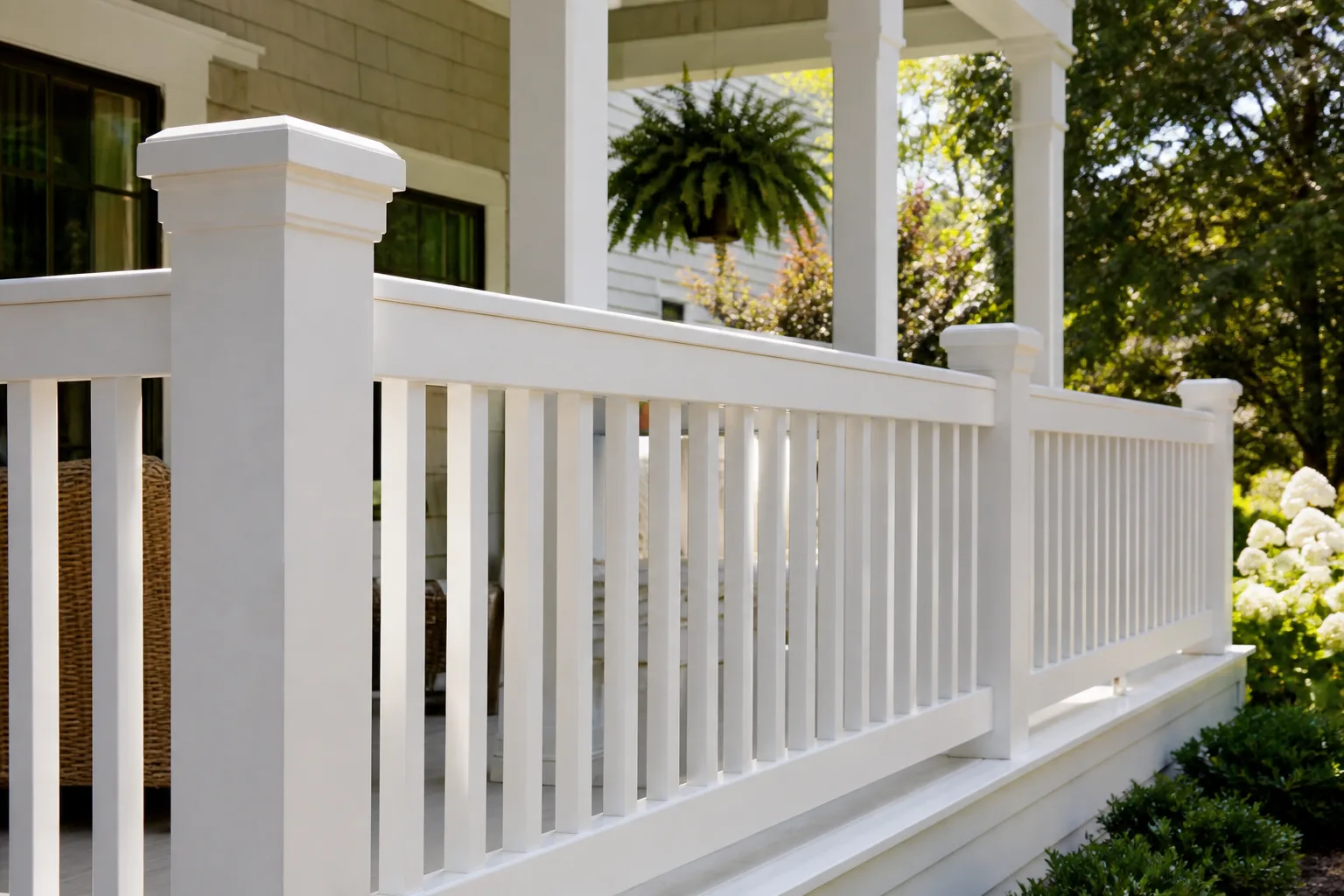
A maintained exterior coating protects exposed wood, but damaged or damp boards still need repair.
Firewood and new lumber: Bring in only the amount of firewood you will use soon, keep it raised and away from the house, and inspect new furniture, flooring, bamboo, pallets, and reclaimed wood before they enter the building. UC IPM notes that wood-boring beetles can arrive in furniture, firewood, and wooden decorative objects, while some forest beetles that emerge from lumber cannot reinfest finished structural wood.
Trees and plantings near the house: Prune branches away from siding and roof edges, remove dead limbs and stumps where practical, and fix the water sources that keep surrounding wood damp. Do not remove a healthy tree simply because ants forage on it; trace the route, correct building moisture, and distinguish an outdoor food trail from an indoor nesting site.
Mistakes that make wood-pest problems harder
Calling every hole a termite hole: A round carpenter-bee entrance, powderpost exit hole, and termite kick-out hole do not mean the same thing. Start with the evidence table, then confirm the pest before choosing treatment.
Treating the insect you can see instead of the nest: Carpenter ants may forage far from the colony, and a male carpenter bee hovering near a hole is not the same risk as termites inside a sill. Killing visible insects without finding the source can create temporary quiet while the damage continues.
Plugging active holes too soon: Sealing an active carpenter-bee entrance can trap insects or push them to a new exit, and covering a termite tube can erase a useful inspection clue. Treatment and repair should be sequenced so that the pest is addressed before the opening is permanently closed.
Using moisture as a complete diagnosis: Damp wood raises the odds of termites, carpenter ants, and some beetles, but it does not identify the insect. Dry hardwood can still support powderpost beetles, and a dry, old hole may be historic.
Assuming “natural” means harmless: Borates, dusts, oils, and home remedies can still harm people, pets, pollinators, finishes, or beneficial insects, and they may be ineffective for a pest that does not consume treated wood. Use only a product labeled for the site and pest, and follow its current directions.
Conclusion
The fastest way to identify a bug that eats or bores into wood is to read the combination of evidence. Mud tubes and equal-winged swarmers point toward termites; smooth galleries and coarse debris near damp wood suggest carpenter ants; a clean, round entrance in exposed wood suggests carpenter bees; flour-like frass beneath tiny holes raises powderpost beetle suspicion; and small exit holes with fine, gritty frass in older furniture or timber fit the furniture-beetle or woodworm category.
A hole alone cannot tell you whether activity is current or whether a structural member is safe. Photograph first, check for fresh debris and moisture, keep suspect movable items separated, and escalate promptly when the evidence involves termites, structural wood, repeated fresh frass, or hidden galleries. Correcting the moisture and access conditions is as important as dealing with the insect you eventually identify.



