How to Plant Flower Bulbs in August by Zone
Plant snowdrops, daffodils, and tulips in August only if soil is below 60°F. Depth, frost dates, and Colchicum pet safety included.
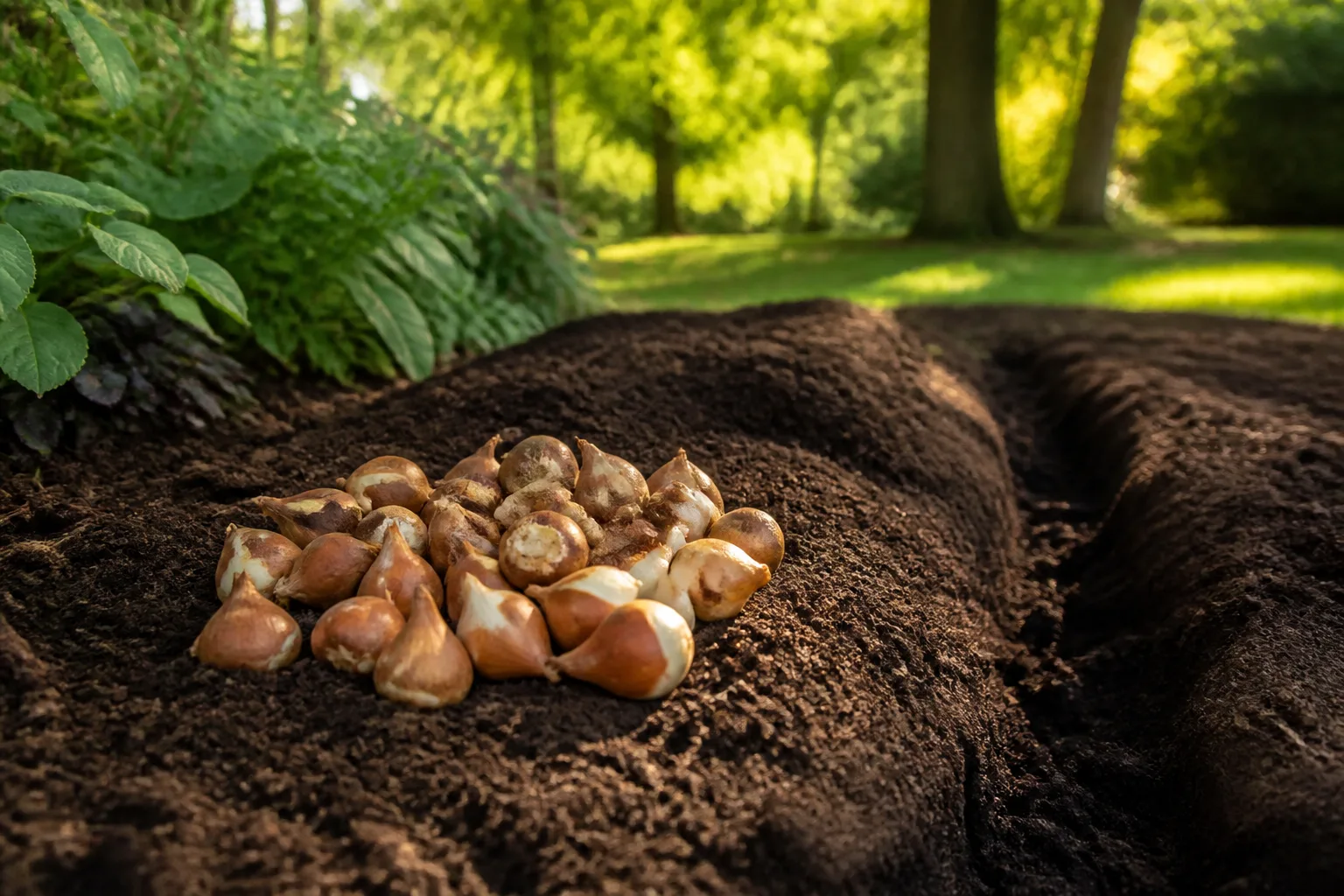
August is not a magic planting month. It is the start of the hardy-bulb window in cold climates, and it is usually too early in warm ones. If nighttime air is still in the 70s and the soil at planting depth feels like a sun-baked pot, wait. If the soil has cooled, your first frost is still four to eight weeks out, and the bulbs are firm, you can plant.
The useful question is not “which eight bulbs did a list name.” It is whether this week’s soil will let roots form without cooking the bulb. Get that right, then choose snowdrops, muscari, daffodils, tulips, crown imperial, alliums, autumn-blooming crocus or Colchicum, and tiger lily with their real bloom seasons — not a fake “everything flowers next spring” calendar.
August vs September: what actually decides timing
Hardy spring bulbs are not summer annuals. They need cool soil to root, then winter cold to set flower buds, then a thaw to bloom. August only works when the first half of that sequence can start now. Southern Living is blunt for much of the South: many spring bulbs should wait until the ground cools, often September at the earliest.
Treat August as a permission slip in cold zones and a hold in warm ones. The calendar month is a reminder to check soil, not a command to dig.
Soil temperature, chill hours, and first frost
Clemson HGIC tells gardeners to plant most spring-flowering bulbs only after soil temperature at planting depth stays below 60°F. Store unplanted bulbs cooler than 60°F. In coastal South Carolina, that planting date can slide to late December or early January. Daffodils there often go in October or November; hyacinths wait until the same 60°F threshold.
Gardener’s Path, citing Rodale, uses the same 60°F at six inches rule, or nights in the 50s for two weeks. They also want four to six weeks of rooting before first frost. BHG uses that same four-to-six-week frost buffer. Some popular roundups say six to eight weeks. Use the overlap: soil below 60°F and at least four to six weeks before your average first frost, longer if you can get it.
Chill is a separate clock. Purdue says most spring-flowering bulbs need about 10 to 13 weeks below 40°F to initiate flowers, plus roots that form only when soil is above 40°F. Clemson describes a 12- to 16-week chilling period and warns that short-chill bulbs bloom on very short stems. Warm-zone gardeners who cannot meet that cold often pre-chill in the refrigerator in ventilated bags, away from ripening fruit. Fruit gives off ethylene gas, which can abort blooms (Clemson; Garden Design).
RHS (UK timing, still useful for sequence) plants spring bulbs in autumn, daffodils and crocus preferably by the end of September, tulips in November, hardy summer bulbs such as lilies and alliums in September–October, and autumn-flowering bulbs by late summer. That last line is why Colchicum and fall crocus belong on an August list even when tulips do not.
A zone-by-zone decision before you dig
Find your zone on the USDA Plant Hardiness Zone Map. Then ignore the zone number long enough to feel the soil at six inches. Zone is climate context. Soil temperature is the go/no-go.
| USDA zones | Typical August move | Why |
|---|---|---|
| 3–5 | Plant hardy spring bulbs in late August if soil is cooling and first frost is still 4–8 weeks out | Short fall; OSU wants bulbs in through October so daffodils root before freeze |
| 6–7 | Plant only after a cool spell; many beds still wait until September | Soil often sits above 60°F mid-month; PSU still treats western Pennsylvania’s best window as September–October |
| 8–10 | Skip classic tulips and trumpet daffodils in August heat; wait until late fall and pre-chill | Clemson waits for soil below 60°F; coastal plantings may be December–January |
BHG puts tulips in Zones 8–10 in late November to early December, not August. If you are in that band and someone told you to plant tulips this week, they skipped the chill math.
First action: probe soil at planting depth in the morning. If it is still warmer than about 60°F, store bulbs cool and dry and plant when it drops. If it is cooler, and you have weeks before frost, plant the bulbs below that fit your bloom goal.
How to plant late-summer bulbs without rotting them
Daffodil and tulip bulbs in an outdoor trench with pointed ends facing up
August soil can be dry on top and still hold winter-killing wet in heavy clay. Drainage is not a style preference. It is whether the bulb is a flower or a mushy snack for fungi. Clemson calls good drainage essential and amends problem beds with 2 to 3 inches of organic matter worked 10 to 12 inches deep, or uses raised beds.
Buy firm, dry, unbruised bulbs. OSU wants the largest bulbs you can afford — larger bulbs generally mean larger flowers — and a site that will get spring sun, including under deciduous trees that leaf out later. Discard anything soft, moldy, or already collapsing in the bag.
Depth, orientation, drainage, and the first watering
Sources disagree slightly on the multiplier, and that disagreement is worth stating. BHG says plant at twice the bulb’s height. PSU and Garden Design say two and a half to three times the bulb height. Clemson says three to four times as deep as the bulb’s width, measured from the base. Get Busy Gardening uses two to three times height and tells you to read the package.
Use the package first. If there is no package, plant most hardy bulbs about three times their height, pointed end up, basal plate down. Garden Design notes that if you cannot tell top from bottom, plant on its side and the shoot will find the surface. Too shallow and shoots can heave or frost-burn. Too deep and bloom can run late or fail (Garden Design; Clemson links shallow daffodils to sparse bloom).
Space large bulbs about 3 to 6 inches apart and small ones 1 to 2 inches, in masses, not lonely singles (Clemson; RHS wants groups of at least six and often 25 to 50 for a real show). Backfill with native soil, not a fertilizer dump in the hole unless a bulb-specific product’s label says otherwise. PSU covers with 2 to 3 inches of mulch to buffer freeze–thaw and hold moisture.
Water once if the ground is dry and no rain is coming (Get Busy Gardening; RHS says watering is not critical when autumn soil is already moist). Do not keep the bed soggy. Roots need air as much as water.
Heat waves, squirrels, and other August failure modes
Do not plant into a late-summer heat wave. Warm, wet soil is a rot chamber. Tiger lilies and other true lilies are especially unforgiving if you bury them while the bed still feels like August pavement. Wait for a cool stretch.
Squirrels and chipmunks treat tulip and crocus plantings like a buffet. Clemson says animals rarely eat daffodil bulbs, and the only sure protection for the rest is wire mesh around the bulbs. Garden Design adds chicken wire staked over the bed or bulb baskets. Daffodils, many fritillarias, and alliums are the practical “plant these if rodents own your yard” group — still not a reason to skip mesh on tulips.
Do not store bulbs next to apples or other ripening fruit. Ethylene can ruin flower initiation (Clemson; Garden Design).
Do not plant in a low spot that puddles after storms. Failure to bloom is often rot, overcrowding, or shade, not a “bad bulb brand” (Clemson).
If you miss the window entirely and the ground later freezes, Purdue still says plant as soon as you can dig, as long as soil is above 40°F for roots, then mulch against heaving. Those late bulbs may bloom late, skip a year, or need indoor forcing. That is a winter problem. In August your job is simpler: plant only if the soil has actually cooled.
Eight bulbs that earn an August planting
These eight cover three calendars. Snowdrops, muscari, daffodils, tulips, crown imperial, and most alliums bloom next spring (alliums sometimes early summer). Autumn crocus / Colchicum can bloom this fall if you plant promptly. Tiger lily blooms next summer. Ranking listicles that dump all eight under “gorgeous garden in the spring” are mixing jobs.
Hardiness ranges below are typical catalog bands, not a promise your microclimate matches. Check the USDA map and the vendor’s zone listing for the cultivar in your hand.
| Bulb | Typical USDA zones | Planting depth (guide, then package) | Blooms | August fit |
|---|---|---|---|---|
| Snowdrop (Galanthus) | 3–8 | ~3 in (small bulb × 2–3) | Late winter–early spring | Strong in cold zones once soil cools |
| Grape hyacinth (Muscari) | 4–8 | 4–6 in (BHG) | Early–mid spring | Strong; naturalizes fast |
| Tulip (Tulipa) | 3–8 | 6–8 in (Clemson; BHG) | Spring | Only if soil < 60°F; wait in warm zones |
| Crown imperial (Fritillaria imperialis) | 5–9 | ~8 in, slightly angled (BHG) | Spring | Late summer–early fall in cool soil |
| Daffodil (Narcissus) | 3–8 | 6–8 in standard (Clemson; BHG) | Early–mid spring | Often the first hardy bulb to plant as soil cools |
| Tiger lily (Lilium lancifolium) | ~3–9 (cultivar-dependent) | ~3× bulb height; package first | Next summer | Only after heat breaks |
| Ornamental allium (Allium) | 3–9+ | 2–12 in by size (BHG) | Late spring–early summer | Cool climates now; warmer wait until fall |
| Autumn crocus / Colchicum | 4–8 / 4–9 typical | Colchicum 2–3 in; fall Crocus 3–4 in (PSU) | This fall (if planted promptly) | Best August candidate of the eight |
Early spring: snowdrops and grape hyacinth
Snowdrops (Galanthus nivalis and relatives) are often the first flowers through late-winter snow. They stay short — about 4 to 10 inches — so a single bulb looks like a mistake. Plant in drifts of 25 or more in full to part sun and sharp drainage. RHS notes that snowdrops are often happier moved “in the green” after bloom, but dry bulbs still work if they are planted soon and not cooked in hot soil.
Grape hyacinth (Muscari armeniacum and kin) throws short grape-like spires, usually 6 to 9 inches, in early spring. Clemson calls them easy naturalizers and good companions for taller spring bulbs. BHG plants them pointed side up, 4 to 6 inches deep, and flags Muscari neglectum as invasive in some U.S. regions — check your state list before you let that species loose. Full to part sun, moist but drained soil, zones roughly 4–8.
These two are the “plant a lot, plant shallow-to-medium, enjoy early” pair. They do not replace tulips. They fill the weeks before tulips.
Classic spring: daffodils and tulips
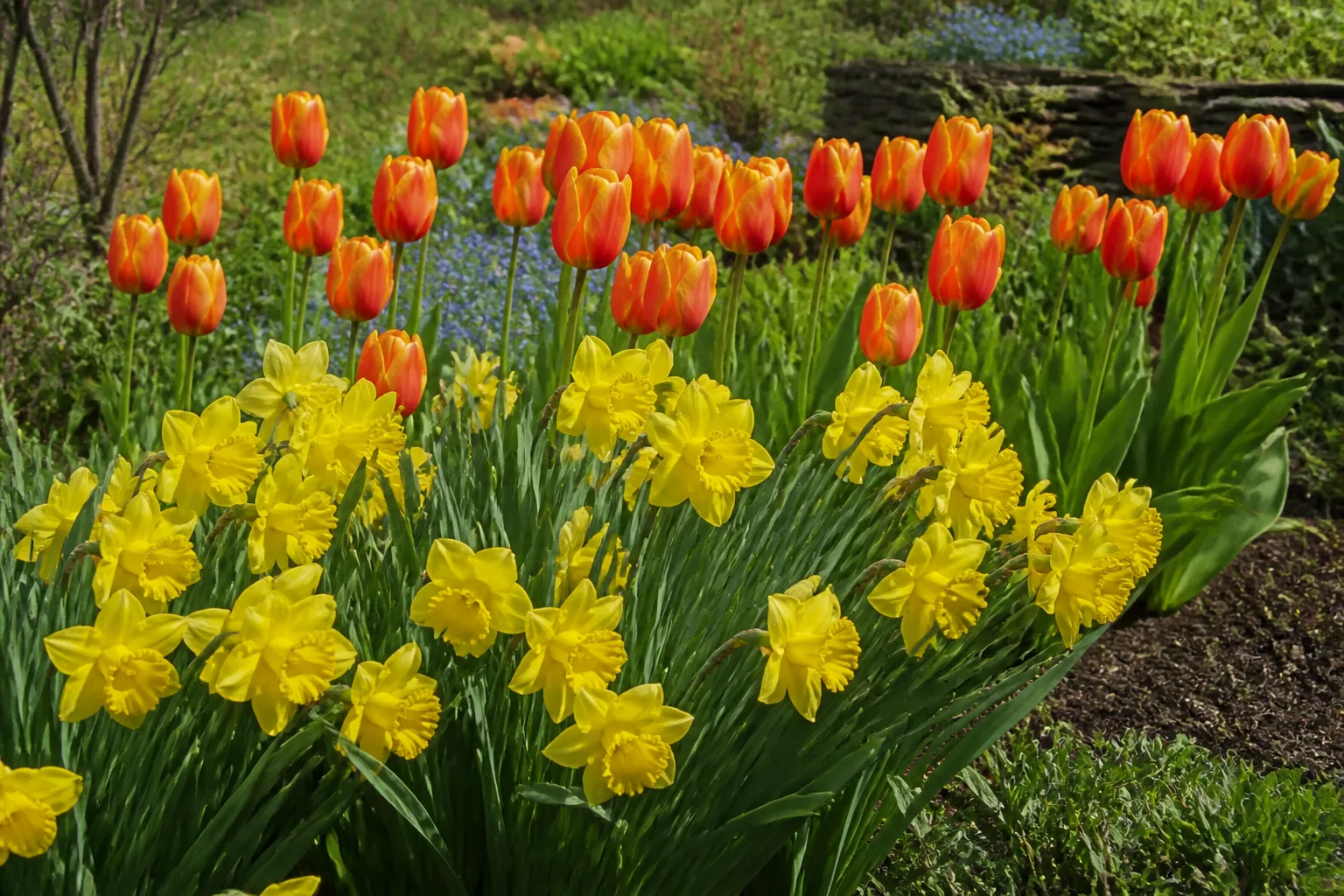
Yellow daffodils and tulips blooming together in a spring garden border
Daffodils (Narcissus) are the workhorse. Clemson plants them 6 to 8 inches deep, 3 to 6 inches apart, with at least six hours of sun while in leaf, and calls them the most successful popular spring bulb for naturalizing in the South — if you choose jonquil, tazetta, poeticus, and species types instead of fussy big trumpets. BHG uses about 8 inches for standard bulbs and 4 inches for miniatures, pointed “noses” up, and notes multi-nose bulbs often bloom better. Height at bloom runs roughly 6 to 30 inches by cultivar.
Daffodil bulbs contain lycorine and other alkaloids. ASPCA lists them toxic to dogs, cats, and horses, with vomiting, drooling, and diarrhea; large ingestions can cause tremors and heart-rhythm problems. The bulb is the most poisonous part. Wear gloves if your skin reacts, and keep chewed bulbs away from pets. The same chemistry is why rodents usually leave them alone (Clemson).
Tulips (Tulipa) want full sun, rich drained soil, and 6 to 8 inches of depth (Clemson; BHG also says many gardeners go even deeper). Pointed end up. In warm climates, treat most hybrids as one-season color: Clemson refrigerates bulbs from purchase until a November to late-December planting in central and coastal South Carolina. August tulip planting in that climate is how you get rot, not ribbons.
ASPCA lists tulips toxic to dogs, cats, and horses (tulipalin A and B), with the highest toxin concentration in the bulb. Squirrels do not care about your design board. If you plant tulips in August-cooled soil, cover the bed with 1-inch mesh until the ground freezes or the shoots are up.
Plant daffodils as soon as soil is ready. Hold tulips a little later than daffodils if your August is still warm — that matches both Clemson and RHS sequence.
Statement plants: crown imperial and ornamental allium
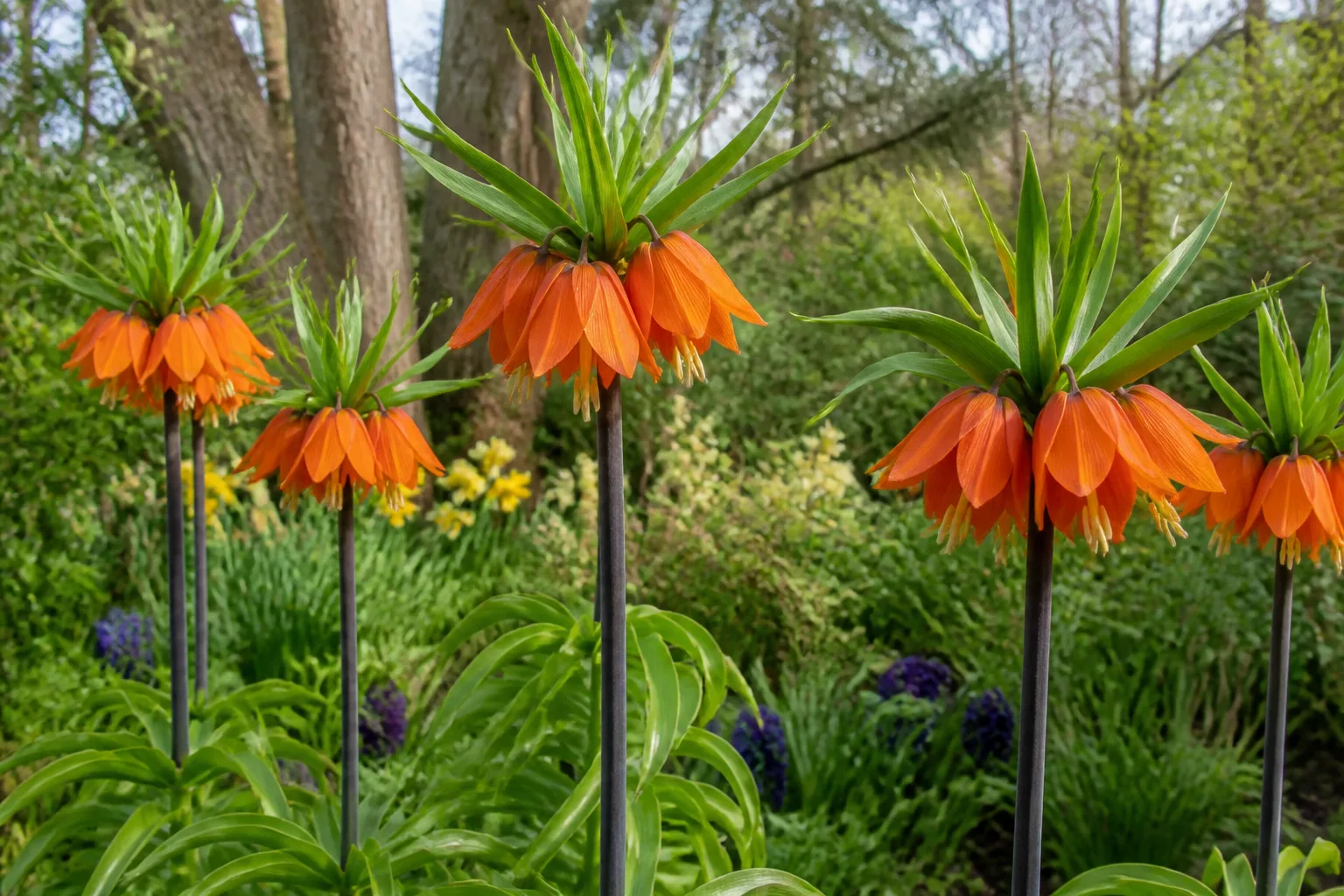
Crown imperial (Fritillaria imperialis) is the tall spring exclamation point: a cluster of bell flowers under a pineapple-like tuft, often 2 to 4 feet. BHG lists it for Zones 5–9, plants the large bulb about 8 inches deep, and tips it slightly so water does not sit in the dimple on top. The skunk-like smell is a feature for deer and rodents and a reason to plant it where you will not kneel all spring. Full sun, rich drained soil, late-summer to early-fall planting once the bed is cool.
Ornamental alliums are onion relatives grown for globes of tiny florets on skinny stalks. Clemson likes southern performers such as Naples onion (A. neapolitanum), drumstick allium (A. sphaerocephalon), and star of Persia (A. christophii). BHG plants them 2 to 12 inches deep by bulb size, point up, in Zones 3–9. Bloom is usually late spring into early summer, not with the first snowdrops.
In cooler climates, late summer is a fair allium window. In warmer areas, wait until true fall, the same way you wait on tulips. Alliums are generally rodent-uninteresting. They are still Allium: keep pets from grazing foliage and flowers, and do not assume “ornamental onion” is a snack.
Same-year fall bloom: autumn crocus and the Colchicum warning
Pink-lavender autumn crocus flowers blooming on bare soil in fall
This is the bulb August actually owns. Fall-blooming corms are ready to grow now. PSU says they do not keep well on store shelves, can flower in the bag, and should be planted as soon as you get them — not after you finish every other fall chore. If Colchicum has already bloomed in the box, remove the flowers before planting.
Two different plants share the nickname autumn crocus:
- True autumn-flowering crocus (Crocus speciosus and relatives): usually blue-lavender or white, plant 3 to 4 inches deep, full sun, excellent drainage (PSU).
- Meadow saffron / Colchicum (Colchicum autumnale and hybrids): pinkish or rose-lavender (white forms exist), larger “naked” flowers without leaves, plant 2 to 3 inches deep, a bit more moisture except in dormancy (PSU).
PSU is explicit: all parts of Colchicum are poisonous to humans and animals. Wear gloves. ASPCA lists Colchicum autumnale as toxic to dogs, cats, and horses because of colchicine and other alkaloids. This is not a “maybe upset stomach” plant. Do not put it where toddlers or pets forage. Do not confuse it with edible saffron (Crocus sativus), which is a different species PSU discusses separately.
Plant these in August for flowers this autumn, then expect foliage later — sometimes not until spring. Leave that foliage until it yellows. Colchicum leaves are large and floppy; PSU tucks plants at shrub feet or into groundcovers so spring leaves do not smother neighbors.
Next-summer bloom: tiger lily
Healthy true lily in outdoor bloom
Tiger lily (Lilium lancifolium, also sold as L. tigrinum) is a true lily, not a spring crocus. You plant the bulb in late summer or fall after the weather cools; you get the spotted orange (or cultivar-colored) flowers the following summer on stems that can reach 3 to 6 feet. Full to part sun, loamy soil that stays moist but drained. In cold climates, late August can work once a heat wave has broken. In warm climates, follow the lily’s fall window, closer to the RHS September–October hardy-lily timing.
ASPCA lists Lilium species as toxic to cats, with kidney failure as the clinical sign, and non-toxic to dogs and horses on that page. If you have cats that go outside, tiger lily is a hard no unless the bed is fully inaccessible. Pollen, leaves, and flowers all matter. This is a YMYL line, not a style note.
Do not plant lily bulbs into oven-hot soil “because the article said August.” Wait until the bed has cooled. That is the whole August rule, applied to a summer bloomer.
Aftercare until the flowers show up
After planting, your job is mostly not to wreck the roots. Keep the mulch in place through winter so freeze–thaw does not heave bulbs out (PSU; Purdue). Water only in a true drought. Label the bed so you do not dig it for a new shrub in March.
When spring bloom finishes, deadhead tulips and daffodils so they do not waste energy on seed, and leave the leaves at least six weeks or until they brown (Clemson). Cutting foliage early is a classic reason next year has leaves and no flowers. Hide yellowing leaves by overplanting with perennials or summer annuals, without stabbing the bulbs.
Divide crowded daffodils every few years when bloom thins (Clemson; PSU). In hot climates, expect many hybrid tulips to be one-and-done unless you lift, chill, and replant — or switch to species tulips that actually like heat (Clemson).
If you bought bulbs early, store them cool, dry, and dark, below about 60°F, away from fruit. Plant fall-bloomers immediately. Plant spring-bloomers when the soil, not the marketing calendar, says go.
Conclusion
August bulb planting is a soil-temperature job with a frost deadline, not a themed weekend. If the ground at planting depth is still above about 60°F, wait. If it has cooled and you still have at least four to six weeks before average first frost, plant.
Put snowdrops and grape hyacinth in for early color, daffodils in as the reliable backbone, tulips only when the bed is truly cool and protected from squirrels, crown imperial and alliums for height, Colchicum or true autumn crocus for this year’s fall flowers, and tiger lily for next summer — never in a heat wave, and never where cats can chew Lilium. Depth is about two to three times bulb height unless the package says otherwise. Pointed end up. Drain the soil. Mulch. Leave the leaves after bloom.
That is the whole decision. Dig this week only if the soil has earned it.



