15 Blueberry Companion Plants for a Healthier Crop
Choose 15 blueberry companion plants by soil, water, bloom time, and spread, with clear advice on spacing, containers, and plants to keep away.
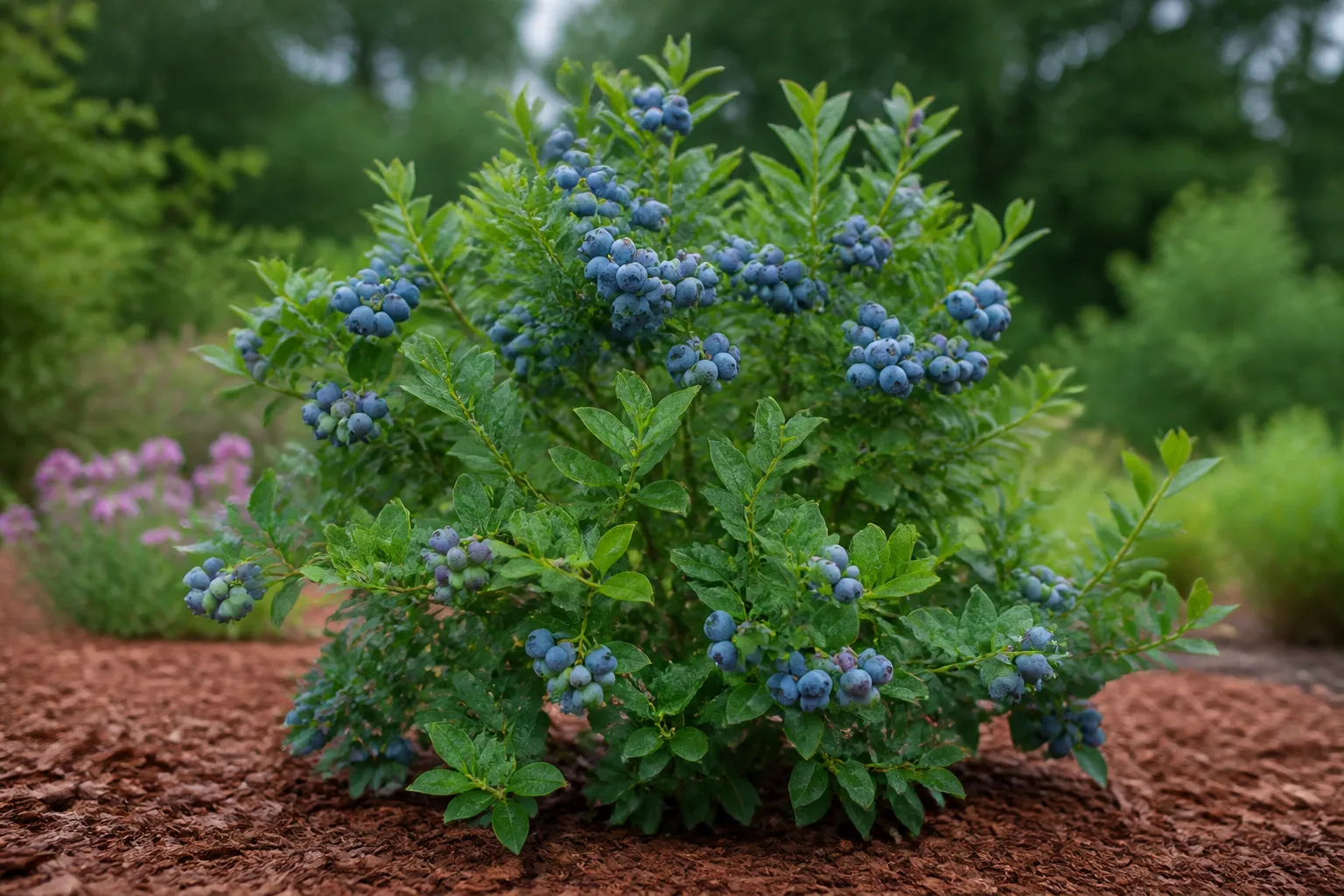
Yes—but the best blueberry companion is not simply the plant with the strongest scent or the prettiest flower. It is a neighbor that shares the blueberry’s acidic, well-drained root zone, supports pollinators at the right time, or can live close by without stealing light, water, or room.
Blueberries have fine, shallow roots, so a crowded planting can backfire quickly. Use the list below as a placement guide: same bed, edge, container, or separate bed. The first choice is often another compatible blueberry; the rest are useful only when their own needs fit your site.
What companion planting can actually do for blueberries
Companion planting can make a blueberry area more functional, but it is not a yield guarantee. The Royal Horticultural Society describes the main possible benefits as efficient use of space, disruption of some pest and disease patterns, and support for more mixed, wildlife-friendly plant communities. It also cautions that a claimed benefit will not work for every crop or every combination, so treat a pairing as a design decision rather than a magic formula. RHS companion-planting guidance
For blueberries, the most dependable “companion effects” are straightforward. A second compatible cultivar can improve pollination; an acid-loving shrub can share the same soil-management routine; a low plant can cover some bare ground if it does not invade the root zone; and a succession of flowers can give bees reasons to keep visiting the garden. None of those replaces the basics: correct pH, full sun, moisture that does not stagnate, pruning, and bird protection.
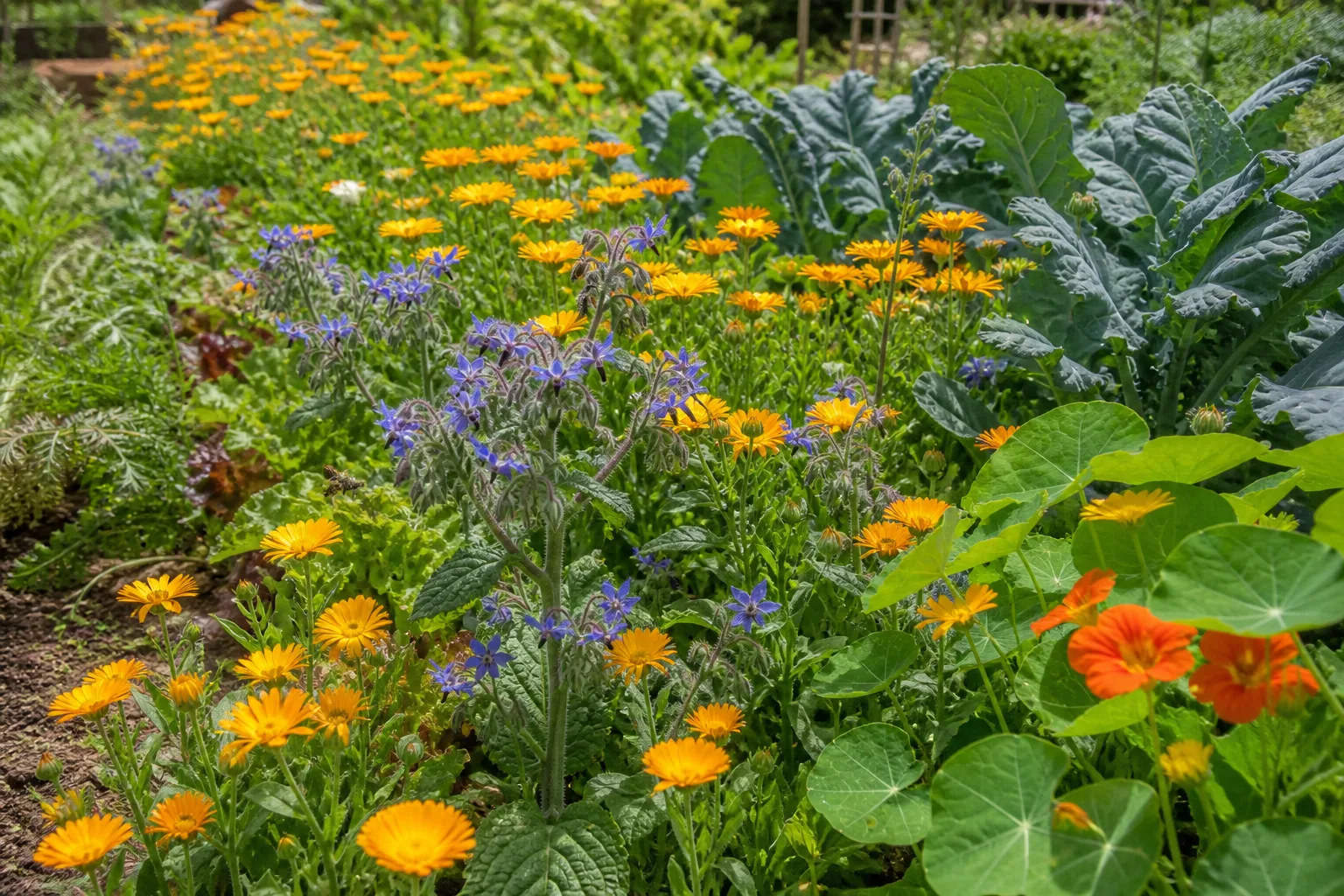
The most useful companion effects come from a deliberate mix of flowers, root zones, and manageable plant habits.
Pollination deserves special attention because blueberry flowers are not wind-pollinated in the way many gardeners assume. USDA Agricultural Research Service guidance explains that bumblebees and diverse native bees are effective blueberry pollinators, while honey bees can pollinate highbush blueberries under suitable bloom conditions. In a study of an introduced blueberry crop, wild bumblebees and managed honey bees supplied complementary pollination services rather than acting as interchangeable workers. USDA Agricultural Research Service blueberry pollination notes Peer-reviewed blueberry pollination study
The four tests for a genuinely good neighbor
Before planting anything next to a blueberry, run four quick tests:
- Does it tolerate the same root-zone conditions? Blueberries generally perform best in strongly acidic soil, consistent moisture, and excellent drainage. RHS guidance gives a practical soil pH target of about 4.5 to 5.5, while Penn State Extension describes an optimum around 4.5 to 5.0. Use your soil test and the cultivar’s needs rather than trying to make one bed suit plants that prefer neutral or alkaline soil. RHS blueberry growing guide Penn State Extension blueberry establishment guide
- Will it leave light and air available? Blueberries fruit best in sun. A companion that grows taller, leans across the canopy, or creates a dense, damp mat can reduce the conditions you worked to create.
- Can you manage its roots and mature size? Fine blueberry roots are easily disturbed. Runners, suckers, aggressive rhizomes, and plants that must be dug every season are poor choices right against the crown.
- Is the claimed benefit specific enough to trust? “Repels pests” is not a complete recommendation. Ask which pest, under what conditions, and whether the plant could instead attract pollinators, compete for water, or hide a developing problem.
The 15 companion plants—grouped by fit
The list is easier to use when you sort the plants by the job they can do. The first group is generally easiest to integrate into an acidic bed. The second group is primarily about bloom and beneficial-insect habitat. The third group can be useful, but water, spread, or mature-size conflicts make the edge or a pot safer than the blueberry’s root zone.
Acid-loving plants for the same bed
Another blueberry, cranberry, strawberry, heather, azalea, rhododendron, and an acid-tolerant fern are the most natural candidates for a bed managed around acidic soil. Even here, “same bed” does not mean “pressed against the blueberry.” Leave room for the shrub’s mature spread and keep the surface mulched rather than filling every inch with roots. For a practical woodland-style layout, Rural Sprout’s blueberry companion overview groups acid-loving shrubs, ferns, and native wildflowers by garden layer; use that as design inspiration, not as proof that a pairing guarantees more fruit.
Flowers that widen the pollinator menu
Bee balm, borage, chives, thyme, sage, and basil can add flowers or aromatic foliage around a blueberry planting. The pollination benefit comes from supplying suitable flowers and habitat, not from a guaranteed chemical shield. Choose plants that bloom when your blueberries are flowering or fruiting, and avoid cultivars with flowers so altered that insects cannot easily reach pollen or nectar.
Herbs and groundcovers for the edge or a pot
Mint and lemon balm are the two choices most likely to become a maintenance problem. Strawberries can also run, while thyme, sage, and basil often prefer a different watering rhythm from a blueberry. These are not automatic “bad plants”; they are plants that need a boundary, a separate irrigation pocket, or a container.
How to arrange companions without crowding the bush
The difference between a helpful companion and a competitor is often layout. Blueberries are long-lived shrubs, so plan around their mature canopy instead of the small nursery pot you bring home. RHS recommends spacing blueberry bushes about 1 to 2 meters (3¼ to 6½ feet) apart, depending on the variety’s ultimate size; companions should fit into the remaining space, not force the shrubs closer together. RHS blueberry spacing guidance
Keep the blueberry root zone open
Start with a clear, mulched ring around each blueberry. You do not need bare soil, but you do need a zone where you can check moisture, add mulch, spot suckers, and water the plant without stepping on or digging through its fine roots. Keep stems and dense foliage from resting against the blueberry’s base.
Use low companions outside that ring, then observe how quickly they spread. A plant that looks harmless in spring can shade the crown by summer or create a wet pocket after rain. If the companion needs division, root pruning, or frequent cultivation, move it farther from the bush before it becomes established.
Match height and bloom timing
Blueberries need sun, particularly when they are being grown for fruit rather than as woodland ornamentals. Place taller shrubs where they will not cast afternoon shade across the blueberry; in the Northern Hemisphere, that usually means putting the tallest plants toward the north side of the planting, while Southern Hemisphere gardeners should reverse the orientation.
Pollinator planting is more useful when flowers overlap the blueberry bloom period and continue afterward. A single flower that opens for a week may be attractive but less helpful than a small sequence of early, midseason, and late flowers. Leave a clear flight path through the bed, and avoid making the blueberry flowers compete with a wall of taller blooms.
Separate the irrigation
A blueberry wants consistent moisture but not waterlogged soil. A culinary sage or thyme wants to dry more between waterings; mint and lemon balm can tolerate moisture but spread aggressively; basil wants warm, regular moisture; and a fern may appreciate more shade than the berry shrub. Group plants by watering pattern instead of forcing them onto one hose schedule.
The simplest arrangement is a blueberry bed with its own drip line or hand-watering zone, companion shrubs just beyond the mulch edge, and herbs in pots nearby. If a companion only succeeds when the blueberry is too wet, the problem is not a lack of fertilizer—it is a mismatched irrigation design.
15 plants to choose from
Here are the 15 options, with the placement decision that matters most.
1. A second compatible blueberry — the highest-value companion
If you want a companion that directly supports the crop, start with another blueberry of a compatible type and overlapping bloom time. Many highbush varieties are self-compatible, so one bush can fruit, but cross-pollination can improve fruit production; many rabbiteye types are more dependent on pollen from another variety. USDA ARS notes that Northern highbush blueberries are largely self-compatible while many rabbiteye blueberries are self-incompatible, making the cultivar label important rather than decorative. USDA ARS blueberry cultivar and pollination guidance
Choose two or three varieties that share the same climate needs and bloom window. Do not buy a second bush solely because its berries look different. Check mature width, winter or chilling requirements, and whether the plant is highbush, southern highbush, rabbiteye, or lowbush before placing it in the same row.
2. Cranberry — a close relative for a specialized acidic site
Cranberries and blueberries are both Vaccinium relatives that appreciate acidic conditions, but they are not interchangeable landscaping shrubs. Cranberry is a low, spreading plant that needs a very specific balance of moisture and drainage; a soggy patch is not automatically suitable, and a dry sunny blueberry mound may not suit it either.
Use cranberry only where you can provide its own low ground layer without letting it climb into the blueberry’s crown. It works best as a deliberate edge planting or in a separate acidic container rather than as filler under a dense blueberry. Think of it as a shared-soil companion, not proof that every Vaccinium can be mixed together.
3. Strawberry — a productive groundcover with runners to control
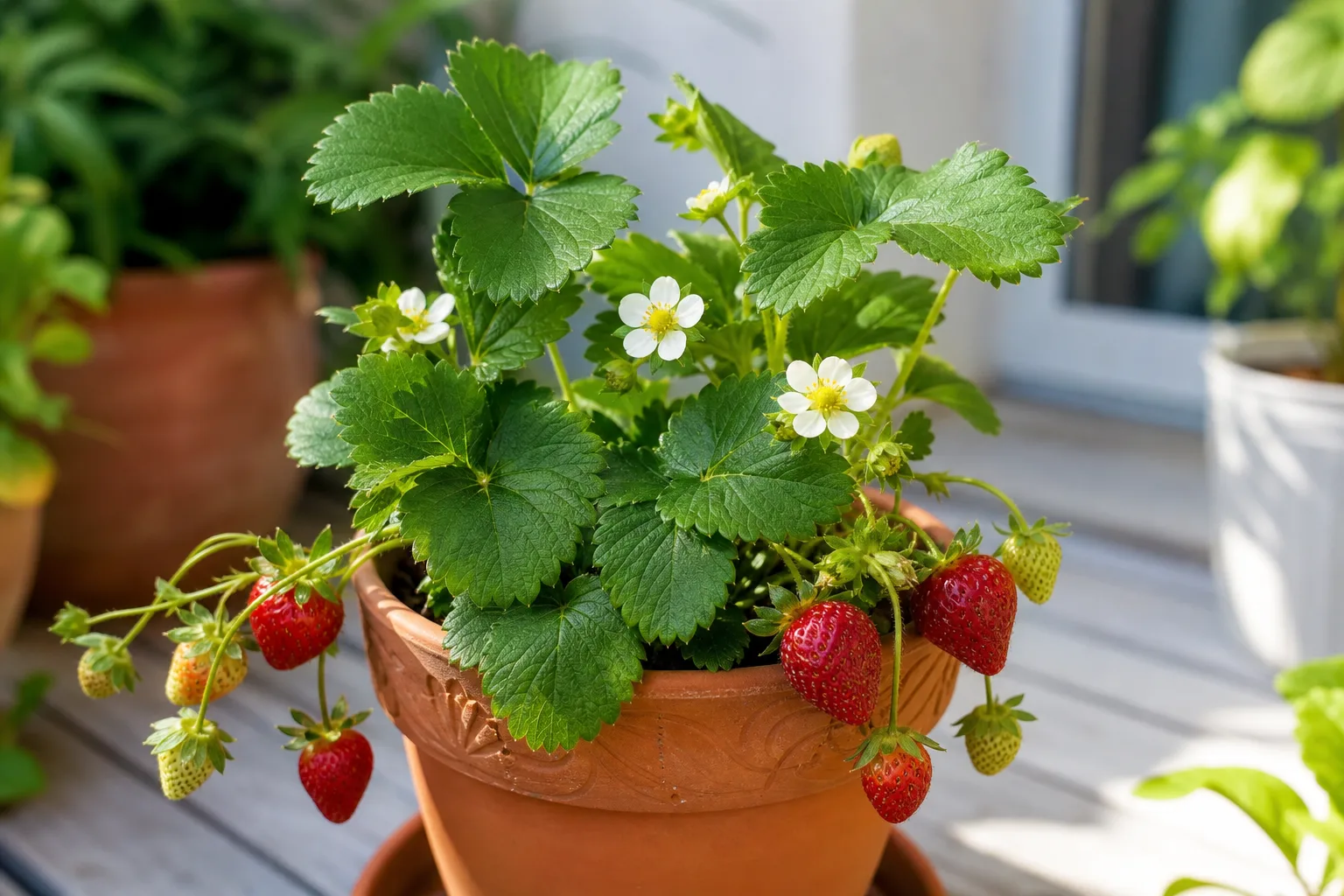
Strawberries are one of the more practical edible neighbors because they enjoy sun, steady moisture, and an acidic growing medium. Their shallow roots can make them compatible with a blueberry bed, and their leaves can cover some soil that would otherwise be open to weeds. Epic Gardening also identifies strawberries as a gently running groundcover with similar growing conditions to blueberries. Epic Gardening on blueberry companions
The trade-off is runners. Allowing strawberries to spread into the blueberry’s mulched root zone can make it difficult to inspect, fertilize, or water the shrub. Plant a compact or alpine type along the outer edge, remove unwanted runners early, and keep a visible gap between strawberry crowns and the blueberry stems. For a small garden, growing the strawberries in a separate trough beside the bush is easier.
4. Heather — a compact acid-loving accent
Heather is a good visual and cultural match for a sunny, well-drained acidic bed. Its small flowers and low, fine texture contrast with blueberry foliage, and its mature size is easier to control than a large shrub. Choose a heather that fits your climate and does not need a wet pocket that stays saturated.
Do not use heather as an excuse to overplant the surface. It still needs air around the crown, and a dense mass of small shrubs can hide weeds, pests, or a drying mulch layer. Plant it outside the blueberry’s clear ring, where it can receive light without shading the lower canopy.
5. Azalea — a flowering shrub with similar acidity needs
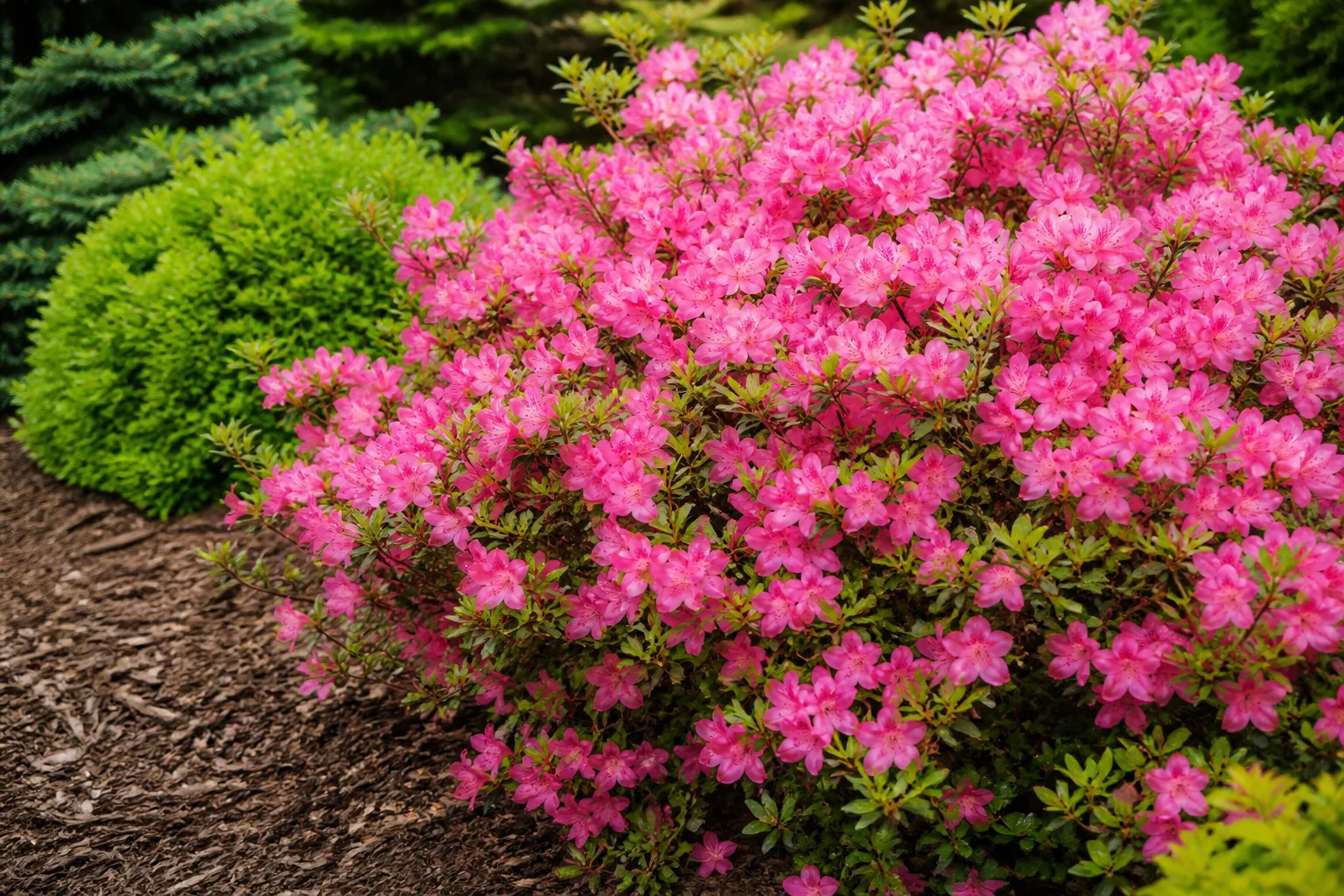
Azaleas are fellow acid-loving plants and can share a carefully prepared bed with blueberries. Their flowers add spring color and may provide nectar for visiting insects, while their preference for acidic soil lets you monitor one broad pH zone instead of creating separate amendments for every plant. Use a compact variety if the bed is small; the label’s mature size matters.
The fit is not perfect in every yard. Many azaleas tolerate more shade than a fruiting blueberry, and a large azalea can eventually compete for space and block light. Place it to the side rather than directly south of a blueberry in the Northern Hemisphere, keep its branches from closing over the berry shrub, and read more about its placement in the azalea care guide.
6. Rhododendron — an acid-bed partner that needs room
Rhododendrons share the blueberry’s preference for acidic soil and moisture that does not stagnate. Their evergreen or semi-evergreen foliage also gives an edible planting more structure outside the fruiting season. A rhododendron can be a strong choice for a larger border where the blueberry is not the only focal plant.
Mature width and shade are the deciding factors. A rhododendron that fits beside a young blueberry may eventually create a cool, shaded pocket that reduces fruiting. Give it more distance than you would a small herb, keep the canopy open, and choose a cultivar whose full size suits the bed. For a landscape border, the rhododendron placement guide can help you think through scale before planting.
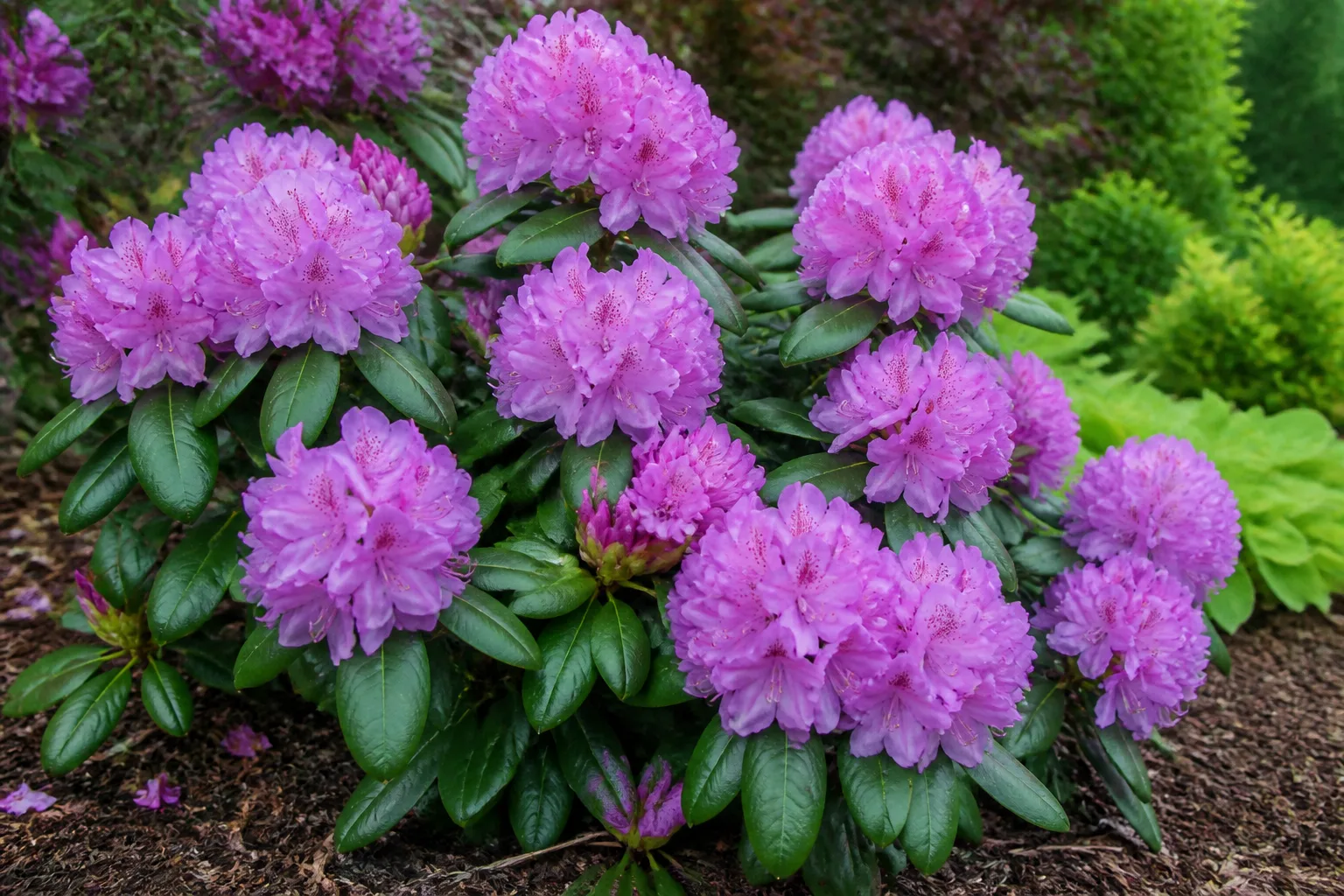
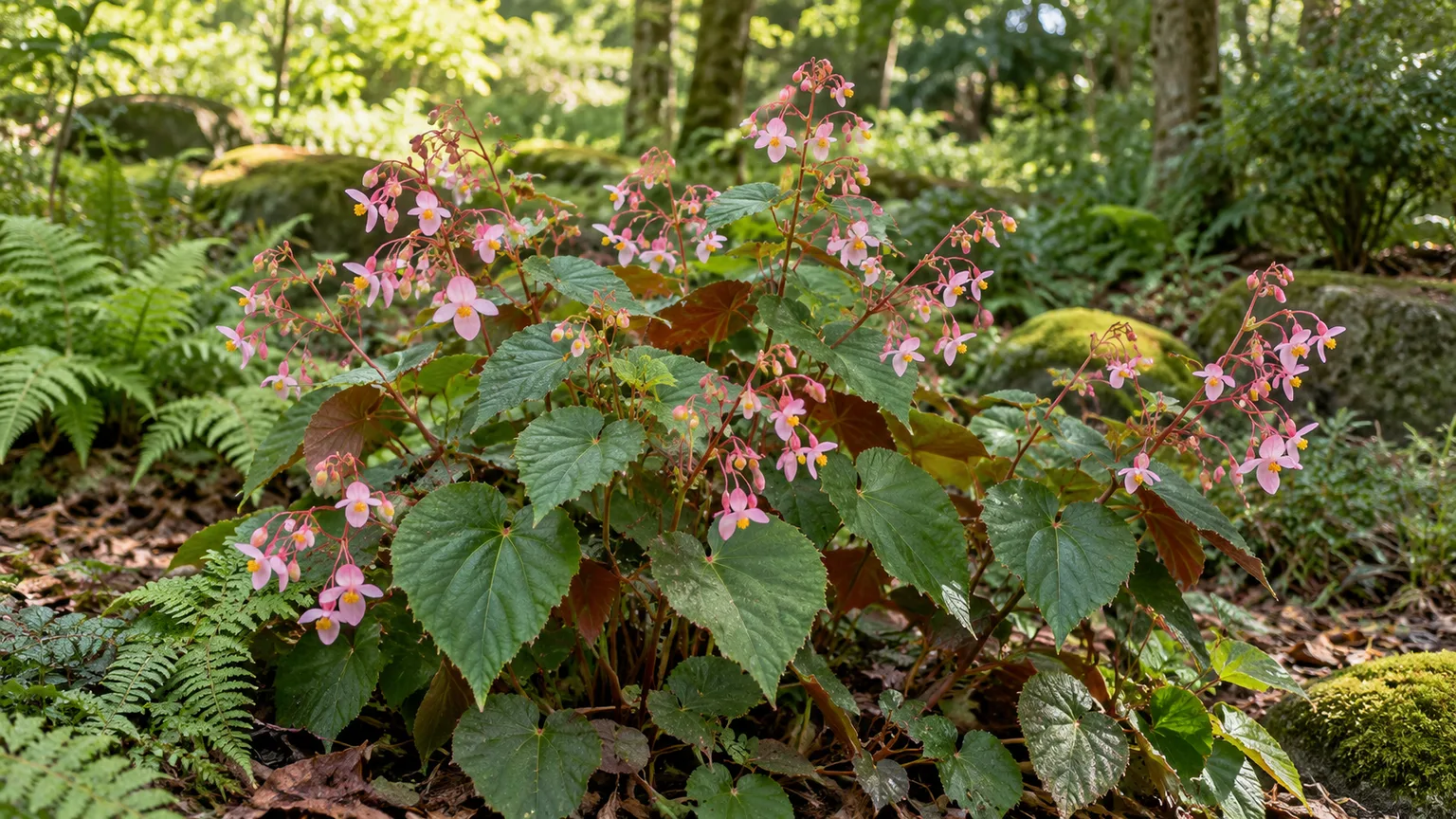
Acid-loving shrubs can share a planting theme, but the blueberry still needs its own sun and root space.
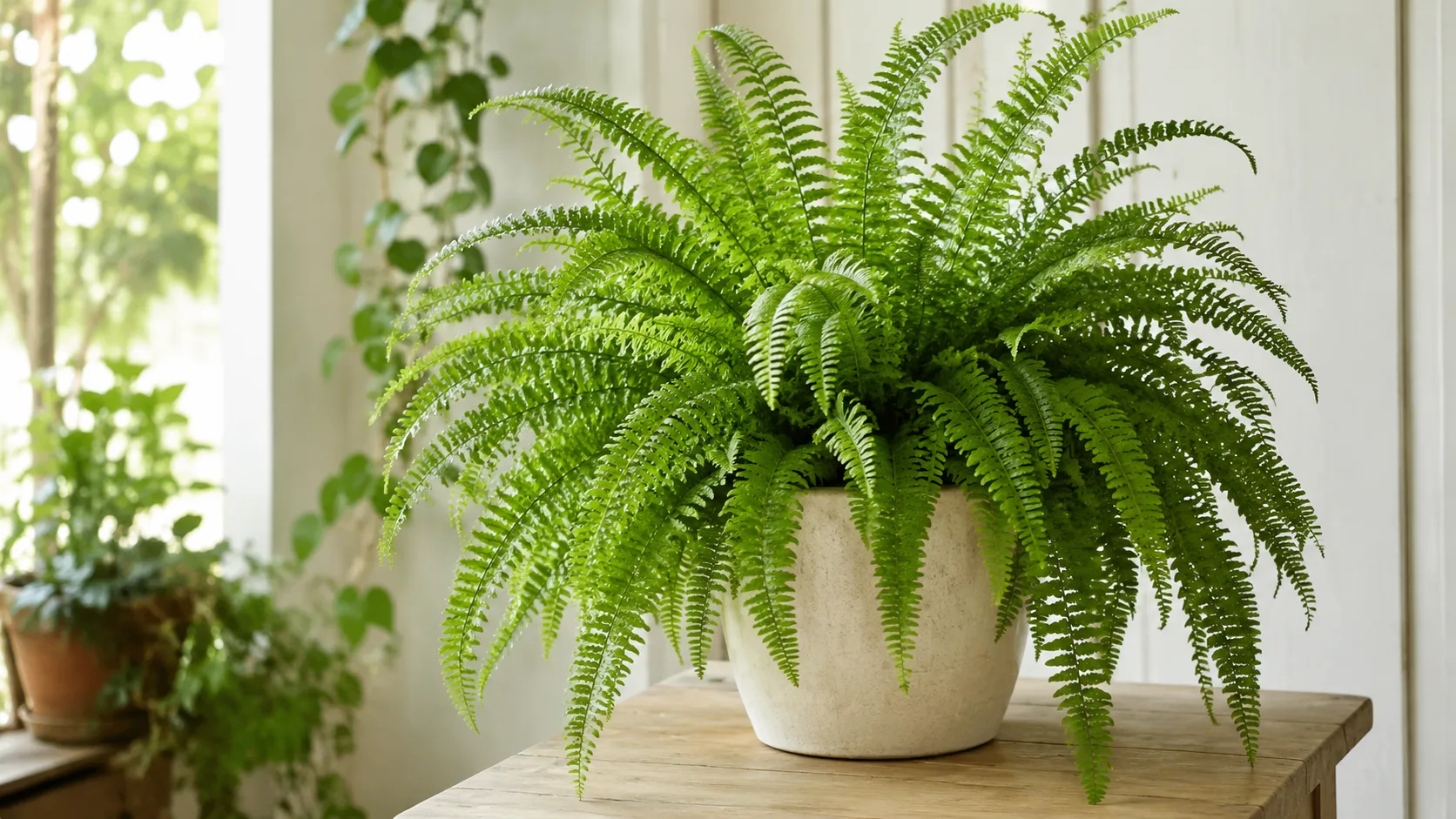
7. Acid-loving ferns — useful on the shaded side, not in full sun
Cinnamon fern and royal fern are examples of moisture-loving woodland plants that can complement blueberries where the site includes a naturally shaded edge. Ferns bring a different texture and can occupy a lower layer beneath taller plants, but not every fern tolerates the same soil or light. Choose a species suited to your region rather than treating “fern” as one set of requirements.
Keep ferns away from the blueberry crown and out of poorly drained depressions. The blueberry may tolerate a moist root zone, but Penn State Extension emphasizes that its fine roots still need oxygen and porous soil; wetland habitat should not be confused with stagnant garden soil. Use a fern on the shaded north or east edge, and keep the fruiting canopy in the sun.
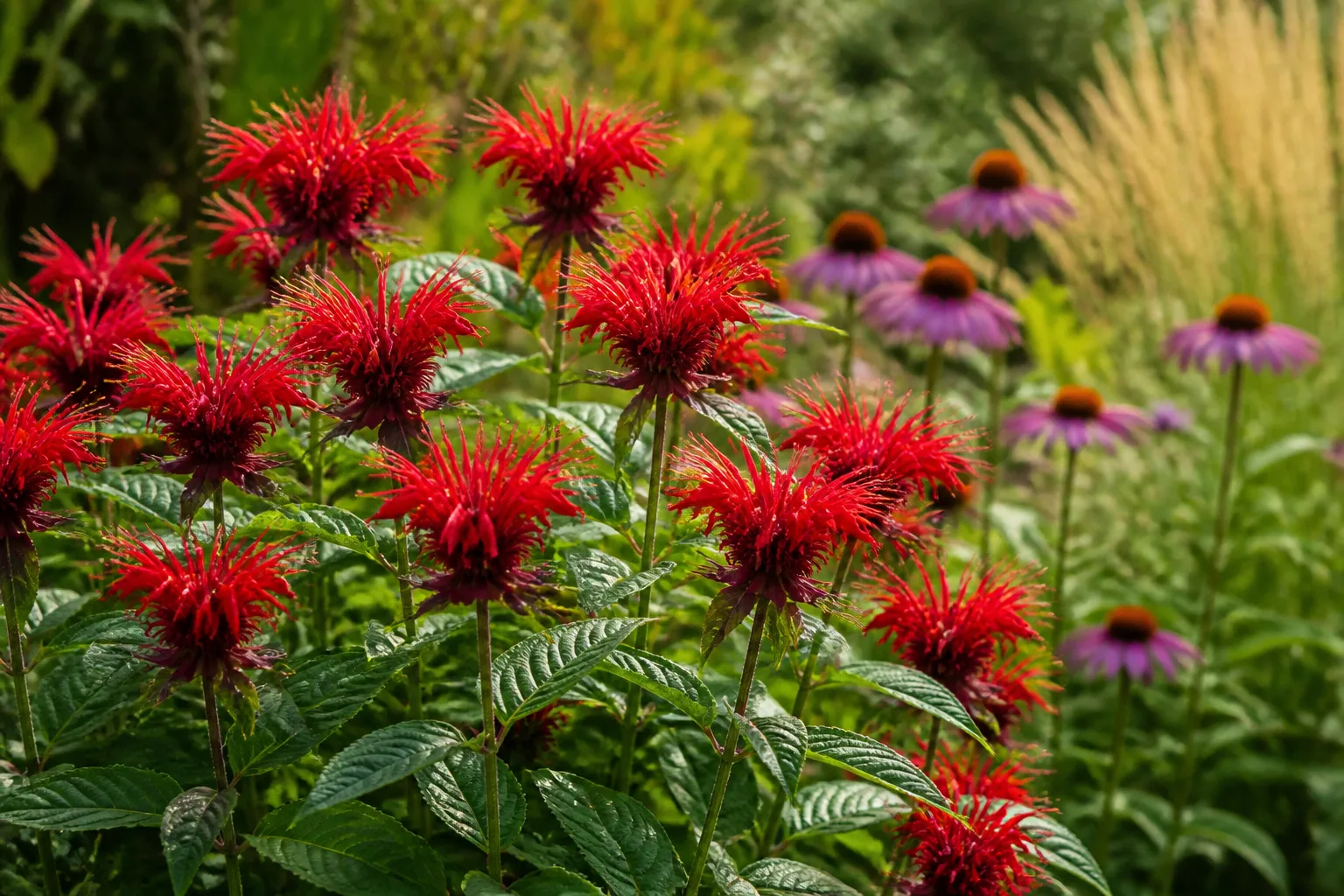
8. Bee balm — a pollinator magnet with an airflow warning
Bee balm adds tubular flowers that can draw bees and other flower visitors during the growing season. It is most useful as part of a mixed flower strip near the blueberry rather than as a plant wedged between blueberry stems. Select a species or cultivar that fits your climate and the bed’s moisture level, and avoid a dense monoculture.
The main limitation is crowding and humidity. Bee balm can become a substantial clump, and dense foliage in a poorly ventilated bed is harder to inspect and more likely to stay damp. Give it room to spread, divide it when necessary, and keep the blueberry canopy open. The bee balm growing guide covers the plant’s own requirements before you add it to a berry border.
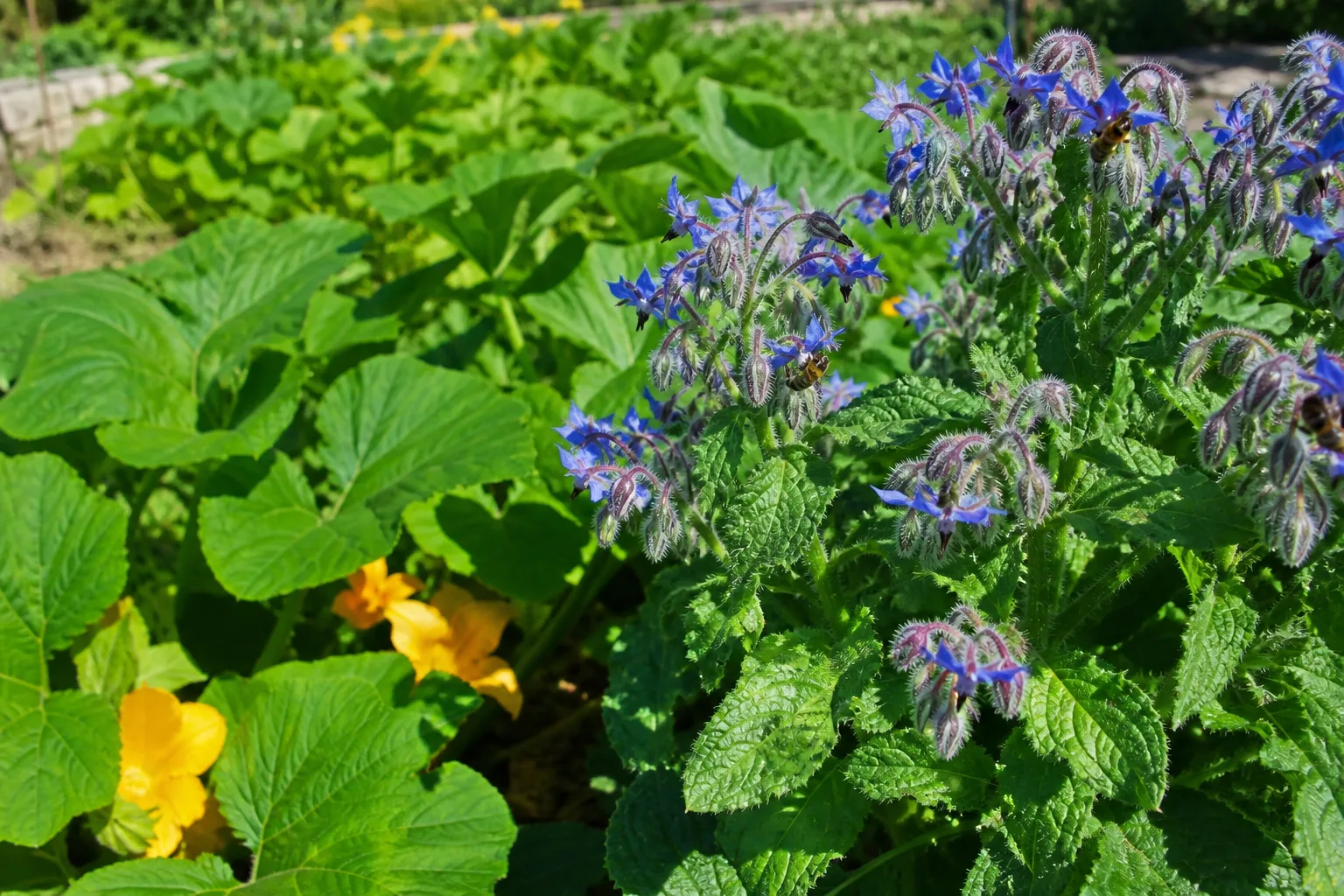
9. Borage — a blue-flowered edge plant for busy pollinators
Borage produces open, blue, star-shaped flowers that are easy for many insects to find. It is a good candidate for a pollinator strip beside blueberries, especially when the flowers overlap the berry bush’s bloom or early fruiting period. Its value comes from supplying accessible flowers and diversity, not from a guaranteed increase in berry size.
Borage is also large, rough-textured, and capable of reseeding. Put it at the edge where you can remove seedlings and where its leaves cannot flop across the blueberry. A single borage plant may be plenty for a small garden. If it dries out or collapses into the berry row, it is no longer helping the layout.
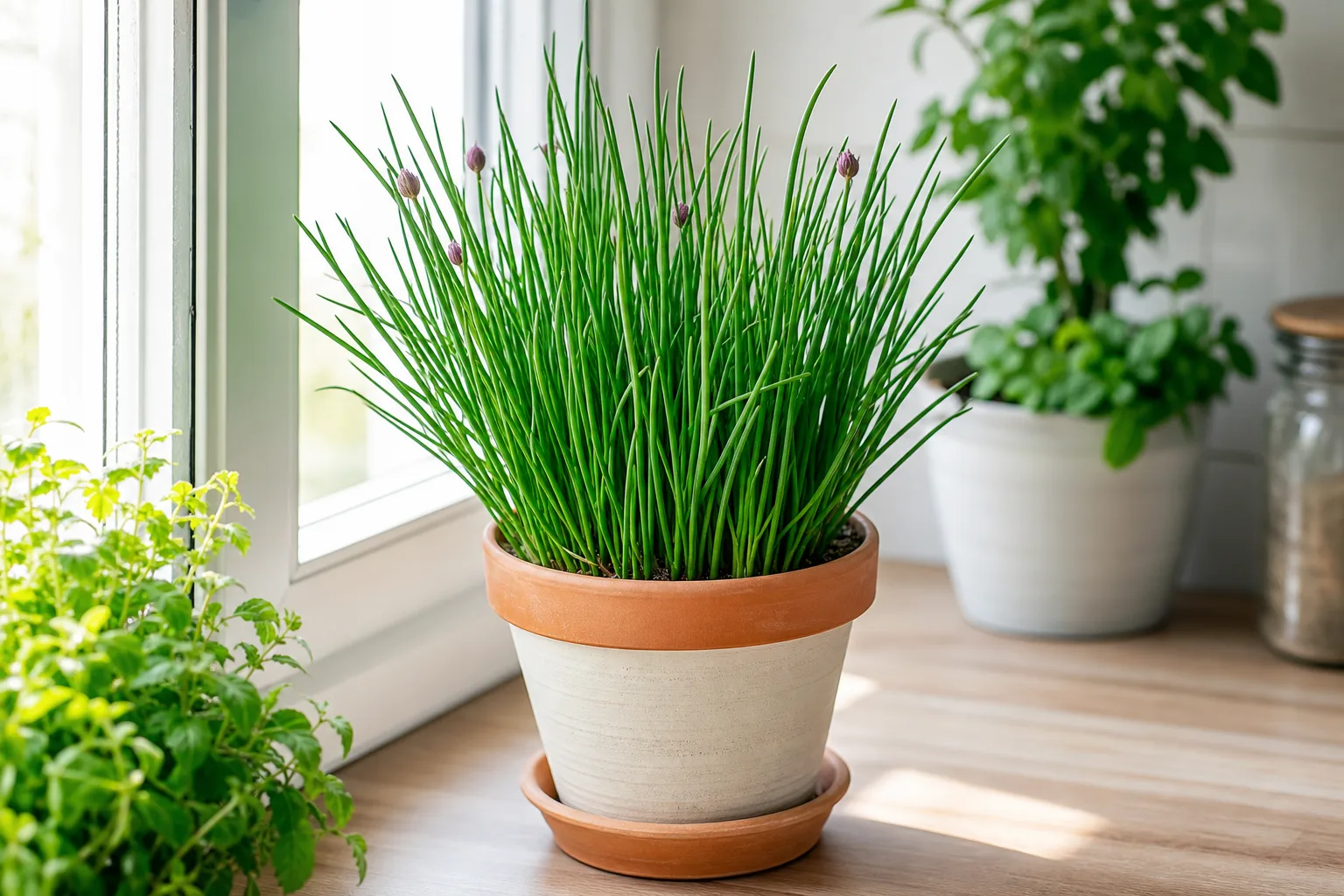
10. Chives — a manageable allium with flowers worth leaving
Chives form a neat clump and produce rounded purple flowers that can add early-season interest around a blueberry bed. They are less troublesome than running mint and can live along a path or outer edge where you can harvest them without cultivating close to blueberry roots. Leave some flower heads open if pollinator habitat is part of your goal.
Chives are not a guaranteed insect barrier. The general claim that aromatic plants repel pests is uneven, and RHS guidance describes many such effects as claims that vary by crop and circumstance. Use chives for their compact habit, flowers, and kitchen harvest first; regard any pest-disruption benefit as a possible extra. Keep the clump from expanding into the blueberry’s mulch ring.
11. Thyme — a low flowerer for the sunny edge
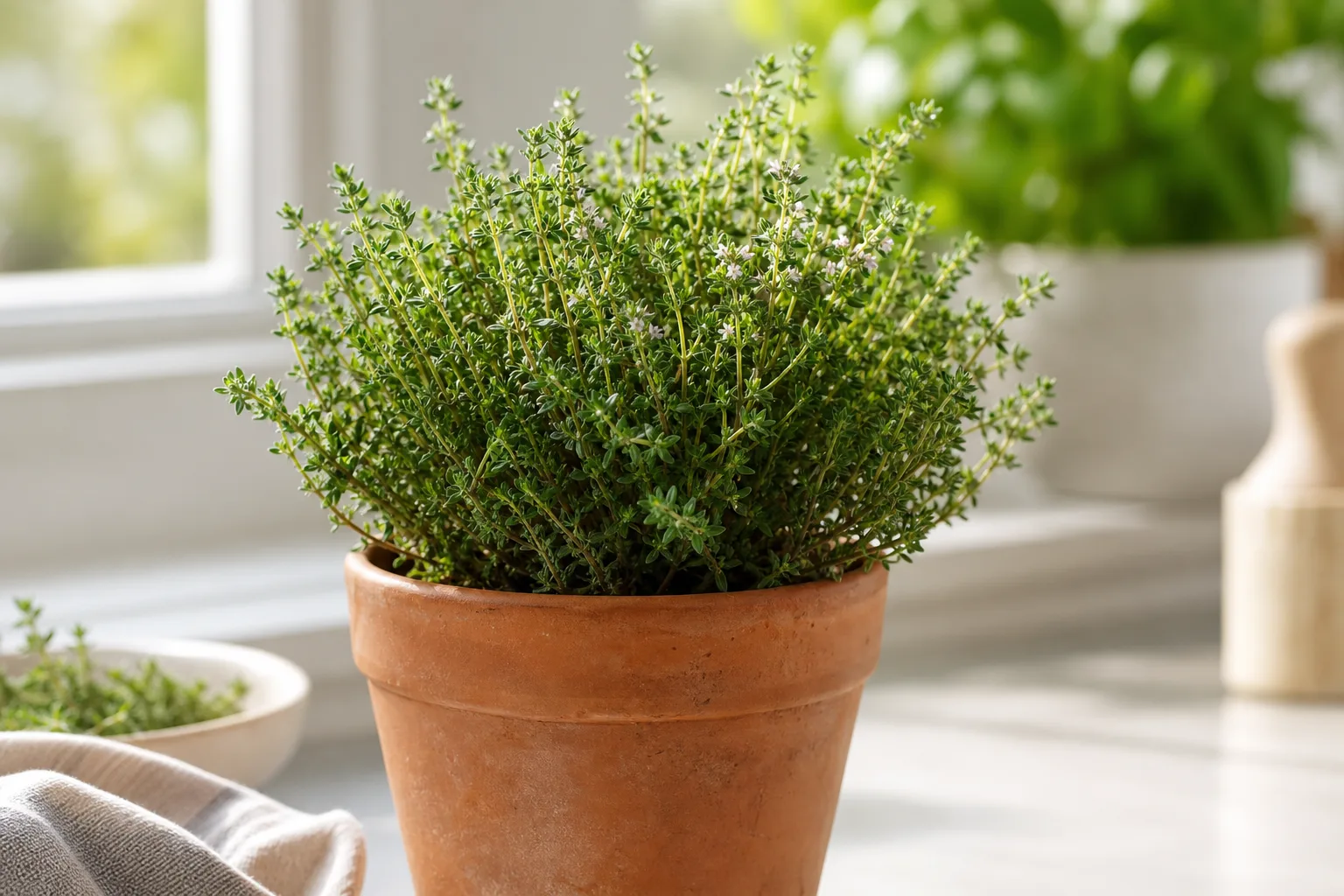
Thyme’s small flowers can attract insects, and its low growth makes it tempting as a groundcover around a blueberry. It is most useful on a dry, sunny edge or in a pot near the bed, where its aromatic foliage and compact habit are easy to manage. A creeping type can soften a path without competing directly with the shrub.
The mismatch is water. Thyme prefers sharper drainage and a drier rhythm than a blueberry, so do not plant it under the same emitter if the soil stays damp. Use a raised edge, gritty container, or separate irrigation zone, and keep it out of the blueberry’s shaded, wet interior. You can compare its needs with the thyme growing guide before deciding whether the site is dry enough.
12. Sage — a pollinator-friendly herb for a separate pocket
Flowering sage can contribute nectar and aromatic foliage to a fruit garden, but culinary sage is a better neighbor at the edge than at the base of a blueberry. It prefers full sun and free drainage, while a blueberry bed is usually watered more consistently and managed for a much lower pH. A shared bed can work only when the plants occupy clearly different soil and irrigation pockets.
Grow sage in a pot, a dry border, or a separate raised section beside the blueberries. Keep it far enough away that you do not have to water the entire root zone to keep the herb happy. This is a case where “nearby” provides the habitat benefit without forcing two different watering patterns into one hole.
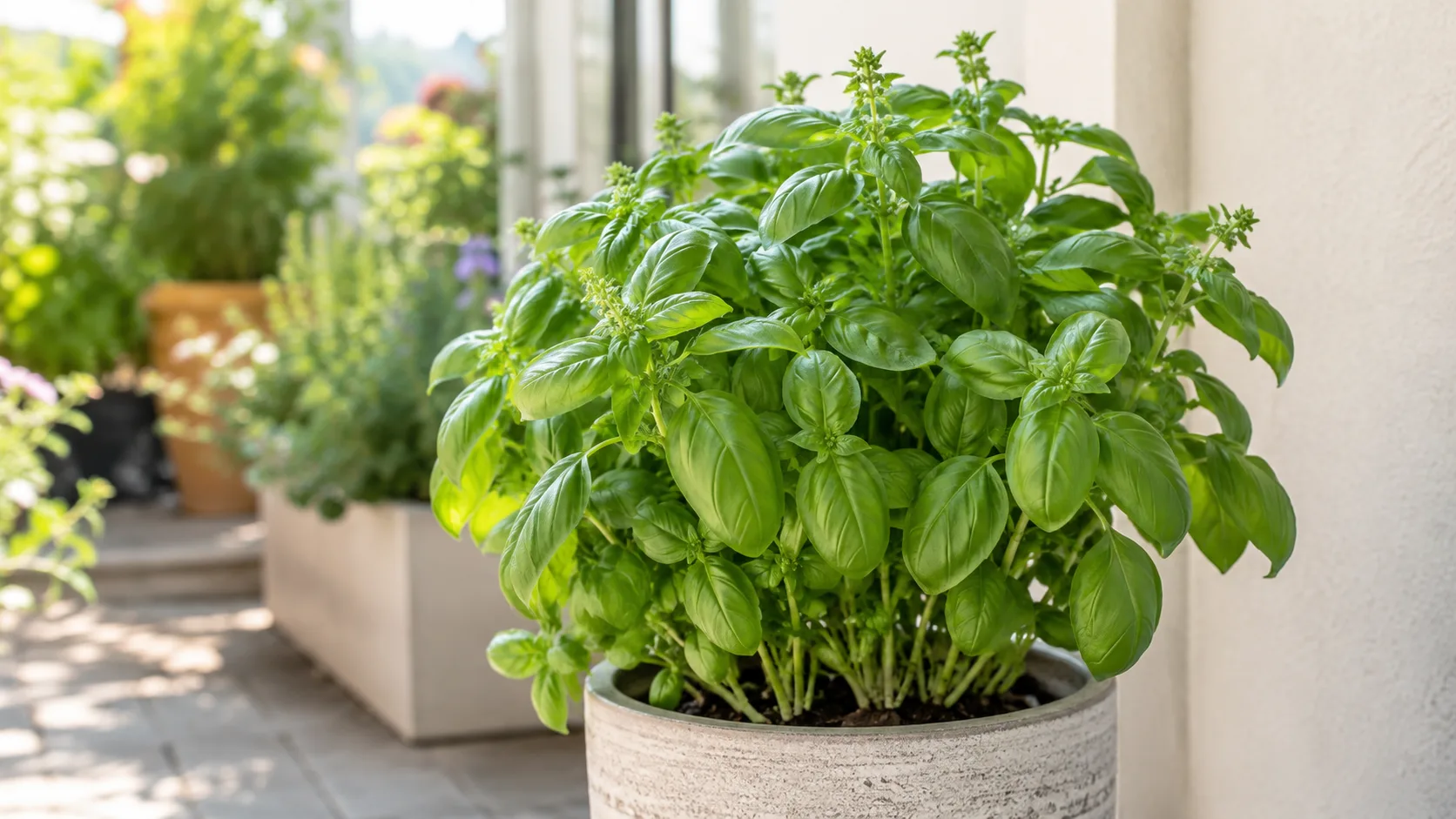
13. Basil — a warm-season annual for a container or outer edge
Basil can flower for bees if you allow some stems to bloom, and its short season makes it easy to move or replace. It is a useful choice for a gardener who wants an edible herb near the blueberry without committing another perennial to the bed. Put it where it receives the warmth and light it needs, then harvest enough to keep it from shading the shrub.
Basil typically wants richer, more regularly watered soil than the low-nutrient acidic conditions blueberries prefer. It also grows quickly and can become a leafy mass in a small bed. A pot on the sunny side of the blueberry area is usually the cleanest solution; it lets you water the basil well without raising fertility or moisture throughout the berry root zone. Use the basil growing guide for its own care rather than treating it as a blueberry understory plant.
14. Mint — useful scent and flowers, but container-only
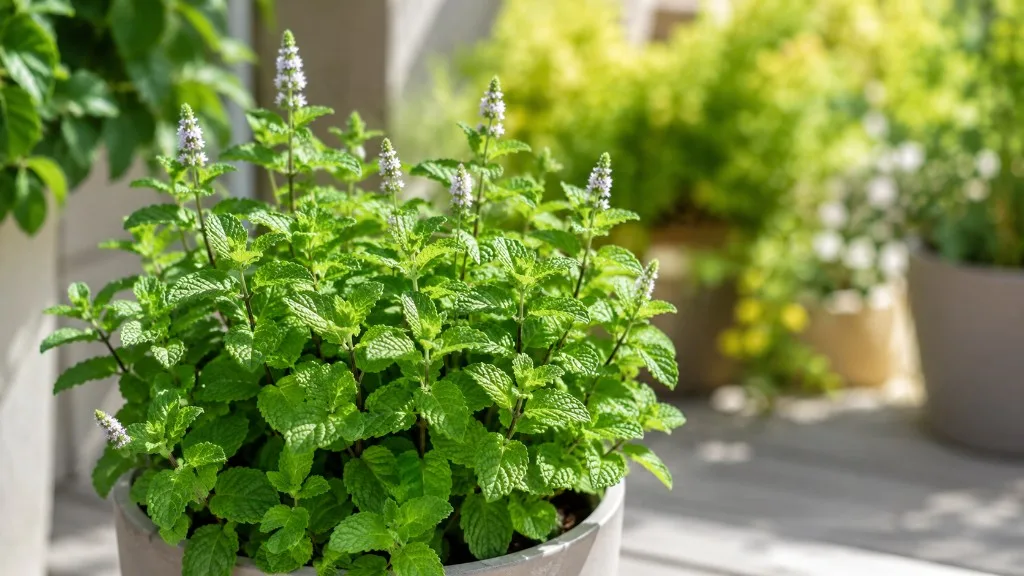
Mint is frequently suggested as a blueberry companion because its foliage is aromatic and its flowers can attract insects. The safer recommendation is to keep it in a pot near the blueberry, not planted in the same ground. Mint’s stems can root where they touch soil, and a patch that begins at the edge can move through the shallow root zone before you notice.
Even a pot needs a boundary. Keep the container from sitting directly in the blueberry’s mulch ring, trim flower stems if you do not want seedlings, and check for runners that escape through drainage holes. Epic Gardening specifically recommends keeping mint and lemon balm in pots or separate beds when they are used near blueberries because their vigorous growth can create competition and dense, damp cover. Epic Gardening on mint and lemon balm near blueberries The mint container guide has the practical containment details.
15. Lemon balm — the mint alternative that also needs a boundary
Lemon balm has fragrant leaves and small flowers that can contribute to a mixed pollinator planting. It is often easier to justify near a blueberry than a tall shrub because it stays herbaceous and can be harvested repeatedly. Still, “herbaceous” does not mean “well behaved.”
Treat lemon balm like mint: use a dedicated pot or a separate bed, and do not let it form a continuous mat beneath the blueberry. Its growth can conceal the mulch surface, change the moisture pattern, and make it harder to see whether the blueberry is drying out or staying too wet. If you want fragrance in the berry area, one contained plant is enough; the rest of the bed should stay easy to inspect.
What not to plant right beside blueberries
The most useful “avoid” list is about incompatible conditions, not plant superstition. A plant is a poor neighbor when it forces you to raise soil pH, overwater the blueberry, cultivate its roots, or tolerate shade and crowding. Separate it from the berry bed, grow it in a pot, or give each crop its own irrigation zone.
Nightshades, brassicas, and hungry annuals
Tomatoes, peppers, eggplants, tomatillos, and potatoes generally prefer a less acidic root zone and need more fertility during a single growing season. Broccoli, cabbage, kale, and related brassicas can also be heavy feeders and occupy a lot of space. Epic Gardening recommends keeping these groups apart because their soil preferences, resource demands, and potential pest or disease pressures do not line up neatly with blueberry culture. Epic Gardening’s blueberry planting cautions
This does not mean a tomato will poison a blueberry. It means one shared bed makes both crops harder to manage. Put vegetables in their own bed, where you can fertilize and water them without pushing the blueberry away from its acidic, low-disturbance routine.
Aggressive grasses and spreading shrubs
Avoid placing spreading ornamental grasses, suckering shrubs, privet, barberry, or other vigorous plants close enough to occupy the blueberry’s root zone. They can take light, water, and space, and some become difficult to remove once their roots are woven through the mulch. The same rule applies to a “groundcover” that needs constant cutting back: if it takes more work to keep it out than to grow it, it is not the right companion.
Do not use a conifer as an automatic excuse to plant directly beneath a blueberry, either. A nearby pine or other evergreen can fit a woodland design, but a mature tree can cast shade and absorb moisture. Penn State Extension notes that blueberries evolved in porous, organic soils and have shallow roots; the garden version of that habitat still needs oxygen, sun, and deliberate spacing.
Use containers when soil or growth habits conflict
Containers are useful in two directions. They can hold the blueberry when native soil is heavy or alkaline, and they can hold the companion when the companion’s watering or spreading habit does not belong in the berry bed. RHS recommends large containers filled with ericaceous compost when the ground is heavy, alkaline, or only slightly acidic. RHS on containers for blueberries
For a potted blueberry, choose a compact cultivar and a container large enough to keep the root zone from drying rapidly. Keep the growing medium slightly moist but never stagnant, and expect more frequent checking than with an in-ground shrub. Place pollinator flowers or herbs in separate pots nearby so you can move them as the season, sun angle, or watering needs change.
For a potted companion, use drainage holes and set it outside the blueberry’s clear mulch ring. Never bury a mint or lemon balm pot into the ground and assume the problem is solved; roots can escape through the drainage holes. A pot on a hard surface or a regularly inspected stand gives you an actual boundary.
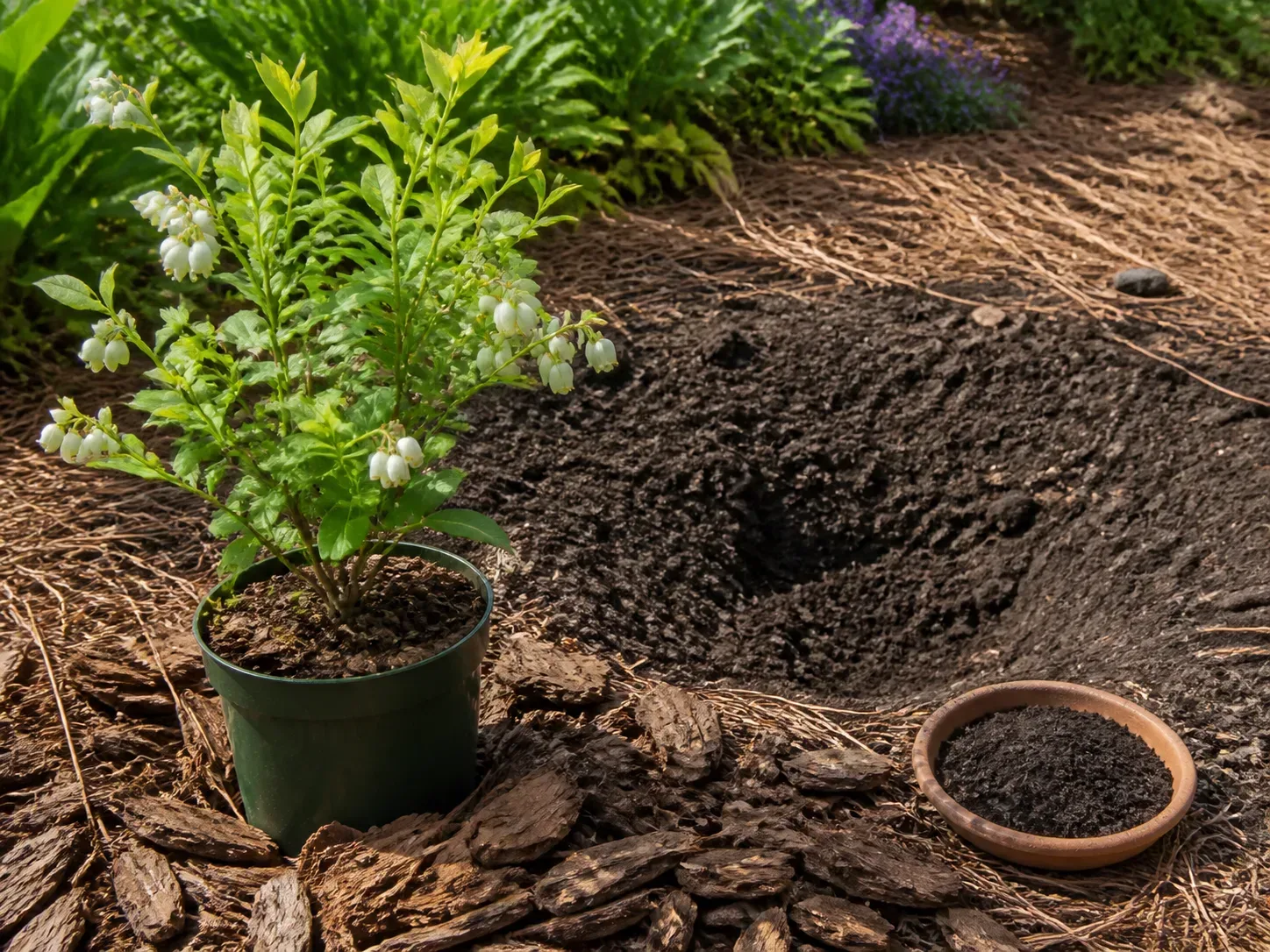
A clear planting area makes soil testing, watering, mulching, and root inspection easier than a crowded mixed bed.
The simple seasonal plan
Before planting: Test the soil pH and drainage first. Choose the blueberry type and cultivar, confirm mature size and bloom timing, and decide whether the ground, a raised bed, or a container gives you the most reliable root zone. Penn State Extension recommends treating soil preparation as an advance project because changing pH takes time; do not wait until a struggling shrub is already planted to discover that the site is alkaline.
At planting: Set the blueberry at the correct depth, leave room for the mature canopy, and add an acidic mulch suited to the site. Keep the first companion choices modest: one pollinator strip outside the root ring, one compact acid-loving accent, or one contained herb. Water the blueberry consistently while it establishes, and check below the mulch rather than relying on the surface appearance.
During bloom: Watch which bees actually visit the flowers. A mixed planting is useful when it provides accessible flowers without shading the blueberry or forcing you to spray the whole bed. If you are adding native wildflowers, choose regionally appropriate species and let the planting remain open enough for air movement and berry harvest.
As berries color: Thin or redirect runners, remove aggressive herb growth, and keep the fruiting branches visible. Birds may become a larger problem than insects once berries begin to ripen; RHS recommends covering plants with suitable netting or growing them in a fruit cage. Companion plants can increase garden diversity, but they do not replace physical protection when birds have found the crop. RHS blueberry bird-protection guidance
After harvest: Check whether the layout made care easier or harder. If one companion stayed too wet, spread into the mulch ring, or blocked the blueberry’s light, move it while the soil is workable. A good companion planting should reduce friction over time; it should not require constant rescue.
Conclusion
The safest blueberry companion plan starts with the shrub’s non-negotiables: acidic soil, good drainage, steady moisture, full sun, and undisturbed shallow roots. Add a second compatible blueberry first when a heavier crop is the goal, then use acid-loving shrubs, ferns, flowering plants, and contained herbs to fill specific roles.
If a plant needs a different pH, a different watering rhythm, or a bigger footprint, move it to the edge or a pot. That small amount of separation is often more valuable than a long list of supposed pest-repelling plants, because it keeps the blueberry healthy and the whole garden easier to manage.