How to Grow and Care for Flowering Crabapple Trees
Get flowering crabapple tree care for planting, cultivar choice, watering, pruning, disease prevention, bloom problems, and fruit cleanup for your region.
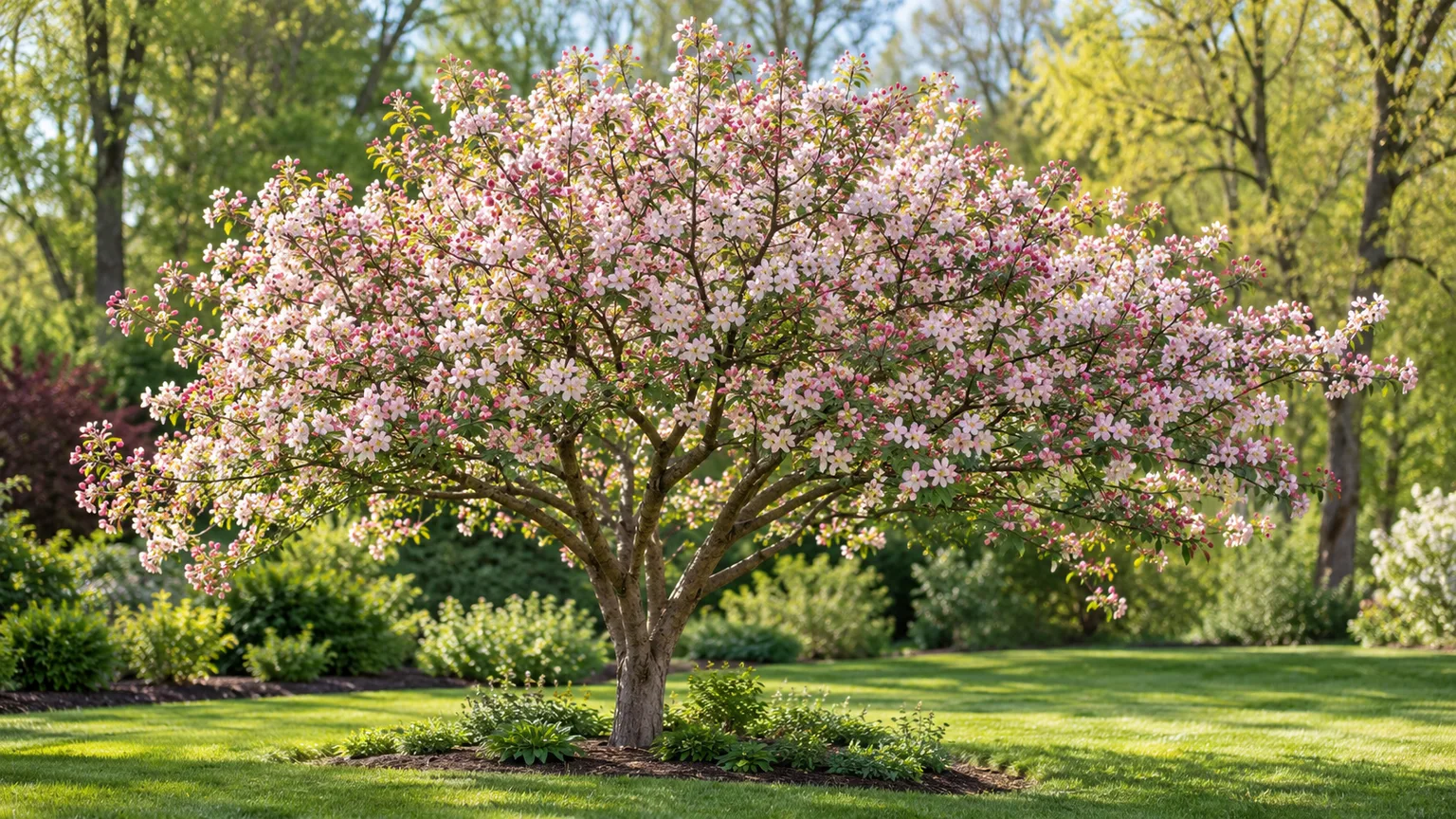
A flowering crabapple can give a yard spring blossom, fall color, and fruit that feeds birds—but the wrong cultivar can also mean recurring leaf disease, a canopy too wide for its site, or fruit dropping over a walkway. Start with the tree’s disease ratings and mature size, then choose the flowers and fruit you want. Correct planting depth and measured care matter, but the cultivar decision has the biggest effect on how much upkeep the tree needs later.
What a Flowering Crabapple Is
Flowering crabapples are ornamental trees and shrubs in the apple genus, Malus, in the rose family, Rosaceae. The word “crabapple” generally describes Malus trees whose fruits are about 2 inches or smaller; cultivars vary widely in form, flower color, fruit size, and persistence. Some are upright and narrow, others spreading, weeping, or compact enough for a smaller yard. Many bloom for only a week or two, with the bud stage and opening flowers creating a longer but weather-dependent display.
The ornamental label does not mean “no fruit.” Most crabapples produce small pomes after flowers are pollinated; fruit may be red, orange, yellow, or purple, and some varieties hold it into winter while others drop it in fall. Flower color can also change as buds open, so a photo of one named selection tells you little about another. Colorado State University Extension describes the range of crabapple flower, fruit, and form, and Virginia Cooperative Extension notes that size, shape, fruit, and disease resistance differ substantially among cultivars.
Choose Cultivars for Disease Resistance First
Choose a cultivar by local disease performance before you choose it by blossom color. Flowering crabapples are susceptible to apple scab, fire blight, cedar-apple rust, and powdery mildew, but a rating for one disease does not make a tree resistant to all of them. A tree that performs well in a dry region may struggle in a humid, rainy climate, and disease rankings can change as weather and local pathogen pressure change.
Ask a regional nursery, arboretum, or Extension office for the disease ratings that apply where you live. Prefer cultivars rated resistant or highly resistant to the problems common in your area; read “resistant” as lower risk, not immunity. The Morton Arboretum recommends prioritizing disease resistance and warns that performance varies with region. The University of Minnesota Extension’s scab guide calls resistant varieties the best way to manage apple scab and lists cultivars evaluated for Minnesota conditions.
Match Mature Size and Fruit Habits to Your Yard
Measure the site in all directions before buying. Catalogs may list a young tree’s nursery size, but you need the mature height and width of the named cultivar, plus room for branches to clear the house, path, driveway, utility lines, and neighboring trees. A compact form may fit a courtyard; a wide canopy can shade a small lawn or overhang a walk. Do not plan to keep a naturally large tree small by topping it every year—the repeated large cuts produce vigorous shoots and weaken the shape.
Decide what should happen after flowering. Persistent small fruit can feed birds and extend winter interest, but falling fruit can stain paving, attract wasps as it ferments, or become a cleanup chore. A fruitless selection such as ‘Spring Snow’ avoids fruit litter, while a persistent-fruited cultivar such as ‘Prairifire’ keeps color longer. Those benefits carry tradeoffs: fruitless trees do not provide fruit for wildlife or pollen for an apple orchard, and disease ratings still need checking. The Morton Arboretum notes both the wildlife value of persistent fruit and the mess from fruit that drops early.
If you prefer fruit for preserves, confirm the cultivar and use only fruit from a tree that has not been treated with a pesticide whose label prohibits harvest. Ornamental crabapples vary in flavor and size; sourness alone does not tell you whether a fruit is safe to cook. Select for an edible use only when the plant is correctly identified and you can follow food-safety and pesticide-label directions.
Pick Full Sun and the Right Planting Site
Give the tree full sun for the best flowering and fruit set. Many crabapples tolerate some partial shade, but a shaded crown tends to flower less, become more open, and dry more slowly after rain. That last effect can raise fungal disease pressure. Avoid a cramped space between mature trees: crabapples need air and light around the canopy, and they compete with nearby roots for water.
Check the site after heavy rain, not just on a sunny day. Crabapples prefer moist, well-drained soil and generally tolerate a range of soil types, but an area that stays saturated or where roots meet compacted subsoil can cause decline. A soil test can identify pH or nutrient problems; adding peat moss, coffee grounds, or fertilizer automatically is not a substitute for knowing the site. Do not make a small amended pocket in the planting hole that holds water while the surrounding soil remains compacted.
Plan the tree’s season in your climate. In regions with late spring freezes, a hot south- or west-facing wall can encourage earlier bloom that is more exposed to frost damage. Hardiness and bloom timing are cultivar-dependent, so check the local rating rather than assuming every crabapple fits one national zone range. Colorado State Extension notes that full sun helps flower and fruit production, while warm exposures may advance bloom into late-frost risk.
Plant at the Root Flare, Not Below the Graft
Plant when the soil is workable and you can water through establishment. Bare-root trees are commonly sold dormant; container-grown trees can be planted across a longer season if you can keep the root ball watered. Before digging, locate underground utilities and check the nursery tag for mature size. Planting too deep is a particularly costly mistake with crabapples: it can encourage suckering and contribute to girdling roots that slowly constrict the trunk.
Inspect the root ball before setting it in the hole. Find the uppermost structural roots where they emerge from the trunk; this widening transition is the root flare. Do not confuse a swollen graft union higher on the trunk with the root flare. For crabapples, Colorado State University Extension advises locating the top structural root within the top inch of the root ball, because the genus is prone to trunk-circling roots. Remove extra nursery soil if needed to expose the structural roots, but avoid damaging them.
Dig a broad hole no deeper than the prepared root ball, leaving firm, undisturbed soil underneath so the tree does not settle lower after watering. Loosen the sides of the hole, position the tree upright, and set the top structural roots at or slightly above surrounding grade. Backfill with the original soil, firm it gently, and water to settle air pockets. Do not bury the graft union or pile soil and mulch against the trunk. If the root ball is tightly pot-bound, loosen or correct circling roots before planting; if it is large or balled-and-burlapped, follow local Extension directions for removing packaging without letting the root ball fall apart. Gardeners’ World also emphasizes keeping the graft point above soil level when planting crab apples.
Water a New Tree Until It Is Established
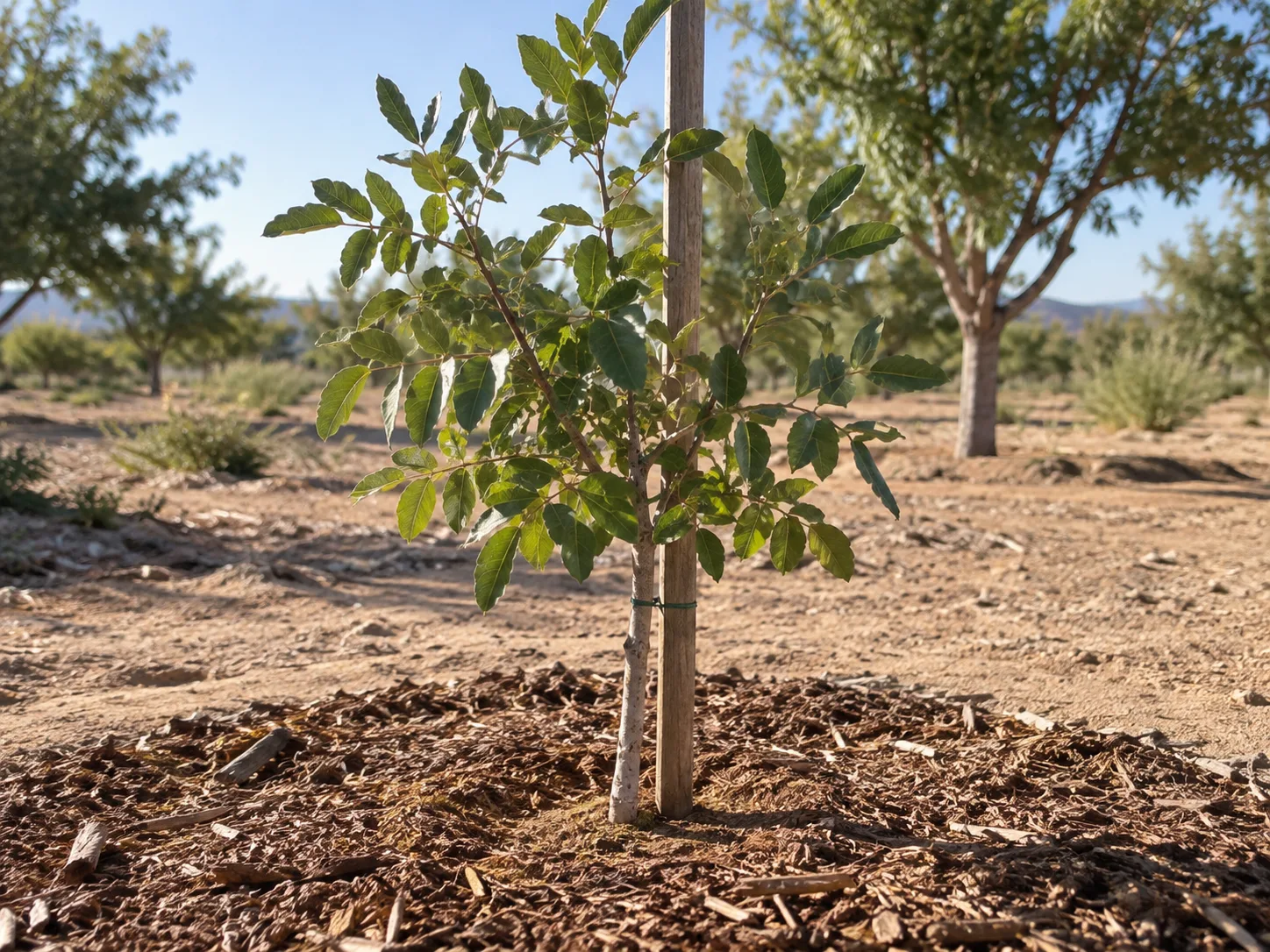
Do not treat drought tolerance as permission to neglect a newly planted crabapple. Its roots are still mostly inside the nursery root ball, and they need consistent moisture while they grow into surrounding soil. Check moisture in both the root ball and the backfill: one can be dry while the other still feels wet. Water slowly at the root zone when the soil begins to dry; skip irrigation when soil is saturated or standing water remains.
Watering frequency depends on tree size, soil, wind, temperature, and rainfall. As a general planning reference, Colorado State’s recently planted tree guide estimates that a one-inch-caliper tree may take 12 to 18 months to establish and a four-inch tree may take four to six years. These are not a schedule for every yard; the same guide stresses checking soil before watering, especially in clay, because too much water can waterlog the planting hole. Continue checking through dry spells, including fall and winter in climates with little precipitation, until the ground freezes.
After the tree establishes, it is more tolerant of short dry periods, but long drought can still reduce growth and increase pest stress. Deep, less frequent irrigation that wets the expanding root zone is more useful than frequent shallow splashes at the trunk. Keep water off foliage where practical, because extended leaf wetness favors apple scab. CSU Extension gives establishment guidance and cautions against both under- and overwatering.
Mulch and Fertilize Without Overfeeding
Mulch a broad ring to reduce competition from lawn grass and protect roots from mower and string-trimmer injuries. A few inches of wood chips or bark spread over the root zone is enough; keep the material several inches away from the trunk and leave the root flare visible. Do not build a mulch “volcano.” Grass against the trunk competes for water and makes it easier to damage bark, while mulch touching the trunk keeps the bark damp and invites decay.
New trees need little fertilizer while roots establish. High-nitrogen lawn fertilizer can push leafy growth before the root system can support it and may aggravate disease pressure. If a soil test shows a nutrient deficiency or the tree is growing poorly, first check planting depth, irrigation, compaction, light, and disease; correct the cause before feeding. Compost applied lightly over the mulched root zone can improve surface soil over time, but do not fill the planting hole with a rich amendment that roots may fail to grow beyond.
An established tree with normal leaf color and steady annual growth usually does not need a routine fertilizer dose. Avoid fertilizing a drought-stressed, newly transplanted, or diseased tree to “wake it up.” CSU Extension recommends minimal fertilization during establishment and warns that high nitrogen can favor canopy growth over root growth.
Prune for Structure and Next Year’s Flowers
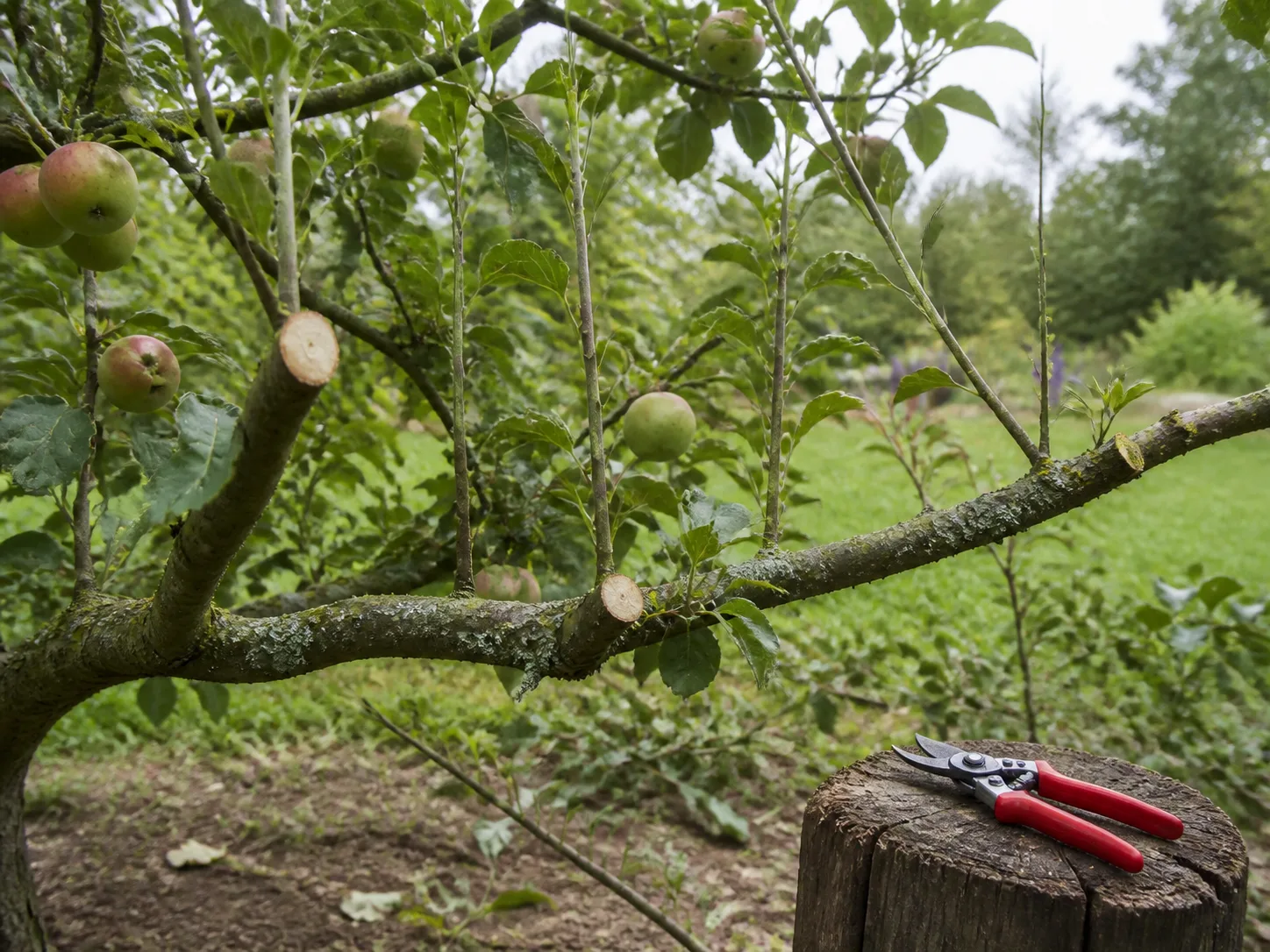
Prune to correct structure and remove dead, damaged, or diseased wood—not because every crabapple needs an annual haircut. Start with a young tree’s framework: keep well-spaced scaffold branches, remove rubbing or crossing branches, and maintain clearance where people walk. Remove suckers that grow from the rootstock below the graft; these shoots may have different flowers or fruit from the named cultivar. Cut a sucker at its origin rather than shearing the whole base.
For routine shaping, prune during late winter before spring growth or just after flowering, depending on local disease and climate guidance. Crabapples set flower buds for the following season during the growing season, so pruning too late or removing many flowering branches can reduce next year’s display. Colorado State Extension advises finishing pruning by June 1 in its Colorado context because buds begin forming in June and July; elsewhere, use regional timing guidance. The Morton Arboretum recommends light pruning and cautions that heavy cuts can trigger excessive water sprouts.
Make cuts just outside the branch collar; do not leave long stubs or flush-cut into the trunk. Avoid removing more than a modest share of the live canopy in one season. If the tree has large dead limbs, a split leader, a trunk crack, or branches near a roof or power line, hire a qualified arborist rather than climbing or making large cuts from a ladder. A photo guide from Fine Gardening shows selective pruning of an apple tree, a close relative in the same genus; use it for the branch-selection idea, not as a reason to copy orchard training cuts onto an ornamental tree.
Understand Bloom, Fruit, and Pollination
Flowering crabapples usually bloom in spring, but the calendar shifts by cultivar, elevation, and weather. A showy tree may display colored buds for days before opening and can finish quickly in warm, windy weather. One cold snap can damage open flowers without injuring the tree, so a sparse fruit crop after a late frost is not proof that the plant is failing.
Fruit forms after flowers are pollinated; some cultivars hold small apples into winter, while others drop fruit earlier or produce little fruit. Bees and other insects visit the flowers, and a flowering crabapple can supply pollen for some edible apple varieties. It must bloom at a compatible time, and the edible cultivar still has to be compatible; verify both before planting it as an orchard pollinizer. University of Minnesota Extension explains that crabapples can pollinate apple trees when bloom timing overlaps.
There is a tradeoff if you have a home orchard: crabapples and edible apples share the apple-scab fungus, so a susceptible ornamental tree nearby can be a source of infection during wet springs. If pollination is the main goal, select a locally scab-resistant crabapple whose bloom overlaps with the apple variety and keep up with sanitation. Do not assume any flowering tree will pollinate any apple simply because bees visit both.
Use a Cultivar Shortlist, Not a Universal Best Tree
Use the table as a starting point for questions to ask a local nursery. Disease ratings here are based on Colorado State’s Front Range evaluation; they are not a national guarantee. Mature dimensions also depend on cultivar, rootstock, soil, and climate.
| Cultivar | Useful fit | Tradeoff to check |
|---|---|---|
| ‘Adirondack’ | Narrow upright habit, white flowers, orange-red fruit; CSU rates it resistant to four common diseases in its Front Range list. | Verify mature width and local disease ratings before placing it near a path. |
| ‘Sargent Tina’ | Small dwarf form, roughly 5 by 6 feet in CSU’s list; white flowers and persistent red fruit. | A compact tree still needs sunlight and air movement; fruit can remain on the tree. |
| ‘Prairifire’ | Broad rounded canopy, pink-red flowers, purple-red fruit; strong resistance ratings in CSU’s table. | Its roughly 20-foot spread is too wide for many narrow beds. |
| ‘Spring Snow’ | White flowers and no fruit, useful where fruit drop is the main objection. | CSU lists susceptibility to scab and fire blight in its Front Range table, so it may be a poor choice in a high-disease site. |
The point is not to buy one of these names everywhere. Compare at least four traits on the nursery tag: mature width, local hardiness, resistance to the diseases you see locally, and whether fruit drops or persists. CSU’s cultivar table separates ratings for fire blight, apple scab, cedar-apple rust, and powdery mildew; the Morton Arboretum’s cultivar list provides additional size, fruit, and disease details.
Protect Young Crabapples Through Winter
Most crabapples that are correctly matched to local hardiness do not need elaborate winter wrapping once established. A young trunk is more vulnerable to sunscald, mower injury, and browsing animals. Use a breathable trunk guard or commercial tree wrap when local conditions call for it, install it without trapping moisture, and inspect it in spring so it does not girdle the growing trunk. Remove guards that are no longer needed.
Keep the mulch ring in place but clear of the bark. In a dry fall or winter, newly planted trees may need occasional watering when soil is not frozen; a dry root ball can be injured even while the canopy is dormant. Avoid heavy late-season nitrogen that encourages soft growth before cold. Do not assume a general zone range applies to every grafted crabapple: confirm the cultivar and rootstock’s winter performance with a regional source.
After leaf fall, rake or mulch fallen leaves if apple scab has been a problem. Remove mummified fruit and pruned disease material when recommended by Extension. Sanitation lowers the amount of overwintering inoculum near the tree, but it cannot stop spores arriving on wind from other susceptible apples or crabapples nearby.
Recognize the Main Crabapple Diseases
Look at the pattern, timing, and newest growth before reaching for a spray. Several crabapple diseases can cause leaf discoloration or dieback, and a picture alone may not distinguish them. A local Extension office can help confirm a diagnosis from clear photos or a sample, especially when a major branch or trunk is affected.
| Problem | What to look for | First response |
|---|---|---|
| Apple scab | Olive-green spots that darken; leaves yellow and drop early; fruit can become corky or cracked. | Choose resistant cultivars, improve airflow, keep foliage dry, and remove infected leaf litter. |
| Fire blight | Blackened shoots that bend like a shepherd’s crook; cankers or dead branch tips. | Avoid excess nitrogen; get local diagnosis and pruning guidance because this is bacterial, not a fungus. |
| Cedar-apple rust | Bright orange or yellow-orange spots on leaves; related galls on susceptible junipers nearby. | Identify the rust and host plants; choose resistant cultivars where rust is common. |
| Powdery mildew | White-gray powdery coating, often with distorted or narrowed leaves. | Improve light and airflow; avoid dense shade and unnecessary nitrogen. |
Apple scab is encouraged by leaf wetness and can repeat through a warm, rainy growing season. The fungus overwinters in fallen leaves, then spreads spores onto new growth; sanitation and resistance reduce risk but do not make the tree immune. UMN Extension describes the scab cycle and why repeated early leaf loss can weaken a tree. Fire blight can kill branches and sometimes threaten a susceptible tree, but fungicide will not cure an existing bacterial infection. Do not treat all spots as a fertilizer shortage: yellowing between green veins can be chlorosis linked to soil pH, compaction, or excess water, and needs a different diagnosis.
Check for Pests Before Treating
A few insects on a large tree do not automatically require treatment. Aphids cluster on tender growth and leave sticky honeydew; Japanese beetles chew leaves between the veins; spider mites are more likely in hot, dry weather; borers often attack stressed trees. Check the undersides of leaves and the pattern of damage, then decide whether the tree is actually losing health or merely looks imperfect for a short period.
Start with cultural controls: reduce drought stress, keep grass and weeds from competing at the trunk, prune out dead wood, and use a strong water spray or hand removal for small accessible pest populations. Avoid blanket insecticide sprays, particularly while crabapple is flowering and pollinators are visiting. If a pest is causing serious damage, identify it and select only a product whose label lists the pest, tree, and site; follow the label exactly and seek local Extension advice for timing. CSU Extension lists aphids, borers, and spider mites among crabapple pests, with drought and poor tree health contributing to vulnerability.
Troubleshoot a Crabapple That Will Not Bloom
Before changing fertilizer or pruning harder, check the tree’s age, light, weather, and recent work. A small nursery crabapple may be young or still establishing roots; a larger transplanted tree can need several seasons to recover. Some cultivars bloom earlier or later than the neighbors, and late frost can kill flower buds after they have formed. One poor flowering year does not diagnose a long-term problem.
Use this order of checks:
- Look for buds and compare timing. If nearby trees of the same cultivar are also late, weather may be the cause. A cultivar with double blooms or later timing may open after your other trees.
- Check the canopy’s light. New shade from a neighbor or larger tree can reduce the number of flower buds. Improve light only if you can do so safely without topping surrounding trees.
- Review pruning. Heavy pruning, shearing, or late-season cuts can remove flower-bearing wood or provoke water sprouts instead of flowering shoots.
- Look for stress and disease. Drought during establishment, repeated scab defoliation, root-zone saturation, or a deep planting can limit growth and blooming.
- Check cultivar and fruiting habit. A young grafted tree can flower before it bears much fruit, and a heavy crop in one year may be followed by a lighter one in some cultivars.
If it is healthy and has adequate light, give the tree a full season after a move or major correction before deciding it needs replacement. If the original planting is too deep, the grafted canopy is dead, or the tree is repeatedly defoliated, an arborist or Extension educator can help decide whether to correct, manage, or replace it. Colorado State Extension links shade and plant stress to poorer flowering and notes cultivar differences in bloom timing.
Grow a New Tree Only If You Accept Genetic Variation
Most named flowering crabapples are grafted: a branch or bud from the named cultivar is joined to a rootstock selected for size, hardiness, or other traits. A seed from its fruit is not a reliable way to reproduce that cultivar. Seedlings may differ in flower color, fruit, disease resistance, hardiness, and size; if you want a specific ‘Prairifire’ or ‘Adirondack’, buy a grafted tree with a verified label.
Home propagation by grafting is possible but requires compatible rootstock, suitable scion wood, careful timing, and several years of care. Softwood cuttings can also root in some conditions, but results are less reliable than grafting and may not match a cultivar’s performance. For most gardeners, a certified nursery tree is more practical and predictable than trying to clone a large ornamental tree from cuttings. If you do raise seedlings, label them as seedlings rather than selling or sharing them under the parent cultivar name.
Handle Crabapples and Fruit Safely
Many crabapple fruits are edible when correctly identified, though they can be very tart and are often better cooked into jelly or sauce than eaten fresh. Remove the seeds and stems before cooking, and do not use fruit from a tree that has been treated with a pesticide unless the product label permits harvesting it. A “wild apple” or ornamental fruit should not be eaten based on appearance alone; verify the tree identity and local treatment history.
Keep pets from chewing leaves, twigs, and seeds. The ASPCA lists apple trees, including crabapples, as toxic to dogs, cats, and horses because stems, leaves, and seeds contain cyanogenic glycosides. Fallen fruit flesh is not the same exposure as chewed seeds, but rotting fruit can upset an animal’s stomach or attract pests. Rake windfalls from dog runs and play areas, remove pruned twigs promptly, and call a veterinarian or animal poison-control service if a pet chews a substantial amount of seed, leaves, or wilted branches.
Conclusion
The best flowering crabapple is the one that fits its exact site: locally hardy, resistant to the diseases common in your area, sized for the available space, and suited to your tolerance for fruit drop. Plant it with the top structural roots at the right level, water the root ball through establishment, mulch without touching the trunk, and prune lightly at the right time. These choices help prevent the recurring problems that a generic annual care routine cannot fix.
Compare regional disease ratings, mature dimensions, and fruit behavior before buying; then water consistently through establishment and prune only to maintain a sound structure.