How to Deal With Leaf Galls on Trees: Identify and Manage
Learn how to identify leaf galls by host and shape, when to remove affected leaves, why sprays often fail, and which fungal galls need different care.
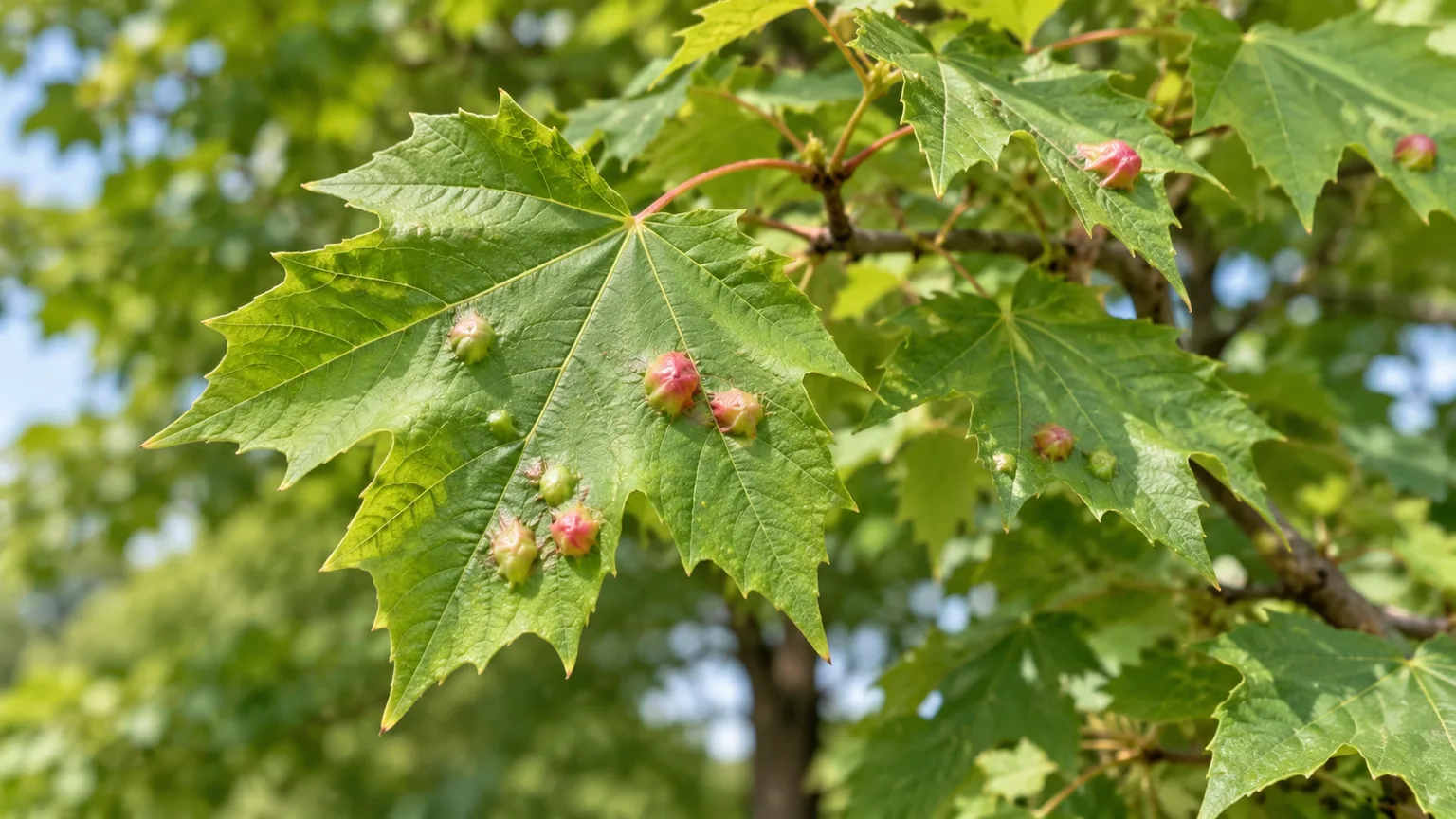
If you find rounded blisters, spikes, or puckered patches on a tree leaf, pause before reaching for a spray. Most leaf galls caused by insects or mites are cosmetic, and treatment after the gall is visible usually cannot restore the leaf. But “gall” describes a growth pattern, not one pest: the host plant, gall shape, location, season, and whether the tissue is fungal or insect-induced determine what to do.
The safest first move is to identify the tree or shrub and photograph both sides of an affected leaf. If the plant is otherwise growing normally and only a portion of the foliage is marked, monitoring is usually enough. If galls recur heavily, leaves are dropping early, shoots are dying, or the growth is on stems or roots, treat that as a separate diagnostic question rather than assuming ordinary leaf galls explain the decline.
First, Decide Whether the Bumps Are Galls
A gall is plant tissue that has grown into an abnormal shape after a living organism altered the plant’s development. Many are triggered by insect or mite feeding, egg laying, or chemicals associated with the developing young. Certain fungi, bacteria, and nematodes also cause gall-like growths, so the word alone does not tell you whether you are dealing with an insect, an infectious disease, or something else.
Galls are part of the leaf itself. A raised pouch, bead, cone, felt-like patch, or swelling that blends into the leaf tissue is a clue; it is different from a loose insect sitting on the surface. Some insect galls actually shelter eggs or larvae. Penn State Extension’s maple gall guide describes bladder galls in which mites feed, mate, and lay eggs inside the gall, while other gall makers leave at a different stage. So it is not safe to assume every inducer has already left just because you noticed the swelling.
That distinction changes the response. A pesticide sprayed onto an established gall may not reach a protected mite or larva, while a pathogen-caused gall may need sanitation or a confirmed disease diagnosis. The practical goal is not to make every marked leaf look normal again; it is to decide whether the plant is at meaningful risk and whether any action can reduce future damage.
What Actually Causes a Gall?
The gall maker manipulates new plant growth, and the plant supplies the tissue that forms the structure. Eriophyid mites, gall midges, aphids, psyllids, and small wasps are common insect or mite groups associated with leaf galls. Their feeding or egg-laying can redirect cell growth around a vein, bud, or patch of leaf surface. A gall may then provide food and protection to the inducer while it develops.
Galls tend to be specific to a host or a narrow group of related hosts. The same-looking bump on an oak and a maple can come from different organisms, and a single tree species can host several different gall makers. The Morton Arboretum notes that host identity and gall shape help narrow the cause, but some pathogen galls can resemble insect galls closely enough that appearance is not a definitive diagnosis. Gardening Know How’s overview also stresses that gall identification can be difficult because forms vary with the host and cause.
This is why “leaf gall” should not be treated as a single disease. A red bead on a maple, a saucer on an oak, and a swollen pale azalea leaf are different cases with different life cycles. Most common insect and mite galls on established trees do little lasting harm; some fungal or bacterial problems, especially when they affect shoots, crowns, or roots, deserve more attention.
Identify a Gall by Host, Shape, Location, and Timing
Start with four clues, in this order: host plant, shape, leaf surface, and season. Host is usually the strongest clue because many gall makers are plant-specific. Then note whether the growth is round, pointed, felted, pouch-like, or flat; whether it is on the upper or lower surface, along a vein, or near the leaf stalk; and whether it appeared with spring growth or later in summer.
Photograph a whole branch so the host is identifiable, then take close views of the front and back of a representative leaf. Include a ruler or coin for scale and record the month, whether the growth is new, and whether multiple trees of that species are affected. Don’t cut open every gall: dissection can destroy useful evidence, and a photo plus an intact sample is often more useful to a diagnostic service.
Compare the texture with likely look-alikes. Leaf spots are generally flat or sunken areas of dead or discolored tissue, often with a defined margin; leaf mines make winding or blotchy tunnels within the leaf; ordinary aphid clusters or scale insects sit on the surface and can often be seen directly. Galls are usually raised or thickened as part of the leaf. This is a field clue, not a lab diagnosis: fungal disease may form a swollen gall, and several causes can overlap in one canopy.
Common Leaf Galls and Their Likely Causes
Maple bladder, spindle, and felt galls
Maple bladder galls often begin as small green pouches on the upper leaf surface, then become red and may darken toward black later in the season. They are associated with eriophyid mites on susceptible maples. Spindle galls are narrow, pointed projections, while erineum or felt galls look like fuzzy green or red patches on one or both leaf surfaces. Penn State Extension’s updated maple guide describes these forms and notes that heavy infestations can distort individual leaves, even though overall tree health is usually not affected.
The underside can add context: a pouch may open there, and a felted patch has a different texture from a simple discoloration. These patterns can help distinguish one gall form from another, but the exact mite species may require an expert. Don’t assume the red color itself means infection or that a red gall needs fungicide.
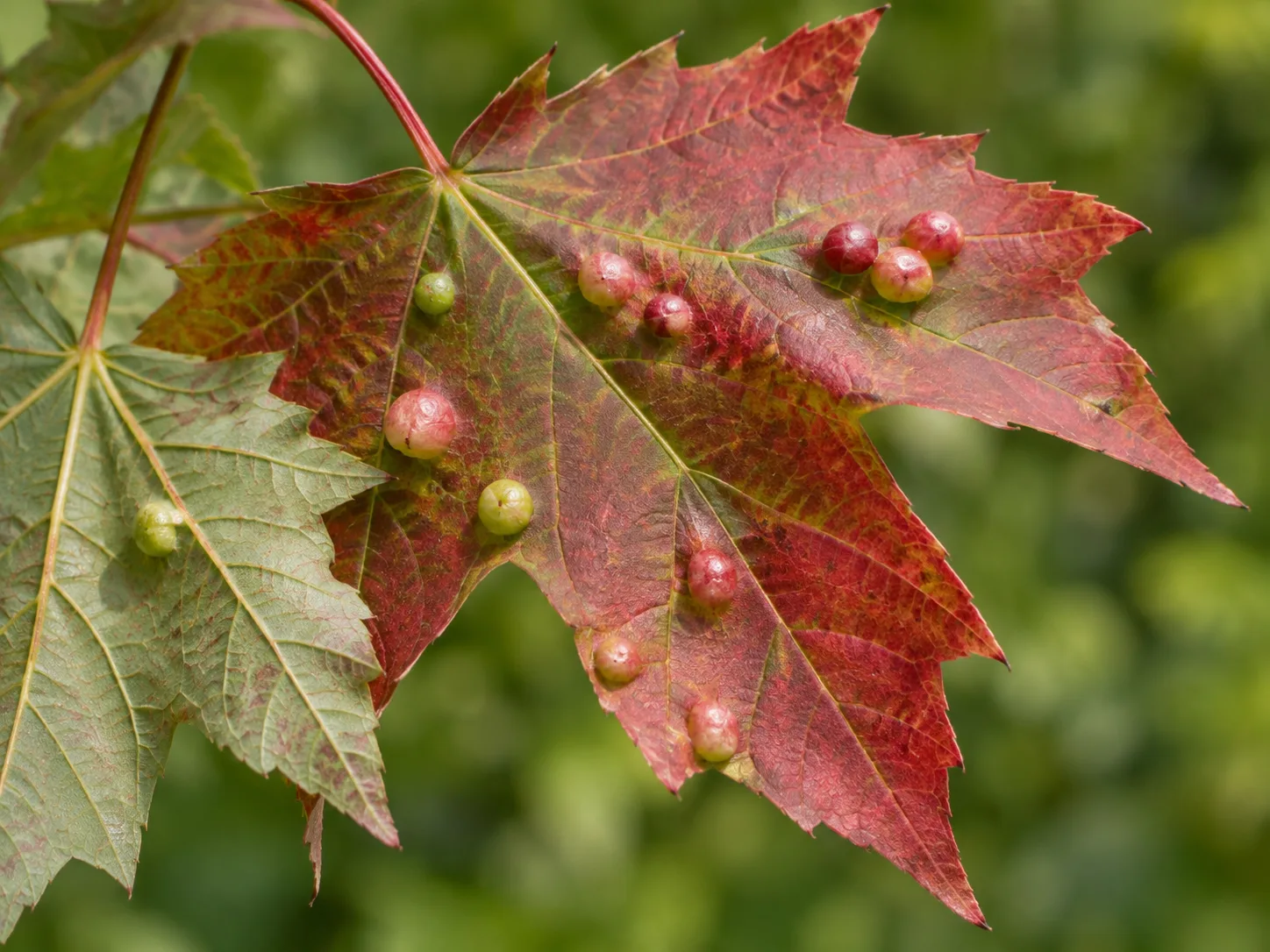
Maple galls can change color as they develop; the host and the shape of each growth help narrow the identification.
Oak galls
Oaks host a wide range of gall-making wasps, midges, and other insects. Some galls are rounded like small apples; others form as tiny discs or saucers on the underside of a leaf, sometimes leaving a spot on the upper surface. The Morton Arboretum’s oak gall descriptions explain that oak spangle and jumping oak galls can fall with the gall maker inside; the latter may move after falling, a behavior that surprises gardeners but does not mean the tree is diseased.
Because an oak can carry several gall types at once, a generic “oak gall” label is not enough to choose a treatment. Purdue Extension’s guidance on common oak leaf galls describes typical leaf galls as primarily cosmetic and says chemical control is not warranted. If the same tree is also wilting, losing whole branches, or declining, investigate those symptoms separately instead of attributing them to every gall on the leaves.
Hackberry, witch hazel, and other hosts
Hackberry nipple galls are small rounded projections associated with psyllids; the swollen tissue develops around the feeding young. Witch hazel cone galls are shaped like tiny cones and are caused by an aphid that uses witch hazel during part of its life cycle, then moves to birch. Galls also occur on cherry, linden, roses, and herbaceous plants. These examples show why the same control calendar cannot be applied to every plant.
A useful field note is “host + gall shape + where it sits,” not just “bumps on leaves.” For example, “witch hazel, cone-shaped growths on the leaf blade in late spring” is more diagnostic than “red bumps.” The Morton Arboretum’s plant-gall reference illustrates how varied these host-specific forms and life cycles can be.
Do Leaf Galls Harm Trees?
For many mature, established trees, the answer is usually not much. A gall can deform the leaf and reduce photosynthesis in the affected area. When only a few leaves are involved, the tree can generally compensate with its remaining foliage; Penn State Extension notes that leaf galls seldom justify chemical control on maples, and the Morton Arboretum describes most plant gall damage as aesthetic.
The situation deserves closer attention when a young or already stressed plant has a large share of its new foliage distorted, repeated heavy infestations, premature leaf drop, or thinning growth over more than one season. Even then, galls may be one stressor among several rather than the primary cause. Check for drought, root disturbance, planting problems, stem injury, other pests, or disease before assuming the galls caused the decline.
Location and tissue matter. A few leaf galls are different from a swelling that girdles a twig, a gall around the root collar, or a hard tumor-like growth on a trunk. Some pathogen-caused galls and unrelated woody diseases can be more damaging. If the abnormal growth is on a branch or root, or if dieback accompanies leaf galls, get the plant identified before using an insect treatment.
What to Do When You Find a Gall
Document the host and pattern before intervening
Identify the tree or shrub as closely as you can, then photograph the whole plant, affected branch, and both sides of several leaves. Note whether the symptoms are limited to one species, whether they appeared on new spring leaves, how much of the canopy is affected, and whether there is leaf drop or shoot dieback. These details help distinguish a seasonal gall from a broader decline problem.
If the plant is valuable or symptoms are severe, contact your county Extension office or a plant diagnostic clinic and follow its instructions for sample collection. A lab may need a fresh section of affected leaf or shoot rather than a dried, bagged handful. Purdue’s advice on suspected oak galls makes the important point that wilting or other symptoms may require a separate sample-based diagnosis; a photograph alone may not confirm the cause.
Choose among monitoring, limited removal, and diagnosis
For a healthy established tree with scattered insect or mite galls, leave the leaves in place and monitor the next flush of growth. If a few galled leaves spoil the look of a small ornamental shrub, remove only those leaves if doing so will not strip the plant. If the gall appears to be fungal, occurs on a high-value plant, or coincides with decline, get a cause-specific recommendation before pruning or spraying.
This sequence avoids two common errors: doing nothing when a pathogen is causing real damage, and treating harmless insect galls as an emergency. A gall’s visual drama is not a measure of risk. The tree’s overall growth, the amount and location of affected tissue, and whether the gall maker can still be reached are more useful decision points.
Should You Remove Galled Leaves?
You can remove a small number of affected leaves for appearance, but removal is rarely necessary for ordinary maple or oak insect galls. Pruning a galled leaf after its tissue has formed will not restore it to normal, and taking many leaves off a tree can remove more photosynthetic area than the gall itself would have. Don’t shear or heavily prune a canopy just to make every leaf look clean.
Sanitation can matter for certain gall makers if their life cycle includes an overwintering or developing stage in fallen foliage. Raking and disposing of affected leaves may reduce that source in some cases, but it will not stop species that overwinter in bark, buds, twigs, soil, or alternate hosts. The University of Georgia Extension’s guidance on Exobasidium leaf gall gives a very different, specific recommendation for azalea and camellia: remove and discard affected tissue before the white spore-bearing surface appears.
When you do remove leaves, use clean pruners if cutting a petiole or shoot, and take care not to over-prune. Put fungal-galled leaves in household waste when local guidance recommends discarding them; don’t leave them beneath the same shrub if spores or infected debris are part of the disease cycle. For other galls, ask your Extension service whether sanitation is useful for that host and gall type rather than assuming all galls spread the same way.
Will Dormant Oil or Insecticide Work?
Usually, a spray applied after you can see leaf galls will not fix the current problem. The gall is living plant tissue, and insect or mite stages may be protected within it. Even when a pesticide kills a target, it cannot reverse the distorted leaf that has already formed. That is why routine spraying of visible galls is rarely useful and can harm predators and parasitoids that naturally feed on gall makers.
There is a narrower exception: some identified mite galls may be reduced by a correctly timed treatment before the mites move to newly expanding leaves. Penn State Extension describes a pre-bud-swell timing for eriophyid mites in its regional guidance, while the Morton Arboretum emphasizes that sprays are generally too late by the time galls are obvious. These statements are not contradictory: they refer to different stages in the life cycle. “Dormant oil in early spring” is not a universal treatment schedule for every gall, tree, or climate.
Before using any product, confirm the gall maker and host, check that the product label allows the use on that plant and target, and follow label timing and precautions. A local Extension specialist or licensed arborist can tell you whether a preventive treatment is practical in your area. Avoid broad-spectrum insecticides applied on speculation; they may kill beneficial insects without preventing next year’s gall.
Fungal Leaf Galls Need a Different Response
Azalea and camellia leaf gall caused by Exobasidium is a useful exception to the “mostly cosmetic insect gall” rule. Infected young leaves or flowers can become thick, fleshy, swollen, and pale green or pinkish; as the disease develops, a white spore-producing layer may appear. Cool, wet spring conditions and repeated overhead watering can favor infection. The LSU AgCenter’s overview and University of Georgia Extension both describe this as a fungal disease, not a mite pouch.
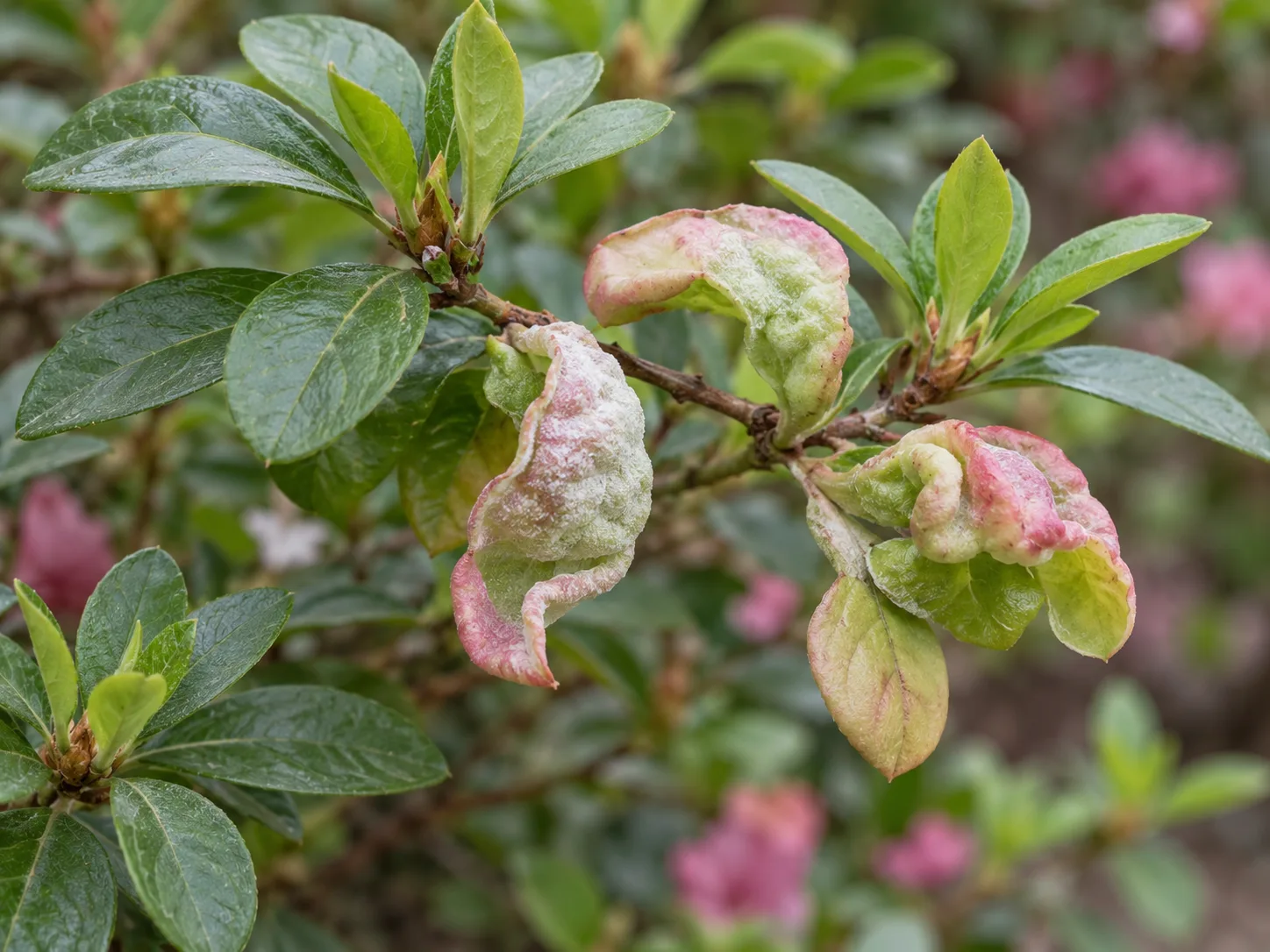
Exobasidium leaf gall changes the leaf itself; its white spore-bearing stage is the cue to remove affected growth promptly.
For this specific problem, pick or prune out the affected leaves and flowers as soon as you notice them and before the white surface releases spores. Discard the material rather than leaving it under the shrub. Reduce avoidable leaf wetness by watering the soil instead of repeatedly wetting the foliage, while still watering the plant appropriately for its conditions. If the white stage is already present, sanitation can still improve appearance and remove some infected material, but it may not erase spores that have already dispersed.
Fungicides, where labeled, must be preventive and timed before infection; they will not cure visible galls. University guidance notes that chemical control is seldom necessary and may offer limited benefit. Don’t borrow an insecticide or dormant-oil recommendation for maple mites and apply it to an azalea fungal gall—the cause and useful timing are different.
How to Reduce Repeat Problems Next Year
First, learn the likely gall maker’s seasonal cycle. Some mites overwinter under bark or near buds; some wasps or midges develop inside galls or fallen leaves; some aphids use an alternate host. A sanitation step helps only when it removes a stage that would otherwise survive. The Morton Arboretum’s examples of maple, hackberry, oak, and witch hazel galls show how widely those cycles differ.
Keep the plant in good baseline condition: water during prolonged dry periods, protect the root zone from compaction and mower injury, and avoid unnecessary heavy pruning or excessive fertilizer. Those practices support a tree’s ability to tolerate leaf damage; they do not make a susceptible host immune to a host-specific gall maker. A sunny or rainy spring, a local pest cycle, and the identity of the plant may matter more than any routine “gall prevention” product.
If the same ornamental plant is badly affected each year, confirm the gall before making a long-term change. Your options may include targeted sanitation, a locally timed preventive treatment when justified, accepting some cosmetic damage, or replacing a repeatedly affected plant with a suitable less-susceptible alternative. The right choice depends on how much damage occurs, the value of the plant, local climate, and whether the proposed treatment will reach the vulnerable stage.
Mistakes That Turn a Minor Gall into a Bigger Problem
The first mistake is spraying because a leaf looks alarming. A random insecticide cannot identify whether the cause is a mite, wasp, fungus, or something else; it may miss the protected stage and disrupt natural enemies. Treat a confirmed target at its vulnerable time, if treatment is worthwhile at all.
The second is assuming every gall is harmless or that every gall is an insect. Most common leaf galls on established trees are minor, but pathogens such as Exobasidium cause a distinct disease that can benefit from early removal. Large branch or root swellings also do not belong in the same “ignore it” category as a few red maple blisters.
The third is over-pruning or removing all fallen leaves without considering the life cycle. Heavy pruning can stress a small tree, and blanket cleanup may not affect gall makers that overwinter elsewhere. Finally, don’t diagnose a wilting tree from gall photos alone: multiple symptoms can coexist, and a lab or arborist may need a representative sample to identify the real cause.
When to Ask an Arborist or Plant Clinic
Contact a local Extension plant clinic or diagnostic lab if you cannot identify the host, the gall has an unusual appearance, a pathogen is plausible, or the same plant suffers heavy recurring damage. Send clear photos of the upper and lower leaf surfaces and follow the clinic’s current sample instructions. A qualified diagnostic service can separate gall injury from leaf spots, mites, root issues, and unrelated decline.
Bring in a certified arborist when galls are on major limbs or the trunk, when branches are dying, when the tree is declining over successive seasons, or when inspection requires climbing or specialized equipment. Davey Tree’s scientifically reviewed homeowner guidance similarly advises an arborist when repeated heavy galling occurs alongside dieback or limb damage. For a large tree near people or structures, branch safety matters more than the appearance of the leaves.
If the plant is healthy and the only symptom is scattered, host-typical leaf galls, you likely do not need an urgent service visit. Keep your photos and compare the next flush of leaves. That record will tell you whether the gall was a one-season cosmetic event or a recurring pattern worth investigating.
Conclusion
For most leaf galls on established trees, the best response is to identify the host, note the gall’s shape and location, and monitor the plant rather than spraying the visible bumps. Insect and mite galls are often harmless, and a late treatment cannot undo the leaf deformation; a small amount of removal is mainly for appearance unless the gall’s life cycle makes sanitation useful.
Treat exceptions on their own terms. Fungal azalea or camellia gall calls for early removal and disposal, while galls on stems or roots, repeated heavy defoliation, or tree decline merit a confirmed diagnosis. If you are unsure, send clear photos or a sample to a local plant clinic before choosing a pesticide or pruning plan.