How to Identify and Get Rid of Whiteflies on Houseplants
Whiteflies on houseplants? Learn how to confirm the pest, target hidden nymphs, use traps correctly, and follow a safer repeat-treatment plan.
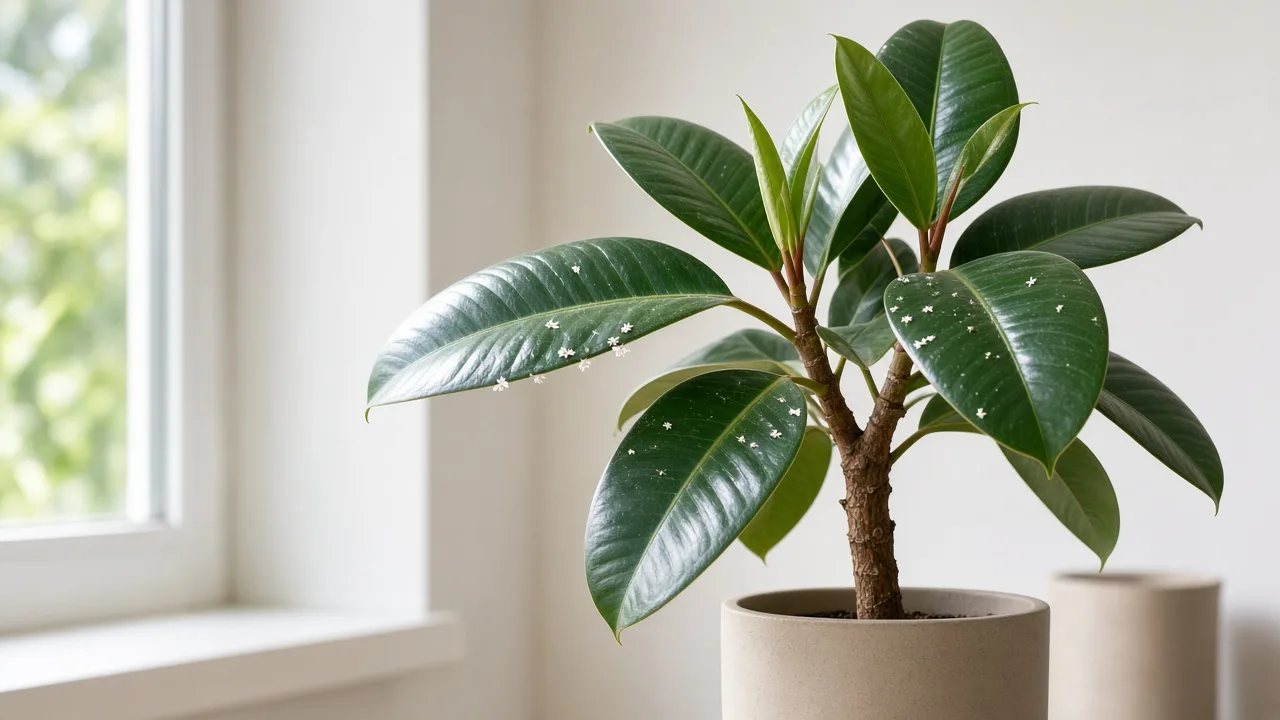
Tap a suspect plant gently over a pale sheet of paper. If a cloud of tiny white, moth-like insects lifts from the leaves and settles again, whiteflies are likely; turn over the leaves next, because the eggs and feeding young usually stay out of sight there.
Those two checks matter more than how many adults you see in the air. A plant can release a few adults while carrying a much larger, stationary population underneath its foliage.
The most reliable response is a sequence: isolate the plant, inspect nearby pots, lower the number of visible pests, then use a labeled contact product only if needed and keep checking for new activity. One rinse or one spray can make a plant look dramatically better for a day without reaching every life stage. Whiteflies are manageable when you treat the leaves they occupy and judge progress over time instead of chasing every flying adult.
Confirm whiteflies before you treat
Start with a gentle shake or tap, not a spray bottle. Adults that scatter from the foliage are a strong clue, but look at the underside of several leaves before calling the diagnosis confirmed. You may find tiny pale, flattened shapes attached to the leaf surface, clear or whitish eggs, a sticky film, or black sooty growth on leaves below the colony.
Whiteflies are sap-feeding insects in the same broad insect order as aphids and scales, not true flies. The University of California’s IPM guidance describes adults as small, pale-winged insects and the later nymph stages as flat and largely immobile on leaf undersides (UC IPM).
Check a few leaves from different heights. Whiteflies often concentrate on tender or sheltered foliage, and a single clean leaf does not rule them out.
If you only see white specks on top of a leaf and no insects rise when you disturb the plant, wipe one speck with a damp cotton swab: dust and mineral residue move or dissolve, while attached nymphs remain anchored. A hand lens helps, but a phone camera’s close-up setting and light angled across the leaf can be enough.

Leaf undersides are the place to confirm settled whitefly nymphs; the adults that flutter away are only the visible part of the infestation.
What whiteflies look like at each life stage
Adult whiteflies are usually about 1 to 2 millimeters long, with a pale yellow body and powdery white wings that make them look like tiny moths. They tend to rest on the underside of leaves and fly when the plant is moved.
Because adults are mobile, they can shift to a neighboring plant while you clean or treat the original one. Work with the plant isolated and avoid shaking it beside the rest of your collection.
Adults, eggs, and settled nymphs
Eggs are minute and sit on the lower leaf surface, sometimes in arcs or loose circular arrangements depending on the species. A newly hatched “crawler” moves briefly before settling at a feeding site. Later nymphs are oval, flat, and scale-like; they do not look like miniature white flies.
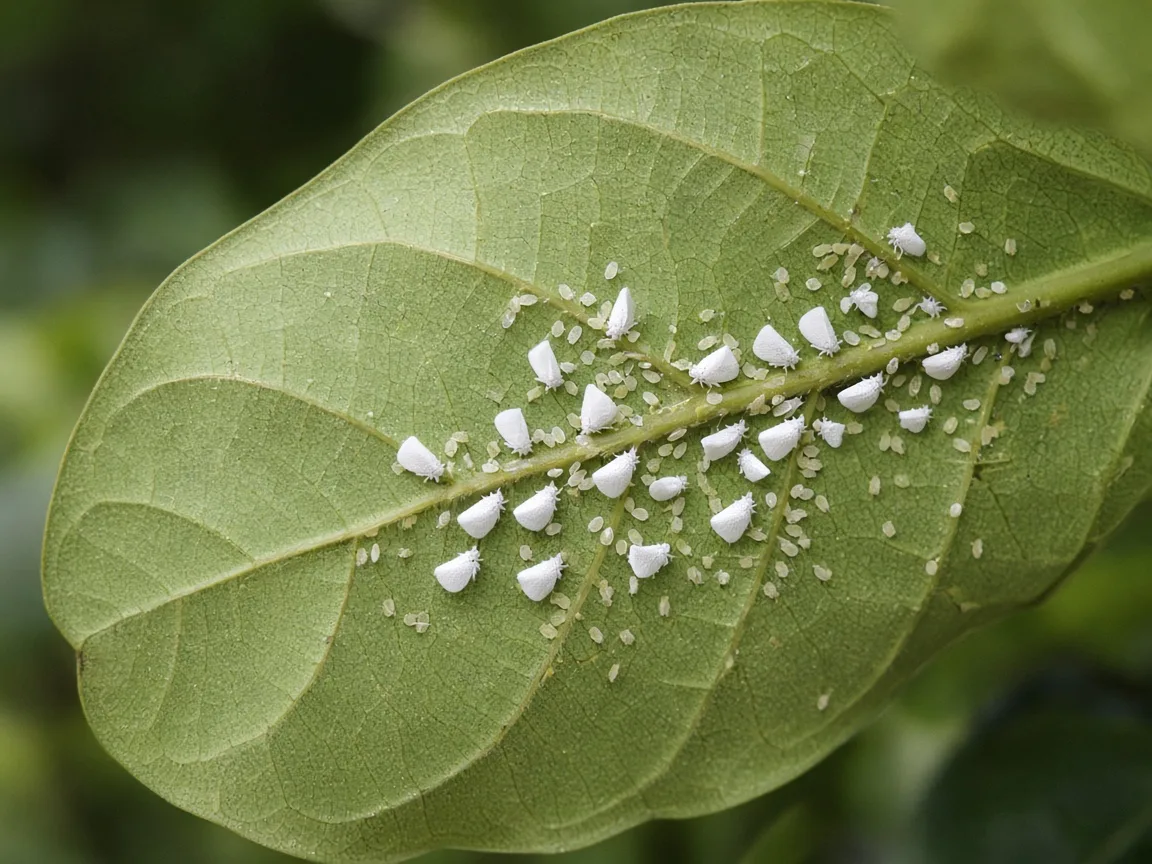
They feed in place and can be mistaken for pale scales or harmless marks unless you inspect them closely. Whiteflies pass through several nymph stages, and the final resting stage is sometimes casually called a pupa even though they do not have a true butterfly-like pupal stage (UC IPM).
Warm, protected conditions can speed development. Wisconsin Extension reports that greenhouse whiteflies may complete development in about 18 days at 82°F, while the broader timing depends on temperature and species (University of Wisconsin Horticulture).
Treat that figure as an example, not a timer for every room or every whitefly. The practical lesson is that eggs, nymphs, and adults can overlap, so a treatment that only knocks down flying adults cannot be your entire plan.
Damage signs and what they tell you
Whiteflies pierce plant tissue and feed on sap. A small population may leave little visible damage, but sustained feeding can cause pale or yellow leaves, reduced vigor, early leaf drop, and weak new growth.
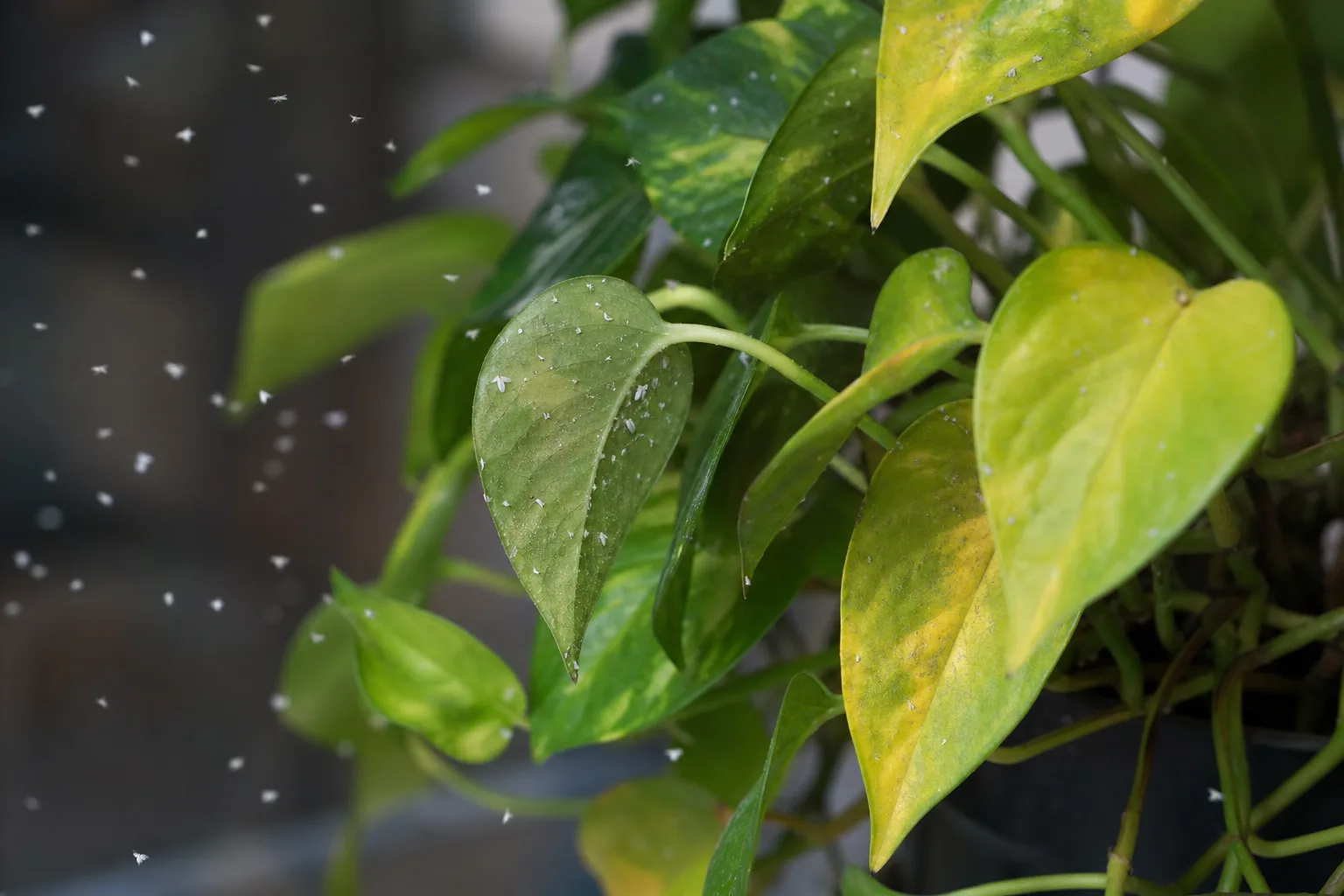
The immature stages matter because they remain attached and feed while the adults disperse. A few adult insects are evidence to inspect, not a reliable measure of how much feeding is happening.
Honeydew is another clue: a clear, sticky residue on leaves, pots, or the shelf below them. Sooty mold may grow on that sugary residue as a black or brown surface film. The mold is secondary; cleaning it off improves appearance, but the whiteflies must also be controlled or new honeydew will collect.
Sticky leaves can also come from aphids, soft scale, or mealybugs, so pair the residue with a close inspection rather than diagnosing by stickiness alone. RHS notes that sap-feeding pests can produce honeydew and that sooty molds grow on it (RHS indoor plant pest guidance).
Some whitefly species transmit viruses to certain crops, but that does not mean every whitefly on an ornamental houseplant has infected it. If you grow tomatoes, peppers, or other edible plants indoors, isolate affected plants promptly and remove them from the crop area if symptoms continue to spread.
Whitefly presence alone cannot identify a virus; mottling, curling, or stunting can have other causes, too. UC IPM distinguishes crop-related virus concerns from the ordinary sap-feeding damage seen on many ornamental hosts (UC IPM).
Whiteflies compared with common look-alikes
Where the insect flies from is often more useful than its color. Whiteflies rise from foliage, and their attached nymphs occur on leaf undersides.
Fungus gnats are dark, mosquito-like flies that gather near damp potting mix; their immature stages live in compost, a distinction also used in BBC Gardeners’ World Magazine’s fungus gnat guide (Gardeners’ World). Changing watering habits may help fungus gnats, but it does not remove whitefly nymphs from leaves.
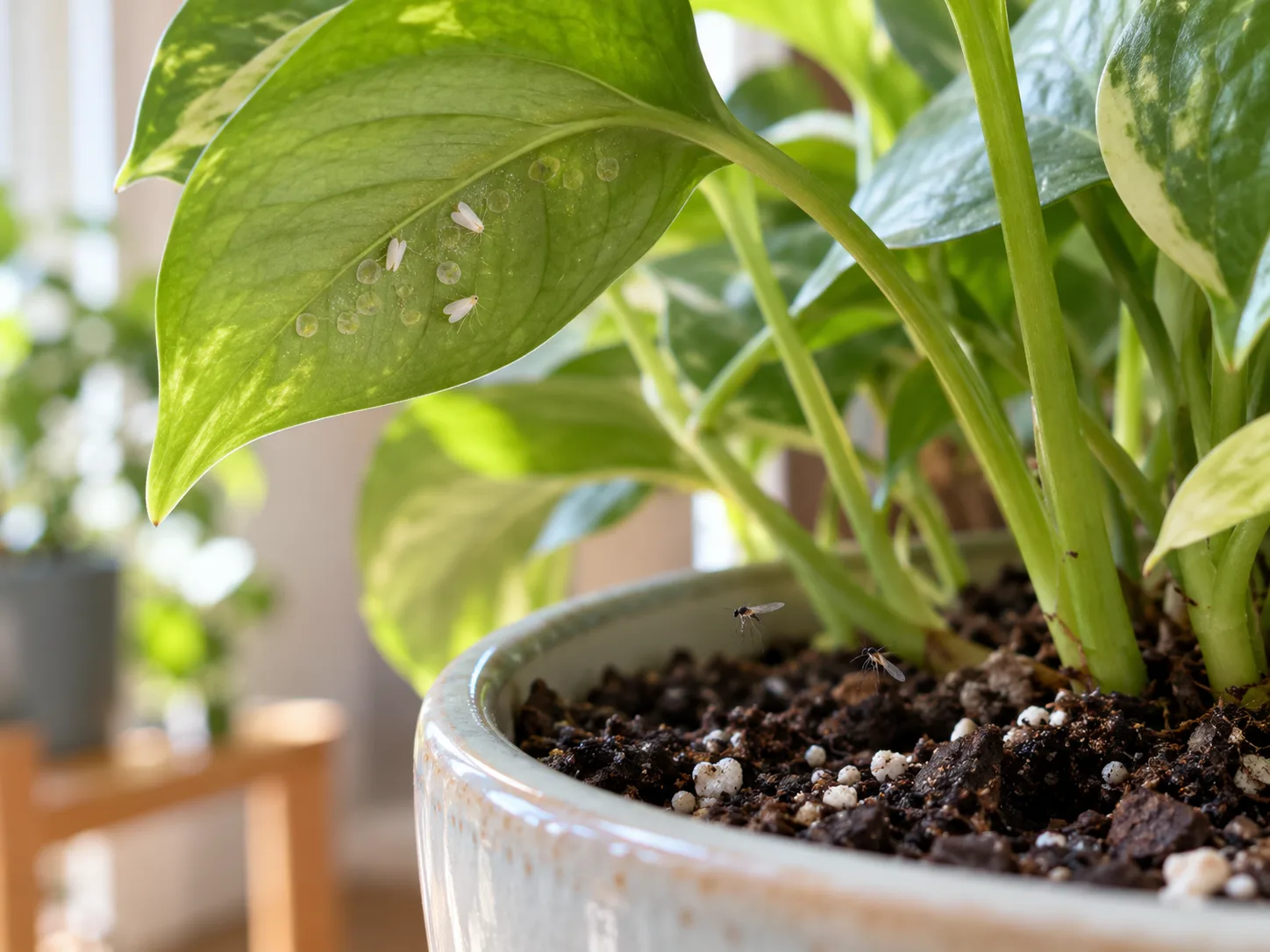
| Suspect pest | Where to look | Best first clue |
|---|---|---|
| Whiteflies | Leaf undersides and the air around foliage | Tiny pale adults flutter up when leaves are disturbed; flat nymphs remain attached below |
| Fungus gnats | Potting mix and the area just above it | Dark, slender flies hover near moist soil |
| Aphids | Tender stems, buds, and new leaves | Pear-shaped insects cluster on growing tips; some have visible cornicles |
| Mealybugs | Leaf joints, stems, and roots | White, cottony or waxy clusters tucked into crevices |
| Scale insects | Stems and leaf surfaces | Fixed, shell-like bumps that do not fly when the plant moves |
If the insects are white but stay on top of the leaf, check whether they are shed skins, mealybugs, or a different whitefly species before treating. RHS notes that the adults’ sudden flight and the flat, pale nymphs beneath leaves are useful signs of glasshouse whitefly, while other whiteflies can be host-specific (RHS glasshouse whitefly guide). For a houseplant, you rarely need a species name to begin sensible control; you do need to confirm that the active pests are actually on the leaves.
Why whiteflies return after a spray
The adults you see are mobile; eggs and settled nymphs are small, sheltered, and easily missed. Contact products only affect insects the spray reaches, so leaves that were not turned over, lower foliage hidden by a dense canopy, or new adults arriving from a neighboring plant can restart the visible activity.
Some life stages may also be less exposed to a particular product. That is why an apparent “reset” after spraying is not proof that the infestation is gone.
The life cycle also changes with warmth. RHS describes glasshouse whitefly as active year-round indoors and says its development can take several months in cool conditions or about three weeks near 70°F (RHS glasshouse whitefly guide). Different species and room conditions produce different timelines, so do not rely on a fixed day when all eggs will hatch.
Use repeat inspection and the product label’s retreatment interval instead. A calendar helps you remember; the leaves and traps tell you whether another labeled treatment is warranted.
What to do in the first 24 hours
Move the plant away from the collection before working on it. A separate room is useful; even a few feet of distance with no touching leaves is better than leaving it pressed against neighbors.
Then inspect plants that shared a shelf, window, or airflow path, especially plants with soft new growth or leaf undersides you cannot see from above. Mark suspects or photograph a few representative leaves so you can compare them during follow-up.
Use a calm first-day sequence:
- Isolate and scout. Check both sides of leaves on the affected plant and nearby plants. Do not start treating every plant in the room solely because one adult flew past.
- Remove what you can reach. Prune leaves that are badly yellowed or densely covered with nymphs if the plant can spare them. Bag the clippings immediately and take them out of the home.
- Reduce adults. A low-suction handheld vacuum can collect visible adults. Keep the nozzle from scraping leaves, then empty the container outdoors or seal and discard the contents promptly.
- Wash the foliage. Rinse a sturdy plant with lukewarm water, paying attention to the undersides. For delicate or hairy leaves, wipe gently with a damp soft cloth instead of blasting or rubbing them.
- Clean the station. Wipe sticky shelves, cachepots, and the saucer. Clean surfaces make it easier to notice fresh honeydew rather than old residue.
- Set a yellow card for monitoring. Position it near the canopy, where it can catch adults without touching the plant. Treat the count as a trend signal, not a cure.
Rinsing and removing heavily infested leaves are established physical measures in UC IPM’s whitefly guidance, while RHS recommends separating affected houseplants and monitoring the collection (UC IPM; RHS indoor plant pest guidance). The specific mix depends on leaf texture and plant size. A shower rinse suits a sturdy rubber plant; it may shred a fine-leaved fern, in which case a gentle wipe and selective pruning are more realistic.
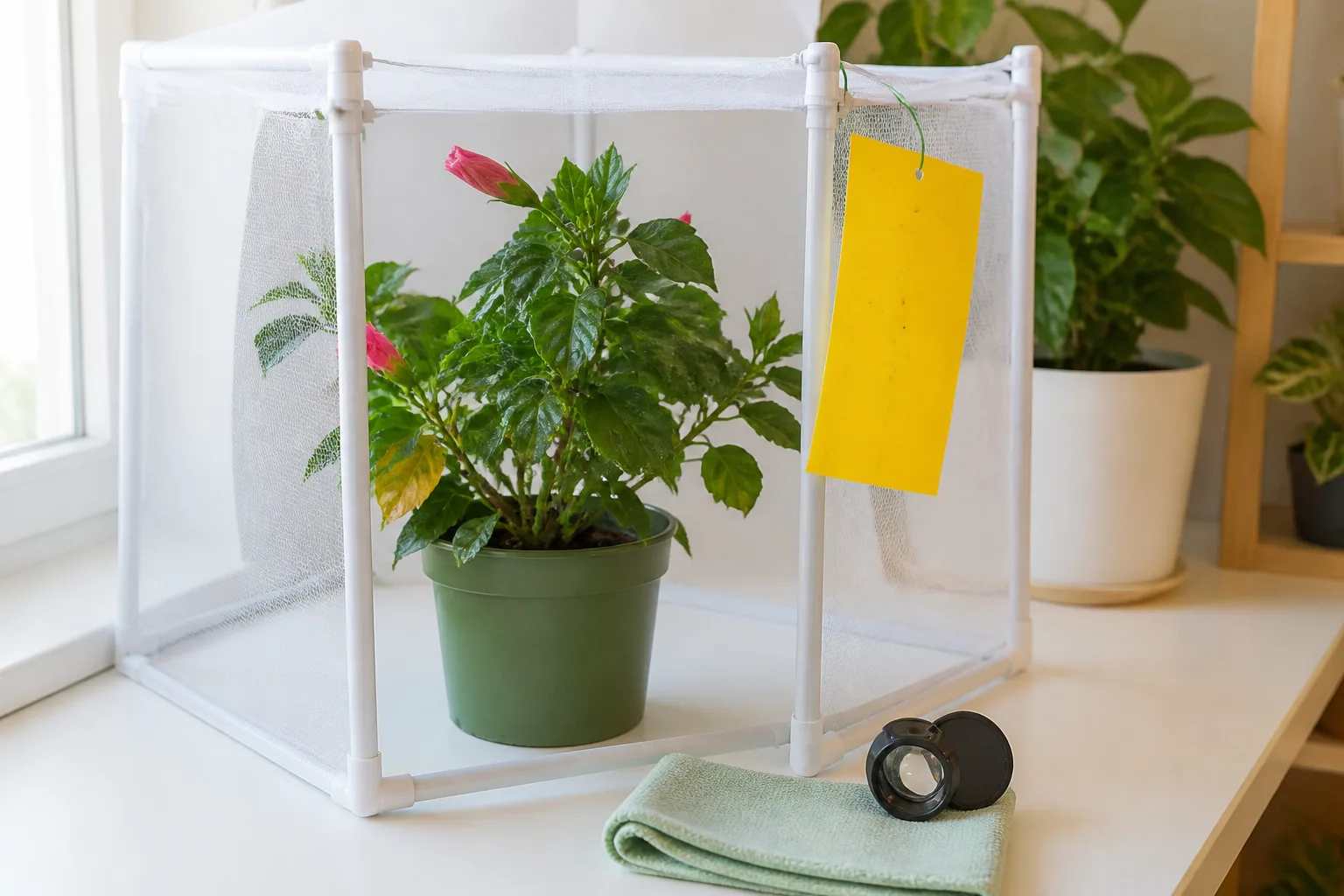
Isolation and a nearby yellow card help contain and monitor adults; the card does not reach the eggs or settled nymphs on leaves.
Wash, wipe, prune, and remove adults
Physical removal is a useful first step because it immediately lowers the number of adults and visible immature pests without exposing the whole room to a pesticide. Rinse from different angles so the water reaches leaf undersides, but protect the potting mix from being washed out and let the foliage dry with airflow. Do not place a cold-sensitive plant outside or in a chilly shower just to get a stronger stream.
On broad, smooth leaves, wipe the underside from the leaf base toward the tip with a clean damp cloth, rinsing the cloth often so you do not redistribute insects. Avoid polishing products, alcohol, or vigorous scrubbing unless a reliable plant-specific source supports them; they can leave residue or damage the leaf surface.
For delicate plants, test a small area first and use the least force that removes the pests. Removing a few badly infested leaves may be kinder than repeatedly wiping every fragile leaflet.
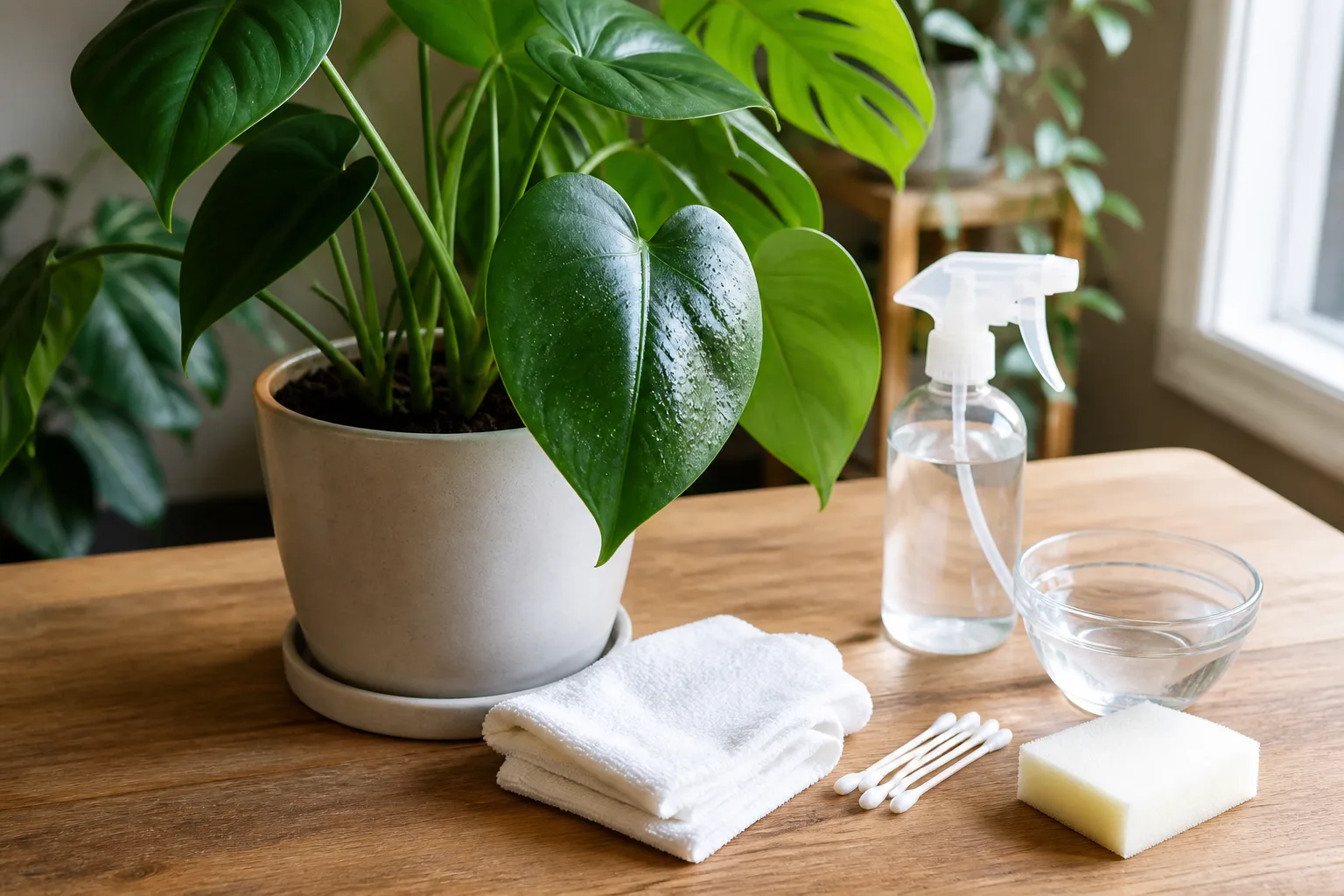
Use a soft cloth or gentle rinse on foliage that cannot tolerate a hard spray.
Vacuuming is mainly a quick adult knockdown, not a way to treat eggs or immobile nymphs. Work slowly with low suction, and stop if leaves are being pulled into the nozzle.
Garden Know How includes handheld vacuuming and leaf washing among practical ways to reduce adult numbers, but its advice also emphasizes that treatments may reduce rather than eliminate a population (Gardening Know How). Continue to examine leaf undersides after the adults are gone.
Use yellow sticky cards to monitor
Yellow sticky cards catch flying adults and can tell you whether new adults are still appearing. Place a card level with the foliage and close to, but not against, the plant. If you have several plants, use separate cards and label them with the date and plant name; that simple record can show whether activity is dropping on the isolated plant or continuing around the room.
Cards do not reach eggs, nymphs, or the life stages attached beneath leaves. They also catch other small flying insects, and in a greenhouse they may catch beneficial parasitoid wasps.
The RHS describes yellow sheets as a way to monitor whitefly activity rather than provide control, and cautions that sticky traps can catch non-target insects (RHS glasshouse whitefly guide). UC IPM likewise calls traps useful for monitoring and detection, not a standalone solution (UC IPM).
Use the card together with a leaf check. Fewer captures over successive checks plus clean undersides is more encouraging than a clean card by itself; a trap placed too far away can miss activity while nymphs remain on the plant. Replace a dusty or full card, and remove it if you are using beneficial insects that could be caught by it.
Choose a labeled soap or oil treatment
If live whiteflies persist after isolation and washing, a product labeled for the plant and pest can be a next step. Insecticidal soap and horticultural oils work by contact; thorough coverage matters because a droplet on the upper leaf does not treat insects tucked below it. UC IPM notes that soaps and oils may reduce populations rather than eliminate them and advises covering infested leaf undersides (UC IPM).
Choose a ready-to-use or properly diluted product whose label explicitly permits use on houseplants and identifies whiteflies or the relevant pest group. Follow the label for dilution, application site, protective equipment, ventilation, reentry, and retreatment interval.
These directions vary by product and jurisdiction; a recipe or dose from another crop, country, or website does not override the container in your hand. Do not use a spray on an edible herb or vegetable unless the label allows that crop and tells you the required interval before harvest.
Keep children and pets away from treated foliage and the application area for the period the label specifies. If you cannot provide the required ventilation or keep a curious pet from chewing leaves, choose a physical-control plan or move the plant to a suitable treatment location only if the product label permits it.
Before treating the full plant, test a small area on a few leaves and wait for the period recommended by the label or product maker to spot injury. Do not apply oils or soaps to a drought-stressed plant, and avoid intense direct sun, heat, or high grow-light exposure while the foliage is wet if the label warns about burn.
If the test area spots, curls, or turns translucent, rinse it and choose a non-spray approach or a different labeled product. Repeat only as directed, inspecting first to see whether live pests remain.
Shortcuts that can hurt plants or beneficials
Kitchen dish detergent is not automatically an insecticidal soap. Detergents and fragranced cleaners can contain degreasers, surfactants, or additives that strip leaf surfaces; improvised concentrations are unpredictable.
Use a formulated product rather than increasing the amount until the insects disappear. “Natural” oils and botanical insecticides can still injure plants or kill non-target insects, so they still require the label’s precautions.
Avoid spraying a broad-spectrum pesticide repeatedly just because adults keep appearing. UC IPM warns that many broad-spectrum products can disrupt natural enemies, and whiteflies can be difficult to manage with insecticides; RHS recommends starting with cultural and biological measures and considering pesticides only when needed (UC IPM; RHS indoor plant pest guidance).
Do not combine soap, oil, neem, or other products unless both labels explicitly allow that combination. Avoid homemade garlic, onion, pepper, or alcohol sprays: a plant’s tolerance is not predictable from the recipe’s ingredients.
A repeat-treatment and inspection schedule
Whitefly control is a monitoring routine, not a single “spray day.” Use the product label’s minimum interval and maximum number of applications; do not shorten the interval because adults are annoying.
If you are not using a pesticide, continue physical removal and inspection on a consistent schedule. A simple three-week framework keeps the process organized without pretending every infestation follows the same development clock.
| Checkpoint | What to do | What you are measuring |
|---|---|---|
| Day 1 | Isolate, inspect neighbors, remove heavily infested leaves, wash or wipe foliage, and set a dated card | Starting adult activity and where nymphs are present |
| Days 4–7 | Inspect the same marked leaves and nearby plants; repeat a labeled treatment only if the label allows and live pests remain | Newly emerged adults, live nymphs, new honeydew |
| Days 10–14 | Clean old residue, replace full cards, inspect new growth and leaf undersides, and continue label-directed treatment if necessary | Whether the population is actually declining |
| Weeks 3–4 | Keep the plant isolated and check weekly; broaden treatment only if evidence shows pests persist | Clean new growth, no fresh sticky film, and no new adult captures |
The dates are check-ins, not a universal pesticide schedule. Wisconsin Extension’s greenhouse recommendations use repeated treatments to cover overlapping stages, but home growers must follow the product directions for the product and setting they use (University of Wisconsin Horticulture).
A contact product that permits a four-day interval and one that permits a seven-day interval are not interchangeable. If you choose not to spray, keep using physical removal and leaf checks rather than applying a chemical on a schedule.
Take a weekly photo of the same leaf undersides and note trap counts. This prevents yesterday’s flying adults from becoming the only measure of success.
If numbers stay level or rise after two or three careful rounds, check for missed plants, poor underside coverage, an unsuitable product, or a plant too dense to treat. More pesticide is not the automatic answer when the main problem is an untreated reservoir.
When biological control makes sense
Beneficial insects can help in an enclosed greenhouse, conservatory, or plant cabinet where temperature, release timing, and monitoring are manageable. The parasitoid wasp Encarsia formosa attacks whitefly nymphs and is an established glasshouse biological control; parasitized nymphs may darken. The RHS notes that it must be introduced before plants are heavily affected and does not provide instant cleanup (RHS glasshouse whitefly guide).
A few plants scattered through an open living room are a less predictable setting. Beneficial insects may disperse, and sticky cards or a residual pesticide may undermine the release.
Ask the supplier whether the species and conditions fit your setup, and avoid sprays that conflict with the beneficial organism’s instructions. Outdoors, protect natural predators by avoiding unnecessary broad-spectrum treatments; a balanced garden may keep low whitefly numbers below the point where plants are harmed (UC IPM).
Prevent whiteflies from entering the collection
Inspect new plants before they join the shelf, including gift plants and anything returning indoors after a summer outside. Check leaf undersides, stems, and the spaces where leaves meet the petiole.
Keep a new plant separate for a few weeks when possible and inspect it more than once; a single clean day cannot rule out eggs or small nymphs. RHS recommends quarantining new plants where possible so developing eggs and nymphs can be noticed before they reach established houseplants (RHS indoor plant pest guidance).
Leave enough space between plants to lift leaves and see their undersides. Crowding does not create whiteflies, but it makes detection and complete spray coverage harder.
Clean fallen leaves and wipe sticky saucers or shelves promptly. Healthy growth helps a plant recover from feeding, but extra fertilizer is not a pest treatment; avoid pushing soft growth with unnecessary feeding while an infestation is active.
When you move a plant outdoors, first check that the species tolerates the expected temperature, sun, and wind. Outdoor predators may reduce pest pressure, but a sudden move into strong sun or cold weather can injure the plant. When bringing it back inside, inspect it carefully and keep it separate from the main collection while you watch for renewed activity.
When to discard an infested plant
Saving every plant is not always the kindest or most economical choice. Consider discarding a plant when it is declining, densely branched enough that you cannot reach the leaf undersides, repeatedly reseeding whiteflies onto valued neighbors, or still heavily infested after several thorough, label-compliant rounds. RHS advises removing severely affected plants in its indoor pest guidance, and UC IPM notes that removing heavily infested leaves or plants can reduce a population (RHS indoor plant pest guidance; UC IPM).
If you decide to let the plant go, cover it before moving it through the home, bag it, and take it directly to the outdoor waste bin. Do not shake it beside other plants or compost it near the collection.
Wipe the shelf and inspect plants that were close to it over the next few weeks. If the plant is valuable or rare, isolate it farther away and choose a treatment routine you can maintain before deciding to discard it.
How to tell whether control is working
Look for a pattern, not one clean afternoon. The strongest signs are fewer adults on the dated card, no fresh adults flying up during a gentle check, no live nymphs on repeatedly inspected leaves, and no new honeydew collecting below the plant. Old yellow leaves or a black mold stain can remain after the insects are gone, so do not keep spraying solely to restore the appearance of damaged tissue.
New growth is a useful final check because it has developed while the plant was under observation. If it emerges clean and firm while adult captures stay low or stop, treatment is likely working.
Keep checking weekly for a few more weeks before returning the plant to the middle of the collection. If new nymphs or sticky deposits appear, isolate it again and look for the source plant you may have missed.
Conclusion
Confirm whiteflies by checking both the flying adults and the flat, pale stages attached under leaves. Isolate the plant, inspect its neighbors, rinse or wipe what you can reach, and use yellow cards to track adults rather than expecting traps to cure the infestation. If you add a soap or oil product, choose one labeled for your plant and use it exactly as directed; coverage and follow-up matter more than a stronger-sounding ingredient.
Keep the plant separate until leaf undersides and new growth stay clean through repeated checks. That measured approach protects the rest of your collection, avoids unnecessary pesticide use, and makes it clear when a plant is recovering or when removal is the better decision.